59.3 F
Davis

Davis, California

Sunday, December 21, 2025
Home Blog Page 832

Northern California Kaiser nurses strike ends

0

ebola_COMBINEDrevised

At 7 a.m. this morning, the Northern California Kaiser nurses strike involving 18,000 nurses came to an end at some 86 Kaiser Permanente hospitals and clinics. They have been on strike since Monday, according to a California Nurse Association (CNA) released statement due to the U.S. hospitals’ inadequate Ebola safeguards.

According to the CNA, lowered care standards for Ebola patients, nurses and other healthcare workers are among the reasons for the strike.

“Our call for a strike speaks loudly and clearly that we want management to stop their stalling in bargaining our first contract, stop the unfair labor practices and provide the safeguards and resources needed to deliver safe patient care. It’s high time to listen to the nurses,” said Sutter Tracy RN Dotty Nygard in a statement released by the CNA.

Kaiser Permanente said in a statement that they have met the criteria the nurses have asked for when it comes to provisions for treating Ebola. The statement says that Kaiser has tried to work with the National Nurses Union on creating the best strategy for dealing with Ebola, but they have refused.

“The union leaders at National Nurses United/California Nurses Association are letting all of us down on this critical issue of public health. This is not the time for conflict-based tactics that will put America’s health at risk. They should be working with all of us as the nation faces this important fight against Ebola, not calling on nurses to step away from their patients’ bedsides,” the statement said.

The statement goes on to say that this strike is fueling fear of Ebola, and that the timing of the strike coinciding with flu season is irresponsible.

As of today, there have been four documented cases of Ebola in the United States, one of which, who was treated at Texas Health Presbyterian, proved fatal. Of the three remaining patients, all of which are healthcare professionals, two have since recovered and one is still in treatment. The two recovered patients were the nurses that treated the since-deceased patient in Dallas, Texas. The remaining patient was proclaimed Ebola free on Nov. 10. He underwent treatment in New York, as he had contracted Ebola while working in Guinea with the non-profit Doctors Without Borders. As of now, there are no known Ebola cases in the United States.

Due to the threat of the spread of Ebola the California State Health Officer Dr. Ron Chapman issued a risk-based quarantine order on Oct. 29 holding individual counties responsible for administering quarantines to individuals susceptible to contracting or spreading the disease.

This order applies to those entering California from an Ebola-affected area and has had confirmed contact with a person infected with Ebola. According to the order such persons would be subject to quarantine for 21 days.

“This order will protect the health and safety of Californians and support the state’s local health officers’ existing authority to develop protections against disease spread,” Chapman said.

National Nurses Union is calling for appropriate protective gear as well as interactive training because the health care workers that are on the front lines of this epidemic do not have the proper materials to protect themselves.

“You just can’t have [the protective equipment] there and not try to put it on, take it off, and know how to properly use it otherwise you think you have personal protection but you don’t. You end up contaminating yourself from not using the equipment properly,” said Deborah Burger, the president of the California Nurses Association (CNA).

She added that the equipment and training are not wasted once this epidemic of Ebola is over; the equipment and the knowledge of proper protocol can be used for other communicable diseases that healthcare professionals may come across in the future.

Having correct protocol and standardized hospital training is essential, according to Burger, in order to make certain that patients and nurses know how to respond.

“Any one of our hospitals could have been Texas Health Presbyterian,” Burger said.

In California alone there have been three near-misses of Ebola cases, one of which was in South Sacramento at a Kaiser facility where according to Burger, the nurses did not know what to do. The patient was in the emergency waiting room for over an hour where the disease could have easily spread, had he contracted Ebola.

“Some of the facilities are not doing the right thing, they are having the patient stand outside on a green matt until they get the team together. How is that going to work in the rainy season?” Burger said.

The only real way to prevent transmission of the disease is to have the equipment in order to prevent infection. According to Burger, it is more likely than not a healthcare worker will contract the disease.

Burger also said that the CNA is encouraging pressure on the federal government to send resources to West Africa to stop the spread of Ebola. She said she believes the countries with the most resources should be helping Liberia, Guinea and Sierra Leone because they simply don’t have the resources and infrastructure to control the Ebola outbreak.

While the strike ensues in Northern California, across the country in Atlanta the CDC is holding a training for healthcare workers planning to deploy to West Africa with various non-governmental organizations (NGO).

According to CDC spokesperson Jason McDonald, the training includes the donning and doffing — meaning the putting on and taking off — of the Ebola gear as well as using the gear in practical situations so that healthcare workers can practice donning and doffing the gear in the most realistic way possible.

“There’s always a chance that there will be cases [in the United States], but thankfully because of our sophisticated medical facilities and sophisticated healthcare systems, we probably won’t see an outbreak [here] like we see there,” McDonald said.

Will Heegaard, an emergency medical technician from Minnesota is currently enrolled in the CDC course and plans to deploy to West Africa with a non-governmental organization (NGO) as soon as he is called upon.

Heegaard believes that the U.S. health care workers planning to treat Ebola in West Africa as well as those who may treat the disease domestically should be trained sufficiently. The infected West African nations, however, are struggling to maintain supplies.

“It is hard to keep the supply chains flowing with the proper equipment partially because hospitals in rich countries are buying it all up and storing it,” Heegaard said.

Additionally, NGOs attempting to treat Ebola in the most infected nations are having to outbid wealthy governments to get the protective gear they need.

Heegaard said he thinks that proper training and having protocols in place of who to call and how to transport a patient to designated facilities would take significantly fewer resources and go farther than just providing equipment to hospitals in the U.S.

While still on U.S. soil Heegaard said he has no fear of contracting Ebola.

“It is unfortunate that the fear has crippled the response. I am more scared that people are so scared [of Ebola] that [they] quarantine every healthcare worker that goes [to West Africa],” Heegard said. “The longer we wait to get [the disease] under control in West Africa, the more likely it is to spread, ” Heegard said.

Graphic by Courtesy
News in Brief: First Jumpstart Davis Meeting Tonight

0

On Nov. 19 from 6:30 to 8 p.m. there will be a Jumpstart Davis meeting at Sophia’s Thai Kitchen, an opportunity for community members to share and strengthen startup business ideas.

This monthly meetup is designed to provide a way for new ideas to be supported by other members of the community, creating a space for discussion and the furthering of local businesses in the city of Davis. For more information, email Bill Habicht at bill@dccpres.org.


UC Davis Police launches online crime reporting system

The UC Davis Police Department launched a crime reporting system last month that provides the student community with a venue to report minor crimes online.

The police department worked with a software service company, COPLOGIC, to create a reporting system that will allow students and faculty to report crimes such as theft, vandalism, car burglary, lost property or other minor incidents online.

“We created this system to allow students to report minor crimes at their convenience without having to wait in line to speak to an officer,” said Mark Spangler, the police department’s Support Services manager. “We hope students will respond positively by filling out reports at their own convenience between classes.”

The crime must be minor and a non-emergency occurring on campus. Emergencies will not be accepted by the system and must be reported by calling 911 or (530) 572-1230.

“For those students who are hesitant to contact the police department, this will offer a different avenue to file reports,” said Dispatch Supervisor Leticia Garcia-Hernandez, who worked on the system configurations and implementation. “We’re still here for them 24/7 so people can still contact us and speak to officers in person if they prefer that.”

The system asks questions about the nature of the crime and allows the user to generate a description. The user must provide an email address, in case further investigation is deemed necessary.

The cases will be reviewed by the police department, and action will be taken as needed. Users will be able to print a copy of their filed report after its approval.

“The reports will go to the inbox of the sergeant who will review them and then distribute the approved reports to investigators,” said Spangler. “The response time of the police department will be the same if not faster than the regular way of reporting at a station.”

Within 24 hours of filing a report, students will either receive an approved copy of their report and a case number, a follow-up message asking for more information or a rejected copy of the report for cases that do not meet the criteria or should be filed with the city of Davis instead.

Garcia-Hernandez said she has already seen positive results from those students who have utilized the system and hopes students will continue taking advantage of this new avenue of reporting. Students also are optimistic regarding the service.

“I think students will use the system but will doubt its efficacy unless efforts to publicize its results are undertaken,” said undeclared first-year student Ryan Brobst.

UC Davis students win international engineering competition with innovative biosensor

0

1_iGEM Grand Prize winnersPicture 1 (from left to right): Brian Tamsut, James Lucas, Sarah Ritz, Simon Staley, Yeonju Song, Aaron Cohen, Randy Rettberg (President at iGEM Foundation), Marc T. Facciotti (student advisor), Lucas Murray

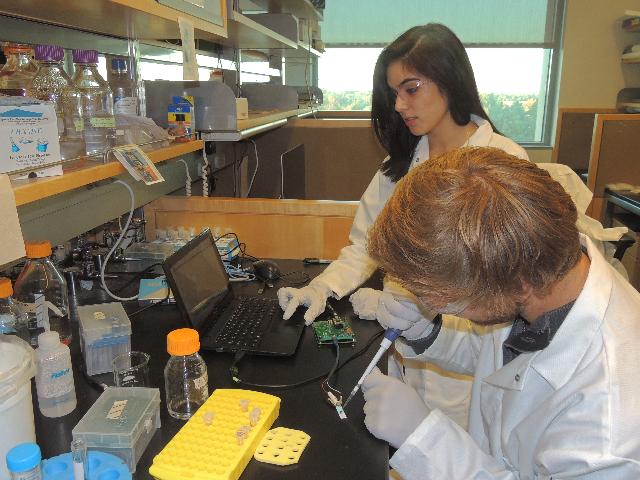
Picture 2: Sarah Ritz and Lucas Murray testing the quality of olive oil with their electrochemical biosensor

A team of UC Davis student inventors won the Grand Prize in the “overgraduate division” at the 2014 iGEM (International Genetically Engineered Machines) competition in Boston last week. The group developed an electrochemical biosensor that can measure the quality of olive oil.

70 percent of the olive oil sold in the United States is already rancid although labeled as fresh, according to a 2010 study by the UC Davis Olive Oil Center. The team sought to fix this problem.

“By consuming rancid olive oil, you’re not getting the health benefits and flavor that you paid for,” said Sarah Ritz, a fourth-year biochemistry and molecular biology major who was one of the six group members who spent her summer working on the biosensor.

The team, consisting of Ritz, third-year biomedical engineering major Lucas Murray, third-year biochemistry major Brian Tamsut, fourth-year biochemistry major with minor in biomedical engineering James Lucas, fourth-year biomedical engineering major Aaron Cohen, third-year biosystems engineering major Simon Staley, and second-year biomedical engineering major and “shadow” member Yeonju Song, presented their invention at the iGEM competition in Boston from Oct. 30 to Nov. 3, competing with 245 other student-research teams from Asia, Europe and Latin and North America.

“We presented in the second day of the competition and I think we did pretty well. We had a good presentation and the judges were happy, but we had no idea we [were] going to win anything,” said Lucas Murray, a fourth-year biomedical engineering major.

On Nov. 3, the UC Davis team was awarded the highest prize in its section, as well as the Best Policy and Practices Advanced Presentation Award.

“I am very happy for them; this is a great result for our campus” said Marc T. Facciotti, an associate professor and one of the student advisors for the UC Davis team. “It’s the sixth year I’m advising iGEM student teams, and this is the best project we’ve ever had.”

The students managed to develop a quick and inexpensive method to ensure product quality for producers, distributors, retailers and consumers of olive oil, called OilView. At the beginning of the project, the team spoke to researchers from the UC Davis Olive Oil Center and quality control experts at olive oil mills, finding out that a certain group of chemicals, aldehydes, changes when olive oil becomes rancid.

“So we built an enzyme-based electrochemical biosensor, which can test for different levels of aldehydes in olive oil,” explained team member Cohen.

The team not only developed the device itself, but also accompanying software, which helps quantify the degree of rancidity found in the solution.

Their invention is highly relevant to the olive oil industry. The team said that consumers are willing to pay more for fresh, extra-virgin olive oil, since its fatty acids and antioxidants are known for providing health benefits, such as a reduced risk of heart disease or cancer. But when olive oil oxidizes over time, or is exposed to too much light, heat or air, it loses its characteristic fruity flavor and beneficial effects.

Lower-grade olive oils are produced by using heat or solvents to extract the oil, and therefore do not contain the healthful components of naturally crushed olives used for extra-virgin olive oil. Since olive oil standards are voluntary, imported olive oil is often mislabeled and leads consumers to unknowingly buying a low-quality product.

The iGEM award and the overall positive reactions to the team’s innovation motivated the UC Davis team to further improve their device, making it available for retail in the future.

“Attending a conference like iGEM and meeting so many other bright, talented students with fantastic projects was really inspiring,” said Song, who supported the UC Davis iGEM team as a “shadow member,” and hopes to be a full member next year. “It is incredible to see what students can achieve.”

Photos by Courtesy


UC Davis wins Causeway Classic Blood Drive

0

On Nov. 4 and 5, UC Davis won BloodSource’s seventh annual Causeway Classic Blood Drive in a friendly competition with Sacramento State. UC Davis has now won the blood drive for the fourth time since its first occurrence in 2008.

The blood drive is a competition between UC Davis and Sacramento State in terms of numbers of participants. UC Davis won the competition by a mere 11 donors. UC Davis had a total of 1,653 participants, 43 of whom donated at a different donation center during the competition time frame. Sacramento State had 1,642 participants, 25 of whom donated at an alternative center. Both campuses drew impressive turnouts, as 3,295 students donated blood in total.

Felicia Roper, the account manager for BloodSource, managed the event for the UC Davis campus and released the final results. She said that this was the closest margin of victory for either campus during the competition’s history and that UC Davis now leads Sacramento State 4-3.

According to Alexander Sigua, public relations manager for BloodSource, having the blood drive be a competition increases donor turnout.

Sigua said that the Causeway Classic Blood Drive not only encourages friendly competition between UC Davis and Sacramento State but also evokes awareness for the importance of donating blood and will affect many who seek blood transfusions in the Sacramento and Davis areas.

“Thanks to the generosity of blood donors, the Causeway Classic Blood Drive makes a tremendous impact in our community,” Sigua said. “For example, blood collected at UC Davis can directly help patients at UC Davis Medical Center.”

Roper also stressed the importance of donating blood and BloodSource’s appreciation for the overwhelming amount of participation.

“Because of this friendly, but spirited, competition between neighboring rivals, 3,295 total participants represented both schools and thousands of life saving pints of blood and products were collected,” Roper said.

Next year’s competition will take place from Nov. 3-4. BloodSource will also be holding another blood drive on the UC Davis campus this January.

“This year alone ,thousands of lives will be touched thanks to the great folks on both campuses,” Roper said.


Sacramento, Placer County citizens remember fallen deputies

Deputy Danny Oliver and Deputy Michael Davis Jr., two officers who were killed in an Oct. 24 shooting rampage, were laid to rest at Adventure Christian Church in Roseville, Calif. Oct. 27 and Oct. 28.

An estimated 3,000 people were in attendance at both services, as reported by The Sacramento Bee.

“The citizens and communities have shown great support in response to this incident.  From phone calls, emails, social media posts, letters, flowers and visits, to hosting candlelight vigils, fundraisers, donations, support at funeral services. [Their] presence at an organized funeral ceremony or procession is overwhelming to officers and survivors who serve the community,” said Sergeant Lisa R. Bowman, the sheriff’s spokesperson for the Sacramento County Sheriff’s Department.

The Oct. 24 shooting turned into a six-hour manhunt, which included the participation of the California Highway Patrol (CHP), Sacramento Police Department, Sacramento County Probation, State Parole, and the FBI — with a team of around 300 officers — along with citizen cooperation. Alleged shooter Luis Enrique Monroy-Bracamonte — accompanied by his wife — supposedly shot Deputy Oliver in the head while in a parking lot on Arden Way. From there, Monroy-Bracamonte and his wife reportedly attempted hijacking two cars, wounding citizen Anthony Holmes and Deputy Jeff Davis and killing Deputy Davis Jr.

“This incident serves as a real reminder that our years of ongoing, updated and tactical training may come into play some day. We battle complacency within our organization, just like in any other line of work. I think what happened that day is a testament that law enforcement and services provided to the public are often dangerous and can happen in an instant,” Bowman said.

Sacramento and Placer Counties citizens were warned to stay in their homes and schools went into lockdown. Media outlets worked to cover the event for the safety of the citizens.

“Information given was much of what we were hearing through news media: It was the person involved in the shooting down in Sacramento, that he was armed and extremely dangerous and that he killed two people, along with injuring others and [committed] several carjackings,” said Peter Efstathiu, principal of Placer High School.

As the hunt continued into the evening, citizens were further directed away from the police activity and told to stay home. Monroy-Bracamonte was finally found around 5 p.m. in Auburn, where he was taken into custody.

Community members have also acknowledged the amount of coordination and teamwork used by the police force.

“I feel law enforcement did a remarkable job considering the events and the amount of coordination required among all the agencies. I never felt unsafe for myself, the school or the people in it. They communicated well, and did their job,” Efstathiu said.

“This is still an ongoing investigation. Information that has been made public at this point can be viewed on the Sacramento Sheriff’s YouTube channel, where they posted the video from last week’s press conference,” said sources from the response staff of Sacramento County District Attorney’s Office.

Monroy-Bracamonte was found to go by multiple identities, with an extensive legal history, and has been deported to Mexico twice. This fact launched the story to the forefront of a number of immigration debates. (According to a study at the Migration Policy Institute, from 2003 to 2013, about 1.1 million deportations resulted from reinstatements of citizens’ court orders from previous deportations.)

A memorial fund was established to show support for the Officers’ families. The Sacramento County Deputy Sheriffs’ Association and its STAR 6 Foundation have set up an official memorial fund for Deputy Oliver through Exchange Bank. A fund was also set up for Michael Davis Jr. with Wells Fargo Bank. For more information visit www.Placer1035Foundation.org.

This week in women’s sports

0

This Week in Women's Sports

Basketball (0-0):

UC Davis vs. Sonoma State (W, 85-57)

In their pre-season tune up game against Sonoma State, the Aggies prepared themselves for the intensity of the regular season opener next Friday.

Junior Celia Marfone scored a game-high of 17 points, while seniors Kelsey Harris and Sydnee Fipps also broke into double digits with 13 and 12 points, respectively. Freshmen Pele Gianotti, Rachel Nagel and Lauren Seyranian played impressively in their first-ever college game, bringing home 12, eight, and four points respectively.

The Aggies shot a notable 59 percent in the second half, coming back from a shaky start in which Sonoma State was, at times, up by as many as six points. The Aggies finished fiercely, winning on an 11-0 run. This success marked their 11th consecutive exhibition-game victory.

Cross Country:

Doc Adams Open

At UC Davis’ last home meet of the season, the Doc Adams Open, freshman Elizabeth Greif was the solo Aggie representing the UC Davis women’s cross country team.

Greif put in her second-fastest time of the season, 24:31, to finish 9th overall. This was also Greif’s highest place finish of the year. The 6-kilometer race was run at the Putah Creek Reserve Course on Saturday. Chico State’s Hannah Dorman led the race with a time of 22:54.

The Aggies are now focusing their energy on the NCAA West Regional next weekend.

Field Hockey (6-14):

NorPac Tournament (3rd Place)

UC Davis finished its season with a third-place finish at the NorPac Tournament in Stockton, Calif. on Saturday.

Senior Mattie Maloney made the game-winning goal during the third-place game against California. Maloney’s goal was also her first-ever career goal during her last game as an Aggie, a sentimental accomplishment for the athlete.

Freshman goalkeeper Briana Sooy’s 10 saves in this game were also a notable accomplishment, as it set a new single-game high for her career. Junior Hannah Drawbridge set up Maloney’s goal in one of her eight assists of the game.

While the Aggies allowed just three goals to their opposing teams, No. 4 Stanford lost just 2 goals, and Liberty Flames only one, earning it the title of tournament champion. UC Davis finished the season with a final record of 6-14.

Swimming & Diving:

UC Davis vs. Nevada (L, 171.5-126.5)

The undefeated Nevada Wolf Pack dominated again last Saturday at Davis’ own Schaal Aquatic Center.

Despite the Aggies’ loss, many swimmers put in outstanding performances. Junior Audrey DeNeffe scored 278.55 on the 1-meter board and 296.85 on the 3-meter board, surpassing both personal and school records with these marks. This qualified her for her first NCAA zone championships in March. Junior Lucy Lafranchise will also be attending the NCAA zone championships for the third consecutive year.

The 200-yard medley relay squad of senior Hilary Hunt, junior Hailey Ferko, sophomore Hilvy Cheung and freshman Courtney Schultz posted a season-best time. The foursome completed the relay in 1:44.28.

The Aggies will play host to another home meet on Saturday against Brigham Young.

Volleyball (13-11):

UC Davis @ UC Riverside (W, 3-0)

UC Davis dominated Big West rival UC Riverside on Saturday, posting scores of 25-16, 25-16 and 25-22 for three consecutive wins.

Junior outside hitter Kaylin Squyres delivered an impressive 14 kills, while senior Valerie Brain and redshirt freshman Aima Eichie managed seven blocks collectively. An additional six blocks were tallied by sophomore opposite Kendall Walbrecht and six block assists were contributed by senior middle blocker Katie Quinn. The Aggies’ total of 16 blocks is second only to the school record of 18, set against Sonoma State in 2000.

UC Davis will bring the action back home this week with a Thursday night match against Cal State Fullerton.

Graphic by Courtesy


This week in men’s sports

0

This Week in Men's Sports

Cross Country:

Doc Adams Open

At the final home meet of the season, the Doc Adams Open proved to be the last time senior Trevor Ehlenbach would wear the Aggie uniform on home territory. He finished the 8K course in 25:45, coming in 13th place. Five Aggies raced in the Open: Ehlenbach, sophomore Luke Dorman, junior Eric Neill and freshmen Ryan Dimick and Oliver Abundez-Dominguez, placing 13th, 18th, 20th, 31st and 35th, respectively.

UC Davis will be competing Nov. 14 in the 2014 NCAA West Regional in Stanford, Calif.


Football (1-8):

UC Davis vs. Northern Arizona (L, 23-21)

UC Davis fought hard in the Big Sky Conference game this Saturday but lost 23-21, bringing their record to 1-8 and 0-6 in the conference. Ranked No. 25 nationally, the Northern Arizona Lumberjacks went scoreless in the second half due to the Aggies’ strong defense.

Junior wide receiver Ramon Vargas caught four receptions for 97 yards, including two scores. This nearly tied a UC Davis school record for reaching 100 receiving yards for the fourth game in a row.

The Aggies will play Cal Poly in San Luis Obispo on Saturday before returning to UC Davis for the Causeway Classic against Sacramento State on Nov. 22.


Soccer:

UC Davis vs. Cal Poly (W, 2-1) 2OT

UC Davis vs. Cal State Fullerton (L, 2-1)

As the clock in the second bout of overtime ticked away, sophomore forward Dashiell MacNamara scored to win the game 2-1 against Cal Poly. This victory brought the Aggies to a record of 7-3-9 overall and 5-3-2 in league standings. This ended Cal Poly’s season at 8-7-4 overall and 3-5-2 in conference standings.

MacNamara scored the first and only UC Davis goal against Cal State Fullerton on Saturday. The Titans were able to sneak two goals in during the last five minutes.  This loss brings the Aggies’ season to an end, while Cal State Fullerton will advance to the Big West Conference Semifinals.


Water Polo

UC Davis vs. UCLA (L, 16-4)

The overall record for the Aggies thus far in the season is 13-16, after losing to UCLA 16-4. The Aggies had multiple opportunities throughout the match, but were not able to convert them into points, including a five-meter penalty break in the second frame. Sophomore Jacob Ley scored twice while sophomore Mark Coufal and junior Alex Bagdasarian both scored once.

UC Davis will compete at Fresno Pacific on Friday before finishing out the regular season playing against Santa Clara University on Sunday.

Graphic by Courtesy

UC Davis begins 2014-15 season

0

womensbasketball_sp_Ma

With 5:11 left in an exhibition game against Sonoma State — Aggies were winning by 19 points — freshman forward Morgan Bertsch scored on a layup. Despite being about as inconsequential of points scored as possible in a collegiate game, the UC Davis bench erupted with cheers and shouts. Bertsch had just scored her first points as an Aggie.

This exchange seems to define a UC Davis team that will return all five of its starters, and ten players total, from a year ago. The team undoubtedly practices and plays hard, and every player will hit the deck searching for a loose ball. Still, they are clearly out there to have fun and play basketball. As senior forward Sydnee Fipps said, “Ultimately I just want to have fun. This is my last year of competitive basketball, so I want to go out with a bang and have a really fun year with my fellow seniors and teammates.”

Don’t, however, let this happy sentiment make you think that the Aggies aren’t here to play, because this team will be extremely competitive in the Big West. The Aggies are returning all five starters and 10 out of 11 players overall from a team that won four out of their last five regular season games. This is simply a team full of good chemistry, that secret ingredient that evades most squads.

Head coach Jennifer Gross played up the importance of having so many players returning to the team. “I think it gives us a lot of confidence. We are finally starting to get that feeling of what it is like to have played together for a couple of years. You know each other’s strengths and tendencies, and I think that is really comforting, going into the season.”

The success of the Aggies largely hinges on the play of Fipps, who has been named to the All-Big West first team the past two seasons. The senior scored a team high 17.7 points per game last season while adding 5.7 rebounds per game. Fipps also shot 158 free throws last season, leading the team by 48.

While Fipps was quick to note that she had not even considered the possibility, she is on a short list for winning Big West Player of the Year this season.

Junior forward Alyson Doherty is another key member of the Aggies returning starters. Doherty averaged 13.1 points and 6.3 rebounds per game last season and continued to see her offensive role increase as the year progressed.

“[Doherty] has been tremendous with her work ethic in the offseason, and she has put herself in a position where as soon as she is cleared health-wise, we are going to be going to her,” Gross said. “She has added another dimension to her game with counters, and her weak hand is no longer her weak hand anymore.”

The rest of the Aggies lineup represents a series of important roles being filled. Senior Kelsey Harris, who broke the UC Davis single season record for threes made last year, will be seen darting around screens and hitting big shots for the Aggies. Junior Molly Greubel – when she comes back from a lingering lower leg injury – offers quintessential point guard skills, controlling the ball and playing stiff defense. Meanwhile, senior Brianna Salvatore will space the floor and play her special brand of rangy defense on the perimeter.

There will also be five freshman players to add to the mix, and each already showcased skills that they will add to the team in their game against Sonoma State. Guard Rachel Nagel scored a quick eight points in 15 minutes while forward Morgan Bertsch had five rebounds and a big block. Sophomore Brianne Yasukochi, who played just five minutes per game last season, also showcased her potential against Sonoma State, pushing the pace and adding three steals.

This Aggies squad has the potential to make a serious impact in the Big West Conference this season. They have great individual players, depth and a level of continuity rivaled by few. As starters Greubel and Doherty come back from their respective injuries, watch out for this fun-loving yet competitive team to make major noise in the Big West.

Photo by Johnny Ma

Golf short course training facility opens in El Macero

0

For years, the Aggies have fielded two consistently high-ranked teams in the men’s and women’s golf programs. Now, UC Davis looks to continue to improve as they open the John and Diane Watson Short Game Training Center at the El Macero Country Club.

The new facility offers the ability to practice just about any shot, featuring multiple types of grass, a deep and pot bunker and two large putting greens. Bruce Summerhays Jr., Head Golf Professional at the El Macero Country Club, stated the training facility offers all of the different shots that players can try.

The new training course cost $250,000, which was raised mainly by donations from alumni, family and friends of the UC Davis golf program. The project has been in the works for well over eight years, culminating in the opening on Sunday.

UC Davis men’s golf head coach Cy Williams played up the importance of the facility, both for El Macero and the Aggies’ golf programs.

“Our members and teams are going to get to practice on a facility that other clubs don’t have.” Williams said.

Williams also stressed how the new training facility will affect recruiting efforts at UC Davis, saying that the team had already brought a few recruits out and had received rave reviews.

“It’s also a wonderful resource and recruiting tool for our golf programs in our ever-continuing efforts to maintain a level of excellence with our golf program,” Williams said.

For years, the Aggies have stood out among their elite competition for not having the same access to professional-level training courses, which is something that has changed with the opening of the new training facility.

In addition to the short course training facility, El Macero now boasts an area in the back of the course that gives golfers the chance to calibrate the distance of their wedge shots. David Knox, the PGA General Manager of the club, stated this would attract strong golfers both to the club and the UC Davis golf program.

UC Davis golf is currently off for the winter, but will return to play in February with some practice on their new facility under their belts.

ThinkDavis Builds Connections Through Craft

0

For many months now, the UC Davis Department of Design has collaborated on a project called ThinkDavis. ThinkDavis embodies the creative collaboration of design undergraduates and professors to build an installation for this year’s Sculpture, Objects, Functional Art and Design showcase in Chicago (SOFA Chicago).

Hosted every fall, SOFA Chicago is the premier art fair for 3D art and design. With this year’s exhibition running from Nov. 6 to 9, those who are part of ThinkDavis recently embarked to the Windy City to bring their work to life.

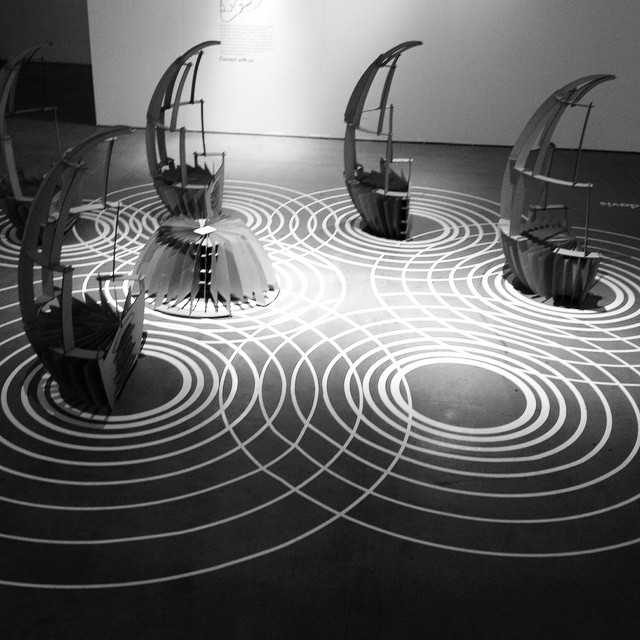
The final project comprised a constellation of luminescent chairs united by a translucent canopy. Underneath the chairs lay a map of fields of study that allow the UC Davis community to collectively thrive, such as the arts, design, engineering and social sciences.

think_ar1

ThinkDavis encompassed two themes central to the UC Davis design department: collaboration and connections. Brett Snyder, UC Davis assistant professor of design, said that the group’s experience at SOFA Chicago personified such ideas.

“Participating in SOFA Chicago was a chance to be both a part of a design community with other top design schools like Pratt and Illinois Institute of Technology, [and] also a chance to look closer at our own community,” Snyder said. “To this end, all of the chairs that we designed were created from cardboard material collected in [the Davis] community.”

The installation, constructed of free and donated cardboard, set a dynamic among SOFA Chicago’s cosmopolitan environment. Via email, students involved in ThinkDavis collaboratively said that the project was dynamically out of place, but in a positive way.

“We felt out of place, but in the end realized [that it was great], because it made our exhibition more provocative and meaningful,” the team said. “Sometimes it’s OK to be the odd one out!”

The students of ThinkDavis include eight UC Davis students of different ages and various majors. All members were able to put in their own personal touches for every facet of the project — ideation, prototypes, designs, media, etc. They expressed that ThinkDavis was a pivotal experience in their design careers.

“For the first time, we were able to see a tangible separation between what it means to be an artist, and what it means to be a designer,” the team said. “The mark of our effort is not necessarily in the physical form of the chairs, but in the processes and challenges that we faced designing, transporting and implementing [our ideas].”

Overall, SOFA Chicago was a successful expedition that connected Davis designers with their creative sides, with one another and with the greater design community. ThinkDavis garnered much positive feedback, strengthening the designers’ connection to their art even more.

As for future projects, Professor Snyder stated that he looks forward to new ways to strengthen the very themes that premised ThinkDavis.

“While it would be great to see the students develop our prototypes further, I’d be equally thrilled to see the ideas about sustainability and community engagement taken to the next level,” Snyder said.”

You can find ThinkDavis on Instragram @ThinkDavis and via the #thinkdavis hashtag.

Photo Courtesy ThinkDavis


Department of Theatre and Dance presents ‘The Gambling Lady’

0

gambling_ar_Gelvezon

Beginning Thursday, The UC Davis Theatre and Dance Department will be presenting its fall production of The Gambling Lady (The Basset Table). The play is being directed by the Granada Artist-In-Residence Fidelis Morgan.

The Gambling Lady follows the life of Lady Reveller, a young woman who runs a gambling table and whose addiction to gambling drives her family mad. The play was written by English playwright Susannah Centlivre in 1705. The show is termed as a restoration comedy due to its prominence during England’s Restoration period.

The comedy is one of the many plays Morgan rediscovered in her book, The Female Wit, which sought to bring neglected women playwrights back into the public’s attention.

Lisa Quoresimo, a graduate student in the Theatre and Dance Department who will be playing Lady Lucy, praised the play for including a female scientist and passing the Bechdel test, which tests if women have good vocal representation in a play and which Quoresimo noted was a progressive move for the time period.

“For a play [that] old to stand up to [the Bechdel test] — you don’t get to see that again for hundreds of years on the stage,” Quoresimo said.

Morgan echoes Quoresimo’s thoughts and commends the play for featuring a cast resembling the actual gender makeup of the world.

“Why are so many plays written that have 10 men in it and two women when there are not 10 men for every two women in this world?” Morgan said. “And when you do have a cast of five men and five women, people say, ‘Isn’t it extraordinary? Fancy that.’ But that’s what the makeup of the world is.”

While the play includes the use of heightened language, Chris Wolfe, a graduate student who will be playing Sir Richard Plainman, assures that Morgan’s directing will allow for a clear understanding of the lyrical speech style.

“You see a lot of Shakespeare in the states where people don’t have a clue what they’re saying or they know what they’re saying, but they don’t know how to communicate it to the audience,” Wolfe said. “[Morgan] is very attuned to what’s going to land with the audience.”

Wendy Wyatt-Mair, who will be playing the lead Lady Reveller, agrees with Wolfe and says the heightened language allows for a funner experience and an overall funnier play.

“I think some of the stuff that happens in the play wouldn’t be funny if it was written nowadays,” Wyatt-Mair said, “but somehow if you put it in a period piece and everything’s heightened and everything’s ridiculous it kind of works because it’s not necessarily natural.”

Although Morgan remained tight-lipped on the unique spin she’s taken on the classic play, Wolfe hinted that the play will have a rock n’ roll vibe where the men will have spiked hair and tattoos.

Morgan is an English actress, writer and director who has an impressive history with theater — particularly for her work at the Glasgow Citizens, where she received a Best Actress nomination from The Observer. She was chosen as UC Davis’ Granada Artist-In-Residence two years ago before beginning her term this fall.

Having experience working with both university and professional theaters, Morgan said what’s different between the two is that university theaters allow for larger scale production due to the more flexible budget.

With her extensive history with classical theater, Morgan said she appreciates classic plays for their large ensembles and exciting storylines.

“I always do the classics. I’m not a mad keen friend of minimal theater,” Morgan said. “I don’t like plays where two people sit on stage and talk for four hours. It’s not interesting to me at all.”

Although the play is aged, Morgan said her production will feature colorful and rousing performances that will shatter the misconception that classical theater is boring.

“It’s not like a stuffy old classical play; it’s not museum theater, which is something I detest,” Morgan said. “Don’t come along thinking it’s going to be some dry old fuddy duddy show, because it’s not.”

The Gambling Lady will have its debut performance on Thursday at 8 p.m. The show will run through Nov. 23 on select dates. Tickets can be purchased at tickets.mondaviarts.org for $18/22 general, $16/20 students, children and seniors.

Photo by Jay Gelvezon.

The Theory of Everything makes a “Big Bang” into theaters

0

We are still unsure if the universe has an end, but human life does, so why not live it to the fullest? — at least that’s what physicist Stephen Hawking believes. Hawking is one of the most well-known scientists of our time and is particularly famous for his theories regarding black holes and their existence in space. It seems surreal that one man could ultimately imagine and put into accessible language the origins of the cosmos; Hawking not only did this, but accomplished these feats while battling the physical and emotional effects of a motor neuron disease called amyotrophic lateral sclerosis (ALS) for the last 51 years.

This past Friday The Theory of Everything — a biopic about Hawking’s personal life — premiered in theaters to a limited release. The  film, directed by James Marsh and written by Andrew McCarten, follows Hawking’s 30-year marriage to Jane Hawking and the hardships his diagnosis of ALS had on their relationship. Though the movie addresses Hawking’s scientific accomplishments, his critical work is more of a backdrop to the true aim of this film: to show audiences the reality and humanness of an extraordinary couple.

The movie is based off Jane Hawking’s autobiography, Travelling to Infinity: My Life with Stephen, in which she recounts her experiences dealing with Hawking’s fame, love and heartbreak. McCarten wanted to do justice to their story, so he spent eight years working on the screenplay adaptation with Jane before they thought it worthy of the big screen.

“I [didn’t] overdo the physics [aspect of the film] because I wanted to serve the ALS story — [Hawking’s] incredible battle with that disease and his and Jane’s refusal to let the disease silence him,” McCarten said. “But there’s [also] this incredible love story [in the film] — a one-of-a-kind love story that I don’t think has a precedent in most films. The elements [of their relationship] are just unlike anything else that I’ve covered.”

The movie stars Eddie Redmayne and Felicity Jones, who were given the challenge of portraying the physical and emotional complexities of the enduring couple. Upon being chosen for the roles, Redmayne said that though they felt privileged to play such amazing parts, he and Jones felt a responsibility to do this multifaceted love story justice.

Redmayne in particular faced the difficulties of acting out the bodily deterioration of an ALS patient and began studying the disease months in advance of shooting. He spent time at the Queen’s Square Neurology Clinic in London and worked with a specialist there who introduced him to people suffering from the ALS. He said that this allowed him to not only see the physical and emotional effects of the disease, but also the extraordinary humor and the amazing passion for life that many of the patients, like Hawking, had.

TTOE_D48_ 13300.NEF

Redmayne also had the opportunity to meet Hawking, and he said that their conversations greatly aided his portrayal of the physicist.

“The amazing thing about spending time with Stephen is he was only supposed to live to 21 [years old] and he describes every moment beyond that as a gift,” Redmayne said. “[Hawking] has managed to live every second of his life as passionately and fully as possible and he has been a great inspiration to me. We only have one shot at [life] and really trying to live [to the fullest] is what I’ve taken away [from this film].”

The Theory of Everything is currently on limited release in theaters across the nation, including the Embarcadero Center Cinemas in San Francisco. For more information on the film, please visit focusfeatures.com/the_theory_of_everything.

Photos courtesy of Focus Features

Zombie genre comes to life onscreen and on campus

0

AggieTV’s first original movie series – BLiND – is making waves. Written and directed by former AggieTV member CJ Hwang, the series premiered its third episode last Friday on the AggieTV Youtube page. The production is a five-part film that focuses on a group of four students attempting to survive a zombie apocalypse on the UC Davis campus. Some students who have seen the series, like second-year environmental science and management major Maverick Bellard, are thoroughly impressed with the film’s moodiness and slick, cinematic style.

“[The film] was intriguing and suspenseful,” Bellard said. “[I was amazed] that it was produced by students; it was far from amateur.”

Instead of making a zombie film that focuses mainly on violence and gore, BLiND takes a more character-driven approach to the genre, illustrating the emotional and psychological state of each survivor. The drama and tension of the series comes not only from the danger of the undead threat, but also from the interpersonal conflicts between the characters.

BLiND’s production manager, Stacy Han, a third-year technocultural studies major and aspiring Hollywood producer, expressed that the focus on the psychology and emotions of the survivors is what led AggieTV to give the film the go-ahead.

“[Director CJ Hwang] really wanted to focus on the human condition and what humans would do during the zombie apocalypse,” Han said. “He really enjoys [exploring the character’s] psychological [state of mind].”

As production manager, Han was tasked with assisting both Hwang and assistant director and third-year human development major Crystal Chen, in making sure the behind-the-scenes work was handled as efficiently as possible. From procuring sets for filming to signing off on budget reimbursements, Han stayed busy throughout the course of the series’ production. According to Han, the most draining aspect of her job wasn’t handling finances or planning premieres.

“[Rescheduling filming] was always a conflict.” Han said. “It was the number one conflict working on BLiND.”

Han went on to express that as a completely student-run production, having to reschedule filming was difficult when considering the time and effort that went into each filming day. This difficulty was further compounded by the academic and social schedules of everyone working on set. Fourth-year technocultural studies major Eugene Arai, who was a sound mixer and Steadicam operator, commented on the strenuousness nature of the schedule.

“[The shooting schedule] was mercilessly strenuous,” Arai said. “[We had schedules that were] ranging from a 10-hour long shoot that started at 5 a.m. and other shoots that ended at 2 a.m. We worked day and night, weekdays and weekends.”

Despite the difficulty in balancing the schedules of a full crew and cast, Han was appreciative of the persistence shown by everyone on set.

“I’m very proud that we were all able to sacrifice a lot of our time and sleep,” Han said. “We [were able to film] everything we wanted.”

Throughout the six-month process behind creating BLiND, the long hours, days and nights that the crew logged together not only led to the creation of a film, but also long-lasting relationships.

“The most rewarding thing about the creation [of BLiND] was the teamwork and love that accumulated within the production crew and actors,” Arai said. “We all still keep in touch.”

For more information on BLiND, the cast and crew,  you can visit http://www.aggietv.org/blind/.

Science is Serendipitous: The issue with the “Monsanto” model

0

Have you heard of Monsanto? It’s a biotechnology company focused on enhancing agriculture. You may have heard about them through the news, or even here on The California Aggie due in large part to the bad press they’ve been getting. You see, the debate is largely focused on two issues with Monsanto — its use of genetically modified organisms (GMOs), and its suspicious business practices. Whatever you may think of either issue, there is no denying that Monsanto has had massive success in its endeavors. Yet for all of the success this company is having, they are embroiled in scandals and controversies from both the scientific and public communities. The research that Monsanto and other biotechnology companies are doing to genetically engineer our food is a topic that requires a lot of academic reading for a proper debate. What I’m primarily concerned about is the ethics behind Monsanto’s model of “doing science.” It’s a profit-first-based model, aimed at establishing a monopoly-like foothold in the agricultural sector and keeping research behind a closed door. It’s a sore in the scientific community and I believe it’s not how scientific research should be conducted.

We sometimes like to think that science and the law, or science and politics really have nothing to do with each other. Nothing could be further from the truth, as just as in any other field scientists always have to question if their research practices and advances are ethical — something we simply call bioethics. In the case of Monsanto, their whole practice of bioethics has been called into question. One controversial issue is their use of biological patents on many agricultural items that were genetically modified. Their scientific advances to crops are not shared with the agricultural industry, but rather sold at high costs and vehemently guarded against any changes or further alteration. Essentially what this company is doing is creating a monopoly on research.

The work that Monsanto is doing with agriculture is fascinating, and I believe the use of genetic engineering has its benefits. What I disagree with is the model of closed-society research conducted by for-profit companies. I do not believe it is productive to patent essential research for the gain of profit. Research should be shared throughout the scientific community, and from there it can be incorporated to a company’s engineering.

Why do I point to the Monsanto model as a problem? It encourages the aggressive pursuit of a closed-research society, protected under the guise of patents and given political power through lobbying. While doing research for this column, I came across a documentary called The World According to Monsanto. This documentary argued that Monsanto uses politics more than science to establish their domination over agricultural engineering. During Monsanto’s ascendance in the biotechnology industry, much attention was focused on getting politicians and the government to stand behind approving genetically modified crops and techniques — without asking too many questions or debating research.

This came across as shady to me because my belief in genetic engineering has been shaped by scientific research that is shared among the science community. I want to encourage private industry to concern themselves with ethical ways of practicing scientific research. It’s not all about making profit and monopolizing your hold on information. It should be about sharing information with many, so better products can result for society.

For those interested I’ve included a link containing 1783 studies relating to GE safety.

I might be in hiding after writing this, but you can always email me at uwsufi@ucdavis.edu or tweet me (@umayrsufi).