58.7 F
Davis

Davis, California

Sunday, December 21, 2025
Home Blog Page 831

Davis non-profit FARM plants winter vegetables to donate

0

Members from the non-profit FARM Davis gathered Saturday on Valdora Street in South Davis to plant vegetables. FARM Davis is a non-profit organization dedicated to growing and donating fresh, local food in order to help homeless or low-income individuals obtain healthy produce.

Robyn Waxman founded the organization and wrote her master’s thesis about it at California College of the Arts (CCA). Waxman saw the project as a way to engage the millennial generation by converting a strip of toxic soil into a space capable of producing food for the homeless on Hooper Street, San Francisco — its first official location.

“The FARM project is a way of creating a new way of thinking about protest that appeals to the social and cultural nuances of [the millennial] generation, and that’s why it was formed. It was trying to solve a problem, which was that [the millennials] wanted to do something but felt totally overwhelmed,” Waxman said.

After completing her graduate work at CCA, Waxman moved to Davis to teach graphic design at Sacramento City College. FARM Davis began in Waxman’s front yard on K Street. Nineteen people came for the first work day five years ago, and since that day, FARM’s presence in Davis has grown to include two more sites and the participation of about 600 people.

FARM relies on volunteer power, but received a grant from the city of Davis to hire a part-time farm manager, the organization’s only paid employee. Volunteers can commit as much time to the organization as they are able. All of the space FARM uses is either donated or volunteered to be converted into a farm. The Valdora Street FARM is the front yard of a retired UC Davis linguistics professor, Orhan Orgun. Orgun began volunteering with FARM three years ago, and after a year of volunteering his time and energy, Orgun decided to convert his front yard to become the third FARM location.

One significant aspect about FARM Davis is that it’s volunteer based. The Valdora and K Street yard locations are given up voluntarily for urban farming. The people who work on these farms, aside from the farm manager, are also volunteers. As a result, the people involved are invested on a personal level. They just like farming, giving and being around those who are similar, said Ged Mendoza, a third-year political science major who volunteers for FARM.

FARM donates about 1,200 pounds of produce annually to another Davis non-profit, Davis Community Meals. Every Tuesday, Thursday and Saturday Davis Community Meals prepares and serves a free meal at St. Martin’s Episcopal Church. FARM delivers produce such as broccoli, garlic, onions and spinach every Tuesday, and during the highly productive summer months, they are able to deliver produce for all three meals.

“Getting a healthy, nutritious meal— being on the streets, that is difficult to do. FARM helps with that,” said Bill Pride, executive director of Davis Community Meals.

According to Pride, the homeless population in Davis varies between 110 and 120 individuals. Of these, about 60 percent are in some kind of shelter or transitional housing, such as Cesar Chavez Plaza, a housing project on Olive Drive that provides a permanent housing solution to low-income individuals. Davis Community Meals oversees Cesar Chavez Plaza, which receives weekly deliveries of food from FARM.

“That program [houses] a lot of folks with special needs and the food comes to help supplement their fixed income….We do get folks there who go out and help on the FARM. It’s a good way to get them to socialize, get out of their environment, do something a little bit different,” Pride said.

The largest FARM site in Davis is called FARM 2.6, a 2.6-acre plot of land on County Road 95. Waxman and her husband bought the property two years after FARM began in Davis. Initially FARM 2.6 only had a house, barn and small orchard. Waxman and many other volunteers have converted this site over the last three years. FARM 2.6 now includes another small orchard, a natural dye and fiber garden, a vineyard, multiple vegetable gardens, a chicken coop, a horse pasture and more open space to be farmed in the future.

“The idea with FARM Davis is that nobody dictates it, really, so that if people come with ideas then we do their ideas, if it’s within what we’re all kind of thinking,” Waxman said.

Designed by Jennifer Wu

FARM is open to new ideas and experimentation. If someone wants to start a project, the group will find a plot for them on one of the FARMs. The natural fiber and dye garden is an example of this kind of experimentation. FARM partnered with the Davis Spinners Guild to make yarn.

“We had a big dye workshop where we…had these outdoor fires and we cooked the dyes and we dyed yarn, a lot of it that we spun ourselves. We’re trying to make scarves and mittens and hats for the Davis Community Meals cold-weather shelter,” Waxman said.

In addition to the Davis Spinners Guild and Davis Community Meals, FARM is also involved with elementary schools in the community. They give tours of the FARM 2.6 site and work directly with a fifth grade classroom on a project called Grow and Give.

This is the second year of the Grow and Give program, in which a fifth-grade classroom learns about FARM, then comes to FARM 2.6 and plants its own garden. The class grows the food in order to cook a meal for residents of Eleanor Roosevelt Circle, which is a senior middle-income housing community on 5th Street.

This year’s garden includes bok choy, celery, kale, broccoli and peas. The students will return to FARM 2.6 in December to harvest their garden. The Davis Food Co-op will then meet the class at Eleanor Roosevelt Circle and teach the students how to cook the food they grew and harvested. Finally, the fifth-graders will serve their handmade meal to the seniors and eat it with them.

FARM Davis describes itself as a new type of protest. The gift economy on which FARM operates is unusual, but it allows the organization to form strong bonds within the community.

“We call it slow protest— it’s the slowest protest in the world. It’s the act of undoing and making the world the way you want it to be. Of publicly and productively voicing yourself,” Waxman said.

Waxman’s thesis is a 55-page newsprint publication describing and depicting the process of establishing the first FARM at CCA. While Waxman spearheaded the project, throughout her thesis, as well as in FARM Davis, she emphasizes the importance of the community to FARM.

“FARM is about creating a means for quality engagement between FARMers and the land beneath the farm, between FARMers and outside agencies who will receive half the harvests, and between FARMers and the local communities in any site specific area,” Waxman wrote in her thesis.

Their regular work days are every other Saturday, alternating between its three sites in Davis.


Courtesy Robyn Waxman

Graphic by Jennifer Wu

UC Davis researchers discover fossils that fill missing evolutionary gap

0

On Nov. 5, UC Davis released that a team led by campus researchers discovered the first fossil of an amphibious ichthyosaur that fills a missing part of the dinosaurs’ evolutionary period.

The fossil represents the transition from land to sea in the evolutionary history of ichthyosaurs, marine reptiles from the Age of Dinosaurs.

“Ichthyosaurs are fish-shaped externally but their skeletons are reptilian, suggesting that they descended from four-legged land reptiles and evolved into a fish-shape over time,” said team member and Professor Ryosuke Motani from the department of earth and planetary sciences. “However, no fossil was known to represent this transition from land to sea.”

Between 2010 and 2012, the team, consisting of scientists from UC Davis, Peking University, Anhui Geological Museum, Chinese Academy of Science, University of Milan and The Field Museum in Chicago, led multi-year excavations in Chaohu City, Anhui Province of China.

The fossil was discovered in 2011, and almost two years were spent in the lab studying and analyzing the fossil before the team noticed significant differences in the structure of this animal. According to a paper published by the research team in the scientific journal Nature, the ichthyosaur fossil had unusually large, flexible flippers and a short snout that allowed for movement on both land and sea. The body of the ichthyosaur also contained thick bones, an indication of an animal requiring a heavy bone skeleton to combat rough sea waves.

According to Motani, this transitional animal will allow scientists to scrutinize the timing of marine invasion.

“The important question here is if the invasion was related to the global warming that seems to have preceded the invasion,” Motani said.

According to co-author and team member Da-Yong Jiang from the department of geology at Peking University, the causes driving marine invasion could be multiple, including predation pressure and competition for food that may be lower in the sea than on adjacent land

Future studies will be conducted to determine if any other climatic or geographic factors affected the transition.

“We did not realize the importance of the specimen until much later.” said Motani. “It took about two years to fully appreciate what it was. Then, I was finally really excited, and the same goes for my colleagues.”

UC students protest against proposed tuition hike

The ASUCD and a coalition of student organizations and labor unions have called UC Davis students to gather on the Quad for a campuswide protest on Nov. 18 at noon against the possible tuition hike. Event coordinators expect upwards of 1,500 students to participate.

The action is a response to University of California (UC) President Janet Napolitano’s proposed Long-Term Stability Plan, which implies a five percent rise in tuition fees annually for all UC undergraduate and graduate students over the next five years. This would likely raises tuition to $15,564 tuition by the academic year of 2019-20 (compared to the current amount of $12,192). The UC Board of Regents will consider the Long-Term Stability Plan during its meeting at UC San Francisco Mission Bay Campus on Wednesday.

“We oppose the tuition hike because education is a right and it should not be cost-prohibitive,” said Harvey Litzelman, director of the ASUCD Office of Advocacy and Student Representation, a second-year sociology major and one of the organizers of the UC Davis protest action. He argued that according to the California Master Plan for Higher Education from 1960, higher education should be free for all in-state residents.

“Given the upcoming tuition increases, we are seeing just how dissociated from that promise our Regents and our administrators are,” Litzelman said. “We will not accept this norm of not only a costly education, but an education that requires a massive commitment and sacrifice [from] the students’ families.”

Andy Fell, a spokesman for UC Davis, explained that the tuition hike is necessary due to the declined state funding over the past few years. He said that the intent of the proposed plan is to provide long-term stability to UC’s tuition and financial aid:

“The proposed plan [is] to ensure that the UCs can continue to be excellent, but still affordable and accessible, by providing various programs for low-income students,” Fell said. “Right now, 55 percent of all California undergraduate students pay no tuition fees at all — this will continue under the new plan.”

In a joint statement, the UC chancellors expressed their full support of the Long-Term Stability Plan, arguing that it is “predictable and fair” and allows families to plan ahead. They said that the plan would enable the UCs to enroll at least 5,000 more California students over the next five years.

The plan follows a four-year tuition freeze period, during which UC administrators developed a long-term funding plan in response to reduced state support. Despite cost-saving efforts, the UC sees itself unable to meet long-term funding needs for investments in academic quality and faculty.

State funds for UC were cut by nearly $1 billion during the course of the recession. The UC Office of the President made clear that the proposed five percent increases should be considered as a ceiling, meaning that, depending on the future level of state funding, charges may increase by a smaller amount or remain flat during the next five years.

Other UC campuses will also hold similar events tomorrow. Litzelman insisted that the university needs to prioritize affordability by reigning in its various programs and administrative costs.

“The UC is focusing on its grandiose ego at a cost that is prohibitive to students. That is unacceptable,” he said. “We will rally, we will march, we will occupy. We will make ourselves be heard.”

Senate Endorsements: Consider the following

0

Tomorrow, Nov. 18, voting will begin for the 2014 Fall Quarter ASUCD elections to determine six new ASUCD senators. The Aggie Editorial Board interviewed and evaluated each of the seven senate candidates, and, because of the small number of candidates, we chose to endorse two. In each candidate, we looked for someone who had a strong understanding of ASUCD and its workings, who had feasible, tangible platforms that would positively affect a large number of students and who displayed a strong ability to contribute and thrive in the senate environment.


We hereby endorse the following candidates, in order of our preference:

Roman_asucdsenate_fe_Pasturel1) Roman Rivilis — Independent

Rivilis, out of all the candidates, by far had the greatest knowledge and understanding of ASUCD, and we can attribute this to his constant activity and participation within the association over the past three years. His platforms – creating a program to put peer advisors in the Financial Aid office, mobilizing the Greek system to work with The Pantry by holding food drives and philanthropy events and developing an accessible testing center for students with disabilities – are conducive to helping vasts amounts of students in a tangible way. Rivilis fully understands the ASUCD budget and is aware of the current complications with the Intercollegiate Athletics program. Additionally, Rivilis’ decision to run independently from a political slate convinced us of his desire to work across party lines to effect real change on campus.


Casey_asucdsenate_fe_Pasturel2) Casey Nguyen — S.M.A.R.T.

Nguyen made a strong impression on the Editorial Board with her platforms – creating an early academic probation and subject to dismissal warning system and expanding and establishing new and current resources for sexual assault and sexual harassment prevention on campus – and with what she has already done to try to accomplish them. The Editorial Board strongly identified with Nguyen’s second platform. Regardless if she is elected or not, we feel that she will be a strong influence toward creating a safer community and a vital resource in trying to stop sexual assault and harassment at UC Davis. Nguyen knows how ASUCD works, and she understands how the resources of the greater campus community can help assist in accomplishing her platforms, and we think that she would be a valuable ASUCD asset if elected.

Votes can be cast online at the ASUCD elections website, elections.ucdavis.edu, from Nov. 18 at 8 a.m. to Nov. 21 at 8 a.m.


AggieAngelous

0

ThePoetry-ThePoets&ThePoetesses


The Poetry

“How Does it Feel?”

By Manjot Bhathal

Are you sane now?

Disengaged from the world.

How does it feel to be so far from the ones you loved?

Do you feel happy, or are you feeling numb again

Because you said you had enough but feelings still remain.

Is the fight over, or are you still fighting to forget?

All the things that made you crazy, and all the things that you regret.

You would say this is all i want, and this is all i need

to end it all now and go peacefully.

Tell me now how is that working out?

Because you’re not here but left your soul behind.

Its trapped in an hour glass with the time ticking by,

wishing you had waited, because now there’s more pain inside.


The Poets&ThePoetesses


“How Does it Feel?” by Manjot Bhathal


Second-year student currently in Biochemistry.

I don’t know if what I write is good or not, but it comes from the heart. Poetry has given me a way to express myself. I enjoy spoken words, poetry, music and anything else that could inspire me to do better. This poem is the first one that I ever shared with my friends and family, and I hope those who read it are able to look beyond the emotional distress of it. There are many interpretations of it, but from my perception it’s about suicide. Here, I’d like to mention that there are many programs on campus that help students and the community deal with emotional distress and other stresses. One of the groups I’m a part of is called “Out of the Darkness: Suicide Prevention,” and I’d love for everyone to check it out if you have questions, concerns or need information about suicide. To end this, I’d like to say that things may get rough sometimes, but please find a reason to move on because there’s at least one person wanting you to find that reason because you might be that reason for them.

Hold on.


Men’s Basketball poised for comeback season

0

The heightened anticipation for the start of Aggie basketball is finally over. Official practices began on October 6 as UC Davis began preparation for the upcoming 2014-2015 season which starts against Holy Names on Nov. 16.

Coming off a 9-22 overall season with 4-12 record in Big West during last year’s campaign, the Aggies begin this season with a healthy squad with hopes to improve.

A tandem of guards led the Aggies last season. Senior guard Corey Hawkins averaged 18 points per game, and former guard Ryan Sypkens average 11.4 points per game off the bench. Sypkens has since finished his career at UC Davis and was recently selected by the Idaho Stampede, a Utah Jazz affiliate, in the NBA’s Development League draft.

Hawkins has led the Aggies in scoring since transferring from Arizona State. He has accumulated a total of 1,108 points in his two years as an Aggie. As he enters his last year of NCAA eligibility, the coaching staff is confident the Hawkins will lead UC Davis to victory.

“He’s a talented guy,” said head coach Jim Less on Hawkins success at UC Davis.  “He’s got a chance this year to put UC Davis basketball on the map, and be a big part of that, and that’s what we expect him to do in his senior year.”

Last season’s woes emerged from the lack of depth in the front court. Senior forwards J.T. Adenrele and Josh Ritchart missed significant minutes of the 2013-2014 season due to injuries; leaving the Aggies vulnerable in the front court.

“I think they’ve handled the adversity of their injuries, and are coming back extremely healthy and hungry… To their credit, not only did they get healthy, they became better basketball players during their time off,” said Les.

The return of Adenrele is going help the Aggies find more second chances on offense and to be more aggressive on both sides of the ball.  UC Davis ranked last in the Big West in rebounding, only averaging 28.2 boards per game. Adenrele will also help with rim protection, the Aggies averaged 2.3 blocks per game, second to last in the Big West. During his 2012-2013 campaign, Adenrele average 1.5 blocks per game, third best in the conference.

Additionally, Adenrele’s ability to finish in the paint will take a load off Hawkins, who led the Big West in scoring two seasons ago. The duo will be a frustration for opposing defenses. After not playing for a year, Adenrele is determined to make presence is known this season.

Due to the aforementioned injuries, sophomore forward Georgi Funtarov was called upon to replaced Adenrele and Ritchart in the paint, where he developed into an offensive threat. During his freshman season, Funtarov averaged 8.8 points per game and 4.4 rebounds per game. His ability to shoot from mid-range and beyond the arc will help the Aggies with their spacing issues. He will spread the floor and will allow Adenrele space to work in the post and open up lanes for the guards to drive to the basket. Funtarov will be a great asset to the Aggies’ offensive attack.

After redshirting the 2013-2014 season, senior guard Tyler Les will intimidate opponents from beyond the arc. Les has made 144 three-pointers during his college career. He will succeed former Aggie guard Ryan Sypkens as the main three point threat. Sypkens currently holds the record for most three-pointers made in Aggie history with 315.

The return of key players and the experience of the team will certainly help the Aggies construct a productive season. The Big West is deep, but if UC Davis manages to stay healthy, they have a shot at competing for the Big West championship.

“… We’ve got four fifth-year seniors,” said Les “We’ve got experienced guys who have logged a lot of minutes at the Division I level. [They] understand what it takes to have success, and they provide us with a really good daily visual of how to go about their business, and everybody else has fallen into line.”

UC Davis opens the season on November 16 as the host the Holy Names Hawks at the Pavilion in Davis, Calif.


UC Davis takes on basketball titan

0

The UC Davis women’s basketball team seems poised for a successful season, returning all five starters and ten players total from the previous year’s team. The team has already faced its first opponent Sonoma State in a exhibition game and came away with a dominant win. Despite coming out of the gates slow, the Aggies showed a level of cohesion and effort that will take them far.

Unfortunately for the Aggies, their next game won’t be against a Division II opponent. Instead, UC Davis will face off against reigning National Champions UConn who are currently ranked No. 1 in the nation.

Last year, UC Davis took a trip to Storrs, Conn. to face UConn at home and came away with a 97-37 loss. Seniors Sydnee Fipps and Kelsey Harris were able to score in double digits, 13 and 12 points respectively, but no other Aggie finished with more than five points. The next lowest amount that they scored in a game all season was 48 points to a Stanford team now ranked No. 6 nationally.

The Aggies should expect to fare better this year than they did the last. They have improved in all facets of the game and have a cohesive offensive unit that should be able to put up more than 37 points. Still, two starters for UC Davis, juniors Molly Greubel and Alyson Doherty, will likely be missing the game as they recover from injuries.

The UConn team returns three starters, including two preseason All Americans, from a team that won all 40 of its games last season en route to a second straight national championship. Forward Breanna Stewart, who stands at 6’4, will be in the running for National Player of the Year this season and is a major player to watch in the game.

Despite the long odds, UC Davis head coach Jennifer Gross is excited about the game. “We see this game as a win/win for us,” Gross said. “We get the opportunity to compete against the two-time defending national champs on our home court. We are not looking at it as a pressure situation.”

The UC Davis women’s team will start their season playing against the best of the best, something that Gross hopes will positively impact their season. For fans, this represents a chance to watch a basketball titan, led by legendary coach Geno Auriemma, play in the Pavilion.

Arts Feature: A crash course in UC Davis’s sculptures

On the UC Davis campus, public art is more than just a part of the scenery. Art unifies the campus, inspires myth among the student body and is the result of some very rich history.

The majority of the campus’ sculptures are a result of an art-in-public-places campaign by the Nelson Gallery Price Amerson and the UC Davis Fine Arts Collection.

“In Davis, students and community are connected to our arts, which is unique for a college campus,” said Rachel Teagle, director of the Jan Shrem and Maria Manetti Shrem Museum of Art.

The pieces are the result of the many talented artists who have passed through our university over the years, and their diverse styles match Davis’s quirky atmosphere.

“In selecting pieces, we consider what is appropriate to our audience. We pick pieces that reflect our history.” said Teagle.

In addition to staying true to the campus’ history, the art is also selected to spark conversation and sometimes, debate.

“If nobody is talking about it, it’s probably a [poor] work of art,” Teagle said.

Here is an overview of some of the campus’ most interesting sculptures:

sculptures_ar_Willis5

“Apollo” by Ralph Johnson (1987)

Wedged between Wellman and Kerr halls stands “Apollo,” a tall bronze figure. While not immediately resembling the Greek and Roman deity, a squint and a tilt of the head results in a slightly humanoid resemblance, and its jagged angles give it a godlike appeal. Due to the hustle and bustle of the area and natural patina covering, it doesn’t stand out much to passersby.

“Wait, there’s a statue over there? I never noticed that,” said Jason Kao, a fourth-year biological sciences major.

While a cursory glance at its accompanying plaque will reveal that at one time “Apollo” was subject to metal rot and repairs, the process of keeping up Apollo’s appearance is tricky for its caretakers.

“[Apollo] came out of the campus forge, which was experimental; people were pushing the envelope and trying different metallurgy techniques. Some of the work is inherently unstable,” Teagle said.

When considering repairing works of art, it comes down to identifying original vision for the piece. In Apollo’s case, repairs were cast only after considering the artist’s intent.

“There was an entire generation where entropy was simply part of the art and the artists didn’t want their work preserved. The general public doesn’t always understand that what we are doing is what the artist wanted,” Teagle said.

sculptures_ar_Willis1

“Bum, Bum, You’ve Been Here Before” by Tio Giambruni (created in 1967, moved to campus in 1987)

Cast out of bronze and aluminum, south of Shields library sits the massive, tubular, coiled sculpture. The title is inscribed 10 times on the piece, adding a whimsical flair to the otherwise industrial first impression.

With the administration’s blessings, creator Giambruni founded UC Davis’ TB-9 foundry and built a number of complex pieces, including “Bum, Bum.”

“Our university has a history of giving faculty members amazing tools. Giambruni built the foundry from scratch; administration said, ‘If that’s what you need to advance your project, it’s allowed,’” Teagle said.

Bravehearted second-year art studio major Danielle Bronson climbed up the tallest part of the sculpture to look inside of the hollow top.

“It’s a very utilitarian, minimalist structure… It looks like part of a sewage system,” Bronson said. “It’s way cooler from up here.”

“Bum, Bum” in particular has had a history of dividing its audience.

“Before the sculpture was installed on campus, it was placed in the city of Davis, and apparently it caused a huge uproar. People loved it, hated it, it became this point of civic debate,” Teagle said. “[Giambruni] loved that it was divisive, because he thought that’s the point of art, to cause conversation … It caused people to be engaged and talking about art.”

‘The Egghead Series’ by Robert Arneson (installed from 1992-94)

Strategically scattered across campus, Arneson’s seven commissioned Eggheads have become nothing short of landmarks. Made from bronze and a special cementitious paint, these heads are at once fragile and sturdy, smooth to the touch and well loved by the student body.

“Our Eggheads are a source of community pride. On graduation day, there is a line of families and students all waiting to take their photo with [‘Eye on Mrak.’] That’s something that you don’t see on other campuses,” Teagle said. “The eggheads are at once friendly and serious, and I think that riding that edge provokes conversation.”

Designed as a spoof of the intellectual pretensions of the university, the series has garnered the admiration and respect of the student body.

“They’re happy and silly. They bring a lot of humor into the campus,” said Angely Castro, a first-year transfer student and psychology major.

sculptures_ar_Willis10

“Bookhead” sits in front of Shields Library, eyes open, face down in an open book. This Egghead is immediately relatable to students — we’ve all desperately placed our faces into textbooks in hopes of learning through osmosis, right?

“People rub [Bookhead] for good luck before midterms. I walked out of Shields one night after studying to see a group of people all rubbing [the sculpture],” said fourth-year political science and psychology double major Elizabeth Tran.

Others see the most recognizable Egghead as a photo and pranking site.

“I planked on it,” Kao said. “It was part of a summer bucket list.”

sculptures_ar_Willis3

“Eye on Mrak (Fatal Laff),” grins upside-down at those approaching Mrak Hall, and on the back, one eye intently stares up at the building. “The eye on the back represents that the students are watching their administrators,” said third-year psychology major Rukhsar Akhtar.


sculptures_ar_Willis7

“See No Evil Hear No Evil,” located east of King Hall, depicts two Eggheads conversing. They each have their left eye closed and lack ears, so that when placed across from one another, are unable to see eye-to-eye or hear one another’s arguments. Their placement suggests a subtle jab at the future lawyers studying next door.

“Stargazer” faces the heavens behind North Hall with a relaxed smile and swirly eyes.

“I feel like Stargazer is showing what it’s like to be lost in life here at Davis. Gazing up in class like, ‘Oh man, what’s happening here?’” said Graciela Del Rio, a first-year transfer and political science major.

sculptures_ar_Willis

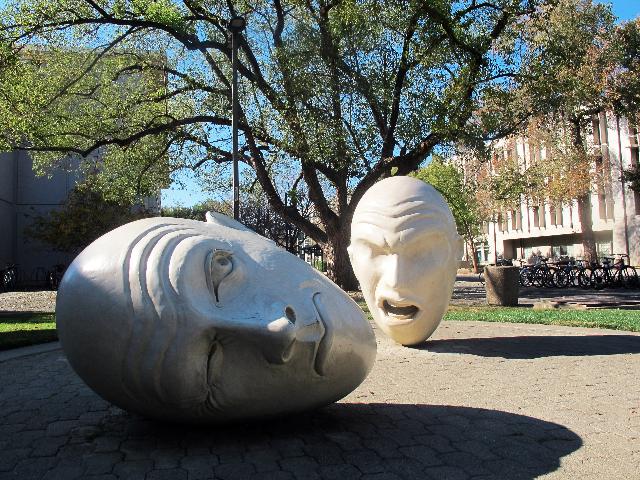
The “Yin & Yang” duo are located in front of Wright Hall. One is upright, yelling and with eyes closed at the other, who is lying on its side with one eye open, visibly annoyed at the other.

sculptures_ar_Willis2

“Shamash” by Guy Dill (created in 1982, installed in 1996)

This tall red and gray concrete structure can be found on the lawn north of Mrak Hall.

“It looks like the symbol pi, with a book on top and a seesaw. And it’s about halfway between the library and engineering [buildings], so I guess it’s appealing to different fields [of study],” Akhtar said.

Shamash’s conspicuous 14-year hiatus is not uncommon, as many large works of art reside with their artists until they find a home.

“Outdoor pieces of art have very particular buyers, the room and space needed for it mean that sometimes they don’t immediately sell. Artists have studios [where they store their pieces], and sometimes it’s as straightforward as keeping them in their homes or yards,” Teagle said.

sculptures_ar_Willis6

“Stone Poem” by Steve Gillman (originally exhibited in Davis’ Nelson Gallery in 1986)

Located south of the Bike Barn, these 13 Stonehenge-reminiscent granite blocks are loosely huddled together. While a number of them are conveniently sunk into the ground and used as benches, this was not the original intent. Between exhibition in the Nelson Gallery and placement on campus, the sculptures were in Gillman’s studio during the 1989 Loma Prieta earthquake. Several blocks were knocked over and broken, and later repurposed to lie on their sides to act as a seating area.

“[‘Stone Poem’] highlights how important the site and installation are. You can plop down a sculpture anywhere, but you’d be amazed at the impact it has on how you frame the experience,” Teagle said. “One small thing that they did a few years ago was to install the native grasses around it. When they were originally trimming around it, weed-whackers were hitting and damaging it. The team at the Nelson Gallery went back and did research on the artist’s original vision for how the work would be installed.”

What they found was that “Stone Poem” was never intended to be on a perfectly trimmed golf course, and that instead, it was envisioned as one with the earth beneath it.

“It’s integrated into the landscape. It’s what the artist wanted, the stones look like they are emerging from the earth …  Its rough edges are enhanced by the current grass around it. Its previous installation was a little to straightlaced for it,” Teagle said.

“Redwood Tree” by Ted Hirsch (1992)

Obscured by shade and made of completely organic matter, this sculpture is easy to miss despite being just feet off the path when approaching Wellman Hall from the Coffee House (CoHo). Carved from a tree stump, the whittled sculpture features images of upside-down axes and stands of tree trunks.

sculptures_ar_Willis4

Whole Earth Bench by Whole Earth participants (2004)

Between Wellman Hall and the CoHo is an earthen, dusty brown bench constructed during the 2004 Whole Earth Festival. Handmade from cob (comprised of clay, sand and straw), stones and at least one blue ceramic pot, this seating spot in the sun is like no other on campus. The bench is located in the perfect place for an extremely conspicuous mid-day nap, although considering the hard-packed materials, a pillow is recommended.

sculptures_ar_Willis11

Dutton Fountain (1999)

In front of Dutton Hall’s entrance sits a massive flan-shaped fountain. The basin on top fills and spills over the side ever so slightly to slick the sides and give passerby something to run their hands along.

However, when the fountain is off, students’ opinions of the installation are less positive.

“Well, it’s just a big block,” Castro said. “I’m sure it’s pretty when the water is on, but right now, it’s kind of ugly.”

Photos by Angela Willis


Aggie Style Watch

0

This week ASW roamed the Quad in search of dapper dudes. I looked specifically for male students who appeared to have put some thought and effort into expressing themselves by showcasing their personal style identity through daily dress.

As a female design student and long-time fashion maven, I always assumed that men had it much easier than women when it came to putting on clothes in the morning. There are definitely students who put little effort into getting an outfit together to go to class, but I’ve found that being on a college campus changes the context of dress.

We, as college students, are surrounded by tens of thousands of our peers, and many of us feel the need to dress to impress. The three male students I interviewed all spoke of some level of dressing so as “not to face too much judgment from others,” as well as of choosing clothes that reaffirm identity and show a sense of self.

It is also worth noting that all the students I interviewed on campus happened to be fourth-years and had time here at Davis to develop a personal style identity.

Erick “Panda” Malver – an American studies major – caught my eye while sitting at the Ski or Snowboard Club table wearing bright red, flouncy harem pants, expensive looking skier / snowboarder sunglasses and mismatched socks.

asw_ar_Kinkela

ASW: Can you tell me a little bit about what you chose to wear today?

Malver: I’m wearing some harem pants that my friend brought back from India. They are really comfy and flowy, and they have pockets with jewels on them. I threw two socks on that I found on the floor.

ASW: How would you describe your personal style in three words?

Malver: Steezy and fab.

ASW: What is your favorite item in your wardrobe and why?

Malver: My panda onesie. [It’s great for] the ski season. I wear it a lot, maybe a couple times a week. [It’s fun to wear] to parties or even when I want to put on cozy pajamas.

Chris Lui’s newsboy cap drew my attention immediately. Lui is a fourth-year sociology major from San Francisco. His expressive style reminisces the roaring 1920s but still incorporates some more modern elements such as off-brand Converse-style sneakers.

asw_ar_Kinkela2

ASW: How would you describe your style in three words?

Lui: Easy, simple and timeless. I don’t like name brands or trends.

ASW: Where do you shop for most of your clothes?

Lui: Not anywhere in Davis. Most of my clothing is either hand-me-downs or found at thrift shops in San Francisco. I am lucky because my dad is really into fashion, so I get a lot of his clothing.

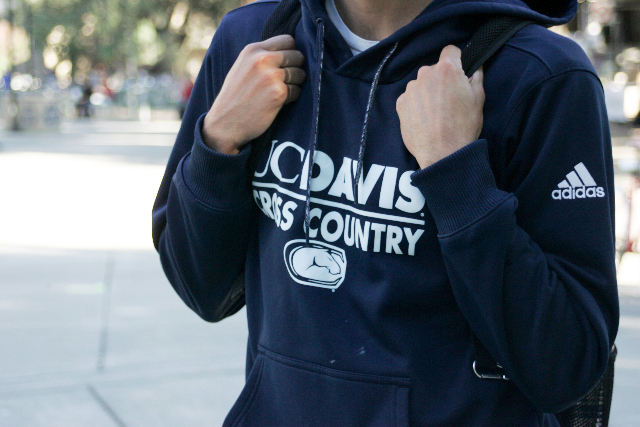
I wanted to interview Trevor Ehlenbach because he was dressed in full cross-country athletic wear. Ehlenbach is a fourth-year film studies and Spanish double major. I picked him because it seems to me that exercise clothing has become a new dress norm across campus, and I wanted to see what he might say about this trend.

asw_ar_Kinkela4

ASW: How many days out of the week would you say you wear athletic gear?

Ehlenbach: When I’m in season it’s every single day of the week. The season is about to end soon, so I will take advantage of being able to wear “normal” clothes like jeans and T-shirts.

ASW: How does wearing athletic gear emphasize your personal style identity?

Ehlenbach: One of the reasons why I wear it is for convenience, but another reason is that it definitely makes me feel more Aggie pride. It also makes me feel empowered because only one percent of students are athletes and even less than that are on the cross country team.

Aggie Style Watch would like to thank Malver, Lui and Ehlenbach for taking time out of their days for impromptu interviews and photoshoots that help give students a better idea of UC Davis campus dress culture and understand what it means to express oneself through clothing choice on a daily basis.

Photos by Julia Kinkela

Album Review: ‘1989’

Although the year 1989 is typically characterized by leather blazers, tunic dresses and feathered hairstyles, Taylor Swift’s fifth album is nowhere remotely near bad fashion.

1989, titled after Swift’s birth year, marks the singer-songwriter’s official departure from cowboy boots and country twang and her full-fledged leap into music’s pop industry. The album marks a new era for Taylor Swift fans, one that is characterized by red lipstick, sleek bobs and an evolved version of Swift who is unapologetic, self-deprecating and a general badass.

Swift leads 1989 with synthpop track “Welcome to New York,” which represents Swift’s move from country town Nashville to The Big Apple. Co-penned with OneRepublic’s Ryan Tedder, “Welcome to New York” serves as an anthem for equality as evidenced by lyrics “You can want who you want / Boys and boys and girls and girls.”

Swift’s move away from country is further seen in pop anthem “Style,” which is rumored to be about Swift’s alleged ex-boyfriend Harry Styles (hence the title) and includes one of the most melodically appealing James Dean references I’ve ever heard, as well as track “All You Had To Do Was Stay,” which features Swift singing a high-pitched version of the word “stay” that is both initially irritating and insanely catchy.

If you thought Swift’s lead single “Shake It Off” was sassy for the songstress, wait until you listen to pop track “Blank Space.” In the song, Swift criticizes the media’s depiction of her by donning a fictional persona of a man-eater who is overly emotional, insane and probably eats ex-boyfriends for a midnight snack. Not only are lines “Got a long list of ex-lovers / They’ll tell you I’m insane” and “I can make the good guys good for a weekend” hysterically brilliant, but they also show that Swift isn’t taking what the media says about her lying down, instead she’s doing what Taylor Swift does best: write a song about it.

Several interesting beats make their way into the singer’s album, as seen through piano-driven track “I Know Places,” which explores the singer’s darker side, and synthpop song “Out of the Woods,” which takes the listener on a breathtaking journey through a dangerous relationship and serves as an ambitious musical venture for the songwriter.

Relatively new best friend Lorde is likely to have inspired Swift’s album through mid-tempo pop lullaby “Wildest Dreams,” which can only be described a combination between Lana Del Rey and a good night in bed in the best ways possible.

Those nostalgic for Swift’s trademark heartbreak ballads have nothing to fear, as the singer includes two tear-worthy songs, “This Love” and “Clean.” The latter, which was co-written with Imogen Heap and ends the album, features one of the songwriter’s most beautiful heartbreaking line on letting go of love: “When I was drowning, that’s when I could finally breathe.”

However, 1989 is not without its flaws, as seen in weaker tracks “How You Get the Girl,” which seems like a step back for Swift through detailing the ways one can get a girl, and “Bad Blood,” which is rumored to be about Swift’s secret feud with pop-singer Katy Perry. Although “Bad Blood” features a catchy tune and is undeniably relatable, the song overall comes across catty and unnecessary for the talented songwriter.

In 1989, Swift wipes the tears off her guitar and uses her music as weapon against the media and critics by concocting an album that not only solidifies her as a masterful pop artist, but also as a versatile act who can transcend genres and produce catchy melodies while still maintaining her lyrical brilliancy.

While the singer is receiving a lot of heat for her departure from music streaming service Spotify, the singer is sure to be shaking it off to her million+ first week record sales that are only bound to grow in the upcoming weeks.

Even though ’80s fashion has made its way to near extinction, after listening to 1989, I will gladly make the claim that Taylor Swift never goes out of style.

Film Review: ‘Birdman’

In a world where Marvel is dominating the superhero movie industry, Alejandro Gonzales Iñárritu’s latest film Birdman waits patiently in the wings as the next great superhero movie, although not for the reasons you might think.

Iñárritu’s black comedy follows the cast of a New York play as they frantically prepare for opening night. Michael Keaton portrays Riggan Thomson, a washed-up actor who acts, writes and directs the play in an effort to restore his career to what it was 20 years ago.

Riggan is continually haunted by his past in the form of Birdman, a superhero he once played in a blockbuster franchise, who is heard through voiceovers offering words of discouragement to the actor.

Both in life and in theater, Riggan struggles with taking center stage as he is often outshone by those around him, particularly his co-star Mike Shiner (played by Edward Norton), a pretentious Broadway actor who joins the cast after another actor is injured.

Despite possessing the superpower to telekinetically move items, Riggan poses as one of the movie’s least special characters.

Though missing the red capes, Birdman takes a new approach on what it means to be a hero. The movie explores the way fame and uniqueness, or lack thereof, drastically affects one’s self-esteem.

Much like his character, Keaton fails to capture the audience’s attention for the first half of the film as the audience is often left waiting for another character to swoop in and save the notorious Birdman from his lackluster scenes.

This isn’t the only way Iñárritu parallels the screen with the stage. The film is primarily shot with a single camera on a dolly following actors in one long extended scene which mimics the fluidity of a play.

Halfway through the film, Birdman wins over the audience (myself included) when Riggan receives the modicum of fame he needs after being filmed in a viral video crossing Time Square in just his underwear.

The movie features dynamic performances by Keaton and Norton, who go head-to-head both on stage and on screen to create powerful portrayals of two complex male characters dealing with insecurities in very different ways.

However, one of the film’s secret gems was superhero veteran Emma Stone’s portrayal of Sam, Riggans’ spunky drug-recovering daughter and personal assistant, who often serves as the voice of reason for the broken men of the movie. Stone delivers one of the film’s most powerful speeches when she brutally criticizes her father for caring too much about what people think.

Though none of the characters are entirely capable of being rooted for, Iñárritu juxtaposes a cast primarily consisting of antiheroes with a superhero film in a piece that makes us question our favorite heroes.

Although Birdman takes a while to get off the ground, by the end, the movie flies high as a cinematic masterpiece concocted by Iñárritu that effectively captures what it takes to be special.

There is no word yet on whether Birdman will fly alongside Thor and Iron Man in the next Avengers movie, but something tells me that Birdman will be soaring toward a best picture nomination come this year’s Oscar season.

Tunespoon: A major crisis

0

Google “useless college degrees.” “Music,” along with a crappy stock photo of a confused man/woman in a graduation gown scratching his/her head in worried bewilderment, is on that list. I assure you.

I have heard it so, so, so many times. From unimpressed aunts and uncles, from my sometimes unsure parents, from inexplicably shocked fellow students. It’s a tough life, and it often feels unfair that this course of study that I’m embarking upon, with every passion I have within me, pales in comparison to the science-technology-engineering-mathematics fields. It doesn’t exactly help that UC Davis is a premier research university. My music degree, in comparison to the highly-regarded STEM universe, often feels like a death sentence. I know so many people who work in labs, who study in bays and farms, who have dreams of medical school, who take internship opportunities that will lead them to prosperous days of discovery — and for a living nonetheless.

And you have me, lost, not sure and maybe a little scared of the future, studying something I’m passionate about.

It’s not that I don’t have the opportunities I need. I have great classes. Many professors share the passion that their students strive to maintain. For example, I am enrolled in an amazing jazz composition class; our class is four students big and every Thursday our own, original material is read by student musicians and workshopped by our fantastic instructor. In another class, I’m finally learning the distinctions between European styles of opera and the way political influences informed music making in the Baroque era. My academic future is busy and bright: more composition, more one-on-one learning with a private instructor, more interaction with a small faculty. It’s nothing short of awesome.

And yet I still feel that skeptical dullness in your eyes when I tell you I’m a music major.

I know a lot of people will nod and say, “Oh, cool!” at some sort of attempt at sincere interest. But I don’t blame you for looking down on me. It’s been internalized since childhood that engineers make a lot of money. That high school teachers are underpaid. That doctors are the breadwinning geniuses of the world. That musicians won’t make a buck. That lawyers hold a noble, generously-paid occupation. That artists are often called “starving” for a reason. But know that, even with all that stigma, I want to be a musician — just like you want to be a doctor, or an anthropologist, or a mechanical engineer brainiac. I want to be a musician. Because you know what? My future is just as valid as yours.

Of course, it’s impossible to rewire year upon year of arts and humanities shaming in a heartbeat. Don’t forget — many music majors struggle with that same internalized self-doubt, with that same skepticism, with that same harmful expectation that we will never be as successful as we want. But we study in spite of what you think, what they think and most incredibly of all, what we ourselves think.

It’s indubitably a struggle to continue sometimes. I don’t have those same move-out-of-my-parents’-house, job-secure, food-on-the-table prospects to resort to when I feel like I’m falling. And it happens a lot, because I’m a college student just like you, just like every first- or second- or fourth- or fifth- or sixth year-student in Davis. I have my highs and I have my lows. Sometimes learning is the best, most fulfilling thing; sometimes it drives me to tears. I feel on top of the world, and in the next moment, the burden of my future crushes me to anxious crying, shattered remains.

I’m not asking you to kiss the feet of every music major that you see, to profusely apologize to every arts and humanities major that you’ve so discourteously wronged. I’m beseeching you to look upon us with validity, with respect, with dignity. Look me in the eye when I tell you I’m a music major, and just as I imagine you with your doctor coat or chemist goggles or engineering gloves, imagine me making a difference in peoples’ lives through the art of sound.

STEVEN ILAGAN enjoys light literary discourse, for he is also an English major! Contact him at smilagan@ucdavis.edu.

(Re)Fashioning Gender: School Dress Code

0

When I was in eighth grade, I got sent to the office in the middle of geometry class because of the skirt I was wearing. Really. That’s it. A skirt. It wasn’t even a particularly offensive skirt. It didn’t have any images of weapons or defamatory slogans on it. It was just a plain old denim skirt. It was tacky maybe, but definitely not offensive. So why, you ask, would anyone send such a respectful student like myself to the office for such a harmless offense?

Well, the answer is the school dress code.

Ah, the school dress code. The term brings back vivid memories of casual shirts tucked haphazardly into pants and sneakers worn with virtually every type of outfit imaginable because other kinds of shoes simply were not allowed at my public school. I remember telling myself in the eighth grade, at least I was no longer subjected to those hideous brown, yellow and green uniforms that my old private school required. This was comforting knowledge, but I ended up failing my geometry test because I missed the entire review session while I was changing out of my skirt into the more “appropriate” hand-me-down sweatpants that were left in the lost and found. They had odd stains and smelled like somebody else’s body odor, but hey, at least my thighs weren’t showing.

School dress codes weren’t always a thing. In fact, a lot of public schools were hesitant to implement dress codes, probably because they didn’t see a need to police the bodies of 10-year-olds. But dress codes have become increasingly popular over the years, requiring students to wear clothing that is considered to be appropriate and non-distracting. The question that has recently sparked the most controversy, however, is whose learning environment is being protected? And, more importantly, at whose expense?

One of the most prevalent rules of a dress code prohibits students to wear clothing that reveals too much of their body. No tank tops, no short shorts, no dresses or skirts that bypass the oh-so-infallible “fingertip rule.” This rule, which prohibits a student’s fingertips from going beyond their skirts, shorts, etc., overwhelmingly affects a great deal more girls than it does boys. In my experience, it’s almost impossible to shop for non-revealing clothing when you’re a teen or even a pre-teen girl, especially in the summertime. So it’s really no surprise that, according to the M-A Feminist Club, 64 percent of the 118 female students they surveyed said they’d been punished for violating their school dress code. Compare this to the 12 percent of 111 male students who were surveyed, and the repercussions of these codes become clear.

While girls are sent home or given lost-and-found items to cover up, boys remain in class and “undistracted.” But what does this say to students about their own bodies? The message seems clear: Girls must be sure to cover themselves in order to protect their male peers from losing focus. And boys must remain privy to the idea that they need protecting from female bodies, as if they are virtually unable to use any other portion of their brain that does not revolve around sexual arousal.

As college students, many of whom have attended public schools that implement dress codes, it is necessary to recognize the repercussions of being subjected to these types of rules. Being fearful of our bodies since elementary school has surely had some kind of impact on the ways in which we perceive ourselves. A lot of the time, being told and re-told to be aware of how you present yourself to others makes you overly conscious about your body. This has various results — namely, eating disorders and other types of self-mutilation; but also a strange perception of ourselves and others that has much to do with the problematic ways the school system tells us how to see ourselves. Men too, are largely influenced by dress codes as they learn to see themselves as innately hypersexual criminals that aren’t to be trusted.

What this does is create a kind of collective case of body dysmorphia that influences many aspects of our lives. Although we may have graduated from high school long ago, we haven’t necessarily graduated from the destructive influences of the school dress codes that taught us how to perceive our own bodies.

CHELSEA SPILLER can be reached at ctspiller@ucdavis.edu.

Edumacation with Calvin and Hobbes: Political bliss

0

flesch_ca

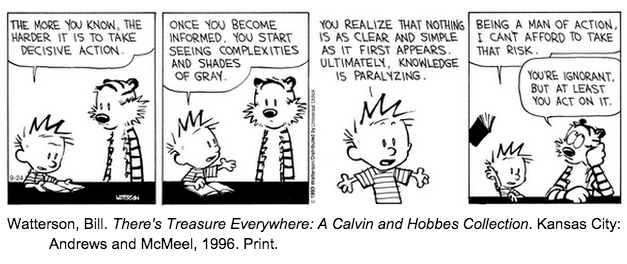
One of the most contemporary debates about higher education concerns the value of going to college. Most of the debate focuses on fiscal reasoning and future economic prospects. But talking about college only in these terms would be ignoring other vital advantages that come with education. The panel above shows Calvin making a rather backhanded argument for skipping his homework. His flippant attitude is indicative of a modern problem in political participation, and can be analyzed to show the growing importance of higher education that often extends beyond job concerns.

One phrase Calvin often advocates (with disastrous results), is that “ignorance is bliss.” I hate when people use this expression. It supposes that being aware of your surroundings (always inevitably negative) has the effect of creating an equally negative temperament in a person. This is a low opinion of learning, which I believe most people find to be a rewarding experience. It ignores the fact that education values problem solving, and that perhaps some optimism could be gained from knowing enough to propose a solution to certain problems.

Here, Calvin argues for willful ignorance. Watterson makes a humorous play on the idea that the most decisive people in history have typically been the stupidest. What the reader ultimately gets is an impression of reality. We have come to view almost all disagreeable political decisions as the result of a kind of willful ignorance: congressman X cannot be this dumb. As political participation declines in the United States, higher education finds that it carries more weight in determining whether citizens perform such basic duties as voting.

The political climate of a college campus has the power to shape a person. Higher education has a generally liberalizing effect on students: Professors tend to be progressive, and they may impart their opinions directly or indirectly to students. In a political climate where extremes are starting to carry more power, students need to be more aware of the socializing power of their institutions.

The only exposure many students have to civic education is in their high school government classes. This is not the most ideal time for students to be exposed to the various types of political participation. As colleges become more competitive, high school students practically have to seek out civic duty as necessary extracurriculars, not as experiences in their own right. For example, I earned the Presidential Volunteer Service Award for 100 hours of work at a soup kitchen. I doubt I would have worked that amount of time without college as an incentive.

Civics is a unique topic that is difficult to teach to an unwilling audience. For many, ignorance is indeed bliss, in the sense that they would rather just not be bothered. This mentality needs to be fostered out at the intermediary age of college, when students are not yet past their youthful certitude. Unfortunately, a passing grade on the AP U.S. government exam has the effect of allowing students the option of not taking any political science courses in college.

For all the downsides to an enormous student population, one advantage may be that students are exposed to a wider variety of opportunities concerning their civic lives. Professors need to encourage students to seek these opportunities and also reward earnest participation. But ultimately, the student is responsible for recognizing that the effort is worth their time, and that even an act as simple as voting represents their self-interests.

I mentioned that disaster often ensues when Calvin treats ignorance as bliss. In one comic he refuses to believe his wagon is going off a cliff. Subsequently, he crashes. Whatever political melancholy may come from civic action seems worth the trouble in the long run. I’ve never been the type to brood, and neither should you.

To involve yourself, you can reach ELI FLESCH at ekflesch@ucdavis.edu or tweet him @eliflesch.

An interview with electrical engineering professor Josh Hihath

0

Josh Hihath is an assistant professor in the electrical and computer engineering department at UC Davis. He is beginning his fourth year teaching and conducting research on campus. Prior to his time in Davis, he was a research professor at Arizona State University.

Hihath teaches undergraduate and graduate level classes in electrical engineering, where students learn to describe the physical processes that control semiconductor devices like transistors and diodes. He has also started a graduate class on molecular electronics, which is directly related to his research.

Hihath’s research includes the study of single-molecule devices, determining the functionality and practicality of single-molecule transistors. He also explores the wider use of the method for singling out a molecule, including its use in the field of biology.

What in general do you do in your research?

We focus primarily on the electrical and energy conversion properties of molecular scale devices. Most of what we do is at the single-molecule level. We have this technique where we can make contact to just one molecule at a time, and then apply voltages to it and measure the current through it, so that we can study the charge transport and electronic properties of one molecule at a time. I would say the simplest idea would be, can you do something like make a transistor out of just one molecule, so, a device that has maybe 10 total atoms in it.

There’s this thing called Moore’s law, where transistors have been getting smaller and smaller now for five decades, and if you extrapolate that line all the way to the possible endpoint, it’s at sizes where there’s only a few atoms in the device. That’s where molecular electronics comes in. Trying to see if we can have molecules that operate as functional devices at this scale is one big part of what we’re trying to do in my lab.

What’s the significance of this research?

There’s multiple parts to it. One is what are the physical limitations of Moore’s law? You’ve been scaling down all this time, but are you actually going to be able to make a molecular device which operates as a transistor? Transistors are in practically every electronic piece of equipment which exists — cell phones, laptops; all these kinds of things have lots and lots of transistors in them. Can you make those kinds of systems out of single-molecules devices? This could potentially make them faster — as you get smaller and smaller, devices tend to get faster and faster. So you can potentially make circuits that are much faster if you can make accurate, molecular-scale devices.

At what point does it get too small to be practical?

That’s one of the questions we’re trying to answer. Obviously, you can’t get smaller than an atom. The smallest device that we’ve made that operates as a transistor probably has approximately 100 atoms in it in total. Intel makes transistors with gate-lengths as small as 200 atoms, but that’s only in one dimension. The entire transistor still has millions of atoms in it. Here, at the molecular scale, we’re talking about a device where the entire transistor is only 100 atoms.

What’s the purpose of making them smaller?

There’s multiple reasons we’re doing it, but I think the most straightforward [concept] to understand is this Moore’s law scaling. You can have something like a silicon wafer. Transistors are just electronic switches, but they’re the workhorse of everything that requires computation and even many electronic systems that don’t require computation. Transistors are really the workhorse of everything that is electronic. So if you make these smaller, it has two effects. One is you can fit more of them onto a wafer, so you can fit more devices per unit area, so you can make things smaller and that makes them cheaper. At the same time, because they’re smaller an electron takes less time to get from point A to point B, and that makes them faster.

The total physical limit of that is to have devices that are just a few atoms in size. That’s probably as small as you can possibly go. But the physics that we use to describe the way a transistor in a conventional silicon system is completely different than what you get if you only have a few atoms in the system. So, A) we’re trying to see if we can make transistors at that size scale, if so, what the physics are behind how they operate, and B) what are the device characteristics at that size scale, so how does it turn on/turn off, can we obtain current-voltage characteristics similar to conventional electronic devices?

Do you have any results that you can talk about?

The electronics is one side of it. We’re really trying to understand the underlying physics of how things operate at this size scale.

On the other hand, we have this technique where we can make contact with one molecule, which is pretty cool. Doing that, can we make contact to specific molecules to read out information about that molecule. Specifically, one of the things we’re trying to do is look at molecules like DNA and RNA and see if we can electrically read out biological information from a single DNA or RNA molecule.

We’ve actually done a few different things with that. We’ve shown that just changing one base in DNA changes its resistance, sometimes by as much as a factor of 10, so it can be a pretty large change in resistance by changing just one base in a sequence.

There’s also things that are big in biological circles these days, like epigenomics. The genome is basically defined as all of the genes that are in your body. The epigenome is all the genes that are active. For instance, if you have two “X” chromosomes, you’re going to have the same genes on both “X” chromosomes, but probably only one of those two is active. So the epigenome tells which one of those two is actually active. Nature has come up with a variety of ways of encoding that information, and one of the ways is they chemically modify some of the bases, they put an extra carbon on the cytosine bases. We recently did a study where we looked at the conductance of methylated and unmethylated DNAs and we can actually see a resistance change there, so it’s potentially a way we can read out things like what genes are active in a population.

How does the process work?

What we do is, for things like genes, we pick a sequence that we think is relevant and get it synthesized for us. Then we put a whole bunch of these in a solution and try to physically make contact with them, one at a time.

For creating the devices we start with one electrode that is pretty much atomically flat. Then, we make a second electrode that is movable and atomically sharp, so at the end of it there should only be one atom. Then we put a bunch of molecules in that have linkers that are capable of binding to gold on both ends. Then, basically, all we do is apply a voltage between the two electrodes and crush the sharp one into the flat one and pull away. As you do this, sometimes you bind a molecule and sometimes you don’t. By looking at the data, you can do statistics on thousands of these contact and withdraw cycles and say “this” particular molecule has “this” resistance value.”

So with something like DNA, we take DNA molecules that we’re interested in and we put them in this system and measure the resistance and can say “this sequence has a different resistance than this other sequence.”

How do you know that you are only getting one molecule?

This technique’s only been around for about ten years, and that was one of the big questions at the beginning. Was is it really a single molecule or is it not? We can determine this by looking for integer differences in resistance values from the experiments. If you have one molecule, you’ll get one value, if you have two molecules you’ll get double that value, and if you have three molecules you should get triple that value. If you zoom in on the histogram you can actually see peaks at one, two and three, so you know that you’re actually getting integer numbers of whatever it is you’re measuring the resistance of. So, you can actually statistically work out how many molecules there are between the electrodes for any particular device.

What are you trying to learn applying this to DNA?

One of the big ideas that has come from this work, is that we can use this kind of system as a sensor platform. Can we read out biological information from a single strand of DNA?  Can we obtain enough information to say whether a pathogen is present or not, or if a specific gene is active or not? So in effect this part of our work is moving from this idea that we can understand electrical properties and transport physics of single-molecule devices to the idea that can we do real applications based on single molecule electrical measurements. Right now, most biological studies are based on optical methods, so it’s sort of an emerging area to start to look at these things electrically.

What’s your day-to-day process for research?

As an assistant professor trying to start up a lab, I spend a lot of time writing grant proposals. I have a group right now of a couple postdocs and three PhD students. They’re the ones spending most of the time in lab doing the day-to-day hands on lab stuff. I spend a little bit of time in lab myself but not as much as I’d like to.

What are your hobbies?

I’m learning how to golf. And actually, because I don’t get to spend as much time in lab as I used to, a lot of my hobbies have become developing electrical devices and small equipment that we can actually end up using in lab.

The thing that I think gets a lot of people started in electrical engineering is being hobbyists and working on electrical systems. I still have that hobbyist mentality sometimes and I like to go make things like a non-linear current amplifier that may actually be useful in lab if we get it to work. When I was a kid I loved to take things apart and loved to build things, and that really started me as an electrical engineer. Now I get to do that kind of stuff on a much larger scale. Some of the equipment we use in lab is stuff I built.

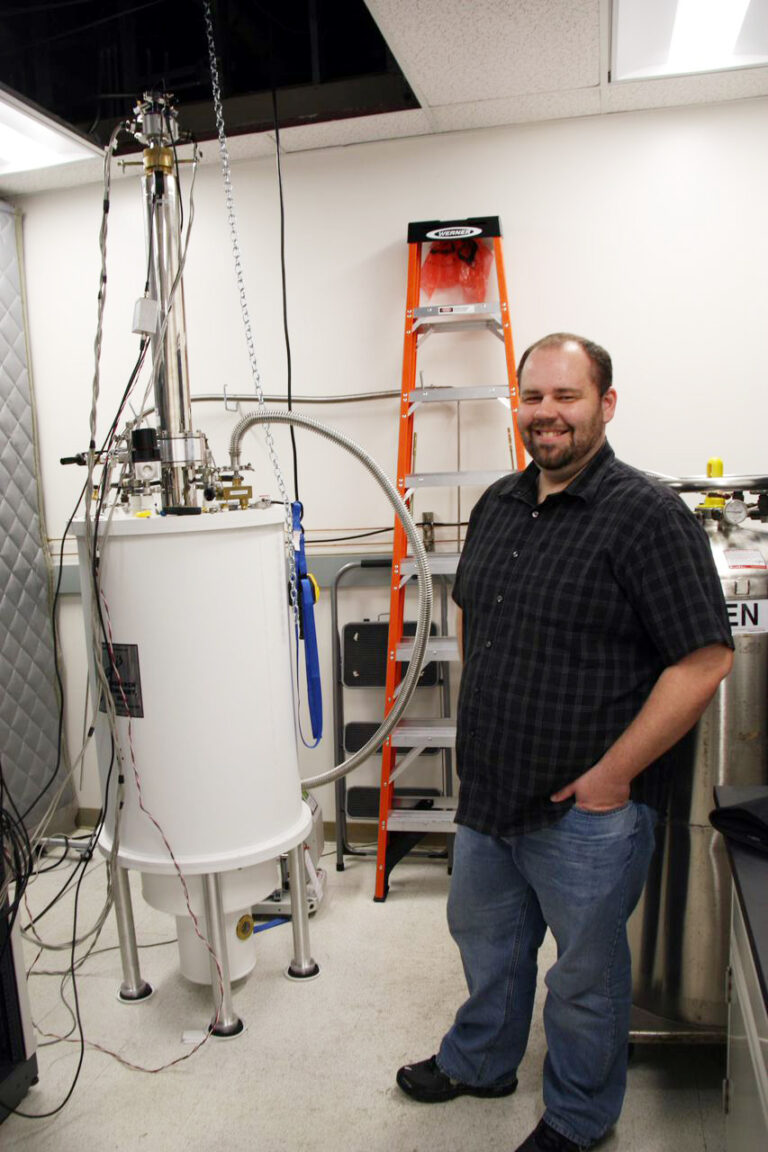
One of the devices we use to do this works all the way down at liquid helium temperature, that’s 4 Kelvin. We bought part of the system, but a lot the system you can’t buy off the shelf, so we built it, and that’s kind of fun to do. It’s nice to get it up and running and then when you start publishing stuff out of something that you’ve built, or doing new science with something that you’ve engineered, it’s really fun.

Photo by Danna Weintraub