57.2 F
Davis

Davis, California

Monday, December 22, 2025
Home Blog Page 830

Davis Police holds open dialogue on military vehicle acquisition

0

The Davis Police Department (DPD) held an open dialogue on Nov. 13, in the Davis Senior Center to discuss the June 2014 acquisition of the Mine-Resistant Ambush Protected vehicle (MRAP) from the federal government. With over nearly 60 people including city council members, the DPD and the general public, the event aimed to conduct a dialogue with different groups within the community.

To begin the dialogue, participants were told to write one word on a piece of paper to be posted around the room. Several words posted include “militarization,” “overkill,” “unity” and “fear”. One attendee expressed her concern for the lack of information and communication between the community, council and police prior to the acquisition of MRAP. Many attendants questioned the appropriateness of an armored vehicle for Davis. One of the posted papers read, “MRAP [is not an] image of what Davis needs.”

Assistant Chief of the DPD Darren Pytel explained the benefits of the acquisition, which included insertion into high-threat environment, officer protection, higher leverage in negotiations and exceptionally low cost.

“It has armored protections so you can move officers into an environment where firearms are present, and you don’t have to worry about them [getting] hit. It would handle any rifles we’ve encountered, and also explosive devices… we [would] have [better] ability to negotiate,” Pytel said.

According to Pytel, alternative vehicles would cost between $175,000 to  $400,000, compared to the acquisition of MRAP which was “virtually free” as it is the result of a military surplus program. Mayor Pro Tem Robb Davis explains that the acquisition would have had unforeseen costs that were not discussed at the meeting.

“A lot of people have focused on the fact that it is ‘free’; that’s absolutely not true. There is significant repair cost, [it is] extremely expensive to operate, and so to suggest that [the MRAP] is free is misleading,” Davis said.

In October, city council voted to return the MRAP to the federal government in light of citizens’ negative reactions. Chief of DPD Landy Black, gave an example of the public reactions from the discussion.

“One of the things I’ve heard a couple of times… people talk about the idea that MRAP or devices like that would inspire people to commit crime… the idea that this [MRAP] would cause somebody who would otherwise be a peaceful surrender and sees it as a challenge and would start shooting instead of surrendering,” Black said.

To emphasize the rationale for owning the MRAP, the DPD presented crime statistics showing an increase by 105 percent in felony arrests, 163 percent in drug related arrests and 27 percent in robberies in Yolo County since 2010.

Because of this, some attendees felt that more considerations should be taken before returning the MRAP.

“I think this is not a bad equipment, it can serve us in many ways…why would we send it back?” said Carolyn Pfanner, a community member.

Others believed that the general public should trust the judgment of the DPD.

“We just need to trust and stay in our lane… trust expertise,” said Dezaree Finch, a community member.

Additionally, other attendants including Davis, believed that returning the MRAP would be more conducive to promoting safety and trust in Davis.

“Questions that I [ask] include: Do we need it? What does it do to trust? There is real concern on how it [will be] used [and existence of] potential misuse. How adaptive is it?….The U.S. military is in the process of dumping these vehicles. I don’t think they have any intention to really support their [MRAP] maintenance. I think it’s a bad partnership,” Davis said.

The majority of attendees expressed their desire for future open dialogues between the DPD and the community on impactful decisions such as the MRAP acquisition. Some stressed the importance of greater attendance in these talks. Future dialogues will be held around January, according to Black.

“I think this is really important to enhance the community and having the kind of community policing that the community wants. This is what is needed to make that happen,” said Judith MacBrine, community member and facilitator of this event.


UC Davis researchers win USDA research award

This November, UC Davis professors Patrick Brown, Jan Hopmans and Ken Shackel, along with retired UC Cooperative Extension Specialist Larry Schwankl, received the USDA National Institute of Food and Agriculture’s 2014 Experiment Station Section Excellence in Multistate Research Award. This award acknowledges universities’ multistate research projects.

These researchers received this honor for their work in the project “Microirrigation for Sustainable Water Use.”

The project, which includes research on micro-irrigation, irrigation scheduling and fertilization, works toward increasing water efficiency.

Contributions from these UC Davis researchers have included the development of sensors and irrigation technologies to increase water irrigation efficiency, as well as methods of relaying water conservation knowledge to others.

“Over the years members of the group have jointly contributed [to] irrigation sessions at academic conferences, cooperated in writing irrigation textbooks and recently developed an award-winning website for maintenance of micro-irrigation systems,” Shackel said. “It is probably surprising to some how maintenance of micro-irrigation systems could be the subject of academic research, but interactions between water chemistry, microbiology, insects and irrigation system design can get pretty complex, so it takes a lot of expertise to address these issues in a coherent way.”

The researchers found out that they had been nominated for this award about a year ago but were informed in June that they had received this honor.

The researchers have also worked closely on conservation projects with the Almond Board of California, a service organization for California almonds that works towards researching and promoting almond nutrition, food safety, environmental research and production research.

Robert Curtis, who is associate director of agricultural affairs for the Almond Board, said that the research of these UC Davis professors has contributed to California Almond’s status as one of the most efficient water conservers.

“Their work has contributed significantly to doubling per acre almond yields and increasing water use efficiency 33 percent over the last 20 years,” Curtis said. “All of their efforts equate to very sustainable bottom line: Efficient almond production with water and nutrient stewardship, particularly in this time of drought.”

Hopmans emphasizes that the California drought has made it more vital than ever to find efficient ways to conserve water.

“Studying water use and availability in California at UC Davis is special, as California’s population is continuing to grow, yet water availability is likely to continue to decrease,” Hopmans said.

According to Hopmans, students must recognize the importance of conserving water so that future generations will still have access to quality drinking water as well as water in natural ecosystems.

Shackel says there is still plenty of research left to do in the water conservation field, citing water management as just one aspect of possible research.

“Micro-irrigation is clearly the most efficient way to get the most out of the water we have, but the best irrigation approach will probably depend on local soil and other environmental conditions,” he said. “This is another area where we need a much deeper understanding of how plants interact with soil, water and climate.”

UC Davis earns USDA honor for agricultural efforts in Afghanistan

0

On Nov. 5, Jim Hill, associate dean for International Programs at the UC Davis College of Agricultural and Environmental Sciences, and Michael McGirr, national program leader of the U.S. Department of Agriculture National Institute for Food and Agriculture’s Center for International Programs, were presented with the 2014 USDA Secretary’s Honor Award in Washington, D.C.

The Afghanistan Agricultural Extension Project, an effort led by UC Davis and three other U.S. universities, took the award within the global food security category, considered the USDA’S most prestigious award.

The honor recognizes exceptional leadership efforts, contributions or public service in support of the mission and goals of USDA.

In fall of 2011, UC Davis was selected as the lead institution for the Extension Project after a competitive process among a group of three other agricultural universities — Purdue University, Washington State University and the University of Maryland.

The Extension Project was coordinated to help rebuild Afghanistan’s agricultural industry in conjunction with Afghanistan’s Ministry of Agriculture, Irrigation and Livestock.

“The primary goal of our project was to create a bottom-up farmer-driven extension project,” Hill said. “We tried to instill public service professionalism that would help them meet the demands of farmers.”

The program trained thousands of Afghan farmers. According to McGirr, some of the difficulties included high illiteracy rates, cultural barriers related to gender and distrust.

“One of the objectives of the project since the beginning was to build capacity within the Ministry and to build the trust that people have of their government in Afghanistan,” McGirr said. “So rather than go in and do it for them, we took the time to really build them as a partnership and as collaborators with us.”

Lack of success from previous extension programs caused Afghan extension agents to be hesitant of the techniques being introduced by the universities. However, once results became apparent, agents were very receptive and took ownership of different technologies, McGirr said.

Sensitive to Afghanistan’s technical capabilities and accessibility, the program remained conscious of the technologies’ relevance to the country’s needs.

The program included reconstruction of old research centers into provincial model teaching farms where Afghan extension workers were instructed. The agents then carried out the knowledge to villages and conducted over 1,000 field demonstrations.

UC Davis was primarily responsible for the staff in Kabul and the northern province of Balkh, focusing on post-harvest technology and horticulture. Although each university focused on its respective expertise, collaboration extended far beyond the four initial provinces.

Louise Ferguson, director of the Fruit and Nut Research and Information Center for International Programs in the College of Agricultural and Environmental Sciences, provided technical knowledge on specific crops and extension training across multiple provinces. During her visit, she discovered an opportunity to help reconstruct the country’s pistachio industry, a crop she specializes in. The industry was destroyed during the Russian invasion.

“I’m determined to help them get their pistachio industry restarted,” Ferguson said.

According to Hill, 14 other provinces have expressed interest in the extension project, expanding the program to a total of 17 provinces.

The United States Agency for International Development (USAID) recently refunded the program for an additional three years, key to Afghanistan’s agricultural movement.

Hill believes that short-term projects that are funded around the world are most effective with a longer duration.

“This is a generational change and it’s not something where you go in for three or four years and leave,” Hill said. “It’s just not sustainable.”

UC Board of Regents passes tuition plan

This morning, a committee of the University of California (UC) Board of Regents approved UC President Janet Napolitano’s tuition plan, which would increase UC tuition by up to five percent annually over the next five years. The board voted 7-2 in favor of the plan at its meeting held at the UCSF Mission Bay campus. California Gov. Jerry Brown voted against the plan, as did Student Regent Sadia Saifuddin.

Hundreds of students from different UC campuses protested outside the event, and the San Francisco Chronicle reported that demonstrators “burst through metal barricades and police security lines and broke a large glass entry door.”

UC Davis students who protested the regents meeting will continue their protest on the UC Davis campus this afternoon beginning at 3:30 p.m. They plan to occupy Mrak Hall — the main office building of UC Davis administrators — where many protesters spent the night of Nov. 18.

The full Board of Regents will review the plan tomorrow, Nov. 20.

Students lead protest in response to impending tuition hikes

Update (11/19/14, 1:30 p.m.): The UC Board of Regents passed Napolitano’s tuition plan this morning, Nov. 19, 7-2. 


Three years to the day of the infamous pepper spray incident involving campus police and student demonstrators, UC Davis students once again filled the Quad this afternoon to protest, this time in response to impending tuition hikes.

An estimated 500-600 students, faculty and community members convened in the center of the Quad at noon, Nov. 18, to make speeches, develop signs and mobilize the crowd to march across campus in protest of University of California (UC) President Janet Napolitano’s proposed UC tuition plan, which would increase UC tuition by up to five percent annually over the next five years.

The UC Board of Regents will vote tomorrow, Nov. 19, at its meeting on the UCSF Mission Bay campus, on whether or not to implement the tuition plan. UC officials hope that the plan will pressure California state legislators and Gov. Jerry Brown to increase UC funding.

Protesters marched through campus, chanting “Whose university? Our university,” and “Hey, hey, ho, ho, Napolitano has got to go.” They walked up to Mrak Hall, the primary location of UC Davis administration, where Chancellor Linda P.B. Katehi, Vice Chancellor of Student Affairs Adela De La Torre, Associate Vice Chancellor of Student Affairs Milton Lang and other top UC Davis administrators stood on the front steps.

After briefly pausing in front of Mrak, the group of protesters occupied the building, where, hours later, protesters who remained in the building spoke with Katehi and other members of the administration.

“Students are upset, obviously, with the state for a very good reason, so we were here just in case they wanted to have a discussion with us,” Katehi said. “It’s important for the students to show their disappointment with the underfunding of the UC, which eventually is forcing the university to raise tuition.”

UC officials announced the tuition plan on Nov. 5, and the ASUCD Office of Advocacy and Student Representation began planning a campus-wide response to the plan on Nov. 7. Harley Litzelman, the director of the ASUCD Office of Advocacy and Student Representation, spearheaded the planning effort and also spoke first at today’s rally. He called upon the UC Board of Regents to act as a public service for students instead of as a private, financially-driven entity.

“These are public servants. These are not market forces we are negotiating with,” Litzelman said to the crowd. “The University of California should not be thinking it needs to compete with corporations who overly pay their top administrators and corporate executives. It does not mean that you can charge your students more and bankrupt the generation that’s going to pay for your ass.”

Many ASUCD officials attended the event, including ASUCD President Armando Figueroa and ASUCD senator Mariah Watson, who both spoke at the rally.

Figueroa strongly criticized the Board of Regents for not heeding student opinion and for representing politicians instead of students.

“We are here on this quad time and time again, while UC administration and UC regents wait out our four-year terms,” Figueroa said. “We’re here, and we have these conversations about accessibility to the university and then four years later we’re here protesting again. Why is that? We can no longer be the apathetic generation we’re taught to be. These millionaires and billionaires serving 12-year terms because the campaigned for Jerry Brown don’t represent us.”

Similarly, Watson, who is African-American, spoke passionately about the struggle that she, her constituency and all students regardless of ethnic background must face in order to fund their educations.

“I am a black woman of color, and I deserve to be at this university,” Watson said. “I am sick and f*cking tired of pamphlets saying ‘We want you here,’ ‘We want you in the classrooms,’ ‘We want you furthering your education,’ but we want to raise our tuition to the point where retention rates are 29 percent for African-American females within four years.”

As protesters swarmed through Mrak Hall, Lang said that he fully supported the demonstrators’ initiative.

“It means that students are really concerned about the increase in tuition and the impact it’s going to have on their ability to continue their education,” Lang said. “I think it’s important that we help the regents and the [UC] Office of the President understand our students’ concerns and help deliver that message.”

A group of about 20 students spent the night of Nov. 18 in Mrak Hall.

UC Davis students plan to protest tomorrow’s Board of Regents meeting at 8 a.m. as well.

Watson may have best encaptured the spirit of the protests when she ended her speech at the rally with a simple message: “Raise tuition, and we’ll raise hell.”


Scott Dresser is The Aggie’s Campus News Editor and can be reached at campus@theaggie.org.

Aggies fall to nation’s best team

0

For 40 game minutes on Friday, basketball artwork was made in the UC Davis Pavilion. The ball whirled around the court, perfect cuts were made and open shooters were found and sunk their shots. Unfortunately for UC Davis, the Aggies found themselves right in the middle of this perfect basketball storm.

The Aggies women’s basketball team took on No. 1 UConn in front of a record crowd of 4,712 fans. The UConn women, who proved themselves to be the NCAA women’s basketball version of the San Antonio Spurs, made quick work of UC Davis despite a strong fight.

With an electric crowd and amped up Aggie team, the game seemed to start off far closer than it actually was. Within four and a half minutes, UC Davis was down 8-19 despite two early threes from senior guard Kelsey Harris. Senior UConn guard Kaleena Mosqueda-Lewis had already begun her record-breaking night, matching Harris with two straight threes. All-in-all, UConn hit its first four shots, all three-pointers.

The margin continued to grow for UConn, who finally figured out the Aggies’ offense with nine minutes left in the first half. From that point on, UC Davis did not score another point until freshman guard Rachel Nagel hit a three almost seven minutes into the second half. In that killer scoring drought, the Huskies scored 39 points. The last 13 minutes of the game played relatively even as UConn backups entered the game. From 13:17 left until the end of the game, the score was 20-28 in favor of the Huskies.

Even though the margin of defeat was large, head coach Jennifer Gross was extremely pleased with the game that the Aggies played. “Despite the score, our goal tonight was to come out and compete for 40 minutes — not look at the scoreboard and not worry about the margin, [but] just play as hard as we can play. I was really proud of our kids; I thought we did that.”

UConn senior and reigning National Player of the Year Breanna Stewart echoed Gross’s sentiments. “UC Davis really battled with us throughout the whole game. You could tell their coach was trying to keep their energy up throughout the entire game,” she said.

Mosqueda-Lewis also felt that the team played well considering the circumstances. “I think UC Davis did a really good job, regardless of what the score was, of trying to score and play tough defense,” Mosqueda-Lewis added.

Entering the game, coach Gross was forced to pick her poison against a team that features a dominant frontcourt and great shooters. She chose to stick mostly to a 3-2 zone defense, which limited the looks inside for Stewart but allowed the Husky shooters a lot of open space to thrive. That environment is what allowed Stewart to rack up seven assists and Mosqueda-Lewis to break a school record with 10 made threes. Overall, UConn hit 18 out of 28 threes en-route to shooting 56.7 percent from the field on the night.

Offensively, UC Davis struggled to break through against a tough defense and coughed the ball up 19 times. Often times, they were perplexed by a tough full-court press and trapping at half-court. As a team, the Aggies only made 30 percent of their shots and were led by Harris, who scored 12. The Aggies also struggled to rebound throughout the game, allowing their opponent to grab 14 offensive boards.

After the game, the Aggies felt optimistic and excited about what they could take away from their challenging game.

“We knew this was going to be a tough game. They are a really good team, so we are just going to use the momentum that we did play really well. I thought that we came out hard, so [it’ll] just [be about] using that,” Harris stated.

Senior forward Sydnee Fipps agreed, acknowledging how the game will help them with moving forward.

“I think now we are just going to move forward. I think we came out of the game with so much confidence and we were playing so well. We need to start every game like that and just carry that energy. I think we did some things well moving forward. We are going to be good this year and I am excited,” Fipps said.

The Aggies will take a quick trip across the causeway to face Sacramento State before returning to play Saint Mary’s at home on Saturday.


NCAA Cross Country West Regional recap

0

While this weekend may have had most folks thinking ahead to the holiday rituals on the horizon, junior runner Christine Hoffman was focused on keeping a different kind of tradition alive: earning individual all-region honors. This marked the third consecutive season an Aggie has brought home all-region honors.  Hoffman’s success in the NCAA Cross Country West Regional, hosted last Friday at the Stanford golf course, helped contribute to the team’s overall 11th place finish.

Leading the Aggies on the women’s side was Hoffman, with a time of 20:54.4 and a 23rd place finish. Sophomore Clara MacLeod finished 47th, followed by Senior Raquel Lambin (67th), junior Erika Barr (77th) and sophomores Rianna Goins (109th), Hannah Kirkegaard (142nd) and Olivia Goins (192nd)

Notably, the women’s 11th place overall made them the top Big West finisher at the meet. Oregon State swept the competition for both the men and the women, finishing with just 88 points on the women’s side and 60 points on the men’s side. On the women’s side, Boise State and Stanford both trailed Oregon State with 103 points each, while Portland followed Oregon State more closely on the men’s side, finishing 2nd with 71 points.

The UC Davis men’s cross-country team suffered from the loss of one of their top runners, junior Brandon Pugh, who was forced to retire after the third mile following an injury from a collision with another runner in warm-up. Pugh finished 34th at this event last year, and was likely to have contributed greatly to the team’s success again this year.

Junior Amar Dholakia (31:10.7) and sophomore Austin Goins (31:16.5) led the Aggies fiercely in Pugh’s absence, pulling off 86th and 92nd place finishes in the men’s 10k. Junior Nick Ratto fell just out of the top 100, with a time of 31:29.3, putting him in 105th place. Juniors Cody Nguyen (122nd), Miguel Aceyes (170th) and Jordon Rushing (185th) also ran hard, contributing to UC Davis’ overall 18th place finish for the weekend. The Aggies finished as the fourth-place Big West school, topped only by UC Riverside (15th), Cal Poly (12th) and UC Santa Barbara (7th).

After taking 11th and 18th place respectively, the men’s and women’s cross country teams will not move on to the NCAA Championships, ending their season.

Aggies stifle visiting Holy Names

0

The UC Davis men’s basketball team started their 2014-15 season off with a 10-0 run against Division II opponent Holy Names. From that point on, the Aggies held off a feistier-than-expected opponent, winning by a final score of 57-42.

“I think we have to come out there and not let up,” said senior guard Corey Hawkins after the game. “We went through stretches where we played good on defense and then we played stretches where they went on runs.”

The inconsistent play may have had something to do with the fact that the Aggies were working four players into the rotation who did not play a minute last season. Junior forward Josh Fox and sophomore center Neil Monson transferred to UC Davis, while senior guard Tyler Les and junior forward J.T. Adenrele returned after missing all of last year. Additionally, senior forward Josh Ritchart came back after falling to a season-ending surgery early last year.

Despite having to manage a number of new players, head coach Jim Les was thrilled with the opportunity to add depth to his team by rotating different players in. “[I like] the fact that we can continue to come at teams in waves. We can ride the hot hand, we can encourage them and they’ve been doing it, playing really hard for six or seven minutes, come out and now we have another guy coming in with great energy.”

The Aggies offense played outstanding, often using their new big men to get easy baskets around the rim. The team shot an even 50 percent in the game, including making seven of 16 attempts beyond the arc. They were led by Hawkins and Ritchart who had 12 and 13 points respectively. Hawkins added six assists, six rebounds and three steals. Fox was the only Aggie to shoot under 45 percent, making just two of his six shots.

Defensively, UC Davis was able to hold Holy Names to 32.1 percent shooting, while only allowing their opponent to shoot four free throws. The team forced 18 turnovers and came up with 13 steals. Meanwhile, their new and returning big men were able to contest almost every shot at the rim. Fox, in particular, made his presence known of the defensive end where he was a disruptive and energetic force throughout the game.

Despite their newfound depth in the frontcourt, the Aggies struggled to rebound the ball. Ritchart and Hawkins had seven and six boards respectively, but no other Aggie finished with more than 3. The team finished with only three offensive rebounds and 26 total despite a clear size advantage. Meanwhile, they allowed Holy Names to grab 15 offensive rebounds and 37 rebounds total. While their defense was able to limit the meaningfulness of these possessions, rebounding is a clear area of concern going forward.

“We held them to low 30’s shooting the ball, but gave up 15 rebounds which means that you are spending more time on defense,” said Les. “Those are things that we have the ability to clean up and we will before we head on the road.”

The Aggies will now head onto the road for a two game trip before returning to play at home on Nov. 26 against Utah State.


This week in men’s sports

This Week in Men's SportsBasketball (1-0):

UC Davis vs. Holy Names (W,  57-42)

Opening their season at home against Holy Names for the second straight season, the UC Davis men’s basketball team jumped out to an early lead before coasting to a 15-point victory. The Aggies were led by senior guard Corey Hawkins and senior forward Josh Ritchart who had 12 and 13 points respectively. Hawkins added six rebounds, six assists and three steals.

The game also saw the long-awaited return of senior guard Tyler Les (redshirt year) and junior forward J.T. Adenrele (injury), who both played through some rust. The Aggies will play two road games before returning to the Pavilion on Nov. 26.

Cross Country:

NCAA West Regionals

Before the race began, the Aggies were dealt a difficult hand as top runner junior Brandon Pugh collided with a fellow runner in warm-ups and could not compete. Without Pugh, UC Davis finished in 19th place as a team. Junior Amar Dholakai and sophomore Austin Goins were the first and second Aggies to cross the line, finishing in 86th and 92nd place.

No other UC Davis runner finished within the top 100 and three other Big West schools finished in front of the team.

Football (2-8):

UC Davis @ Cal Poly (W, 48-35)

Once again, the UC Davis offense put up a dominant performance. Senior running back Gabe Manzanares rushed for a career-high 230 yards while sophomore quarterback Ben Scott completed 75 percent of his passes for 298 yards and three touchdowns.

What changed from their seven-game losing streak, however, was the defense’s ability to stop their opponents. They held the Mustangs on three straight downs at the two-yard line on one possession and helped limit Cal Poly to holding the ball for only 13:31 of the game. While the Mustangs were able to put up 35 points, they were held far below their FCS-leading 358.2 yards per game.

The Aggies will face the Sacramento State Hornets for the Causeway Classic at home on Nov. 22.

Water Polo (15-16):

UC Davis @ Fresno Pacific (W, 10-8)

UC Davis @ No. 17 Santa Clara (W, 11-7)

After a brutal loss to No. 1 UCLA, the Aggies rebounded with two victories on the road. Against Fresno Pacific, UC Davis jumped out to an early two-point lead and clung on for a win. Freshman Cory Laidig led the team with four goals while freshman goalie Spencer Creed had four saves.

The second game saw the Aggies face off against No. 17 Santa Clara in their home pool. Entering the fourth quarter up by two, UC Davis solidified its lead by outscoring their opponent three to one. Creed finished with 11 saves while seniors Teddy Nicholson and Chris Richardson scored four and three goals respectively. The final victory will likely net them a No. 2 seed and first round bye in the WWPA Tournament on Nov. 22.

Graphic by Andrew Li

Photo by Anisa Bashiri

Artsweek

MUSIC


Irvin Mayfield and the New Orleans Jazz Orchestra

Nov. 18, 8 p.m., prices vary

Mondavi Center for the Performing Arts

Grammy-winning trumpeter Irvin Mayfield will lead the 18-piece New Orlean Jazz Orchestra through New Orleans musical classics and works by Basie and Ellington. There will be a 7 p.m. pre-performance talk in Jackson Hall.


Instagon with Suzuki Junzo, Chopstick, and more

Nov. 23, 7 p.m., $5

The Morgue, 1919 Wahl Way

This house show will feature performances by bands Suzuki Junzo (touring from Japan), Chopstick, Instagon, Mulva Myiasis with the Dutchess and Friends.


ART


Village Homes Arts & Crafts Fair

Nov. 22, 10 a.m. to 4 p.m., free

Village Homes Community Cente, 2661 Portage Bay East

This craft fair features woodblock prints, functional pottery, nature artwork, jewelry, paintings, knitted goods, handmade books, beeswax candles and much more. Live music and free hot chocolate / cider will be provided.


Davis Art Salon: Synesthesia

Nov. 22, 7 to 9 p.m., free

Richard L. Nelson Gallery

The Davis Art Salon will be featuring artists who use synesthesia (the phenomena of intermingled bodily senses) as inspiration for their work. Attendees are encouraged to vote for their favorite artists. The winner will be given a week-long solo show in the Richard L. Nelson Gallery.

In addition to the art, Dr. Bryan Alvarez and Lauren Traetto will present research on and experiences with synesthesia. Food and musical entertainment will be provided.

THEATER AND DANCE


‘My Fair Lady’

Nov. 21 and Nov. 22 at 8:15 p.m., Nov. 23 at 2:15 p.m., $16

‘Annie’

Nov. 22 at 2:15 p.m., $8

Both shows will be at DMTC Performing Arts Center

These two Broadway classics will be presented by Davis Musical Theatre Company’s Young Performers Theatre and will feature some of Davis’s best young talent.


LITERATURE AND POETRY


SickSpits November Open Mic: Featuring Mobility

Nov. 19, 7 to 9 p.m., free

TCS Building (Art Annex)

This week’s SickSpits will feature a performance by the Mobility dance troupe. Open mic sign-ups start at 6:45 p.m.


Poetry Night

Nov. 20, 8 p.m., free

John Natsoulas Gallery

The featured reader begins at 8 p.m. and will be followed by an open mic at 9 p.m.


OTHER


TedxUCDavis Salon: “Roots of Inspiration”

Nov. 22, 9:30 to 11:30 a.m., $5

Varsity Theatre

This event will highlight four speakers and two performers from the community who collectively examine the roots of inspiration and what it means to them.


News in brief: Writing circles for Vagina: OurStories build creativity and community

0

Preparation for Vagina: OurStories 2015 has begun. Hosted by the Women’s Resources and Research Center (WRRC), Vagina: OurStories is an annual performance that lets the UC Davis community voice its diverse gendered experiences. The production pays homage to Eve Ensler’s play, The Vagina Monologues.

To get ready for showtime, the WRRC holds writing circles every Thursday for six weeks. At these circles, writers provide feedback on each other’s pieces, developing their work as much as possible before submitting it for the show. According to Holly Ryborz, Vagina: OurStories producer and a third-year communication student, the circles allow writers to work openly and comfortably together.

“The folks who are in the circles tend to be those who understand the need for a safe space and how to be respectful of others as they go through the writing process,” Ryborz said.

Along with developing pieces, creating a safe environment is a top priority for the writing circles. For example, writers share their names and preferred gender pronouns before every meeting. Additionally, counselors from either the Student Health and Counseling Services or the Community Advising Network attend the meetings in case a participant ever feels uncomfortable.

An integral objective that premises Vagina: OurStories involves allowing individuals to heal creatively. With the writing circles, writers do not have to go through the creative process alone. The circles ultimately allow participants to connect with and grow through each other’s experiences.

“The writing circles play a part in building a sense of community by making the written pieces be a product of a team effort and not just the work of one individual,” Ryborz said.

While each story narrates one individual’s experience, the creative process behind them actually comprises the ideas and voices of many.

“Folks in the circle oftentimes share similar experiences,” Ryborz said. “Meeting and being able to become closer to those who can understand what you have gone through can strengthen a community and become a source for healing and support.”

For those with questions about the Vagina: OurStories writing circles or the production itself, please contact Holly Ryborz at wrrc@ucdavis.edu.


ASUCD Elections — Why Vote?

0

For Fall Quarter 2014, six of the seven candidates running for Associated Students of UC Davis (ASUCD) senate will be elected. They will play a part in our student government that will, in some way or another, directly affect you during your time at UC Davis. They will communicate with higher administration, they will assist the units that you go to everyday and they will handle money that comes out of fees you pay. It is important that the people you want to see in our student government get elected; it is important to vote.

Did you know that ASUCD has an annual $11.8 million operating budget? I didn’t know that until I reported on my first senate meeting for The Aggie a little over a year ago, and if I had never been a reporter, I feel that I may never have known that fact. That money goes toward funding their 30+ units, like the CoHo, Unitrans, The Pantry and more, and it is raised through $40 from students’ tuition every quarter. It’s something that a lot of people either do not know or don’t think about.

When I realized that this money is heavily controlled by 12 students who were essentially just like me, the intense pressure it takes to be a part of our student government became clear. These students have power, and it must be a huge weight to handle the responsibility that comes with overseeing our money and the many units ASUCD runs. Although not every student at Davis wants to run for senate, it’s possible for everyone to play a part in who gets that power.

Recently there were a lot of promotions encouraging U.S. citizens to vote in the midterm elections. Many of those advertisements went toward young people, like college students, who have the power to shape election outcomes but tend to not take the time to vote. There are a plethora of reasons that we choose not to vote in U.S. elections; apathy, not being registered or not being aware. However, it’s important to realize that voting in the ASUCD elections is different. These senators can directly affect things that you are involved in right now. They can make the changes you want to see, or at least listen to what you have to say. They handle money that you are paying every quarter. You can email them and get a response, or you can talk to them in person if you want to. You can tell them what you want to see change around this school.

In light of the possible tuition increase coming next year and the protests surrounding it, take this opportunity to make a difference in where your money goes. You can have an effect on who sits at that senate table every Thursday night, who looks at the budget and who communicates with officials in the higher education system. You can vote. Look at those senators’ platforms and think about who will truly serve your interests. With changing policies that we sometimes seem to have no control over, here’s your chance to make a difference.

MELISSA DITTRICH can be reached at opinion@theaggie.org.

Science is Serendipitous: Livermore Lawrence National Lab : Innovation or destruction?

0

The Lawrence Livermore National Laboratory is the pride and often controversy of the city of Livermore California and the general NorCal region. This lab has been the source of cutting-edge science, and the U.S government assigns some of its most innovative and secretive projects at this lab. A lot of people think it’s just a place to make destructive nuclear weapons, and I would respectfully disagree. It’s an institution for the American public and has a hand in benefiting all sectors of society.

As part of Las Positas College in Livermore California, scientists from the Lawrence Livermore National Laboratory (LLNL) give presentations on their work to students every semester. I had a chance to ask questions and listen to Dr. Parney Albright, the current director of the lab. The first thing I asked him was what exactly the national lab is for. Is it really to produce weapons for the nation? The answer he gave was surprising, because he pointed out that the actual mission of the lab does not contain the word “nuclear” at all. The mission of the lab is to contribute to the nation’s overall security. It’s not just a focus on weapons, but investment in energy, science education, engineering, health and more. As I was talking with Dr. Albright, I got the sense that he wanted the lab to be a place to strengthen the country’s science, technology, engineering and mathematics (STEM).

If you want to know exactly how the lab contributes to all of these sectors, just follow the money. It has a budget of $160 million per year for development and research. Through this funding from our government, the lab responds to the needs of the nation. Remember the anthrax scare that surfaced in 2001? The Livermore National Lab was already working on products to defend against anthrax. Through this kind of defense research the lab can also look at enhancing medicine and sharing what they learn to health institutions around the world. It’s because of its public institution status that the lab has the freedom to research other areas, and not just focus on defense.

Another fact about the lab that I enjoyed was its focus on innovation. It’s basically a kind of “super-lab” where all areas of discipline are accounted for. The lab even employs people from the humanities (English, sociology, history) because they believe a full perspective is needed when developing new products. I see a real difference to how this lab operates when compared to others. It’s not a place that is concerned with profit, or a singular mission. I think that’s important when trying to make a tangible difference in society. It brings together people from all walks of life and creates a common goal. The national interest is what concerns the Livermore National Lab, and our nation’s interest is not just in weapons, but in innovation to benefit all sectors of society.

But wait; there is still that tid-bit left about nuclear weapons. Dr. Albright was forward in telling us that it’s no secret that the LLNL has a contract with the government to develop nuclear capabilities (weapons). It’s a significant part of the lab’s function, and many view the development of this technology as immoral and potentially dangerous to the nation. Should LLNL release its views on ethics and provide transparency in terms of the defense developments? It’s a long shot, but it is certainly worth it in my mind.

I would love to hear from you! Contact me (uwsufi@ucdavis.edu) or send a tweet (@umayrsufi)!


Graphic by Jennifer Wu

Meet the ASUCD Fall 2014 Senate Candidates

Alex_asucdsenate_fe_PasturelAlex Lee:

As the founder and president of the UC Davis Filmmaking Society, second-year political science major and independent senatorial candidate Alex Lee plans to prioritize student organizations if elected.

“We have 700+ registered student organizations at UC Davis, but we don’t have ASUCD infrastructure to oversee them,” Lee said. “Student government should be about student services. I saw a need and I am trying to fill it.”

In addition to increasing club resources and advocacy, Lee’s platforms include implementing testing materials vending machines and adding Boba drinks to the CoHo menu.

Lee’s experience includes internships with University Affairs and ASUCD Senators Felicia Ong and Gareth Smythe. Lee said his involvement with the Vietnamese Student Association and Taiwanese Chinese Student Association also helps him understand the needs of clubs on-campus.

Anabiah_asucdsenate_fe_PasturelAnabiah Syed:

Coming from an underrepresented community on-campus, third-year political science major and Students Matter: Activism, Retention, Teamwork (SMART) senatorial candidate Anabiah Syed said she believes running for ASUCD Senate would allow her to give students a voice.

“For me, being from a community that has been underrepresented in the past has been important,” Syed said. “A big thing for me is being accessible for students in general, not just my community.

In addition to being heavily involved in student organizations relating to the Middle East/South Asian communities on-campus, Syed also serves in ASUCD as a Commissioner for External Affairs Commission and as a member of Senator Azka Fayyaz’s executive staff.

“There is a disconnect between ASUCD and students on campus,” Syed said. “I want to make sure I really represent the student voice, not just one community over another. If I have the opportunity to take student voices and represent them fairly, then why not?”

Syed’s platforms include increasing the accessibility and security of charging stations on-campus and improving overall campus climate.


Andrea_asucdsenate_fe_PasturelAndrea Velazquez:

As a result of her early involvement with the non-profit UC Davis student organization M.E.Ch.A, fourth-year political science and psychology double major Andrea Velazquez has demonstrated her leadership interest in community-based work.

As a senatorial candidate with the SMART slate, Velazquez’s platforms include promoting mental health awareness on-campus and establishing transparency with federal grants.

“I am not here just to represent myself,” Velazquez said. “I want to make sure I am voting for everyone, not just my own self interests.”

Although she was originally called upon to run for senate, Velazquez said she herself finds the position to be very important and hopes she can work towards her platforms if elected.

“I want to get my hands on how its all working and moving and what ASUCD is about,” Velazquez said. “I want to make sure to work on my platforms, but also help others with their platforms, especially the ones that I am aligned to.”


Brendan_asucdsentate_fe_PasturelBrendan Chang:

A first-quarter community college transfer student, third-year mathematics and statistics double major and SMART senatorial candidate Brendan Chang became involved with ASUCD immediately after he was admitted to UC Davis last year.

“I was so excited to go to Davis, so I researched ASUCD. I applied to be on Outreach Assembly because of my past experiences being involved,” Chang said. “I have had a great time being involved, meeting people and learning about UC Davis.”

As a member of Outreach Assembly, Chang has helped coordinate events including first-year orientation and ASUCD Harv-Fest. This quarter, Chang’s platforms include expanding tutoring resources and redesigning resources available to transfer students.

“I have always been involved and served students. I want to be a teacher and help students in general,” Chang said. “I want to serve the students and be a voice, especially for transfer students because we don’t currently have that representation at the ASUCD Senate table.”


Casey_asucdsenate_fe_PasturelCasey Nguyen:

For third-year Asian American studies and community and regional development double major Casey Nguyen, running as a SMART candidate for ASUCD Senate was an opportunity to bring her passion for student advocacy to the next level.

I really enjoy all the things senators do in Senate meetings and outside of them,” Nguyen said. “There are a lot of privileges that ASUCD senators are afforded that not all students are given. I think that using those benefits to the student’s good is something I can do as an ASUCD Senator.”

In addition to working at the Student Recruitment and Retention Center on-campus, Nguyen has interned for current ASUCD Senator Robyn Huey and currently serves as the Vice Chair of the Ethnic and Cultural Affairs Commission.

Nguyen’s platforms include expanding sexual assault and sexual awareness resources on campus and creating an early warning system for students facing academic probation and subject to dismissal status.

“If elected, I want to make sure that students know that we are available to them. Senate meetings aren’t just scary place where people yell at each other, but are a place where we get things done,” Nguyen said. “As a senate table we represent the general UC Davis community.”


Reem_asucdsenate_fe_PasturelReem Fatayerji:

For third-year economics and international relations double major Reem Fatayerji, running as an independent senatorial candidate is the best and most transparent way to represent all student interests.

“I have always wanted to be in charge of change rather than just watching it happen in front of me,” Fatayerji said. “I very much believe that everyone is in charge of their own change that they wanted to see. [Before running for senate], I didn’t think I was in charge of the change that I wanted to see.”

Fatayerji’s on-campus involvement includes Greek life and her platforms concentrate on strengthening the bonds between student organizations and ASUCD, expanding peer tutoring opportunities and adding outlets to the CoHo and library.

“I chose my platforms based on what I thought would be the most applicable,” Fatayerji said. “I realized that most of my platforms applied to most students.”


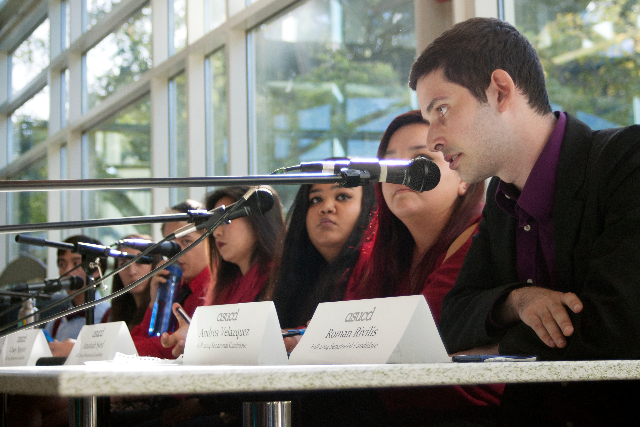
Roman_asucdsenate_fe_PasturelRoman Rivilis:

The decision to run for ASUCD Senate was easy to make for fourth-year political science and economics double major Roman Rivilis, given his four-year long involvement with the UC Davis student government association.

“ASUCD has been a definite part of my college experience,” said Rivilis, who has served as an intern for former ASUCD Senator Justin Goss and commissioner for the Internal Affairs Commission. “As an elected official, I want to be a resource to the rest of ASUCD with historical perspective with what has not worked in the past and what will be successful in the future.”

Rivilis’s platforms include starting a Greek Hunger Initiative to link the Greek community with the on-campus Pantry, establishing a peer advising program within the university Financial Aid office and creating a testing center for students with disabilities.

“I am running because I don’t feel the administration is being responsive to student concerns,” Rivilis said. “I want my term to be about reaching out to as many students as possible.”

Photos by Ciera Pasturel


Volunteers, artists, Davis residents support unique local museum

A little over a year ago, a man carried a 89-pound iron ball into the Hattie Weber Museum, located on C Street in Downtown Davis.

The iron ball had sat atop Davis’s first water tower, previously functioning as a lightning rod. The man’s father-in-law, who was moving to a rest home, told the volunteers at the museum that every Fourth of July, the Davis Fire Chief would crawl on top of the water tower, grab the iron ball and stand on his head to the general cheers of the masses below.

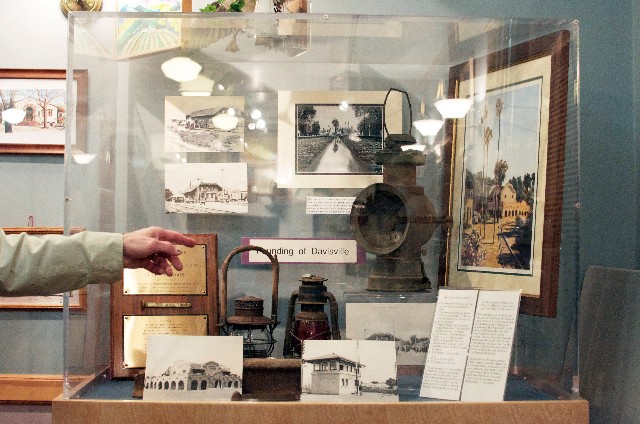
This iron ball is just one of many curious artifacts donated to the Hattie Weber Museum. Situated in the corner of Davis’ Central Park, the little building exhibits a wide range of objects that each hold a little piece of Davis’ history: a locked safe that not even an expert could open, a quilt made during the Civil War, a till from the 1920s that can ring up no more than $9.99 and creamers from when UC Davis first started out as a farm school.

“People come by and donate the strangest things. I think the top of the water tower is one of the most interesting things we have gotten,” said Dennis Dingemans, a retired UC Davis geology professor and volunteer director for the Hattie Weber Museum.

The museum is housed in the building of the old Yolo County Library and is named after Hattie Weber, the first paid librarian in Davis, then Davisville. When Weber started working in 1906, the library only had 200 books; when she retired in 1953, it had 23,144.

“The Webers owned a saloon in town, and Hattie was the youngest and most beautiful of the three Weber girls. She never married because nobody was good enough for her,” Dingemans said. “She was famous for being cranky in her old days. She was strict and she knew a lot.”

Other than housing a variety of historical artifacts, the Hattie Weber Museum also occasionally participates in the Davis ArtAbout, a monthly event dedicated to viewing local art galleries.

Merrily DuPree, a researcher and supporter of the museum, said they decided to partake in last Friday’s ArtAbout since they were featuring watercolors done by local artist Betty Berteaux. Five of Berteaux’s watercolors are featured in the museum’s permanent collection and many of her paintings are of local landscapes. One of her most recent projects was sketching of all the olive trees lining Russell Boulevard.

“What I thought was, ‘I should document these trees,’” Berteaux said. “So I started on the north end and I worked my way down.”

In total, Berteaux estimates she drew around 200 trees. The project lasted several days and the results were showcased in a few sketchbooks displayed in the museum. By now, Berteaux has gotten her technique down and recommends that the novice-olive-tree-artist begins with drawing an olive tree’s negative space.

Other than providing art for the museum, Berteaux has been a member of the Yolo County Historical Society since 1972. The Historical Society is also the organization that operates the museum, previously located on F Street. Her husband gave a helping hand in the design of the new and improved location, which volunteer DuPree says is one of the reason people are so drawn to the place.

“People come in here because they are interested in history, but they end up liking it too,” DuPree said. “I think it’s a really good place to get a vivid sense of Davis’ history. It’s a really welcoming place.”

As a researcher for the museum, DuPree looks further into interesting subjects by digging into archives and reading old newspapers. She is currently working on a project that involves the Schmeiser family, famous German pioneers in Davis during the early 1900s.

The most notable artifacts left over from the family were letters from the family’s daughter, Pauline Schmeiser, whose photo also hangs in the museum. Most of the letters were from a trip she took to Europe in 1903, all of which were addressed back to Yolo County.

DuPree transcribed many of the letters and hopes to publish a piece in an upcoming Yolo County Historical Society’s newsletter. For now she is also focusing on the museum’s current collection of quilts that are on display, ranging from the Civil War era to the 1950s, and helping out with community events like the ArtAbout.

The museum has approximately 3,000 visitors per year, most of whom come on Saturdays. While there are a few Davis families who are regular guests, most of the visitors are not Davis residents.

“The museum is rarely visited by college students, and if it is, it is mostly because their parents are in town and going to a museum seems like a good, cultural thing to do,” Dingemans said. “Most of the visitors are people from out of town — old students or people who are visiting relatives in Davis. We also have quite a few international visitors. Last year 35 countries from six different continents were represented.”

Dingemans explained that when long-time Davis residents visit the museum come for the first time, their most typical reaction is: “Why didn’t I come here earlier?”

Photo by Anisa Bashiri