57.2 F
Davis

Davis, California

Monday, December 22, 2025
Home Blog Page 836

Closed senate, no transparency

0

By The Editorial Board

 Within the past two weeks, ASUCD Senate has held two closed sessions that were not open to the public to discuss various issues on the UC Davis campus. As senate has previously only held less than five closed sessions since the start of Fall Quarter 2013, it is a surprise and concern that two have been held in the last two weeks.

The first closed session of this academic year was held Oct. 16 to allow senate time to discuss information regarding Intercollegiate Athletics (ICA). It was called in the middle of the senate meeting, which is regularly held on Thursday nights. The second closed session was the week after, on Oct. 23, to discuss the Whole Earth Festival (WEF). However, the details of the meeting are not clear to the public. Last year, about $20,000 was lost in the Whole Earth Festival budget.

While we understand that holding these sessions to discuss matters without interruptions could be more efficient and sometimes necessary in weighing personnel issues, the sudden spike in the frequency of these sessions speaks to the Association’s long way to go in improving transparency.

ASUCD Bylaws mandate that a notice of the closed session be issued which should include the specific type of matter that will be discussed, in addition to the title of any person involved in the session. Furthermore, all actionable votes and major decisions should be made public knowledge and must be reported in a way similar to that of routine meeting minutes (BL 2004). A mere one-word mention on a senate agenda is not sufficient and by no means can it be considered “specific”. Additionally, the major outcomes of these sessions are not reported online as regular meeting minutes occasionally are.

Thursday night meetings are the only times that ASUCD has open sessions with the public, which is why this time should not be used to hold closed sessions. It is imperative that students know what is happening on campus and within the student government, and holding closed meetings poses a threat to the transparency that ASUCD needs to maintain with the rest of the UC Davis community.


NOTE: This article was edited for accuracy on Oct. 31, 2014. The original editorial reported that $20,000 was taken out of the Whole Earth Festival budget. These funds were spent by the unit. It was also incorrectly reported that a closed session would be held Oct. 30. The Editorial Board expanded information on ASUCD Bylaws. The Aggie regrets these errors.

Guest Opinion: Policing Palestine on Campus

1

In September, the Anti-Defamation League (ADL) sent an email to Chancellor Linda P.B. Katehi. The ADL is an avowedly Zionist lobbying organization with a long history of attempting to silence criticism of the Israeli state, usually via specious claims of anti-Semitism. They have also spied on Arab American activists in the Bay Area. This particular letter, which we can assume from its contents was sent to other campuses, recommended the heightened monitoring of specific groups organizing on campus. These included American Muslims for Palestine, as well as anyone involved with calls for “Boycott, Divestment and Sanctions” in response to Israel’s state policies of occupation and apartheid in Palestine, and its ongoing blockade and siege of Gaza. Paying risible lip service to free speech, the letter further suggests strategies for policing these students. Its full text is available here.

One cannot be surprised when lobbyists lobby. We could easily imagine the John Birch Society sending a similar letter in 1961 suggesting that schools monitor and police members of the Student Nonviolent Coordinating Committee and anyone supporting the Civil Rights Movement in general. We would recognize this as unacceptable interference by off-campus interests. We would also recognize this as baldly racist.

Harder to imagine is what actually happened. Chancellor Katehi shared the ADL email with the Council of Deans and Vice-Provosts, as well as the “Emergency Manager” for the UC Davis Police Department, with no framing beyond “For your information.” This can only register as approval, not even tacit, of the ADL’s letter. After all, it cannot be that every such lobbying effort is passed along to the upper administration as relevant “information.” Such an action is chilling in every regard. This chill is only intensified when we recall the Chancellor’s record in directing the police toward students engaged in political advocacy.

This comes at a time when discussion of Israel’s occupation and wars, once foreclosed, is becoming more critical in U.S. academia. Various organizations have declared support for the academic boycott. A majority of UC student governments have now passed divestment resolutions, in a sequence resembling the anti-apartheid demands for South African divestment in the ’80s. It seems certain that all campuses will eventually register their principled refusal of complicity with Israel’s occupation.

Meanwhile, the rhetoric of “civility” has become the new discourse through which administrations seek to suppress political engagement. UC Berkeley’s Chancellor Nicholas Dirks went so far as to suggest recently that the standard of civility demands we choose “between free speech and political advocacy,” apparently neglecting that they are one and the same, and that free speech exists precisely to protect the possibility of political struggle.

While this is a broadly pernicious scheme, it seems clear enough at present that the leading target of civility crusades nationally is Palestinian solidarity activism. As scholars and workers on this campus we abhor such politically motivated threats, particularly when levied from outside lobbyists. The most notorious recent example is that of Palestinian American scholar Steven Salaita, who left his tenured job at Virginia Tech upon being hired by University of Illinois Urbana-Champaign, but was then “dehired” for the supposed incivility of his personal tweets, after extraordinary pressure from donors. The tweets concerned Israel-Palestine; Salaita has been a leading advocate of the academic boycott.

Professor Salaita will speak on Nov. 10 at 5:30 p.m. at the Student Community Center. The event is co-sponsored by the newly formed Faculty for Justice in Palestine. We are open to everyone engaged in teaching work on campus: full-time and part-time faculty as well as graduate student instructors and teaching assistants. We invite you to join us at the event, in the organization, and for a free Palestine.

Joshua Clover (Professor, English)

Sunaina Maira (Professor, Asian American Studies)

Faculty for Justice in Palestine


They can be reached through the Faculty for Justice in Palestine email: fjp.ucd@gmail.com.

(Re)Fashioning Gender: I’m a cat, duh

0

Written By CHELSEA SPILLER


It’s almost Halloween! You know what that means: It’s the one time of the year when you get to be anything or anyone you want. Unless you’re a girl. Then, according to most of the costumes available, you can be a sexy anything or anyone you want. Yay! I guess.

OK, I’ll be honest — I’m kind of conflicted. In my experience, Halloween costumes made for women are essentially just sexualized versions of men’s costumes. While I think it’s problematic to say that revealing Halloween costumes are a negative thing, because that could imply an urge to censor women’s bodies, I do know that it’s nearly impossible to find a woman’s costume that doesn’t have the word “sexy” in front of it. But with men’s costumes, the opposite is true. This double standard, in my opinion, is where the issue lies.

On one hand, it’s kind of fun and empowering to dress up and look, well, hot. Maybe that’s just my narcissism talking, but who cares? A little narcissism is fine in small doses, and besides, I think it’s awesome when girls wear what they want and feel good about themselves — I’m all for self-empowerment and high self-esteem.

It’s just that, why is dressing however you want (which, a lot of the time, can be deemed promiscuously) only “allowed” one day of the year? It’s kind of funny (can’t you hear me laughing?) that people who say Halloween costumes made for women aren’t sexist at all because “girls should be able to wear whatever they want!” are usually the same people who, on any other day of the year, shame women for dressing “inappropriately” or showing too much skin in public.

So, what? Girls are only allowed to be empowered and wear what they want one day of the year? No wonder so many of us are eager to dress like a “sexy” cop or a “hot” nurse or a “naughty” slice of watermelon (yes, this is an actual thing). It’s our one free pass to put whatever we want on our own bodies. How wonderful for us!

The other issue I have with costumes made for women is that, when you compare the costumes to their male counterparts, they become totally unrecognizable. Have you checked out this Tumblr? Do it. I’ll wait.

What’s best about this blog is their juxtaposition of costumes made for men and women. Let’s take, for example, Scooby Doo. For men, the costume looks like – you guessed it – Scooby Doo! But for women, the costume looks like…a leotard with a tail? Paw prints on your boobs? I’m so confused.

There’s a plethora of these comparisons: a bunch of grapes which, for guys, looks like a cluster of oversized balloons taped to a spandex onesie, but for women look like a few flimsy pieces of fabric painted purple and tied with a string. Or, one of my favorites, a SWAT costume that, for men, looks pretty realistic with a bulletproof vest, body armor, boots, gloves. The whole nine yards. But the SWAT costume made for women is a mini-skirt and a crop top which the model pairs with an equally practical pair of fishnets and stilettos.

Now, I’m not saying that these costumes are ridiculous because they need to be more realistic. I know that’s not necessarily what Halloween is about. But why are men’s costumes so realistic? Why do they actually look like the person or thing they are meant to be dressed up as, while women look like a sexually objectified version of them? That’s a bit of an issue if you ask me.

It’s just strange that men get to be a realistic version of something while women get to be the sexualized version of them. What does this say to and about women? That we don’t get to be real things unless we’re hot?

Someone pointed out to me that maybe we can be both, and that’s why women’s costumes are made the way they are; but I think the fact that virtually every single costume made for women is a sexy version of something implies that we must be both. We have to be sexy and powerful or intelligent or whatever our costume is supposed to represent.

That’s great and everything; I think that women can be all of those things at once — but it also puts a huge level of pressure on women to appear in a way that amplifies their sexuality. On Halloween (and, let’s be honest, any other day of the year) women have to be pretty and whatever they want. Men just get to be…whatever they want.

On that note, I think I’ll make my own costume this year.

If you’d like to smash some pumpkins, summon spirits from the dead or concoct a pot of witches brew, email CHELSEA SPILLER at ctspiller@ucdavis.edu.

Edumacation with Calvin and Hobbes: Big picture boy

0

Written By ELI FLESCH

flesch_op
Watterson, Bill. Homicidal Psycho Jungle Cat: A Calvin and Hobbes Collection. Kansas City: Andrews and McMeel, 1994. Print.

In today’s society, the value of a college education has greatly increased. Recent trends in the structure of the job market have created a greater need for highly skilled workers. Students seem well aware that how they perform in college will play into their future careers, and they treat it as such. They go to great lengths to build flawless resumes and treat college as a sort of pre-professional endeavor. While this seems a natural response to an ultra-competitive society, it remains to be a surprisingly short-sighted way of treating college.

One of the reasons I love Calvin is because he’s a big picture man. In the column above, he shows Ms. Wormwood that integers are but trifles in the grand scheme of things. Of course, his attitude is a little fatalistic — perhaps he’s too big picture. But that’s the joke.

His attitude does help put education into a larger perspective though. It almost goes without saying that students’ careers will change throughout their lives, and that they will either be disappointed or pleased with whatever station they finally arrive at. But with the increasing specialization of certain disciplines, our generation may find itself in a situation where the highest-paying jobs require extensive education in a narrow discipline. This could have the effect of limiting job opportunities for students graduating from college.

Higher education has long been the bastion of the middle class. But in the past, a person could still expect to earn a decent living without a college degree. In this way, college — the cost of college has risen faster than the rate of inflation.

So what happens when college becomes the new high school?

After reading Calvin and Hobbes, it seems apparent that Calvin comes from a middle class family in suburban America. His true interests are eclectic and fundamentally childish: He daydreams of outer space and travels back to the age of dinosaurs. One could imagine him being disillusioned at a collegiate level, forced to choose one area of expertise in order to make a living. But this has become the standard.

As the value of specializing in a field increases, the value of general education seems to decrease. Speaking in terms of the big picture, a general education is vital. Being able to draw connections across various disciplines helps when the job market changes, as it often does.

Given that the increase in demand for highly skilled workers has made college a standard, it is not hard to imagine a future in which people will need more than four years of higher education to keep in pace with the job market. Graduate school has long been the cornerstone for those wishing to enter academia, law, medicine and various licensed professions. But this does not seem practical for a person undesiring of a career like this.

A solution could be to increase the amount of time undergraduates spend in school, scaling yearly costs appropriately. What would make this different than simply stretching curriculum, would be the addition of various specialties — a sort of compromise between undergraduate and graduate education. This system would look similar to elementary schools that run through sixth grade instead of ending at fifth grade. It gives students an extra year to retain information they learned in elementary school; likewise, an extra year of undergraduate education would help students specialize appropriately for the job market.

Of course, one more year would put an extra burden on universities. The increase of students would certainly warrant the hiring of extra faculty and create other associated costs. Here, I see no other solution than to talk about the gross underfunding that all public schools in the United States experience. Funding should be given far more liberally, and, most importantly, be seen as a smart economic decision. Having a widely educated populace has long been the hallmark of a strong middle class. I’m sure Calvin’s folks would love having him out of the house (and not destroying it) for another year of college.

Education in the United States is unsustainable as it is. With our world rank slipping, and the need for highly skilled workers increasing, we find ourselves in a position that requires a boost in all fields. As much as Calvin fantasizes about his school being blown into the sky, we’ll just have to force him to pay attention to integers; they hold the fate of this country.

To share your big ideas with ELI FLESCH, you can reach him at ekflesch@ucdavis.edu or tweet him @eliflesch.

The Morgue hosts Halloween Spooktacular

0

Written By HANNAH KRAMER — arts@theaggie.org

Anyone who has opened their home as a venue to the multitude of bands passing through Davis knows that having neighbors who don’t mind noise is of paramount importance. It makes it easier if those neighbors are dead.

The Morgue, conveniently located across the street from the Davis Cemetery, is hosting a Halloween Spooktacular this Friday, featuring musical performances by Kaz Mirblouk, The Ostriches and Dust Collector.

Christopher Preston, Kaz Mirblouk’s drummer and a UC Santa Barbara graduate, describes the band as garage psych-surf.

“[The sound is] influenced by [music groups] like Ty Segall and Bass Drums of Death, as well as older artists like the Standells,” Preston said.

Matt Stalcup, a fourth-year technocultural studies and English double major and member of The Ostriches, describes his band’s “acid, psych-rock, freakout” style as a direct result of a mishmash of three very different musical tastes.

“We [have] all [traveled] pretty far in our own directions [in terms of our musical tastes], so [our group has] a large pool of influence,” Stalcup said. “I think that the ‘acid freak-out’ part of what we do is actually more of a confrontation of placid Vacaville monoculture than the direct influence of another band.”

Headliner Dust Collector hails from San Francisco and is billed as a union of cleverly mixed samples and experimental hip hop.

Noa Ver, a second-year transfer technocultural studies major and resident and booking agent of The Morgue, works to promote musical variety at shows, unlike traditional venues which focus on one specific style for its openers and headliners.

Ver sees house shows as an opportunity to bring different styles together for a more memorable listening experience.

“I think about style and complementation but I never make [the booked artists] homogenous — I want them [to complement one another] but not [be musically] the same,” Ver said. “There’s no easy segway, which is something that I’ve always really appreciated about going to house shows. You’ll have an evening where you’ll see four bands that are all very different but work together.”

For example, instead of booking three death metal acts for one evening, Ver will try to book punk and noise performances with one death metal set to mix up the sound.

“It’s not fair to assume that punk rock can only be paired with punk rock,” Ver said. “You can put psych next to it, metal — anything next to it. [Booking according to genre and sound is] purposefully not too strict.”

Musical variety isn’t the only reason to attend. The smaller space produces a different atmosphere than traditional shows.

“[Davis house shows] are really laid back and great places to hang out and hear local and touring bands,” Preston said. “The best part is the intimacy. The bands play right in front of you and usually hang out before and after the show.”

In the same way that the atmosphere and music is unlike any other, the venue itself and audience etiquette are modified at house shows. In addition to following the respecting the vicinity the show is in, audience members are encouraged to donate money to help fund talent.

“It’s weird to say, as a musician, that you should bring donations, but you should seriously bring donations,” Stalcup said. “No one is going to twist your arm or judge you, but $3 to $5 is typical. A lot of the bands that come to Davis are driving all the way from L.A., Olympia, Seattle — even Canada. It helps a lot if you are willing to support them [spread] music across the Pacific coast.”

As for the Spooktacular, the Morgue is living up to its namesake by going all out with decorations, costumes and wild performances.

“I never use the phrase ‘spooktacular’ unless I’m dead serious. This is a spooktacular Halloween extravaganza of the most chilling order,” Stalcup said. “We’ve been busy hexing the house for weeks to summon the right ghouls.”

Audience members are asked to dress for the occasion.

“You have to wear a costume if you want to come — don’t be a square in jeans and a Davis sweatshirt,” Ver said.

The Halloween Spooktacular begins on Oct. 31 at 8 p.m. The Morgue’s address is 1919 Wahl Way.  For more information, visit the Halloween Spooktacular’s Facebook event page.

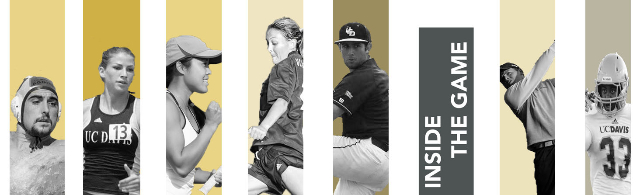
Inside the Game with Blair Lewis

0

Senior Blair Lewis has already been a part of three Big West Championships and carved out a good collegiate career for herself over the past three years. This summer, Lewis committed herself to finish out her time at UC Davis, and has been outstanding, finishing first of all Aggies at two of their four tournaments. As of Oct. 29, Lewis was ranked No. 135 individually in the country.

The California Aggie had the chance to sit down with Lewis and discuss how she got into golf, what spurred on her major improvement, and much more.

So let’s get started with how and when you got into golf:

I started playing in tournaments when I was seven. My Dad just took me out to the driving range when I was five. My uncle played professional baseball and he had an equipment contract and got a set of golf clubs, but he was obviously too busy to play so he gave my dad the clubs and he got into it, and then I just tagged along and haven’t stopped playing [since] then.

Why did you choose UC Davis?

I really wanted a school that had a good balance between academics and golf. UC Davis is a great school academically, but then the golf is also very competitive so it was a really good fit for me. And then, when I met Coach Walker and just met everyone on the team, I felt like it was the place for me.

And you played very well your first year; I know you were an honorable mention for All-Big West. What was the transition like to playing against tougher competition in college?

For golf, high school is not necessarily as important, it’s more about the tournaments you play outside of the high school scene. It’s different, obviously, because everyone in college is really good. I guess it was difficult for me being on my own and having to balance missing a ton of school and having to constantly be on the road. Also, just being on a true team and having that pressure like, ‘Oh, well I want to perform well, not just for myself, but for the team.’

So you guys (the team) played really well over your first three tournaments and then had a few more struggles in the last one, finishing 13 out of a 17-team field. What do you think that finish will do for your team as you head into the offseason getting ready for the next round?

It was a really tough round (the Stanford Invitational). I think we learned a lot and we have a lot to work on during the offseason. We just really have to stay dedicated and keep on doing what we are doing, really individually [working] on our games and just [being] prepared for spring.

You averaged 77.5 strokes per round last season and have had a huge jump to 74.1. What happened, and what did you do differently over this past offseason?

This past year I really just told myself to practice a lot harder and for longer hours and to have more efficient practices. I played three tournaments in a row, so that helped. I just really put my heart and soul into trying to get better, not just for myself but for the team. I think that this year I am just really team-oriented.

I made a goal of the stroke average I wanted, that I was going to average 73. I think the biggest thing that I decided to do was work on my short game. Everybody in college can hit the ball, but what really separates the good players from the OK players is short-game percentage. That is what has really helped me, is just focusing on my short game.

So then what are your goals for the team and for yourself this year?

For the spring, an individual goal of mine would be to win a college tournament. With the good work I have been putting in, it is definitely possible. For the team, we just really want to be in contention at regionals and just make it all of the way to the National Championship. We have been working really hard and that would just be a great end to the year to make it all of the way to nationals.

Best memory so far for the past four years?

Mike Robles, Assistant Athletic Director: Hole-in-one!

Lewis: Oh, yeah! Last year at regionals I had a hole-in-one in the first round, second to last hole. I needed that one. That was great and it was a pretty tough hole. And the pin was behind a dip, so I hit it and thought, ‘Oh, that is pretty good,’ and then it rolled past so I thought, ‘Oh, that is somewhere pretty close,’ but I didn’t see it. Then the people near the green said, ‘It went in!’ and I said, ‘Yes!’

What’s next for you after UC Davis?

Honestly I don’t have plans, I am just trying to [enjoy] college while it lasts. I can really only see myself playing golf, however it is very difficult to pursue golf after college. I’ll just have to see how I play in spring to feel it out. If all of a sudden I am playing lights out, then yeah, I’ll go for it.

Last question, do you have any athletic role models that you look up to?

I would say no, but I guess I admire Michelle Wie with the issues that she was having with her putting. She all of the sudden changed her putting stance to the Table Top putting stance, and everyone was kind of like, ‘What is she doing? She looks ridiculous,’ and having to deal with all of the hate she is getting. And just how she continued to believe in what she was doing and ended up winning the U.S. Open and really sticking to her plan.

Graphics by Sandra Bae

AggieAngelous

0

ThePoetry-ThePoets&ThePoetesses


The Poetry

“Equus”

By Nicole Washington

Your earthy smell fills the air,

And your darkly feathered fetlocks,

Move like the beat of the Native American,

As they drum to the earth and sky,

Their moans loud and crude,

Like the treble and bass that comes from deep within your throat.

Sturdy hooves strike the earth,

Swift like lightning from the bulky thunderhead,

All bone and hardened tissues.

The rhythm of your heart can be felt as it floats beneath your well defined chest.

As one can hear the buzz of the bee,

Or the soft sounds of the bird in the fresh morning air.

The impulsion of muscle,

And forward contact with the slim skeleton.

Floating effortlessly on joints made of delicate cartilage,

You have no boundaries in your free mind.

From the curve of your hardy spine,

You carry a thousand pounds on four slender legs,

A game of balance,

Where one slight slip of the brain can throw everything off to one side,

Or the other.

But you hold yourself with dignity,

This keeps your weight from crashing down on the world.

Gracefully, you take flight,

All spectacular gestures and luscious golden honey browns,

With flowing locks of thickly textured mane,

Spewing from atop your finely crested neck.

Soft skin stretches over dilated red and blue vessels,

Churning blood like cake batter.

Sinewy, solid muscles are blanketed by hairs finer than Chinese silk.

With nimble and strong lips,

You pluck what you want from the rich soil,

And as your rounded teeth crunch heavily on your prize,

You remain attentive to the smell of the wild cat,

Or steely wolf,

With its long, pointed teeth,

And eyes made of rounded charcoal.

The world around you is reflected through wide, rectangular pupils.

With the effortless connection of your large head,

To the bulge of your finely arched neck,

The curve of your cheek gives way to flaring nostrils.

Blind, though you are,

In front and from behind,

Your coned shaped ears,

Tufted with winter growth,

Flicker back and forth,

Listening, and waiting patiently,

For the sounds of lightning to strike again.


ThePoets&ThePoetesses

aggieangelou_arMy name is Nicole Washington and I am a transfer student from Folsom Lake Community College. I recently transferred to Davis this summer and so far I am truly enjoying UC Davis. I have two Associate of Art degrees and I am pursuing a bachelor’s in English so that I can go on to become a journalist. Poetry has been a part of my life for a long time. I also enjoy riding horses, reading and photography.


Be Featured in AggieAngelous

Send your poetry to aggieangelous@gmail.com with your name, major, year and a short, one-to-two paragraph description about yourself. Feel free to include your interests and/or hobbies, or maybe even your favorite quote!


News in brief: Design project to combat water privatization

0

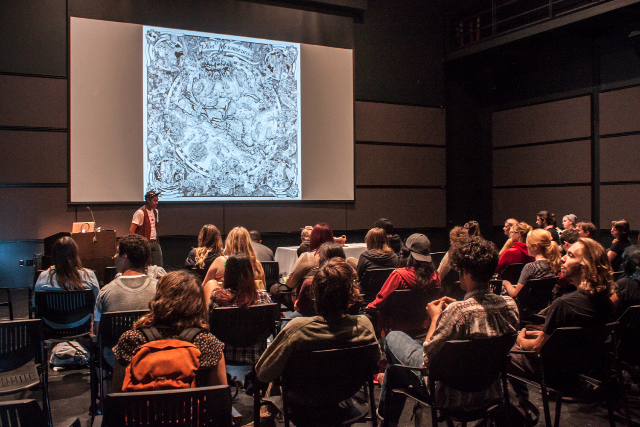
This Friday, a nonprofit activist group known as The Beehive Collective will be stopping in Davis to present their “Sucked Dry: Examining Drought and Privatization from Mesoamérica to California” tour.

“Sucked Dry” is an educational storytelling tour that uses design displays to promote water restoration efforts and demote monopoly on water resources by big businesses across the country. Beehive Collective has partnered with the organizations Restore the Delta and No on Prop. 1 in order to localize and authenticate their cause in northern California.

According to Ryan Camero, one of the Beehive Collective members, the activists use intricately layered fabric murals that depict social and environmental issues in different regions across the nation.

“We are drawing the connections between crises in Central America to what is going on currently in California — the claiming of limited water resources by corporate interests in what is historically the most severe drought our state has ever faced,” Camero wrote in an email.

The “Sucked Dry” tour will feature the group’s latest mural, called Mesoamérica Resiste! The mural depicts resistance to resource extraction in southern Mexico and Central America. With the help of 22 members – 13 of which were illustrators – the project took nine years to complete, and Camero said he believes this effort reflects the resilience of the activists.

According to the Beehive Collective website, the “stories in the [Mesoamérica Resiste!] graphic come from current struggles, but are also rooted in the legacies of over 500 years of colonialism in the Americas … We are in an era of extreme loss of cultural and ecological diversity and rapid climate change.”

The art on the mural is meant to symbolize a link between the struggles of past indigenous people against the colonial pursuit [and privatization] of natural North American resources and the privatization of water resources through the theoretical passing of bills like Prop. 1.

Shoshanna Howard, a campaigner for No on Prop. 1, said that she is passionate about protecting water from being privatized and is looking forward to the message being conveyed through art.

“Privatizing our water is basically giving our small amount of natural resources to big special interests businesses,” Howard said. “Beehive Collective looking at how water is becoming a commodity and less of a free and necessary resource for our lives.”

Howard said she hopes the “Sucked Dry” tour can relay the sentiment that water should be a free natural resource through its artist endeavors. Camero said he believes the design aspect of the tour will help to simplify and convey these sentiments.

“Design is a major component of making these graphic campaigns into reality by [creating] visual metaphors; breaking down complex political dynamics through images and connecting culture and ecology is vital.” Camero said.

“Sucked Dry” will take place at Woodstocks on 219 G St. The event is free for all and will start at 1 p.m.

Photo by Jose Javier Padilla Reyes

Tunespoon: Like unwanted milk

0

On Sept. 9, 2014, the global rock icons of U2 changed the rock world forever. It was during Apple’s annual keynote presentation, which most people were watching for the iPhone 6 reveal. Luckily, everyone got a little something extra; U2’s brand new album released not on the iTunes store, but straight to every iTunes customer’s library. “Now that’s instant gratification!” U2 frontman Bono laughed, shaking Apple CEO Tim Cook’s left hand. Songs of Innocence is a revolutionary album release, the most groundbreaking music-to-person event in history. News outlets went wild; one overly excited headline read, “Did U2 just out-Beyoncé Beyoncé?” referring to her highly surprising, highly successful iTunes Store album launch.

The answer is a firm, definite “No.”

I have nothing against U2, and I also have nothing for them. They’re one of the most successful (and wealthy) bands of all time, and even if you don’t listen to them you probably know who they are (though their relevance is starting to dwindle in Generation Y). Their brand of inoffensive stadium-ready rock feels impersonal and quickly wears thin for my taste. I have no emotional connection to their work, so anticipation for new music was nonexistent.

The problem with launching an album in the manner U2/Apple did is that they assumed one-and-a-half billion iTunes libraries giddily anticipated U2’s new album, and would happily receive it for free, and be grateful for it. “The album,” Bono proudly proclaimed at launch, “is a gift [from Apple] to all of their music customers.” His train of thought is highly egotistical. It’s also pointless in this musical age to “gift” music for free. If someone wants music for free, they’ll find it on Spotify, they’ll stream it from BandCamp, they’ll play a record uploaded to YouTube, they’ll (gasp) pirate it from torrent-hosting sites. If you cannot (or refuse to) pay for music, nothing will stop you from getting it. Free music is hardly a revolution. The album’s release is, however, a revolutionary violation of consumer consent. The album infiltrated countless libraries. U2’s perception of a “gift” is irrelevant; if Davis Waste Removal hurled garbage at Aggie Pack as a promotion, that would be far from OK, even if the trash is a sincere gift. U2 fans were ecstatic to receive the gift, while many were enraged at their violation of consent. I was confused, and eager to find the proper place to throw this trash away.

But violation of privacy is not where the harm lies. It’s easy to decide not to listen to an album, and Apple released tech support that allows people to delete the digital record. But this album is far from a gift. U2 gave this album out for free not out of the kindness of their hearts, but out of a $100 million between them, Apple and Universal Music Group — along with a deal with retail stores to sell physical copies of a deluxe version, according to an article written in Spin magazine. They were paid handsomely for a “free” album release, unlike many musicians who have no choice but to start out their careers putting up their music for free on the internet.

Bono explained that the album’s unusual release was motivated by “a deep fear that [the] songs that [they] poured [their] life into over the last few years mightn’t be heard.” Right. Because artists everywhere aren’t pouring their whole hearts and souls into meaningful, personal sounds, released for free or a few dollars they work their asses off for, that will be forever eclipsed by bands who are paid millions of dollars to give out their music for “free,” out of, you know, generosity.

Later, Bono apologized. “It’s like we put a bottle of milk in people’s fridge that they weren’t asking for.” Lots of people are lactose-intolerant, U2.

Contacting STEVEN ILAGAN at smilagan@ucdavis.edu is free (on behalf of a multi-thousand dollar deal between him, his parents and UC Davis)!


New app “Yik Yak” hits UC Davis

0

Whether keeping students up-to-date on the latest local happenings or simply serving as a source of entertainment during lecture, there has been plenty of chitchat about new smartphone application “Yik Yak” over the past few weeks at UC Davis.

“In general, our biggest communities are college kids,” said Cam Mullen, YikYak lead community developer. “[College students] can use it to connect with the people around them immediately, and that’s a core feature.”

The Yik Yak app requires no sign-up, and upon opening, shows a hundred of the most recent anonymous posts within a two-mile radius of the user’s location. The app has grown in popularity since its launch in November 2013, and is now active at over 1,000 college campuses across the country.

“Yik Yak has two parts. The first one is location based, which is different [from] any of these sites that want you to friend people,” Mullen said. “The other thing is how you keep your privacy — it’s anonymous and that lets you have discussions about things that you otherwise wouldn’t on other platforms. On Yik Yak, you’re not judged by who you are, you’re judged by content and content alone.”

Soon after its launch, Yik Yak personnel made the decision to block all middle and high schools from using the app, as they believe younger users are often not deemed “psychologically mature” enough. Mullen said this rule was created after the infamous app “Ask.fm,” experienced many unfortunate occurrences, including suicides.

On college campuses, the app serves not only as a source of amusement, but also is used to get the latest news on events and happenings around campus.

“At one school in the south there was an armed robbery and people were immediately posting on Yik Yak to find out what happened and where it was, so they could respond accordingly,” Mullen said. “Also, after a big football game or a big win, you’ll see the feed is flooded with comments and humor about it — it’s a really entertaining source.”

From September to December 2014, a Yik Yak team is on a 36-college campus tour to promote the app. On Oct. 7, the Yak made a stop at UC Davis for the day, taking pictures with students and handing out free items near the Memorial Union.

“I think probably the most exciting part of it is just how much we’re growing and how much people love it,” Mullen said. “We’re sending this 45-foot Yik Yak bus down the west coast – the Yak is on tour and it’s like he’s a celebrity when he comes to campus, he’s like a rock star.”

A growing number of students at Davis have begun to use the app. Many students have said they prefer the anonymous aspect of it, as it is not a feature of other apps like Twitter and Facebook.

“My roommate was on it before we’d go to bed, and she would read such funny stuff that I’d crack up, so I just downloaded the app,” said first-year environmental science major Morgan Hashimoto. “[The best part is] definitely the [anonymity], and you don’t follow anyone. It’s so funny sometimes because there are so many things that are relatable since it’s mostly UC Davis students.”

Second-year international relations and psychology double major Riley Sims heard about the app a only couple weeks ago, and is a big fan of the anonymous features.

“One thing I really like about it is because it’s anonymous, the amount of popularity it gets is based solely on what you put on there — it has nothing to do with how popular you are in real life,” Sims said. “All they know is what you said and they can take that for what it is and like it or not. So it’s a way for normal people to gain popularity based on what they’re saying.”

Although unclear thus far as to whether Yik Yak will gain as much popularity as Twitter or Facebook, it has definitely solidified its roots in college-age areas.

“It’s cool because the quiet kid at the back of the class might be the funniest kid in school. Yet they might be a little too shy to post on Facebook or speak up,” Mullen said. “On Yik Yak you connect with that community in a whole new way and you’re able to talk to them and see what they think. We’re stoked that it’s grown so fast, and that UC Davis has popped off so quickly especially in the past couple weeks.”


Artists install public, interactive art throughout Davis

0

hXZiLHgd81H9mvOmm5FEYXHomnI36U5VXQW3TkVlruw
5SxmykzSZ2sFZ4ad6lT8MKV3hGTomw9ugVz6Mf3pHqY,9CZ8M5hp69W8wsKacBN9_bMTaPddeOPUjkBV7Q9B2MI

As Bill Maul painted Godzilla’s torso, standing on a ladder at the top of an outdoor stairwell leading to the roof of the F Street parking structure in downtown Davis, Alex Reisfar outlined the carnivorous pursuits of another less fictional dinosaur on the adjacent wall.

The collaboration, mixing the separate influences of two artists from different parts of the country, brought together two different styles of art sharing a theme to a public space.

The F Street garage, dubbed the “Art Garage” by its creators, is the latest experiment undertaken by art gallery owner John Natsoulas to paint the walls of Davis. Maul is the leader of the Davis mural team, which includes Resifar, from Portland, Ore.; Monto Kumagai, who documents most of the works and several other local artists.

The Art Garage is an expansion of the Transmedia Art Walk, which links together most of the publicly available art on the UC Davis campus and in the streets of downtown Davis, most of the latter being interactive.

“If you think of public art, it’s different than art that’s in a gallery,” Kumagai said. “If you ask people walking by, many people have ideas about art, and many of them think it’s very exclusive, [and have ideas of how] it should be or [that] it’s always been in museums.”

Using a smartphone, one can scan an RFID chip integrated into the sculpture or mural to see interviews with the artist and watch videos of the art’s installation. People can also leave comments which are linked to the artwork through social media.

“Because it’s public, it’s almost like saying we want your opinion about it. It doesn’t have to be positive, it can be negative, [or it can answer] ‘what do you think of this?’ In this way it’s a donation from the artists,” Kumagai said. “As people leave comments, that’s engagement, that’s participation. Because of the way social networks go, we can share that. So, as they engage, it becomes a story that can be shared locally and also globally, and that’s what makes a big difference. Then people can view this art in other parts of the country and the world. Then they start asking [why their city isn’t] putting in interactive art.”

Natsoulas and Kumagai have collaborated for years to develop an art scene that is unique to Davis. They claim it is the first transmedia art walk in the country, and Kumagai hopes that it can expand throughout the world, even as he attempts to keep up with the rapid local expansion.

He recorded the progress of the new dinosaur paintings by Maul and Reisfar, which are located on the southeast corner at the top floor of the garage above Regal Cinemas 6, across the street from the Natsoulas Gallery.

Natsoulas acquired the garage as a canvas for the community after much convincing.

“They were going to give a contractor $15,000 to prime the stairwell,” Natsoulas said. “The city and the theater didn’t have any money to give us to do any of the work, so we did the murals with the money for the paint to paint the stairwell.”

What followed was a mobilization of local artists to paint the stairwell and entryway of the garage. Natsoulas enlisted the help of Chris Wisnia, a local comic artist.

“Within the last year, [Natsoulas] contacted me and said, ‘We’ve got this garage now and I’ve been given free reign to do whatever I want artistically with it, so we’re putting up a giant mural that’s going to show kind of a history of all the arts in town and portray all the artists who’ve been in town and what they’ve done,’” Wisnia said. “…The stairwell [Natsoulas] was picturing [is] kind of like a time vortex that’s walking you through this history of the arts in Davis.”

The artists emphasized that each individual’s style contributed to the larger idea which sparked the garage’s murals.

“[Natsoulas] considers it a collaboration because he had this idea and said, ‘How would you handle this?’” Wisnia said. “I did that, and the muralists interpreted … how to fit it into that tiny space, but I feel like my [style] is in that. You can see it there.”

Wisnia had previously completed a drawing which depicted multiple sculptures in Davis as characters in a comic book within his favorite horror subgenre, giant monsters. Natsoulas purchased the drawing at an auction.

“I had the feeling that he appreciated that I put all that art into the piece and it reminded him how hard he’s worked to kind of change the town and make it something where there’s all this art around,” Wisnia said.

The recent movement of filling Davis with art began with the installation of sculptures throughout the city.

“[Natsoulas] was able to convince the artists to lend the sculptures. They weren’t purchased, and they were put on private property, so it really reduced the amount of red tape to get them installed,” Kumagai said. “We were trying to see whether or not, with a handful of sculptures, we could get some interest and public support, and eventually city support.”

Because several of the sculptures were loaned, they are not necessarily here to stay. Two out of the three sculptures featured in Wisnia’s drawing are no longer on display in Davis, including Finley Fryer’s “Stan the Submerging Man,” which previously towered over the Natsoulas Gallery last year.

“Because it’s gone, people have memories, and they talk about it. How big it was,” Kumagai said. “It might not be accurate, but it still makes it into a story.”

Ultimately, the sculptures generated a small portion of the buzz around public art. Maul said that people really began to notice when the murals started.

“I think it really turned around when the mural team organized and started, because that was much faster than putting in sculptures,” Kumagai said.

Maul painted the first mural by the Davis mural team in May 2012. Eleven more murals were painted that summer in spite of a complete cut to public art spending in the city budget.

“[Natsoulas] tried for years to get approval through the city to do things like this and didn’t get anywhere,” Maul said. “Then a couple years ago [in] 2011, they totally cut out any funding for public art.”

Natsoulas mentioned that most of the public art projects have been completed with very little money. Overall, Natsoulas said the value of the art amounts to a couple million dollars, without any cost to the city or university. Most of the project cost comes from supplies.

Although Maul commented that the physical scale of each mural (compared to the artists’ studio work) meant they should be worth tens of thousands of dollars, he conceded that they are a way to get the artists’ names out to the public.

“That’s kind of how we saw that first year doing our murals,” Maul said. “It was like putting up our resume for everyone. So if you want a mural, now you know who we are and what we can do.”

Natsoulas intends to continue the story of public art in Davis with the Art Garage. In March 2014, he invited the community to help with the largest mural in the garage. The event brought together over 200 contributors of all ages, skill levels and styles, an effort which won a Grassroots Initiative Award of Merit from the American Planning Association of California.

“It’s really interesting because there’s all this talent in this town, and the town is itching to do something, and nobody’s doing anything,” Natsoulas said. “So when we do a mural, and they all show up and want to help, it’s a really rewarding thing.”

The mural displays the history of art and culture in Davis, beginning in 1952, with Richard Nelson, to the present.

“It’s really a heritage thing that we’re trying to carry on. That’s what part of that community mural is about. There’s a long history of art and artists in Davis,” Maul said.

From that starting point, individual artists and muralists have added their own work to the walls of the garage. Wisnia has his own wall on the second floor, where he painted a giant monster, labeled the “bridge troll of the Davis overpass,” called “Bungoo.”

Natsoulas said it may take five years to complete the art garage fully, but he has plans to fill the entire structure. One of the artists’ hopes to attract other artists, professionals or amateurs who contribute to the Davis public art scene, as well as garner more support for public art.

“If you say that they can interact as part of the community, then I think they’re going to be more apt to protect it and support it,” Kumagai said. “You’re not just a passerby, but you’re part of this artistic experiment. Then maybe you might look at some of these things and get inspired, and then create something that fits into this network.”

 Photos by Amelia Evard. 

Davis Police Department Mine-Resistant Ambush Protected Vehicle voted to get sent back to U.S. government

0

On Oct. 21 the Davis City Council voted to send the Mine-Resistant Ambush Protected (MRAP) Vehicle that the Davis Police Department (DPD) acquired from military surplus back to the U.S. government. They also amended the city’s policy on acquiring military surplus equipment in the future. The two-part vote totaled 3-2 and 5-0, respectively.

According to the DPD, the city has been participating in a program for the last 20 years in which military surplus equipment is turned over to city jurisdictions. Approximately five years ago the DPD proposed that they participate in the newest of these programs, titled the Department of Defense Excess Property Program (1033 Program), and they were approved.

It was through this program that the DPD acquired the new MRAP. According to Lieutenant Thomas Waltz of the DPD, the MRAP was to replace an old one that the DPD had acquired many years before.

Councilmember Robb Davis initiated the discussion of the fate of the MRAP at the end of August, proposing the two-part vote for sending the MRAP back to the U.S. government and also requiring any acquisition of military equipment to be approved by City Council moving forward.

“Bringing in a military vehicle, given the association of that vehicle with the destructive force of the military, was really risking eroding a lot of the trust that had been developed [between the DPD and citizens of Davis],” Davis said.

Furthermore, Davis said he felt that the vehicle was not well adapted for the uses that the DPD would use it for.

Waltz said that the department would use the vehicle in the situation of a small arms fire, an evacuation, rescues in which armored protection was required or in the case of a natural disaster.

In recent weeks an MRAP was used by police during a shooting in Placer County and in the city of Roseville. It was used most recently in the city of Davis several weeks ago to serve several search warrants.

In the event that the DPD needs to use a MRAP, they would now have to borrow one from the West Sacramento Police Department. This means that in the event of an emergency the DPD would have to wait to use the vehicle for up to three hours until it could get approval for use.

Although Waltz said he feels the DPD could use a piece of equipment such as the MRAP, his priority is to maintain the DPD’s positive relationship with the city of Davis.

“We police the community and the community will let us know how they want to be policed through the community leaders. We work for them,” Waltz said.

In the upcoming months, the DPD will be holding forums with community members. The goal of the forums is to foster positive relationships within the community by creating an open dialogue about what the police feel they need to do to keep the community safe and what the community feels is appropriate.

Matthew Carmichael, the UC Davis Police Department (UCDPD) Chief, said that he believes the MRAP to be an important safety tool and that he is sorry to see it sent back.

Carmichael said that a piece of equipment like a MRAP could be critical in an incident like a school shooting. Waiting for the equipment to come from West Sacramento may not be good enough.

“Safety is about timeliness; the closer the better,” Carmichael said.

However, he said he believes that creating a safe environment is a collaborative process of the police and the community and that both bodies must work together for the best result.

Although both the DPD and the UCDPD have expressed a need for an armored vehicle like the MRAP, the community consensus is that the MRAP doesn’t belong here.

“Davis is an extremely safe community, and having something as powerful as an MRAP is excessive in my opinion,” Kelsey Hutcherson, a fourth-year international agricultural development major said.

“I understand that it is intended to keep the peace, however I can’t help but think about the danger an over-militarized police force could have on the community.”

UC Davis Police Accountability Board holds first public session of the year

0

The recently-formed UC Davis Police Accountability Board (PAB) held its Fall Quarterly Meeting on Oct. 22 at the Student Community Center. The PAB was formed in May 2014 to strengthen the relationship between the campus community and UC Davis Police Department (UCDPD). The board handles complaints made against UC Davis police officers and is responsible for making policy recommendations to the chief of police.

ASUCD representative Ben Marchman opened the public meeting shortly after 7 p.m. After introducing board members and alternates, Marchman proceeded to update the public on the board’s activities since summer. Two major themes the PAB highlighted were accountability and building community trust.

“Having these public meetings is one way to build trust with the community and bring you guys into the process,” Marchman said. “I think that’s really important, and over summer we’ve been doing that. It’s been a great process where we’ve learned a lot of things from other boards that have been doing this for a long time.”

In addition, the PAB sent alternate Abram Jones, representing the Graduate Student Association, to the National Association for Civilian Oversight of Law Enforcement (NACOLE). At the annual convention, Jones connected with other police accountability boards to provide insight from a higher education perspective, as well as receive input to make improvements. A key point the PAB took away from NACOLE was establishing a more formalized relationship with the UCDPD.

“We are an independent body that serves the community, but we also work with the police department,” Marchman said. “That doesn’t mean friendship with the police department, but equal working partners.”

Another improvement the board is pushing for is enhancing its language program for students concerned about reporting a complaint in a language they are uncomfortable speaking.

Later, UC Davis Police Chief Matthew Carmichael updated the public on the department’s recent activities. The student escort service, Safe Rides, is now wheelchair equipped and has increased its support to three vans. Its newly extended hours will provide students transportation during the hours Unitrans stops running, from campus to anywhere within the city of Davis. Online police reporting is now available, and the number of Aggie Host student patrol officers has increased for more campus coverage.

“We’ve re-diverted funding from vacant officer positions to increase security profile, after conducting comprehensive staff assessment to determine needs on campus,” Carmichael said.

Chief Carmichael also mentioned that the department is currently in good balance, with 48 police officers and 130 student officers.

Before opening up discussion to the public, Marchman addressed expectations of the public forum, informing attendees that the board may not immediately have all the answers.

“It’d be very unfair and completely reckless of me to speak on behalf of the board, especially if the board hasn’t come to a consensus on it,” Marchman said. “We want to know what you have to say, we want to hear your suggestions… but we have to go about it in a responsible and accurate way.”

Public discussion opened at 7:19 p.m. with the first comment from Theodore Mitchell, a second-year clinical nutrition major minoring in neuroscience.

“Recently in the [Sacramento News and Review], it said that UC Davis has one of the highest reporting of rapes in the college system,” Mitchell said. “Is that because of an increase in the number of reports, or are we actually having more incidents on campus?”

The board was unable to provide an answer and Marchman advised Mitchell to speak with the police department regarding the issue. Harley Litzelman, external director of ASUCD Lobby Corps responded from the public by shedding the boost in campus sexual assault reports in a positive light.

“Universities have done such a scandalously bad job of sexual assault reporting and consent education historically, that any increase in reporting indicates an improvement in the culture of reporting, rather than an actual change in the rape culture at the university,” Litzelman said.

Fifth-year African American studies and sociology major Brittany Jenkins made the next comment, regarding broken trust between the non-white community members and the UC Davis police officers.

“What would be your role in communicating concerns with people of color and communities that have distrust between the police department, and those who feel targeted or profiled?” Jenkins asked. “If we want to complain about an officer, what does that process look like and how do we build that trust back up?”

Although the PAB wished to withhold any statements directly addressing Jenkins’ question, Marchman agreed to discuss at least the process surrounding reporting. He advised those fearful of reporting in person to utilize PAB’s other resources such as online complaint submissions at pab.ucdavis.edu. He said that the Office of Compliance then investigates these reports and passes it along to PAB to further deliberate and make policy recommendations.

PAB member Tamara Cole, representing the UC Davis Health System, stated that anonymous submissions were one way to protect the identities of students and those filing complaints.

“To address your comment about trust, which is probably one of the reasons why this board was instituted in the first place, is to improve the transparency of what’s going on with police practices on campus,” Cole said. “The best way you can help us is to tell us what’s going on.”

Litzelman made the meeting’s final public comment, asking the board about its knowings and policies surrounding UC police’s receipt of military grade material. The board claimed to have no prior knowledge regarding any supplies or equipment the police department receives. However, Chief Carmichael elaborated on the issue of not having a policy.

“There’s policy as to what we can receive, how long we have to keep it and how we dispose of it, but there’s no policy that says we have to be trained on it, that we should consult with our community about the nature of the equipment and what it’s intended use is,” Carmichael said. “So we should work together to formulate a policy that talks about the 1033 DRM program, that will help us drive as a community.”

The meeting adjourned at 7:38 p.m.

The next public forum will be held at the UC Davis Medical Center on Jan. 28, 2015.

President Bill Clinton headlines rally at UC Davis

0

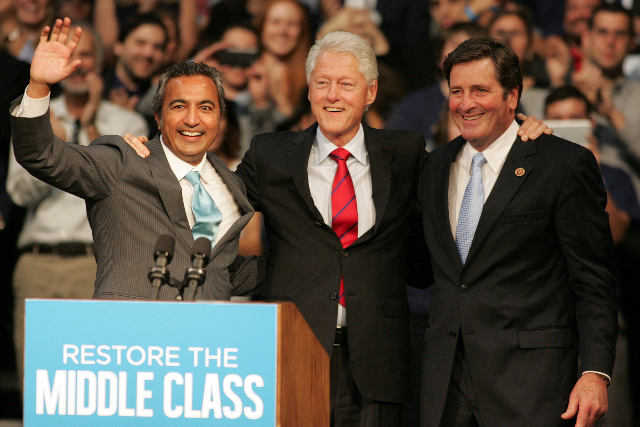
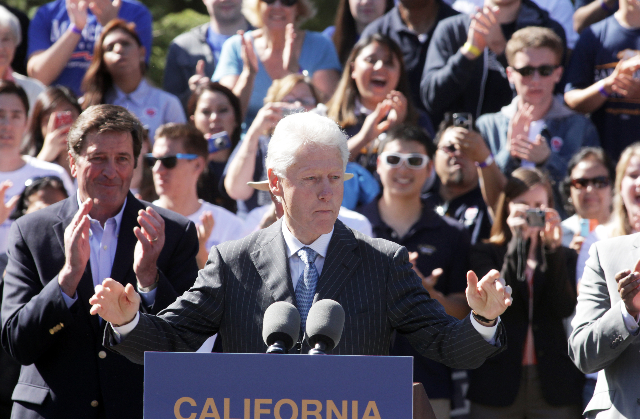
Bill Clinton, the 42nd President of the United States, spoke to UC Davis students and community members Wednesday morning at UC Davis’ ARC Pavilion, headlining a “Get Out the Vote” rally with representatives John Garamendi (CA-03) and Ami Bera (CA-07) in advance of the Nov. 4 election.

More than 4,500 people flocked to The Pavilion to see President Clinton, with lines stretching around the structure by 11 a.m., over an hour before doors opened. Tickets for the event were made available to the first-arriving students, who were able to stand in front of the speakers.

Clinton has appeared at UC Davis three times since 2002, most recently in 2012, when he helped campaign for Democratic congressional candidates Bera, Garamendi, Jerry McNerney and Jose Hernandez.

“I love this campus. I love California. I came here 29 times in my first term,” Clinton opened his speech today. “I think it’s important that all of you know why you should vote. This is America’s future. You’ve got diversity, intelligence, energy and youth.”

Before the rally, Bera spoke to media and acknowledged the importance of having President Clinton’s support in this race.

“[Clinton] reminds us of a time when we had a budget surplus, when people had optimism that if they worked hard enough they would move forward,” he said.

Clinton spoke of the importance of raising the minimum wage, closing the gender wage gap and funding public education systems. He was particularly adamant about the importance of raising the minimum wage, citing that Republicans have continued to veto legislation that would do as such.

“They’re wrong — we are right about this,” he said of raising minimum wage.

President of Davis College Democrats James Cheap began the rally at 1:30 p.m. by urging students to vote.

In addition to Cheap, Clinton, Garamendi and Bera, speakers included Axana Paola-Rodriguez, a UC Davis student and program director for the UC Davis Medical Professions Conference; Matthew Paranial, vice president of the UC Davis Student Veteran Organization; Betty Yee, current member of the California Board of Education and candidate for California State controller; Tom Torlakson, the state superintendent of Public Instruction; and Alex Padilla, current state senator and candidate for California Secretary of State.

Students invested in and indifferent to the upcoming election alike made a point to attend the rally.

“For me, I’m just curious to see an ex-president,” said Raul Girardello, an international graduate student from Brazil studying horticulture and agronomy. “I know he plays basketball [and] saxophone, and about Monica Lewinsky.”

Sarah Dyer, a fourth-year human development major, came to the event with her older sister and thought that Clinton’s appearance was important in increasing UC Davis’ national exposure.

“Some people aren’t aware of UC Davis, even though it’s a big school,”  Dyer said. “[This] gives it some political presence.”

During his speech, the former president expounded on the Clinton Family Foundation and its current work in Africa helping to treat areas and people affected by the Ebola crisis.

“The only thing that matters when you finish is if people are better off than when you started,” Clinton said.

Garamendi, in his discussion with media, stressed the importance of having President Clinton as a campaign and party resource.

“For everyone on the Democratic ticket, [Clinton] is our leader,” Garamendi said. “And [President of the United States Barack] Obama isn’t here in California, Clinton is, so we’re delighted. Absolutely delighted.”


Photos by Kenny Cunningham

President Bill Clinton to speak at UC Davis tomorrow

0

Bill Clinton, the 42nd President of the United States, will be at UC Davis tomorrow, Wednesday, Oct. 29, headlining a “Get Out The Vote” Rally for Congressmen Ami Bera (CA-07) and John Garamendi (CA-03). The event will take place at the ARC Pavilion at 12:30 p.m., and all three will speak, along with UC Davis student leaders.

Clinton has spoken at UC Davis twice in the last six years — he appeared in 2008 to campaign for his wife, former New York Senator and U.S. Secretary of State Hillary Rodham Clinton, during her run for the Democratic presidential nomination and again in 2012 to endorse congressional candidates Bera, Garamendi, Jerry McNerney and Jose Hernandez. He also spoke at the Mondavi Center in 2002.

The California Democratic Party is organizing the event to encourage students to vote, and Davis College Democrats has created a Facebook page to publicize the rally and encourage students to show up early in order to get a seat in Pavilion, which holds upward of 8,000 people.

Follow The California Aggie on Twitter (@CaliforniaAggie) and Facebook for ongoing coverage of the event.

Scott Dresser can be reached at campus@theaggie.org and will be live-tweeting the event at @scottzaballsoup.