57.9 F
Davis

Davis, California

Monday, December 22, 2025
Home Blog Page 839

No. 6 Montana Grizzlies roar past UC Davis

0

football_sp


The UC Davis Aggies (1-6 overall, 0-4 Big West) fell to the No. 6 Montana Grizzlies (5-2, 3-0) 42-28 despite a valiant effort by the Aggie offense in Missoula, Mont.

Sophomore quarterback Ben Scott was under center for the second straight week and threw for 257 yards and four touchdowns, while completing 20 of 37 attempted passes. Scott connected with junior wide receiver Ramon Vargas eight times for 129 yards and two touchdowns.

The Grizzlies were led by Jordan Canada, who rushed for three touchdowns with 152 yards, and Jamaal Jones, who scored a touchdown and earned 146 yards in five receptions.

Senior running back Gabe Manzanares led the running game for the Aggies as he ran for 110 yards in 10 carries. Manzanares also caught three passes for a total of 24 reception yards; one of which resulted in an eight-yard touchdown.

The Aggies and the Grizzlies ended the first half with a 14-14 tie.  However, the Grizzlies scored two unanswered touchdowns in the third quarter. With a 14-point deficit, the Aggies were able to cut the lead to seven after Scott passed an 11-yard touchdown to senior running back Dalton Turay.

Montana responded with a two-play drive, which ended in a 24-yard touchdown run from Canada. But UC Davis would not go away quietly. Vargas received a 15-yard pass from Scott to earn his second touchdown of the game.

With a seven-point lead and 2:22 remaining, the Grizzlies’ defense stopped the Aggies on a fourth and fifteen play. The Grizzlies closed the game with a 21-yard touchdown run by Canada.

Despite the loss, the Aggies demonstrated that they can keep up with high-ranked opponents.

UC Davis has a bye week on Oct. 25, but return to Aggie Stadium on Nov. 1 to face Northern Colorado.

This week in men’s sports

0

Cross Country:

Santa Clara Bronco Invitational

NCAA Pre-Nationals

In the SCU Bronco Invitational, six Aggies competed with junior Eric Neill, pacing the team with an 86th place finish. Junior Miguel Aceves and sophomore Luke Dorman finished in 122nd and 132nd place, respectively.

In the NCAA Pre-Nationals, UC Davis finished in 13th place out of a 28-team field. The Aggies were buoyed by junior Brandon Pugh, who finished the 8-kilometer race in 25.46 minutes. Junior Nick Ratto was the second Aggie to finish, coming in six seconds after Pugh for a 34th-place finish individually.

Football (1-6):

UC Davis @ No. 6 Montana

Visiting the sixth-ranked Montana Grizzlies, the Aggies were defeated 42-28 as UC Davis once again saw strong play from their offense and a weak showing by their defense. Sophomore quarterback Ben Scott, making his second career start, finished with an impressive 257 yards and four touchdowns. Meanwhile, senior running back Gabe Manzanares ran for 110 yards, reaching the 100-yard mark for the second straight game.

The Aggies defense let Montana score almost at will. The Grizzlies scored touchdowns on six of their 11 drives, including a two-play, 70-yard drive. The Aggies will have a week off to prepare for Northern Colorado on Nov. 1.

Golf:

Alister MacKenzie Invitational

After 36 holes of the Alister MacKenzie Invitational, the Aggies sat in fifth place out of the 16-team field. Sophomore Nicholas Noya and junior Luke Vivolo both played their way into the top 10 individually, finishing the day in fifth and ninth place, respectively. UC Davis finished the day just a shot behind San Diego State.

A strong second day by Noya and senior Matt Seramin, who shot a 1-under 70, propelled the Aggies to a fourth-place finish overall. Noya and Vivolo held their fifth- and ninth-place spots while Seramin vaulted into 11th place. This tournament marked the last weekend of fall play for the Aggies. The team will resume play in February.

Soccer (5-1-8):

UC Davis vs. UC Santa Barbara

The UC Davis men’s soccer team delivered a stunning victory in an overtime game in front of a sold-out crowd. The Aggies played much of the game with an extra man after UCSB player Brandon Brockway was sent off six minutes into the second half. Still, they were unable to score until junior Lucas Mohageg put one into the net in the 107th minute of the game.

The Aggies now share the top record in Big West play with UC Irvine and Cal Poly, each team having gone 3-1-1 thus far. They will go on a three-game road trip before returning home for the final two games of the season on Nov. 1 and 5.

Tennis:

ITA Northwest Regional

Two Aggies are currently still alive in the ITA Northwest Regional as the doubles tandem of sophomore Alec Adamson and junior Adam Levie are advancing to the semifinals of the main draw. In the singles draw, no player was able to advance past the Round of 32.

Water Polo (9-12):

UC Davis vs. Concordia University

The No. 12 Aggies were able to get out to a fast start against visiting Concordia University, leading 9-3 at halftime before coasting to a 13-8 win. Senior utility Chris Richardson scored five of the team’s goals while junior Sean Grab and sophomore Jacob Lay finished with two each. Freshman Spencer Creed, who has played almost all of the Aggies’ minutes in goal this year, had 14 saves on that day, including 10 in the first half.

UC Davis men’s soccer defeats rival UCSB at home

0

Soccer_sp


The UC Davis men’s soccer (5-1-8 overall, 3-1-1 Big West) continue to roll as the Aggies beat rival UC Santa Barbara (6-6-2, 2-2-1) in a thriller in front of a soldout crowd of 1,344 spectators at Aggie Soccer Field.

After ending regulation and the first overtime in a scoreless tie, the game continued with a golden goal with just a few minutes to go in the double overtime period.

With just over three minutes left in the second overtime, junior midfielder Ryan Gross crossed a free kick near midfield, and junior midfielder Lucas Mohageg headed the ball into the top left corner of the net.

“Not too many teams are able to shutout a team like UC Santa Barbara, but we did today,” said head coach Dwayne Shaffer. “We applied so much pressure, attacking for so long, I felt like eventually they were going to break down. We need to capitalize on our set pieces, and Lucas, at 6-foot-4, is so good in the air — it was a really nice goal.”

UCSB played too aggressively, committing a total of 21 fouls and receiving six yellow cards, including a team infraction and two yellow cards to Brandon Brockway in the 50th minute.

The rivalry between UC Davis and UCSB added fuel to the fire for the Aggies. After losing and tying to the Gauchos last year, UC Davis came into the game seeking revenge.

The absence of senior defender Ramon Martin del Campo, out for a red card suspension, did not phase the Aggie defense. The Aggies limited the Gauchos to two shots on goal and only two corner kicks.

Sophomore goalkeeper Armando Quezada earned the win in his second shutout of the season with two saves against the Gauchos.

The Aggies will now embark on a three-game road trip to face Cal Poly, Sacramento State and UCSB. The Aggies return to Davis on Nov. 1 to face the Sacramento State Hornets.

Holy Ghost! to perform at UC Davis

0


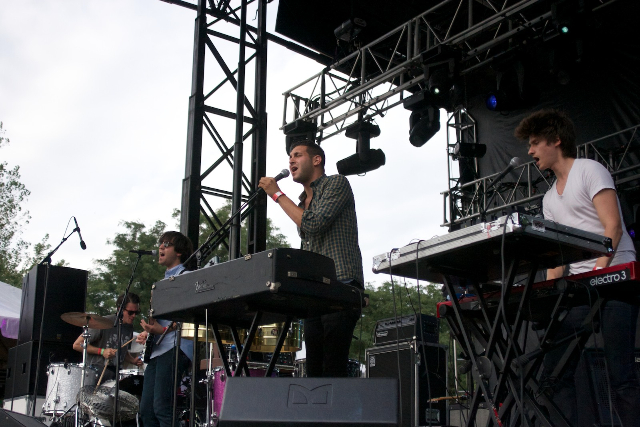
This Wednesday, the ASUCD Entertainment Council (EC) will be hosting a Holy Ghost! DJ set in the ARC Ballroom.

The EC has brought artists such as Muse and The Strokes to campus in the past, they were extremely successful. EC Director and fourth-year music and communication double major Alexis Munnelly believes that Holy Ghost! will make that same jump to fame.

“Our budget doesn’t allow for top 40 talent, so we seek up-and-coming talent that we believe will expand….We’re striving for variety [in the acts we bring to campus],” Munnelly said.

“Holy Ghost! is indie electronic. It’s a unique style that has become prevalent at Outside Lands and Coachella. It’s not rave style and not as hardcore as EDM.”

To keep costs down and the entertainment top notch, the EC keeps an ear to the ground of what types of music are becoming popular and reaches out to artists accordingly.

Physical promotions director and fourth-year chemistry major Megha Chandrashekhar compares Holy Ghost! to artists like Disclosure, but stresses that they bring a sound all their own.

“Holy Ghost! brings an indie, ‘70s [and] ’80s disco ball feel,”  Chandrashekhar said. “If you like dancing, you’re going to love their stuff.”

EC councilmembers have decided to host the concert inside of the ARC Ballroom for its cost efficient price, lighting capabilities and intimate space.

“The ballroom can hold 500 people, so I’m looking forward to it being a huge dance party,” Chandrashekhar said. “It’s a great opportunity for students to come out mid-week and listen to some great artists.”

Opening for Holy Ghost! is Shaun Slaughter of D.A.M.B. and GLSS. Slaughter recently performed at this year’s Sacramento TBD Fest. His music is described as a mix and sampling of styles from indie dance and rock, funk, disco and soul, house music, old time radio songs and ’90s tracks.

GLSS is a DJ and production project comprised of fourth-year mechanical engineering student Brandon Whitney and UCLA design and media student Philip Scott.

“It grew out of various music projects we’ve done together since high school. Unfortunately, Phil won’t be able to make it up for the show on Wednesday, so I’m playing alone,” Whitney said in an email interview. “Our music and DJ sets mostly feature house and techno but we’ve also been known to play music coming out of the darker side of the beat scene.”

As a UC Davis student himself, Whitney enjoys the opportunity to share his music with fellow students.

“We’ve played shows to college crowds before both here and at UCLA. The response from those kinds of shows is always amazing,” Whitney said. “I think [Holy Ghost! and GLSS will] complement each other well. Indie dance and house are intrinsically linked historically and sonically. As much as the sounds have diverged in the past, I think they are currently growing closer together. Right now there’s a lot of innovative music coming out of both camps with clear influence from the other.”

As for Wednesday, Whitney says he is eager to open for Holy Ghost!.

“As far as bands that occasionally play DJ sets go, I think Holy Ghost! are one of the few that actually get the form of a DJ set. It’s less about performance and more about curation,” Whitney said. “DJing is like giving a tour of a museum and less like actually creating the art. I believe that’s a very honest approach to the form and it’s an approach that I think we share with [Holy Ghost!].”

For students looking to become familiar with the music that will be played Wednesday night, all of the performing artists have releases available online from various websites and applications, including iTunes.

Tickets are $6 for UC Davis students (with valid ID) and $12 for non-students. The tickets are available online on Tuesday from 10 a.m. to noon at the EC table outside of the Memorial Union until they sell out. Doors open at 7 p.m. and the opening set begins at 7:30 p.m. This event, like all EC events, is drug and alcohol free.

Photo by Gozamos/Wikimedia Commons

The Art Theater of Davis presents ‘Hay Fever’

0

From Oct. 29 through Nov. 23, The Art Theater of Davis will present Noël Coward’s English play Hay Fever. The play marks the fledgling theatre company’s third production and first comedy.

The 1927 English comedy follows a weekend with the Bliss family, a group of eccentric bohemians who prove to be nightmarish hosts to their bourgeois guests.

Timothy Nutter, artistic director and founder of The Art Theater of Davis, said the play will be a departure from the company’s previous heavily dramatic productions. According to Nutter, his English heritage also played a role in choosing Hay Fever as the next production for his theatre company.

“Our first two plays were pretty heavy dramas, so to do something different, we chose a comedy,” Nutter said. “My family is English, so that played into it too. I just thought it’d be fun and that my family would like it if I did an English play once in a while.”

Hay Fever features a nine-person cast consisting of actors from all across the Sacramento region. Nutter expressed his excitement about the fact that the play is an ensemble piece that allows a lot of stagetime for everyone in the cast.

“It’s an ensemble piece in the sense that most of the roles are about the same size, so it isn’t dominated by one character,” Nutter said. “I think that’s helpful because it gives more people more chances to have something to do rather than just putting it on the shoulders of one person.”

Hay Fever also marks the company’s first untranslated production after its previous productions of translated German and Russian plays.

Although the company plans to take a classic approach to the play, Nutter said what distinguishes his production of Hay Fever from others is that he is using the original manuscript instead of the edited, licensed one. He said his goal isn’t to reinvent a classic play, but to allow the playwright’s original words to speak for itself.

Although The Art Theater of Davis has been able to work with a few UC Davis students in the past, Nutter encourages more students to participate in his productions.

“I hope the university community and our group can cross more. I’d love it,” Nutter said.

Lisa Halko, a longtime Davis resident, returns for her second production as the play’s lead, Judith Bliss, a retired actress and mother of the Bliss family. As a mother and former retired actress herself, Halko found the role closely resembled her real life, which made her part interesting to perform.

Several cast members expressed their excitement for opening night. However, Gayle Tominaga, who will be playing a ditzy flapper named Jackie Coryton, expressed her nervousness about trying to create a believable English accent onstage.

“I’ve never done accents; they’re actually my weak points,” Tominaga said. “That’s been the most work for me, but it’s getting better. If you don’t know it, you won’t notice.”

Sara Matsui-Colby, a West Sacramento resident, will play Myra Arundel,  a character who is described in the play as “a vampire and a woman who uses sex as a shrimping net.” She said she looks forward to entertaining the Davis community on opening night.

“Say maybe someone’s having a bad day or something — hopefully they’ll come see the show and I can help them laugh and have a good time for a couple hours,” Matsui-Colby said. “That’s what I’m hoping for opening night.”

Hay Fever will be presented at Third Space at 946 Olive Drive from Oct. 29 through Nov. 23 on Thursdays, Fridays and Saturdays at 7 p.m. and Sundays at 2:30 p.m. Tickets cost $15 and can be purchased at arttheater.org/tickets-for-hay-fever.

Crafting Gemeinschaft: Making stranger danger obsolete

0

What if I told you to hop into a random stranger’s car and take a drive to Washington so you could see all of your favorite bands play while overlooking the Columbia River? What if I told you to spend the night in a stranger’s extra room so you can enjoy the city while saving enough money to actually eat? See, this would sound pretty strange 10 years ago, but today it’s all becoming more normal. Social institutions that have been around forever like car dependency and hotels are being challenged by social media, and I think it is great. I just think it’s ironic that we are willing to take risks in certain aspects of our lives, such as sleeping in near proximity to strangers and trusting their driving skills, when we remain so distrustful in other aspects.

Hotels are facing competition from the website Airbnb, where individuals can offer up a room in their home to strangers who might be looking for something more comfortable and cheaper than a hotel. Airbnb has faced opposition, specifically in New York. Attorney General Eric Schneiderman filed a lawsuit against the company and was quoted in the New York Post saying that he is is trying to protect the state’s extremely successful hotel industry. The other side of the argument is that while it is the Attorney General’s duty to protect the hotels, it is also his duty to advocate for New York citizens. Some of these citizens are able to stay in their homes because of the revenue they make from Airbnb.

Another site where people display lowered trust thresholds is Zimride, which allows people to post about road trips they are taking so that strangers can tag along and split the gas money. In addition to setting up a business model that is profitable and good for the environment, the founders of Zimride wanted to emphasize the community value in carpooling. This is shown by the company ethos which claims, “Life is better when you share the ride.” One way Zimride creates community is by allowing people to share experiences, something that is becoming more rare in our individualistic, “I-can-do-it-all” society. Some people have found signifanct others while giving rides, which is like the best two-for-one deal ever: reducing your carbon footprint while finding love.

While we trust people giving us rides in their cars with Zimride, and we trust staying in the homes of strangers through Airbnb, one thing we are still particularly distrusting of is food. A group of college students from the University of Southern California challenged the notion that all food has to be heavily regulated by opening a pop-up restaurant out of their apartment called Paladar. While there are many benefits to living in the USC area, one thing the school does not have is opportunities to get healthy and tasty food (without access to a car). Paladar was the students’ solution to this; the thing is, its not exactly legal. They did not pay for a food license, they did not have a license to serve liquor, they did not get their facilities checked out by the USDA. But why should people have to go through all these hoops just to do something that brings them joy — serving people food?

People are willing to lower their trust threshold to stay in someone’s house with Airbnb and ride in a random stranger’s car with Zimride, so they should also be open to the idea of having a sit-down dinner out of someone’s apartment. The implications of being more trusting and changing the nature of our everyday transactions is that we are ensuring that our economy is “for the people, by the people.” There are lots of social constructs we accept because they have existed for so long, but it is in our interest to sit down and think about which ones are primarily serving our interests and which ones are serving the interests of the business man.

To contact Nicole Nelson, email her at nsnelson@ucdavis.edu.


Science is Serendipitous: University behind Costco

0

“Let there be light”

When you see the logo of any University of California, you always see that phrase, “Let there be light.” The phrase lets the world know exactly what the purpose of the UC is — to shine a light on what’s possible in the world of education and research. In the midst of cutthroat private universities, we should be proud to know that UC is a world-class public research institution, dedicated to the needs of California and the world. I myself am marveled by the research, both scientific and general, that comes out of the system of schools under the UC umbrella. Being a UC Davis student and a science major, you might expect me to get my drive for research from what the UC system has done, but that’s not true. I had the opportunity to conduct real research at the community college level, something I did not think was possible before I did it. I would love to see community college students all over California get the same chance I did — and I believe the UC can help make that happen.

My collegiate journey began at one of California’s community colleges, Las Positas College, which is located in Livermore, Calif. It is a hub for public research because of the Livermore Lawrence National Laboratory and Sandia National Laboratory (both 15 minutes away from the college). Community college has a reputation among students of being a place where four-year rejects go to shape up, but that’s actually not true. It’s a place to save money on your general education, and where you get extraordinary attention and opportunities from your faculty. Fun fact: the college is located right behind a Costco so the students swore if it was ever made a UC, it should be called UCBC, or the University of California behind Costco.

Anyway, what surprised me about Las Positas was the passion behind the faculty. What I expected to be a “boring” transition between high school and a four-year university turned out to be a thrilling journey filled with academic delights. In my short time there, I wrote three research papers and was able to conduct research independently and with professors. I conducted wet-lab research on Drosophila melanogaster, looked at HOX genes and how they can help with regenerative medicine and applied green chemistry methods to the production of furan-based reactions. Some of my research took place in conjunction with Sandia/Livermore National labs, since community colleges don’t have all the resources that, say, a UC would have. My response to that lack of resources: why?

I propose an opportunity to the University of California — create a culture of research at the community college level. Most of the faculty attain degrees from public and private universities and have participated in research during their careers. With the smaller ratio of students to professors at the community college level, students get to know and collaborate with their faculty at a more intimate level. This can create an excellent batch of highly motivated individuals who have experience with research and are ready to jump into upper-division coursework at UCs.

Our UC President, Janet Napolitano, said in the L.A. Times that transfer students “are an important part of UC’s strength… put simply, if we are serving transfers well, then we are serving the state well.” Students have a choice of attending a four-year college out of high school, or choosing the path of community college like I did. I was given many opportunities to advance myself through independent research at my college; however, not all community colleges have the resources to do this.The community college I came from fought for grants from the state to have the equipment and ability to conduct independent research for high-achieving students. The UC Board of Regents can help all community colleges by allocating funding to let transfer hopefuls conduct their own research. The UC has a real chance to instill the values of “Let there be light” into transfers, and in turn, gain motivated and experienced students when they join our ranks.


Share your ideas over a slice of Costco pizza with UMAYR SUFI (uwsufi@ucdavis.edu). Tweet them too! (@umayrsufi)

An interview with new Classics professor Colin Webster

0

researchspotlight_fe_AlcalaUC Davis Classics professor Colin Webster recently joined the department this year after receiving his doctorate in Classics from Columbia University in June. He is currently researching ancient science, medicine and philosophy. More specifically, he’s researching the way shifts in technology change our explanations of the natural world’s inner-workings. Webster, who has been researching the subject for about 10 years, is planning to create new courses related to his research in the near future.

What are you currently researching?

I research ancient science and medicine. On one hand I do a lot of research on the medical side of things, and on the other side a lot of mathematics, diagrams and the history of optics.

What I’m particularly interested in is the way that shifts in technology produce new assumptions about nature. The big modern analogy for [how we read the technologies around us into our explanations of how the natural world works] is the computer….When the computer [was] invented people immediately [started] thinking of the brain as a computer….Before the computer, there were the mechanical computational machines and previously people looked at the brain as [such]. I look at the same type of phenomenon in ancient science, where the technologies are a little less sexy, like pipes and mirrors and glass — [questions like] what happens to conceptions of eyesight when the glass is not a particularly good quality, and what … other technologies [there are] that people adopt to think about how eyes work?

Why did you decide to research that?

I am a bit of a completist, so originally I was planning to research philosophy. And [I] felt that in order to say anything about modern philosophy or early modern philosophy, I thought, “Oh, no, I have to go back all the way to the ancients to understand them first and then make my way back,” – but of course when you get back there you’re sort of stuck – there’s a lot of material there. So on the one hand I got into Classics, but I still did a degree in contemporary studies with a lot of history of science. Studying the history of ancient science and technology is a way to push those two things together.

Why do you believe your research is important?

More broadly, ancient science and medicine as a discipline [has really been] undergoing a renaissance in the last 10 to 15 years, especially in the last couple years because people are getting more and more interested in it. There is a massive body of literature that people used to know a great deal about, and in the last hundred years or so have not really paid all that much attention to, so it’s useful so far as we don’t know about this. I think my approach to it is particularly useful because it is so complicated — what’s neat about ancient science is you can think of it as a sort of artificial experiment. It’s a time when there’s lots of technologies around, but a lot of them are far simpler than computers and digital information. They use rakes, pipes – very simple, basic technologies – and nevertheless you can see how these very simple technologies influence the world. And that’s what’s so neat about ancient science…that you can strip away thousands of years of buildup and really see how a very select group of technologies affect the way people think. And you aren’t going to get that sort of clarity in studying modern science. Looking at ancient science in these ways helps us think again about how we encounter the world.

What aspect of your research do you find most interesting?

The questions I find myself continually asking are almost always about how content shapes form, how when you type an essay on a computer versus writing it out it involves drastically different writing styles; what writing an essay is actually changes based on the technology that you’re using to do it. Think about writing an essay on an iPhone: it’s going to produce really different literature. So I am continually drawn to questions like this, especially what happens when you try to classify animals – when you draw diagrams in a particular way, what happens when you try to understand anatomy and you don’t have 3D models you only have expensive parchment paper, where what you draw is what you get. Reproducing these diagrams is extremely difficult, when you draw a diagram of the interior of the human body there’s no guarantee that the next person who comes across it and tries to copy it is going to do a good job of it. So in this particular instance, how does our understanding of anatomy change based on the technologies that we have to reproduce our knowledge?

What aspect do you find most challenging?

There are so many, it’s really hard to pick just one. A lot of these old manuscripts are getting digitized now, so a lot of the materials are becoming more widely available. But they’re poorly catalogued, or we don’t necessarily know how to navigate all the different databases where all this information is kept. You can’t just Google the result; it would be very easy if we could. So really, trying to find the bodies of information that are applicable to the questions that you ask is probably the most difficult thing. Then, of course, everything is in different languages [and] in different time periods, so trying to find what you need and then trying to read it [has also been challenging].

Do you plan to integrate your research into your teaching?

Absolutely, I’ll be integrating them. In fact, I’ll be giving a course on ancient science in the winter [quarter], and next year I’ll be hoping to offer an ancient medicines course. So those are the two most proximate plans, and in the future I’d love to develop more courses that deal more directly with integrating things from the biological sciences. Students in the sciences [and] students in the humanities, [will] all find something that is worthwhile; pre-med students will hopefully learn by looking at [how] ancient doctors dealt with their patients. You can learn a lot about modern bedside practices and be in a better position for that.

Do you have any hobbies that you’re involved in?

I’m in a rap band, and we are terrible. I’ve been in the band for about five years, our album has yet to drop — but when it drops, you’ll hear [it] in the mainstream media; everyone will surely know.

Senate braces itself for critical ICA information

0

An otherwise routine ASUCD Senate meeting on Thursday saw tensions rise as an appearance of school officials raised more questions about the objectives of both the administration and the athletics program.

Dr. Milton Lang, associate vice chancellor of Student Affairs, attended the meeting, followed by four members of the Student Athletic Advisory Committee (SAAC): Elsie Fullerton, Brandon Greenberg, Sophia Lisaius and Danielle Steffen. SAAC, according to Lisaius, “[provides] a liaison from the athletics faculty members to the student athletes.”

The senate had planned to hold a fairly rare closed session, giving the public just the meeting’s description: “Athletics.”

“We heard there was something going on with athletics and we figured we needed to step up our involvement with ASUCD,” said Greenberg, a senior on the men’s track and field team.

Fullerton, a junior on the women’s water polo team, added that she also would like to see more collaboration with the student government and student-athletes.

“We wanted to be available as a resource and open up a line of communication,” Fullerton said.

Lang addressed his appearance at the meeting, alluding to what ASUCD may do in light of the discovery that the Intercollegiate Athletics (ICA) department failed to adhere to the principles of the athletic department, to which every UC Davis student pays around $500 per year.

“I come four or five times a year [to senate],” Lang said. “It’s up to them to make the decision, collectively, on what they want to do. That’s not my opinion, that is not my decision.”

Paul Medved, a UC Davis alumnus and parent of a former student-athlete, launched an investigation into ICA in 2010 when the administration cut four sports – men’s swimming and diving, men’s wrestling, men’s indoor track and field and women’s rowing – breaking one of the eight Core Principles of ICA at UC Davis. The principle states that “UC Davis cannot reduce its broad-based program but rather must seek to add sports.”

“Certainly, when the four teams were eliminated, I found that very offensive,” said Medved, whose daughter was a member of the women’s swim team. “After four years of research, I can conclude that it is inconsistent with the intent of the students’ funding.”

Medved spoke at senate on Oct. 9 to fill in the senators regarding his findings. As a result, senate looked to hold a closed session on Oct. 16 to sort out the information and to figure out a way to move forward with it. However, the session was not properly called to order, causing Lang and the SAAC members to leave. Senate later voted to have a 30-minute closed session meeting in regards to ICA.

“[We need a closed session] just to say anything we feel,” said senator Janesh Gupta, during the public senate discussion before the closed session took place.

The SAAC had no previous knowledge of any rumbling within the athletic department, but the members expressed their concern over any internal corruption.

“Honestly, Wednesday was the first time I had heard about all of this,” said Steffen, a sophomore pole vaulter on the track and field team. “I knew sports had been cut in the past, but I didn’t realize this issue was being revisited. I came today to get some questions answered, go in with an open mind … see what was going on and how we could help if they had any questions for us.”


New Institute for Social Sciences opens

0

The new Institute for Social Sciences opened Oct. 13 at UC Davis. The institute, which has been in the works since 2011, will focus on interdisciplinary research projects.

Vicky Austin, assistant director of the institute, said that it will work to bring together researchers from different academic interests on campus.

“We will actively work to connect our researchers with scholars across campus to build bridges between the social sciences and disciplines ranging from education to engineering, medicine to management and law to the liberal arts,” Austin said.

Joe Dumit, a UC Davis professor of anthropology and science and technology studies, is the director of the new institute.

“I’m really happy to be heading up this new institute to support interdisciplinary research in the social sciences,” Dumit said.

According to George R. Mangun, dean of the Division of Social Sciences, Dumit was chosen as director of the new institute from a highly selective group of accomplished individuals. A search committee of faculty and staff reviewed formal applications that were submitted last year, after leading candidates were interviewed. Based on the committee’s recommendations, Chancellor Linda P.B. Katehi made the appointment.

Austin believes that the new Institute for Social Sciences can help support and further interdisciplinary research on tough social issues from multiple perspectives.

“Social sciences research has bearing on the most important issues of our day, from things like inequality and poverty to bullying, education reform, delivery of healthcare and climate change. If a topic has to do with humans and society, social sciences has something to say about it!” said Austin.

Dumit believes that improvements to technology will also present new ways of attaining research.

“Current challenges include the many new sources of data from our technology, social media and everyday surveillance,” Dumit said. “How is this changing our lives and how is it changing how we can study our lives?”

In addition to research, the new institute will hold a variety of events and program opportunities.

“We will be hosting many different conferences, lectures and colloquia, which will bring the community of scholars and students together to talk about the important issues of our day,” Austin said. “We will support and assist faculty in the social sciences in their efforts to apply for external funding for their research.”

Mangun hopes that undergraduate and graduate students will become involved in the variety of different social sciences programs the new institute offers variety of different programs as well. The institute will allow students to attend all events (e.g., visiting speakers) and they will also be able to compete for fellowships and participate in research with faculty.

“We are also going to be planning and launching an undergraduate research program, where we will pair undergraduates with social sciences faculty so they can participate actively in research projects,” Austin said. “We plan to have this program launched by next academic year.”

Meanwhile, students interested in learning more about the institute will be able to find its offices in the Social Sciences and Humanities buildings, where the other social sciences programs are also located.

Austin stresses that the new Institute for Social Sciences was created to have a positive impact on research, perhaps even globally.

“We hope [it] will help to foster new research… that will have a positive impact on the world, especially when that research might be translated into new knowledge that may impact [policymaking],” Austin said. “We hope that through helping to train the next generation of scholars, the ripple effects of our work will be felt for generations.”

Administration, ASUCD streamlining efforts to raise sexual assault awareness

0

On Sept. 28, Governor Jerry Brown signed Senate Bill No. 967, redefining sexual consent on California college campuses. Commonly known as the “Yes Means Yes” bill, No. 967 is the first of its kind to clearly define consent, as it requires “an affirmative, conscious and voluntary agreement to engage in sexual activity,” excluding a lack of resistance or silence.

The bill aims to alter how schools prevent, report and examine sexual assault cases. “Yes Means Yes” serves as a significant stepping point toward these goals, according to ASUCD senator Amelia Helland.

“This legislation mandates that all post-secondary schools in California enforce an affirmative consent policy and dedicate resources toward expanding and strengthening prevention education, counseling and health care resources,” Helland said.

In efforts to improve campus sexual assault policies, both the administration and ASUCD are joining together and developing plans to further strengthen existing resources at UC Davis. A video project for Domestic Violence Awareness month is currently in the works with the athletics department, the Campus Violence Prevention Program (CVPP), Student Affairs and ASUCD.

A partnership with Student Housing is also part of the agenda. Faculty and Resident Advisors are to receive special training to ensure that all sexual assault reports are appropriately handled and discussed.

In addition, Helland is working to re-establish the ASUCD Sexual Assault Awareness and Advocacy Committee (SAAAC), initially implemented by the passing of ASUCD Senate Bill No. 67 last year. According to the bill, the committee will support programs that address issues of sexual assault and collaborate with other campus resources, such as CVPP. SAAAC is already in the process of hiring a chairperson and is expecting a mid-November launch. Committee-member applications are to be posted on the ASUCD website.

“Once meetings commence, members will collectively develop an action plan, which should include an ongoing awareness campaign, in addition to some sort of event,” Helland said. “Committee members will also be expected to keep in touch with resource centers on campus for weekly updates at the SAAAC meeting.”

The Chancellor’s Student Advisory Committee on Sexual Assault is also currently being developed. Committee members will provide official student recommendations and perspectives to Chancellor Katehi about sexual assault. This will differ from SAAAC’s focus of establishing a student-support system on campus, by directly implementing campus policies.

Student Affairs recently approached Harley Litzelman, the external director of ASUCD Lobby Corps and the new director of the Office of Advocacy and Student Representation, to recruit several ASUCD members for the Chancellor’s advisory board.

Litzelman told Student Affairs that the board should be composed of survivors and that the responsibility of those in charge was to properly direct and guide the members to further empower the say of survivors.

“We’re dealing with a population that is not educated on consent effectively,” Litzelman said. “When you look at the narrative as to what has inspired change, it is very revealing of how important it is that.”

Although changes have been in motion since the signing of Bill No. 967, affirmative consent is not a new concept at UC Davis or to the University of California system. The university has had existing programs educating students on campus sexual assault. In addition, on May 20, ASUCD Senate passed Senate Resolution No. 27 in a unanimous vote, formally supporting Bill No. 967. University Policy, Ch. 400 – Campus Climate, Sec. 20 – Sexual Harassment and Sexual Violence, details procedures for reporting sexual assault allegations and defines consent. It was passed earlier on June 19.

The bill requires campuses to adopt sexual assault response policies that focus on the victims, altering the way administrative reviews of assault allegations are handled. This sheds an entirely new light on survivors in contrast to the previously taught “no means no.”

“It clearly changes our message to victims because this is about supporting victims and victims’ rights,” said UC Davis Police Department (UCDPD) chief Matthew E. Carmichael.

Fifty-five higher education institutions, including UC Berkeley, USC and Harvard, were found in violation of Title IX for improper response to sexual assault cases. These schools are under investigation by the U.S. Department of Education.

“I think it’s about time that the government changed its attitude toward sexual assault victims and started supporting them instead of blaming them, especially on college campuses where the issue is so rampant,” said Alena Loomis, a fourth-year anthropology major. “The stand against former negative misconceptions of sexual assault victims is a good step forward.”

UCDPD is also upping campus security in its overall effort to create student safety. Aggie Host security officers will now conduct routine checks in the 24-hour reading room and inside various buildings. Safe Rides, a safety escort service, will be extending its services to cover the late hours in between Unitrans operation, as well as providing transportation from campus to anywhere within the city of Davis during those hours.


News in Brief: Legislation that would have provided significant funding for California universities vetoed

0

Gov. Jerry Brown vetoed part of the Budget Act of 2014 (AB 1476) in early September,

denying the state’s public universities heavy funding. The bill would have allocated $100 million

apiece the University of California (UC) and California State University (CSU) systems.

This funding for UC and CSU universities was conditional and dependent on the

outcome of property tax revenues in comparison to projections. The $100 million was originally

incorporated into the legislation to be given to UCs and CSUs; however, the money was

rejected in July once property tax revenues did not exceed expectations. The funds would have

been allotted for deferred maintenance at UC and CSU schools that was deemed critical.

In Brown’s veto message, he wrote that property tax revenues were below budget

estimates and the state couldn’t afford the $200 million this year. The legislative session for the

California state government ended Aug. 31. Governor Brown vetoed the funds shortly after.

“Making investments to maintain the state’s aging infrastructure continues to be a major

priority for my administration, as is paying down the state’s debts and reducing other long-term

liabilities,” Brown said in the veto message. “However, we are nearly one quarter into the fiscal

year now and we should not commit additional General Fund monies of this magnitude when

we are facing unanticipated costs such as fighting the state’s extreme wildfires.”

The UC and CSU systems have repeatedly lobbied for funds greater than those

mentioned in Brown’s January budget proposal but have not been successful.

After the nullification of the funds for higher education in July, Speaker of the Assembly,

Toni Atkins (D-San Diego), added similar language to the Budget Act of 2014 to reestablish a

method for state universities to receive funding for deferred maintenance. Because General

Fund revenues exceeded projections by $400 million, the Assembly sought to restore the

funding that was desperately needed. Atkins’ efforts were also quelled by the Governor’s veto.

“Given California’s continued economic rebound, we disagree with denying this funding

simply because the money involved comes from Pot B instead of Pot A,” Atkins said in an article

that appeared in the Sacramento Bee.

Brown signed various other pieces of legislation regarding education in California the

same day he denied UC’s and CSU’s $100 million each. He signed a bill that would require high

schools to submit student grade point averages electronically to the the California Student Aid

Commission to enable greater access to the state’s Cal Grants scholarship program.

Chancellor Linda P.B. Katehi expressed her disappointment in Governor Brown’s veto of

AB 1476.

“We were disappointed with the governor’s veto and hope to work closely with him on

next year’s budget to secure the resources needed to meet our shared goals of affordability,

access and quality.” she said.

— LAURA FITZGERALD

UC Davis continues implementation of Drought Action Response Plan

0

In January 2014, the California State Department of Water Resources announced a drought emergency for California. California Governor Jerry Brown called on the state to conserve water and created a goal for all Californians to reduce their water usage by 20 percent. This past April, in response to the drought emergency, UC Davis released its Drought Response Action Plan, which details UC Davis’ plan to reduce its water usage.

The Drought Response Action Plan includes reductions in water usage in dining services and landscape management, and seeks to make students more aware of the drought and ways that they can reduce their own water usage.

“Our campus communication office issued a news release, the sustainability office has written blog posts and added content about the plan to our website and Facebook, the Vice Chancellor of Administrative and Resource Management has emailed the whole campus and our utilities group has created a water dashboard for campus in partnership with some students,” said Camille Kirk, assistant director of sustainability at Office of Environmental Stewardship and Sustainability.

When members of Sustainable Resource Organization (SRO), a club focused on sustainability at UC Davis, heard about the Drought Action Response Plan, they wanted to become involved with helping the university implement water conservation practices on campus.

“As a sustainability-minded club, SRO is constantly looking for ways to educate fellow students and staff on environmentally conscious practices,” said Jordan Ramalingam, a third-year environmental policy analysis and planning major and the president of SRO. “We have found that the campus is already doing a tremendous job applying sustainable practices and policies in their respective fields.”

However, Ramalingam said that many students remain unaware of the environmental impact of UC Davis.

“The truth is that most students have no idea what our campus is doing to reduce their ecological footprint and therefore are very limited in their ability to get involved and play a role in these endeavors,” Ramalingam said. “SRO is trying to bridge the gap between students and staff and get students involved in intelligent projects that mutually benefit all the stakeholders on this campus.”

Ramalingam said that the California drought and the resulting Drought Action Response Plan is the perfect time for UC Davis students to increase their awareness of UC Davis’ environmental footprint.

“Virtually every student at Davis acknowledges that there is a drought in California right now, but few have any concept of how their actions affect it and what our campus is doing to meet it,” he said. “SRO held several meetings that highlighted ways to conserve water on a daily basis and [we did our] best to personalize this challenge and make it practical for other UCD students.”

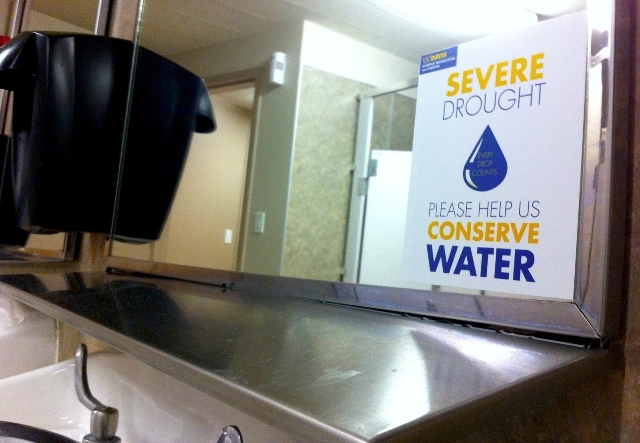
UC Davis has been working with SRO to make others on campus more aware of the drought as well as more involved in water conservation. One integral part of this has been the new Save Water stickers, which are being put on the mirror of every bathroom of central campus buildings, as well as the bathrooms of some south and west campus buildings.

“The stickers are designed to raise awareness about reporting leaks,” Kirk said. “Our campus is really big (141 buildings on 900 acres just for the central campus) and one of the most helpful things people can do on campus to save water is to report leaks, broken irrigation and other water waste when they spot it.”

After a training session with the staff from Facilities Management, SRO helped put up the stickers in bathrooms during the beginning of fall quarter.

“In late September, the Sustainable Resource Organization (SRO), [myself], David, and Lupe Laguna at Facilities Management-Building Maintenance Services worked together to enable student teams from the SRO to hang the stickers on campus,” Kirk said. “It’s a great partnership, and the student teams are finishing up the sticker hanging…during the first part of Fall Quarter.”

Ramalingam hopes that many more people will now be aware of the need for water conservation around campus due to this sticker campaign.

“As the results come in, up to 100 buildings now contain these [stickers] in the bathrooms and [they] are seen by thousands of students [and] staff every day,” Ramalingam said.

Students and community members alike who wish to see how many gallons of water UC Davis has saved since January 2014 can visit the online “water dashboard” at wateroncampus.ucdavis.edu. This website, which tracks UC Davis’ monthly water usage as well as campus water demand, was created to track the university’s effectiveness at reducing water usage.

Kirk believes that there are simple ways for UC Davis students to become more aware of and involved in reducing water usage.

“Look for the Aggie Green Pledge program (#aggiegreenpledge) at a tabling event during UC Davis Farmers Market or the Wellness Carnival and take a water pledge,” Kirk said. “Report leaks; turn off faucets tightly and don’t run the water when you are lathering; [and] if you work in a lab, practice ‘green’ dishwashing techniques.”

According to David Phillips, director of utilities at UC Davis, the administration believes the project to have long-term positive ramifications.

“Our initial goals focused on short-term solutions, but we suspect that many of the outcomes will be long-lasting,” Phillips said.

The team is hopeful that UC Davis will reach its goal of reducing water usage as well as increase students’ awareness of environmental sustainability.


Plastic Bag Ban

This September, Governor Jerry Brown signed a bill to ban single-use plastic bags in grocery and convenience stores throughout the state. The bill made California the first state to issue a statewide ban of this kind.

If this sounds familiar to UC Davis students, it is because the city of Davis became one of many individual cities to adopt a similar ordinance on July 1. Davis City Ordinance 2422 was prompted into action in part by a 10,000-signature petition from UC Davis students. The city of Davis became a part of nearly 100 cities in California to instate the plastic bag ban. In 2011, only 15 California cities and counties were involved.

In addition, the representatives of Davis in the State Assembly and the State Senate, Mariko Yamada and Lois Wolk respectively, voted to pass the plastic bag ban and have been consistent in their support of environmental sustainability. We commend these representatives for voting to pass a bill that over 10,000 students showed their support of.

With the amount of plastic that is currently filling our landfills and failing to biodegrade, it is essential that California takes this step in the right direction. The San Jose Mercury News reported that studies conducted in San Jose showed that the number of people walking out of grocery stores without bags skyrocketed from 13 percent to 44 percent, while plastic bag litter dropped considerably. While these statistics are promising to see in San Jose, we are excited to see them extend to the entire state.

We commend UC Davis students for pushing to create tangible change in the Davis community, which clearly played a part in moving the state toward approving the statewide plastic bag ban. Likewise, the UC Davis community as a whole has taken measures to remain at the top of environmentally-sustainable practices, evident in the new massive solar farm in the process of being built in Davis, south of Interstate 80.

The California-wide single-use plastic bag ban is a great first step to move the rest of the nation toward ending the use of an unnecessary and wasteful product. Hopefully this movement, which ran directly through Davis, catches on throughout the country. We are glad that Davis continues to be at the forefront of environmental issues.

Evan Lilley/ The Aggie


Meet the new UC Davis starting quarterback

0

Sophomore quarterback Ben Scott made his debut as the UC Davis starting quarterback in a loss against No. 14 Montana State in which he gained 379 yards through the air and ran for 72 yards. Despite the loss, Scott is hopeful that the team will head in the right direction under his leadership.

As Scott begins his career as the starting quarterback for the Aggies, The Aggie sat down with him for a one-on-one interview to learn more about his new position on the team.

Scott was born in San Jose, Calif. but soon moved to Los Banos, Calif. which is where former starter senior quarterback London Lacy lived at the time. Scott and Lacy both played on the same Pop Warner (youth league) team, where Lacy was the quarterback and Scott played wide receiver. Scott was surprised to see London playing at UC Davis after the two had not seen each other for almost a decade.

After living in Los Banos, the Scott family moved to Vacaville when Scott was in the fourth grade. Scott admits not playing football every season in favor of playing baseball and basketball. Scott’s dad, Kevin, was a high school and college basketball coach, and he influenced Scott toward playing basketball.

When Scott started high school, baseball became boring to him. He had begun to play football in the eighth grade and decided to focus on it.

Scott met his first quarterback coach, Ted Martinez, after attending a few football camps, and was trained by Martinez. During his sophomore year of high school, Scott was called up to be the quarterback of the varsity team after the starting quarterback tore all the ligaments in his thumb.

During his senior year, UC Davis began to recruit him. UC Davis assistant coach Jason Fisk met with Scott, went to his games and was impressed. Scott was then invited for a one-day camp and was quickly offered a scholarship. After a few weeks Scott made his decision to commit to UC Davis.

After redshirting his freshman year, and not seeing any action as a backup during the 2013 season, Scott was given his chance at the starting quarterback role after a tough loss to Portland State on Oct. 4. Lacy had been struggling and UC Davis had lost four straight games. Scott became the starting quarterback during the Homecoming game when the Aggies hosted the Montana State Bobcats.

Scott mentioned that the transition was very easy: Lacy was very supportive and the two helped each other throughout the process. He believes that the team is moving in the right direction.


“London and I are really good friends, and so it was one of those [things] where we were competing, [and] we wanted the best guy to play. It was a friendly competition,” Scott said regarding the change in quarterbacks.

In addition, Scott commented on the supportive nature of his teammates, despite the midseason change.

“The teammates were very supportive,” Scott said. “London and I were fighting for the start, and the coaches decided that I was going to make the start on Saturday.”

“It’s just the mental mistakes, I don’t think teams are flat out better than us,” he said regarding the team’s tenuous season so far. “I think we are just shooting ourselves in the foot.”