58.6 F
Davis

Davis, California

Monday, December 22, 2025
Home Blog Page 838

Cross Country teams look forward to Big West Championships

0

With over half of the season in the books, both the men and women’s cross country teams have seen up-and-down performances. In the first race of the year, each team defeated nearby rival Sacramento State. Since then, the performances have been far more varied.

After winning the meet against Sac State, the women’s cross country team travelled to the West Coast Conference Preview held in Sunnyvale, Calif. The Aggies placed a middling sixth place out of 11 teams. Still, UC Davis had three runners finish in the top 20, led by sophomore Clara Macleod, who ran the 6-kilometer course in 21:35.

The next race, the 41st Annual Stanford Invitational, saw the women’s team finish in second place overall. The Aggies were able to best Cal Poly and Loyola Marymount just two weeks after falling to them at the WCC Preview. UC Davis was led by junior Christine Hoffman, who finished in seventh individually. Two other Aggies finished in the top 20.

On Oct. 18, the UC Davis team split up to compete in the Santa Clara Bronco Invitational and the NCAA Pre-Nationals. As a team, the Aggies failed to make a strong appearance at the Pre-Nationals meet, finishing 28th out of a 43-team field. Only Hoffman was able to finish inside of the top 100 racers, completing the race in 17th place overall.

The Santa Clara Bronco Invitational had the same result, as neither freshman Elizabeth Greif nor sophomore Kazune Shidara placed within the top 40. Greif and Shidara finished in 45th and 64th place, respectively.

While the team has failed to place well in several races this season, Hoffman has been a bright spot for the Aggies. The junior has finished first out of all UC Davis runners in all of the meets that she has participated in, completing the race a full minute ahead of the second Aggie to cross the finish line at the NCAA Pre-Nationals. None of this should be surprising of Hoffman, seeing that she finished 16th last year in the Big West Championships.

Meanwhile, the UC Davis men’s cross country team has also remained competitive throughout the season. At the WCC Preview, the Aggies came in fourth place, buoyed by a 15th-place finish from sophomore Austin Goins. Only one other UC Davis runner was able to finish inside of the top 25, but consistent, solid running gave the team a solid finish.

While the women’s team dominated at the Stanford Invitational, the men’s squad faltered and finished in last place. Junior Brandon Pugh was the lone Aggie to finish in the top 50, coming in at 13th place. Pugh finished a full 44 seconds ahead of the next UC Davis runner to cross the finish line.

In their most recent race, the men’s team also split up to take on the Santa Clara Bronco Invitational and the NCAA Pre-Nationals. At the Pre-Nationals, UC Davis was able to finish in 13th place out of 28 teams, largely thanks to Pugh and junior Nick Ratto, who finished in 29th and 34th, respectively.

The Aggies also sent six runners to Santa Clara, but none were able to finish before junior Eric Neill rolled in for 86th place.

Pugh has been the best runner for the Aggies throughout the season, finishing in first place for the team in all of the races that he participated in. Last season, the junior was a member of the All-Big West Conference team and finished in third place at the Big West Championships.

With much of the season behind them, the Aggies have the Big West Conference Championships on Nov. 1 before turning to the NCAA West Regionals on Nov. 14.
AggieAngelous

0

ThePoetry-ThePoets&ThePoetesses


ThePoetry

“Phosphenes”

By Alice Hsueh

I was so certain until yesterday.

Well, as certain as I was ever going to be.


Like the sunsets you admire, I felt myself evanescing

Embracing the idea of your love

Colors deliquesce into swathes of poppy-bright warmth, tangerine heat

I could surrender like the last sigh of the sun.


But as I sat, he caught my eye.

A pat on the shoulder, a gentle touch to the knee, we twinkled over nothing.

“I remember you,” was all he said.

And as I swirled the wine in my cup, watching it glimmer in the candlelight

I knew.


The stars, they dance in our lanterns.

Windows of the soul, they say.

So then tell me, can you see at all into mine?


There’s a brightness that is blinding me, even in the dark

It hits me like an accusation in the night

I am full of it, lost in a haze of shapes and incandescence

And trapped inside my premonitory vertigo, as I close my eyes


Just these words:

“I am sorry I am living a lie.”


ThePoets&ThePoetesses


Phosphenes by Alice Hsueh

My name is Alice Hsueh; I am a fourth-year pursuing a degree in English, as well as a psychology minor. My career goal is to enter the field of journalism and my dream is to become a famous novelist. I spend most of my free time daydreaming in the clouds, or in the virtual aisles of online stores. On the rare occasions that I am not doing these things, I also like to spend my free time drawing, singing and performing. You can follow my artsy-fartsy ramblings via medium.com/@lilyrin or twitter.com/adrieleverin.


Be featured in AggieAngelous

Send your poetry to aggieangelous@gmail.com with your name, major, year and a short, one-to-two paragraph description about yourself. Feel free to include your interests and/or hobbies, or maybe even your favorite quote!

Arts Week

0

MUSIC


Daedalus String Quartet

Oct. 24, 7 p.m., $8 for students

Mondavi Center for the Performing Arts

Listen to classical music from this quartet, consisting of violinists Min-Young Kim and Matilda Kaul, violist Jessica Thompson and cellist Thomas Kraines.


San Francisco Symphony

Oct. 25, 8 p.m., $62

Mondavi Center

Enjoy performances Appalachian Spring, Piano Concerto No. 20, Madame Press Died Last Week at Ninety and Symphony No. 93 from this Bay Area orchestra.


The Swon Brothers

Oct. 25, 8:30 p.m., $15

The Graduate, 805 Russell Blvd.

See country music duo and “The Voice” finalists The Swon Brothers perform songs from their debut self-titled album at this show presented by country radio station, 101.9 The Wolf.


Halloween Karaoke Party

Oct. 25, 7 p.m., $10

Jean Henderson Performing Arts Center, 607 Pena Dr.

The Davis Musical Theater Company presents this Halloween party including festivities such as karaoke, a costume contest and a dance performance of Michael Jackson’s “Thriller.”


ART


Pumpkin Carving Contest

Oct. 25, Noon, Free

Sudwerk Dock Store, 2001 Second St.

Guests will be able to carve and pick pumpkins from a local pumpkin farm with a chance of winning prizes for their finished creation.


THEATRE AND DANCE


“Thriller” Class

Oct. 23, 8:30 p.m., Free

Pamela Trokanski Performing Arts Center, 2720 Del Rio Pl.

The last of a series of classes that will teach the dance from Michael Jackson’s “Thriller” in preparation for a flash dance that will be performed at the Downtown Davis Trick-or-Treat Trail.


‘Hay Fever’

Oct. 30, 7 p.m., $15

Third Space, 946 Olive Dr.

The Art Theater of Davis presents Noël Coward’s 1925 comic play, Hay Fever, the story of a weekend with a family who prove to be nightmarish hosts to their guests with their outlandish behavior.

LITERATURE AND POETRY


Stories on Stage

Oct. 25, 7:30 p.m., $5

Pence Gallery, 212 D St.

This event features actors performing dramatic readings of short stories written by two Davis authors, New York Times bestselling novelist John Lescroart and emerging fiction writer K.E. Montieth.

Artist Review: James Ragan

0

On Oct. 16, I had the pleasure of listening to internationally renowned poet James Ragan at the John Natsoulas Gallery in downtown Davis. In his career Ragan has written plays, poetry and essays.

Ragan is an incredibly effective and eloquent speaker, and through his poetry reading I discovered how language can create a unique, shared human experience among listeners.

This was the first time I’ve attended a poetry reading. Part of me expected to be bored to tears. The visual arts have always been my area of concentration and I had never given too much thought to the art of spoken word. I was pleasantly surprised to find that Ragan did not live up to the self-indulgent beatnik persona of what I imagined a poet might be like. He was very personable and his work was stirring. There was never a dull moment during the event.

It did not take very long for me to truly feel that I was not just sitting back watching Ragan speak; I felt I was communicating with him and having a conversation of sorts through the shared feelings and emotions he evoked.

I found the poetry reading to be an intensely personal, yet somehow communal, experience that I shared with the others in the room. Ragan’s words resonated with the 20-something attendees in different ways. I found myself glancing around the room, wondering how the others were interacting with him.

The ethereal imagery in Ragan’s poem, “A Good Sky,” washed over me with a beautiful, comforting ease. This particular poem about the loss of loved ones conjured up peaceful emotional resolutions to replace the unsettled ache I had been feeling over the recent loss of my grandmother.

The poem ended with, “I show you a good sky, / its broad blue ribbon will wrap / its mind around your eyes’ imagination / and tease you into smiles — / Now, be patient, let your grieving rest awhile.” This final stanza moved me in a way I didn’t think that the art of the spoken word could. I loved the way the image settled in my mind.

I was fortunate enough to participate in a question-and-answer session after Ragan’s reading, and I asked him if he could tell us about his creative process. I told him that as a visual artist and design major, I would begin by sketching or painting pictures and find the words to write a poem from there. I asked Ragan if he ever tried this approach, to which he responded, “I pick up [and read] a book when I need inspiration.” He also stressed the importance of revision.

“I revise like crazy. Sometimes I’ll come back to a poem after six to eight months. I give it time and let it sit,” Ragan said.

The poet also invited attendees to be aware of the trust and experience you bring to the poem. These words were encouraging to me and I vowed to pick up a book and channel another writer’s style the next time I found myself with writer’s block.

Through Ragan’s event, I discovered that poetry readings can be a personal experience for the individual as well as a shared experience for the group of attendees as a whole. I feel very lucky to have participated in Ragan’s performance and I certainly gained new insights that I did not think were possible to gain from a poetry reading.

Regina Carter to take Mondavi Center stage

0

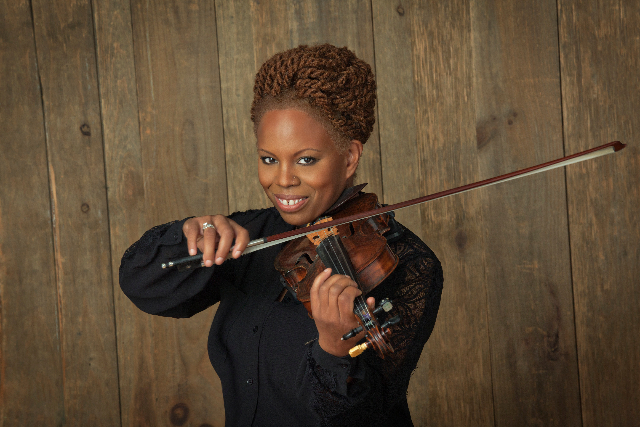
The wonder of music is its ability to combine creativity, passion and history into one collective sound. Jazz violinist Regina Carter showcases this phenomenon in her latest album, Southern Comfort, which explores and honors popular music during her grandfather’s days as a coalminer in Alabama.

Carter will be performing Southern Comfort at the Mondavi Center for the Performing Arts on Nov. 1. The event is part of the Mondavi Center’s Director’s Choice series. The series is a selection of shows featuring performers that Don Roth, executive director of the Mondavi Center, holds close to heart. Roth said he had much respect for Carter’s passion and authenticity as a musician.

“What’s so cool about Regina’s project is that it is a very different kind of music from the [traditional] jazz she’s famous for,” Roth said. “It is ‘roots’ music in the most authentic sense of the word. She’s exploring music that her grandparents knew when they were growing up in the Deep South, but she makes it [modern and] her own.”

Also involved is African American and African Studies professor Elisa Joy White, who’ll be hosting a pre-performance talk alongside Carter.

White said she is excited to discuss Carter’s creative process — namely, how Carter turned her exploration of race, culture and class into sound.

“Students don’t have to know anything about jazz or [traditional folk music] to understand and enjoy [Carter’s music],” White said. “There’s always a sense that [Carter] and her violin are engaging in a very contemporary moment. There is some atavistic memory that comes forth when you experience [her music].”

To compose the historically rich project, Carter joined ancestry.com to reach her relatives all over the nation. Together, they exchanged stories about Carter’s grandfather and pieced together his life.

Carter also listened to field recordings from her grandfather’s time, mainly of solo voices singing traditional folk songs. She found such recordings on the internet and in the Lomax and John Work III collections from the Library of Congress.

Carter said that she easily found an artistic connection with the recordings, which all arrangements from Southern Comfort are based on.

“In a way, it was easier to make arrangements around those recordings,” Carter said. “There’s very limited information [presented], so I could really act [musically] upon whatever I felt or heard. But, the main thing for me was to stay true to the [original melodies of the historic recordings] and not take away from the beauty that was already there.”

While Southern Comfort centers on paying homage to Southern folk songs, you can still hear Carter’s renowned style of incorporating diverse musical elements.

“[My band and I are] approaching this music and bringing to it our experiences,” Carter said. “You hear our experiences, but you also hear melodies from [my grandfather’s] time period.”

Each show will be a unique experience, as Carter will still implement jazz improvisational styles within her performance.

“With Southern Comfort, [improvisation] comes from knowing where this [folk] music comes from and from having heard a lot of music from that era,” Carter said. “[My band and I] are also inspired by each other on stage because, really, what’s going on is we’re having a conversation with one another.”

Overall, the project documents a myriad of memories from Carter’s time spent with her grandparents, to songs she remembers being lulled to sleep to. Regina said that Southern Comfort is a medley of narratives that ultimately shares with listeners a huge part of her heritage and identity.

“If you just heard the music by itself, it might not be a story,” Carter said. “But when we play live, I tell stories in between, which paints a picture [for attendees]. That’s my goal: that the music, in the end, paints a picture and hopefully inspires other people to discover their own ancestry.”

For show and ticketing information, please visit tickets.mondaviarts.org.

Photo by Regina Carter


Edumacation with Calvin and Hobbes: Testing Bad

0

Through policy and culture, the way we test students in the United States has begun to show that we do not assess students on knowledge and understanding as much as we do on memory. The consequences are both economic and personal and relate to problems concerning critical thinking. In the strip above, Calvin demonstrates the predicament. He finds fault in the “system” and the way it values information. Many students would relate to his caustic sarcasm.

To understand the problem of testing, we should understand its function. One part serves to gauge how much a student has learned. The other part allows for categorization — testing is an effective tool with which we can compile rankings, establish grade-point averages and help get a visual standing of a student’s academic progress. These are fair reasons to test.

Nevertheless, testing has its limits, especially in the job market. In a recent New York Times article, Kevin Carey explains two studies conducted by sociologists Richard Arum and Josipa Roska. The first, “Academically Adrift,” suggested that collegiate students learned hardly anything in their four years; critical thinking and analysis suffered the brunt of this stagnation. The second study found that this lack of critical thinking was statistically significant when applied to the job market: students who learned more effectively showed more positive economic signals.

But if tests gauge what we learn, and it appears that we learn nothing at all, what are we left with?

These studies bring us back to an old debate: teaching fact versus teaching skills. Calvin does not seem to appreciate the facts. But what makes him such a unique character is his uncanny ability to think critically on worldly matters. He critiques post-modern art, espouses existential philosophy, examines the consumer culture — no wonder he’s a cynic that holds a remarkably low opinion of others and a superior opinion of himself. It’s hard to call the boy dumb, despite his inability to make four out of two and two. His intelligence is what seems to be lost in traditional testing.

Given that critical thinking is the most effective method of learning, we must learn how to test it properly. A large part of the process comes from experience, interaction and observation. It is active. Our tests should be just as active. Students should be tasked with asking their own questions, and using prior knowledge to attempt an answer. They could write a paper, give a presentation; many subjects will call for different modes of assessment. This form of testing is particularly useful in higher education, where students are closer to the frontiers of their field.

Ultimately, this form of testing would help students beyond the classroom — they would be able to approach ambiguity in the workspace with a greater set of tools. The downside is that it forsakes some ease of categorization. These assessments could fluctuate varying on the professor and different rubrics. But if the final outcome is sustainable knowledge, and a more economically sound workforce, this may not be so bad.

Unfortunately, we live in a multiple choice culture. And multiple choice by itself is a form of expediency and efficiency. In my psychology class last year, I sat in a lecture with 500 other kids. We were never assigned an essay. To give even one essay would mean hours of grading for teaching assistants. It would be impractical. But at what point does practicality become a hindrance to learning? At 500 kids, it seems. I barely remember a thing. At the time, I earned a “B,” and like Calvin, I felt like I played the system. But now, I feel like the system played me.

Education will always be a two-way deal. You need to be open, willing and motivated to learn. But that means your mentors and teachers must meet you with proper guidance and forms of assessment. I put a lot of effort into psychology, but I don’t think I could earn a “B” today. Sure, some things will always be lost, but I honestly feel like I would earn a “D” or an “F.” That’s too low.

Testing is a stressful process any way you go about it. Tests are what affect report cards and transcripts more than anything else. As our society becomes more competitive, the test will need to reflect what students have learned. Students and educators have a dual responsibility to ensure that tests properly assess critical thinking, and that there is a fair way to rank students according to this metric.

To test ELI FLESCH on his knowledge, you can reach him at ekflesch@ucdavis.edu or tweet him @eliflesch.

Tunespoon: The devil’s pitchfork

0

Music criticism ruined music for me.

When I was younger I sought the best music out there. Google led me to Pitchfork.com, which offered its bright, shiny opinions. I trusted them. As uncomfortable as Animal Collective’s obnoxious yelps and screams made me, Pitchfork told me that this was the best new thing to happen to music at the time. My opinion assimilated to theirs.

I listened to pop through their cynical headphones. “Fireflies” by Owl City? Psh, that’s a cliched, emasculated moan of a Postal Service rip-off (I was in sixth grade). I looked back at my old playlists. KT Tunstall? Norah Jones? No, not anymore. I was a new kind of music consumer — a smart one, getting the most value for my allowance dollar — and my impressionable brain would only seek out the best.

However, I soon found out that music criticism’s criteria of best and worst are subjective. One of the most unbearably written and produced records I’ve ever heard, How to Dress Well’s Love Remains, proudly holds an 8.7 on Pitchfork. The review addresses everything I hate about the record — its unintelligible lyrics, soulless warbling falsetto, drenching-wet reverb, lazy melodies — as something to appreciate as different and original. I realized that something was up; there was absolutely no merit to How To Dress Well’s music. For someone else, it was a beautiful, ethereal listening experience.

By the time I was in high school, I consumed music like a competitive eater, taking pride in the sheer amount of music that I bought. But I owned jewel case upon digipak upon slipcase of CDs half-listened to — artists’ work treated with the utmost disrespect of mere cursory attention. My heart broke when I picked up Cat Power’s Jukebox and could only name a single song from it. I was purchasing Pitchfork’s and Spin’s and Metacritic’s recommendations at a too-fast rate. I subscribed to their opinions so fanatically that I had none of my own.

What a burden to maintain my musical identity. I absolutely had to stay above the mainstream… oh God.

I was one of those people. A snob-in-denial corrupted by the devil’s Pitchfork.

Last summer, a much hyped band, FKA twigs, dropped their critically acclaimed debut LP1 to laudatory adjectives like “irresistable” (from The Independent), “euphoric” (Consequence of Sound) and “singular” (Resident Advisor). The album sorely disappointed me. And that was OK. People having their own opinions is a beautiful thing, but no one has the right to brainwash another’s mind. From then on, I strove to master my own opinion.

Now that I’m older and capable of attempting to master my own brain autonomy, I see music criticism as utterly useless. Criticism is the evaluation of the merits of an artistic work. It’s an ever-expanding universe based on human opinion, a troubling concept in itself.

Unlike literary criticism, where a plot hole or out-of-nowhere twist is undeniably poor storytelling, a musical non-sequitur is often billed as “brilliant” or “experimental” (e.g. every Deerhoof album ever). Unlike video game criticism, where glitches are always unwelcome, glitchy and buggy music is “the future” (Aphex Twin, anyone?). Unlike film criticism, where cliches of the past rarely rear their obsolete heads outside of campy homage, many serious artists thrive on the days of yore (Foxygen’s ’60s, Daft Punk’s ’70s, Haim’s ’80s, Jessie Ware’s ’90s).

Quantifying a musician’s art with an arbitrary number rating or letter grade belittles the soul put into it. Even rating-less high accolades are harmful because that pressures the artist into that genre, rendering any aesthetic change dangerous, career-threatening territory (like if John Green exclusively wrote tween cancer dramas). Bad reviews are caution tape, warning many potential listeners to stay away; one man’s trash becomes everyone’s trash if that man is a music critic.

I won’t flog anyone for following a music journal. They might be the best way to discover music outside of the front page of iTunes. Acknowledge, but do not slavishly follow critics. They hold an unwarranted stake in the industry; they are theives whose only asset is their sense of taste. Your sense of taste is just as valid, just as meaningful and just as correct.

Your opinion gets a 10.0 from STEVEN ILAGAN. Share it with him at smilagan@ucdavis.edu!


(Re)Fashioning Gender: The Beauty/Gender Myth

0

Pick up any fashion magazine, and you’re bound to be presented with page upon page of perfect-looking humans flaunting the latest trends. In many advertisements, you may find yourself faced with a very particular type of image (i.e. white, thin, young and beautiful), and the clothing that’s being advertised seems to be only secondary to the narrow sets of beauty standards that are promoted. While it’s easy to skim past these images without giving them a second thought, it’s important to be aware and critical of the images that we’re exposed to day after day. Whether we’re skimming through a magazine, watching television or simply driving past a bus stop, beauty myths become normalized every time we are exposed to them.

Advertisements perpetuating an ideal type of beauty have been around for decades. These images, which are virtually everywhere, are bound to have some effect on our psyches, whether we’re conscious of it or not. In fact, studies have shown that advertisements, which are quick and to the point, have more of a subconscious effect on people than anything else. It’s crucial then to take into consideration just how much the effects of these images impact our understanding of what it means to be beautiful.

Jean Kilbourne says it best in her series of documentaries, Killing Us Softly, as she claims that, “ads sell more than products … They sell concepts of normalcy … They tell us who we are and who we should want to be.” Pair this with her idea that “[if there’s only one way to be beautiful on offer], it can hardly be considered a choice to choose it,” and it’s clear where the body image issues that girls and women face are coming from.

Take, for example, Viti Levu, an island in Fiji where the rise of eating disorders and body dysmorphia were eerily proportionate to the introduction of television. Eating disorders and body image issues were virtually unheard of on the island before television became popular, but after a few years, the percentage of such issues increased phenomenally. According to the Klarman Eating Disorders Center at Harvard Medical School, the percentage of girls on the island who resorted to vomiting to control their weight rose from 3 percent to 15 percent, and girls who watched television frequently were 50 percent more likely to describe themselves as “too fat” than those who watched less television.

It’s not just women who face unrealistic standards of beauty. Men are posed with their own set of standards when it comes to their appearance: They must be shaped a certain way, have the right amount of body hair and be able to live up to the lifestyle that images of men are promoting.

Erving Goffman, a Canadian sociologist who studied how commercial advertisements shape our perceptions of femininity and masculinity, concluded that in many advertisements, women were portrayed as subordinate to men, “relating to them not as equals, but as children to parents.” Although his studies were mainly conducted in the ’80s, his findings are still incredibly relevant today. Women are still often pictured as aloof, in childish positions, self-touching and looking vulnerable or playful. Men, on the other hand, are often portrayed as alert and upright, with much more control over their bodies than their female counterparts.

Studies like these make it clear that there is more than meets the eye in what images in fashion ads perpetuate. With these standards of beauty comes inherent standards of being. Girls must be fragile, delicate, sensitive, coy and infantile, while boys must be strong, assertive, brave and insensitive. This could be why issues of domestic and sexual abuse are so prevalent, or why stereotypes of masculinity and femininity are still largely dominant in the ways we perceive men and women.

It’s easy to flip through a fashion magazine without taking into consideration what we’re actually looking at. While high-fashion and glamor are appealing at first glance, gender stereotypes and notions of unrealistic beauty are often lurking beneath the surface. These notions are harmful in many ways, one of which is the normalization of subordinate women and aggressive men. Being critical of images that perpetuate these sorts of narratives is the first step in changing the ways we approach sexism and other gender-related issues. So next time you find yourself face-to-face with a fashion ad, try looking a little closer and you might find that what’s being sold to you goes far beyond fashion.

To reach CHELSEA SPILLER, email them at ctspiller@ucdavis.edu.


The AB540 and Undocumented Student Center celebrates grand opening

0

102214_AB540CENTER_Nguyen

The AB540 and Undocumented Student Center celebrated its grand opening and ribbon-cutting event Oct. 21 at its on-campus location in the Student Community Center.

In addition to guest speakers, including Vice Chancellor of Student Affairs Adela de la Torre and UC Davis Law School

Dean Kevin Johnson, the event featured cultural dance performances from Danzantes del Alma and a tour of the new center for guests.

“I am really proud that this campus has a very strong visual [and] political statement of what it means to be inclusive. This [center] is a great form of accountability,” said ASUCD President Armando Figueroa. “We talk about diversity every day [on this campus], and we finally put our money where our mouth is.”

In 2001, the state of California passed Assembly Bill 540 as an addition to the existing California Education Code. According to the AB540 website, the legislation created an exemption for certain non-resident students from paying non-resident college tuition. Specifically, students who have received a high school diploma in California qualify for this exemption.

Out of 240,000 students in the UC system, 2,000 are undocumented. At UC Davis alone the number of undocumented students has tripled from 70 enrolled in January 2012, to over 200 enrolled in fall of 2013.

“Seeing such a large group of people makes me realize how much this center is needed. It’s exciting to see the support and the interest,” said Andrea Gaytan, AB540 and Undocumented Student Center director. “I think the [number of AB540 and Undocumented student applicants] will definitely increase because of the variability in funding.”

The event not only celebrated the center’s presence as a new resource for AB540 and undocumented students on campus, but also the hard work and collaborative effort of students, staff and faculty to reach this point.

Ana Maciel, academic coordinator for the AB540 and Undocumented Student Center and a third-year Chicana/Chicano studies major, was one of the lead proponents of the center.

According to Maciel, the proposal for the center was in the works since December 2013. By June 2014, plans were already in motion to open by the beginning of the new academic year. The center officially opened its doors Oct. 6.

“It speaks dear to my heart about student voice and student power and how it’s crucial to a movement to getting something done and to getting a center fully established,” Maciel said. “A few of us actually wrote the proposal…it’s something we’ve been working for for a really long time, not only with us, but students before us started the conversation.”

The grand opening was met with much enthusiasm from the audience of students and faculty alike.

“I think it’s historic. This is a project that the entire UC system is undertaking. I’m glad UC Davis could be at the forefront of that,” said ASUCD Senator and third-year political science and history double major Gareth Smythe. “I think obviously from the testimonials we heard today, it is going to benefit a lot of Aggies that until now have been afraid of their identity, and if I’ve learned anything here in my position, it’s that you shouldn’t be afraid of your identity.”

The center’s outreach intern, Jesus Flores Rodriguez, a second-year political science and psychology double major, adds that the center is not only a resource for college students, but also for AB540 or undocumented high school students.

“My struggles in high school were so impactful and so challenging that I felt like I needed to inform other high school students and make a change. I want to be that change,” Flores Rodriguez said. “As an undocumented student, my first year when the center was not established, I gathered a lot of resources and support groups. I plan to utilize that to my advantage and provide students with that information. I don’t only want to be a speaker, I want to be that person that students can relate to. Personally or academically, I want to be that support.”

Likewise, Maciel sees the center as a “radical change for the better” from when she began college with no readily available resources and countless barriers. She says it has gotten much easier relative to her first year and that the center’s staff hope to utilize the center to provide resources to students and their families.

“[AB540 and undocumented students] do have different barriers. If we want to pursue a masters or a Ph.D, we don’t have all the resources that the traditional college student has, so [we’re] really bringing awareness to that,” Maciel said. “We want to make sure that families are also included in the center because families play a crucial role in the academics of their sons and daughters. We will be tying in both of those relationships and creating workshops that make the center a safe space and make UC Davis a safe space.”

Smythe says he looks forward to working with the center and that its establishment is important to creating a supportive environment on campus.

“I think undocumented students until now have been afraid. Afraid of their status, afraid of coming out and saying ‘this is who I am, this is the type of student that I am,’” Smythe said. “I think just having the center exist and having it have a place in the SCC says, ‘UC Davis is committed to supporting you.’”

The center is an educational resource for all students. Maciel encourages everyone to learn about  the stories of the undocumented students at UC Davis and to visit the center.

“If you can relate to someone on a more personal level, I think it makes it all so much more real, so much more personal — because for a lot of people it’s not a topic they think about or it’s taboo. But just being open to the topic and just listening to undocumented students and what they have to say is crucial,” Maciel said. “Everyone is welcome at the center. It is for everyone. Just walk in, ask questions if you need to. The resources are there for everybody.”

Photo by Brian Nguyen  


Ideas, grants and public benefit continue to drive research

0

The University of California system prides itself on its leading role in worldwide research, and the UC Davis campus is no different.

From tenured faculty and graduate student projects to on-campus research institutes and the Undergraduate Research Center, UC Davis serves as a major contributor to the UC system research pool.

“[Faculty are] constantly doing research. One of the reasons we’re called a research university is [because] that’s really what it’s about,” said Molly McCarthy, associate director of the Humanities Institute at UC Davis. “The expectation is that our tenure-track faculty, assistant, associate and full professors are doing research all the time. They are researchers; they are scholars who also teach. They live and breathe their research. They do it when they’re not teaching, they do it when they’re teaching.”

Darrene Hackler, executive director for Humanities and Arts Research Development in the UC Davis Office of Research, said that professors are evaluated each year under certain categories, including teaching and research. At a research university like UC Davis, research is weighed more during evaluations than at other institutions.

“If you go on to graduate school, most likely you’ll have a master’s thesis, you’ll have a dissertation — and a lot of that work often builds your body of research, of which your questions might come out of for early work,” said Hackler.

For many researchers on-campus, projects start with an idea, and ideas can come from several sources.

“Ideas for humanists and social scientists come out of conversations that they have with their colleagues and [rely] on some of the work that they had done in the past,” McCarthy said.

Once an idea is proposed, there are multiple possible sources for research funding, including the federal government, the state government, private institutions and private corporations.

“We’re one of the leading research universities in the United States,” said William Lacy, a UC Davis sociology professor and founding vice provost of University Outreach and International Programs. “Just in the last 15 years since I’ve been here we’ve gone from about $250 million annually, which is a fairly significant amount of money, to $750 million annually. Most of that money comes from the federal government through competitive grants where our scientists compete with scientists all across the country, and we do very well, because we have very good scientists.”

In the fields of humanities and social science, research is often done on an individual basis, with faculty coming up with their own ideas and doing the work on their own. Some apply for grants to fund time away from the university or travel to other places for new materials and research perspective.

“We’ll send out funding notices, which are opportunities for a person to submit a proposal in this themed area that we think a professor is doing research in already,” Hackler said. “How much can they adjust their research question and their research interests to what that funding notice is about is also something they have to decide as an individual researcher.”

In most cases, humanities and social science research does not have to go through the university’s Office of Research, as the office is not concerned with these types of grants. On the other hand, scientific research proposals, which might include the use of UC Davis resources and be subject to ethical concerns, are screened by the Office of Research.

“If you’re submitting a grant proposal from any agency on behalf of the University of California, it has to go through the research office,” Lacy said. “It has to be reviewed to meet [UC Davis’] policy standards.”

Lacy also mentioned that private corporations only provide around 10 percent of the university’s research funding, and there are policies in place to make sure that the goals of private companies overlap with the goals of the public university.

According to Hackler, funding for scientific research often exceeds funding for humanities and social science research, simply because it is cheaper. Whereas scientific research is often a collaborative effort, requiring several people’s work and space, McCarthy said humanists’ and social scientists’ greatest need is time.

The product of research can also take many forms, each with a potential benefit for the university. On the scientific side, the product might even be a patentable invention or discovery, in which case there is potential for commercial development on top of contributing to the field in a larger sense.

“The university is an academic institution. It’s not oriented toward commercialization, but it is oriented toward technology transfer,” said David McGee, executive director of InnovationAccess at UC Davis, a patenting unit within the Office of Research. “One of the missions of the university is public benefit through research and education. The most fundamental and by far the largest amount of technology transfer that occurs at the university is publication of research results. The faculty are oriented toward conducting academic research, not toward coming up with commercial ideas that are going to get licensed to make money.”

Commercialization of a product may not be the goal of the researcher, but McGee pointed out that it helps to compensate the university for the cost of the research while giving recognition to the researchers in the form of 35 percent of the net revenue from the product.

“We average about 200 inventions disclosed to this office a year. I’m sure there are more potentially patented inventions that are not disclosed to us, but that’s simply because faculty do not necessarily realize that they have a discovery that may be potentially patentable,” McGee said. “We try on a continuing basis to educate faculty and staff about what is a patentable invention [and] how to disclose the invention to us. It’s an ongoing education process.”

Patenting not only helps with compensation through commercialization, but is also an important part of benefiting the public with discoveries by UC Davis researchers.

“The idea is to take the knowledge and put it to work, to get it out there, and one of the arguments for patenting is if you don’t do it, it doesn’t get extended because nobody will take the risk of generating something that somebody else can steal,” Lacy said. “The investors take it to the next step. You can do the basic research and the applied research, but somebody has to develop it. If the intellectual property is not protected, then the investor doesn’t have an incentive to develop it, [and] then some really good technology or knowledge doesn’t get extended to society.”

In terms of the humanities and social sciences, researchers might write books or articles which further discourse in their field and contribute to the reputation of the university.

“A lot of our department building within the humanities and others is [because] we want faculty who are really well-respected, have good reputations and are leaders in their field of research,” Hackler said. “The whole idea is that we want to attract faculty that are going to attract the students who want to study with them, especially as they go on through a master’s and Ph.D. type of program, and those individuals that go out and get jobs in academia or other jobs that would point back to UC Davis having a really great program.”

East Covell to receive road upgrade

0

On Oct.7 City Council approved a plan for the East Covell Corridor. The plan will help to improve traffic flow, increase safety for cyclists and pedestrians and adapt for the increase in population from The Cannery, the housing and business development currently under construction off of East Covell.

Development of the East Covell Corridor Plan (ECCP) began in 2012, when The Cannery applications were submitted. In the final development agreement, The Cannery agreed to the funding of infrastructure accommodations that would have to be made for the influx of people moving into the area.

“The Cannery development was the impetus for taking a look at the East Covell Corridor. We try to take into account what the trip generation is going to be like and how we can develop the infrastructure to accommodate all modes of transportation, but giving special attention to the vulnerable user, which [are] bicyclists and pedestrians,” said David Kemp, active transportation coordinator for the City of Davis.

Before the plan was conceived, the City of Davis hired two separate companies to assess East Covell from F Street to Birch Lane — The Dutch Cycling Embassy and Mobycon, a consulting group from the Netherlands that specializes in active transportation and “place making.”

After both companies gave their input, the current plan was designed, presented to and approved by City Council on Oct. 7.

The City Council’s staff report, dated Oct. 7, differentiates the changes to be made by placing them into three categories for the improvement — immediate, near-term and long-term. The immediate improvements will take place over the next 12 months, the near-term in one to three years and the long-term in three years or more.

The immediate improvement category consists of installing Dutch junctions at both the L street and J street intersections.

A Dutch junction is similar to a regular intersection, but is adapted to improve safety for cyclists and pedestrians. Instead of cyclists having to come over from the bike lane to a lane situated between forward-moving traffic and a protected right turn, as in a traditional intersection, the cyclists remain next to the curb. Small cement barriers will be situated on every corner protecting the turning cyclist from a simultaneously turning car. Additionally, this will keep cyclists out of the way of pedestrians waiting to cross, because cyclists will have their own crossing paths.

“It has a few bells and whistles that make it a little safer for cyclists and pedestrians,” Kemp said.

For the near-term projects, the plan outlines a two-way cycle track along the south side of East Covell, a raised crossing at the entrance for the Oak Tree Shopping Center. As well as installation of buffered bike paths and improvements to the shared-use path on Birch Lane.

The funding for all of these improvements are coming primarily from The Cannery, as well as community enhancement and road improvement fees and grants the city will potentially apply for.

According to Bonnie Chiu, the forward planning director for The New Home Company and developer of The Cannery, although some of the ECCP is being funded by The Cannery, “The improvements and the prioritization of improvements within the ECCP will ultimately be the Davis City Council’s decision.”

The New Home Company plans to work with the City of Davis on whatever improvements they choose to implement.

One such choice, categorized as near-term, is the H Street Tunnel crossing. The reason that this improvement pending is because in order to make a safer crossing for cyclist using the H Street tunnel, the City of Davis would have to acquire some property from the Cranbrook Apartments and the Pinecrest Apartments.

Chiu said that The New Home Company would prefer the City of Davis decide to make the crossing under Covell and connect to the existing bike path on the south side of Covell because it takes fewer accommodations and it would be done sooner.

“We want new residents at the Cannery to have this amenity in place or under construction early on so they can opt to use the bike path as part of their daily travel if they choose,” Chiu said.

Mayor Dan Wolk said that the City Council would like to make the H Street tunnel crossing if at all possible.

“Physically, it is a little tricky to get down to that H Street crossing, but council wants to keep pursuing it. But if that doesn’t work the council will have to decide if they want to loop the path around eastward and back to the overpass on the south side — but I think it is safe to say that the council still wants to use the H Street tunnel,” Wolk said.

He added that he encourages students to get involved and give their input on the ECCP as it is their community that will be impacted by this plan.

“Our plan is a huge step in addressing these challenges but we still have a ways to go,” Wolk said.


News in Brief—Aggie Surplus renovations in progress

0

Aggie Surplus, formerly known as the Bargain Barn, recently underwent renovations to bring in more student traffic and update the overall aesthetic appearance of the facility. These aesthetic renovations have varied from painting walls and redoing flooring to rearranging the store display.

Aggie Surplus specializes in the sale of marketable items that are either sold or donated to the facility for resale. Some of these items include office supplies, technological supplies, mattresses and blankets from student housing and dorms and video games from the game area in the Memorial Union.

Typical student supplies such as laptops, cell phones, computer batteries and other technological supplies that are typically more expensive can be found the the sales floor.

According to Aggie Surplus coordinator Michelle Belden, the new name and logo were created in the hopes of encouraging more student involvement and traffic. Belden said that the new name has the potential to “foster some Aggie Pride” and more closely associate the facility with the campus and UC Davis students. UC Davis students have played a vital role in the revamping of the Aggie Surplus facility since the project began last school year. The Aggie Surplus logo was designed and created by various students in the design department on campus. There are also six student employees that work part time on the sales floor in addition to a full time staff.

According to Larissa Whelan, a former student employee at Aggie Surplus and UC Davis student, she was surprised by how little the student body appeared to know about Aggie Surplus while she worked there.

“This business is where you can get free binders and file folders, where recycling and reusing coincides with a person getting an item they love and where regular customers quickly learn each other’s names and become part of this community,” Whelan said.

According to Whelan, the facility provides both students and community members with various items at a lower price and is an beneficial employment opportunity for students on campus that many may not know about.

“It’s really more than just a surplus store. It helps employ students, decreases the amount of waste that goes into the landfill, and gives a sense of community to those who both live and don’t live in Davis,” Whelan said.

Non-profit organizations are also able to register with Aggie Surplus to receive excess materials that are donated. According to Belden, this list serve plays a large role in diverting waste and working towards sustainability.

Photo by Kenny Cunningham

UC Davis Police Department makes major effort to enhance campus safety

0

saferide_ca_Wu1

The UC Davis Police Department (UCDPD) is currently implementing new programs, while also revamping existing ones, to promote student safety on campus. Pushing to better serve the campus community, the department has been working on several projects to be released this fall.

Safe Rides, the police escort service, has previously provided students transportation around campus during late hours. The free service is now extending its hours as well as its drop-off limit. Campus-to-campus transportation still runs from 5 to 10 p.m. Beginning Oct. 20, however, students have been able to request rides from campus to anywhere within the city of Davis when Unitrans stops running from 10 p.m. to 6 a.m. For the first time, more than one vehicle will be employed, in hopes of reducing wait times.

Safe Rides is an inclusive service that now offers 24/7 VIP wheelchair transportation around campus at UC Davis. Off-campus VIP service runs the same hours as Safe Rides seven days a week. Escort services previously operated with a vehicle that was not wheelchair accessible. With a 12-passenger van, 8-passenger van and wheelchair assistance vehicle, UCDPD can provide safe transportation for all UC Davis students. The department also ordered a multi-purpose six-person golf cart with wheelchair access.

According to UCDPD Chief Matthew Carmichael, escort ridership was low, with approximately 7,000 to 8,000 student riders last year. In addition to negative feedback from students, Carmichael said that the vehicle’s graphics were unclear to those unfamiliar with the service. With police sergeant Ray Holguin’s graphic design of Gunrock on the doors, however, Safe Rides’ vans are visually noticeable. Safe Rides anticipates an increase of 20,000 in ridership because of all its improvements.

“We’ve had the Safe Rides program for years, but as we studied it last year we [realized that we] were falling short,” Carmichael said. “Students were walking because the wait time was too long, calling the dispatch center was cumbersome and then [calling] back to get an update was difficult. So with the technology in addition to the vehicles, this is one of our ways that the police department can proactively combat sexual assault on campus.”

Escort vehicles are operated by Aggie Host security officers who have all been fingerprinted and background-checked and are California DMV pull system-compliant. Each van will utilize DVD players to play safety and incident reporting tips during the rider’s drive.

Also in development is a smartphone application called TapRide, in which users can request Safe Rides services on demand and view wait times and vehicle locations. The app requires users to log in with their Kerberos username and password to electronically verify all riders as UC Davis affiliates. Real-time tracking will allow users to see the closest shuttles and all requests will be sent directly to Aggie Host drivers via iPad. The aim of the application is to alleviate the inconvenience of having to contact the non-emergency dispatch line for ride requests, although the line will still be accessible for non-smartphone users. Other universities, such as Oregon State and Northwestern University, already utilize TapRide. The app is currently available to download and UC Davis is to launch its services shortly.

Striving to strengthen the relationship between the campus community and the department, the UCDPD implemented a 10-foot rule in high frequency areas on campus. Public safety personnel will serve as a friendly presence by acknowledging and greeting those who are within 10 feet of them.

“We are really going to target making contact and allowing the community and our department to get to know each other through highly congregated areas during the business day,” said Benjamin McNulty, Aggie Host Security division manager and a UC Davis alumnus. “We want you to know that we’re there and that we’re here to help — and that goes for faculty and staff also.”

McNulty hopes the increase in personnel presence will act as a crime deterrent as well.

Photos by Jennifer Wu

Although research building patrol has already been in effect for approximately 18 months, critical building checks will be conducted more frequently and student Aggie Host Officers are pushing to patrol the 24-hour Reading Room twice an hour.

“To sum up this entire program, it’s students serving students,” Carmichael said.

This boost in security calls for an increase in Aggie Host Officers and the department anticipates going from the current number of 120 officers to hiring an additional 15 to 30.

The department is also bringing some new energy to its patrol staff in the form of Officer Charlie, a 3-year-old Labrador-retriever mix specializing in explosives detection, article searches and obedience. Charlie was rescued in the Davis area by a private training group called Law Dogs, and UCDPD adopted him on Sept. 1. Charlie had no prior training before his eight-week program to become a working K-9. As a recent graduate of the program, Charlie can detect any item as small as a hair pin with human scent. He will support the Yolo County Bomb Squad, conduct sweeps at large events and make appearances at places such as the UC Davis Children’s Hospital. The department hopes that beginning in November, Charlie will host nights in the dorms for students missing their pets back home. Officer Charlie’s official welcoming event will take place on Nov. 4, from 11 a.m. to 1 p.m.

“We’ll be there from a safety standpoint, but then also stick around to interact with the campus community,” said Officer Kevin Skaife, a UC Davis alumnus.

Additionally, the UCDPD is revamping its Volunteers in Police Service program. Although VIPS has existed for just under two years, the department is granting the volunteers enhanced responsibilities, such as collaborating with Aggie Host. UC Davis students in good standing may receive up to two units of credit per quarter depending on the amount of hours worked.

“They help with anything and everything from assisting the front desk, [helping with] evidence and riding along with officers,” Holguin said. “This is an opportunity for students interested in public service or law enforcement to work at a smaller agency and get one-on-one time with officers.”

Last Wednesday, Oct. 15, members of the campus community were invited to attend a lighting walk hosted by campus Utilities and the UCDPD. Participants were led around the campus at night to identify areas significantly deficient in lighting, to further address campus safety.

Stickers not quite sticking


On Jan. 17, just one day after University of California President Janet Napolitano set a UC systemwide goal of decreasing on-campus water use by 20 percent by 2020, Governor Jerry Brown declared a “drought state of emergency” in California.

One month after UC Davis initiated the Drought Action Plan — a long-term program designed to invest in water-conserving appliances, implement “green” work habits in university facilities (e.g. Student Housing, Dining Services, laboratories) and eliminate water-wasting behavior on campus.

ASUCD passed Senate Resolution No. 16 this past February in support of the DAP. The resolution acknowledged the need to reduce water usage on campus and it encouraged UC Davis administrators to take action against hydro-waste, leading Chancellor Linda P.B. Katehi to email the UC Davis community about water conservation. We appreciate ASUCD for increasing DAP awareness to the larger UC Davis population.

Recently, the Sustainable Resource Organization (SRO), a UC Davis student club dedicated to environmentally sustainable practices, became involved with the DAP in an attempt to support water-conservation among the student body. The SRO implemented a “Save Water” campaign, in which they placed stickers designed to raise awareness about reporting leaks in bathrooms and near other water-extraction sources.

Along with the sticker campaign, the DAP was used to expand publicly-accessible online information about the drought, implemented water-sustainable training to on-campus staff – especially in Student Housing and Dining Services – and continually reminded the UC Davis community via email about ways to reduce water waste.

Although the UC Davis administration is taking positive steps toward decreasing water use significantly, many students are still unacquainted with the DAP and/or are unaware of how they can conserve water.

With the knowledge that California is suffering from one of the worst-ever recorded droughts, our hope is that UC Davis students get the information they need in order to live water-savvy and ultimately help pull California out of its environmental state of emergency. The sticker campaign, as encouraging as it is, has yet to “stick” in the minds of students’, and we believe more aggressive action by the UC Davis administration, SRO and ASUCD through increased on-campus advertisement about the DAP will push students to live more sustainably.


This week in women’s sports

0

Cross Country:

Santa Clara Bronco Invitational

NCAA Pre-Nationals

The Aggies sent freshman Elizabeth Greid and sophomore Kazune Shidara to the SCU Bronco Invitational. They finished in 45th and 64th place respectively.

Meanwhile, UC Davis struggled in the NCAA Pre-Nationals and only junior Christine Hoffmann finished inside of the top-150 individually. Hoffmann finished in 21:10 minutes for 17th place individually and has now led the Aggies in every race that she has competed in.

Field Hockey (4-10):

UC Davis @ University of Pacific

On Oct. 12, the Aggies faced University of Pacific and won 2-1 at home. The rematch game on Oct. 18 seemed to be going in the same direction as UC Davis led 2-1 with only a few minutes to go. Instead, the UoP Tigers scored with 2:59 seconds left, took the game into overtime and saw the game-winner splash into the net six minutes into the overtime period.

UC Davis outshot their opponent 14-10 but could not capitalize on their numerous opportunities. Sophomores Augusta Singh and Kayla Wigney scored the two UC Davis goals.

Golf:

Stanford Intercollegiate

Facing off in their last tournament of the fall season, the Aggies finished in 13th place out of a 17-team field, including six other teams in the national top 20. Sophomore Paige Lee and junior Andrea Wong paced the team on the final day of play, shooting a 2-under 69 and par-71, respectively.

Lee finished the tournament in 24th place individually while Wong ended in 43rd place. No other Aggies finished inside of the top 55. UC Davis will not play again until February 2015.

sp_thisweekinsportswomen_Lin2

Soccer (4-10-3):

UC Davis @ CSU Northridge

UC Davis @ Long Beach State

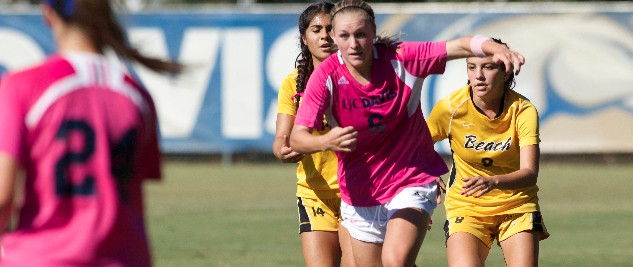
After a strong stretch that saw the Aggies tie three and win one game, UC Davis has lost their two games on Oct. 16 and 19. The first, an away game against CSU Northridge, started slowly before seeing the Matadors blow open the game with a three pointer during the second half. The Aggies took seven shots but missed all of them, whereas Northridge was able to successfully counter-attack against a scrambling UC Davis squad on the offensive.

While the second game of the week against Long Beach State was more manageable, the Aggies were still unable to finish possessions with goals. UC Davis was able to hold the 49ers to two shots in the entirety of the second half but could not overcome the one goal deficit that they faced at halftime.

Swimming & Diving:

UC Davis vs. San Jose State (S/D)

UC Davis @ University of Pacific (S)

In their first meet of the season, the Aggies fell to the visiting Spartans by a score of 172-128. UC Davis was still able to score wins in several events. Senior Samantha Shellem won the 200 meter freestyle, junior Hailey Ferko finished in first in the 100 meter breaststroke and freshman Courtney Schultz won the 50 meter freestyle with a time of 23.79 seconds. Meanwhile, sophomore Hilvy Cheung finished first in both the 100 and 200 meter butterfly. The diving team also had a strong showing, taking 2nd through 6th-place.

Cheung continued to dominate against Pacific, winning the 200-meter butterfly and individual medley while also taking part in two winning relays. Sophomore Elise Roberts also scored two victories, winning the 200-meter breaststroke and a relay. This dual-match was not scored.

Volleyball (9-10):

UC Davis @ Cal State Fullerton

UC Davis @ UC Irvine

After splitting the first four sets of their match against Cal State Fullerton, the Aggies scored a hard-fought victory with a 15-13 score in the last set. UC Davis saw a phenomenal performance from junior outside hitter Kaylin Squyres who finished with a career high of 25 kills and 20 digs. The match ran for just under two and a half hours and extended a season-high four game win streak.

Unfortunately for the Aggies, that winning streak quickly ended at the hands of the UC Irvine Anteaters who bested UC Davis in straight sets. The first two sets were extremely close, finishing with scores of 28-26 and 26-24, but the Aggies were unable to close out either for a win. The last set, a 25-16 loss, saw the Anteaters dominate throughout.

After two more away games, the Aggies will return home for six out of their last seven regular season games.

Photos by Katie Lin