53.5 F
Davis

Davis, California

Tuesday, December 23, 2025
Home Blog Page 845

Men’s Team of The Quarter: Men’s Golf

0

UC Davis men’s golf team started off the 2013-14 season with its goal to return to the postseason. The Aggies eventually accomplished their goal, making the Big West Conference Championships once again and even making their first appearance in the NCAA Championships since 2012.

The team performed impressively and put together an exceptional 2013-14 season. At the El Macero Classic tournament, UC Davis, led by senior Matt Hansen, won its first title of the season. Hansen finished first and picked up his second career win.

The success continued as the Aggies went after their third Big West Championship over the past four years. Last season, UC Davis finished a close third to Pacific and Cal State Fullerton, which tied for first place. This year, with the team’s efforts, the Aggies finished second and Hansen finished first. This marked his second tournament win in a row.

After finishing second in the Big West Conference, UC Davis was selected for the NCAA Auburn Regional and was given the 11th seed. Eventually, the team finished with a tie for ninth place, and sophomore Luke Vivolo’s strong finish put him in tie for seventh place in the final individual standings.

As one of the leading players, Hansen played many great rounds and helped the team become better and better. With his impressive performance this season, Hansen won the UC Davis Athletics’ top student-athlete award for the 2013-14 season and was named to the Division I PING All-West Region team for the second time in his career. In April, Hansen was honored to the All-Big West Men’s golf first team while his teammate, sophomore Ben Corfee, received second-team recognition.

For the outstanding work the UC Davis men’s golf team has done this season, The Aggie chooses men’s golf as the Men’s Team of the Quarter.

JANET ZENG can be reached at sports@theaggie.org.

Fifth annual Tour de Cluck Bicycle Coop Crawl huge success

1

The fifth annual Tour de Cluck Bicycle Coop Crawl took place on Saturday, May 24.

This collaboration of Davis Farm to School, Yolo Farm to Fork and other sponsors and participating businesses bring a chicken-centered community activity to the City of Davis.

The City of Davis is well-known for its flat ground that is suitable for biking, exemplified by the city symbol of an old-fashioned bike. Similarly, the land surrounding Davis are vast areas of farmland; UC Davis is referred to mainly as an “Ag school.” The two concepts of agriculture and biking come together in this Davis-oriented family event.

“The event is a fundraiser to benefit the programs of Davis Farm to School and Yolo Farm to Fork, non-profit organizations supporting farm-fresh and local produce in school lunches, school gardens, elementary school farm visits and recycling and composting programs,” said Beth Harrison, executive director of Yolo Farm to Fork.

This year, the proceeds from ticket purchases and sponsors benefited the Davis Farm to School and Yolo Farm to Fork programs, with a shared mission of supporting farm-fresh school lunches, farm visits, garden programs and recycling.

According to their website, the mission of Yolo Farm to Fork is to educate the public, especially children, about the value of a farm to table community food system that also teaches us to value the environment. Davis Farm to School is a project of Yolo Farm to Fork, specifically working to create an educational and cultural environment in our schools that connects food choices with personal health, community, farms and the land.

“Davis Farm to School values good nutrition and has always had a desire to help the community understand and appreciate our local agriculture,” said Dorothy Peterson, founding chair of Davis Farm to School. “With Davis being a bicycle town, we came up with an idea of bikes and chickens for a ‘Coop Crawl’ for Tour de Cluck. With May being Bike Month and the idea of a chicken riding a penny farthing evolved into our logo. Over the years, Davis has supported what is now a successful fifth Tour de Cluck.”

The Tour de Cluck signature event is the Coop Crawl — an excursion around Davis, in which all participants travel by bike. Starting at the Davis Farmers Market in Central Park, there are all sorts of exhibits and activities by the Bicycle Hall of Fame, the Fowl Food Fair and the Community Crowers on the Green.

“Local restaurants (Fowl Food Frolic) prepare signature fowl dishes for two weeks to show the skills and talents of local chefs, Chicken Skool introduces education to a little known subject to inform novices about good chicken raising practices, and Community Crowers on the Green are groups and businesses that are showcased at the Davis Farmers Market to share valued information that center around the Davis Farm to School messages of good nutrition, waste management and growing their own food in school and home gardens,” Peterson said.

Many popular Davis hotspot eateries have shown support for this cause by their participation in the “Fowl Food Frolic.”

“Dos Coyotes was the first restaurant to support the Davis Farm to Fork program. It is the Dos mission to help with food literacy as well as teaching kids to eat healthy foods,” said Bobby Coyote, founder and owner of Dos Coyotes.

All of these Davis restaurants have local roots and exhibit their support for the Yolo Farm to Fork message by brandishing the Tour de Cluck emblem. Portions of chicken-related dishes bought at these establishments will go towards funding the Tour de Cluck cause in the last two weeks of May.

“The Symposium is very happy to be taking part in the program,” said Yanni Pendelos, owner of Symposium. “We feel that the more people understand their food supply chain, better, healthier decisions can be made about what they choose to eat. Symposium always tries to buy local and fresh, not always easy, but nonetheless important.”

The businesses of Davis come out to show their dedication to benefitting the people in their community.

“Since day one we’ve been a passionate supporter of any effort to help our kids get excited about eating healthy, delicious foods (which tend to be produced by our big hearted neighbor farmer friends),” said Pru Mendez, chef and owner of Tucos. “We’re so proud to be a supporter of the pioneering efforts of Davis Farm to School!”

SHANNON SMITH can be reached at city@theaggie.org.

UC Regents plan to improve transferring process

0

University of California (UC) Regents published a report on May 15 addressing a plan to ease the transferring process from California community college students into the UC system.

This report followed UC President Janet Napolitano’s November 2014 address to UC Regents regarding upcoming plans for the UC system.

“The University [UC system] must reexamine how we interact with community college transfers,” Napolitano said. “Many California students begin their higher education journey at a community college, yet yearn for the opportunity to earn a four-year degree. We must continue to support the access and success of the diversity of the California community college population.”

The report entitled “Preparing California for Its Future: Enhancing Community College Student Transfer to UC”examines current issues surrounding the process of transferring into a UC school and details proposals to enhance the situation. These solutions have been imagined via collaboration of students, faculty, staff, the California State University (CSU) system and California Community Colleges (CCC).

“Transfer students who enroll at UC repeatedly demonstrate their ability to succeed, posting high graduation rates comparable to freshmen who began college at a UC campus,” the report stated. “Despite these achievements, the transfer process can be challenging, sometimes preventing otherwise promising students from meeting their goal of earning a four-year degree.”

The connection between UC and CCC is unique to California among national “selective research universities,” the report stated. While a majority of these prestigious institutions let in comparatively few transfer students from community colleges, about one-third of transfers enrolling in a UC in any given fall term started at a California two-year community college.

UC has found that these students perform at a high level, often just as well as UC freshmen, and have confidence in the level of education CCC offers. For this reason, UC hopes to expand their reach to CCC transfer applicants.

The current issues regarding UC transfer students include a lack of diversity and large percentage of students coming from only a handful of colleges.

Gov. Jerry Brown acknowledged that increasing transfer students into the UC system would benefit the state and save money by drawing in greater numbers of low-income and minority students.

According to studies conducted by UC Corporate Student System and California Community College Chancellor’s Office, minority transfer students enrolled in the UC system during the 2012-13 academic year at a rate of 3.6 percent African American, one percent American Indian and 21.3 percent Chicana/o or Latina/o. Furthermore, a lack in demographics “traditionally underrepresented in higher education,” including low-income and first-generation college students, was reported in UC transfer students.

Furthermore, Napolitano cited in her November address that 75 percent of UC transfer students transfer from one-third of California’s community colleges.

In order to diversify the UC community, the report details plans to increase UC presence at every CCC.

“Such an approach would expand the University’s presence in more underserved communities and increase students’ and counselors’ access to services and programming,” the report stated. “In order to instill confidence among community college partners that UC will maintain such a presence, programs must be supported by a system-wide commitment to a long-term, multi-pronged strategy that contributes to diversifying the transfer pool and encouraging those in it to matriculate at UC.”

Additionally, the UC identifies a lack of ease and transparency for transfer students during their application and course planning process.

“I wish I would’ve known more about transferring before I did it,” said Mallory Bonnema, a third-year human development major who transferred to UC Davis Fall Quarter 2013. “I wish that somebody had told me about the negative aspects of it and warned me that the first year would be rough.”

Regents seek to lighten the burden for transfer students by streamlining transfer pathways and creating “transfer-affirming cultures.”

“The [UC] Team believes that the institution must provide clearly defined and articulated pathways that delineate a road map for student transfer and completion of the baccalaureate degree,” the report stated.

However, some students are opposed to an easing of this process.

“I feel that the application process for transfer students shouldn’t be any easier than the process for incoming freshmen,” said first-year English major Amanda Leanne. “The measure of intelligence or ambition should be valued the same amount for any student attempting to go to a UC. I feel that transfer students already have an advantage from having more experience in life and in education. So if anything, the process should be more difficult or the same, but definitely not easier.”

After experiencing a slight decrease in transfer student applicants for the upcoming term, according to the fall 2014 Undergraduate Applications Fact Sheet, UC hopes their plans will expand applicant numbers and enhance the undergraduate experience for transfer students.

BRENNA LYLES can be reached at city@theaggie.org.


Davis Nugget Markets aim to support local school garden programs

0

In the past two months, the Nugget Markets and Davis Farm to School and Yolo Farm to Fork have been awarding schools with ‘stellar garden programs’ across Yolo County. These organizations have been working to provide everything from workshops, grants for gardens in schools and supplies to supplement school-based garden learning.

The Nugget Markets is a family-owned upscale supermarket chain operating within the greater Sacramento metropolitan area headquartered in Woodland, Calif. Davis Farm to School and Yolo Farm to Fork are both non-profit organizations aiming to create an educational and cultural environment in local schools that connect food choices with personal health, community, farms and the land.

The schools, which received the awards in late April, were Holmes Junior High, Davis School for Independent Study and King High School in Davis, and Plainfield Elementary and Dingle Elementary in Woodland.

The criteria for winning were that of demonstrating effective, innovative and creative educational experiences through the school garden program. The schools chosen were able to provide several practical learning activities involving many subjects and classes in order to paint a unique and clear vision for the garden’s future and plans for sustainability for local students.

Dorothy Peterson, a representative from the Davis School of Independent Study (DSIS), believes that children have different ways of learning.

“DSIS affords their students to approach learning that best meets their needs at this stage in their lives. DSIS has created a way for the garden program to be a part of their educational experience regardless of what is being studied,” Peterson said.

Peterson adds that she believes all knowledge comes from books or the web and that hands-on experience is the best way to integrate a young mind without boundaries. She hopes the gardens will influence students to further appreciate California’s local and seasonal agriculture.

“Gardens in schools can not only assist with expanding the curriculum, but can provide a vehicle to see how things are grown within their own environment on the school grounds. I’ve discovered over the years in working with students in the garden, if they grow it, they will at least taste it. Eating and sharing a meal is a social and educational experience,” Peterson said.

King High School is a continuation school that specializes in credit recovery. It helps students who are at risk of dropping out but may want to graduate from high school. The school presented the garden as a club that incorporated cooking rather than a graded class.

“[The club] allowed the students to have an opportunity to participate as much as they were willing without the commitment of a class with grades. Also, we made sure that we used veggies from the garden or from the store that were farm fresh — one of the building blocks of Nugget Markets,” said Karey Spivey, a teacher at King High School.

Next year, King High School hopes to start the year with more organized curriculum starting with composting, harvesting and irrigation. They want to inspire students to move into careers involving farming and green energy. They are also working to include students in field trips that include farms, grocery stores, restaurants and recycling centers so students can see where vegetables start and eventually end up.

At Dingle Elementary, their garden is based on the “demonstration” model, where children may walk through and taste, smell, touch and look at the plants growing. The garden program is run by a fourth grade teacher and a community volunteer.

Each Monday, the school Garden Club meets for an hour of planting, watering, tasting, potting and composting. The garden provides a place for different methods of learning — hands-on practice in agricultural, scientific, writing and sensory development.

“At the Dingle Garden, students are consumers as well as farmers. The garden is a place where students who might have very little exposure to choosing fresh vegetables learn about what varieties of fresh produce they can grow and eat,” said Dingle Elementary School teacher, Jessica Friedman.

Friedman adds that the club members get the opportunity to plant several vegetables such as zucchini, lettuce, beets, chard, cabbage and watermelons that later in the year will be harvested and shared.

Across the board, leaders in these garden programs believe that many students do not know where and how their food ends up in their mouths. Because of this, they believe it is important that students learn how to garden at home no matter where they live and take that knowledge from school into their futures.

“I think the earlier that children learn about gardening and how to grow things they will take that knowledge and apply to their lifestyles — hopefully creating a healthier diet and outlook for themselves,” Spivey said.

ROHIT TIGGA can be reached at city@theaggie.org.

Awareness event at UC Davis combats hijab misconceptions

A UC Davis alumna was fired in 2010 from her stockroom job at a Bay Area Hollister for wearing a hijab, a traditional covering for the head and neck worn for religious reasons.

The then 19-year-old Hani Khan was restocking merchandise one morning when a district manager approached her on the sales floor to tell her that her headscarf violated Hollister’s “Look Policy,” a strict set of appearance instructions that prohibits employees from wearing headgear, according to Khan.

Khan said she was confused. When she first applied to the Hollister job her interviewer told her that she would be able to wear her scarf as long as she wore it in navy, grey or white, the store’s signature colors. Khan had complied, and in her five months as an employee, her hijab had never caused any issues.

After explaining the religious meaning of the scarf to the manager and refusing to remove it while she was at work — as a human resources representative suggested — Khan was suspended from work for a week, and then ultimately fired.

In the days after her firing, Khan filed a complaint against Abercrombie & Fitch, Hollister’s brand parent, with the Equal Employment Opportunities Commission, who would eventually sue the company on her behalf.

Abercrombie & Fitch defended its decision to fire Khan with the claim that its “Look Policy” was central to the business’ success, and therefore violation of said policy would constitute undue hardship to the company.

In September 2013, three-and-a-half years after the legal struggle began, the court ruled that there was insufficient evidence that hijab-clad employees would hurt Abercrombie & Fitch’s business, and that banning employees from covering up was a violation of their rights: Khan had won.

From the trying experience, she said she gained a new perspective on her religion and the head-covering practice that started her very public journey.

“When someone questions what you believe in and what you stand for, it makes you question yourself, it makes you fight for what you believe is right,” Khan said.

The case, she said, has only made her prouder to wear her hijab.

Back at Khan’s alma mater, Maheen Ahmed, a third-year community and regional development major and president of the UC Davis Muslim Student Association (MSA), said that it is instances like this that signal a greater need for awareness.

“We always say that we have freedom of expression, but when you see these types of things happen in society — where women are discriminated against and all of these stereotypes are played out through our various institutions — then it’s our job to go out and create awareness and build allies so we don’t have these problems in the future,” Ahmed said.

In an effort to combat misunderstanding and mistreatment toward Muslims and Sikhs who cover their head for religious purposes, the MSA partnered with the Sikh Cultural Association to host a Turban & Hijab-a-thon on May 14. For each non-covering student who agreed to wear a hijab or turban for the day, the two organizations pledged to donate $5 to the The Pantry.

Seventy-five students of various cultural and religious backgrounds participated in the daylong challenge, which culminated with a roundtable discussion about participants’ experiences and the ultimate meaning behind the wraps and scarves. $375 were donated to The Pantry.

The question and answer session was an hour and a half long, and by the end it was clear that the hijab was a mysterious phenomenon to many of the non-Muslim participants.

One permanent hijab-wearer who attended the reflection event works in a Davis elementary school and spends a lot of time fielding questions from youngsters about the scarf she wears into class each day.

“In the same way that I expect patience from them, I have to remember to have patience myself,” the woman shared at the roundtable.

Ahmed believes that negative portrayals of the hijab in the media have led to misconceptions about its purpose.

“A lot of people have stereotypes that Muslim women are oppressed if they wear it or are being forced to wear it,” Ahmed said. “These ideas don’t allow us to show Muslim women as confident and courageous people who do this on their own.”

When asked about the stereotype of oppression, second-year international relations major and active MSA member Hiba Saeed laughed.

“Do your research, that’s not why we wear it,” Saeed said. “The girls that wear hijab, they are the least oppressed people that I know.”

Ahmed said she chose to begin wearing her hijab to school when she was 13, even though her mother advised against it, worried about the potential mistreatment her daughter might endure post-9/11.

According to the Quran, a girl should begin wearing the hijab when she begins menstruating, and according to Ahmed, Muslim women observe wearing the hijab to strengthen their relationship with God and abide by the way of life written in the Qu’ran. The hijab is only worn around men she is not related to and is a portrayal of a Muslim woman’s faith and is a symbol of prioritizing of a woman’s mind and soul over social beauty standards.

“In Islam, women are considered gems,” Saeed said. “Why would you flaunt something that is so important to you?”

According to Ahmed, instead of oppressing them, women see the hijab and prescribed modest dress as a form of liberation from sexual objectification. Most importantly, she also said that the hijab is a reminder to a woman’s self and her community that she is committed to modesty.

“Hijab is something that I would someday like to wear, I just feel like I’m at a point in my life where I can’t appropriately represent my religion,” Saeed said. “In everything you do you represent Islam.”

 SAMANTHA SPARGO can be reached at features@theaggie.org.

Roving reporter: What is art?

For the final online issue of the 2013-14 school year at UC Davis, Muse decided to conduct a special roving report in which random people at the Memorial Union and the Quad were asked the age-old question, “What is art?” Dozens of people were candidly asked and those who chose to respond offered their views on the question.

“Art is something that people make that makes you feel good inside. Art is a piece of work that an artist creates that invokes an emotion within me.”

— Steven Anyanwu, fourth-year computer science major

“I’m an artist and I still haven’t figured out a response to that question.”

– Kajsa Edvardsson, second-year art major

“Art is the purest form of expression of the soul.”

– Dawson Bell, second-year environmental science and management major

“I’m fond of Scott McCloud’s definition of art: art is anything a human does that doesn’t directly grow out of the impulse to survive or reproduce; other stuff we do just because this is what we want to do.”

– Casey Davis

“Art is that that applies to an aesthetic theory.”

– Isaiah Juarado, third-year English major

“Art is a visual expression of what’s going on in your mind.”

– Vanessa Verdin, third-year international relations and Spanish double major

“I think art is an expression of how you feel and how you see the world.”

– Andi Sanchez, fourth-year human development major

“Art is a form of expression that specifically expresses constraints that one experiences in one’s life or in society.”

– Tanya Rodman, second-year design major

“Art is completely subjective. Whatever you think is art — that’s art. To me it’s something that a group of people can come together and experience the same thoughts and feelings over. It’s a way to express your perspective about the world and to offer an opportunity to the rest of the world to appreciate your perspective on the world.”

– Christian Million, third-year economics and psychology double major

“Art displays and expresses things that happen in everyday life. It makes you pay attention, but at the same time art can be self-expression… Art can be anything based on people’s perspectives. I mean, you can argue anything in the world is art, just like you can argue that anything in the world is science; you could argue it’s both.”

– Heidi Roodvoets, second-year art major

“I think art is anything anyone creates. You don’t have to be an artist to be creative. Anything in this world could be art.”

-Jessica Arena, third-year human development major

“I think art is a matter of self-expressions, feelings, emotion — it doesn’t have anything to do with logic, you just have to feel what’s inside of you and try to express it on a canvas or any kind of medium. Art is made for an aesthetic appeal and to make people feel a certain way.”

– Jennifer Wu, third-year design major

University Chorus perform “Songs Folks are Made Of”

On Friday, June 6, the UC Davis University Chorus performed their program “Songs Folks are Made Of.” Led by guest conductor Ben Johns, the University Chorus performed an eclectic array of songs that expressed the “whimsical nature” of the human spirit.

Ben Johns served as guest conductor while conductor Jeffrey Thomas was on sabbatical leave for Spring Quarter, and has previously performed under the conductorship of Thomas while performing for the American Bach Soloists.

According to Johns, the set list for the program features shorter songs with noticeable shifts in emotional weight.

“[The program] is intended to illustrate the wacky and offbeat in all of us — there’s some classical things, some jazzy things in there,” Johns said. “It’s a little bit whimsical like our daily lives are, where there are some moments that are somber and studious, and it can quickly change to expressions of joy.”

Lila Atchison, a UC Davis community member who sings soprano in the chorus, explained that the performance of this unique array of songs reflects the diverse membership of the University Chorus.

“It’s been great, a lot of students and community members are enjoying themselves, and there’s a lot of great music being made,” Atchison said. “Especially from this choir, people come from all walks of life. Most of the students in the choir aren’t music majors, which is really cool.”

Levi Sole, a community member who sings tenor for the choir, hopes that this diversity of spirit can be presented to the audience on June 6.

“I hope that we can stay on pitch. I hope that we can channel and display that diversity of spirit to the audience,” Sole said.

Sole also explained that the diversity of both the program list and the choir also offered its own challenges, which is conspicuously present in the shift between Cristobal de Morales’ “O Sacrum Convivum” and Anders Edenroth’s rendition of Sweden’s The Real Group’s “Chili con Carne.”

“[The program has] very old music and then there’s very new music in the space of 30 seconds. It’s a completely different mindset and thought process,” Sole said.

According to Johns, it’s a special opportunity to be able to rehearse and perform in the Mondavi Center with relative frequency.

“[The Mondavi Center is] still very young, and absolutely beautiful inside both to look at and hear things in. It’s such a versatile space for all sized performances. A lot of the great music conservatories don’t have venues of this size and quality,” Johns said.

PAUL SANCHEZ can be reached at arts@theaggie.org.


Professor portfolio: Nik Palomares

Meet Professor Nik Palomares: in the realm of academia, UC Davis and beyond, he’s known for teaching communication and conducting various studies on language use and conversation. But what you might not know is that he’s got a knack for photography. He also has quite an Instagram following, currently one of Instagram’s Suggested Users and recently breaking 30k followers. MUSE sat down with Palomares to discuss his photography endeavors.

MUSE: Can you tell us a little bit about your hobby?
I’m into photography. I like the artistic aspects of it. It’s something different from academia, doing research and teaching — at least for me. I’m a very rational individual and very logical and technical in a lot of ways, but I found that I wanted a little something more than the academic aspects of things and got into photography.

Has photography always been a passion of yours?
I guess I’ve always had an interest in photography over the past several years, but really got into more of the technical aspects of it and using my camera not just as capturing moments, but as more of an artistic expression.

How did you get started in the Instagram scene?
My family and I went on a trip in fall 2012 and brought back pictures we were really disappointed with. I knew we were going on another trip that summer of 2013, so I took a photography class and learned aperture, shutter speed and all those aspects and started using them more.

Then I learned more of Instagram than what I originally thought it was. I had always thought of it as a photo-editing tool to make pictures look retro, so I used it for that primarily. Then I learned that it’s more of a photo-sharing tool and also a bit of a community-organizing tool; people gain friendships in that way. It’s not just the idea of sharing photos, but it also has this community component to it. So I started to meet and connect with people with similar interests in photography from the Bay and Sacramento areas, and eventually from various parts of the world. It was really nice to be able to have this forum to display what I was doing already with photography and also see other people’s photographs and getting inspired that way.

You recently organized an Instameet in Sacramento. Can you tell us what takes place at those?
A bit of it is, “hey, let’s get together and shoot,” but also, “let’s meet people I know through the app, but I never met in person.” Even if it’s formally organized, once you get there, it’s very informal. Like, there was this father and daughter, and the sun was setting. I wanted to get a silhouette shot of them by the Sacramento River, so I asked them to stand there and hold hands to get a picture.

Do you have a certain photographic style or aesthetic?
I try to post what I like, what I find aesthetically pleasing, but there’s also this component of having an audience, so I like to do things I know others will like as well.

I use the photo-processors, VSCO and Lightroom, as my primary tools, whether I’m shooting with my iPhone or DSLR. I guess my aesthetic is more of what VSCO’s is, which is sort of a muted, retro film emulation.

I also personally like shooting when the sun is low to capture the “golden hour.” I like shooting trains and train tracks lately; I like the fact that the boxcars are graffitied and that they’ve been all over the country — there’s a bit of a history behind the transportation.

What do you hope to communicate through your photos?
A lot of art tells a story, but I don’t think there’s any one story I’m trying to tell. But I would be happy if — when someone sees a photo of mine — they’re able to bring up memories, or images, or have their own take to it. For me, my response to my photos is nonverbal, really. It’s much more of a feeling or an emotion behind it rather than anything I could put into words.

You can find Professor Palomares on Instagram @nikpalomares.

CHLOE CATAJAN can be reached at arts@theaggie.org.

Photos courtesy of Nik Palomares.


UC Davis hosts 14th annual Big Bang! Business Competition

The 14th annual Big Bang! Business Competition, hosted by the Child Family Institute for Innovation and Entrepreneurship at the Graduate School of Management, provided the opportunity for UC Davis students, staff, faculty and alumni to compete in order to win prize money for their respective companies.

According to Cleveland Justis, executive director of the Child Family Institute for Innovation and Entrepreneurship, the event had more than twice the number of applicants than in previous years.

“There were 66 teams, about 200 people, entered,” Justis said. “They go through a series of rounds, and the rounds get smaller and smaller.”

Justis says that a wide variety of companies enter the competition.

“It’s a wide range,” Justis said. “In order to enter the competition you have to be somehow involved in UC Davis. It’s the kind of businesses you would think given UC Davis. A number of agricultural relations, medical devices, you name it. There was diversity.”

The competition, which includes a series of workshops and programs, begins at the start of Fall Quarter and runs through May each year. As the school year progresses, a group of judges lowers the number of competing teams until a group of finalists remains.

“We have a series of judges that are community members and business members that are outside of the UC Davis area that are known for their expertise,” Justis said.

UC Davis graduate Benjamin Wang won the $10,000 first-place prize for his company, Nevap Inc., which builds medical devices to prevent deadly hospital-acquired infections.

Wang says that the win was a surprise.

“When they called my name I was really shocked,” Wang said. “All of the ideas [at the Big Bang! Competition] were fantastic. It’s a great feeling.”

Akshay Sethi, a third-year biochemistry and molecular biology major, won the $5,000 second prize for his company, Ambercycle Inc.

“Ambercycle takes waste plastic and uses enzymes to break it down into chemicals that can be used to make new plastics,” Sethi said. “It takes plastics that we throw away, breaks it down and sells chemicals to make new plastics. Right now if you want to recycle plastic, you cannot maintain the quality. Our process doesn’t have reduction of quality in any steps. Bottles could be 100 percent recycled.”

For Sethi, the second-place win reaffirmed his belief in the company.

“It felt great,” Sethi said. “Really, it’s kind of another validation that we’re not the only people who think that this can work.”

In addition to being a source of validation for winners, the competition also gave contestants the opportunity to learn more about business.

“Our whole goal is education,” Justis said. “We want people to get educated around the business plans.”

Carl Jensen, whose company Zasaka won the People’s Choice Award, says that the competition allowed the contestants to see how other entrepreneurs have succeeded.

“Just the level of exposure we got to people who have succeeded as entrepreneurs before was amazing,” Jensen said.

Additionally, the prestige from winning the competition helps the companies to succeed even further in the business world.

“It’s been pretty instrumental in how we’ve developed over time,” Sethi said. “We started in 2012, and we entered the 2013 Big Bang! And after that it spring-boarded us into things across the nation. We really formed the company through the process last year.”

Wang agreed, saying that his first-place win has already positively affected his company’s progress.

“The Big Bang! Competition has propelled our project forward significantly,” Wang said.

ALYSSA VANDENBERG can be reached at campus@theaggie.org.

Katehi delivers State of the Campus address to UC Davis students

On May 19, UC Davis Chancellor Linda P.B. Katehi delivered her State of the Campus address to students at UC Davis. The address took place in the UC Davis Welcome Center presentation room at 5:30 p.m.

Katehi said that the presentation was the same one she gives each year to the faculty senate and the foundation board, which handles UC Davis endowments. She said she decided to give the same presentation to students. A group of about 10 students appeared, and Katehi said the presentation was able to be more interactive than it would have had there been a larger group.

One of the main parts of the address reviewed the UC Davis Vision of Excellence, which is revisited every five years. The vision includes the six goals for the institution within the next five years.

“One of the main points was to increase financial support because these goals were decided during a difficult financial time,” Katehi said. “Now we are more stable financially.”

There was a 30 percent decrease in state budget for the University within the last five years. Katehi said that this decrease was what resulted in a tuition increase in order to pay for staff and faculty salaries.

“When this goes down, unfortunately the only place you can get money for salaries is from tuition,” Katehi said. “We try not to lay off too many people because it’s not just hurting one person, it’s a whole family.”

Another goal that is part of the “Vision” is to achieve academic success, and Katehi said that another goal that UC Davis hoped to reach was to gain more funding for student and faculty research. Katehi said that many private companies, such as Boeing, come to the University to have research done because they want a new design. Although private companies are investing in the UC Davis research, Katehi said that it is not contributing to privatization of the University of California (UC) system.

“It’s not privatization because it’s basic research but it’s available to everyone,” Katehi said. “In my mind, it is very important for the University to do work with private companies.”

One issue that a student in the audience brought up was the lack of help he received when going to the Internship and Career Center (ICC) to find a job after graduating. Katehi said that the work done by the ICC is mostly done under the provost, but that there is currently a plan to move the ICC into its own building with its own director.

“We’re trying to improve placing students not just here, but internationally as well,” Katehi said.

Katehi spoke of future projects currently in progress. These include a graduate student and teaching assistant center in what is currently Walker Hall and also a new chemistry of life building. She said that part of the 2020 initiative is to be the top UC campus, to recruit from high schools across the state and to have a faculty growth of 600 to 700 faculty members by 2020. Katehi also said that a national campaign to raise funds for scholarships is currently in progress and that the campaign has currently raised $1.1 billion.

MELISSA DITTRICH can be reached at campus@theaggie.org.


UC Davis holds UCSB candlelight vigil

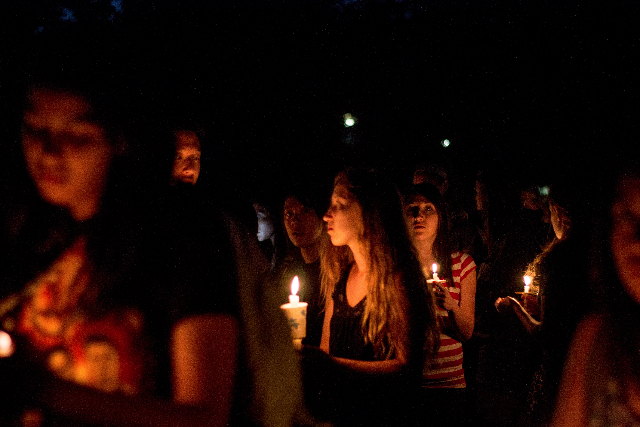
On May 29, a student-organized candlelight vigil to honor the victims of the UC Santa Barbara (UCSB) tragedy was held on the Quad. The event included speakers from both the UC Davis and Davis communities, along with students who personally knew the UCSB victims.

The event was planned by second-year neurology, physiology and behavior, and English double major Sasha Kasper. During the event, she said that a testimony by UCSB victim Christopher Martinez’s father, Richard Martinez, inspired her to plan the vigil. She said wanted to be able to hold a ceremony that would recognize the victims lost during the event and to promote healing for the the people who were affected by the tragedy.

“This vigil tonight is to express our support to the family and friends of the victims, our fellow students at UCSB and the community of Isla Vista,” Kasper said during the vigil. “But most importantly, it is a time to celebrate the lives of the students we lost.”

According to the Facebook page for the vigil, roughly 3,900 people said they were attending.

Chancellor Linda P.B. Katehi, who spoke at the vigil, said that she was tremendously proud of students who gathered and helped plan the event. Katehi also said that the tragedy shows the need for change in the way mental health is treated.

“My generation has failed at treating mental disease as a disease that can be cured,” Katehi said. “Unless we go forward and raise our voices, I’m afraid we will go through the same thing again.”

Katehi also said that the ability to acquire a gun in America is easier than acquiring a driver’s license and that the gun availability is part of the reason this tragedy took place.

Joe Krovoza, mayor of the City of Davis, and UC Davis Police Chief Matthew Carmichael also said that we as a community have to take a different approach to mental health in order to prevent similar tragedies.

Sarah Hahn and Leilani Kupo, the director of the Women’s Resource and Research Center, also spoke at the event. Kupo announced a group discussion on gendered violence at the WRRC would take place on May 30.

Sydnee Norton, a UC Davis student who was in Santa Barbara on the night of the killing, described her experience of being in a pizza parlor when the drive-by shooting took place. She said it was more important to honor the victims of the night than to express concerns that would give the man who killed the victims more power.

“My family and I, along with everyone in the restaurant, were safe and uninjured, but this will forever alter my life,” Norton said. “In my opinion, as a survivor of this tragedy, we do not need to give this individual the power to turn this into something it isn’t … Instead of focusing on him, we as UC Davis students need to have the compassion to help our sister campus and any of us here mourn the loss of the beautiful lives we lost that night.”

After the speeches, moments of silence were given to each of the six victims; Cheng Yuan (James) Hong of San Jose, Calif., 19; George Chen of San Jose, Calif., 19; Weihan Wang of Fremont, Calif., 20; Katherine (Katie) Breann Cooper of Chino Hills, Calif., 22; Veronika Elizabeth Weiss of Westlake Village, Calif., 19; and Christopher (Chris) Ross Michaels-Martinez of Los Osos, Calif., 20.

An open microphone was available for people who knew the victims to speak about their lives.

Katehi said the event was important because it allowed the UC Davis community to provide support to the UCSB community.

“Many members of the UC Davis community have family and friends at UC Santa Barbara and have been shaken by this tragedy,” Katehi said via email. “It will take courage and compassion as a society and a democracy to address the root causes of these horrific events, but I am hopeful in knowing that the spirit of unity demonstrated at Thursday’s vigil, and the numerous other vigils just like it, will play a key role as we grapple with these challenges.”

Katehi also said that there are two members of the Academic & Staff Assistance Program (ASAP) stationed in Isla Vista for the rest of the week. ASAP provides free, confidential consultant services to UC staff and faculty.

Zachary Ward, a psychologist at Counseling and Psychological Services (CAPS), said that the most important aspect of the vigil is to show support to UCSB students and to each other.

“The vigil is a spot where we can all come together and support each other about this event,” Ward said.

Ward said that students can find resources to get help through appointments and walk-in services at CAPS, the Each Aggie Matters program, which allows students to educate themselves and get help with mental health and through the Just in Case mobile app, which gives specific tips on how to reach out to a friend who might need help.

MELISSA DITTRICH can be reached at campus@theaggie.org.

Photos by Katie Lin.


“Health Happens Here” initiates pilot program at UC Davis

In the next few months, “Health Happens Here,” a statewide health campaign, will bring hammocks and hydration stations to UC Davis to promote wellness and a healthy learning environment.

These projects will be funded by a $50,000 grant provided by The California Endowment, a statewide health foundation that has brought its campaign to UC Davis.

Having already established a longstanding relationship with The California Endowment, UC Davis approached the foundation a year ago to discuss health initiatives existing on campus and also expanding the project to the Davis community.

“Wellness is a holistic approach but education and knowing how to advocate for yourself when it comes to medical and mental health … that’s an important piece of a person’s wellness,” said Lora Jo Bossio, associate vice chancellor of Student Affairs.

UC Davis is the first institution to implement “Health Happens Here” and hopes to continue the partnership beyond the end of this one-year pilot to serve as a model for other campuses. The program’s chairs include Bossio and Michelle Famula, executive director of Student Health and Counseling Services (SHCS).

According to the Community Health Education at UC Davis grant, its purpose is “to support a project that educates college students and staff in Davis on how social, economic, and environmental conditions impact health.”

The campaign serves alongside with UC Davis’ own Student Mental Health Initiative (SMHI), a three-year project funded by the California Mental Health Services Authority and the Mental Health Services Act (Proposition 63).

Additional programs launched under the SMHI include “Each Aggie Matters,” an online resource for open dialogue about mental health, and “Just In Case,” a mobile-friendly website that provides resources based on the user’s feelings.

Grant money provided by The California Endowment will install a dozen free-standing hammocks throughout the Quad beginning June 5 as well as hydration stations, areas to fill up reusable water bottles with filtered water, over the summer.

The hammocks were thought to be an innovative method to capture students’ attention in emphasizing a message of wellness and of the importance of rest.

“Students are so busy and they’re at a fairly healthy stage of life so the last thing students really think about is their health,” said Cynthia Spiro, development officer of Student Affairs.

The hammock concept originated in 2009 by ASUCD Senator Andre Lee. Recently, former ASUCD President Carly Sandstrom reached out to various students, SHCS and a Mental Health task force she created, who all supported the idea.

“I hope with this grant and our partnership with ‘Health Happens Here,’ we can influence UC Davis students to continue to improve their health and spread it to their families and hometown communities, particularly for marginalized and lower income individuals,” Sandstrom said.

Remaining funds will also largely contribute to the Student Health Ambassador internship. Training begins next fall, and ambassador roles involve gathering feedback from focus groups, providing wellness information and resources and educating in health insurance. Conducting surveys and monitoring focus groups will serve to indicate whether the outreach methods used were effective by the end of the one-year pilot period.

NICOLE YI can be reached at campus@theaggie.org.

The Maturing Moviegoer: Fin

0

mug_fleschThis is it — this is the end. For the last 10 weeks, I have had a wonderful time watching and rewatching some of the classic movies of our time in an effort to learn something about what it means to come of age today. I have learned a great deal about myself in the process of writing this column, and it is my sincerest wish that some of my readers feel the same way about themselves.

To conclude a topic as expansive as the one that I have chosen is no easy task. So I’ll take the easy way out and not give this column a nice and tidy ending. After all the ambiguities that we’ve considered thus far, would coming up with one steadfast thesis on aging really be appropriate?

For me, self-deprecation has been a fun tool to use for humor. I amuse myself thinking that someone may actually take what this 18-year-old has to say to heart. It’s part of the reason that I have no conclusion. Aging never ends,and I am no end-all authority. But at the same time, no one possesses such an authority.

Movies seem to play to these ambiguities, providing a visual medium by which themes can be illustrated with a photographic truth. To see something happen can be far more impacting than reading about it. This is why I believe coming-of-age movies are so impactful. They provide tales both simple and complex, unified in their ability to capture the collective essence of what it means to mature.

My favorite movie of all time is probably Boogie Nights by Paul Thomas Anderson. It’s a movie that I can keep coming back to over and over. It’s so good that it makes me want to vomit with envy. That, more than anything, is the mark to which I hold the best movies. If you get me nauseous, you’ve done something right.

Ultimately, film will only be a tool. An instrument for gauging your thoughts, experiences, hopes and, perhaps most importantly, failures. I feel like a better person when I watch films like The Iron Giant and Magnolia. I actually am a better person when I decide to contemplate myself in relation to the film. On a subconscious level, this is the thought that I believe I have been trying to impart through this column.

Okay, one conclusion. In viewing the nine films we discussed, I have come to believe that personal autonomy is the greatest treasure in aging well. Being able to step back from enormous amounts of social pressure and self evaluate is critical to happiness. Or not. People learn to love their chains. I think someone famous said that. I just looked it up: Daenerys Targaryen from “Game of Thrones” said it. Awesome!

Maybe I shouldn’t trust the philosophy of a teenager who mothers murderous dragons. But I will. The point is that sooner or later, failure to acknowledge pressures just becomes a way of accepting them. Perhaps a mid-life crisis, in addition to being a recognition of one’s own mortality, is a way of despairing over one’s life choices. Perhaps the high paying job (or low paying job) that you sought with such vigor is not one which you want to take to the grave with you.

The stakes of being young are higher than ever. Never has there been a time when adolescents were so responsible for the overall trajectory of their lives. Figuring out your personal values at a young age is no longer something to do on a romantic, bohemian escape to the south of France. It’s something to do right now, as you’re sitting in your underwear, wondering when Netflix is going to update your favorite TV show. “Breaking Bad” is over, so I got plenty of time to reflect.

Film is only one way to accomplish the ends you desire. Literature is fantastic. Writing out thoughts never hurt anyone. Having honest discussions with close friends and family tend to help many people.

The prerequisite for any form of personal growth is courage. You must have extraordinary wherewithal to be able to stand the process of aging. Find the courage and you’ll find something real — I can promise that. As a wise man, Walter White, once said: “Apply yourself.”

Not one person reached ELI FLESCH at ekflesch@ucdavis.edu or tweeted him @eliflesch this quarter. Send some love, goddamnit.


Robb Davis, Rochelle Swanson win city council seats

Robb Davis and Rochelle Swanson won the two open seats on the Davis City Council, beating out the other three candidates, in the General Municipal and Special Elections on June 3.

Davis came in first with 4,909 votes and 43.3 percent of the vote. Swanson came in second with 4,123 votes and 36.3 percent of the vote. The remaining three candidates, John Munn, Sheila Allen and Daniel Parrella, came in third, fourth and fifth, respectively. 

Also on the June 2014 ballot for Davis voters were two measures, Measure P and O.

Measure P passed, repealing the water rates that were set up in May 2013. Those in support said more fair rates can be created, but opponents and city staff said this could cause Davis to fall short of its financial obligations to the Woodland-Davis surface water project.

Measure O did passed and will increase the sales tax in the City of Davis by 0.5 percent, raising it from 8 percent to 8.5 percent. The sales tax increase is projected to bring in about $3.6 million extra to pay for city services, programs and staff, such as police officers and parks employees. However, this does not solve the city’s $5 million budget deficit.

— Paayal Zaveri

Davis organization attempts to raise minimum wage to $15

Raise the Wage Davis has been an active organization in both the city and on campus since early January, and its main goal has been to raise Davis’ minimum wage from $8 to $15.

Raise the Wage Davis’ first event was its campaign kick-off in early January. Since then it has also hosted a Rally for a Living Wage on April 19, and its members were also present at the Inequality for All screening at the Mondavi Center on May 19.

The organization is comprised of a number of Davis citizens, and a few UC Davis students and workers. One of these students is Hayley Benham-Archdeacon,  a third-year transfer student double majoring in political science and public service. She is also the chief spokesperson and deputy field director of Raise the Wage Davis.

“We are not just coming from the side of the moral imperative of not paying people poverty wages; we have economic sense on our side as well,” Benham-Archdeacon said.

Benham-Archdeacon said that there is still a lot of confusion regarding the topic of the minimum wage, as some believe it will negatively affect their communities. On their website, however, Raise the Wage Davis claims that raising the wage to $15 would have several positive impacts on the community as well. They said more money would be put into the pockets of customers who would create more business, and that taxpayers would also pay less money for poverty relief. This would mean having their tax money spent on roads, schools and other public works instead.

“The minimum wage is one of the most widely studied topics in the field of economics. So it’s weird that there is so much misinformation about it,” Benham-Archdeacon said.

Benham-Archdeacon said that many of the counter-arguments against raising the minimum wage may seem intuitive, but are mostly untrue.

“I mean, I believed most of that misinformation till about three of four months ago, before I started looking in to it,” Benham-Archdeacon said.

According to Bernie Goldsmith, Raise the Wage Davis’ campaign co-chair, many of these counter-arguments are a result of circulated misconceptions of the negative effects of raising the minimum wage.

Goldsmith said the first common misconception that people have is that the average minimum wage worker is young. In reality, he said that the average minimum wage worker is a 33-year-old woman.

Goldsmith has also found that the main supporters of raising the wage are those ages 55 or older, and the primary reason students don’t typically support raising the minimum wage is because they think it would mean higher prices for them.

According to Chris Benner, professor of community and regional development and a supporter of the campaign, raising the minimum wage wouldn’t have a significant impact on the consumer.

“The estimates for $15 of minimum wage are that it would be a 10 percent increase in restaurant prices and a four percent increase in retail,” Benner said.

Many business owners also worry about the additional costs that raising the minimum wage would have on their businesses. Benner added that research and practice points to the fact that raising the minimum wage has two positive impacts. First, by paying workers more, businesses tend to have lower turnover rates and are able to spend less money with training and startup costs. Secondly, workers are generally more productive.

Goldsmith cited a study by Daniel Aaronson, an economist with the Federal Reserve Bank of Chicago. The study found that with every 10 percent increase in the minimum wage, prices actually rose by only about 0.7 percent in the restaurant industry.

“In most industries, the proportion of the final price that is labor costs, it is a minority,” Benner said. “Even in restaurants, which is one of the most labor intensive industries, it’s only about a third of the cost which is labor. Raising the minimum wage only incrementally increases that labor cost.”

For the last six months, Raise the Wage Davis has been trying to collect 7,000 signatures for the fall ballot, but unfortunately they have fallen short of their goal. Benham-Archdeacon said that their new aim is to have the $15 minimum wage on next year’s ballot.

“People think that if they aren’t working, it’s really not their problem. Or if they make more than $15 an hour, they say, ‘why does it matter to me?’” Benham-Archdeacon said. “The reality is when you help one piece of the economy you help all the economy.”

Benham-Archdeacon said that she works two jobs, one for a low wage and the other as a volunteer. She moved to Davis from San Jose, which famously just made their minimum wage $10.

“When I saw that happen I saw an opportunity to do that here,” Benham-Archdeacon said.

Benham-Archdeacon also said that even though the recession has technically been over since 2010, we are still not in the best economic climate. But raising the minimum wage could mean more than just improving conditions for people who are working minimum wage jobs and could improve the overall economy for everyone, including students, in the future.

“It’s about improving income inequality, so that our degrees actually mean something,” Benham-Archdeacon said.

LEYLA KAPLAN can be reached at features@theaggie.org.