


59.3 F
Davis

Davis, California

Wednesday, December 24, 2025
Home Blog Page 860

UAW Workers strike hits UC campuses

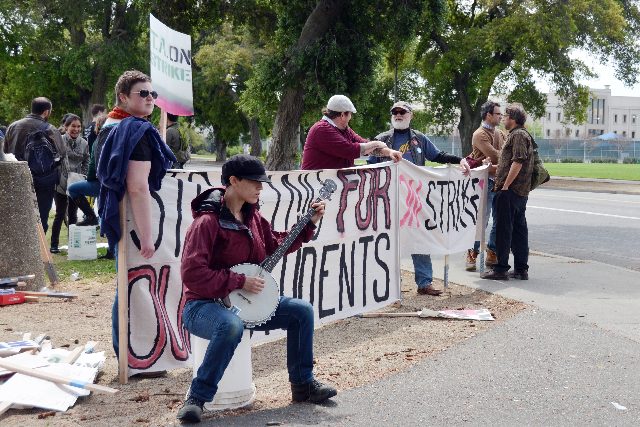
Members of the UC Student Workers Union (UAW 2865) struck statewide at University of California (UC) campuses on April 2 and April 3 to protest some of the system’s alleged unfair labor practices. Davis strikers took their protest to the corner of Russell Boulevard and Howard Way on April 3.

UAW 2865 represents student workers across the UC system, including teaching assistants (TAs), graduate student instructors, readers and graduate and undergraduate tutors. The union filed a series of Unfair Labor Practice charges against UC over the past year. Their complaints are largely centered on instances of UC’s alleged intimidation surrounding strikes.

Complaints range from the UC threatening to invalidate international students’ visa status for participating in union activity to unlawfully videotaping those participating in strikes at UC Berkeley and UC Santa Cruz and sending out emails claiming that legal strikes are illegal.

“The worst part is they sent an email to UCLA international students saying that if they struck they might be risking their visas,” said Duane Wright, TA in the Sociology Department at UC Davis and UAW 2865 Davis unit chair. “It’s disgusting that they would do that.”

UAW claims that these practices are part of a pattern of intimidation from UC.

According to a UAW press release, “On February 23, 2014, the Director of the Writing Program at UCSC told a group of union members in his employment: ‘If you strike, you will not work in this program again.’”

The UC declined to comment on any particular allegations of intimidation, but did offer its opinion regarding the strikes.

“The bottom line here is that if someone feels unfair labor practices have occurred, they need to resolve that with the Public Employee Relations Board, not at the picket line,” said Shelly Meron, a spokeswoman for the University of California Office of the President.

While the UAW and UC are still in the process of bargaining over the student worker contract, many strike participants noted that their decision to strike was due in large part to the UC’s perceived lack of respect for union members.

“It doesn’t seem that they respect our right to strike,” Wright said. “We have to push back and say you can’t break labor laws. You have to respect our rights.”

According to Wright, the other catalyst in the decision to strike was the UC’s refusal to bargain on key issues, such as class size.

“They still haven’t given us a proposal on class size,” Wright said. “They don’t even want to talk to us about it. We’re just saying they need to start bargaining.”

The issue of class size came up repeatedly throughout the day of the strike. The University is increasing class size to accommodate the growing number of students flowing into the UC system every year, but TAs claim this is negatively affecting students. They argue that grading has become increasingly mechanical and impersonal to meet the needs of larger classes at the cost of valuable face-to-face time.

“I TA’d for upper division labs in viticulture and enology,” said Anna Mantheakis, viticulture and enology graduate student and strike participant, in an email interview. “Many of my students had a really hard time writing full lab reports in V&E labs … At this point in their academic career, report writing should be second nature. The basic science courses are overloaded, with poor TA allocation to labs … What’s worse is, when assignments and tests in the basic classes are designed to be quick to grade, there’s less emphasis on critical thinking skills. Instead of short essays we get multiple choice, and instead of lab reports we get worksheets.”

TAs see the concrete ways in which these shortcuts affect students.

“Students make it through these classes with Bs, only to get Cs and Ds on their upper division lab reports,” Mantheakis said. “This is a rather rude surprise for students, and it’s extremely unfair to both students and TAs.”

The trend of increasing class sizes and decreasing attention in the classroom extends to all fields of study, according to other strikers.

“They say that class size doesn’t matter, but we see how it hurts students,” said Andrew Higgins, TA in the history department and strike participant.

UAW 2865 workers were joined on April 3 by a number of supporters. Members of other unions, such as University Professional and Technical Employees, American Federation of State, County and Municipal Employees and The American Federation of Teachers came out to the main picket line. Some even brought their classes out to observe the strike.

Julie Setele, adjunct instructor and former UWA union member, brought her class out to the strike.

“I’m supporting them in solidarity,” Setele said. “We shouldn’t have to strike to get a new contract.” Setele plans on discussing the strike with students in class this week.

Some undergraduate students and community members also stood in solidarity with the strikers, as passing cars frequently honked to show their support for the cause.

“I think it is a moral imperative that students wake up and see what is happening around them,” said Melody Yee, a second-year undergraduate student and member of the Student Labor Organization. “When the University refuses to grant fair contracts to workers and intimidates them when they fight for one, they are really saying that we as workers, student-workers and students are expendable.”

UAW’s demands include tightening the wage gap between UC TAs and those at competitor institutions, gaining a voice in class size discussions, new opportunities for undocumented students, better leave policies, improved childcare support and resolutions on non-discrimination issues.

“The vision of the regents is so far off from the needs of the school,” said Pat Cabell, TA in the Comparative Literature Department and a strike participant. “I feel like we are in dramatic need of change. I don’t want to have to keep coming out here every quarter.”

LAUREN MASCARENHAS can be reached at campus@theaggie.org.
UC Davis Stores unveil new graduation gowns

0

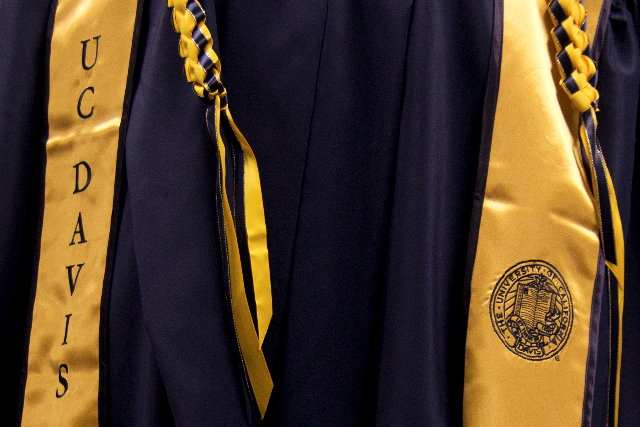
The graduating class of spring 2014 will be the first to wear blue graduation gowns at UC Davis. The color of the gowns used by the majority of UC schools, and the color of robes previously used by UC Davis, is black.

The new robes will be blue with a gold stripe to match the UC Davis school colors. They will also feature a UC Davis emblem on the shoulder of the robes for those graduating with bachelor’s and master’s degrees.

Tracy Roman, associate director of finance for UC Davis Stores, said the idea to switch to custom robes was presented to the UC Davis Stores by Strategic Communications and the Office of the Chancellor and Provost. Their goal was to make UC Davis graduates stand out among the rest of the UC schools. The new robes are manufactured by Herff Jones, which also manufactures gowns for many other UC schools.

“We met with multiple companies to see which had the best services,” Roman said. “Herff provided the best overall program.”

Roman said that the robes are made more sustainably than previous ones. Each robe is made out of 74 percent recycled water bottles and is also constructed out of a recycled fabric, called REPREVE yarn.

“The gowns are made out of 100 percent recycled fabric,” Roman said. “The way they’re cleaned and stored also beat EPA [Environmental Protection Agency] standards.”

Lindsey Richardt, a Herff Jones representative, said that the gowns made out of recycled water bottles are called EarthGrad Gowns. They are custom-made, as opposed to Herff Jones’ keeper gowns, which are typically black and allow students to keep the gowns after graduation.

“The EarthGrad gowns benefit the students and the school because they are uniquely customized for each school,” Richardt said.

Richardt said the advantage to having the gowns be rentals is that they are made out of a better quality. They are also more sustainable so they can last for years after to be rented to more students.

“This means instead of keeping the gowns, they are passed down from one graduating class to the next,” Richardt said. “This prevents gowns from ending up in landfills after being used one time.”

Previous ASUCD President Carly Sandstrom, currently an international relations and economics fourth-year, said that she thinks the color of the gowns and the sustainability represent UC Davis better than previous gowns. The robes were presented to her when she was ASUCD president.

“I really like the new robes because our old ones just didn’t look like Davis,” Sandstrom said. “It’s huge for the robes to look more Aggie Pride.”

The graduation robe material accounts for the $10 increase in graduation robes from previous years. Last year, the gown set, along with the graduation cap and tassel, cost $42, while this year it will cost $52. A bachelor’s degree cap and gown package at UCLA costs $37, while a package at UC Irvine costs $57.

“Chancellor [Linda P.B.] Katehi really liked the presentation of the robes, but was concerned about the price increase,” Roman said. “We kept prices of the grad gowns competitive with other schools.”

UC Merced is the only other UC switching from black to custom blue robes for its spring graduation. But Merced’s gowns will be keeper gowns instead of rentals, like at UC Davis, because UC Merced is a smaller school. The package at UC Merced school costs $45.

Sandstrom said that the price to have the robes more sustainable is small. She said that the robes also fits the mission of UC Davis to be an environmental friendly school.

“It makes us stick out more,” Sandstrom said. “We might take the first step to encourage other schools to switch.”

Roman said that the gowns were presented to many different groups on campus before they were decided upon. The final approval was given by the Dean’s Advisory Council.

In a statement, Chancellor Katehi said that the custom blue gowns will make the ceremony more memorable for those graduating and those watching the graduation.

“By moving to the ‘Aggie Blue’ gowns, I think it makes the ceremony … more distinctly our own,” Katehi said. “The new gowns are also more environmentally friendly, which aligns with our campus’ dedication to seeking sustainable solutions in all we do.”

Josie Cravotto, a fourth-year political science major who will be graduating this spring, said that she was not yet aware of the change in graduation robes.

“The black robes were more traditional, but I like the blue,” Cravotto said. “I don’t really like the logo.”

Cravotto said she was not concerned about the price increase but wonders if it will keep increasing more in later years.

Roman said that the feedback she has received from the robes so far has been positive. She said that three students so far have questioned the change in color via email, and after being given more information have not further replied.

“Everybody who has seen and reviewed the robes in person have said positive things,” Roman said.

MELISSA DITTRICH can be reached at campus@theaggie.org.

Photo by Rousseau Gleitsman.

Experimental College classes resume for Spring Quarter

0

After the suspension of Experimental College (EC) in December due to financial insecurity, the program will once again offer classes beginning April 14.

ASUCD Senate approved reinstatement of classes for spring on March 13, and the launch of EC’s website went live April 8, allowing students to register for Spring Quarter classes.

Although EC officially depleted its reserves, it will resume this quarter and offered classes will pay for themselves. Already having paid ASUCD a recharge fee back in July to cover expenses and for Creative Media’s services, EC will therefore not need additional funding to run during  the spring. The EC hopes that class fees will allow it to break even for the rest of the academic school year.

“The reinstatement of classes for spring 2014 will be revenue neutral or revenue positive,” said Richard Schubert, chair of EC’s Instructors Advisory Board. “No ASUCD funds are being used in order to reinstate classes for spring.”

Creative Media, an ASUCD unit, has been crucial in the success of EC as the program heavily relies on its website. According to Schubert, EC has requested that Creative Media create a fully functioning website to allow online registration for over five years. Prior to the site that was produced this past fall, students were required to sign up at EC in person at its Silo office. Also, EC previously relied on print media marketing, such as The California Aggie, which provided course catalogs in its issues. However, as the popularity of print media has declined, so has the effectiveness of EC’s marketing campaign.

“Experimental College became increasingly dependent on Creative Media because Experimental College is required by ASUCD to use Creative Media as its sole internet services provider,” Schubert said. “So the Experimental College was dependent on Creative Media to advertise for it and produce the website but Creative Media didn’t deliver.”

Now that the website is up and running, EC will offer Tai Chi 1, Tai Chi Advanced, Xingyi and Baguazhang, Hapkido, Hapkido Advanced, TKD, Aikido, Lindy Hop, Fencing, Beginning Social Dance, Continuing/Intermediate Social Dance and Learn to Meditate classes. To help out funding, EC has decided to only offer classes that have proven to be profitable in previous years.

Due to the suspension of classes, two-thirds of instructors have been lost, leaving 10 remaining instructors for spring. Instructors will receive 50 percent of course fees rather than the 70 percent previously earned, while EC receives the remaining 50 percent. Instructors were willing to work without compensation in the face of suspension, but the University prohibited it because of risk management. The EC office manager was let go and other changes have been made to accommodate the program financially.

“When the ASUCD Experimental College Task Force embarked on a plan to bring classes back for spring 2014, they decided to create a campaign to secure enrollment pledges in advance,” said Janice Corbett, ASUCD business manager. “Per the plan, if the pledges are fulfilled then the ASUCD Experimental College will be financially stable this quarter.”

Whether or not EC will offer classes after Spring Quarter depends on ASUCD’s approval of budget allocation and its financial operation this quarter.

“The EC Gardens will soon be renewing their gardening agreements, which will lead to an expected income stream of over $13K,” Corbett said. “Therefore, if the EC can stabilize its financial picture with regards to the classes this quarter, then the unit would be projected to end the year with a small amount in its reserves.”

ASUCD’s budget hearings will determine whether EC’s stay will extend past the academic year.

Although EC is facing numerous transformations, it remains to uphold its mission.

“One change the students will not see is a change of atmosphere,” said Amrit Sahota, former ASUCD senator and member of the EC Task Force. “The EC has always presented students with a different learning environment which many participants cherish. That teaching method will not change.”

NICOLE YI can be reached at campus@theaggie.org.

UC Davis implements preferred name service

0

On March 27, UC Davis began its preferred name service, which allows UC Davis students to change their legal first names on campus systems to a preferred name through the online directory if they so choose. The name change would then automatically propagate into other campus systems such as SmartSite (which includes class rosters), electronic grade reports and the library.

For spring 2014, students who use this service will be able to exchange their AggieCards to represent their preferred name at no cost.

UC Davis is the third UC to adopt this service behind UC Santa Cruz and UC Irvine. The service first began at the University of Vermont.

However, the UC Davis Office of the University Registrar specifies that preferred names will not apply to services necessitated by legal requirements such as financial aid, transcripts and diplomas, and that legal first names will continue to be used for these services.

According to Amy Kautzman, associate director of academic services for the UC Davis Library, the service is primarily directed towards transgender students who wish to have their names reflect their gender identity and international students who may choose a westernized name for convenience of pronunciation.

Kautzman said this service was born out of a conversation she had with transgender students who came to the library’s circulation desk asking for the addition of more gender-neutral restrooms and for the library system to reflect their preferred names. According to Kautzman, gender-neutral restrooms were added to all library locations approximately a year and a half ago.

“They really wanted to be respected by going by the name they wanted to be going by,” Kautzman said. “And in some cases they were passing as the gender they identified and it was important to them that they would not be outed. It wasn’t safe.”

While Kautzman took the initiative to bring this idea to various departments, including the Office of the Registrar who finally implemented the service, she takes no credit for the idea and emphasizes that it came entirely from student voices.

“Students brought it to us and we took it home; they raised the need,” Kautzman said. “They were the ones that said, ‘This is important to us.’ They absolutely deserve credit for that. I would not have carried this without the students bringing it to the front desk and saying that this is a service that we need. We need to know what students need, everything from quiet space to the ability to use our own name.”

Ali Marie Cordone, assistant registrar, said the delay of the service was largely due to making sure that the change in student identification would not interfere with legal processes.

“Changing a campus culture really takes a while,” Cordone said. “I think if you look at the world today, when we talk about identification, it’s very important. Those things are very important. And those are all legal government issued identifications. I think to change campus culture and that ID card and necessarily needing to meet that criteria takes time.”

According to Cordone, incoming UC Davis students also have the option to begin their time at the University with a preferred name. She said when students are submitting a photo for their AggieCard, they will also be asked if they would like to use a preferred name.

While Cordone says there is a lot of freedom in a preferred name a student may choose, the registrar’s website explicitly warns against names that are inappropriate or misrepresentative. However, Cordone says that there is no current system to check for this behavior.

According to Kautzman, UC Davis is among the first to partner preferred names with campus police. According to Matt Carmichael, UC Davis police chief, UC Davis officers have been trained specifically to use preferred names in their interactions and, in the event that a legal name is required, the officers have been instructed to pull students away and speak in privacy in order to not disrespect or out them if they are transgender.

“Our goal is not to out anyone and to make sure the environment is comfortable for everyone,” Carmichael said. “This is unique for us because I don’t know of any other policy that’s like this. It gives police very clear direction and it gives students very clear understanding that we support this.”

While Elizabeth Coté, interim director for the LGBTQIA Resource Center, still sees work to be done by the University in terms of transgender equality, she praises UC Davis for taking this progressive step.

“I don’t think it absolves me of thinking about all the work that we have to do to continually improve our campus,” Coté said. “There is still data that our campus is not particularly welcoming, especially to trans-folks. There’s other systemic issues that we’re needing to talk about. But of course it feels fabulous that UC Davis is making this powerful decision that is inclusive and progressive.”

According to Coté, preferred names provide a useful resource for students who are unable to pay for the financial process or not ready to change their name legally.

“I think that for college-aged folks, they might not be out to everyone in their life, including family, so making that decision to change your legal name before you’re really out to everyone might feel pretty complicated,” Coté said.

While the registrar has limited free identification cards solely for Spring Quarter, Cordone says there is a general appeal process in place for students who may not be on campus this quarter.

“We do have to put a time limit on things,” Cordone said. “I’m certain if a student comes to our office and says, ‘I wasn’t on campus last term, I would like to use preferred names,’ that we would make an exception. We do have a general appeal rule for those instances because we’re not going to continue to hand out AggieCards willy nilly because there is a cost to them.”

However, Coté views the limit to Spring Quarter problematic for transgender students who are not out as transgender yet.

“Ideally it would continue to stay in place because it’s not like everyone has scheduled their coming out process for spring 2014,” Coté said. “In my ideal world, it would always be free. If you needed a new ID card, not because you had lost it, but because you were changing your name, it would be nice if it was always free.”

According to Cordone, faculty and staff are not included within the preferred name service because of them using a different system and the more legal departments staff deal with that would make the process more complicated.

“The directory is a way to feed Banner, which is a student information system,” Cordone said. “This program is student focused. When you talk about staff and faculty, those records are maintained through human resources and payroll and personnel. Those can be considered legal records. I think that there are more things to consider.”

However, Coté remains hopeful that this service will include staff in the near future.

“I think that it’s a really great example setting on the Office of the Registrar who has done this and I think that it will hopefully serve as an example for the staff systems,” Coté said. “ I’m hopeful that it will only be a small amount of time before it slides over to the staff side as well.”

In his experience, Wesley Young, director for Services for International Students and Scholars (SISS), has found that many international students may use a westernized name because of the difficulty of pronouncing their legal name.

Because the SISS deals with many legal immigration documents for international students, Young says extra processes may be done in order to certify the identity of a student.

“Because all of our records are with their legal name, we don’t encourage them to use [a preferred name] because it makes it hard for us to find them in our records,” Young said. “If their legal documents have their legal name and it doesn’t match their ID card, normally we would say, ‘I’m not going to give you this document.’ But now that we know that they could have a preferred name, what we’ll have to do is check their student ID number to confirm that and confirm their identity.”

In addition to campus police, Cordone says faculty and staff who have an educational purpose have access to Banner, which is the system that holds information regarding legal and preferred names. Cordone maintains that Banner is Central Authentication Service authenticated access which means that users must obey the Family Educational Rights and Privacy Act and maintain a student’s privacy.

According to Cordone, as of April 3, 11 students have changed to a preferred name.

Kautzman said that the service promotes respect on campus among diverse individuals.

“I think you’ll find that most people who work for the University care deeply about the people who work with us, for us or come to school here,” Kautzman said. “It was just really important that we did this simple thing. What does it cost us to call people by the name they wanted to be called by? It’s nothing. It’s just respect. It’s about respecting how people want to be addressed.”

Students who wish to go by a preferred name may go to directory.ucdavis.edu/PeopleSearch.htm and set their name within the directory.

JASON PHAM  can be reached at campus@theaggie.org.

Modern Bey Feminism: Not just his little wife

1

mug_strumwasserOn Dec. 13, 2013, the world changed forever when Beyoncé released her fifth album, titled Beyoncé. The Queen’s musical baby came into the world less than two years after her actual baby, Blue Ivy, was born.

The surprise album left fans stunned (and so so happy), but also piqued the age-old question: can women really have it all?

Beyoncé was a success according to both the critics and the charts — Apple announced that it was the fastest selling album ever on iTunes, after 828,773 copies sold in the first three days.

From my perspective, Blue Ivy has been a success as well. She is dressed to the nines every time she’s photographed, and is featured on two chart-topping songs (“Glory” by Jay-Z and “Blue” by Beyoncé).

So it would seem that Beyoncé, at least, can have it all.

Her success so soon after becoming a mother shows that women can make achievements while simultaneously raising a child. However, Beyoncé is not your average mom. With what is likely a full-time support staff at her beck and call, her ability to pursue career goals is much more accessible than it is for many other mothers.

As a young woman about to enter the workforce, I face the reality of ultimately having to choose between a career or a family.  The pressure to start my career sooner rather than later in order to beat the “ticking clock” of my uterus is very real, as I face the fact that I am sadly not Beyoncé.

But I think the Queen’s success should ultimately be seen as inspirational, and not unattainable. Having a role model who shows that it is possible to juggle a child, a very public marriage and one of the most successful music careers ever proves that you don’t necessarily need to sacrifice one part of your life for another.

Despite some changes, our society still creates a work environment where women are forced to think about the effect of their career on their desire for children, and vice versa.

In her much-talked about “feminist manifesto,” Lean In: Women, Work and the Will to Lead, Sheryl Sandberg addresses the issue of women in the workforce with anecdotes about her time working as a CEO at Facebook.

As Sandberg mentions in her book, the United States is the only industrialized nation to not have a paid maternity leave policy, according to the Human Rights Watch. This is one of the many aspects of the American workplace that puts women at a disadvantage.

However, there have been issues with Sandberg’s critique of women in the workplace, as she asserts the idea that women have to have it all — that they need the baby, the job, the husband, the 828,773 copies sold in order to be a successful woman. While this may have worked for Sandberg and Beyoncé, it’s not necessarily the path that all women should choose to follow. Feminism is about being able to make a choice and do whatever you want, and if you want to be a housewife with a baby or a forever single lady instead of having a spouse or a career, that’s just as feminist as wearing a rhinestone-studded bodysuit on your world tour.

Beyond having a career and raising a child, Beyoncé has maintained her relationship with Jay-Z — an extraordinarily successful musician and businessman — despite both of their individual fame.

Bey and Jay have lasted longer than most music careers — they’ve been together for over 12 years and they’ve been married for six. In her HBO documentary, “Life is But a Dream,” she frequently mentions how much support he has given her throughout their relationship, both emotionally and professionally.

Time and time again Beyoncé has proved that she is more than just Jay-Z’s wife, and even wrote about it in her song “Flawless,” singing, “I took some time to live my life/But don’t think I’m just his little wife.”

At the same time, Jay-Z is featured in multiple songs on her new album, most notably “Drunk in Love.” The video shows them being their cute selves on the beach, and their real-life chemistry comes through (although the content of this song is questionable, but that’s a topic for another week).

Beyoncé has managed to have a family in the spotlight while building a successful career, but she does leave women wondering if this is possible for those of us without 17 Grammys and the King of Hip-Hop for a husband.

Remember what they say: you have just as many hours in a day as Beyoncé. But don’t feel bad if they’re not spent looking for a boyfriend or a record deal.

If you want to talk more about Blue Ivy and her impeccable style, HANNAH STRUMWASSER can be reached at hstrumwasser@gmail.com.

Design Museum to display selected undergraduate design pieces

0

The Annual Picnic Day Design by Design exhibition in the Design Museum will be displaying selected entries submitted by UC Davis undergraduate design students.

Sponsored by the Birgitta and Helge Olson Design Award and the UC Davis Design Museum, the exhibition of undergraduate design pieces will be on display at the Design Museum beginning April 11 and will run through June 5.

Tim McNeil, UC Davis Department of Design chair and associate professor of design, explained that the exhibition’s presentation of undergraduate design talent intentionally coincides with Picnic Day annually because the event’s popularity draws in a large number of interested visitors.

“In terms of outreach and visibility for students, absolutely this is the most important student showcase, and considering all the people connected to the student body or newly visiting, certainly in terms of attendance for the museum, Picnic Day is the biggest day for us,” McNeil said.

McNeil said he and Design Museum Curator Adele Zhang are responsible for the first cut of submissions that are “incomplete or not deemed of a quality worthy of the exhibition.” After this cut, a jury comprised of a design faculty member, a UC Davis faculty member and an external person involved with design will select exceptional pieces from three categories which reflect the growing overlap of design disciplines.

“We’re doing [the judging of works] differently this year. Previously, it was more discipline based, but in keeping with the department [of design] becoming more general and allowing more crosswork, we’ve made the categories two-dimensional work, three-dimensional work and then digital pieces,” McNeil said.

The selections made by the jury will be announced May 30, and the student creators of pieces chosen for award recognition will also receive a monetary prize sponsored by the Birgitta and Helge Olson Design Award.

According to Zhang, the Design Museum’s display of student work has been beneficial for exposure and interest for the entire department.

“I’ve had a few visitors that came to the museum during the spring and when they saw our students’ work on display, it was pretty much that moment that the students made the decision to come here for design,” Zhang said.

Unlike previous years, this year’s exhibition goes on until June 5 because the MFA design students’ exhibition is being moved to another venue, which, as Zhang explained, allows graduating design students a fitting end to their career

“The duration of this exhibition is strategically set during most of the spring where most of the families and prospective students come visit, and ends around senior commencement. Every year I feel like [Design by Design exhibition is getting bigger and better,” Zhang said.

Mark Kessler, assistant professor of interior architecture, considers the exhibition to be both a source of pride and attraction for the UC Davis design program.

“We are showing the surrounding community what we do here at the Department of Design, and also what design is; I think many people are unfamiliar with this scope of disciplines that are included in the word ‘design,’” Kessler said. “I take pride in the work that they produce, and I’m happy to share it with everyone who visits.”

PAUL SANCHEZ can be reached at arts@theaggie.org.

Editorial: Intercollegiate Athletics – Clear as mud

7

In March 2003, former UC Davis Chancellor Larry Vanderhoef announced that UC Davis would shift its athletics program from Division II to Division I. This move, which has been funded by student fees, was initiated by the passing of the Campus Expansion Initiative (CEI) in November 2002. The CEI “put the students on record as supporting an increase in student fees to help fund the move to Division I and the Big West Conference.”

It has been six years since UC Davis entered into “the big leagues” of college athletics and received full Division I certification by the NCAA. Instead of reaping the rewards of a successful move to Division I, the University has struggled to adapt and has been unwilling to follow the guiding principles of the move.

These principles state: “UC Davis cannot reduce its broad-based program, but rather must seek to add sports” and “There can be no ‘tiering’ among UC Davis sports,” as well as a few other requirements.

To many students and affiliates of the University, the principles laid out in the CEI were just as important as the move to Division I itself. These principles represented UC Davis’ outward rejection of the failing “student-athlete” model that many major universities in the National Collegiate Athletics Association (NCAA) held. UC Davis was meant to be the trailblazing force in the fight against the revenue-generating focused visions of Division I athletics.

However, the University crumbled under the spotlight of Division I pressures. In 2010, UC Davis cut four sports: men’s swimming and diving, men’s wrestling, men’s indoor track and field and women’s rowing. Chancellor Linda P.B. Katehi and the administration cited the state budget crisis as the reasoning for these cuts, while at the same time increasing the funding for sports such as basketball and football.

It seems strange that the state budget crisis would have any impact on the Intercollegiate Athletics (ICA) program whatsoever, as it is funded largely through student fees. According to the University’s own Equity in Athletics Data Analysis report, which breaks down the revenue and costs of specific sections in the ICA, the University does not actually discuss the use of any state funding in its athletics department. Currently, UC Davis student fees fund 75 percent, or $18 million, of the total Intercollegiate Athletics budget. Students pay upwards of $600 a year to fund the athletics program.

So what are the real reasons for the cut? No one really seems to know.

Furthermore, the ICA budget has increased yearly. All of this adds up to the conclusion that state budget issues were not the actual reason for the cutting of four sports in 2010.

UC Davis’ ICA program has faced many changes in the 11 years since the move from Division II to Division I. Athletes and coaches have come and gone, there has been a chancellor change and the Aggies went from champions of Division II to bottom feeders in Division I.

Beyond their unwillingness to follow the principles, the administration has shown a tendency to block the quest for answers regarding past decisions. The lack of transparency is blatantly obvious in Katehi’s decision and explanation of the cutting of the sports.

The administration’s lack of transparency exposes the blatant disregard for honesty and straightforwardness shown by Katehi during her decision to cut UC Davis sports and is something that she should be held accountable for.

Furthermore, what is the purpose of this disregard to the principles and honesty if the results are subpar? Since the move to Division I, UC Davis has struggled greatly as evidenced by the 9-22 record for men’s basketball and the 5-7 record for football this year. Compare this to UC Davis’ Division II career, when it won six Director’s Cups, which are given to the top Division II university in the nation.

After the preponderance of information regarding the failures of the transition to Division I, we are left wondering why the administration would make promises it doesn’t keep. But more importantly, the lack of transparency that occurs in the administration’s decision-making process is concerning not only in regards to UC Davis athletics, but also in regards to the future actions of the administration.


The Maturing Moviegoer: Breakfast Club Wisdom

0

mug_fleschI could not write a column on coming of age in film if I did not make reference to The Breakfast Club, the famous 1985 John Hughes comedy-drama. That would be harder than criticizing Donald Trump and not mentioning his terrible hairdo. Such an omission would ignore the fact that this film has resonated with many young adults and has become a symbol of what it means to grow up in a society that stereotypes and categorizes.
Last quarter, I was fortunate enough to find myself in Psychology 1 with over 500 other undergraduates. I loved the class because it helped me judge people in ways I never thought possible. I love judging people. I also found myself with a masterful, new, more whole and more insightful view of the way people work.

Now, upon reading that last sentence, I’m willing to bet my two cents that you categorized me as one of those pretentious assholes who thinks they know everything about the world after one psych class. We make assumptions like these because they fit nicely into our concepts of other people. I may be an asshole, but not because I have an inflated opinion of my psychological knowledge.

The Breakfast Club attempts to dispel the power of stereotypes by giving each main character a shade of gray. The “criminal” John Bender lives in an abusive household, “athlete” Andrew Clark is pushed too hard by his father, “brain” Brian Johnson has attempted suicide upon receiving a bad grade, “basket case” Allison Reynolds is a compulsive liar and “princess” Claire Standish is a virgin.

The first time I saw this movie, I saw what the director wanted me to see — namely, the fact that beyond the way we’re socially perceived, we all have certain growing pains that have the power to bond us.

The second time around, I was less impressed. It struck me that the individual struggles of each character were archetypical to who they were perceived to be. If Claire was one of the most popular girls in school, with a flair for fashion, her virginity may not come as much as a surprise as it is portrayed in the movie. This double standard can help us define our individuality, and how that individuality can change as we age. Whew, this is a doozy.

It goes without saying that a large part of who we are is a byproduct of who we want to be. But we cannot ignore that others have an influence on us as well. If we are not able to resolve our identities in the earlier stages of life, it is likelier that a person may experience crisis later in life.

I fear that people may adhere to their stereotypes as a way of resolving identity issues with ease. Does The Breakfast Club have anything to say about this? Well, it just so happens that it does. In the final essay Brian turns into the strict Mr. Vernon; he points out that despite how he views each member of this “club,” they all have some of the aforementioned qualities.

I’m not sure I’d like that. I like things cohesive. Simple. I’m afraid to wear clothing with words on it because it disrupts the continuity of a plain shirt. So that’s why it’s hard for me to swallow that we can be such a mix of so many traits.

But if I don’t like a blend of identities, and I don’t like a single stereotypical identity, how do I proceed? The Breakfast Club leaves us here. For me, identity has been picking and choosing what I like from my culture and my life. It’s an ongoing process in which sharp turns are poor turns. Age helps us reflect on these changes.

In eighth grade, I had god-awful hair that went down to my shoulders because I wanted to look like the rocking and rolling John Lennon. So I left that fragment of my identity behind. Didn’t dig it anymore. That’s okay.

There are more serious examples. Some people think that radically changing their identity for college is good. It isn’t. Ninety-nine percent of the time, your identity doesn’t need a change like Donald Trump doesn’t need any more hair gel. Let it be. Let your coming-of-age dictate how you choose to shape your identity, and be cognizant of how the groups you may be a part of play into the equation.

Okay, I’m done preaching. Watch the movie. Join me next week. I’m off to bring pretension elsewhere.

If you want to tell ELI FLESCH that making fun of Donald Trump is out of line, you can reach him at ekflesch@ucdavis.edu.


Editorial: Graduation gown change – Now we’re feeling blue

0

Starting Spring Quarter 2014, graduating students of UC Davis will no longer wear the traditional black cap and gown for commencement. Students will have to rent a blue gown with gold piping with the addition of the UC Davis emblem on it.

The new gowns are made out of 100 percent recycled fabric, and this is the first time Herff Jones, the company that sells graduation materials, will offer sustainable graduation materials — meaning the way they’re laundered and what they are made of are better for the environment.

Last year, the rental price was $42. This year the price is $52. This price is still among the higher graduation costs of the UCs, and Davis students don’t get to keep their gowns. For example, UCLA’s price for a black cap, gown and tassel is $37. UC Irvine’s is $58 for the same items — except their students don’t have to return their purchase.

According to UC Davis Stores Director Jason Lorgan, the reason the price has increased is due to the higher quality of the material. When the gowns were plain and black, we were renting from a pool of graduation gowns open to the rest of the nation. With the new sustainable gowns, UC Davis selected its colors and added the emblem, ensuring that only UC Davis students will wear them.

Even though no other school in the nation will wear these gowns, UC Davis isn’t even purchasing them — they’re renting from Herff Jones themselves. Lorgan said that the gowns cost approximately $40 for the school, leaving a 23 percent profit that will allegedly go toward operating costs of the Memorial Union (MU). So will prices go up in future years due to the planned MU renovations?

Chancellor Linda P.B. Katehi requested that the emblem be included on the new gowns. Why? To differentiate ourselves in pictures. To show that we are from the “prestigious UC Davis.” But let’s be realistic: the emblem will probably end up being covered by any stoles or graduation flowers students choose to wear.

Apparently it didn’t make sense to continue with all-black gowns, due to reasons such as Aggie Pride (!!!). Here are some facts: blue and gold are the colors of every single UC school. No other UC campus has changed their gowns except for UC Merced, who changed to a solid blue this year. No other UC has its name on its gowns. Did anyone consider the fact that specialty groups and organizations on campus purchase colored, embroidered stoles to wear against the traditional black gowns? If the school is so concerned with image, are they okay with the clashing colors of established groups’ graduation accessories?

Why does it matter that some students would want to keep their gown? Besides sentimental reasons, many would want to resell their gowns to save money. Black gowns signify a collegiate graduation. Now what happens to the students who were planning or have already purchased an all-black gown from a third party in order to save money? Will they be able to walk at graduation? What happens if a student can’t afford the increased price?

Sure, the rental gown is apparently a better-looking garment. But let’s be real. Graduating students could care less about the quality of a gown that they don’t even get to keep; they are broke from textbook prices and tuition.

Becoming more sustainable is the reason UC Davis decides to pursue certain projects such as this. But when it’s costing the students more and keeping its decisions in the dark, this only seems like yet another occasion in which the University is squeezing one last dollar out of its students.


Aggie Arcade

0

Facebook’s Virtual Reality

While I was busy relaxing during spring break, Facebook created quite a buzz with its acquisition of Oculus VR for $2 billion, the company responsible for the Oculus Rift.

The Oculus Rift is a virtual reality head-mounted display which has yet to see a commercial release. Developer kits have been out there for a while now and those who have experienced the VR device express a level of excitement often saved for groundbreaking technology.

Facebook founder and CEO Mark Zuckerberg said of the Oculus Rift, “Oculus has the chance to create the most social platform ever, and change the way we work, play and communicate.”

Some may see that statement as hyperbolic, but plenty of people share the sentiment when it comes to the Oculus Rift.

The acquisition itself proves far more divisive though. After reading the press release, I went to numerous game sites to see reaction to the news. To my surprise, it was overwhelmingly negative — it seems that a lot of people don’t trust Facebook. And the uproar is not limited to angry forum users.

Markus “Notch” Persson, creator of Minecraft, had plans to work on an Oculus Rift version of his wildly popular game. Upon hearing the news of the acquisition, he canceled those plans. He then took to Twitter and said, “Facebook creeps me out.”

I’m not the biggest fan of Facebook. I use it to stay in contact with old and current friends, but my life doesn’t revolve around the website. Also, I understand the distrust of Facebook — this is a company that has had security concerns and made questionable business decisions over the years. But it’s also a company with a lot of money.

Oculus VR will now have access to that money, which will only help strengthen the core technology. It will allow the company to be more ambitious and push its ideas even further. It also allows Oculus VR to compete with Sony, which revealed its own VR device — Project Morpheus — last month.

This all assumes that Facebook won’t interfere with the development process, which appears to be the main concern among skeptical individuals. They fear that Facebook will take the technology, disband Oculus VR and completely change the direction of the device. But a recent conference call indicates otherwise —Facebook sees this as a long-term investment, and they plan to let Oculus VR have full creative control of the development process.

Though I have my own concerns about the acquisition, I remain cautiously optimistic. I may not trust Facebook completely, but I do understand that this is the kind of business move Oculus VR had to make. The Oculus Rift could be a game changer, and with Facebook’s money and resources, the chances of success only increase.

ANTHONY LABELLA can be reached at arts@theaggie.org.


UC Davis produces Miss Sacramento County winner, again

0

According to Ashley Ott, a fifth-year cell biology major at UC Davis, expectations are high for contestants in the Miss Sacramento County pageant. This year, Ott came the closest to meeting them, as she is the fourth UC Davis student in a row to win the competition.

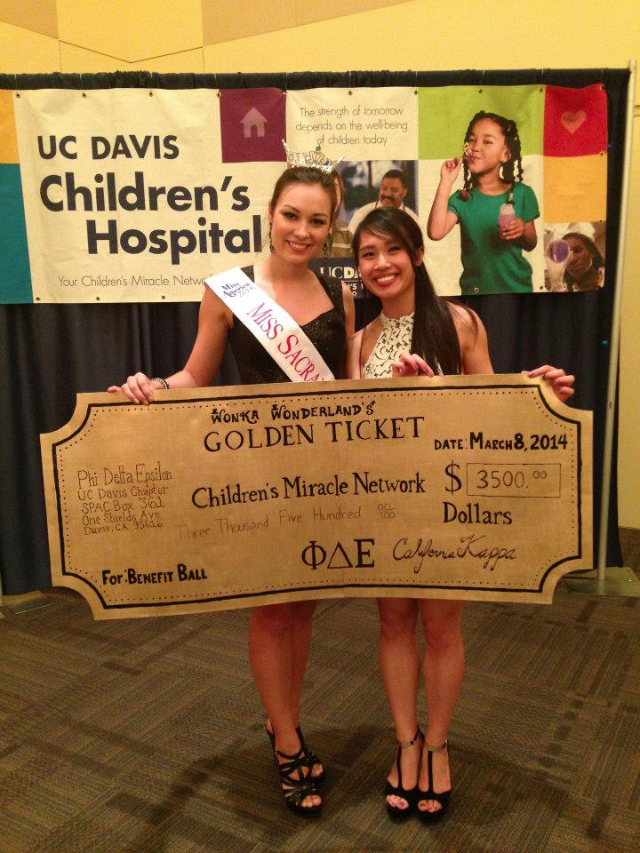
She continued the relationship between Davis and the pageant, which includes a history of winners and finalists from the school, as well as a connection with charitable organizations that are active on campus.

The history of UC Davis students competing in the pageant has been motivated by two key factors. The first involves money. The Miss Sacramento County program director, April Smith, said the Miss America program gives out over $45 million a year to contestants, and Ott said that it is the largest provider of scholarships to women in the world.

Ott won over $2,000 this year alone as a contestant, and a total of about $3,000 in the two years she’s been competing. A portion of that was from winning, the rest was from individual achievements within the competition.

“I got additional scholarships for getting top interview, community service and academic achievement awards,” Ott said.

The second factor is the students’ involvement in their platforms. Smith said the organization is partnered with the Children’s Miracle Network (CMN), which functions on campus as part of the UC Davis Children’s Hospital.

Ott said she has been raising money for CMN for the past five years, even before she began competing and working with them on her platform, “Trading Cope for Hope.” Her goal is to work with CMN to help kids with cancer. She said she hopes to go to med school and plans to focus on pediatric oncology.

Julianna Johnson, a fourth-year human development major, won the competition in 2012. Although she stated that the scholarship was a motivation for competing, she too appreciated the opportunity to get involved with charitable organizations and promote her personally chosen platform.

“Having the title of Miss Sacramento County opened a lot of doors for me, and I was able to work closely with the UC Davis Children’s Miracle Network, the Salvation Army and the One Sight Organization,” Johnson said.

Two years after winning, Johnson still works with the One Sight Organization on her platform “The Gift of Sight.”

“So far I have collected and donated over 740 pairs of prescription eyeglasses, originally valued at more than $210,000,” Johnson said. “All of these glasses have been hand delivered to patients in the United States, Ghana, Gambia, Paraguay, Mexico, India, South Africa and Thailand. I continue to collect glasses at the ‘donation locations’ I have set up in various optical clinics and hospitals in the Bay Area and the Sacramento region.”

Ott and Johnson credit both the Miss Sacramento County program and UC Davis for their opportunities to achieve.

“A huge component of becoming Miss Sacramento is promoting your platform, being involved in student activities and using your involvement to help the community. And I think UC Davis provides those opportunities,” Ott said.

Although both students believe the school has helped them to win the pageant, Smith believes there is another way to view the cause and effect relationship.

“I think the UC Davis students do so well because they are so prepared,” Smith said. “Typically, in order to get into UC Davis you have to have good education and organizational skills and this carries over to this program.”

The preparation required is the source of the high expectations Ott mentioned.

“They want someone who’s extremely smart,” Ott said. “They want someone who’s really driven, who’s done a lot of philanthropies and they [have] this unrealistic expectation of what a woman should be. And they’re not telling us to become that, they’re telling us to strive towards achieving greatness in all areas of your life.”

The competition consists of multiple, differently weighted stages. Contestants are expected to appear physically fit and express a sense of confidence and attractiveness.

“We have the fitness competition which, though it’s controversial, I personally appreciate, because it’s taught me how to eat better and how to treat my body with respect,” Ott said.

The contestants should also be able to demonstrate a talent.

“I practice piano every day for at least an hour or two,” Ott said.

They are also tested on their communication skills and their knowledge of current events.

“I have to remain aware of what’s going on,” Ott said. “I think what’s cool about this organization is that they don’t really care what opinion you have, they just want to make sure that you are aware and you do have an opinion and that you can translate and communicate your opinion to an audience.”

Ott is currently preparing for the next step in the pageant circuit. She will be competing for the title of Miss California this June.

 NICK FREDERICI can be reached at features@theaggie.org.

Courtesy photo.

Guest Opinion: The Environment Club … more of a social club?

0

As a transfer student to UC Davis I was unsure of what to expect of the environmental movement here on campus. Unsure of where to look for campus environmentalists, I was sure the Environment Club was a good place to start.

However, it was CALPIRG that really snatched me in off the street and got me excited about their “Million Clean Cars Campaign,” which has received a lot of attention from Gov. Jerry Brown as well as other campaigns such as their campaign against “Citizens United.” This important Supreme Court decision has allowed unprecedented amounts of corporate monetary contributions to enter our political system, undermining public and environmental protection efforts.

The CALPIRG “Anti-fracking” campaign is part of the brand new UC Davis Chapter of the Students Against Fracking, a statewide coalition with the California Student Sustainability Coalition (CSSC), joining student organizations statewide in support of a moratorium on fracking in California. Many cities, such as San Francisco and L.A. have said no to fracking, which pollutes groundwater and our oceans with carcinogenic chemicals and has been shown to release harmful greenhouse gases and cause earthquakes. In an effort to reach out to other environmental groups on campus to gain more support for the statewide ban, I decided to attend my first Environmental Club meeting last quarter.

I quickly began to understand why I had heard a less than flattering reputation of the club, although it is an active part of the campus community and a valuable organization. There were not any environmental issues addressed during the first half of the one hour meeting, which consisted of a laundry list of activities that did not include environmentally conscious agendas or information. Although very fun activities such as ice skating, snowboarding and skiing were addressed, to my disappointment, issues such as the inevitable carbon footprint resulting from such activities and concerns for the current devastating drought in California were not.

A guest speaker spoke of the recycling services offered in the City of Davis, which was very informational (although the services offered here on campus recycle a larger variety of items). However, my complaint is that no time was reserved for public comment on environmental issues, and the only environmental issue raised was cut off — the meeting had run past 8 p.m. A member had mentioned BPAs in recycled receipts and other materials; however, unfortunately neither the guest speaker nor any club members had heard about the issue and it was largely dismissed, despite the speaker’s efforts to explain the issue.

The Aggie opinion piece “Guest Opinion Re: Recycling” discusses this important issue, in which recycled products are often released without proper public health hazard risk assessments for the toxic chemicals that are retained within paper, plastics and other materials used and reintroduced into the market.

Concerned about the lack of involvement with the club in campus environmental issues, I decided to approach the club personally. I was able to speak with the president of the club, Patil Karkazian, about the fracking campaign in hopes of gaining the club’s interest. I was quickly deferred to a Google document on which any environmental concerns could be uploaded for students to look at when they felt like periodically checking the Google form. My request for any face time at club meetings was not even slightly entertained.

I tried to convey my concerns for a lack of representation from the club of the environmental concerns on campus to the club president, and she simply responded to me with a blank expression: “This is more of…a social club,” explaining to me that these were just the things that people want to do.

Looking at the Google form later, I found another student who had asked to attend that very same meeting, and had offered to bring all the materials needed for the club to make Valentines for Congress urging them to support a statewide fracking ban. When I emailed the club president about my interest in several activities on the form I received no response. My interests included fracking and a GRID solar opportunity, which would require great leadership and organization, but would create incredible benefits for our students and communities if implemented.

Fracking has been shown by Cornell University to be as much of a greenhouse polluter as Big Coal, and has been shown by a Colorado study to contaminate groundwater supplies.  The EPA has closed investigations on groundwater contamination in several states despite findings from their own scientists suggesting causal links between fracking and drinking water contamination. Surprisingly enough, 9 billion gallons of waste water containing these carcinogens are legally dumped off the California coast each year, and millions of fresh water that should be used in Californian communities and agriculture are wasted each time a fracking operation begins.

If you believe as I do that we live in a time when our world needs to hear the valid concerns of environmentalists, please consider joining Environmental Voices, a non-profit organization in Davis committed to environmental advocacy and research. I met the founder of Environmental Voices at an environmental advocacy rally — the group focuses on public involvement as a vehicle for change, and internship positions are available. Please contact me if you are interested in an “Environmental Voices” club on campus for the advocacy of current environmental issues. You can find us on Facebook and online at environmentalvoices.org. You can also visit UC Davis CALPIRG and Students Against Fracking on Facebook and online as well.


Kelsey Craig
krcraig@ucdavis.edu
Third-year transfer, environmental toxicology major


UC Davis research team discovers reason behind zebra stripes

0

A research team led by UC Davis has discovered the reason for zebras’ black and white stripes. Possible purposes for the stripes have included camouflage, reducement of heat, social function, disruption of attack by predators and avoidance of biting flies. The results of the study, published April 1 in the online journal Nature Communications, revealed that biting flies are the cause for zebras’ stripes, as flies are likely to avoid black and white-striped surfaces.

The team made the discovery by using a geographic analysis that had never been used before. The team first looked at the seven species of zebras, horses and asses, scoring different parts of their bodies to see how striped they were. The team compared the geographic regions of these animals with variables such as temperature and likeliness of large predators in the area. They then looked at the overlapping of the striped animals and these variables.

“The one that popped out is always biting flies where there is a greater amount of overlap with a greater amount of striping,” said Tim Caro, the lead author of the research as well as a UC Davis professor of wildlife biology. “We never found any significant associations between the other variables and striping.”

“It was a multi-pronged approach,” said Hannah Walker, who graduated from UC Davis this past December as a wildlife, fish and conservation biology major with a minor in Spanish. “This is the one that had the most support.”

It is believed that zebras, as opposed to other mammals, developed stripes because their hair is shorter, thus making them more vulnerable to biting flies than other mammals are.

This discovery also shows how undergraduates can become involved in research.

“Winter Quarter of junior year I took one of his classes,” Walker said, who worked on research for the project during her time as an undergraduate. “The beginning of the next quarter I just asked him if he needed help with research. I’ve been with it ever since.”

Walker’s involvement in the research included doing most of the measurements of zebra pelts and other African animal pelts at museums in Los Angeles, Berkeley and Chicago. She also researched many of the diseases caused by the flies and also helped compile the table in the study published in Nature Communications.

Caro said that Walker’s involvement is a prime example of the opportunities undergraduates have to become involved in research.

“Undergraduates can get involved in research if they take the plunge and ask a professor,” Caro said.

The team’s finding proves that funding is not always key to a project’s success, as Caro’s team received no funding. Rather, Caro said that his team pursued their research because they found the topic interesting.

“We didn’t get funded for this,” Caro said. “Large grants aren’t necessarily the key to doing high-profile scientific projects.”

UC Davis students, in addition to the scientific community, are interested in the research team’s discovery about zebra stripes.

“This is a very exciting discovery,” said Regina Wang, a first-year animal science major. “I have never seen anything about why zebras have their trademark black and white stripes, so this is a very interesting discovery. As an animal science major, it is always wonderful to learn new facts about the animals in our world.”

Now that Caro’s team has discovered why zebras have stripes, other scientific questions can be researched, such as why biting flies avoid striped areas, an answer still unknown to scientists.

 ALYSSA VANDENBERG can be reached at campus@theaggie.org.

Celebrating a century of excellence

As the sun comes out and Spring Quarter rolls in at UC Davis, the excitement and anticipation for one of the most monumental student-run events in the nation heightens.

Boasting cockroach races, honey tastings and maggot art, the 100th annual UC Davis Picnic Day event returns to campus this Saturday, April 12.

“It’s definitely a hallmark year, it is a testament to us as a student organization having come so far,” said second-year biological sciences major and Picnic Day Parade Director Grace Scott. “It’s a testament to UC Davis for how cohesive we are as a campus, how we are one of the world’s best universities and how the community celebrates with us.”

The theme of this year’s event  is 100: A Timeless Tradition, and the board plans to push this theme in every aspect.

“Just seeing the design come together is amazing,” said Publicity Assistant Director and second-year technocultural studies major Summer Kang. “Seeing that [the directors] can form an idea into a product and the fact that they are all students is great.”

Although most of the day will have activities similar to those in previous years, this year’s 100th Picnic Day will also commemorate the alumni that have worked to keep the event alive for so many years.

“In the parade this year, we are allowing our Picnic Day board alumni to walk along it just so we can show them how much we appreciate what they have done for Picnic Day in the past,” said fourth-year communication major and Chair of Picnic Day Jackie Kong. “Without all of their help, we wouldn’t be at the 100th and we wouldn’t be at such a spectacular place.”

Apart from alumni, current Picnic Day Board members have also been delving into the rich history of the event through reflection and thorough research.

“We’ve been going back catacombs of the parade and researching, and we’re hoping to highlight that aspect of Picnic Day,” Scott said. “In 1909, when Picnic Day started, it was just a bunch of people sitting around listening to speeches, and when the parade started it was just a couple of floats. But as Davis has grown, so has the parade.”

Scott compared this year’s 100th anniversary to that of Disneyland’s, making it clear that this year’s parade event is significant to the Picnic Day board and the Davis community alike.

“It is very community-oriented, so it’s going to include a lot of groups from the community and from UC Davis,” Scott said. “It really shows how UC Davis is integrated in our community.”

By incorporating history into the upcoming Picnic Day, those involved can reflect upon the growth of the event and the general UC Davis campus.

“For alumni who come back, it’s to revisit their experiences, to see how the campus has changed and how it has remained the same,” said Advisor to Picnic Day and Assistant Director at the Center for Student Involvement Paul Cody. “There’s people who have been coming to Picnic Day their whole lives. They grew up with UC Davis and Picnic Day being a part of that.”

In addition to alumni involvement in the parade, a history room will be set up on the second floor of the Memorial Union where alumni will have the opportunity meet with their past board members.

“This year we are taking more of a look back at where we’ve been, but I think that ever since Picnic Day’s inception, the idea has pretty much been the same,” said Vice Chair of Picnic Day and recent graduate Martin Guo. “It’s really just celebrating the campus and what it has to offer all of the people who come to it.”

In addition to activities highlighting the 100th year, many Picnic Day staple events will also be held, including the Doxie Derby and Chemistry Magic Show. Several UC Davis academic departments will also be open to visitors, showcasing the university’s efforts in education.

“Most of the events are the same,” Cody said. “ That’s one of the great things about Picnic Day, you can go to different events every year and still not see all of them.”

Over the years, Picnic Day attendance has fluctuated from 50,000 to 70,000 people, peaking in the past at 100,000 visitors.

“It’s a way for people to come together on an annual basis,” Cody said. “It’s a catalyst to celebrate UC Davis.”

Bringing alumni, the Davis community and current students together serves as one of the main purposes of Picnic Day, and Cody expects there to be a lot more alumni on campus than usual for this year’s event.

“We have reached a milestone, and there will probably be more people because of that significance,” Cody said. “It’s a natural human thing to celebrate significant milestones, and 100 of anything is a pretty major accomplishment.”

As one of the largest student-run events in the United States, this year’s Picnic Day celebration is backed by the effort of 16 Directors, 60 Assistant Directors and close to 350 volunteers and staff members.

“It’s a student-run event and coordinated, but it needs the support of everyone on the campus and community to make it a successful event,” Cody said. “Everyone is contributing in some form or fashion, and that’s what a lot of people take pride in — to be a part of one of the most cherished events on campus that has happened 100 times.”

Ritika Iyer and Lujain Al-Saleh can be reached at features@theaggie.org.

UC Davis celebrates centennial picnic day

0

On April 12, UC Davis will celebrate its centennial picnic day by bringing back loved events from past years and further expanding its safety zones into the City of Davis.

Long time Davis residents might remember that in the past, police have had issues with alcohol at Picnic Day.

There will be about 60 police officers on campus and the surrounding areas from CSU Sacramento, Los Rios Community College, UC Riverside, UC Irvine and USF to ensure the safety of all Picnic Day participants, according to UC Davis Police Chief Matt Carmichael.

This year’s expanded safety zone will reach east of the UC Davis campus from First Street to the railroad tracks, and north of campus from Russell Boulevard to West Eighth Street and with Anderson Road bordering it on the west.

Citable violations in the safety zone will include general noise, urinating in public, open containers of alcohol and smoking violations, with an additional minimum noise citation of anywhere in Davis.

The safety zone was implemented a few years ago by the City of Davis to try and overcome what was becoming an excessive use of alcohol and to ensure a safe Picnic Day. Recently, police have seen an improvement, according to Carmichael.

“You have people from all over the country who want to come and enjoy the day,” Carmichael said. “It’s an amazing, longstanding tradition, and last year was very successful, so we want to continue that.”

In the last two years, ASUCD and the Greek system have stepped up and committed to safe partying practices, with leaders of Greek organizations even signing pledges to promote safety and responsibility on Picnic Day.

Carmichael wants to emphasize the importance of being responsible, and to point out to students that they’re not going to get in trouble for helping someone in need, whether they’re suffering from alcohol poisoning or something else entirely.

“We need the community and the student community to come through like they did last year,” Carmichael said. “We turned a corner a year or so back, and it’s all about members of our community.”

In the past, some of the biggest arrests and violations have been open containers, urinating in public and being drunk in public, according to Carmichael, although he mentioned that the increased amount of portapotties on campus has had a big impact on decreasing the amount of violations for urinating in public.

“People need to look out for one another. If you see anything suspicious, stop an officer and let them know,” Carmichael said. “I’d rather risk attending to something that wasn’t a big deal than missing something.”

Since this will be Picnic Day’s centennial celebration, efforts are being made by its directors to bring back some of the best events from Picnic Day’s past.

Shield’s Library will have an open house showcasing photos and other pieces of history, and an event from 50 years ago in which guests can guess the weight of a pig for the prize of a ham will be brought back.

“It’s very quirky,” said Dustin Li, this year’s Picnic Day publicity director and a second-environmental science and management major.

Li recommends that students make an effort this year to go to the smaller attractions that they may have never heard of.

“They’re really amazing, and a lot of planning has gone into everything,” Li said.

TAYLOR CUNNINGHAM can be reached at city@theaggie.org.