



57.3 F
Davis

Davis, California

Wednesday, December 24, 2025
Home Blog Page 861

Davis City Council halts paid parking proposal

On March 25, Davis City Council halted a proposal to implement paid parking in downtown Davis.

In October 2012, Davis City Council appointed members for the Downtown Parking Task Force (DPTF) which would meet monthly to identify the parking problems in downtown Davis. The task force came up with solutions for the management of parking as well as parking availability.

After much research, the DPTF presented a package of 19 recommendations for downtown parking. Among these 19 recommendations were paid parking for the Southeast Quadrant and the Amtrak lot because these areas have the highest density at peak parking periods.

“The purpose of paid parking was not for city revenue, the purpose was because it is an appropriate parking management tool to ensure that on-street parking space in the highest demand areas are available for customers, the secondary byproduct of that is that it does generate revenue,” said Brian Abbanat of the Transportation Planning Division of the City of Davis Public Works department.

According to the Downtown Parking Management Plan the paid parking would cost a dollar an hour.

Abbanat said that implementing every recommendation made by the DPTF would cost $1.4 million.

“If we sign all the costs of the parking plan to the parking meters, [we could never get] cost recovery with $0.50 an hour, or even $0.75 an hour,” Abbanat said.

According to Robb Davis, a committee member of the DPTF, although two-hour parking has been implemented downtown, people tend to move their cars to a different downtown parking space every two hours, which doesn’t open up spots for new customers to park.

“What paid parking has been empirically demonstrated to do in many cities when you ask for a small amount, it frees up parking [because] people are cost sensitive,” Davis said.

The goal of the committee, according to Davis, was to have no more than 85 percent parking occupancy at any given hour during any day, meaning that there would be approximately one free parking space on every block face.

Additionally, Davis said that the encouraged parking turnover is good for downtown Davis businesses because more customers would be able to have access to the businesses.

Part of the process of coming up with the Downtown Parking Management Plan was to collect data in the downtown area to assess peak times and parking availability to better inform the recommendations to be made. One of the discoveries that the DPTF made was that the E Street paid lot had similar occupancy levels to the free street parking.

“People will pay a little something to have certainty about getting a parking spot. I think our data has demonstrated the potential of paid parking,” Davis said.

Dan Wolk, Davis City Council member, said that pieces of the Downtown Parking Management Plan were approved, like wayfinding endeavors, but that the recommendations pertaining to paid parking are on halt for now.

“The parking problem we’re having is a good problem, it is a reflection of the popularity of our downtown,” Wolk said.

However, Wolk found that in talking to downtown business owners many said they felt that paid parking would negatively affect their businesses, despite support for paid parking from the Davis Chamber of Commerce.

Additionally, Wolk said that he did not agree with making the Amtrak Station lot a paid parking lot as he feels it would deter people from using public transportation.

“The bottom line is that [parking] is a problem. It is a good thing that our downtown is so popular and vibrant … but at this point I was not prepared to say paid parking was the answer, [however] it may ultimately be the answer,” Wolk said.

SYDNEY COHEN can be reached at city@theaggie.org.

UC Davis men’s tennis wins; women’s streak ends

UC Davis men’s tennis defeated Air Force, 4-3, in their last home tournament of the year on March 5. Heading into the weekend, the Aggies were recovering from their eighth loss of the year against Hawai’i on March 1.

After losing two of three doubles matches, UC Davis was able to rally its way to victory by taking four of the six singles matches. Senior Kyle Miller led the Aggies with a singles victory against the Falcon’s Jack McCullers in two sets, 6-2, 7-6.

UC Davis improved to 13-8 overall and 2-1 in conference play as it travels down south to UC Santa Barbara to face the lowly Gauchos, who are 7-12 this season. The Gauchos, however, are undefeated in conference play, 2-0.

The Aggies hope to finish the regular season strong as they head into the last two tournaments before the Big West tournament on April 24.

The UC Davis women’s tennis team saw its six-game winning streak snapped by the streaking UC Irvine Anteaters, 4-1. The Aggies now have a 11-7 overall record and a 3-3 conference record.

The Aggies won two of the three doubles matches as the third match was left unfinished. Seniors Megan Heneghan and Melissa Kobayakawa recorded their 12th consecutive doubles win.

Currently in fifth place in the Big West, the UC Davis women’s tennis team hopes to regain its momentum against Cal State Northridge (10-6) on April 8 at the Marya Welch Tennis Center in Davis, Calif.

OSCAR DUENAS can be reached at sports@theaggie.org.

Aggie softball falls to Northridge

0

After April showers postponed UC Davis softball’s season opener against Long Beach State, the Aggies looked to turn their luck around when they traveled to Northridge, Calif. to take on Cal State Northridge in the next three games of Big West conference play.

The Aggies dropped all three games to Long Beach in the season opening series at home in Davis, Calif., and looked to put some much needed wins on the board versus the Matadors.

Unfortunately, the athletes were unable to come away with the series, but they did snag one win from Northridge, putting their current conference record at 1-5.

Northridge came into the series with an overall record of 23-13 and 1-2 in the Big West. In the series opener on April 5, the Aggies were unable to wake up the bats as the Matadors recorded their first win at home versus the Aggies since 2010. After falling 5-1 in the weekend opener, UC Davis still had plenty of softball to play as the teams began their second game of the day.

Fighting back in the second game of the doubleheader, the Aggies were able to take down the Matadors at Matador Diamond, 5-4, marking UC Davis’ first conference win of the year. Big contributions from several UC Davis players aided in the 5-4 victory. Sophomore Lauryn Saunders belted her fourth home run of the year to put the Aggies atop the Matadors in the third inning. Northridge was unable to answer back after Saunders’ blast, as the Aggies cruised to that 5-4 victory.

In the final game of the three-game series on April 6, UC Davis could not find a rhythm at the plate falling to the Matadors, 4-0. However, several positives can be taken from the loss. Sophomore Christa Castello went 2-for-4 on the day, leading the team in hits. Unfortunately, her teammates were unable to score Castello in six innings of play, as runners left on base killed the Aggies in that matchup.

Other high points from that third game came from the feet of sophomore Cat Guidry, who recorded her eighth stolen base of the season, putting her in second place behind freshman Brianna Warner on the Aggies’ overall base-stealing leader board.

With two losses and one win this past weekend, the Aggies fall to 1-5 in Big West conference play, with their next series coming up fast versus Cal Poly in San Luis Obispo on April 12 and April 13.

Cal Poly holds a current overall record of 21-14 and 3-3 in Big West play. The Aggies will need to come out firing from the first pitch if they want to see any hope of making it to playoffs come mid-May. Every game from here on out is a must win for UC Davis, as their season is quickly coming to a close and their number of win opportunities is rapidly dropping.

First pitch versus the Mustangs is at 4 p.m. on April 12 in San Luis Obispo, Calif.

 SLOAN BOETTCHER can be reached at sports@theaggie.org.

Gymnastics finishes fifth in NCAA Regional

UC Davis women’s gymnastics placed fifth among six teams at the NCAA Fayetteville Region Championship at Barnhill Arena on April 5. It was the first time the Aggies competed as a team in the NCAA postseason for gymnastics since 1998.

The Aggies started the meet slow, scoring 47.850 on beam. Sophomore Stephanie Stamates posted a team-high 9.725, followed by a 9.700 from sophomore Dani Judal and a 9.600 from senior Madeline Kennedy. With 47.850, UC Davis placed fifth on beam, while UCLA and Utah tied for first with 49.200.

However, UC Davis rallied back in the third rotation on floor exercise, scoring 48.825 with a 9.859 team-high score again from Stamates. Junior Kala DeFrancesco continued her good form and finished with a 9.800 on floor, followed by a 9.750 from junior Tiana Montell. UCLA finished with a season-best 49.925 on floor exercise.

The Aggies continued their momentum on vault and finished with a 48.600. Senior Anna Shumaker hit a team-high 9.825, and it was her last performance of her collegiate career. DeFrancesco scored a 9.750 and Stamates finished with 9.725. Utah made the highest score, 49.325 on vault.

In the final rotation, the Aggies closed the meet with a 48.625 on uneven parallel bars. Junior Lisa Wiktorski notched a team-high 9.825, while Shumaker, DeFrancesco, sophomore Jamie Yamashita and freshman Yonni Michovska each hit a 9.700 for UC Davis.

With the team’s effort, UC Davis finished its first team appearance at NCAA Regional with a 193.900. Utah ranked first with a 197.300, with UCLA making a second-place finish by scoring 196.375.

Shumaker was the only UC Davis’ all-arounder, and ranked eighth among 13 all-around gymnasts with a 38.550. UCLA’s Samantha Peszek scored 39.700 in total for the first place, and Katherine Grable from Arkansas placed second with a 39.675.

Additionally, during the postgame conference, Tamara Ross was named as the West Region Assistant Coach of the Year. She has been coaching the Aggies for five years.

JANET ZENG can be reached at sports@theaggie.org.

Guest Opinion: For your consideration

0

It’s usually the same plot: a good-for-nothing rookie is paired with an experienced but reckless renegade to solve a seemingly impossible case to prove to the chief of police that they are, in fact, worthy of their badges. Throughout their case, a handful of screw-ups, a slew of ungentlemanly vocabulary and the jerk on the force trying to cause all kinds of trouble make for a great adventure that ends all too predictably. Along the way, we laugh at the excessive number of exaggerated police stereotypes (some cops like bagels instead, you know) and we celebrate when the perpetrator is caught. We hail the valiant efforts of the unlikely duo and quickly forget that a day in the life of a police officer is not nearly as glamorous as the comedy kings in Hollywood seem to portray it.

And let’s not forget about the Oscar-worthy triumphs that uplift spirits and momentarily become everybody’s favorite movies. Trigger-happy law enforcers who seem all too eager to silence criminals. Stone-faced men in blue all hardened by the wear and tear of serving justice in the streets whom have all lost their empathy. Not to mention our favorite hero in disguise, the darkest knight of all, putting all the policemen in Gotham City to shame. These movies, as with the knee-slappers, have given us but a bland taste of the reality every policeman and woman experience on the daily. Perhaps we’ve been Hollywood-washed to believe too much in these stereotypes and perhaps we all need a fresh perspective.

I admit I’ve immediately reduced my speed by 10 miles per hour if I see a police vehicle on the highway, even if I’ve barely reached the limit. And I’m most certainly guilty of silently dropping some F-bombs under my breath, again in the presence of a cop car. I have no doubt that a majority of our population feels similarly, but I must contend that our attitudes need serious adjustment.

In my recent personal experience, I’ve had the pleasure of meeting some of the men and women of the UC Davis Police Department. I recall my internal monologue instructing me to shake hands firmly and make eye contact for an appropriate amount of time (these are the police for goodness sake!). But though I was incredibly nervous at first, I was humbled to be in the presence of the men and women who protect me every day. It might not cross our minds on the daily, but we are so fortunate to live with the security of knowing that help is only a phone call away. I am also indebted to the service of my fellow peers, the Aggie Hosts — students, like myself, who perform duties above and beyond because they are committed to the safety of their school. I am grateful to know for a fact how truly dedicated these men and women are, oftentimes sacrificing themselves for the overall good and protection of the community.

I believe we all need to be reminded that all police (and Aggie Host) share a common goal: to protect. This world may well be doomed to the same fate as crime-ridden Gotham City’s without the Batmen and Batwomen to keep watch. I would most certainly not feel safe without them.


Tiffany Lam
Fourth-year psychology major


FADS to present Picnic Day fashion show

0

The UC Davis Fashion and Design Society (FADS) will be hosting their annual runway fashion show in Freeborn Hall on Picnic Day, April 12. This year’s show is called “Raw Edge” and will feature 16 new collections from advanced design students at UC Davis.

A small group of UC Davis design students spent the entire 2013-14 school year imagining, planning out and creating four to six new garments for the show as their senior projects. After taking a series of classes that taught them how to cut, sew and dye garments, the students were able to advance to the class known as “Signature Collection,” or Design 179, taught by design professor Susan Avila. There, the students spent 10 weeks drawing and putting together unique lines of garments based on a theme each designer chose.

Each designer cut, dyed and sewed their outfits by hand. The inspirations of the collections range from religious traditions to a modern twist on British aristocracy to the galaxy and beyond.

Fourth-year design major Nancy Pulciano said she’s looking forward to seeing her collection on the catwalk. She said that her line is inspired by urban streetwear fused with the ideas of silence and meditation.

“It’s all about urban streetwear for the show,” Pulciano said. “Many of my designs are androgynous or unisex, though each garment is completely different and unique from the others in its own way.”

Many of the designers in the show are basing their lines off their personal cultures, beliefs and experiences, but some students have chosen to take a more abstract route. Eve Wanetick, a fourth-year design major and publicity chair of FADS, has based her collection off of shadows.

“I was inspired by 1930s silhouettes and the concept of the use of dark shadows in that time frame,” Wanetick said.

Along with the “Raw Edge” advanced design showcase, the show will also feature The Single Garment Competition and The Dress Red for Heart Health Campaign.

The Single Garment Competition is a competition in which UC Davis undergraduate students from any major can enter a single outfit to be displayed and judged. The garments will be judged in two categories: individual expression and sustainability. The competition will be judged by professional designers Whitney Roe Thornburg, who is the head fashion designer at ISDA & Co., and Katherine Karnaky, who is a textile designer at Williams Sonoma/Pottery Barn. The competition is open to any student with an interest in fashion design to showcase their talents in the art of garment making.

The Dress Red for Heart Health Campaign will showcase red dresses from February’s Heart Health Campaign showcase. The Dress Red for Heart Health Campaign was created to promote awareness about women’s heart disease and inspire women to live heart-healthy lifestyles. The red dresses will be displayed at the FADS fashion show to support the cause.

Overall, though, the show is meant to show the hard work UC Davis design students have accomplished in the 2013-14 school year. Fourth-year design major Ryo Kasagi expressed that fashion design is a lot harder than it seems and that he is excited for non-design students to see the end product of the advanced design students’ work.

“I’m excited that the people who come get to see what we’ve made,” Kasagi said. “A lot of people don’t know a lot about the design program at UC Davis and this is a good way to publicize it. It’s good for students to see what the design major is like because it’s a lot harder than it seems. I’m excited to see how all our hard work pays off.”

The doors of Freeborn Hall will open at 1 p.m. and the show will start at 1:30 p.m. Tickets are $5 for general admission and $3 with a valid UC Davis student ID. You can purchase tickets online at the UC Davis ticket box office or at the door on the day of the event.

AKIRA OLIVIA KUMAMOTO can be reached at arts@theaggie.org.


Arts Week: April 10, 2014 to April 16, 2014

0

April 12 is UC Davis’ 100th Picnic Day, which will feature a huge variety of events on and off campus. A thorough schedule can be found at picnicday.ucdavis.edu.

ART

2nd Friday ArtAbout
April 11, 5 to 11 p.m., prices vary
Downtown Davis
This is a special pre-Picnic Day edition of the 2nd Friday ArtAbout which features artistic events on display throughout the downtown area. This month features wine tastings at Whole Foods and the Davis Food Co-Op as well as live music at Monticello Seasonal Cuisine.

Design Department Fashion Show
April 12, 1:30 to 3 p.m.; $5 general, $3 student
Freeborn Hall
The UC Davis Fashion and Design Society will present their work at a runway show. The show will feature collections by senior students and individual articles by lower division students.

Davis Dance Revolution 2014
April 12, 7:30 p.m.; $15 student, $20 regular, $7 children
Freeborn Hall
The 10th annual edition of the Picnic Day dance contest will, as always, feature competitors in the traditional and modern dance categories. Modern dancers will include Mobility, Agape and Popping Club, while traditional dancers will include Sunatya, Davis Ballet Company and Vintage Dance Troupe.

“Water” by Judy Yenma
April 14, 1 to 4 p.m., free
Gallery 1855, 820 Pole Line Road
A free open house at Gallery 1855 will exhibit a collection of images by Judy Yenma that focus on water. While water has come up recently due to the drought, Yenma claims that she began working on this collection because water makes her feel relaxed.

FILM

Davis Feminist Film Festival
April 10 at 7 pm, local films
April 11 at 6 pm, international films
Suggested donations: $5 for students, $10 for non-students
Veterans Memorial Theatre, 203 E. 14th St.
This film festival focuses on independent films — whether they’re narratives, documentaries or experimental — that address issues of social inequality. The first night will feature films by Jesse Dizard, Sally Tran and Trisha Gum among others, while the second night will feature works from France, Kosovo and Italy.

MUSIC

Vandaveer and Dead Western
April 11, 7:30 p.m., $15 at door
Davis Musical Theatre Company, 607 Pena Drive
The Davis Live Music Collective presents two bands. Vandaveer is an alt-folk band from Washington, D.C. with four albums under their belt. Dead Western is a psych-folk band from Sacramento whose members include a UC Davis alumnus.

The John Scofield Uberjam Band with the Joshua Light Show
April 12, 8 p.m., tickets $25 to $49
Mondavi Center
This jazz funk outfit will rock Davis on the night of Picnic Day. The band features guitarists John Scofield and Avi Bortnick who performed on Scofield’s 2002 album Uberjam and his 2013 album Uberjam Deux. They will be joined by the light show of Joshua White, a man who worked on light shows at the Fillmore East in the 1960s.

French Cassettes
April 14, 12 p.m., free
The Quad
The first of the Entertainment Council’s noon shows this quarter will feature SF-based indie rock band French Cassettes. They’ve been around since 2006 and they make music that’s perfectly fitting for a sunny day.

THEATER

MFA Thesis Performances
April 10 through April 13, 6 p.m.; April 12, 11 p.m.; April 13, 3 p.m.
Suggested donation: $5
Around Wright Hall Lab A and Wyatt Theater, UC Davis Arboretum
This program features two sets of performances, each roughly 90 minutes and representing the work of three MFA students. The first program, which begins in Lab A, features the work of Lindsay Beamish, Deirdre Morris and Mary Ann Brooks. The second program, which begins in the Wyatt Theatre, features the work of Peet Cocke, Andrea del Moral and Amanda Vitiello-Jensen.

Police Briefs: April 2, 2014 to April 6, 2014

0

Wednesday 4/2

Ran out of steam

A man was sleeping in a running vehicle parked at a gas pump on Mace Boulevard for over an hour.

Friday 4/4

Block party

Four people were lying in the street in oncoming traffic and taking pictures on G Street.

I wanna rob

On Regis Drive, someone made a comment on the reporter’s blog about breaking into his residence again.

Excessive expenditure

Someone’s ex-girlfriend logged into his debit account and used his funds on J Street.

Sunday 4/6

Game face

A drunk guy in a Laker’s jersey was yelling profanities and trying to fight passersby on G Street.

Inexcusable

Someone was wandering around the reporter’s back lot on Russell Boulevard. When the reporter asked what he was doing there, he shrugged and left the property.

Police briefs are compiled from the City of Davis daily crime bulletins. Contact EINAT GILBOA at city@theaggie.org.


Column: The love of the game

0

kenSince Little League, Pop Warner and youth basketball leagues, many of us learn that we should play “for the love of the game.” This phrase has been ingrained into many a young athlete. We train, we eat right, we share the ball because it’s “the right way.”


In many ways, I don’t disagree with this philosophy. To me, the team basketball of Wisconsin was a much better viewing experience than the isolation, me-first offense of Kentucky. I love the life lessons former UCLA coaching legend John Wooden imparted on his players to help them both on and off the court. In short: I am a firm believer in playing sports “for the love of the game.”

Yet, I strongly disagree with the use of this phrase as a reason for why college athletes should not get fairly compensated for their work. Playing “for the love of the game” is not the same as being free labor for a corporation which makes millions off of the hard work.

According to a USA Today article, the National Collegiate Athletics Association (NCAA) made a “nearly $61 million surplus for its 2013 fiscal year” and had a year-end net asset of more than $627 million. In other words, the NCAA makes a ton of money off of college athletes.

These college athletes do not see a cent of the money that the NCAA makes, except the tuition and room and board scholarships which they receive.

That sounds fair. After all, these athletes are getting an education for free and in turn, they play for their college. Sounds like a win-win situation.

The problem? These “students” are on the practice field more often than they are in the classroom. According to the evidence presented in a recent regional National Labor Relations Board (NLRB) case — in which the players at Northwestern University earned the right to unionize — football players at Northwestern University spend close to 50 hours a week on the practice field or with the football coaching staff.

Beyond that, there have been complaints that students were dissuaded from taking “difficult” classes and majors. What is the point of giving students “free education” if they can’t challenge themselves and strive for betterment in the classroom just as they strive for progress on the field?

Some might say these student-athletes generally don’t care about their education anyways. The worrying evidence presented by a former tutor turned whistleblower at the University of North Carolina at Chapel Hill (UNC) in regard to the low academic standards of certain athletes is an example of how desparate universities are to field “top athletes.”

While it is sad to see this type of maneuvering happening in college athletics, I don’t see this as a failure of the athletes — rather, this is a failure of the NCAA. For all we know, these athletes at UNC could really believe that they are succeeding in school. The system has failed them and has made their “free education” useless.

This is unacceptable in its own. However, it brings to the forefront another injustice which collegiate athletes face. If their “free education” has been made useless due to the watering down of classes and the lack of accountability in the educational system for athletes, what do these athletes really gain?

The answer? Nothing. Meanwhile, the universities gain prestige and recognition and the NCAA gains millions of dollars off of these athletes. You know the NCAA Football video game that is annually released? Well, the athletes never see a cent from that despite the fact that their likeness is used in the game.

On a slight tangent, thankfully Electronic Arts, the company that makes the NCAA Football video game, has decided not to make the game for this upcoming year due to the tension between the NCAA and the athletes regarding, guess what, compensation.

Back to the point. Athletes aren’t getting a fair shake. There isn’t fair compensation for all athletes. Believe me, I know not all athletes are the same and this doesn’t affect all athletes equally. Some athletes are great students and are able to gain valuable skills in the classroom which will help them for the rest of their lives.

However, this is not consistently happening, especially for a lot of the athletes who play major “cash cow” sports, meaning men’s basketball and football. The NCAA is at fault for this problem.

Some might say, “So what? Even if the athletes don’t learn, they don’t need compensation. Let these college athletes play for the love of the game.”

That is a load of bullshit.

What if you were a great artist and the university said they would give you a free education for your paintings. Then, the university turned around and sold your paintings for millions, way more than what your education cost. Isn’t that unfair?

This isn’t about athletes being ungrateful and unwilling to “play for the love of the game.” Rather, it is about the unfair nature of the NCAA’s business practices and the fact that many student-athletes are being treated like professional athletes while at the same time being paid like “amatuer” athletes.

Just because they’re athletes and get more publicity and fame than an artist would does not make the NCAA’s treatment of them alright. Something needs to change. Whether it be payment of the athletes, more intensive focus on the educational benefits college has on athletes or even letting high school students go straight into the NBA — I’m calling you out, Adam Silver — something needs to change.

So, congratulations to former Northwestern University quarterback Kain Colter and those who led the charge for unionization at Northwestern. I hope it signals a change in the NCAA system because despite my “love of the game,” I hate the system.

If you want to defend the NCAA you can contact KENNETH LING at sports@theaggie.org.


News in brief: Marsh trial to be postponed until June

0

According to the Yolo County District Attorney’s office, Daniel Marsh, 16, will have his April trial date postponed until June 16. His attorneys successfully moved the date at a conference on March 27 because the investigation is still in process. Prosecutors on the case are not supportive of the motion to postpone trial.

The accused, Marsh, at the time 15, allegedly murdered and tortured Davis residents Claudia Maupin, 76, and Oliver Northup, 87, April 13 2013. He has pleaded not guilty.

The reason for the continuance was that prosecutors recently gave the defense DVD’s containing some surveillance footage in the area surrounding the crime scene. And though it may not have much conclusive evidence, the Yolo Superior Court Judge David Reed said that the need to examine the evidence is necessary before the trial to fully consider the importance of the DVD footage.

A status conference will be held April 29 and a trial-setting conference June 9. On June 16 Marsh will be tried as an adult at a Jury trial.


— Gabriella Hamlett

Taxicab service Uber comes to Davis

Whether it’s getting from North to South Davis or avoiding a Biking Under the Influence charge, most college students can find a reason to hitch a ride.

To meet this demand, a worldwide taxicab service called Uber has expanded to the Sacramento area, including Davis. As of just over a year ago, anyone in the area can book a ride around town for fares starting at $3.80, with just a click of a button on a smartphone or tablet.

“We tend to do pretty well in areas where there’s college students, because a lot of them don’t bring their cars to campus and then they’re going out or into town, so that’s part of the reason we chose Davis,” said Uber Community Manager Allison Grant. “The last two months we’ve really pushed our Davis plan — we’ve got some great ambassadors on campus.”

Uber originally started in San Francisco in 2009, when current CEO Travis Kalanick realized the difficulty in tracking down a high-quality cab in the busy city. Today, the service is provided in over 80 cities around the world, spanning 35 countries total.

 “It’s really important because, especially in the current, modern-day environment, a lot of people don’t have cars and I think Uber has been great for a lot of cities both domestically and internationally,” Grant said. “It’s just grown astronomically — I don’t think there’s a city we can’t work in because we’re changing the way people move around.”

Appealing to college students in the Davis and Sacramento areas has proven to be a huge reason for the company’s success in the expansion.

“You’re in college, you’re having fun, and you need to party responsibly — so Uber ensures that you always have a safe ride home,” said Uber Operations Manager Jason Fiedler. “Whether you need to get back from class or you’re going to meet friends, there’s Uber for you and it’s encouraging to see all the students take advantage of it.”

Fourth-year environmental policy analysis and planning major and Uber user Christine Hoang said that although Davis is a small city that makes walking an option, Uber has been helpful in getting her to and from the bars safely in other places as well.

“It just makes getting places safe and easy,” Hoang said. “Especially when people are going out partying, you never want to get behind the wheel. It’s a safe way to get around, and it’s really cheap.”

Although the application’s main users tend to be in the 18-35 age range, a wide variety of people use it for reasons other than going out on weekends.

“There’s definitely need for people in cities who don’t want to have a car, don’t want to have to deal with parking, and use Uber as an alternative to having a car or as an additional public transportation,” Grant said. “We have people that use it to go to work instead of driving or some that use it on the weekends when they’re going out, so I don’t think there’s necessarily a ‘typical Uber user.’”

So far, Uber has seen rapid growth within the Davis community, and is expecting to gain more popularity as time passes.

“Whether you’re in Shanghai or Dubai or Sacramento, there’s a need to get from A to B, and I think people connect with the need to do that in a way that leverages technology,” Fiedler said. “[Uber’s success is] about being first, being simple and being something that people need.”

When the idea for the application came about, Fiedler said there was a vitamin versus painkillers debate in which they discussed whether the service was something actually needed, or just nice to have.

 “It was just obvious that there was a need for a better way to connect with the driver,” Fiedler said. “Uber started out of that need and it’s grown a ton and it’s changed a bit here and there, but the core premise of efficiency and quickness and being cheap has stayed the same.”

From requesting a ride to reaching a final destination, user convenience was a major factor in the creation process, according to Fiedler.

“With the traditional taxi and even with public transportation you have to have cash or a credit card, but with Uber all you need is your phone and you can literally request a ride with the tap of a button,” Grant said.

Hoang said the reliability and accessibility of Uber makes the application popular.

“I love the service because it’s always available. The driver picks you up and drops you off and you don’t have to deal with anything,” Hoang said. “It’s nice that you can see where the driver is at all times, you can easily track where the driver is.”

Apart from convenience, the Uber concept is split into different parts, each designed to appeal to a different crowd and market. Uberx is a low-cost option, and is 20 percent cheaper than an average taxi in Davis, while Uber Black is a little more expensive.

“The reliability of Uber — the fact that almost anywhere in the cities that we operate you can get a car in less than five minutes — that’s a pretty crazy concept and I think that’s really exciting and appealing to people,” Grant said. “Since we do have an option that is cheaper than a taxi, it’s great for very cost-conscious college students.”

 ELLIE DIERKING and RITIKA IYER can be reached at features@theaggie.org.

Stride for Aggie Pride 5K raises funds for students

0

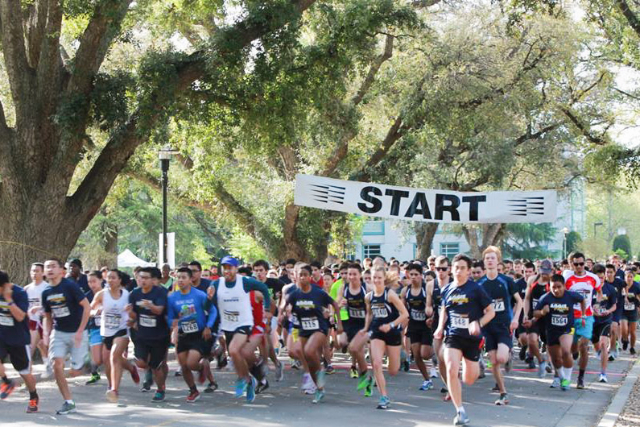
Looking to complete the 50 Aggie Traditions? By running the Second Annual Stride for Aggie Pride 5K on May 18, students can successfully check number nine off their lists.

As of now, 2,550 participants are pre-registered to embark on a 3.1 mile running adventure through some of the key sights of the UC Davis campus, including the Arboretum and Quad. All participants who register by the early registration deadline, April 4, will be guaranteed a shirt.

“Our main goal is to collectively, as an Aggie community, support this event and the purpose: to help Aggies in need,” said Artem Trotsyuk, founder of the Stride for Aggie Pride 5K. “I am very excited that so many people have signed up so far.”

While working as the Student Assistant to the Chancellor last year, Trotsyuk noticed that there was a lack of races geared toward student philanthropy in the Davis community and eventually proposed the idea of holding a 5K on campus.

“I am very passionate about health and wellness and I figured I would work on my passion by organizing a philanthropic fun run on the UC Davis campus that promotes health and wellness in a fun way — while at the same time raising money for student scholarships,” Trotsyuk said.

By serving as the ex officio director and the marketing lead of the race this year, Trotsyuk works closely with professional staff, administrators and students across campus to expand upon event publicity and sponsorship opportunities.

Among the several organizations and individuals that Trotsyuk collaborates with, ASUCD continues to stand as an integral component due to the fact that the Stride for Aggie Pride 5K is chiefly run by students.

In order to specifically address any and all ASUCD matters pertaining to the 5K, Gareth Symthe, a second-year political science and history double major and president pro tempore of ASUCD Senate, has adopted the role as an ASUCD liaison for the 5K.

“This event was the first of its kind that allowed for the campus and community to show support for those Aggies who need help finishing their undergraduate education,” Smythe said. “In addition, it was the first of its kind in the sense that the event was student led.”

All proceeds will directly benefit the ASUCD Endowment Fund and We Are Aggie Pride, a program which provides short-term financial assistance to students.

“Last year, we raised $17,500 and this year we are looking to double this,” said Samuel Sugarman, competitive sport manager of UC Davis Campus Recreation and Unions and student chair of the Stride for Aggie Pride 5K.

After becoming appointed by Laura Hall, the director of recreation, Sugarman took on the role by overseeing the general logistics of the event.

“Last year with the course there were some bottlenecks that we needed to fix and we just had to figure out logistically how we were going to deal with those. We ironed out those problems pretty quickly,” Sugarman said. “Fortunately, we could still keep the general course going and still show off what Davis has to offer, whether it’s through the Quad or the campus buildings.”

Some parts of the course which snaked through the Arboretum were too narrow for the 1,850 participants who signed up last year, and Sugarman noticed that many people had to walk due to the small space.

Due to the need for wider pathways, the race route has been moved up to Old Davis Road.

Sugarman stated that bigger trails were necessary to ensure the overall safety of those participating in the event.

Additionally, the racecourse has been deliberately mapped out in ways to include scenery that not every participant may have the opportunity to view on a daily basis.

“It showcases all that UC Davis has to offer to the community [and to the] UC Davis students who don’t get to go down to the Arboretum or don’t get to go through the Quad because their classes are on the other side of campus,” Sugarman said.

Along with displaying the dominant features on campus, the event will also showcase multiple acapella and musical groups. At the end of the race, participants can celebrate their feat as they enjoy musical performances on the Quad.

Although the race inevitably comes to an end, Sugarman has noticed several participants who continue to represent the event throughout the course of the year.

“I still spot students running around campus in the Stride for Aggie Pride 5K shirts and that is one of the coolest things to see,” Sugarman said.

While students support the 5K through volunteering and participating in the event, the race supports students in return as funds will help to generate the UC Davis scholarship programs.

“You can never really have enough to help students and our goal here to raise awareness,” Sugarman said. “Some students cannot pay for school and with rising tuition costs, it’s causing some students to even drop out of school and we want to try and help as much as we can. If that means putting on a 5K and a fair for the students, then that’s a great way to start.”

LUJAIN AL-SALEH can be reached at features@theaggie.org.

UC Davis professor receives 2014 Wolf Prize

0

UC Davis Professor Jorge Dubcovsky discovered a gene that can increase the nutritional value of wheat, and in January, was awarded the 2014 Wolf Prize in Agriculture.

The prize, which has been awarded since 1978, is one of six prizes established by the Wolf Foundation and is awarded once a year in Israel. The foundation’s website states that one of its main goals is “to award prizes to outstanding scientists and artists … for achievements in the interest of mankind and friendly relations among peoples.”

Dubcovsky and his team conduct their research using an applied breeding program that produces commercial varieties of wheat, which include things like pasta and bagels, and make up about 20 percent of the wheats grown in California.

“We discovered a gene that increased the amount of protein and iron that you have in the wheat grain,” Dubcovsky said. “This gene controls the remobilization of nutrients.”

Though the Wolf Prizes are usually each given to a single recipient, this year Dubcovsky shares the prize with Leif Andersson from Uppsala University in Sweden.

The foundation, according to its website, believes that Dubcovsky’s achievements are “truly impressive,” providing “groundbreaking contributions” to the field of wheat genetics.

“My program goes from very, very applied to very basic,” Dubcovsky said. “The focus of our research is on the genetics of the traits that contribute to develop better wheat: we study genes that improve quality and the nutritional value of wheat and that make wheat more resistant to biotic and abiotic stresses.”

Dubcovsky was born and raised in Argentina, and graduated from the University of Buenos Aires in 1984. He first came to Davis as a visiting scientist in 1992, but after returning to Argentina for a couple of years and finding it difficult to make a living, he moved to the United States and joined the UC Davis faculty in 1996.

“I enjoy it a lot here,” Dubcovsky said. “There are better opportunities for me. The system has more resources and is less corrupt. Argentina is a very nice place but we couldn’t make a living, and science wasn’t such a priority — that has changed a lot in recent years. That situation has gotten better for scientists, but when I came [to America] it was almost impossible for scientists [in Argentina].”

Dubcovsky currently teaches advanced statistics and an experimental design class at UC Davis. Previously, he taught undergraduate courses in molecular genetics and bioinformatics.

“I’ve had about 60 grad students every year for about 17 years — a lot of you!” Dubcovsky said. “I enjoy [being a professor], but I’m very passionate about my research also, so I like having time for that.”

Prior to receiving the Wolf Prize, Dubcovsky was also elected to the National Academy of Sciences (NAS) in 2013, where he has meetings with legislators to advise on plant breeding and on the need to train new plant breeders. His NAS responsibilities also include the revision of manuscripts for the Proceeding of the National Academy of Science (PNAS) as well as a general promotion of science and science education.

Tyson Howell, a fourth-year Ph.D. student in the Genetics Graduate Group, has been a student of Dubcovsky since March 2011.

“I think he is an excellent teacher with a passion for his work that really shows,” Howell said. “He has an in-depth knowledge of the subject matter, and endeavors to help students understand the material. It is clear that he takes teaching seriously and has a sincere interest in helping students learn the material for their own benefit, rather than just teaching so the students can pass a test.”

Howell specifically remembers a late meeting with Dubcovsky one evening in which the professor had to rush home after realizing mid-sentence that he was late for dinner.

“I’m sure he was hoping his wife hadn’t noticed he had stayed late in the lab yet again,” Howell said. “I remember this because it made me realize that he truly is passionate about his research, but he is also a husband and a father and has to balance many different aspects of his life, and I hope that in the future I can do as good a job of it as he does.”

Another Ph.D. student, fifth-year genetics and plant breeding major Rebecca Turner, has known Dubcovsky for six years now, works in his lab and said that she believes his Wolf Prize is definitely well deserved.

“From an undergraduate perspective, Jorge is an enthusiastic professor, who takes the time to present applicable material in a thorough way,” Turner said. “As a graduate student, he is a serious advisor, who imparts in his students a responsibility to report accurate results and to address relevant research questions.”

According to Turner, Dubcovsky’s work has resulted in the collaboration of public institutions across the country, creating resources for identifying genes and traits in wheat and barley breeding.

“These contributions have a global impact, as wheat is one of the top staple food crops in the world,” Turner said.

ELLIE DIERKING can be reached at features@theaggie.org.

UC Davis releases annual apartment vacancy survey

0

In early March 2014, the UC Davis Office of Student Housing released its yearly Apartment Vacancy and Rental Rate Survey. The Office worked with BAE Urban Economics, a private real estate consulting firm located in downtown Davis, in order to conduct the yearly survey.

According to the UC Davis Office of Student Housing, “The objective of the survey is to provide information that will help inform planning decisions on campus, and throughout the broader Davis community. For example, survey results help campus officials to assess the current housing market conditions faced by UCD students, and to determine the likely feasibility of proposed housing projects.”

The vacancy and rental rate survey has been conducted annually for the past 38 years.

In past years the survey had been conducted on paper through mail. There was an increase in participation this year by offering the online version via SurveyMonkey, a website used for administering surveys through the web.

“The Vacancy and Rental Rate survey participants consisted of apartment complex managers, property management companies and property owners on campus and in the Davis community,” said Faye Perata, business and financial specialist of the UC Davis Office of Student Housing, in an email. “The incentive for managers and owners to participate in this survey is to get comparable information about the market. For example, the average rental rate or vacancy rate for a specific apartment type. Individual students were not asked to participate in this survey.”

Out of the 486 rental units, the survey reported that 160 apartments, or 1.9 percent, of 8,206 leased by unit were vacant.

“The introduction of units rented out by beds is one of the more complex dynamics of the local rental housing market,” said Julia Ann Easley, senior public information representative at UC Davis. “Among the 818 units leased by bed, 81, or 3.5 percent, of 2,302 beds were vacant.”

The 2012 survey showed 1.7 percent of about 7,800 units captured in the survey were vacant.

During the last 10 years, the apartment vacancy rate in Davis has varied from as low as 0.7 percent in 2007 to as high as 4.2 percent in 2005, according to the 2012 survey.

Most of the apartments responded either constant or increasing rents from the previous year.

The mean rent for an unfurnished two-bedroom apartment was approximately $1,275.

The majority of leased units by unit size are two-bedroom and one-bedroom units. Forty-six percent of the distributions are two-bedroom units and 31 percent are one-bedroom units.

“These questions were asked because they provide enough detail to determine a vacancy rate and average rent for each unit type as well as offer insight into the need to offer special incentives or programs to fill units,” said Ramona Hernández, business director of UC Davis Student Housing.

It was concluded by the survey that it is often in a property owner’s best interest to provide certain services and incentives to residents. This often helps to encourage resident attraction and retention. For properties that offer bed leases, a roommate-matching program can often be an important tool for leasing up units.

“Given the lack of housing growth in the Davis community, it has been decided going forward the survey will be conducted biannually,” Perata said. “There are currently no apartment projects being developed in the city of Davis that would serve UC Davis students. Given that the total number of apartments in the community is not changing significantly, one can infer that the information collected this year would be very similar next year.”

The next Vacancy and Rental Rate survey will be conducted in 2015.

“Overall, this survey benefits the students because it provides insight into the rental market that shapes decision[s] about future planning and rental rates offered,” Hernández said.

ROHIT TIGGA can be reached at city@theaggie.org.


Davis Chamber of Commerce holds forum for City Council candidates

The Davis Chamber of Commerce Political Action Committee (PAC) held a forum April 2 to interview the five Davis City Council candidates for the June 2014 election. The Q&A based forum discussed various concerns that the City of Davis is facing and lasted from 6:30 p.m. to 8:30 p.m. at City Hall.

The main topics of conversation focused on the $5.1 million annual deficit, the parcel tax, the city employee changes and visions for the future of Davis.

Chamber PAC members will be endorsing candidates or slates of candidates and releasing a video recording of the event later this month.

The Davis Chamber of Commerce created the PAC in 1997 in order to support or oppose local, county or state ballot measures that influence the Davis business environment. According to its website, the mission of the Chamber is to promote, support and advocate the general economic vitality of its membership and the quality of life for the community.

The PAC is funded by individuals in the Chamber and is financially independant of the organization. Chamber funds do not support the PAC financially.

Questions for candidates came from audience members and members of the Chamber PAC. The five candidates are Rochelle Swanson, Sheila Allen, Daniel Parrella, John Munn and Robb Davis. Two of the five will be elected for City Council in June.

Rochelle Swanson, a current City Council member, is running for re-election. On her campaign website she says she wants to finish what she’s started since being on City Council.

“Economic stability continues to be our City’s most important challenge. I and my Council colleagues have worked hard to control and reduce expenditures. It has been a very difficult time with many difficult choices,” Swanson said.

John Munn was a 2012 Republican candidate for District 4 of the California State Assembly. He is a UC Davis alumnus with Bachelor of Science degrees in soil and water science and engineering and a Master of Science degree in soil science. Munn is retired from the California Department of Forestry and Fire Protection in Sacramento where he worked as a soil and watershed scientist for 25 years.

Sheila Allen has been a trustee on the Davis School Board for nine years and founded the Yolo Healthy Aging Alliance among other things. She hopes to promote healthy living and economic development.

Daniel Parrella was born in Davis in January 1991. According to his press release he hopes to run a bottom-up campaign. He graduated from UC Santa Barbara in 2013 and came back to Davis to start a solar panel company called “Solarize Davis.”

The fifth candidate is Robb Davis. He hopes to alleviate the community’s homelessness, addiction, food insecurity and abuse, reduce car use and lessen community conflict with programs such as Neighborhood Court.

“My political career begins and ends in this town,” Davis said at the forum.

The candidates had differing opinions on various subjects. A main point of discussion was the $5.1 million yearly deficit and how to alleviate it.

“It’s a large apple to swallow; we need to look carefully and prioritize to address topics,” Allen said when asked about how to address the deficit.

Parella adds that the only way to address the deficit is through business, and with such a large student population, Measure I isn’t what’s best for the community.

“I always supported it. One issue is that there is a huge transient population. There are thousands of students and … if we want a 20 percent decrease in water with a holistic approach we must appeal to all our citizen[s],” Parella said. “City budget is reduced without taxes. The parcel tax and sales tax is essential. Business is the only way to address the deficit.”

Swanson believes that it is worth looking into creating new businesses and using the assets the community has to bridge the deficit.

“We’ve gotten sidelined. We must re-engage and recommit … we need to look at places for revenue with an innovation task force,” Swanson said.

Davis explains the need for a parcel tax, a special tax that can be used for any type of spending — construction costs, employee salaries and other projects or spending needs. He believes it is vital to bettering the community, especially in terms of alleviating the homelessness downtown.

“What you’re seeing is driven by meth. People can’t get out. We’re dealing with syndromes of problems. Drug addiction, prison time … it’s time to have parcel tax to bring resources in. We’ve done it for parks, schools … we’re talking human resource and i’m going to open that discussion,” Davis said.

Munn believes the parcel tax is premature because existing problems must be solved before asking the community for more money. Because of Measure I, Munn sued the City of Davis. He won’t be dropping his lawsuit even though he is running.

“As a plaintiff I’d have to recuse myself … at some point we need to straighten our situation… we need to fix our problems first. The tax must be reliable with what it’s replacing,” Munn said.

GABRIELLA HAMLETT can be reached at city@theaggie.org.