57.5 F
Davis

Davis, California

Wednesday, December 24, 2025
Home Blog Page 862

Yolo County tobacco, alcohol availability statistics high

1

A statewide survey, including regional and county level data, reveals the density of stores selling, advertising and making available tobacco and alcohol products in proximity to minors. According to this study, Yolo County has more stores selling tobacco products near schools in comparison to the rest of California.

To sell tobacco, stores must attain a tobacco retail license from the California State Board of Equalization (BOE) as well as a California Cigarette and Tobacco Products License. Even with a displayed license these establishments are not permitted to sell tobacco or related paraphernalia to minors, have a self service display or give out samples. Additionally, there are restrictions as far as tobacco packaging, outdoor/storefront signs and general advertising.

“How tobacco products are marketed has long been one of the keys to the tobacco industry’s success at getting people to use their products,” said Steve Jensen, Yolo County Tobacco Education Program coordinator. “Marketing itself isn’t a bad thing, but targeting a young … population with visuals that give the impression tobacco doesn’t kill most of those who use it, is a troubling practice.”

According to the Center for Disease Control and Prevention (CDC), there are many factors associated with tobacco use, including social and physical environments, social groups, cognitive processes, biological factors and psychological needs. However, advertisements have proven to be a very powerful factor as well.

“Decades of research on the impact of marketing on youth shows that it is more influential than peer pressure at getting kids to start smoking,” Jensen said.

It has become concerning to health officials and the general community that these advertisements and general availability of tobacco and alcohol are becoming increasingly enticing to younger children and influencing them to lead lifestyles of possible obesity or chronic illness.

“As adults we’re desensitized to the unhealthy advertising and products in stores,” said Yolo County Health Officer Constance Caldwell, M.D., in a press release. ”We need to stop and notice how many unhealthy messages are surrounding our children every day.”

According to the statewide survey, the results of Yolo County, specifically, indicate that 74 percent of stores sell chewing tobacco as compared to 56 percent statewide, 54.5 percent of stores have tobacco products near candy at the checkout, 77.1 percent of stores sell sugary drinks at the checkout and 59.1 percent of stores that sell alcohol have exterior alcohol advertising.

“As I understand it, the marketing and products are visually accessible,” said Beth Gabor, Yolo County manager of public affairs.

The study has not indicated greater illegal consumption of tobacco and alcohol by minors in the area, but an increased usage once legal, probably correlated to the psychological effects of advertising in socially neutral locations.

“The easy access allows minors to fuel their curiosity to get their hands on these different products,” said Bar Lazar, a fourth-year human development and psychology double major. “Through advertisements, movies, these different industries trick children into thinking that smoking is ‘cool.’”

According to Counter Tobacco, the first comprehensive resource for local, state and federal organizations working to counteract this in-store advertisement by the tobacco companies, the tobacco industry spends the vast majority of its annual marketing and promotional dollars in the retail environment. Point of sale marketing builds brand recognition and positive brand imagery, encourages tobacco use and undermines attempts to quit.

Many employees of these commercial businesses realize the influx of younger children experimenting with legal, yet generally adult-oriented substances.

“I think it makes them feel grown up,” said Liana Egan, a Starbucks barista. “Younger kids come in and order caffeinated drinks, and I usually make sure they are aware of the caffeine content. These kids probably shouldn’t be having so much caffeine.”

Adolescents and college-age youth are targeted by these advertisements because of the generally acknowledged eagerness to experiment and steady progression into the world of self-moderated choice.

According to the CDC, smoking and smokeless tobacco use are initiated and established primarily during adolescence. Almost 90 percent of current smokers start smoking by age 18, and 99 percent started by age 26.

However, there could be positive aspects of beginning to smoke and continuing to do so.

“There is a high proportion of people with mental illness like depression, anxiety who smoke cigarettes as a way to cope,” said Renee Babcock, a fourth-year anthropology major. “E-cigarettes could provide a benefit to these individuals, as they now have a healthier outlet to ease stress caused by their disease.”

This would be one medically-related explanation that does not come solely from outside pressure or recreational desires.

“The average age of a first time [smoker] is 14 to 15 years old. College-age students are another population that the tobacco industry admits to promoting their products because they are adults,” Jensen said. “The newest tobacco products including e-cigarettes, flavored cigarillos, snus and hookah bars are all updated versions of old strategies to get younger people hooked.”

The statewide survey initiated the creation of the Healthy Stores for a Healthy Community campaign, a combination of tobacco use prevention, nutrition and alcohol prevention to educate people about how product marketing influences the consumption of unhealthy products. Overall, this program hopes to increase the communal health of Californians.

“We hope the results of the study will encourage store owners to choose different ways to market unhealthy products and promote the healthier ones,” Jensen said.

SHANNON SMITH can be reached at city@theaggie.org.

Proposed bill may divide California into six states

0

Tim Draper, a venture capitalist from Silicon Valley, is collecting approximately 808,000 signatures for a bill that would divide the State of California into six separate states.

Draper said that this measure is necessary for the state to move forward as the “state government has become rusted, and operates as a monopoly.”

According to Draper, the State of California is ranked 50th out of 50 as the worst managed state in the Union.

The Forward Observer, a non-partisan consulting firm that conducted an analysis of the Six California’s ballot measure, reported that the measure could cause two out of three UC students to pay out-of-state tuition. Notably, the analysis states that 78 percent of UC Davis students would be required to pay out-of-state tuition under this new bill.

However, only the physical boundaries of these six new states have been drawn up — if the bill were to pass, 24 people would be appointed to consult with industry leaders on the best way to proceed, according to Alexandra Klun, the campaign manager of Six Californias.

While those involved with getting the bill on the ballot, notably Draper and Klun, believe that it’s important to bring up these topics, others feel as though lobbying for this bill highlights issues as worse than they are, and harms the image of the State of California.

Specifically, the topics under discussion as California’s main “issues” include the prison system and the water crisis, among other things, according to Democratic Political Consultant Steve Maviglio.

The media attention that the proposal has drawn is damaging to California’s image as a national leader, according to Joe Rodota, CEO of The Forward Observer.

“While most political observers feel that this bill is unlikely to pass, the proposal is a signal to the state and to the country that California cannot be governed,” Rodota said. “California hasn’t failed. If people feel that something needs to change, it should be locally or at the state level. It’s a misguided and bad idea . . . the California experiment hasn’t failed.”

Klun believes that these conversations are one of the most important things about the bill.

“We haven’t had a political conversation like this for awhile,” Klun said. “A more local and centralized government will bring people to the areas that they’re making decisions about.”

Maviglio believes that there is a less than zero chance that the bill will become reality.

“This is somebody’s pie in the sky idea that might be on the ballot just because he’s able to write a big check,” Maviglio said. “That’s not the way that public policy should be made.”

While dividing the State of California into six smaller states may be a huge task, Klun pointed out that similar divisions have been made in the past in the United States.

“It’s definitely a big change, nothing like this has been done in a couple of hundred years, since the 1800s,” Klun said.

Economically, Klun said that any up-front costs that the restructuring would encounter would be offset in the long term.

“It’s an investment. Put in capital in the beginning to make a long term impact,” Klun said. “We’re talking millions now versus billions saved and a better structure for the future.”

Rodota argues that money should be spent on expanding higher education in California, not dividing our current system.

“Splitting up California would open up a Pandora’s box,” Rodota said. “It would be extremely costly, and there would be squander trying to sort and split up the assets and liabilities of the State of California.”

Draper said that he hopes that the bill will bring more efficient, streamlined state governments, choice for Californians and better representation for the people of California.

In opposition, Rodota said that he only sees one good thing coming out of the proposal of the bill.

“Bipartisan, diverse group of Californians who speak up about a misguided proposal and reaffirm upon their commitment to building upon California’s reputation as a worldwide leader,” Rodota said.

The proposed bill needs to collect eight percent of the number of votes that were cast for governor during the last election, approximately 808,000, to be verified by the county election officials.

TAYLOR CUNNINGHAM can be reached at city@theaggie.org.

Regents discuss de-freezing UC tuition

The UC Board of Regents met on March 19 to discuss the developments in the 2014-15 budget. Although Gov. Jerry Brown did increase the UC budget by five percent in his proposed budget, it leaves the UC with a $124 million shortfall.

Due to this shortfall, the UC Regents said they doubt the current tuition freeze could be upheld in the 2016-17 school year.

Brown’s proposed budget, which was leaked and then officially released in January, allocated five percent more money for the UC system than the budget had the year before. However, the UC Regents had requested a 10 percent increase in funding in November to cover mandatory costs.

As reported by the Daily Californian, the California legislative analyst’s office proposed a budget that would return the UC system to a “workload” budget, which would be dependent on $78 million from tuition leading to a nearly four percent increase.

According to Kelly Ratliff, associate vice chancellor of budget at UC Davis, mandatory costs include salary increases for faculty and staff, contributions to retirement, healthcare and the maintenance of campus buildings.

“Over the last five years the state cut the budget a ton and there were tuition increases but they never fully offset the state cuts,” Ratliff said.

Additionally, these mandatory costs have increased over the years. Specifically, according to Ratliff, the salary increases for the faculty and staff have been lagging behind the industry standard.

“If the state doesn’t give us enough money to cover those costs and the tuition stays flat, we need to be in a mode of cutting budgets to make things work, we’ve done so much cutting in recent years it’s really hard to see how you could keep doing those kinds of cuts without really harming the academic program,” Ratliff said.

Increases in tuition were discussed to fill the gap left by the lack of state funding, however, UC President Janet Napolitano said in a statement that the tuition will stay frozen for the 2014-15 school year and if the tuition is to be increased, there will be modest and predictable increases.

“There’s still a lot of discussion to be had, obviously with regards to what this budget will be. We are grateful for the five percent the governor has proposed and we could end up with a little more when the budget deliberations are all said and done and that is something we are hopeful for,” said Adrian Lopez, the director of State Government Relations for UC Davis.

As far as financial aid goes, Lopez said that when there is an increase in the budget there is also an increase in financial aid to help low income families pay tuition.

However, for families that don’t qualify for financial aid, this increase could be devastating. For Rachel Vogel, a second-year nutrition science major, the current UC tuition is already posing a challenge to her family.

“By raising fees even further, I myself am going to have to take out student loans, even though my parents want to be able to pay for my undergraduate education. They’ve been looking into options such as selling the house and way downsizing in order to not go bankrupt. Increasing tuition only worsens the situation,” Vogel said in an email.

Although Vogel will not have to worry about an increase until her fourth year at UC Davis, she is disappointed that the tuition is not what she had planned on when she chose to come to UC Davis two years ago.

“The cost of attending UC Davis puts financial and emotional strain on my family, and it makes me worry that I made the wrong choice putting my family through this much stress,” Vogel said.

Vogel continues to work a minimum wage job to help pay for textbooks, but her income will never be enough to ease the financial strain on her family.

“The important thing to note here is the tuition is frozen for the 2014-15 year and anything beyond that is speculative. It’s too early to tell,” Lopez said.

SYDNEY COHEN can be reached at city@theaggie.org.

Sacramento freeway closures to cause heavy traffic for UC Davis commuters

0

UC Davis student and faculty commuters will be affected by Caltrans’ Fix50 plan this spring.

The first stage of the rehabilitation project to enhance the W/X Viaduct of U.S. Highway 50 in Sacramento begins April 22. The Viaduct is the elevated section of the highway that requires construction from heavy use.

Eastbound construction starts from April to May 21, with the westbound side beginning shortly after from May 27 to June 25.

Ramp closures are expected to cause congestion and traffic for drivers. Eastbound and westbound traffic will share eight lanes with three lanes on the construction side open and all five remaining open in the opposite direction.

The most crowded areas are predicted to be where the U.S. 50 connects with Business 80 and where U.S. 50 connects with state Highway 99. Ramp closures will cause major detours as well.

“Caltrans estimates that the delay going through the affected side of the W/X Viaduct could be as much as an hour during high traffic periods,” said Deanna Shoopman, chief of Public Information & Graphic Services of Caltrans. “That could be reduced if motorists help by reducing unnecessary trips, carpooling, taking public transit, walking or biking, or modify their schedule to avoid rush hour.”

Traffic from the Fix50 project may not only be exclusive to the highways. Some congestion extending to the city of Davis is also a possibility.

“The work to be done will have the greatest impact on commuters; however, we may see some backups on city streets due to increased congestion on Highway 113 and Interstate 80,” said Brian K. Mickelson, assistant city engineer and transportation manager of the City of Davis Public Works Department.

UC Davis Transportation and Parking Services (TAPS) has provided a Commuter Guide available on its website, http://taps.ucdavis.edu, to help alleviate the hassle. For those potentially affected by Fix50, the TAPS Commuter Check program will provide an $18 discount on Amtrak passes between Sacramento and Davis. Details can be found on http://taps.ucdavis.edu/fix50.

“The congestion will certainly cause delays for UC Davis faculty, staff and students coming to the Davis or Sacramento campuses, or traveling between the two campuses, as well as commencement guests and other visitors, and hospital and clinic patients,” said Leslie Mancebo, transportation demand and marketing coordinator at UC Davis. “UC Davis is currently encouraging commuters to plan ahead for delays, consider alternate transportation or talk with supervisors about flexible scheduling, telecommuting or compressed workweeks.”

Many transportation services have made efforts to collaborate with each other and Caltrans to make the best of the situation for drivers. Caltrans is working closely with the University’s Public Information office to provide information and assistance, while the City of Davis is actively relaying information provided by Caltrans to the rest of the community and its employees.

“In particular, Yolobus is advocating for resources from Caltrans to provide additional service between Davis and downtown Sacramento in an attempt to get cars off the road and to address the significant delay in transit service that Yolobus expects as a result of the Fix50 project,” said Teri Sheets, assistant general manager of Unitrans. “To the degree that Unitrans can support Yolobus in its efforts to serve residents of the City of Davis, we will do so.”

Unitrans provides direct service to the Amtrak station and connects passengers to almost every major destination within the city. Unitrans also accepts Amtrak transfers without any additional fares, making it a smooth transition for commuters.

NICOLE YI can be reached at campus@theaggie.org.

Campus Council on Community and Diversity announces 2014-15 Campus Community Book Project

0

“Thinking in Pictures: My Life with Autism” by Temple Grandin has been announced as the 2014-15 Campus Community Book Project.

Created in 2002 as a response to the Sept. 11 attacks, the Campus Community Book Project aims to strengthen the UC Davis community through community discussion and the promotion of diversity. Events are planned throughout the year that relate to the chosen book, including lectures, films and discussions.

The process of choosing a book for the year begins when the Campus Council on Community and Diversity chooses a theme for the Campus Community Book Project. Books that fall under that topic are then nominated. A volunteer committee made up of faculty, staff and students reviews all of the nominated books before making a decision.

This year, the Campus Council on Community and Diversity chose the theme of disability. Grandin’s “Thinking in Pictures: My Life with Autism” was chosen from 46 nominated books.

“We look for books that draw from a range of disciplines and that will engage our campus community as a whole,” said Jill Van Zenten, a member of the book selection committee. “Grandin’s book certainly does this. Whether you are interested in psychology, agriculture, medicine, educational theory, art, engineering, neuroscience or disability issues, you will find something in this book that will make you think differently and ask new questions.”

Grandin’s book allows readers to explore her life with autism as well as understand her visual thinking process.

“In her book, Grandin explains how her autism puts her on a continuum that we all live on, not in some separate category of humanity,” Van Zenten said. “She may be on the far end of the continuum, well into what she herself calls the “abnormal” range, but with that “abnormality” comes genius as well.”

Grandin’s autism has helped her create world-famous inventions in agricultural engineering.

“The flip side of her autism is her unique ability as a visual thinker and designer — for example, in her words, her ability to take a “cow’s eye view” when designing systems for handling livestock,” Van Zenten said. “Today, one-third of cattle and hogs in the U.S. are managed in humane processing systems invented and designed by Dr. Grandin.”

As a professor of animal science at Colorado State University, Grandin has spoken at UC Davis previously. In 2007 the UC Davis MIND Institute held her talk, “My Experience with Autism.”

“It is especially compelling that the author of the book is someone who has autism, is a prominent figure in the autism community and is also a scholar,” said Mikael Villalobos, the administrator of Diversity Education and chair of the Campus Community Book Project. “It gives the opportunity to see how we define disability and look at the limitations regarding these labels.”

The Campus Community Book Project committee hopes that the UC Davis community will gain a greater understanding of autism.

“It touches so many people’s lives,” Villalobos said. “Autism is something that has been covered a lot in the news. This can provide a resource in more autism understanding … It’s one of the topics that really has a lot of interest in regard to having a dialogue of greater understanding.”

The committee also hopes that the book will help the UC Davis community understand disabilities on a larger scale.

“I always hope that the community will gain empathy not for one specific condition, but for a point of view that you hadn’t had access to before,” said Sharon Knox, a member of the selection committee.

In May, a committee will begin planning campus events that relate to “Thinking in Pictures: My Life with Autism” for the 2014-15 academic year.

Additionally, Grandin will come to speak on Feb. 10, 2015 in Jackson Hall at the Mondavi Center.

ALYSSA VANDENBERG can be reached at campus@theaggie.org.

Campus Judicial Report

0

The start of Spring Quarter marks the opening of the Recreation Pool, the beginning of beautiful weather and the longtime traditions of Picnic Day and the Whole Earth Festival. Unfortunately, Spring Quarter often brings with it an additional side effect: excessive underage drinking.

While many individuals believe that underage drinking is a harmless ritual of colleges across the country, it still remains a punishable offense and a risky endeavor. Fortunately, UC Davis provides many resources for students to assist them in their nights out.

UC Davis Safe Party (safeparty.ucdavis.edu) is an exceptionally useful website created for students with the intention of informing and preparing them for attending a party where alcohol is being served. Students often do not realize that Student Judicial Affairs (SJA) has off-campus jurisdiction in matters where campus members’ health and safety are threatened. The consequences of such actions can be criminal, financial and academic, especially for freshmen who are living in Student Housing, since drinking violates the Student Housing Contract and is grounds for eviction.

Many students forget that alcohol brings with it an entirely new set of problems outside of alcohol poisoning. Alcohol is still the number one date rape drug and can also increase the risk of property damage, theft and assault. In order to prevent these offenses, students should remember that alcohol should never be the focus of any party. Drinking slowly, in moderation and respecting others’ rights to not drink will go a long way in ensuring the safety of students and an enjoyable night out!

Trivia Question (Answer Below)

What is the best way to manage your drinking during a party?

A. Drinking only one type of alcohol (Beer, Vodka, Rum, etc.)

B. Drinking energy drinks to keep yourself alert

C. Bringing your favorite drink to the party

D. Alternating your drinks with water

Helpful Resources

Safe Party (http://safeparty.ucdavis.edu/)

Physical Wellness (http://mywellness.ucdavis.edu/physical.html)

Check Your Drinking (www.checkyourdrinking.net)

(D is the correct answer)

UC Davis Police arrest man suspected of breaking into dorm room

On March 19, the UC Davis Police Department announced its arrest of a man suspected of breaking into three female students’ dorm room in Potter Hall at the Tercero Housing Area two days prior. The police arrested Justin Chiou, 18, a previous first-year student at UC Davis. The suspect was charged for burglary, according to Matt Carmichael, UC Davis police chief.

The arrest came two days after Shelby Sanders, first-year art studio major, reported an unknown man sneaking into her dorm room at approximately 6 a.m. on March 17 and crawling on top of her as she slept. According to Sanders, she initially mistook the intruder for her roommate. When she was able to see the suspect was not her roommate, she screamed to her sister, first-year animal science and management major Savanna Sanders, for help, waking up her other roommate, Amanda Bogden, a first-year animal science major. Sanders said that the suspect then calmly left her room.

“I just saw this looming shadow over my feet, kind of like one knee on the bed, looking like he was crawling over. At first I thought it was my roommate cause I’m on the bottom bunk so that’s the most accessible bunk and I just figured her phone might’ve fallen onto my bed,” Shelby said. “I was scared. I was like, ‘Savanna, there’s somebody in here.’ And right when I said that, I have a light on my bed and I turned it on, and then I screamed at the guy, ‘Who are you?’ And that’s when he opened the door and left. It was creepy. Very creepy.”

According to Carmichael, Chiou gained access to Potter Hall through a stolen access card and eventually found the girls’ unlocked door room when he returned later that morning. The access card along with a cellphone, both belonging to student Hsin-Min Cheng, were stolen at approximately 12:30 a.m that same day out of the girls bathroom while Cheng was taking a shower.

“He went into the girls’ bathroom and stole my card,” Cheng said to News10. “That’s scary. Every girl is taking a shower at that time.”

According to Shelby, the room was left unlocked because her roommate was doing laundry late at night, fell asleep and forgot to lock the door which allowed Chiou to enter later that morning.

“It could be any of us leaving the door open and we could’ve forgot about it,” Shelby said. “We were all asleep. So it was kind of all of our faults in the sense of not knowing to remember to close the door.”

According to Shelby, Chiou has been kicked out of the University and his dorm room at the Cuarto Housing Area. After his arrest, he was held at the Yolo County Jail before being released on bail shortly after. According to Carmichael, the next steps for Chiou include the eventual arraignment and judicial process.

Shelby said that she is satisfied with Chiou’s dismissal from the school.

“Honestly, he was kicked out of the University,” Shelby said. “That was a pretty big punishment. Punishment enough is that he’s not here and I’m happy he’s not here. I would’ve wanted him to leave anyway.”

The crime was initially described as aggravated trespass; however, after further investigation, Chiou was officially charged for burglary upon his arrest. According to Shelby, there wasn’t any tangible proof for the suspect to be charged for any charges other than burglary. However, Carmichael says there is potential for other charges once Chiou is formally arraigned.

“At the time, we only knew the guy entered the room and then left. So at that time it met the threshold for aggravated trespass,” Carmichael said. “By the time we made the arrest, we were able to formulate the fact that it well-fit the classification of burglary.”

While Shelby hopes to eventually press charges against the suspect, the more pressing issue is her finding out Chiou’s motivation for entering her dorm room.

“The only thing they can only really get him with is that he broke in and stole somebody’s phone and ID. So that doesn’t really hold up much in court either,” Shelby said. “Honestly though, I just want to know what he was thinking. That’s kind of all I really care about. That’s all I’m left with, so I’m just wondering on that.”

Carmichael declined to discuss any specific details about the case as to not diminish his ability to prosecute and interfere with the investigation.

In order to increase safety and prevent similar incidents from happening, Carmichael urges dorm residents to stop “tailgating” and using the deadbolt to hold room doors ajar, which was how the suspect entered Shelby’s room. Carmichael describes tailgating as when students swipe into a building themselves and then hold open the door for the people they don’t know behind them out of courtesy.

“I know you want to be polite, but if you don’t know the person, let the door close and let them swipe in,” Carmichael said. “When you leave your deadbolt out, that’s for ease of access for your friends. But unfortunately, that also gives access to everybody else.”

Shelby agrees that there needs to be further awareness on the dangers of these actions.

“I still see people leaving their doors open. You want to tell them something, but people are going to do what they want to do,” she said. “I think the best we can do right now is spread more awareness. But it’s really up to the students. I know it might be embarrassing for someone to turn somebody down from letting them in. Like asking, ‘Do you have an ID?’ And they say no and you’re like, ‘Sorry. I can’t let you in.’ It’s hard to tell people that, but it’s a start.”

According to Carmichael, this was the first instance in which UC Davis Police sent out a Campus Crime Alert Bulletin via email. Previously, UC Davis Police sent paper bulletins to campus units on UC Davis and the UC Davis Medical Center. He said the switch to email was done in order to ensure the bulletins would reach a greater number of people in the most timely fashion as possible. Crime alerts are sent out to every person with a UC Davis email.

“Instead of sending out crime alerts on a piece of paper, that a student may or may not see, we used email for the first time where it hits everybody,” Carmichael said. “By sending this out via email we actually received tips that helped us to identify the individual who was eventually arrested. So it’s kind of a big deal from going from pieces of paper bulletins to very clear emails to the entire community.”

While Carmichael declined to go into details on how the suspect was located, he did say the tips provided from sending out campuswide bulletins were helpful in the investigation.

“I can tell you that anytime we get support or information about any crime from the community it’s vital. That’s that big piece about us being good about ensuring that we’re sharing this information with everyone,” Carmichael said.

Prior to locating the suspect, Carmichael said UC Davis Police placed extra student patrol around Student Housing areas. Once the suspect was arrested, Carmichael called off the student patrol out of privacy for the residents; however, the added officers will remain patrolling the perimeter of residence halls.

On the same day as the incident, Student Housing held a community meeting with its residents in in order to address student concerns and provide resources on how to maintain safety at the residence halls.

According to Emily Galindo, associate vice chancellor, Student Housing does not have any plans for new security measures as she believes the residence halls are secure as is.

“All residence halls are locked 24/7 and can only be entered with an access card,” Galindo said via email. “We are reminding our residents of the importance of reporting any missing ID cards and of keeping their room doors secured at all times.”

Carmichael shares similar support on the effectiveness of Student Housing’s security system, although he urges students to utilize these precautions carefully.

“The other thing is that this raises awareness. I think we can all get a little complacent,” Carmichael said. “While we enjoy a very low crime environment, it just reminds us that we should always be vigilant and watch out for things. See something, say something kind of campaign.”

In addition to sending Campus Crime Alert Bulletins via email, additional changes to UC Davis Police technology include updating their website to improve navigation to resources and the new inclusion of traffic stop tracking. Since February, UC Davis Police have been tracking traffic stops by age, gender and ethnicity. Carmichael said this was done in order to combat complaints that police are profiling. According to him, tracking will be done based on the officer’s perception.

“We do that because we receive complaints in the past, ‘Well, the police are profiling. Well, the police are only stopping X person in our community,’” Carmichael said. “So we capture that data now. That will be up on the website. So it’s factual data.”

After the incident, Shelby said she’s staying safe by keeping her door locked and being wary of the people she lets into her building. She encourages other students to do the same.

“We’re definitely keeping our door locked all the time,” Shelby said. “My ID is with me all the time now. Even if I just go to the bathroom for a second, I just bring it with me now. I think people just need to decide if they want to let people in. And even me, now I have to decide that. Now, I probably won’t. But back then, I probably would have. People need to be educated. You need to know about it.”

JASON PHAM can be reached at campus@theaggie.org.

ASUCD Entertainment Council to bring French Cassettes to Quad

West Coast band-to-watch French Cassettes will perform at the MU West Quad on April 14 at 12 p.m. French Cassettes’ first album Gold Youth was released in August 2013 following their 2011 Summer Darling EP. Scott Huerta, founding member and vocalist, spoke to MUSE in a phone interview about the band.

MUSE: Tell us about the formation of the band.

HUERTA: My brother and I [began the band] in a really small town called Ripon, Calif. We started writing in our home. I found another guitarist [Mackenzie Bunch], then my brother [Thomas Huerta] joined and he played bass. Then we found a drummer [James Gallagher] and we moved to San Francisco. We gigged around here a lot.

What made you settle in San Francisco?

We were playing the same three coffee shops over and over and we just knew we had to get out of Ripon. There was a surprisingly good music scene at the time and it was a great community. All my friends were super talented and encouraged each other, so we moved to San Francisco. Two of the members also went to San Francisco State.

What’s the story behind the name French Cassettes?

We used to be called The Lite Brites in high school, in 2006. We had to think of a new name and the truth is we spent more time thinking of fake stories than the name. We were just kids sitting around. We came up with all these crazy stories, none of which were true.

How would you describe your style of music?

Anywhere online it’ll be under indie rock. We basically want to kind of expand. We wanted to write indie music, which is a gamble, but we also wanted to make it danceable — not like cheap dance, where you throw a beat on it — just interesting ways to get people to move. We love the technicality. We wanted to do that instead of straightforward chords, we wanted everyone to really focus on their own parts and get better with each song.

How did your recent John Wayne tour go?

Fantastic, it was great. It makes a huge difference if you treat yourself to a little vacation each year. We’ve done [the tour] before and we got a really good response over in Texas. Mac’s parents live in Arizona so we had a resting spot on the way. Lots of people bought CDs and offered places to stay. Touring is my favorite thing to do and it solidified our live set.

Tell us about your first album, Gold Youth.

[Gold Youth] is our first full-length album. We had an EP out before that really got it going for us and got our confidence built to come out with another. We spent a year writing these songs, a really long time for us. The recording process went by really well and we released at the Great American Music Hall here in San Francisco. It’s got a really good buzz and helps get our name out there. I’m really proud of it.

What’s your favorite track?

We’ll play almost all of the album [at the Quad show]. My favorite would be the first, “Us Kids.” That one was a whole day writing in the garage and we were really excited. Everyone wrote their parts, Mac wrote the chorus and I wrote the verse, it was kind of a proud parent thing.

Which other musicians have inspired you?

From 2000 to now I’ve only listened to like three different bands. I listen to The Strokes and Pixies and my all-time favorite was Electric Light Orchestra. Anything with good composition.

What has been the most memorable moment for the band so far?

Probably the most emotional one for me, I’ve been with the band forever and it means a lot to me, was this one time, when we were 18, and we played this battle of the bands gig. The stadium was like 1,000 people and we competed and it got narrowed down. We ended up getting first place. That was a big moment that meant a lot to me.

What are your hopes for the future?

We want to tour independently. I really want to do a sort of retreat and bond that way and work on new stuff together. I would love everyone to bring songs to the table. I don’t want there to be “key” songwriters and I want to be able to travel.

French Cassettes will play at the MU West Quad on April 14 at 12 p.m. The event is hosted by ASUCD Entertainment Council.

ZOE SHARPLES can be reached at arts@theaggie.org.


Column: Smells Like the ‘90s

Do We Need A New Nirvana?

Nirvana was a pretty important change agent in the ‘90s. They brought on a massive cultural shift that essentially juxtaposed the ‘80s with the ‘90s. I think the world was on a precipice anyway and Nirvana happened to be making the right kind of art at the right time and in the right place.

I think the most recent cultural shift has been brought on not by art or music but by technology, and so to say we need another artist like Nirvana to shake things is only half true. If you ask me there is more important music being made today than ever before, especially in Australia. Genres are being stretched and recreated; ideas and boundaries are being challenged. The issue isn’t the music; it’s the audience and the manner in which they consume the music.

People listen to songs on iPods and download tracks from blogs and this happens at such a fast rate that any artist with anything important to say needs to sink their claws into the listener within the first two minutes or they don’t have a chance.

Take Gotye, he is probably the best example of an Australian act really connecting with people and he’s done it all off the back of “Somebody that I Used to Know,” with lyrical content that is extremely literal. It’s not ambiguous in any way and his audience gets it instantly. They understand what he is trying to say and listen on because he’s reached them on an emotional level.

Adele is another example. “Someone Like You” is also literal and that’s part of the reason she’s had so much success. One of her acts, Belles Will Ring, just released an incredible record that’s complex and layered and worthy. We knew the road would be a much longer one because you have to convince people to invest their time and energy into it, and in this day and age that’s not an easy thing to do. People aren’t willing to put in the time with music anymore so you have to hit them really quickly if you want success in a manageable period of time.

On the other hand the majority of pop music isn’t intended to connect. Most of it is designed to be disposable and to appeal to really short attention spans. Artists like Kanye West are challenging that idea and it’s working well. On the extreme end, artists like OFWGKTA, who are aiming for Grammys, are doing everything they can to illicit an emotional response of any kind from their audience.

I guess what I’m saying is that I think the art is there. The audience just needs to work on their attention spans. If any one act or one album was going to shake us up out of this tech-imposed vacuum, it would have been Radiohead’s OK Computer. They predicted all of this and it still wasn’t enough to stop it from happening.

 ESTEFANY SALAS can be reached at arts@theaggie.org.


MFA thesis projects

The MFA Thesis Performances will be held from April 8 to April 13 in and around the Wyatt Theatre and will present various styles of performance art, from site specific choreographies to adaptations of fantasy novels.

The five pieces — which consist of one hour-long collaboration and four half-hour long solo works — are organized into two programs, which will run on different days. Program 1 consists of works by Lindsay Beamish, Mary Ann Brooks and Deirdre Morris, while Program 2 features works by Peet Cocke, Andrea del Moral and Amanda Vitiello-Jensen.

From Lake Spafford to a fantasy land and from historical female figures to race relations, the MFA Thesis Performances will explore various times and places. MUSE was able to speak with most of the artists behind each piece. Lindsay Beamish was not available by press time; her untitled piece features performers interacting with video footage.

Mary Ann Brooks — Improvising While Black: The Wreck Part 2
Mary Ann Brooks’ piece is a work of dance improvisation with a focus on African American dance styles such as tap dancing, step dancing and hip hop dancing. The piece aims to explore how oppression can express itself.

“I’m looking at how, on an everyday level, institutions are set up to undermine people’s humanity, which to me is what it means to be constantly living within a wreck,” Brooks said. “I’m looking at how people live in that as well as the term ‘hustle.’ People learn how to ‘hustle’ in situations that are oppressive. I’m also looking at how there can be some play in an oppressive situation, such as how people use comedy or dance or artistic expression to break open the ways that they’re expected to behave in.”

Brooks began working on this piece during her first quarter at UC Davis in fall 2012, drawing inspiration from her own experience as well as what she had been researching as a grad student.

“I’ve been really inspired by the work of a group of scholars who are looking at the ‘afterlife of slavery,’ such as Saidiya Hartman who coined this term,” Brooks said. “In addition, I was also inspired by the poet and scholar Fred Mohen who writes about improvisation, specifically in the realm of jazz. In my piece you can see these parts in images that come up reflecting jazz.”

Brooks’ piece also exhibits some elements of site-specific choreography, using the bridge outside of the Wyatt Theatre as part of the performance.

“We lead the audience over a body into the theater space which I call The Wreck,” Brooks said. “Using the bare room, I created an undersea world with seaweed and a ladder of rocks. I think my process has been to use these kind of inspirations to create a world that I can bring the audience into based on these images such as a shipwreck, a prostrate body under some force that’s restraining it, or two dancers seducing the audience in one way or another. I like to work with multiple images and piece them together like a collage.”

Andrea del Moral and Peet Cocke – Oracle of the Western Shore

Andrea del Moral and Peet Cocke directed and wrote respectively an adaptation of the fantasy novel Voices by Ursula K. LeGuin, which is part of her Annals of the Western Shore trilogy.

“The scenes and story itself were compelling to me because there’s magic in it that doesn’t seem totally impossible, as it’s a kind of magic that could happen on Earth,” del Moral said via phone. “The story is about a military occupation of a town, but it doesn’t end with a really dramatic uprising or with violence solving it. It was complex how the characters solved the occupation and I was drawn to that complexity.”

Oracle of the Western Shore was written through a process called devising, which del Moral described as making something physically through collaboration. The actors in the piece all helped create the play.

“We’ve been working on this piece for two quarters,” del Moral said. “We made up scenes through improvisation and research. We read the novel and discussed the content, scenes and qualities of place. It was hard for people to approximate things in the story without having lived in its fantasy world, so we spent a lot of time working on that. We also worked on imaginations and what would be true to the novel. This quarter was a process of developing the script through rehearsal time and Peet writing the scenes.”

One thing del Moral was surprised by was how well the actors devised the show’s music.

“We have several songs — instrumental and words — that the actors developed from prompts I gave them,” del Moral said. “A lot of them are in the show, which I feel is one of the strengths of the piece.”

Deirdre Morris — We Do Not Live In Splendid Isolation

Deirdre Morris’ choreography uses the area around Lake Spafford in the Arboretum to explore audience participation in art.

“My main interest with this particular site work was to activate the audience, allowing for participation and agency to occur within the viewers themselves,” Morris said. “We’re getting the audience to walk around with us and do some specific tasks so they have to participate with us. The piece itself is very movement based. It’s both performatory and acting. It is still theater but it’s more of a physical theater if you had to put a label on it.”

Morris’ work in creating site particular choreographies goes beyond just performing in a certain location.

“I’m interested in how to create site work through different modes of research, such as the history of a particular site,” Morris said. “When I looked into the history of the Sacramento Valley, I found out about the the people who were here 10,000 years ago until the 1800s when they got wiped out. I also did a bunch of research on how Lake Spafford got built. I also focus on sociological and biological information. I also focus on working within the landscape itself, such as what the landscape does to the performers and their bodies and how we identify in outdoor places, like how we would feel different in a more organic space as opposed to a cement park with man-made materials. You can look at the structuredness of a space; the Arboretum is organic yet structured.”

Morris said she felt like the experience was a challenge.

“I had to do a lot of permission-getting at first, since I needed to make sure it was okay to use the sites,” Morris said. “There’s a boat in the piece, so I had to ask for permission for that. Thankfully the Arboretum is super helpful, as they helped me find history, water reports and stuff like that. Another challenge was finding performers interested in the piece, as well as people who wanted to stilt walk, which ended up being easy. Out of the seven people I did a project with back in the fall, three could commit so, including myself, there are four performers total. I would not have been able to make this piece without their help.”

Amanda Vitiello-Jensen — Travesty: Representations of Joan of Arc & Gypsy Rose Lee

Amanda Vitiello-Jensen’s piece is a solo performance in which Vitiello-Jensen shifts between the roles of three women: herself, Joan of Arc and Gypsy Rose Lee.

“I take a little bit of the burlesque style of theatre and have weaved this into a piece where I’m playing myself transitioning into Gypsy into myself into Joan of Arc,” Vitiello-Jensen said via phone. “I’m playing with the idea of revealing these women for more than what we know of them as well as revealing myself a bit in the process.”

This piece comes from a lifelong interest Vitiello-Jensen has had in both of these women.
“I’ve been researching these women since I was a child. I fell in love with St. Joan as a young person and when I saw the musical Gypsy I thought, ‘what a fascinating woman,’” Vitiello-Jensen said. “They seem to be polar opposites but I’m drawn to both of them. I’m interested in their crossover, their intersection, which is me. I can relate to traits in both of these women. Even though you wouldn’t think there is a crossover, there is one.”

This is Vitiello-Jensen’s first time working on a solo piece, but she has been working on it for a while.

“I have done burlesque acts on my own and in the past but they’re usually short three-minute long numbers,” Vitiello-Jensen said. “I’ve been working with Chris Wolfe, one of the first-year MFAs, and he’s been acting as a director. He’s been very integral to the process. I’ve spent a lot of time along tearing my hair out but I’m working with material that is interesting to me.”

Program 1, which features Beamish, Brooks and Morris, will run on April 8, 10 and 13 at 6 p.m. Program 2, which features Cocke, del Moral and Vitiello-Jensen, will run on April 9 and 11 at 6 p.m. and on April 13 at 3 p.m. A special performance of Oracle of the Western Shore will run on April 12 at 11 a.m. Program 1 will begin on the north side of the Wyatt Theatre while Program 2 will begin inside the Wyatt Theatre.

JOHN KESLER can be reached at arts@theaggie.org.

Willie Nelson and Family to perform at Mondavi Center

Willie Nelson and Family will perform at The Mondavi Center on April 9 at 8 p.m. Lukas Nelson, Willie’s son, will open the show with his own band, Lukas Nelson and Promise of the Real. Lukas is also part of Willie’s band. While traveling to Taos, N.M., Lukas spoke with MUSE in a phone interview about family, his music and being on the road.

MUSE: How is the tour going so far?

NELSON: It’s going really great. I just left Fort Collins and we stopped for only eight hours of rest. We were in Victor, Idaho; it’s where Wyoming, Utah and Idaho connect and Montana is close, just north. We played at a place called The Knotty Pine and before that we we were in Salt Lake City.

Your own band [Lukas Nelson and Promise of the Real], opens for Willie and you also perform in his band. What do you like about touring with your dad?

I’ve been playing with my dad [Willie Nelson] since I was 13 years old. I used to be on stage playing percussion when I was three years old, running around on stage. He’s always been very family oriented and he’s the best father anyone could ask for. Being on stage with him really makes me proud. That’s where he’s most comfortable, I think. He surrounds himself with his family and a lot of people on the road.

What is Willie like on tour?

He’ll ride his bike and hang out on the bus. Sometimes, on tour, it’s so quick, I get 15 minutes to spend with him in a day. He stays up until between four and five in the morning. I’m a day guy and he’s a night guy but we hang out and have a glass of wine or something and talk about life.

Can you tell us what songs you’ll be performing?

We make a new set list every night. We look at the crowds and we try and read what they might like. Sometimes, when we’re performing with my dad, there’s an older crowd and we try not to blow their ears out. Sometimes when we tone it down we get a better reaction. Then we get people saying ‘just rock out.’

You sometimes perform with your brother Micah too. Is family important to you?

Family is really important to me. I have a lot of extended family that I don’t know very well. I believe that family is very important but I also believe that people really transcend family; like, there’s a lot of people that have dysfunctional families and their friends become their family. It depends how you define family but the people that matter are there for you always. Micah is one person who I can open up to completely.

Willie is known as an activist as well as a musician. How do you feel about the role of musicians in politics?

Well politics, that’s the world around you. You can choose to pay attention or you can choose not to. I don’t recommend, as a musician, endorsing a political party but to endorse ideals that you believe in is part of being a human being. I think, really, there’s got to be common sense in this world. As musicians, we go out and we love each other and we spread joy and happiness. Playing music is catharsis and we go out to let our souls free. When we have people coming out and letting go, that’s already a huge statement. It’s a personal preference but I admire people that have ideals.

What’s the most memorable thing to have happened on the tour so far?

Here’s a great story. I woke up a few days ago in Salt Lake City and we got a call from the guys at Park City, Utah, about half an hour away. Their artist had cancelled last minute and they heard we were playing and said “So you wanna play this gig for 5,000 people?” I’d just woken up and I was still asleep really. It was 11 a.m. and we had three hours to pack everything up and drive down there and we just rocked it. We killed the show for 5,000, got an incredible reaction and went back and played The State Room in Salt Lake City. That day was just a really memorable day and we pulled off two great shows.

Which musicians have inspired you?

I really got into Jimi Hendrix, when I started he was my idol besides my dad. Stevie Ray Vaughan as well. I started getting really into Ray Charles, he was a huge love. I listen to Neil Young now almost every day, he has been a great mentor. The Beatles are huge, [Led] Zeppelin — I could sit here for hours and name more. I like The Arctic Monkeys and Arcade Fire, I mean anything that has soul to it. But of those few, Jimi was the catalyst for me.

How would you describe your own style of music?

I think it’s a combination of all those that I love. It’s rock n’ roll, it’s poetry, it’s folk rock and it’s indie rock. Not one song is really in the same genre. We’ve avoided being signed for that reason. It’s hard for a label to figure out what we do. You have to see us live and it’s a matter of the crowd. We’ll play a bunch of original tunes and covers at the end, like my dad.

The album you’re working on at the moment will be your third after Promise of the Real in 2010 and Wasted in 2012. How is your new album coming along?

It’s nearly out and we’ve drawn up the final pieces. We’ll have a date for you guys soon. There’ll be a press release out soon, probably in the next two months. I’m really excited about it and I feel it’s the best we’ve ever done. It’s got a lot of soul and is positive and uplifting but also deep.

What are your future hopes for your own band?

I really hope to be pushing the limits. We’re a young, small band so we don’t have a lot of money to use in the studio but we want to get creative. We want to look at techniques to make the production better so hopefully we’ll keep getting better at producing. I want to explore electronic dance music and I want to collaborate with hip hop artists, my idols, like The Roots. There’s a lot of great music out there and I don’t feel like genre should have anything to do with it. As long as it’s got a good vibe.

ZOE SHARPLES can be reached at arts@theaggie.org.


TEDxUCDAVIS turns Davis “Inside Out”

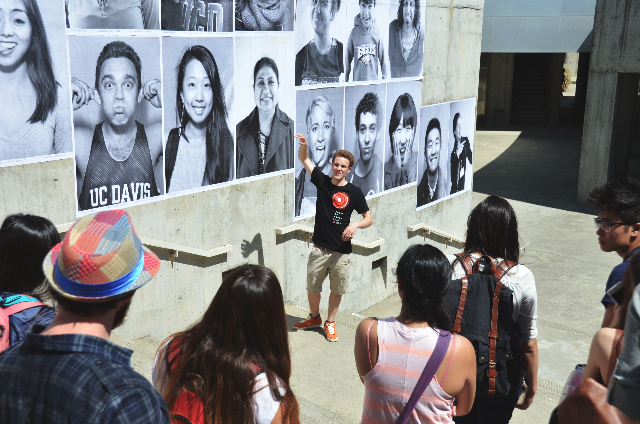
The art exhibition “Davis Inside Out,” which is set to officially open April 9, will soon line the walls of UC Davis’ Social Sciences and Humanities building. The installation features 400 large black and white portraits of UC Davis students and community members pasted along the building’s concrete exterior, and aims to celebrate individualism and identity.

The installation is modelled after the work of French artist JR, who in 2011 won a TEDx prize for his public displays of mass portraiture. His work pushed the boundaries of street art and encouraged people to be vocal in their beliefs.

Since his initial project in 2005, JR has encouraged others to join in and replicate versions of their own Inside Out as a means of showcasing identity. Today, tens of thousands of people from over 100 countries have participated in Inside Out exhibitions.

According to Shavika Singha, a fourth-year communication major and director of marketing at TEDxUCDAVIS, Inside Out projects quickly gained global popularity.

“Several campuses have done it and a lot of TEDx followers have done it,” Singha said. “So we decided to bring it to Davis and really showcase the Davis community and celebrate its diversity on our campus as well as the city.”

The project is an extension of the student-run conference TEDxUCDAVIS. In hopes that the artwork will reflect the singularity of the City of Davis, photo booths were set up in the Quad, the Davis Farmers Market and other public forums to allow all ages, shapes and sizes of people to be a part of the project.

The portrait can be whatever the individual wants to make it. Expressions can range from joy to frustration to dismay. Participants were given very few instructions, which allowed them to express themselves in an honest and forthcoming way.

According to Vice Chancellor of Student Affairs Adela de la Torre, both Davis and the University have always been accepting of art.

“Public art expressions and visual art are part of the fabric of UC Davis,” de la Torre said. “You need only walk through the campus and see that we have a long history of making art accessible to the broad community.”

The display has been headed by Lucian Novosel, a third-year design major, who serves as the project’s design lead. Since September, his team has been planning and struggling to finally get the project approved.

“JR’s project is to bring out that humanity,” Novosel said. “In celebrating the centennial of Davis we thought that it would be a fantastic opportunity to actually present our character and turn ourselves inside out as the title goes.”

Novosel said he sees the Inside Out projects as a way of revealing a new perspective to communities through recognizing each individual in a new light.

“You walk down the street and you see a bunch of strangers but you don’t really associate or understand that other people are human,” Novosel said. “You only catch a glimpse … those rare glimpses don’t show enough of the character that every human being has.”

In general, TEDx events strive to spread innovative ideas and encourage honest and open conversation. The exhibition’s curator, Cory Warshaw, believes Inside Out, as a part of TEDxUCDAVIS’ mission, should show the community how a good idea can go beyond just discussion.

“We don’t want ideas on the stage to stop at the stage,” Warshaw said. “So instead of having people talk and do a service to great ideas we want to show that we as a community can actually go out and do something.”

Warshaw hopes that the exhibit will have a lasting impact on the community, even after it no longer lines the campus walls.

“I hope that people will think a little bit more about the people that they pass by every day,” Warshaw said.

The Davis Inside Out installation will be left up until April 25. The group is currently looking for volunteers to put up the images on April 6 and April 7.  Volunteer and event information can be found at their website bit.ly/Davis_InsideOut or through their Facebook page.

COLEMAN PERKINS can be reached at arts@theaggie.org.

Davis Feminist Film Festival celebrates ninth anniversary

The annual Davis Feminist Film Festival (DFFF) is set to take place on April 10 and April 11 at the Veteran’s Memorial Center on 14th Street. This is the festival’s ninth year in production and will once again feature an array of local and international films.

This year’s festival will showcase local films on April 10 at 7 p.m. and mainly international films on April 11 at 6 p.m. The event will feature 16 short films, an interactive art piece/documentary, local food and craft vendors and a silent auction. Admission is free.

The DFFF was founded in 2005 as a fundraiser to support international internships with nonprofit grassroots feminist organizations. The festival is currently spearheaded by the Consortium for Women and Research (with the help of other on-campus organizations) and continues to gain international prestige.

DFFF focuses on showcasing films of underrepresented voices in the mainstream media. Women only make up six percent of the film industry, and this is not including women of color as well as other minorities in the U.S. The festival looks to provide a space for women, people of color (POC), LGBTQA+ people, people with disabilities, people of marginalized ages, working class people and any other groups of underrepresented people in the mainstream media to have a voice in the realm of film production.

Third-year sociology and history double major Lindy Velasco is an intern for the DFFF, and expressed that she believes the festival creates a safe space for people with underrepresented perspectives on life.

“[DFFF] is inclusive of all the things that make people individuals,” Velasco said. “I think [DFFF] is an important part of the Davis community that allows us to see [underrepresented] people’s unique take on life, and [festivals like this] should happen in other communities as well.”

DFFF usually screens 15 to 20 short films, almost all from local filmmakers in Northern California and international filmmakers. Since this is a grassroots event started in Davis, the advisory board of the festival (a panel of locals that choose films for the event) looks to showcase and support local talent both from UC Davis and the larger Northern California community.

The festival simultaneously puts an emphasis on international voices because the U.S. is one of the world’s leading influences in the international mainstream media. Non-North American voices, especially those of women, POC, LGBTQA+ people, people with disabilities, working class people and people of marginalized ages, are rarely given space in U.S. popular cinema, and DFFF wishes to fix this gap.

The DFFF receives over 100 submissions each year, and the process and criteria by which the films are chosen are taken very seriously. The film submissions are first screened by the festival’s advisory board. The chosen films are then sent to a curation class at UC Davis called “Feminist Film and Curation” where the students make the final selections for the festival.

An important criteria used for choosing films are the themes and issues covered in the submissions. DFFF is known for screening films that cover topics such as sex, gender, race, ability, age, the connection between local and global concerns and social justice.

Joanna Rullo, a third-year Ph.D. sociology candidate at UC Davis, is the director of the DFFF this year and said that the themes and issues within the submissions are more important to the advisory board than the actual production quality of the film.

“We don’t just pick the 20 best films that come in,” Rullo said. “The ‘best films’ — the slickly produced or best lit or well-acted tend to also (but not always) reflect the mainstream voice. Sometimes the film that has quality issues or could have used better equipment will make it into the festival because the message is so different, fresh and unique and reflects our educational mission.”

UC Davis professor of sociology and director of Consortium for Women and Research Laura Grindstaff is the producer of the DFFF and said she hopes university students will attend the event.

“DFFF is first and foremost fun and entertaining,” Grindstaff said. “It’s a community event that brings people together. It helps local efforts to support the arts and supports UC Davis efforts in promoting the arts. There are a lot of really important issues that get addressed in these films that can educate and inform the community while being entertained at the same time. It’s truly a great event.”

AKIRA OLIVIA KUMAMOTO can be reached at arts@theaggie.org.


Eleven years of broken promises, questionable decisions mark jump to Division I

(Pictured: UC Davis student-athletes are in tears outside a press conference on April 16, 2010, as they learn that their teams are among the four cut by UC Davis Intercollegiate Athletics. — Photo courtesy of The Davis Enterprise)

In the last decade, the athletics program at UC Davis has gone through drastic changes. Alumni, community members and students alike are now examining the repercussions of a tumultuous time in the program’s history.

UC Davis is unique in that much of the funding for its athletics program is provided through student fees: 75 percent of UC Davis’ Intercollegiate Athletics (ICA) budget is funded through student fees, amounting to a student contribution of approximately $18 million annually.

That money comes from student fees paid alongside quarterly tuition — the two largest sources of which are the 1995 Student Activities and Services Initiative (SASI) and the 2002 Campus Expansion Initiative (CEI). ICA collects 89 percent of the $334.83 SASI fee ($298) and 36 percent of the $539.64 CEI fee ($196.65) annually. Included in both initiatives were provisions under which ICA would collect student funding, including the seven principles laid out in the CEI.

However, there has been speculation from those involved in and around UC Davis about whether the University has upheld its end of the bargain.

In a push to achieve the image and prestige of a school whose athletic reputation matches its continually rising academic standing, UC Davis made the move to NCAA Division 1 (D-1) athletics in 2003, under former Chancellor Larry Vanderhoef’s leadership. This decision faced speculation from the Davis community amid a growing concern that D-I culture generally fosters an emphasis on generating revenue instead of on the student-athlete.

At the time, Vanderhoef maintained that the transition would adhere to the “seven inviolate principles” included in the CEI referendum. The principles would guide UC Davis in maintaining its academic and athletic integrity during the transition and eventually evolved into the eight Core Principles of Intercollegiate Athletics at UC Davis.

ICA graphic
Graphic by James Kim and Scott Dresser

Cuts to athletics program

“UC Davis cannot reduce its broad-based program but rather must seek to add sports.” – Core Principles of Intercollegiate Athletics (2003).

On April 16, 2010, Chancellor Linda P.B. Katehi made the decision to cut four ICA programs: men’s swimming and diving, men’s wrestling, men’s indoor track and field and women’s rowing.

The administration cited the state budget crisis as the reason for the discontinuation of the sports, which directly affected over 150 student-athletes. Yet, according to reports by the Equity in Athletics Disclosure Act (EADA) and National Collegiate Athletics Association (NCAA) reports, there was and remains no state funding in the ICA budget.

“In evaluating alternatives for ICA budget cuts, the campus administration has carefully considered these student initiatives to ensure that its action will not violate any student initiative requirements,” said Fred Wood, former vice chancellor of Student Affairs, in a letter to Katehi dated April 15, 2010.

A month prior to the cuts, the Work Group for Review of Intercollegiate Athletics Budget Recommendations was formed to decide how ICA would handle its purported budget reduction. Kimberly Elsbach, the faculty athletics representative (FAR) at the time, was a member of the Work Group and found fault with the way the group handled its decision-making process.

“There were claims from athletic administration that they had cut everything that they could but we never really saw the budget,” Elsbach said. “They never really showed us what it would have looked like if they had kept all of the sports. Were there any other options? None were ever explored. The decision was sort of made before the group even started.”

While the committee was supposed to serve as an external review group, Executive Senior Associate Athletics Director Nona Richardson served as a member. The committee did not include any coaches or student-athletes.

“Students in particular were purposely excluded in the decision to cut sports by athletic director Greg Warzecka,” Elsbach said.

In an email obtained from UC Davis through a public records request filed according to the California Public Records Act, Warzecka told members of the Athletics Administrative Advisory Committee (AAAC) to withhold from students information regarding the decision to cut the teams.

“For the time being, I have decide [sic] to forward this information only to the faculty and staff of AAAC, not the student or student-athlete members,” Warzecka said in the email. “Please treat this information in a confidential manner.”

Unhappy with the University’s decision-making process, Elsbach, along with Leslie Loyns, chair of the Athletics Administrative Advisory Committee at the time, resigned from the work group.

“I disagree with the decision to cut four sports. If we had followed a careful process and involved everyone — if after all of that there was no other option, then I would have agreed with that,” Elsbach said in October 2013. “We didn’t follow the process; we didn’t follow the data, so we’ll never know.”

Faculty, students question cuts

Some have also questioned whether the ICA’s financial situation during the time of the cuts was really as dire as the University claimed. EADA reports from fiscal year 2010-11 reveal a $200,000 increase in ICA administration expenditures, rather than the $400,000 decrease Katehi had spoken of at the time of the cuts.

Community members found the increase in budgets for the remaining sports after the four programs were cut to strike a discordant note. The University maintains the cuts were a necessary last resort due to the financial crisis. However, since the 2009-10 fiscal year, expenses for the men’s basketball team increased from $798,130 to $1,506,641 in 2012-13, an 88.8 percent jump.

After learning about the cuts to the four teams, student-athletes on those teams suddenly found their futures at UC Davis drastically changed, and they scrambled to find some way to reverse the decision.

“It was shock in the sense that the administration didn’t even tell the athletes directly,” said Darcy Ward, a former member of the UC Davis women’s rowing team. “They had a press conference to announce the cuts, and we only found out a couple hours before. We weren’t allowed in the press conference.”

Ward, along with a group of athletes whose teams were eliminated, led the charge in a fight against the cuts. They were supported by other athletes, students, community members and faculty who felt there was an inherent injustice in the cuts and the way they came about.

“We really tried to bring awareness first to the campus,” Ward said. “The students had passed certain ASUCD measures to protect sports.”

Beyond trying to educate the student body about those measures — and the subsequent conditions tied to the money they were supplying to the athletics program — the group held town hall meetings and protests. The students made numerous public records requests to get the information they felt the University was not making available to them. A coffin was brought onto campus to symbolize the death of their teams and careers as student-athletes at UC Davis.

“We’re at Davis for a limited number of years, and we’re dealing with administrators that have been there for twice as long,” said Zachary Hansen, a former member of the UC Davis men’s swimming team.

When they felt that their pleas to the administration were falling on deaf ears, the members of the four teams that were eliminated filed a grievance with Student Judicial Affairs citing arbitrary treatment by the administration and ICA.

On July 12, 2010, then-California State Senator Dean Florez facilitated a hearing in which Katehi and Warzecka answered questions about the reasoning behind and circumstances regarding the cuts.

“Overall, the process, from my view, was flawed because we have, clearly, … a lack of transparency, given that the decision was made so late in the academic year, and it really allowed very little suggestions for alternatives, very little time to point out inaccuracies, and very little time to point out inconsistencies in many cases,”  Florez said in the opening statement of the hearing. “When I look at the cuts that are offered in this particular case, the cuts, from my view, don’t appear to be designed to produce any substantial budget savings at all.”

During the hearing, Katehi acknowledged the controversial nature of the decision.

“I understood very early that this decision would spark controversy and cause a lot of pain,” Katehi said. “But I made the decision with the gravity that made it final, and it was in the context of understanding of my responsibilities as the chancellor to address the budgetary cuts on our campus … Discontinuing the four sports had the least impact on student-athlete participation and provides the most realistic and sustainable approach to supporting continued academic and athletic excellence in the programs.”

Warzecka conceded that, in cutting the sports, the administration did bend the Core Principles of ICA.

“They’re a philosophical driver to how you run your program, and in 2002, they were well set for us making the transition,” Warzecka said at the hearing. “And eight years later, they have to become flexible. During a financial crisis, a lot of things have to be flexible, whether it’s UC or the state of California.”

Oversight questions ICA practices

Despite outrage from students, athletes, alumni and others, UC Davis moved forward after the cuts with its remaining 23 teams.

Those involved in oversight positions raised questions as to whether ICA was successfully operating within the bounds of the Core Principles. In July 2011, Elsbach and her successor as FAR, Catherine VandeVoort, expressed concern in letters to Katehi regarding academic integrity, student athlete welfare, Title IX compliance and financial priorities within ICA.

Elsbach and VandeVoort cited instances of admission by exception (the UC’s policy of admitting students who do not meet academic requirements) without approval by the FAR. Additionally, they expressed concern with summer school scholarships being offered disproportionately to male athletes. Elsbach and VandeVoort reported a lack of confidentiality in student health records and ICA staff use of laptops intended for student-athletes, among other issues.

In a July 26, 2011, response, Katehi said that the concerns were being investigated.

VandeVoort was dismissed as FAR shortly after.

On April 17, 2012, the Academic Senate Special Committee on Athletics released an in-depth report identifying numerous issues of concern within ICA, including a lack of adherence to the Core Principles of ICA, the budget, a need for more oversight and the discontinuation of sports.

“From 2003 to the present, [the principles] have functioned as a compact between our administrative leadership and the larger campus community,” stated the report. “In 2010, the Chancellor decided to save money in the ICA budget by reducing the number of teams — in direct conflict with one of the Eight Principles. Both the decision and the absence of broad consultation created a great deal of controversy … Controversy associated with the transition to Division I and with the sports cuts continue to color attitudes about the program.”

Moving forward

In July 2012, Terrance J. “Terry” Tumey was appointed as the new director of athletics at UC Davis. Tumey has since led the ICA in its efforts to shake the lingering fallout from the discontinuation of sports and possible breach of terms laid out in the student-voted initiatives.

“I think the only way you can try to resolve some of those issues is through time, and proving time and time again that we are here in service of our students,” Tumey said. “Like anything else, it takes time to grow and right now we’re in a growth mode.”

The reviews of ICA’s transparency and growth have been mixed as of late.

“The budget folks in the athletics department annually give a presentation,” said current FAR Scott Carell, who was appointed in May 2013. “From my perspective, the associate director, Mike Bazemore, has always been very open to come talk about the budget.”

Others hold a different view.

“My personal opinion is that it has been a struggle to get the information of the budget that we would like to do our jobs,” said Joe Kiskis, member of the Academic Senate and Athletics Advisory Committee. “I’m hoping that this year we will get more complete budget information.”

On Jan. 28, 2013, ASUCD passed Senate Resolution 6, calling for greater transparency and student influence in ICA at UC Davis. The resolution invited Tumey to meet with ASUCD quarterly, to which he agreed, and also called for ICA to re-examine its 2010 cuts.

“ASUCD hereby insists that ICA commit itself to the thorough, open, consultative and timely re-evaluation of the decision to cut four sports,” the resolution stated.

While Tumey acknowledged the request, he said that he is currently more focused on the present state of the ICA.

“We can always revisit things as it relates to the discontinuation of sports,” Tumey said. “However, we also have to look at where ICA is today. I think, right now, our biggest concern is making sure the athletic endeavors we currently have are supported properly.”

athletic cut059 W (1)
On April 16, 2010, student-athletes learn that their teams are among those that have been cut. (Photo courtesy of The Davis Enterprise)

Future of ICA

The ICA has had three years now to distance itself from its controversial decision. However, questions still remain as to whether the decisions made at the time were appropriate.

The administration and ICA remain steadfast in their stance that the terms of the SASI and CEI were not violated and that the actions taken were best for the University as a whole.

In a recent statement released to The Aggie, Katehi stood by her decision.

“As challenging as these decisions were, I am confident that we took the steps necessary to protect our core educational, research and public service missions and acted in accordance with our institutional values,” Katehi said.

The room for interpretation in the student initiatives and Core Principles of ICA has left some people unconvinced that the administration was in fact in the right.

Tumey acknowledges that it has been, and will continue to be, difficult for the ICA to uphold principles that were given life over a decade ago and are arguably outdated in the world of intercollegiate athletics.

For example, he cited the seventh Core Principle of ICA — which restricts sources of external funding — a condition he may violate in his endeavor to fundraise and pull ICA out of its current deficit. Last year, ICA projected its deficit for 2012-13 at $3,612,220. However, the athletics department insists that while specifics may not always be upheld, the character of the principles is being sustained.

“I don’t think there’s an outright path to go and break anything,” Tumey said. “We are trying to live up to the spirit of what these principles mean towards the University and for our students.”

According to Tumey, it is time for the Davis community to move on from the 2010 program cuts.

“Are we trying to slay ghosts? I can’t go back and un-cancel sports. At some point all of us — not just in ICA — are going to have to say let’s move forward and make the best program we can,” Tumey said.

However, not everyone is as willing to move forward without further resolution.

“The net result — and the overall objective — should be a 27-sport program that meets every one of those student funding initiative conditions and does not involve any deficit spending or subsidies by the University,” said Paul Medved, a UC Davis alumnus and parent of a graduated member of the women’s swimming and diving team. “That’s what everyone should be striving for.”

Many have noted that ASUCD — representing the students who foot the bill for 75 percent of ICA’s funds — bears the responsibility and the power to hold the administration accountable for its use of student money and compliance with the terms of student initiatives.

Those with differing viewpoints will be left to hash it out as UC Davis continues to carve out its place in the ever-changing world of intercollegiate athletics. 

Written by: Lauren Mascarenhas –– campus@theaggie.org

Kenneth Ling and Scott Dresser contributed to this story.

UC Davis establishes Confucius Institute

For six months, the Confucius Institute (CI) has been trying to create a dialogue between China and Davis.

There are four CIs in California, and many more worldwide. Most of these institutes focus on educating their communities on language, but according to the CI website, UC Davis is the first school to focus on Chinese food and beverages as a way to promote an understanding of Chinese culture.

“We realize that many students won’t have the opportunity to travel or study abroad in China, so we hope to bring a bit of China to UC Davis,” said Sheena Link, the project manager of the institute.

According to Dr. Linxia Liang, CI’s director, the institute began to come to fruition about two years ago, but before it could become a fully established chapter, UC Davis had to find a sister school that had similar goals to facilitate a cultural dialogue through the language of food and beverage.

“Language teaching is not what we really need on campus. So there was an idea to have a Confucius kitchen,” Liang said.

After some deliberation, this led to a partnership with Jiangnan University, which incidentally has one of the top food science departments in China.

“I think in a time of globalization, it is not only important, but also necessary for us to understand another culture. I also hope we can provide programs and events to enrich our international environment,” Liang said.

According to Ruth Shimomura, a retired teacher who regularly attends the institute’s events and classes, the UC Davis CI’s focus on food was an idea that came from one of the founders, Martin Yen.

“I enjoy going to Confucius Institute because I’m continually learning new ideas and ways of doing things,” Shimomura said.

Shimomura first became interested in the Institute after going on a tour of China with Yen.

“He was a former student at UC Davis in the food science department. He’s become a worldwide cook. He has cooking shows in China and he had a show on PBS Yen Can Cook,” Shimomura said.

Since becoming aware of the institute, Shimomura has attended a variety of their classes, which range from tea and dumpling making to Yin and Yang lectures. In a class about serving tea, Shimomura said they focused on greater significance associated with the ritual.

“In the first class they also showed us the different customs for serving tea too. The host is supposed to sit facing the door. The guest is to the right of the door,” Shimomura said.

Shimomura had always been interested in different cultures, and in the last year has visited Ecuador, Peru, Scotland, Great Britain and Japan. The institute had provided her with another way to educate herself about another culture.

“It has been five years since I visited China, but visiting there prompted me to learn more about it,” Shimomura said.

Even though most of the institute’s classes do focus on food and beverages, there are a few exceptions. According to Link, they are not too concerned with deviating from their food and beverage driven education.

“In developing our programming plan, the effect of this focus is that we try to offer a majority of food and beverage related events. However, we do offer other cultural activities such as festival celebrations, Chinese paper cutting workshops and weekly cultural conversation times — because at the end of the day, we want to promote the understanding of Chinese culture in general, not just the food and beverage part,” Link said.

According to its website, many of the classes and workshops are held at the Robert Mondavi Institute for Wine & Food Science. Despite the convenient location, Shimomura says that surprisingly few students attend the classes and workshops, though the institute hopes to change that.

“We would always love students to attend our events. The vast majority are free and we try to offer them at different times during the day to accommodate different schedules,” Link said.

Additionally, the institute is open to any suggestions and feedback from the student body, so they feel more comfortable in the classes and events.

“We’re striving to be a valuable part of the campus community, and feedback will help us with that process,” Link said.

As for future events, workshops and classes are listed on the website. Liang said that there are new events coming up that will hopefully appeal to a greater variety of students and more of the Davis community.

“We are also trying to have more relaxed talks, called Tea & Conversation, which will be on our website soon. So it is going to be our conference room on the third floor of Wickson Hall once a week. It’s more casual,” Liang said.

During these talks, participants will also be served Chinese cookies and tea. Each talk will also provide a new topic to focus on. This event aims to be more collaborative than the classes, workshops and lectures, while once again incorporating food (in the form of tea and cookies) into the event.

An even larger event looms in the future on Sept. 27, which is International Confucius Day. It is the 10th anniversary of the Confucius Institutes, and Liang hinted that something exciting will be held.

“But we haven’t finalized our plans for that yet,” Liang said.

LEYLA KAPLAN can be reached at features@theaggie.org.