56 F
Davis

Davis, California

Wednesday, December 24, 2025
Home Blog Page 866

California authorities support relaxed ban on marijuana

3

Administration for California is backing Senate Bill (SB) 1262, which would license medical marijuana dispensaries and cultivators while ensuring that healthcare providers are regulated in their medicinal marijuana recommendations. This is the first marijuana bill to be supported by police and state legislation.

SB 1262 was introduced by State Senator Lou Correa on Feb. 21, and supported by the California Police Chiefs Association in a joint effort with the League of California Cities. Additionally, nine law enforcement associations and over 5,000 churches in California are amenable to passing this piece of legislation.

“This bill is an example of California coming late to the game trying to marry a currently illegal marijuana industry to a changing public attitude,” said Allen St. Pierre, executive director for the National Organization for the Reform of Marijuana Laws (NORML). “It would be presumed that California would have allowed a regulatory scheme for medical marijuana 10 years ago”.

Currently, the standing laws in California regarding marijuana and medical marijuana usage are outlined in the Health and Safety Codes 11357-11362.9, the Compassionate Use Act of 1996 and SB 420 in 2003.

According to Landy Black, police chief of the City of Davis Police Department, the Davis police force has dealt with regulatory chaos, piecemeal legislation and perpetual litigation since the passage of Proposition 215, the Compassionate Use Act.

“This legislation is not an endorsement of the legalization of recreational marijuana. Rather, SB 1262 provides a much needed and long overdue framework to effectively implement Prop. 215,” Black said. “None of the aforementioned consequences serve law enforcement, local governments or patients well. I see this piece of legislation as a more pragmatic approach adopted by Cal Chiefs when acting as an information source for legislators and the Governor, and as a legislative lobbying group.”

Marijuana, also known scientifically as cannabis, is a preparation of the cannabis plant used as a psychoactive drug and for its medicinal properties. It may come in several forms including dried flower or “nug”, kief, hash, butter and pipe resin. Intake varies by individual, but it is frequently taken orally by either edibles or by inhaling its vaporized form through glassware or a rolled vessel.

According to the United Nations, cannabis is the most-used illicit drug in the world.

Earlier generations may notice that the potency of marijuana has increased over time. Since the 1980s, the average marijuana sample concentration has increased from 4 percent to 15 percent of the active ingredient, delta-9-tetrahydrocannabinol (THC). This is a result of cultivation and genetic variations.

According to Dr. Barth Wisley, a UC Davis Medical Center pain medicine specialist, medical marijuana is widely used to treat pain. This can be in the form of headaches, cancer, glaucoma, nerve disorder, HIV or Crohn’s disease among other long term medical conditions.

Should a licensed physician in a state with legalized medical marijuana usage feel that marijuana would improve the health of a patient, the patient is issued an official card with which to purchase from an authorized dispensary.

“This bill seems to direct attention toward the doctors themselves”, St. Pierre said. “Arguably, the fulcrum to the medical marijuana industry is the recommendation by the doctor to the patient on medical marijuana. In some respects, this bill could be thought of as progressive by putting all the responsibility on the doctor.”

There is, however, much opposition to this bill on logistical grounds.

“This bill addresses our primary concern that if medical marijuana is medicine, it should be treated as medicine,” said Carla Lowe, the founder and northern chair of Citizens Against the Legalization of Marijuana (CALM). “We made a test study using a decoy patient, and found that a doctor can talk to somebody over Skype and issue a pot card after 40 seconds”.

Several associations would, with greater amendments to the current bill text, support the legislation.

“The restrictions on physicians will not just be an unreasonable burden for the medical community, but more pointedly for the patients who rely on them,” said Kris Hermes, the media specialist of the Americans for Safe Access (ASA). “In addition, while the bill enshrines the right of local governments to ban dispensaries, it provides no incentives for them to opt-in and adopt regulations that would enable legal access for patients in their communities.”

As this bill may be seen as progressive, several see this as a possible shift to even further marijuana legalization in California, following in the footsteps of Colorado and Washington.

“If marijuana were legalized in California, I think that all my customers would turn to marijuana stores for their product instead and leave me without a clientele,” said an anonymous UC Davis cannabis dealer, identified as “Mighty Whitey.” “There is less risk in buying from marijuana dispensaries because it is legal, whereas selling without a license would still not be legal.”


UC Riverside, Russian Academy for Science produce holographic memory

Joint research out of UC Riverside and the Russian Academy for Science has produced a new type of holographic memory device utilizing spin waves. Their invention has the potential to make improvements to modern technology, including the benefits of increased storage and processing capacity that has never before been attainable.

The UC Riverside team is led by Professor Alexander Khitun, who has worked on spin wave-based technologies for over nine years. He, along with team member and UC Riverside graduate student Frederick Gertz, submitted their research for publication in the journal Applied Physics Letters on Jan. 21 of this year.

Spin waves are magnetic waves that are caused by an alternating magnetic field. They were used in order to increase memory capabilities, lower energy consumption and meet the requirements of today’s electrical components.

“If you throw two rocks into a pond at the same time, they will both create waves, and where these waves meet they will ‘interfere’ or cause the waves to change slightly. The same is true for our system. We can make two magnetic waves, whose interference pattern will change, based on the number of magnets and the direction that those magnets are facing that those waves encounter as they travel along their path,” Gertz said.

One instrumental feature of spin waves is accredited to their wavelength; shortening the wavelengths increases the number of bits that can be stored and processed. This is how the increase in memory capacity and capability is brought to life in their device.

“The utilization of spin waves allows us to reduce the operating wavelength to tens of nanometers. According to the estimates, magnonic holograms may have capacity up to 1Tb/cm2 due to their nanometer scale wavelength,” Khitun said.

Holography is a technique which creates three-dimensional images through the use of lasers; when the laser detects an object, it records the resulting light interference pattern created. Thus, holograms are inherently greater than standard photographs in terms of pure information, as they hold all angles of an object, rather than one.

“Since we are using a holographic technique it means that our spin waves can pass through several different magnets with different orientations and the output will tell us ALL of the magnet’s orientation. This allows us to build devices that can read out data very quickly, much quicker than a standard electronic design would allow,” Gertz said.

Due to spin waves’ innate low energy, this research has the potential to produce technology considerably more efficient than that presently employed. Such success could lower the energies of a wide range of technologies and provide a solution to lower the costly price of cooling large scale datacenters.

Professor Charles Fadley, a member of the UC Davis Physics Department, has recently worked with holographic imaging of atoms using a technique called photoelectron holography in his research.

“The research is very interesting, and the arguments they make for the possibility of future developments beyond the simple 2-bit device they have demonstrated are reasonable. But it’s difficult to say at this point whether real technological applications to data storage will result,” Fadley said.

The team’s research and improvements to their prototype are ongoing. Future developments include finding a superior material suitable for spin wave use, minimizing the size and energy in exciting spin waves and continued research of the potential of their device.

“The main objective of our work is to demonstrate a holographic co-processor, which can be integrated within the conventional digital processors … We also need to scale down the operating wavelength and make these devices smaller in order to build a practical device,” Khitun said.

The Philosophy of Education: Setting Goals

Have you ever felt overwhelmed by a long-term large assignment or a test to study for? If so, when you felt this way, did you sit down and grind through the assignment or studying until you finished? Or did you procrastinate and then stay up all night the day before to do it, and likely not do a good job? I believe a major cause of this phenomenon is setting improper or ineffective goals for ourselves.

When we set broad and far-reaching goals for ourselves, we often do not know where to start and thus feel overwhelmed. For example, this quarter I had to write a 1,200+ word literature review-type paper for UWP 102B. I could write about any topic I wanted in the biological sciences.

At first, I felt overwhelmed; I did not know what to write about, where to do research, what to argue, etc. In this mental state, I could not write or even prepare to write the paper. Because my mind was full of worry and feelings of hopelessness, I felt like giving up and distracting myself with something else, procrastinating.

Instead, I divided the large, overwhelming goal of completing the paper into smaller, manageable goals. First, I found a topic that I was interested in. Second, I gathered research articles about my chosen topic. Third, I analyzed those research articles to put them into a coherent body of knowledge. Fourth, I drew an arguable conclusion from that body of research. Fifth, I wrote an outline of what I would argue and my supporting evidence. Finally, I wrote the paper.

While the overall goal of writing the paper from nothing seemed hopeless, each of the six sub-goals was manageable and achievable. Thus, by mentally identifying and organizing the steps I had to take to achieve my ultimate goal, my anxiety disappeared.

Similarly, if you were going on a road trip to Las Vegas, you would probably look at a map first to plan your route; you wouldn’t just get in your car and start driving.

Many of us commit a different but common error with goal setting: we, sometimes unconsciously, change our goal and then become frustrated that we did not accomplish the new goal.

For example, many times, friends have told me that they went to office hours to ask about a specific concept but left frustrated by the professor’s attitude or perceived condescension. In response, I ask, “Did the professor answer your question?” If the professor did not, then the student is rightly frustrated that he or she did not achieve his or her goal.

However, many times the students answer that the professor indeed answered their question but they were still frustrated with the professor. Notice the goal switch: the student went in with the conscious goal of asking a question but left unhappy that a different goal was not achieved.

If you notice this goal switch happening to you, first ask yourself what your unconscious goal was, and then ask yourself why you have that goal. Possibly, my friends went with the unconscious goal of wanting approval and thus an ego boost from the professor, which only bubbled up to conscious awareness when it was not met.

If you experience this scenario in office hours, think of the reverse case. If you went to a party to have fun, would you leave frustrated that you didn’t learn anything about chemical bonding? The office hours scenario is the same way: if you went to office hours to learn about chemical bonding, would you leave frustrated that you didn’t have fun?

Setting goals for yourself is highly effective if the goals feel achievable. Challenging goals are achievable, but overwhelming goals feel impossible. Goals can be as simple as “This afternoon I will do the laundry, clean my room and then do my homework. After I finish those three tasks, I will play for the rest of the day.”

Mentally organizing ourselves with goals greatly helps to increase our productivity and reduce our anxiety. As the saying goes, if you fail to plan, you plan to fail.


To share how you set goals for yourself, contact WILLIAM CONNER at wrconner@ucdavis.edu.


Meet Your Representatives: Katherine Sherman and Lauren Ashe

0

Senators_

Name: Katherine Sherman
Major: Nutrition
Position: ASUCD Senator
Year: Second-year

1: What is one skill you wish you had cultivated when you were younger?
I was the third child in my family so when I was younger, I would definitely try and follow my brothers. So I think [although] I eventually learned to become a leader, if I had started earlier that would have been a great advantage. By getting involved in things and not just following my brothers, I eventually did that once they moved to college. In high school I was able to do that on my own; If I had started even earlier, it would have been so much better.

2: If you could live anywhere, where would you move to best serve your career interests?
I’m not too sure what I want to do with my career yet. So that’s kind of hard, but I’m from San Diego and I love it. So for right now I’m going to stick with San Diego. There’s a lot of culture there.

3: Do you have any pet peeves? How do you deal with them?
One, when people leave their blinkers on when they are not turning. I just want them to turn it off, because I don’t know what they are going to do and it really bugs me. There’s not much I can do about that but get angry in my own car. But that’s about it. My other one is when people talk with their mouths full. I understand if you just took a bite of food; chew it, swallow it and I’ll keep talking to you.

4: Is there a book or other piece of literature that you think every college student should read?
I honestly can’t answer that. I’m not a huge book person. I read for classes and I read for certain topics, but I don’t really read for pleasure.

5: What trait do you find most impressive in an individual?
When people can truly be honest, not just with others but also with themselves. I find that a lot times, people try and cover who they are because they want to fit a certain norm.

6: What is your favorite movie, and why it is your favorite?
My favorite movie for a very odd reason is Spy Kids, the really young kid movie, because my cousins were in it. So I was able to go to the red carpet. You have to love a movie that you were on the red carpet for.

7: How was your transition from high school to college? Did you face any challenges?
I faced a huge challenge. My graduating class was 37 kids, so to go from 37 to 5,000 in my grade alone was a huge transition. It took me a little bit; it took me a quarter to get on my feet. I found a core group of friends and we’ve kind of stuck together and that became my little family, from like high school almost. Then from there I webbed out and I expanded. The transition took at least a quarter to about the whole freshman year. I figured it out and we’re doing well now.

8: If you got to invite three people (dead or alive) over for dinner, whom would you choose?
It changes on a daily basis, which is the hard part. Today it would probably be Alton Brown, he is a TV show host. He was on a show called “Good Eats,” and I’m really into baking. I want to make my own bakery one day; it’s kind of my goal, so to sit and talk to him about his career [and any] tips he could give me would be amazing. I’d probably want to talk to Abraham Lincoln. Just because there are so many stories and rumors about him and that time period. I’d really like to know what he was thinking from his point of view. The third one … I’m going to say my mother. If I were having this experience, I’d want to share it with her.

9: How would you like to be remembered?
A tangible thing would be my bakery. I already have my name for it and I already have recipes. They’re all in my head and they’re not written down anywhere. I do a lot of baking in the kitchen with cakes, cupcakes and cookies. My brother does cake decorating, so we kind of want to do a family business where I bake it and he decorates it. It would be really cute, and he’d be a barista. If I could make that a franchise and make it really yummy — and make a healthier version of dessert — if that went on for years, I wouldn’t complain.

People don’t understand the science behind baking. If you put one ingredient before another, it completely changes the taste. Nobody really gets that. If the eggs are room temperature or if they are refrigerated, it can change the entire thing. It’s detailed enough where you can always change it, but it’s also simplistic enough where anyone can really do it. I’ve wanted to do it since I was five years old.

Senators2_CieraPasturel

Name:Lauren Ashe
Major: American studies with minors in professional writing and textiles and clothing
Position: Outreach Assembly Speaker
Year: Third-year

1. What’s your most embarrassing fashion mistake?

I’d like to think I’ve never made any. Just to be conceited like that. I’m a textiles and clothing minor, so I’m really into clothing, I actually have an internship with a fashion website and have my own fashion blog, so fashion’s a really important part of my life, and I would like to think that I’ve never made a mistake, but I’m sure there are others who would disagree with me.

2. Favorite memory on the UC Davis campus?

That’s hard. I don’t think I have a specific favorite memory, but I have a like, favorite thing about UC Davis campus, is that good? Well, I really like all the trees we have on campus. I love being in the Arboretum and going on daily walks. My friend and I do weekly walks in the Arboretum where we just catch up with each other and talk about our life, and go and pet the horses, so that’s a lot of fun. So I guess that’s like a favorite memory, but it’s an ongoing activity.

3. What skills will your major give you, and how do you plan on applying those skills?

Well, I don’t know exactly what I want to do after I graduate but, I know I want to write and I guess my dream job would be a “fashion and lifestyle” blogger. American studies is a super interdisciplinary program, so you learn about a lot of different things. In my concentration, the major is actually like American fashion, with regards to women and their representation in the media, so that’s kind of what I want to do in my life. Hopefully, it will give me some good analysis and writing skills for my career, whatever I decide to do.

4. Scariest moment of your life?

It was in Washington D.C. a few summers ago. I was actually with my dad in the Smithsonian, in the American history side of it, and there was an earthquake in D.C. It was the first earthquake I’ve ever been in — strange, having been born and raised in California — and it was really scary because we thought it was a terrorist attack. You wouldn’t think there would be an earthquake in Washington D.C. and the ground started to shake, [and] because we were at the National Mall, all the guards started freaking out, and all these automatic gates were closing, and they had to hold them open and we were being forced to run out of the building. So that was probably the scariest moment of my life.

5. Favorite aspect of yourself?

That’s so hard. I think it’s so easy at 20 to hate everything about yourself, and not love yourself enough. Probably I guess my tenacity. I think when I’m stuck in a really bad situation, and everything seems to be going wrong, I’m good about fighting and going on.

6. What does YOLO mean to you personally?

I guess the meaning of YOLO is just to embrace every day and live it to its fullest — but, I don’t know. I think a lot of people are gonna start dying whenever they say YOLO, because I know whenever I make a really risky driving move I say YOLO. I could see people being like “YOLO, gonna drop off this dangerous height” and then dying from it, which is pretty ironic.

7. What is your favorite social media network?

I’m on a lot of different social media things, just to promote my blog because I’m nerdy like that, but I like Facebook because it’s interacting with people and forming new relationships. I also like Twitter. I think people use Twitter like a diary, and they share a lot of intimate things — I definitely do this myself — and people forget that other people are reading their Twitters. So you can learn a lot about them just from looking at their tweets. You can also follow celebrities, which I’m really into doing.

8. Historically speaking, which era of history is most appealing to you?

Probably the American Revolution, just because my parents are originally from New England, so growing up we went into Boston a lot. We did a lot of the Freedom Trail things where like “Oh, this is the church where Paul Revere rang the bell to say ‘the British are coming.’” You can see where Sam Adams is buried and cool things like that, so I think it was really impressionable growing up. My mom is from a small town in Massachusetts and they have a colonial part of the town, where you pay to go in, and all these people are dressed up in colonial New England [outfits], and they’re churning butter and living in these small houses and stuff. So that’s probably the most interesting time period for me.

9. Which Hogwarts house would you be sorted into?

I’ve actually never read Harry Potter. I watched all the movies, but they don’t really explain the houses that in-depth in the movies. I’ve taken a few of the quizzes online just because all your friends do it, so I have the fear of being left out, but it always says, I think, Hufflepuff? But I have no idea why I’d be in it because I’ve never read Harry Potter.

Davis Food Co-op General Manager resigns for unknown reasons

0

General manager of the Davis Food Co-op, Eric Stromberg, was asked to resign by the board of directors and will take a permanent leave starting March 22. This will end Stromberg’s 14 years of employment at the Davis Food Co-op.

“[The Board of Directors for the Davis Food Co-Op] decided to exercise an option under the General Manager contract for separation without cause,” said a memo issued to the Davis Food Co-op members and shoppers by Stacie Frerichs, board president and the entire Davis Food Co-op Board of Directors.

The board made this decision following closed meetings.

“[This was a] very deliberate process and [we] thoroughly considered all information available to [them] before making a decision. We feel our decision was made in the best interest of … the Co-op members … However, for legal reasons, we cannot discuss personnel matters publicly,” Frerichs said.

The management team at the Davis Food Co-op is expecting a smooth transition according to Julie Cross, marketing and education director for the Davis Food Co-op.

“While change is always difficult, the Co-op has a very strong management team. We expect to carry on business as usual during this transition,” Cross said.

Beth Tausczik, the current store manager will fill the role of interim general manager while the search for a new general manager takes place.

“The board is confident in Beth’s ability to lead the Davis Food Co-op during this transition and is confident in all our staff’s ability to maintain great customer service and efficient operations,” Frerichs said.

The Co-op has not expressed any concerns with Tausczik filling this position. According to Cross, Tausczik has been with the Co-op for over 25 years, and has been their store manager for the last 12 years.

The board has formed a task force to conduct a national search for a new general manager. Frerichs said this search will be a topic of discussion at upcoming meetings.

According to Cross, the search will be a lengthy process and done nationwide.

A few members of the Food Co-op expressed their disbelief at the request issued for Stromberg’s resignation.

Bruce Walters, a member of the Food Co-op since 1995 said he liked the direction the Co-op had taken under Stromberg.

“I can’t believe that the board would want to get rid of him, I just hope that I still receive the same great service now that he is gone,” Walters said.

An employee at the Food Co-op who wished to remain anonymous had a similar line of thinking.

“I feel that what happened to Eric [Stromberg] wasn’t fair, I think he was a really great person to be around and made working at the Co-op a fun place to be … I just don’t know why they would get rid of him like that,” the employee said.

The next meeting of the Food Co-op Board of Directors will be April 7 at 7 p.m. in the Co-op Teaching Kitchen.

Honorable Mention: Syndee Fipps

0

With her amazing performance throughout the 2013-14 season, junior forward Sydnee Fipps was named to the All-Big West Conference First Team for the second-straight season on March 10. As a leading player on the team, Fipps played hard in every game, and her consistent and great performance was the key element for all the victories the Aggies had for the past season.

Since her first season, Fipps managed not to pick up any major injuries along the way, as she appeared in every single game throughout the last three seasons. By making a three-pointer in the first half against UC Santa Barbara on Feb. 1, Fipps became the 16th player in the history of the women’s basketball program at UC Davis to reach the milestone 1,000 points. By the end of this season, Fipps hit the 20-point mark 15 times this season and she is currently ranked seventh place in the UC Davis scoring charts with 1,183 points.

With all of her accomplishments in the last three years — especially her outstanding play this season, averaging 17.8 points per game and 5.9 rebounds per game  — Fipps is worthy of being recognized as an honorable mention.

Study tracks Yosemite black bear food consumption

The Yosemite black bear is a curious, bold and predictable creature. Many of these bears, who have learned since infancy to fulfill their energy requirements through consumption of the vastly diverse and procurable human foods, pose an imminent nuisance to campers and hikers vacationing on the Yosemite grounds.

Jack Hopkins, a research fellow at the University of California, Santa Cruz (UCSC), has composed a rigorous investigation of the changing dietary patterns of the Yosemite bear population over time. He has done so hoping to highlight successful methods in deterring food based human-bear interactions.

With the help of his research, Yosemite management will continue to take successful, preventative measures in encouraging bears to return to their natural diets and to spend less time foraging in visitor areas. Through the installation of bear-resistant food-storage containers and the establishment of a “bear team,” Yosemite continues to see increased visitor compliance regarding food storage in areas that are popular spots for bears to scavenge.

“Yosemite has a rich history of bear-management practices as a result of shifting goals over the years. What we found was that the diets of bears changed dramatically after 1999, when the park got funding to implement a proactive management strategy to keep human food off the landscape,” Hopkins said.

Hopkins, who once worked as a biologist for Yosemite National park, collaborated with Paul Koch, Dean of UCSC’s Physical Biological Sciences to conduct an isotopic analysis of bear hair samples. To do this, Hopkins set up various baited fur-traps around Yosemite’s campgrounds. In hopes of finding a dead meal to scavenge, bears that were accustomed to entering these areas would leave a patch of hair behind on these traps. Through testing for the levels of human food-derived chemical isotopes existing in the bear hair, the samples Hopkins collected allowed the team to estimate the level of human food in the bears’ diets.

In order to see how consumption patterns changed over time, Hopkins also obtained samples from deceased Yosemite black bears that reside in the park’s museum. Through obtaining data from historical bear fur and current bear fur, Hopkins was one step closer to understanding the bears’ shift in dietary composition in response to Yosemite’s changing preventative measures.

From the years 1915 to 1919, roughly 13 percent of bear diets was derived from human food; from 1928 to 1939, the proportion was 27 percent; from 1975 to 1985 the proportion was 35 percent; and the proportion has slumped back down to 13 percent again for 2001 to 2007, a favorable result.

“The remarkable thing is that the bears that eat human food are now back to the same level of dumpster diving as in 1915, despite the fact that there are now millions of visitors in Yosemite every year and presumably a lot more garbage,” Koch said.

The study found that human foods have decreased in bears’ diets in response to Yosemite’s preventative measure, yet Yosemite management still must grapple with the bear-human conflicts arise when these bears seek out human food. Hopkins explained that this issue is ultimately a people problem— humans enter into the the bears’ territory and introduce foods like Nutella and Cheetos, and the black bears respond by using these calorie dense options for themselves.

When these bears investigate a great-smelling situation and get a high calorie reward to boot, they will probably come back. As bears become accustomed to consuming human foods in lieu of grass,  berries, and meats (foods that require a significant amount of energy for the bear to obtain), bears become habituated to human environments, and that’s where the conflict derives.

“The primary concern about bears eating human food is that they may learn to recognize it as an easy way to find a tasty and calorie-rich meal with little effort … we often find humans where we find human food. As a result, it places bears in increasing contact with people. This invariably leads to conflict. Because these bears are wild animals, their behavior isn’t completely predictable. Property damage from bears breaking into cars and houses or cabins often upsets people. And on occasions when bears may be dangerous to humans, it’s the bears who lose out,” said Paul Todd, a UC Davis assistant professor of wildlife biology.

According to Hopkins, if you reduce the availability of human food on the landscape, then you reduce the problems between humans and bears. The key is to prevent bears from ever becoming accustomed to consuming human foods in the first place. To do this, Yosemite visitors must store goodies in the proper food storage containers and take action to keep any human foods out of bears’ reach. Through taking these actions, the number of unwanted human-bear interactions may fall and fewer bears will need to be exterminated as a result.


Guest Opinion: DrinkSavvy

1

Recently, words like “rape culture” have become more prominent in news and social media. Anti-rape campaigns are picking up speed and people are becoming more aware of the frequency of rape. Statistics and information have been drilled into my head since high school: according to the U.S. Department of Justice, “between 20 to 25 percent of college women will experience rape or attempted rape,” and “90 percent of acquaintance rapes involve alcohol.” At orientation we are warned of the consequences of sexual assault and are given facts and more statistics regarding rape and date rape drugs. We are forced to become aware of the concepts before college even begins. But how aware are we really?

The honest answer is that as informed as we are that date rape drugs exist and are used, it is impossible to be aware of an event involving date rape drugs because they are odorless, colorless and tasteless.

We can be as informed as possible, yet remain completely unaware of the presence of substances like Rohypnol or GHB (gamma hydroxybutyric acid) in our drinks. When I took the time to acknowledge the statistics that I have been hearing for so long, I realized that as a college student, this is an actual threat, and there needs to be more of a solution than just educating people about it.

The company DrinkSavvy could be that solution. Its goal is to produce straws, plastic cups and glasses that change color upon sensing a date rape drug in the drink. The technology for these products originated with a straw designed by Fernando Patolsky and Michael Loffe, an Israeli professor and scientist, at Tel Aviv University. Founder Mike Abramson developed on their prototype to create a variety of products including plastic cups, which are more functional at parties. The products are expected to launch soon, and Abramson states that his goal is to have DrinkSavvy technology as the standard at bars, clubs and universities.

The technology behind this innovation offers people a chance to increase their awareness. It no longer needs to stop with the facts and statistics. Because of this technology, potential victims of drug-assisted sexual assault no longer have to rely on statistics and warnings. Our awareness can be extended, and the threat is no longer as prominent.

Gov. Brown signs emergency drought legislation

0

Gov. Jerry Brown signed emergency drought legislation on March 1. The bill allocated $687.4 million to aid workers with food and housing that have been directly impacted by the drought and technologies that will assist communities in using less water. Additionally, it will fund security emergency drinking water supplies for drought-impacted communities, according to a press release from Gov. Brown’s office.

Many of the proposals included in the package were proposed earlier this year in Gov. Brown’s budget proposal; however, they are now being expedited due to the dire need of California’s water situation.

“These targeted responses will have tangible results, but the solution requires more than legislation and investment. Every Californian needs to be a part of the solution, and we strongly urge every person in our state to take action to conserve water,” California State Assembly Speaker John A. Perez said.

One piece of the bill that California State Representative John Garamendi highlighted as particularly important was the funding for farmers in the Sacramento region to update their irrigation systems so that they can be more conservative about their water use.

“Conservation is everybody’s responsibility, for homeowners it is about saving water wherever you can,” Garamendi said.

According to Brad Alexander, chief of media relations at the California Governor’s Office of Emergency Services, this legislation is going to have far-reaching positive consequences all over the state, specifically food, water and housing relief for farm workers during these lean times when water demanding crops aren’t coming in.

The bill provides $46.3 million in funding for workers and their families who have been severely impacted by this drought.

“The emergency situation called for an emergency piece of legislation to address it,” Alexander said.

However, according to Alexander, just because this piece of legislation has passed doesn’t mean that there isn’t more work to be done. Because California is technically still in its wet season many of the negative consequences of the drought haven’t come to fruition yet. More specifically, all the needs of workers need to be assessed as do the statues of drinking water programs around the state and the condition of the water storage systems.

“The losses due to the drought will be in the billions of dollars and so while relief is welcome, it cannot begin to cover the serious impacts,” said Daniel Sumner, director of the UC Agricultural Issues Center, in an email.

According to Sumner, the people that will feel the worst effects of this drought are Central Valley workers. These workers are in an area with some of the lowest wages and one of the highest rates of unemployment.

“The more we can do to keep whatever water we have flowing is crucial for employment,” Sumner said.

Although the bill provides aid in the form of state funding, it also calls upon Californians to do what they can to save water.

According to Alexander, people can save gallons of water by taking shorter showers, only running dishwashers and washing machines when on a full load and sticking to the good old ‘if it’s yellow let it mellow, if it’s brown flush it down.’

Although there is more to be done as California enters the end of its wet season, Alexander said that this legislation will make significant changes to aid those bearing the brunt of this drought.

UC Davis Grounds Division removes student debt art exhibit, mistakes it for vandalism

0

Five art history students’ public exhibit consisting of posters emphasizing the issue of student debt were removed hours after they were put up the morning of March 11. The banners were put up at 5 a.m. and taken down before 10 a.m. the same day.

The students involved initially thought it was due to the disapproval of the administration, especially since the exhibit contrasts the administration’s One World, UC Davis banners with One University, One Debt posters.

However, the banners’ removal was an accident, caused by lack of communication between the students and the administration.

One University, One Debt is an art exhibit created by a group of five art history students — Evelyn Frederick, Stacey Kotcher, Heather Wallace, Valerie Brown and Deborah Pavlovich — in Art History 401, Museum Training: Curatorial Principles. The exhibit serves to highlight the problem of student debt both on campus and across the country and hopes to create a forum for public discussion on the matter.

The group hopes it will be a “catalyst for discussion for the solution,” said Brown, a fourth-year art history and design double major.

There are two components to the exhibit: a website — which includes a forum — and a physical exhibit, which was placed underneath One UC Davis banners on the Quad and along Hutchison Drive.

“We want to raise awareness and reach as many people as possible,” said Kotcher, a fourth-year art history major.

The website is similar to the One World, One UC Davis page, showcasing pictures and posts from popular media websites such as Twitter, Instagram and Facebook with the hashtag “#onedebt.”

One Debt and One UC Davis have the same aim: to tell the stories of UC Davis students. One Debt highlights what the students believe to be an understated issue.

“We want more students to look into the problem of student debt,” said Frederick, a fourth-year art history major.

Because the posters highlight a negative issue and were juxtaposed to the supposed positive image of the One UC Davis campaign, their removal was at first seen by the group as a censure of the exhibit.

“Our banners are already being removed. After receiving an email of ‘support’ from administration, what kind of statement are they trying to make?” posted the One University, One Debt’s Facebook page on [March 11] around 9 a.m.

The UC Davis Grounds Division took down the banners because of lack of prior notice, according to Cary Avery, the Grounds superintendent, who oversaw this process.

“Nothing was done intentionally,” Avery said.

Members of the administration have expressed support for the exhibit and its message.

“It’s not a bad thing, it’s free speech,” said Adela de la Torre, vice chancellor of Student Affairs. “It’s a wonderful opportunity to create discussion.”

However, de la Torre did not know that the banners had been taken down that morning.

John Meyer, vice chancellor of Administrative and Resource Management, was unaware of staff members taking down the posters.

“My understanding is that this was an art project and the students who put them up also removed them,” Meyer said.

When the posters were taken down, the students were not sure why they were removed.

“We don’t know who gave authorization to take them down,” Kotcher said.

Skip Mezger, the campus landscape architect, had not heard of the project until Kotcher came into his office at about 3 p.m. on March 11 inquiring about the lost banners.

The policy on posting says: “No poster, handbill, or any other form of announcement or statement may be placed on, attached to, hung from, propped against, or written on any structure or natural feature of the campus such as walls, doors of buildings (either inside or outside), windows, restrooms, building or directional signboards, the surface of walkways or roads, fountains, posts, columns, waste receptacles, or trees.”

“Typically, we work with the campus groups on projects like this to let the campus community know what is coming,” Mezger said.

According to Avery, the Grounds Division sees that no graffiti or vandalism is left on campus each morning. Upon seeing the posters, the Grounds staff took them down on the premise of vandalism.

“There can be issues with banners, posters and art works and we just want to make sure they are installed in the proper places, they are safe and we know when they are going to come down,” Mezger said.

Stacey Kotcher arranged to pick up the posters from Avery’s office at 8 a.m. on March 12. Mezger said that he was open to talk about the project and see to it that the banners could be put up properly.

One University, One Debt can be viewed online at onedebt.info. The group urges students to share their stories on student debt by posting on social media with the hashtags “#oneucdavis” and “#onedebt.”

News in Brief: International House to host “Singing Our World Alive”

0

The International House of Davis will host “Singing Our World Alive,” a fundraiser event in which local musicians will lead the audience in a group song, on March 15.

The event, which is co-sponsored by the Davis Community Men’s Talk Circle, will feature local musician Laura Sandage along with San Francisco based musician Doug von Koss.

Gregory Guss, who organizes the Davis Community Men’s Talk Circle, helped bring Sandage and von Koss together.

“Doug and Laura will bring a chant that people will not know about and they’ll teach a group how to sing it,” Guss said. “Part of what happens is that, as people stand together and start singing, they’ll unify as they work together and start feeling a connection. A community, an experience of community, will be born at that moment.”

Sandage and von Koss have put the performance into two parts.

“The first half will have people on their feet, with lively, energetic songs that can get the music going quickly,” Sandage said. “Then we’ll have a break where people can meet each other. The second half is more meditative. All of this will happen in a circle in a place intentionally set up for positivity, community and raising energy via music.”

Von Koss believes that potential audiences should not be frightened by the prospect of group participation.

“It works in a perfection-free zone, so people should not worry about singing a wrong note or mispronouncing anything,” von Koss said. “It’s okay to make mistakes, because we’re very accepting. Within 10 minutes, we’ll be singing gloriously in three to four part harmonies.”

“Singing Our World Alive” will be held at the International House, which is located at 10 College Park, on March 15 at 7 p.m. The event is free with a recommended donation of $10.

Policebriefs: March 12, 2014

0

Wednesday 3/5

Firebolt
A car was driving down Faro Drive dropping fireworks out the window into the middle of the roadway.

Friday 3/7

Trash-talking
On Anderson Road, several people were hitting the garbage cans in front of the pool yelling “F you” over and over again.

Throwing a party
Several loud subjects on the balcony of the apartments above the Olive Drive Market were dropping things on people as they walked by.

Saturday 3/8

Know-it-all
On Sycamore Lane, someone received a phone call and text saying,“I know where you are.”

Sunday 3/9

Cut to the chase
Someone on L Street was approached by a guy who accused the reporter of stealing a bike, then stated he wanted to cut the reporter up and pulled out a knife.

Monday 3/10

Ball was in their court
Someone reported two juniors at the tennis court on J Street for horsing around and making too much noise for the reporter to tolerate.

Police briefs are compiled from the City of Davis daily crime bulletins. Contact EINAT GILBOA at city@theaggie.org.

Downtown desserts, delicacies hope to draw customers

Downtown Davis recently added Sweet & Shavery, Bambu Drinks and Desserts and Tako Korean BBQ to the restaurant scene.

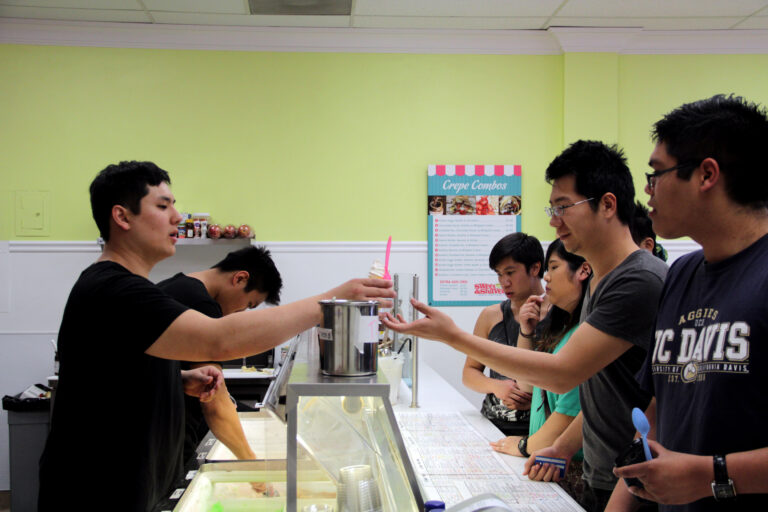
Sweet & Shavery, located at 210 E St., had its grand opening on March 8 from 11 a.m. to 10 p.m. The small store specializes in sweets, its menu consisting of Italian shaved ice, frozen custard and crepes.

Co-owners and UC Davis graduates Lindsay Phan and Brian Nuss, now a graduate student at UC Davis, believed the sweet treat that is more popular on the East Coast would do well in Davis.

“I think it is a little different since we cater to vegans and vegetarians because we have shaved ice … my favorite flavor is the cactus cooler parfait and the fruitier [desserts],” Phan said.

At the grand opening they offered free samples of the shaved-ice-parfait dessert and 50 percent off crepes to draw in new customers. Due to the unanticipated high demand, they had to close early on March 9 at 6 p.m. rather than the usual 10 p.m. and all day Monday.

“The biggest challenge for the shop has been knowing how much product to have every day because we’ve been running out. The frozen custard has been very popular … Another challenge has been that we only have three employees and they are all seniors so they will be graduating, but we have a lot of good, hardworking students,” Phan said.

Danielle Torres, a third-year geology major, went to try the free dessert.

“I see big things for Sweet & Shavery. I definitely think there’s a market for it here; I think the majority of the dessert places that I frequent involve semi-frozen things. And, there’s a ton of frozen yogurt places in Davis, so having another option for my frozen fix is kind of exciting,” Torres said.

Sam Bhatnagar, a second-year biochemistry and molecular biology major, thinks that Sweet & Shavery has a shot at success despite the disproportionate amount of dessert places downtown. He said, however, that he has heard different opinions regarding service.

“As far as the service, it was fine when I went but I’ve heard mixed reviews from people. Some of which include things like they randomly close early if they run out or they were rude or they just told people to leave because they were running out of stuff. They have a bright future ahead and I am stoked to get some more this week,” Bhatnagar said.

Phan said she thinks Sweet & Shavery is a great place for every kind of customer and that they want people to enjoy it.

“We try to appeal to students, kids and families. I want everyone to come … it’s bright and fun. I really like business, I like talking to people and I love desserts,” Phan said.

Bambu Desserts & Drinks, located on 213 E Street, opened in Davis this February. The franchised chain has replaced Zindagi Indian Bistro. It has 35 locations, including Sacramento, Rocklin, Bay Area, and even as far as Texas, Hawaii and Georgia to name a few.

They serve milk teas, blended coffees, smoothies and other combination dessert drinks. They’re open Tuesdays through Thursdays 11 a.m. to 10 p.m., Friday and Saturday 11 a.m. to 11 p.m., Sundays noon to 8 p.m and are closed Mondays.

Torres also went to Bambu and got the Bambu Special, a frozen drink mixture containing coconut, pandan jelly, longan and basil seed.

“I liked it, but it’s kind of exotic, so it might not be for everyone,” Torres said.

The store could not be reached for comment.

Tako Korean BBQ, a chain of Korean-Mexican fusion restaurants with locations in Sacramento, opened on March 7. It is located at the corner of Fourth and G streets downtown and replaced the popular family-owned authentic Mexican restaurant El Mariachi.

The restaurant hopes to offer late night hours and live music, but for now they are just getting their foot in the door, said manager Alex Won. He previously worked at the Midtown location in Sacramento.

“UC Davis students are, I think, critical as far as food goes because there’s a lot of restaurants around here so they know what’s good or not — they’re good at critiquing. We’ve gotten a lot of good feedback. Students will have to try it for themselves and see if they like it,” Won said.

He thinks it will be challenging to get the ball rolling, but he’s excited for what’s to come.

“We are here to try to offer good food at a reasonable price,” Won said.


Aggie Arcade: Your weekly dose of video games

0

March Madness

March has been a slow month in the field of video game news, but that’s because people are busy actually playing games. I can’t remember a March lineup quite like this and it makes for an exciting time of the year (notwithstanding school finals).

This past weekend I finished South Park: The Stick of Truth, the long-awaited collaboration between the creators of South Park and developer Obsidian Entertainment. South Park video games have a long history of being absolutely terrible, but show-runners Matt Parker and Trey Stone make a concerted effort with The Stick of Truth. The game plays like a love letter to fans of the show.

The game’s humor coincides directly with its success — funny video games are rare because writing video game humor can be difficult. But the biting satire, pop culture references and crude jokes that define “South Park” are also found in The Stick of Truth. In fact the entire game feels like an extended episode of the show, right down to the remarkably similar art style.

Now that The Stick of Truth is in the rear-view mirror, I can look ahead to Dark Souls II, perhaps my most anticipated game of the year. I’ve already cataloged my 2013 love affair with Dark Souls — I finished it three times and put over 130 hours into the game. If Dark Souls II captures even a fraction of that obsession, I’m sure I’ll love it.

Much has been said of the changes being introduced to Dark Souls II, namely the fact that players can be invaded by other players at any time. Part of me cowers in fear at the notion of losing progress because someone else wants to flex their muscles and show off their new +5 katana, but I also recognize the thrill of victory. I didn’t spend much time with the multiplayer component of Dark Souls, but when I did defeat another player, the adrenaline rush was incredibly satisfying.

Also out this week is Titanfall, perhaps the biggest release of the month. Following the Infinity Ward fiasco 2010, ex-Call of Duty designers went on to form Respawn Entertainment. The first game from the company attempts to rival other popular online shooters with its emphasis on vertical traversal and gigantic mechs. Think Call of Duty with wall-running and powerful robots.

Titanfall is a Xbox One/PC release, but I don’t own the former and my computer is not capable enough to run the game. Sadly that means I’ll have to miss out on the game, but early reviews indicate fans of online multiplayer shooters will love Titanfall.

Closing out the month is inFAMOUS: Second Son for the PlayStation 4. I’m happy that I purchased a PS4 because I enjoy being part of the early-release zeitgeist, but I must admit that the new console has been collecting dust in my house. I’m simply waiting for the games to come out and inFAMOUS: Second Son looks to be the first big-name release of 2014 for Sony’s latest platform.

I enjoyed the first two inFAMOUS games, and early previews/videos appear to point to another successful entry in the open-world series. If nothing else, it looks as though inFAMOUS: Second Son will emphasize the technical prowess of the PS4 with its top-notch visuals. Hopefully the game’s mechanics are just as good.

Arts Week: March 12, 2014

0

MUSIC

Marriage + Cancer/Virga/No Sects/Pockets
March 13, 9:30 p.m., $5
Third Space Art Collective, 946 Olive Drive
This “pissed-pop” band out of Portland, Ore., formerly called (and intentionally misspelled) Nucular Aminals, is stopping by Davis on their Bay Area tour. Think Magnetic Fields meets Nirvana’s guitar and quintessential Portland reverb grime. Also to perform: Virga, a KDVS-frequent local band; No Sects, post-punk and also local; and Pockets, a band with “sweet dreamy tunes,” according to the Facebook event.

Davis Chamber Choir Winter Concert
March 14, 7 p.m., free
Davis United Methodist Church, 1620 Anderson Road
The theme of the Davis Chamber Choir’s winter concert is “The Development of English and German Music” and will explore the languages’ chronological musical progression. The 20-member student-run choir, founded in 2011, performs once quarterly.

Early Music and Baroque Ensemble Concert
March 15, 7 to 9 p.m, $6 suggested donation
The Episcopal Church of St. Martin, 640 Hawthorn Lane
Both the Early Music Ensemble, directed by William Cooper, and the UC Davis Baroque Ensemble, directed by Phebe Craig and Michael Sand, will perform. The Early Music Ensemble is comprised of both vocalists and instrumentalists. The Baroque Ensemble focuses on a later time period, but both ensembles use period-authentic instruments from the UC Davis early instruments collection.

OTHER

Davis Roots Speaker Series: “Where are they now?” with Mark Otero
March 14, 5:30 to 7 p.m., ages 18 and older, free
Hunt-Boyer Mansion, 604 Second St.
Mark Otero received his MBA in 2007 from the UC Davis Graduate School of Management. He went on to found Klicknation, a video game company whose games are played on social networks. Otero sold Klicknation to the video game magnate Electronic Arts, which funneled Klicknation to EA’s popular BioWare gaming developer. Otero is currently a general manager of BioWare Social, focusing on fantasy and science fiction games. The speaker series focuses on local companies and their founders. Refreshments will be provided.

The Art of Appropriation
March 18, 10 a.m. to 4:30 p.m.
Andrews Conference Room, 2203 Social Sciences and Humanities Building
Davis Humanities Institute Studies in Performance and Practice Research Cluster and The Center for Science and Innovation Studies Presents: The Art of Appropriation is a one-day conference. It will bring together legal, visual media and technology scholars to examine and discuss the role of copyright and ownership in art in the 21st century. The conference will feature talks by Martine Beugnet of Université Paris Diderot (France), Tarek Elhaik of San Francisco State University, Tatiana Flessas of the London School of Economics and Politics and Madahvi Sunder, John Zibell and Mario Biagioli of UC Davis.