60.8 F
Davis

Davis, California

Wednesday, December 24, 2025
Home Blog Page 902

Aggies tip off season against Lumberjacks

0

Teams: UC Davis vs. Humboldt State

Records: Aggies 0-0 (0-0); Lumberjacks 0-0 (0-0)

Where: The Pavilion — Davis, Calif.

When: Friday, Nov. 1 at 7 p.m.

Who to Watch:

As UC Davis heads into the 2013-14 season, the bulk of the production load will be placed on junior forward Sydnee Fipps. Fipps — who won first team All-Big West honors last year — will need to continue her growth in order for the Aggies to have continued success this year.

The junior will be expected to provide more than scoring — though her impressive 17.1 points per game average led the team last year — as her rebounding and leadership qualities will prove vital in the quest for a Big West title.

Fipps, as a junior, is one of only four upperclassmen on the team. Her leadership on the court will be necessary especially at the end of close games.

Fipps’ rebounding abilities, as evidenced by her team-high 5.1 rebounds per game, is crucial as the Aggies struggled on the boards last season. The Aggies finished last in the Big West in rebound margin, getting outrebounded by an average of 8.4 rebounds a game.

All in all, Sydnee Fipps is going to be the catalyst for any run which UC Davis has this season. Her scoring, rebounding and leadership are all needed for success against Humboldt State as well as the tough Big West conference.

Did you know?:

Sydnee Fipps was nominated for preseason all-conference honors. This was due to her outstanding performance in her sophomore campaign. She scored a total of 512 points on the season, which broke the UC Davis record for sophomore season point totals. Fipps also led the Aggies in scoring 21 out of the 30 games last season.

Preview:

As the Aggies begin their 2013-14 basketball season, there are many questions which the team needs to answer. Who is going to replace recent graduates Courtney French and Blair Shinoda in the starting lineup? Who is going to help Sydnee Fipps shoulder the scoring load?

These questions hopefully will be answered over the next few games. One person who possibly could step up and produce right away is sophomore Molly Greubel.

Greubel was a key player off the bench for the Aggies last season. She averaged 6.3 points per game, which was third on the team, only behind Fipps and French. With French graduated and gone, Greubel is the second-leading scorer of all UC Davis’ returning players.

The Aggies will definitely need her to have a more proactive role in scoring this year if they are to have any success. Her season average of 2.1 rebounds and 1.1 steals per game shows that she is willing to work hard on both sides of the floor.

UC Davis’ home and season opener will be against the Humboldt State Lumberjacks. The Lumberjacks went 10-18 last season which included an ugly 3-9 away record. This opening matchup will be just as much of a test run for Humboldt State as it will be for UC Davis.

The Lumberjacks only have two of their five leading scorers from last season returning. Seniors Kelly Kime and Elle Anderson averaged 8.7 and 6.9 points a game respectively. They will be asked to do a lot more against the Aggies in order for Humboldt State to succeed.

The Aggies tip off their season on Friday, Nov. 1 at 7 p.m. The game will be held at the Pavilion.

— Kenneth Ling

Men’s Tennis To Finish Fall Season At Pacific

0

Event: Pacific Tiger Invitational

Where: Hal Nelson Tennis Courts, Stockton, Calif.

When: Friday, Nov. 1; Saturday, Nov. 2; Sunday Nov. 3

Who To Watch:

Sophomore Adam Levie and freshman Alec Adamson made a semi-final run in doubles this past weekend at the ITA Northwest Regional held in Moraga, Calif. They took out three seeded teams along the way before losing in the semis 8-6 against the University of Washington’s eighth-seeded team of Emmett Egger and Jeff Hawke.

This is the second consecutive brilliant tournament for the Levie/Adamson pairing as they won the Flight A doubles bracket the weekend prior at the UCSB classic.

They have turned out to be quite the team and will look for more as they head into the Pacific Invitational.

Did You Know:

With the semi-final showing of Levie and Adamson in Moraga, the Aggies have now had at least one player make the semi-finals of an event at all three fall tournaments. This is an impressive feat that has come against the top of the line talent that the West Coast has to offer in the NCAA.

“I feel like we’ve competed pretty well in all three,” said coach Steidlmayer. “We’ve won several different flights.”

Preview:

The Aggies head to Stockton, Calif. on Nov. 1 to play in the Pacific Tiger Invitational. The field of teams this year will include Pacific, St. Mary’s, University of San Francisco, and also Stanford University.

This tournament is the Aggies’ last tournament this fall, so that should inject a little extra incentive and motivation into the team. Everyone wants to finish well and this tournament will provide ample opportunity for UC Davis to go out on a high note this season and come into the spring session feeling very confident in themselves.

“Getting better really is a good season,” coach Steidlmayer said. “The guys’ effort level has been good.”

This is certainly true of the men’s tennis team so far this year and is hopefully only the beginning for a blossoming young team.

— Vic Anderson

When the Aggies go marching-uh

1

As the California Aggie Marching Band-uh! takes the field to perform this weekend, you could be seeing them in a much bigger venue.

On Nov. 3, as the Oakland Raiders play host to the Philadelphia Eagles, Band-uh! has been given the distinct privilege to perform pre-game and at halftime at the Oakland Coliseum.

“It is a great opportunity for us,” said student manager Audrey Vorametsanti. “We are going to have thousands of people which is a lot more than our usual crowd, and we are also performing in a much bigger stadium.”

Band-uh! will not only be putting on a performance for the thousands of decorated Raider fanatics, but also for the many Bay Area police and firefighters in attendance.

The Oakland Raiders have teamed up with the organization Police and Fire: The Fallen Heroes for another year, in order to pay tribute to first responders from around the Bay Area.

In the Fourth Annual Oakland Raiders Police and Fire Appreciation game, members from multiple Northern California fire and police departments will be recognized in a special on-field ceremony.

“We have incorporated the Fallen Heroes organization into our show,” Vorametsanti said. “We will be playing ‘America the Beautiful’ while they do their salute to the police and fire personnel, in addition to a couple other songs during pre-game.”

Although Band-Uh! has had to rehearse for numerous events including the upcoming UC Davis vs. Cal Poly football game on Nov. 2, Band-uh! has taken the Raiders’ pregame and halftime show with the utmost importance.

“We have been practicing about 10 hours per week,” Vorametsanti said. “We had to memorize all of our drills and all of our music.”

While many of the band members are anxious for the upcoming game, band director Olin Hannum said this event is much more than just gaining public recognition.

“This event is more about the students being able to play in a stadium [Oakland Coliseum] that size and be in front of that many people,” Hannum said. “It is a bigger stage to perform on.”

As for the song list Band-uh! will perform on the big day, Director Hannum did not reveal much.

“The show is going to be Raiders-oriented,” Hannum said.

With Band-uh! preparing for a busy weekend, there will be several adjustments that will have to be accounted for as they prepare to play in the Coliseum.

“NFL hash marks are a bit different than college, so when charting the show, we had to account for that,” Hannum said. “But mostly, the difference is stadium size. Since the fans and cameras are way more elevated compared to Aggie Stadium, we [Band-uh!] can make a lot more [formations] on the field.”

Even with the field changes, Director Hannum views this as a big moment for the marching band itself.

“I think a lot of people in the Bay Area don’t know that we are the largest marching band in the UC system,” Hannum said. “Hopefully this will turn an eye in that the UC Davis marching band is pretty darn good.”

SHAUN MONCADA can be reached at sports@theaggie.org.

Cosmic Relevance: Spooky tradition

0

Today is Halloween, and it’s been one of my favorite holidays since I was a child.  And even though I love it so much, I realized that I know almost nothing about its origins.

So I investigated.

Halloween was originally known as Hallowmas, or Saint’s mass — a three-day observance and feast to honor the deceased and pray for Christian souls. As early as the 13th century, all regions of Europe had its own version of All Saint’s Day.

Equally important, the indigenous civilizations of North and Central America have been honoring their ancestors and rebirth in celebrations for around 3,000 years. When the Spanish arrived, their Christian influence hybridized the month’s practice into Día de los Muertos, a two-day period to honor the dead and respect the cycle of life.

So how did we get to our modern celebration?

In the colonies, Puritans held strong opposition to the “pagan” traditions of Halloween. However, with the influx of Irish and Scottish immigrants in the 19th century, Halloween slowly assimilated into mainstream culture. Its first mention in an American publication was in 1911, and by the late 1930s people from all socio-economic, religious and racial backgrounds were celebrating the holiday.

And it turns out, these observances hold direct connections to our own festivities.

From Ireland, we get the Jack-o-Lantern, hollow turnips lighting the way for lost souls, adapted to the American native pumpkin. From England, we received “souling,” an early version of trick-or-treating.  Children and the impoverished would go door to door, chanting rhymes and asking for “soul cakes,” baked for charity. In addition, from Mexican and Scottish customs, participants adorn costumes to either mock death, disguise oneself from evil spirits or create masked mischief. Lastly, Mexican tradition strongly encourages the locality to share with one another, everyone contributing to the shindig.

All in all, this period historically has centered around death, life and remembering our ancestors. So have we strayed from the true purpose of this ritual? When I asked some classmates what they associate with celebrating Halloween, the answers strongly suggested that the holiday has strayed.

Popular answers included “candy,” “pure fun” and “trick-or-treating.”  And when asked about their college celebrations, mostly one word was uttered: “partying.”

On one hand, it can be strongly argued that our secular society has lost the spiritual aspect of the holiday. Elementary schools facilitate dress-up, but omit conversations of ancestry and the universal subject of death.

Luckily, Día de los Muertos celebrations are on the rise, including processions in the Mission District of San Francisco and midtown Sacramento. These Festivals of the Altar are free and open to the public, and everyone is encouraged to bring flowers, candles and tokens for departed loved ones. In our fast-paced technological world, the organizers of the Mission procession encourage us to spend these days strengthening “our connections beyond our immediate concerns.”

Yet, Halloween still seems to unite us all. Far from its religious roots, children from all circumstances can dress up and join the merriment. I say it’s downright American; anyone can be anything.

Furthermore, in a world with school shootings, ever-increasing airport security and child predators, my hope is that this tradition continues to allow children to walk the streets safely in every neighborhood of the United States. That we can put aside discourses on high fructose corn syrup and child obesity, and trust our neighbors to give children candy. For one day the whole community can have fun together.


If you want to contact the dead with DANIEL HERMAN you can email him at dsherman@ucdavis.edu.


Stay Tuned: Smiling is golden

0

How many times have you shared a smile with a stranger? Think about it. Just today: when you bought your coffee and she told you to have a nice day, when you bumped into him on the sidewalk and you both mumbled apologies, when you crossed the road quickly because that driver insisted that you cross first. Each exchange contains a brief moment of eye contact and complimentary smile. Is this due to human nature? No. This behavior is cultural.

Whether because of our Hollywood-obsessed psyche or our enormous investment in perfected orthodontics, America is without a doubt, addicted to smiling. Americans will smile when we are happy, when we are uncomfortable, when we are see something funny or slightly interesting.

I come from a town where people going for their morning power walks will greet you with a big grin and a chipper, “Good morning!”

To me, this level of friendliness wasn’t excessive or grating, it was almost common courtesy. To the rest of the world, this exchange seems to equate to Disney On Crack. You just try to squeeze in a “Bonjour” to a French lady going for her morning power cigarette and you would be lucky to hold some brief, albeit hostile eye contact.

This inevitably has an effect on street performance.

Usually there is a little song-and-dance that goes along with the interaction between performer and audience. Some people are sitting near you and will hear a whole song; many more are passing you, catching only snippets of your songs as they go about their daily tasks. Usually the people passing will throw you a smile as you play. You take this for granted. It seems natural, second nature! Which makes it all the more unnerving when smiling is somehow subtracted from the routine.

When I was in Germany over the summer I took my guitar with me, for company if nothing else. The first few times I saw some interesting results. Like always, I had tried to find a relatively inoffensive place to play — a public park in the middle of the day. Strangely, the overwhelming reaction I got was uncomfortable.

I had made sure not to leave my case open or anything resembling a tip jar and yet, when I smiled at anyone, they hurried away as if I had asked for their firstborn child. It wasn’t unpleasant, just bizarre and invigorating. I had the power to make every passing stranger visibly nervous. Sometimes a passerby would breathe strangely loud through their nose as they walked quickly by, which I totally counted as acknowledgement. Not a single smile was seen.

Of course location is everything. When I visited a university town in Germany I got a much warmer response. Maybe too warm in some respects.

Again I had chosen a public park. Most of the populace gave me a wide diameter of space; if they did look at me it was hesitance bordering on suspicion. A young couple, however, approached and set up a blanket a little ways in front of me. I wasn’t acknowledged throughout this process but they could have chosen anywhere to sit so I figured they could be considered my audience.

Then they began to suck face about five feet from me and my bench. It would have been cute had it not been mildly gross, but hey, I’m a good sport so I serenaded their little picnic until they got up to leave and the guy thanked me — presumably for helping him get laid.

A while later an older couple approached as I was playing some Bob Dylan. They handed me a couple euros, which I graciously accepted.

“Danke!” I said, butchering the accent.

“Ah,” said the husband, picking up on my foreignness. “You speak English?”

“Yes!” I replied. “I’m from America!”

We began to talk about Bob Dylan and songwriting and the ’60s.

“You know,” I said after a while, “Street performing is different in Germany. People here seem nervous, they hardly make eye contact. You two are the first to approach me and start up a conversation!”

“Well we are not German,” they declared. “We are Swiss!”

“Ah!” I said, as if that explained everything.

Maybe it did. After a bit, they left, smiling as they waved goodbye.

Though I don’t consider myself one to get homesick, it was nice to come back to a country where passersby give you a gold-star smile for effort. We are addicted to smiling and we are nowhere near to finding a cure, and just the thought of it leaves me grinning.


For some great makeout music contact ELLY OLTERSDORF at elly.oltersdorf@gmail.com

Letter to the Editor: UC quality pushes workers to strike votes

0

The University of California’s union TAs, readers, custodians, hospital workers, technical employees and more are all holding strike authorization votes this week. Graduate student-workers are voting Nov. 4 to 6, service workers voted Oct. 29 and 30, and professional and technical employees have already voted 92 percent in favor to authorize a strike.

These union workers have been meeting with a series of Unfair Labor Practices from the UC — including intimidating striking service workers last spring and withholding information from TAs during their negotiations for a new contract. And all of these unions have emphasized the need to fight to defend the UC’s status as a top education and research university: smaller discussions so they can attend to undergraduate students, more competitive funding for graduate students to keep the UC a top research university, better patient care in UC hospitals, increased hours to clean campus buildings.

The call for a strike vote from UAW 2865, the union of UC readers and TAs, came last week in a meeting here at UC Davis in Wellman Hall, with representatives from every UC campus and dozens of rank-and-file Davis graduate student-workers participating. What does this strike vote mean? It means not that there will be an immediate strike, but that union officers are authorized to call a strike if circumstances merit.

With TAs increasingly expressing concerns that current large classes simply do not allow them to give their students the individual attention they will need, circumstances are already desperate. Voting is just a first step, but it demonstrates the severity of problems at UC.


Caroline McKusick

Anthropology Ph.D. student

Guide, UAW 2865 Student-Workers’ Union

The Left Nut: Socially Unacceptable

0

“We’ve got about 30 kids in this county that I’m at that are homosexuals. And it is sickening,” cries 14-year-old radio talk show host Caiden Cowger to thousands of listeners. “I’m going to tell you this, guys: President Obama and Vice President Biden are making kids gay!”

Some of you may find this appalling; others may not think this statement is so far-fetched. Cowger’s rant soon went viral, sparking heated discussion everywhere on the issue of gay marriage. Those on the left scathingly criticized him using epithets such as “dick” and “little asshole,” while those on the social right quickly jumped to his defense.

Cowger’s case is not an isolated incident, either. Every four years, presidential elections bring out the worst in people. Otherwise normal citizens begin calling each other names like “baby killer,” “woman hater” and “fag enabler,” not realizing that whomever they elect as the leader of our country has little control over abortion, women’s rights or gay marriage.

Now, a cynic might argue that I singled out Cowger to attack the right wing, but such is not my intention at all. He is entitled to his opinion, and, thanks to the First Amendment, free to broadcast it to the masses. I’m not necessarily criticizing him or anyone else for their views on homosexuality.

I’m criticizing them because they base their condemnation of the President on something over which he has virtually no control. For those of you still convinced that my bias is showing through, let me give you another anecdote.

Last election, my mother asked me who I would vote for, were I eligible to vote, with the addendum that Romney would ruin this country if elected. As a political progressive, even I found this pretty grossly naive, so I asked her how exactly he would do so.

Her instantaneous response went something along the lines of, “Well, he doesn’t like gay people!” I don’t know Mitt Romney personally, but I highly doubt that he hates all homosexuals solely on the premise of their sexual orientation. Even if he did, I have plenty of friends in support of gay rights who would still vote for him because they agree with him on fiscal and foreign policy issues, among many other things.

I told my mom that, while I would vote for Obama, it would be because, at the time of the election, he had cut the federal deficit by $312 billion and increased government spending at a slower rate than any president since World War II, not because of his magical ability to instantly legalize gay marriage and abortion in all 50 states.

As much as I supported Obama in the 2012 election, I would rather people not vote at all than vote for him without an educated stance on his positions. I have infinitely more respect for someone who votes Republican and has a carefully thought-out position that they can readily defend than for someone who votes Democrat because “Republicans hate women and minorities.”

Making prejudices about our opponents has caused party polarization, which in turn has caused politicians to become overly dogmatic in order to appeal to their constituents. We saw it with Rick Santorum’s short-lived presidential run last year: the bread and butter of his platform was conservative social policy, which made up most of his talking points.

His extremely polarizing persona, which relied heavily on his Christian morals, took almost all of the media attention away from his grossly incomplete fiscal policy proposal, which economists hated with near unanimity.

Yet this man won the Republican primary in three states and finished second in five others, over Romney, Gingrich and Ron Paul, all of whose proposed fiscal policies made up a large chunk of their platform. This is just one example of how some Americans care much more about social issues than economic ones.

My intent here is not to undermine the importance of social issues, but to stress that social policy change usually happens in state legislatures and rarely rests upon the shoulders of the federal government. So please, when voting for the leader of our country, don’t relegate their role to that of a mere social policy advocate. Instead, consider the practical effects this candidate would have on our country before you cast your ballot.


If you want to call ZACH MOORE a “little asshole,” email him at zcmoore@ucdavis.edu.

Minor Alcohol Preclusion Act: Don’t drink and walk?

0

In January 2012, the Minor Alcohol Preclusion Act (MAPA) was introduced to the Davis City Council. The act was proposed in light of community and council members’ concerns over underage drinking and neighborhood disturbances. City Council was scheduled to meet on Oct. 9, but will reconvene in 2014 instead to discuss the act.

The Davis Police can already make arrests for drinking-related conduct, such as public inebriation, possessing an open container and supplying minors with alcohol. There are also other local ordinances that attempt to curb “nuisance parties” and social gatherings that serve alcohol to minors.

If MAPA were enacted, the Davis Police would be able to charge minors with public inebriation if found with a blood alcohol content (BAC) of 0.02 percent or higher. What’s particularly unique about this act is that minors are allowed to drink in private, but can be subject to BAC tests and fines with probable reason if drunk in public areas.

Indeed, we do sympathize — and often, empathize — with our neighbors who have to suffer through the drunken rowdiness and eloquent conversations students yell at each other at 2 a.m. However, we do have some concerns with this proposed “solution.”

We know that those under the influence of alcohol are not the most functional group of people. If MAPA were to be passed, students may be more encouraged to drive home intoxicated instead of walk home, for fear of getting stopped and having their BAC tested.

A drinking culture is inevitable in a college town. Yes, the act would reduce the number of public disturbances, but does that encourage underage drinking in private settings rather than in public?

The City of Davis is made up of about 33,000 UC Davis students. Approximately 25,000 are undergraduates, meaning the majority of those students are under the age of 21. How will a police officer differentiate between minors and those of legal drinking age? We anticipate awkward moments.

Additionally, minors are not the only ones who create neighborhood disturbances. The act does not formally state what police officers are supposed to do with those of legal drinking age who cause disruptions in the community.

When City Council meets again, we’d like to see more defined criteria and expectations for MAPA, an emphasis on alcohol education in combination with enforcement and better student/community/police relations.

If the police can have our BACs, we’d like to have their backs, too.

Construction begins on SkyMine

The construction of a carbon dioxide (CO2) recycling plant in San Antonio, Texas will employ new technology to trap CO2 from power stations and industrial manufacturing processes before it is released into the atmosphere.

Using technology from Skyonic, construction began on the SkyMine demonstration plant on Sept. 30.

The technology utilizes heat in waste gases from industrial chimneys, which is then used to generate electricity. Then the carbon dioxide, sulfur dioxide, nitrogen oxides and heavy metals like mercury are scrubbed from the waste gases and stored. The CO2 enters absorption chambers where it is treated with sodium hydroxide (aka caustic soda ) made from salt and water. The chemical reaction that occurs is:

CO2 + H2O + NaCl —> NaHCO3 + H2 + Cl2

The byproducts of this chemical reaction are baking soda (NaHCO3), hydrogen gas (H2) and chlorine gas (Cl2), all of which have multiple commercial uses. Hydrogen and chlorine gases, for example, can be dissolved in water to make hydrochloric acid, which is frequently used as an industrial solvent.

Furthermore, the SkyMine scrubber technology is less costly and more efficient than the current technology being used in industry, which can cost hundreds of millions up front and millions more annually for maintenance.

“In North America alone, the market for carbonates, soaps [and] limestone products used in making paper, cement or fine chalks is worth $7.5 billion. Even if only about half of that is lucrative, we’ll be able to drive down the price of [the] carbon sequestration process to around $20 per ton. The market will deliver the most sequestration at the least cost to society,” said Joe Jones, CEO and founder of Skyonic.

However, William Casey, a professor of analytical chemistry, had some important comments about the project.

“There are a couple of points to note. They apparently aren’t scrubbing the CO2out of ambient air but putting their plant near a source of CO2, like a power plant,” said Casey in an email interview. “It is preventing CO2 from entering the atmosphere from combustion. This distinction is important because it takes much more energy to scrub the low levels of CO2 out of the atmosphere in the presence of so many other gases.”

Casey continues to explain that this reaction is atypical. Usually the reaction of carbon dioxide and water makes carbonic acid (H2CO3) that then dissociates to form bicarbonate (HCO3(-)). The reaction that Skyonic reports makes hydrogen gas, which is a powerful way to store energy, a detail that may be due to the reaction occurring at such high temperatures, utilizing the exhaust from industry.

Unfortunately, this technology alone will not curb climate change. The Skyonic plant in Texas is projected to be able to remove 83,000 tons of CO2 per year compared to the estimated 5.5 million tons that the U.S. produces annually.

“This is a good project and innovative in terms of the scale of CO2 mineralization that has not been done before. Industrial CO2 capture is an important part of the CCS story. However, given the scale of the climate change challenge (and the volumes of CO2 emitted from the power sector alone), traditional CO2 storage will be needed alongside projects like Skyonic,” said policy and communications manager at the Carbon Capture and Storage Association Judith Shapiro.

Regulations already exist requiring those in industry to filter sulphur and nitrous dioxides from their smokestacks. New EPA standards tighten restrictions on allowable emissions from power stations, a change that could drive up the demand for SkyMine, which is a relatively small and easily installed piece of equipment.

Capitol SkyMine is scheduled for completion in 2014, and if everything goes as planned, the plant is projected to capture 300,000 tons of CO2emissions annually.

Birdstrike Theatre starts season with first show

0


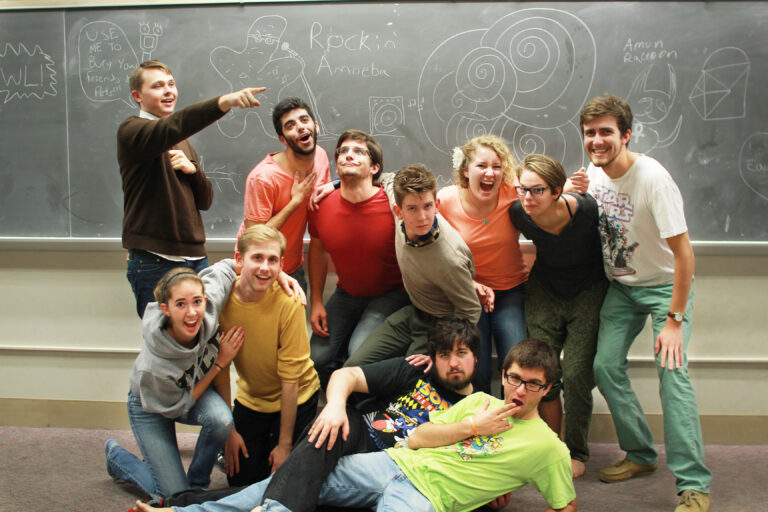
Birdstrike Theatre, UC Davis’ long-form improvisational group, will perform their first show of the school year on Nov. 1 in Kleiber 3.

“This show will be all live, unlike our quarterly ‘big shows,’” said Sarah Lloyd, a Birdstrike member and second-year chemistry major. “It will be 100 percent improv.”

The members of Birdstrike Theatre do long-form improv, which Lloyd mentions is different from the improv that is seen on “Whose Line Is It Anyway?” which is short-form improv.

“It’s not a type for comedy that allows for one-liners and jokes, but instead allows for situational and character-based humor,” Lloyd said. “We get into characters, and then the situations we get the characters into are funny.”

One example Lloyd gave was a scene in which she and another performer acted out a scene in which Lloyd’s character was discovered to be in love with marshmallows. Charlie Norton, a fourth-year evolution and ecology major, said that long-form improv allows for some interesting and funny scenes.

“Some of the best scenes are the ones where we all end up reading each other’s minds really well and come up with a cohesive idea,” Norton said. “When we end up on the same page and perform for an extended period of time it can get really good.”

Norton also said that Birdstrike incorporates the audience into their performances.

“Audience input really drives what we do on stage. We’ll do things where we interview the audience or we’ll use someone’s iPod. We’ll work with the audience to do whatever we can,” Norton said.

The members of Birdstrike Theatre are from various groups but share an interest in improv. Birdstrike Theatre President Omri Kruvi, a fourth-year landscape architecture major, joined the group in his first year in order to find a hobby.

“I discovered improv in high school and I enjoyed it a lot,” Kruvi said. “I had a good time and I wanted to meet other people who were interested in it as well.”

Lloyd also did improv in high school and was seeking an improv group at UC Davis.

“I found out about Birdstrike and saw they were advertising for auditions and workshops,” Lloyd said. “I went to one of the workshops, and ended up on the team.”

Previous improv experience is not required for joining Birdstrike.

“I joined in fall 2012 because I needed a hobby that wasn’t science,” Norton said. “I hadn’t done any improv before this. I tried it on a whim and managed to be somehow successful at it.”

Kruvi said Birdstrike is something that caters to a college audience, and people can expect something different every time.

KDVS to host first house comedy show of year

0

Davis’ local radio station, KDVS 90.3 FM, will be hosting their first house comedy show of the school year on Nov. 7. The show is called “F***in’ Funny” and will be held at the Robot Rocket Residence on M Street.

The event is a showcase of some of the best local standup comedians and is a way for students in Davis to get their comedy fill without trekking to Sacramento or San Francisco.

“F***in’ Funny” was started a few years ago by UC Davis alumna and comedian Allison Stevenson. When Stevenson graduated, former KDVS DJ and Comedy Spot Comedian in Sacramento Mike Cella decided to rekindle the event but kept true to its original house show format.

The event was originally held in a house on Pole Line Road and occasionally at other venues in and around downtown Davis. The house setting was chosen to allow for show-goers to have a comfortable place to laugh and blow off steam.

The new venue, Robot Rocket Residence, traditionally opens its space for musicians and bands to perform.

“We started doing the show at a house on Pole Line in Davis. We had the show in the living room with people backed up to the wall,” Cella said. “It’s very informal. I like having the show in a house because the vibe is pretty laid back and the setting is intimate.”

The event usually features seven to 10 local comedians and a prominent headliner from the Bay Area. Comedian Ray Molina will be headlining the Nov. 7 show.

Molina recently finished up Comedy Central’s “Up Next” comedy competition in which he was a semi-finalist. Molina has opened for big names such as Zach Galifianakis, Maria Bamford and Marc Maron. He prides himself on a feel-good variety of comedy, a characteristic somewhat unique to the standup community.

“I am looking forward to seeing a lot of people there,” Molina said. “When I perform I want people to feel good about themselves.”

Other performers to be featured are Andrew Holmgren, David Gborie, Anna Seregina and Darby Herms. The show will also consist of giveaways and musical interludes by third-year English major Matt Stalcup.

Cella will be co-hosting the event along with comedian and Robot Rocket resident Jaclyn Weiand. Both hosts will be offering short comic sets of their own.

Cella has hosted the event before, while Weiand usually performs comedy acts. Weiand started doing standup in Sacramento a year ago and has done sets at past house comedy events in Davis.

“[F***in’ Funny is] really a different kind of performance. Davis people don’t know to come out to Sacramento to see comedy so they’re really happy to be at this show and it’s a really fun place to perform,” Weiand said.

Admittance to “F***in’ Funny” is free. The show starts at 8 p.m. and will be held in the backyard, weather permitting.

Andrew Bird to perform at Mondavi

0

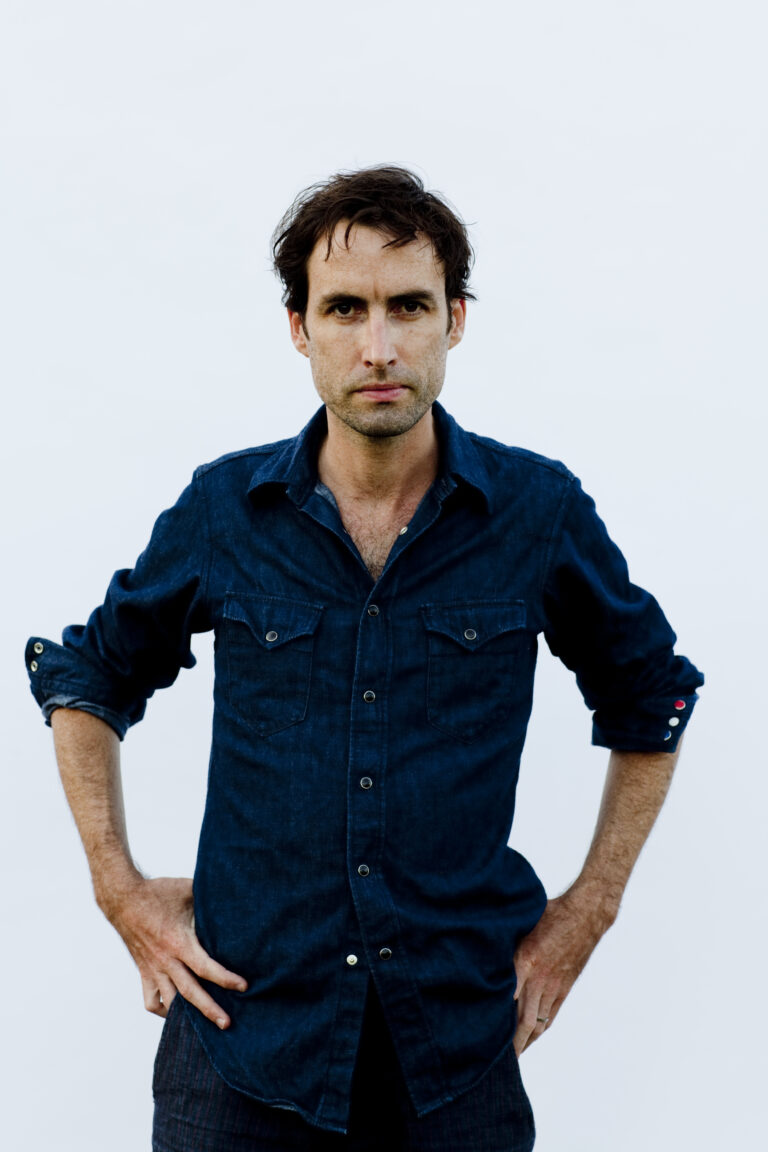
Andrew Bird, critically acclaimed singer, songwriter and multi-instrumentalist who is well-known for his incorporation of violin and fiddle to his indie rock and folk tunes, will be performing at the Mondavi Center on Nov. 14.

Bird first began recording albums in 1996 with the band Bowl of Fire, and soon broke off to create his solo career in 2003. In addition to his six full-length albums and multiple EPs, Bird also made the film score for the film Norman (2010) and The Muppets (2011) and has worked in visual arts, creating installations in the New York Guggenheim and Chicago Museum of Modern Art.

Starting in Davis, Bird kicks off his solo tour around California with opening acts by indie-folk band The Handsome Family. In a phone interview, MUSE spoke with Bird about his creative process, musical development and the process of creating his two most recent albums, Break It Yourself and Hands of Glory.

MUSE: How would you describe your musical development over the years, and what have been your musical inspirations?

AB: I began working on music when I was four, before I was a really conscious being. It was just something I did everyday since I can remember. I think the most formative thing I did early on was that I learned by ear. The idea was that music is like language. This idea is the most important thing for the musician I’ve turned into. People say music is like math, and I cringe when I hear that. Its not like math, it’s anything but math because it’s not about coming up with the right answer in music.

I was just ravenous for everything but classical music — the more obscure the music was, the more interested I was. From ages 16 to 26 I was jumping from one thing to another. I was influenced by early jazz, country blues and early 20th century music. I was really interested in what happened to music before music was recorded. That’s stuff I still play, the hymns, Carter Family stuff. I was influenced by stuff that existed before World War II. I also sing gospel music — it really opens up your singing.

Can you describe your creative process?

It’s not very premeditated most of the time. For the most part I just pay attention to what’s going on around me. I work in the morning, but I don’t have a strict schedule or a desk where I sit at to get all my work done,  unless something comes up and I am asked to do an assignment — then that’s a different process. Mostly, I just wait for things to materialize out of disparate observations. I’ll observe my surroundings and, for example, I’ll see someone sitting on a plane, and then I connect that to something in a book I was reading, and over the years I’ll connect a bunch of different things. There’ll be a common thread and I’ll pull that together in a song. The best way to describe it is: something falls into a stream, like a branch, and then it starts snagging other things around it over time and damns up a river — that’s when you have a song.

How do you think your musical education and training influenced who you are as an artist?

It’s not that I had a teacher that taught me something that stuck with me in particular. I was largely self-taught, and I was not always a model student in school. I give my musical education credit in the sense that I had four years of college to immerse myself in it and not worry about any other distractions. I got better through sheer exposure and osmosis, not so much through book lessons or a particular syllabus. There’s no other time in your life to have that kind of opportunity to focus, so you have to think of it more as an atmosphere where you’re just soaking up as much as you can. All that preparation for the job market makes me cringe. I don’t think that’s the point of higher education.

Describe the tour you’re on right now and the “Gezelligheid” tour coming up right after.

This is my solo songwriting tour. The “Gezelligheid” shows will be played in churches and synagogues around the country. Those shows are more ambient and instrumental and more suited to that kind of reverberant space. In a performing arts center, you can engage with the audience more directly. The church shows are more ambient, with more of a mood and a texture, whereas the tour where I perform in Davis and around California is more about stories, more about words. I’m touring with a favorite songwriting band called The Handsome Family who are opening for me. I cover a lot of their songs, and they’re a huge inspiration.

Your most recent albums are Hands of Glory (Oct. 2012) and Break It Yourself (Mar. 2012), which you recorded in your barn in Illinois. What was the process like for recording these albums?

We just stood up at the barn and recorded around one microphone. These days, I’m kind of into a certain kind of realism when recording. Most of my records are really carefully produced and layered in the studio the way a lot of other records are made, and I got kind of tired of that process. It felt like that process was somewhat less honest than just the band in a room playing with a single microphone live, which is how we made Break it Yourself and Hands of Glory. Pre-World War II stuff has always been there since the beginning of my musical inspiration and I wanted to capture that with the band. We started doing this thing on stage where we just played around one microphone, and it just makes you sing and play better, stripping the production down to its basic elements. The audience responded well to that, and so Hands of Glory is the record that captures that.

Since you recorded both albums in the same year, how would you describe them as companion albums?

Every time I make a record, by the time I get in the studio I’ve imagined each song done in six dramatically different ways. I wonder why I choose to do it this one way on the record versus the other ways to do it. Break it Yourself has a kind of taut, rhythmic, driving version of the songs, so I took Hands of Glory as a chance to show those songs in a totally different emotional backdrop. It makes you look at the lyrics in different way and makes you see the music in different way. Songs on records are never done. They’re always evolving and feel different every moment of the day. In the morning I want to do it one way and in the evening I want to do it in another way. I think that’s worth capturing and it keeps things from getting stale.

Why are you on tour right now?

The prevailing philosophy in the music industry is to hold back all your material and then have a massive publicity push for like twelve songs. I think if you’re going to have any sort of push whatsoever you should get it out there when the machine is going. That’s just what feels right to me. I don’t think I’m at risk of diluting anything. Being onstage is really important to the process for me, so the idea of disappearing entirely and then coming out in five years with a new record is just not good for the music.

Is there something particularly different you try to do to your songs in live shows?

I come from a background of always improvising and exploring. I like to do that on stage. If I didn’t, I’d go crazy. I see other bands who are performing to promote their records. For me, to perform live, I think it’s kind of liberating not to do it to promote new records. I ask myself ‘why are you on stage? Are you trying to create something new and exciting, or are you just recreating your records that you worked on for three years in a studio with producers, etc.?’ That’s not how I do it . It’s never been like that for me, not even close — I started doing records so I could justify playing on stage, that’s really the ultimate experience to perform live. I feel duty to myself that if something new didn’t happen on stage, I could have performed every note perfectly and I’d be disappointed. Every night I need to perform differently from the next in order to feel satisfied.

What’s your relationship with other art forms, like film and visual arts, and where do they fit in with your creative vision?

From the beginning, I didn’t think it’s just enough to be a good violinist. When I made my first records, I got very particular about the artwork and the way everything was presented, even how the stage looked. I wanted to do film scores when I was younger, but suddenly I started writing these full albums with common threads and I thought, ‘Wait a minute, this is my movie. The stage is 35 mm film, and how everything looks and how everything comes together is the movie. This is the thing I understand how to have control over, and I’m going to make this my whole package.’ But that brought me into collaborating with other artists. My mother’s an artist and I’ve always enjoyed working with people who aren’t musicians. Lately, with things like [my project, Sonic Arboretum, in the New York Guggenheim Museum] the “Gezelligheid” tour, they’re explorations of different ways of presenting and performing besides things like a rock n’ roll show, and working with different experience with audience. For that, I need to work with other artists.

Napolitano to allocate $15M to student programs

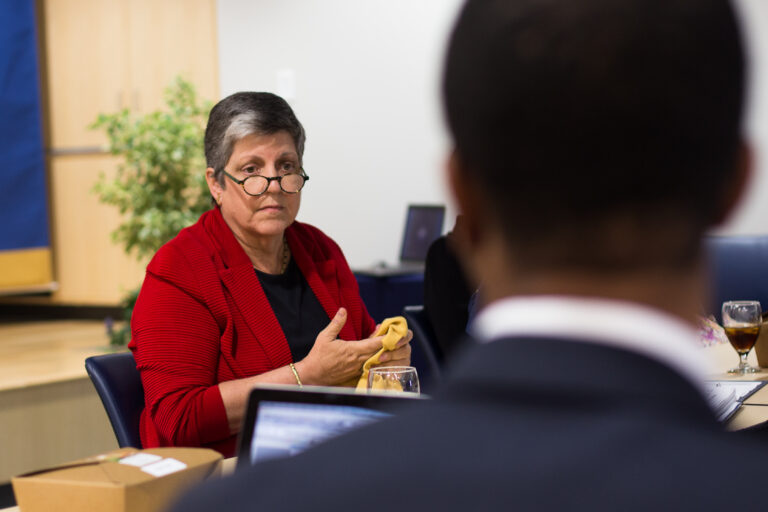
University of California President Janet Napolitano announced Wednesday that she would immediately allocate $15 million to programs for undocumented students, graduate students and postdoctoral fellows as one of her first actions in office.

During her first major public speech as president at a San Francisco hotel, Napolitano said she will allocate a total of $5 million to support the approximately 900 undocumented students in the UC. The funds will be used for resources such as financial aid, advisers and student service centers for undocumented students.

“These Dreamers, as they are often called, are students who would have benefited from a federal DREAM Act,” Napolitano said, referring to the federal legislation that would have granted residency to undocumented students who attended U.S. high schools. “They are students who deserve the opportunity to succeed and to thrive at UC.”

Seth Ronquillo, a fourth-year film and linguistics student, co-chair of IDEAS, UCLA’s undocumented student group, and a former Daily Bruin columnist, said the initiative shows she is listening to undocumented students, who voiced their concerns to her in multiple meetings this month.

“We’ll keep on pushing for undocumented student needs, because there were other demands that still need to be accommodated,” said Ronquillo.

Ronquillo said he still wishes Napolitano would issue a definitive statement saying she will be a champion of immigration reform and undocumented individuals in general – a request he mentioned to her when she came to UCLA earlier this month.

He also said he wants Napolitano to find a way for undocumented teaching assistants to be paid. They currently cannot receive pay since they do not have Social Security numbers.

Napolitano also announced she would dedicate $5 million to graduate student recruitment and $5 million to a UC program that caters to women and minority postdoctoral fellows.

The president’s Postdoctoral Fellowship Program provides research fellowships, professional development resources and faculty mentoring to recent Ph.D. graduates who conduct research at the UC.

“In two weeks, I’m going to be coming to the UC Board of Regents with some big ideas for consideration,” Napolitano said. “In the meantime, however, I’ve heard enough to know that if we are to remain a premier research university, we must increase our support for postdoctoral fellows and graduate students.”

However, Nicole Robinson, president of the Graduate Students Association, said she doesn’t think the funding will be able to fully make amends for the years of budget cuts the UC has seen to student programs.

“Any amount of money that goes back into the system is a good thing,” Robinson said. “At the same time, so much money was cut over the past several years.”

But Robinson said she appreciates the allocation. Budget cuts have made it harder for UCLA to hire enough teaching assistants and have enough classes to meet growing enrollment, and the $5 million for graduate student recruitment would help do this, Robinson said.

No tuition or state dollars will be used for the initiatives. The money will come from one-time reserves Napolitano can use at her discretion.

In the rest of her speech, Napolitano said supporting UC research, technology and diversity would be among her top priorities.

Napolitano said she is developing more ideas that she will bring to her first UC Board of Regents meeting next month. She recently told UCLA students she will bring her ideas for UC revenue solutions to the board.

Although Napolitano mentioned in her speech she has been studying the UC budget, there are still other questions left unanswered about how she plans to solve the UC’s funding problem, said Daniel Mitchell, professor emeritus at the UCLA Anderson School of Management and Luskin School of Public Affairs. Such questions include how Napolitano will resolve the UC’s decreasing amount of available campus space and whether administrative efficiency efforts will be enough to bridge the UC’s funding gap.

“The next regents meeting is in mid-November and, although the agenda isn’t yet posted, there will surely be some real issues on the table,” Mitchell said. “(Napolitano) talked about a learning curve so she will need to be well along that curve in a couple of weeks from now.”

The regents will meet on Nov. 12-14 at the UC San Francisco Mission Bay campus.

 This story was originally posted by the Daily Bruin

UC Davis Engineering Startup Center opens

On Oct. 11, the UC Davis Engineering Startup Center opened with a launch event in Ghausi Hall from 3 to 6 p.m. This event was essentially a reception and celebration of the finished Engineering Student Startup Center (ESSC), a center for use by UC Davis students as a platform to launch their entrepreneurial ideas.

Bruce White, the director of the Engineering Transitional Technology Center at UC Davis, hosted this event. Some other speakers featured at this reception were Enrique Lavernia, the dean of the College of Engineering, and Lucas Arzola, the founder and CEO of BetaVersity, the company that made the Startup Center possible.

BetaVersity, started by a group of UC Davis alumni, specializes in creating spaces and tools to turn ideas into reality. The group shares the common belief that entrepreneurship can solve problems and improve lives throughout the world.

“There is simply no substitute for the hands-on experience and student-led initiative that occurs within our beta spaces,” said Blake Marggraff, chief revenue officer for BetaVersity.

However, the crux of this reception was the speech made by keynote speaker Tina Seelig, the executive director of the Technology Ventures Program at Stanford University. She is a professor working with students to develop skills for entrepreneurship, creativity and innovation.

“Contrary to everything you think, I believe that creativity [is a skill] that can actually be taught,” Seelig said.

In her speech, Seelig outlined six components for generating creativity — resources, knowledge, attitude, habitat, imagination and culture. She argued that creativity is a skill.

“The way you ask the question determines the type of answers you get,” Seelig said. She criticized the way problem solving is taught in our schools. “We often teach children how to solve math problems like ‘5+5 =?,’” Seelig said.

With this problem, there is only one answer in the solution set which is 10. However, Seelig suggested that we should be reframing the problem in ways like setting “x+y = 10.” She argued that if you do not ask the question in a thoughtful way, you won’t get interesting answers.

“So many people don’t live up to their creative potential because they are in environments that don’t encourage innovation,” Seelig said.

Seelig claimed that companies like Google and Pixar are innovative because they have colorful and stimulating offices. For example, these companies have fun venues such as bowling alleys, slides and rock climbing walls. Seelig hopes the ESSC will provide an environment in which students are comfortable which will foster creativity.

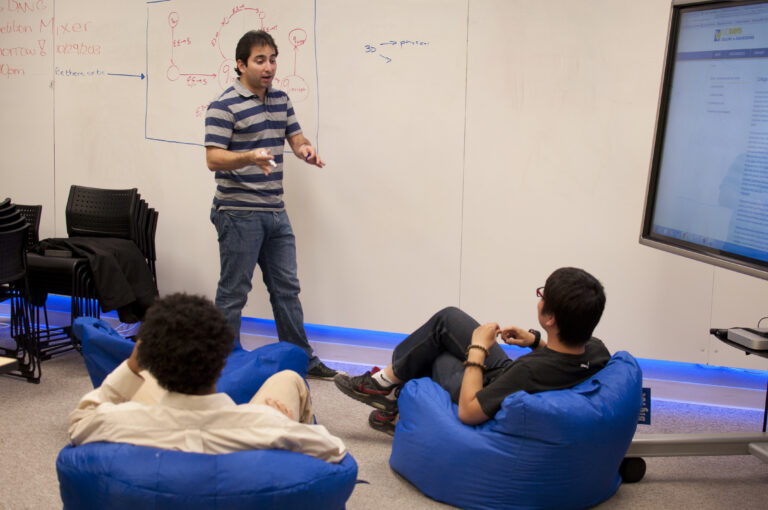
The ESSC features a 3D printer/scanner, a huge computer monitor, whiteboard walls and a Shopbot CNC device for milling and machining plastic, wood and aluminum.

White said that it can benefit all the students of UC Davis as it is trying to draw in students from a variety of majors.

President of the UC Davis Entrepreneurship and Technology Club (ETEC) Natalie Qabazard encourages everyone to join.

“The ESSC is a milestone for students of all disciplines because it’s the first center of its kind on the UC Davis campus,” Qabazard said.

The center provides a design space for all students to work on prototyping their ideas, using the skills they have acquired through academia and applying it to their ventures. Her goal as the president of ETEC is to bring diversity to the center by reaching out to various groups and departments on campus.

“I am looking for an environment in which I could tap my creative potential, freely make mistakes and learn from them; the ESSC is perfect for this,” said Jackie Zhang, a first-year computer science and engineering major.

Similarly, Enrique Lavernia, the dean of the College of Engineering, is eager to see what innovation this center will bring.

“The ESSC will facilitate the development of the entrepreneurial skills of UC Davis students, provide pragmatic hands-on learning opportunities and help speed the delivery of high-impact technology to society,” Lavernia said. “The ESSC will also facilitate collaboration with our colleagues in industry, colleagues across campus and other centers.”

Farmer shares origins of Dixon corn maze

0

Every fall, the Cool Patch Pumpkins farm draws world record aficionados, families, students and corn maze lovers to its fields.

Now listed in the Guinness Book of World Records as the world’s largest temporary corn maze, it’s hard to believe that a few short years ago, the farm was nothing more than a roadside pumpkin patch.

“We started planting a small batch of pumpkins about 12 years ago for [the Halloween season]. At that time, we pretty much had to beg people to stop off the road so we could give away the pumpkins,” said Seth Cooley, a 2012 UC Davis mechanical engineering graduate whose family founded the maze.

The idea for including a maze came about as a way to supplement their pumpkin sales, but it soon turned into a challenge to create something extraordinary.

“The interest in our farm was pretty low. We needed something to attract more people, so we decided to make a small-scale corn maze,” Cooley said. “We became curious as to what the biggest corn maze was in the world, and it was only 18 acres, which is really small by farming standards. We knew we could blow that out of the water.”

From there, Seth’s father Matt and his uncle Mark Cooley set about designing their record-breaking maze. They used an Excel file to visualize the corn field as a grid with coordinates, and from there, they mapped out the entire maze.

The design was then transferred to the field with flags and tape measures to match the computer file. A small fleet of weed eaters then cut down around one-tenth of the total corn to make the path, and after a few long, hot summer days, the 40 acre maze was completed.

From there came the arduous process of getting the Guinness Book of World Records to survey the maze. The official record states that the maze measured 163,853.83 m² (40.489 acres) when opened to the public in September 2007. Since that time, the maze has been expanded to 53 acres.

“One of the reasons that we expanded was that toward the end of year, there are droves and droves of people coming through the maze. The corn can get a bit bulldozed. We make it larger with the hope that near the end of the season, there are larger areas that people haven’t trampled,” Cooley said.
As the years have gone on, techniques for growing the corn have been perfected. Seth explained that vandalization of the paths is to be expected, but that it is important to plant the corn stalks close enough together to discourage people from cutting through while also far apart enough that the stalks will have enough room to grow thick and resilient.

Each year, the maze is completely redesigned, with only one aspect maintained: there is only one true path out. As a result, every guest is given a map, even if they do not think they need one.

“There is no way that it could have been done without a map,” said second-year food science major Melanie Barnes, who visited the maze earlier this year. “It feels massive. To get into the actual maze, you have to walk up this bridge, and when you get to the top, you just see this expanse. The corn goes all the way to the horizon. It’s amazing.”

Fifth-year environmental science and management major Mario Evangelista agreed.

“We needed the map, for sure. There were stakes in the ground that marked where you were, and without the map we would have been so lost,” Evangelista said.

Each year, the Cooleys experiment with designs to fool their guests.

“One thing that we have this year is a whole corner of the maze which is nothing but intersecting circles,” Cooley said. “Even for me, who helped cut it — I get lost really easily. When there is nothing but lefts and rights, it’s easy to read the map. With the circles, it’s harder because you’re never really sure which one you are inside of.”

When a design aspect causes one of Cool Patch Pumpkin’s own to get turned around, it is likely even worse for a guest.

“With no straight lines, the circles were really hard. We got lost a few times,” Evangelista said. “It took us two hours to get through the maze, mostly because we got lost in the circles.”

Cooley estimates that the average time through the maze this year is around an hour and forty minutes. However, some maze-goers try to run through it faster for personal achievement.

“We timed it for fun — it took us an hour and 2 minutes,” Barnes said. “We had a really good leader who likes mazes. We couldn’t have gone nearly that fast without him.”

As the season closes, the field will be leveled to mitigate fire hazards and make way for the next year’s new design ideas. Afterward, however, the corn does not go to waste.

“We plant the corn very late by the standards of a corn field, so it’s green when people are in it, and we want it all gone by winter. What happens is when we close the maze, we chop it all down for silage, level it and feed all that green compost to cows,” Cooley said.

As the years go on, the Cooleys plan on continuing to expand the size of their corn maze to maintain their world record. The maze is open this year until Nov. 3.