59.3 F
Davis

Davis, California

Wednesday, December 24, 2025
Home Blog Page 910

Inside the Game with Kendall Frisoli

0

In just her first year on the UC Davis women’s volleyball team, Kendall Frisoli looks to have a promising future. Currently averaging 1.5 digs per set, Frisoli will have many more years to flourish and develop her game as an Aggie.

A Southern California native who was already known as a basketball standout at Thousand Oaks High School, Frisoli was recognized more for her volleyball talents. Posting 307 kills and averaging .335 kills per game in 2012, Frisoli helped her team to three consecutive 14-0 league records. As a result, Frisoli never lost a league match and earned three consecutive All-Marmonte League Championships.

Frisoli luckily had time to meet with Aggie Sports Writer Shaun Moncada to discuss UC Davis volleyball, the transition from high school to college and her musical talents.

Being a standout in both basketball and volleyball during high school, what made you pursue volleyball heading into college?

I have been a multiple-sport athlete for my entire life and choosing to play one sport was one of the hardest decisions for me. I had a separate passion for both basketball and volleyball, but both complimented each other — the aggressiveness in basketball and the jumping and agility of volleyball. But by the summer of my senior year in high school, I decided to start focusing on the one sport that I was taking seriously going into college —  volleyball.

As a follow up, what was the appeal of the UC Davis volleyball program?

Besides the school itself, I knew I wanted to go to the UC system. Coming up north from Southern California, the environment here was laid back, the people were nice and I am close to family. Volleyball-wise, while participating at Libero Camp the summer before my junior year, that is where I was offered a spot to come play at Davis. Being able to interact with the Aggie players and coaches drew me in. It felt like a family and felt like a home.

You received so many accolades and achieved great success in high school. How has the transition been from high school play to now playing at a collegiate level?

It is an entirely new level, and that is what pushes you to limits and levels that you never thought were possible. So few people are able to play collegiately and while you know it is going to be harder, until you get here and experience it for yourself, it is definitely different. The girls are bigger, serve better; everything is at a new level.

Currently in the midst of Big West Conference play, from your perspective, how would you describe the season thus far?

We have had our ups and downs, but we are becoming a consistent team, and that is our goal. We want to find out who we are and play with that mentality. Although tied for fifth place, we know there is a lot ahead of us. We must focus on every team individually. The Big West conference is so stacked and anyone can be beaten on any given day.

What many people may not know about you is that you play and compose for the guitar. How important has music been in your life?

Music is my expressive outlet. Being in college and balancing it with sports, even if I have no time for playing music, I force myself to do it because it is such a release for me. Writing music and expressing my feelings allows me to be me. I love performing for and with people. Music just brings people together.

Finally, with school now a couple weeks into the quarter, how does it feel to be a student-athlete at UC Davis?

I feel proud. It is a very special thing to call yourself a student-athlete. The work put in, going to class, practicing, even going to get food is a chore now. Then coming home to do homework and going to bed, it is literally eat, sleep, play. This experience, having this team, it is like a family, and it makes for an easier transition into college. I am proud to be a UC Davis student-athlete.

– Shaun Moncada
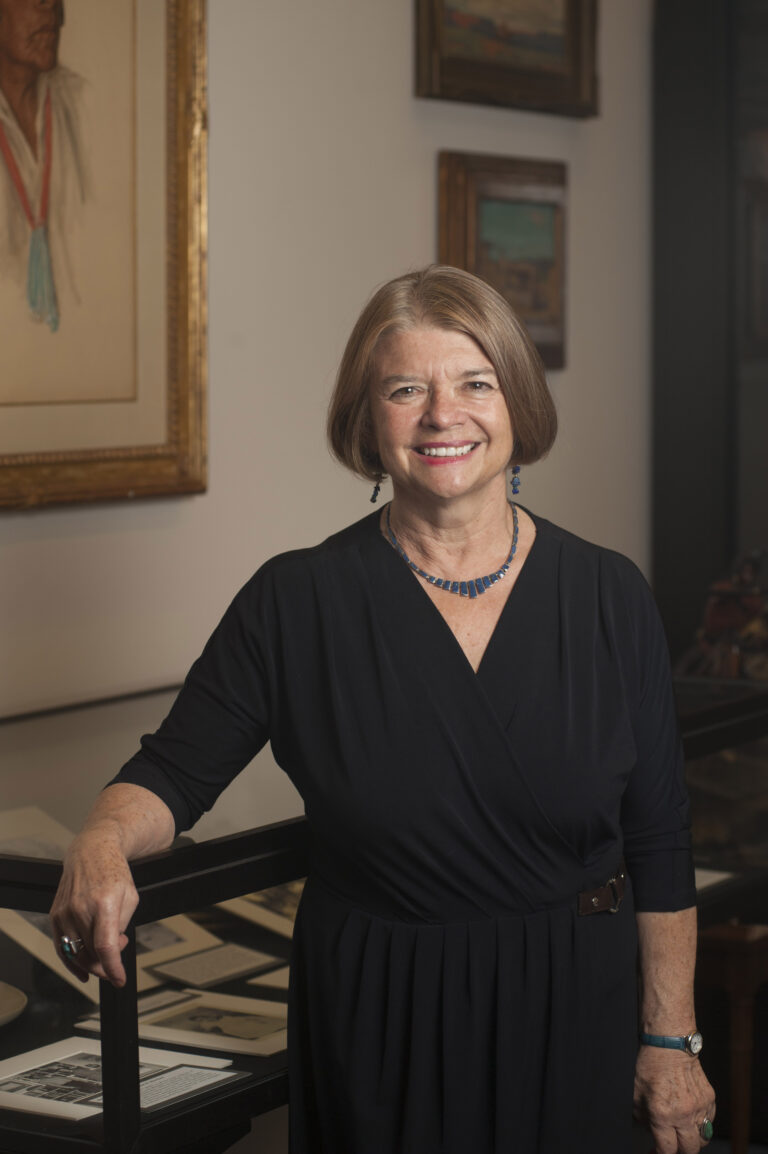
MLA elects Davis professor as president

UC Davis Department of English Professor Margaret Ferguson plans to bridge the gap between college and high school language education as the Modern Language Association’s (MLA) new president.

The MLA is best known for its guidebook to citation style, which is used by almost everyone at UC Davis. When most students start college, they’ve already known about the style guide. It is the standard for citation in high school as well as college. Since not many manage to memorize it, it’s a safe bet that few students know anything about the MLA beyond it.

“The rules are constantly updated. That takes a lot of thought and also feedback from people who are using them, including students. We get interesting feedback from students who say, ‘this just isn’t clear,’“ Ferguson said.

Ferguson is best known to students for teaching a range of English courses at UC Davis, including English 3, the course that introduces many to higher education literature. This stage of college education is very important to Ferguson, as it offers the most variety in students. English 3 is generally a class taken by those who are not pursuing English as a major. It is also one of the first steps to transitioning from high school to college level courses, an area which Ferguson has shown a lot of interest in with her work in the MLA.

As president, Ferguson plans to look at and help with the implementation of new core standards for K-12 curriculum. What does a style guide for citation have to do with K-12 core curriculum? Overall, not much. However, this is much closer to the heart of what the MLA was created for.

“It started in 1883 as an organization for professors of modern languages, to help them gain a place in university and college curricula — different from the very big place that classical languages and literature then held,” Ferguson said.

MLA stands for “Modern Language Association.” Modern refers to the type of language it draws attention to, not how recent the association was formed.

“It is the biggest organization for language and literature teachers in the world,” Ferguson said.

Language, she feels, plays a big role in what the MLA should be focused on. Although recent years have apparently seen a shift of the “L” from Language to Literature, literature is merely a branch of the larger language focus in the MLA.

MLA presidents are expected to write and act as a spokesperson for the organization. Ferguson has already decided one of the things she wants to talk about.

“I want to talk about the ways in which teachers of writing, teachers of foreign languages, teachers of literature, can pool their resources through the MLA to address some major issues in colleges which are losing funding for some of their language departments,“ Ferguson said.

MLA was organized around modern language, which goes beyond classical language. This includes English, but not necessarily only literature. The interests of the MLA stretch beyond college because they involve language education, which starts at the K-12 level. One of Ferguson’s major focuses as president is to begin and continue education effectively.

“I’m hoping to bring some high school teachers in to talk to MLA members, who are mostly but not always employed as college teachers, about how we can better bridge the social and educational gaps between six to 18-year-olds and 18-year-olds through graduate students,” Ferguson said.

Her colleague at UC Davis and the current English Department chair, Elizabeth Miller, recognizes the importance of Ferguson’s focus and efforts.

“We, as professors, need a better sense of how our students are being prepared for college, and high school teachers likewise need a better sense of what is expected of students when they come to university,” Miller said.

Ferguson’s efforts in the MLA are not even isolated to merely educational problems in kindergarten through graduate school, but extend to aiding in the continued success of graduating students.

Another colleague from the English Department, Gina Bloom, expressed interest in Ferguson’s current project with the MLA.

Ferguson has been working on a document to set standards for letters of recommendations done by professors. The hope is that it will help professors to more easily write adequate letters.

“I’m especially excited about the work she has already begun doing to address the problem of inflation in letters of recommendation. More than ever before, faculty are expected to write more and longer letters of recommendation that do not necessarily have any greater of an impact on students’ success securing positions at graduate schools or in jobs,” Bloom said.

In her one-year term as president, Ferguson hopes to continue the success of the MLA and aid in the improvements she feels are already happening in the organization. One of her roles as president is to inform people of what the MLA is and emphasize its advocacy of helpful educational policies and academic freedom.

“I hope that the MLA will continue to advocate on behalf of lecturers and other non-tenure-track faculty, to support graduate students facing a difficult academic job market and to be a national voice for academic freedom. I know that Margie shares all these goals,” Miller said.


NICK FREDERICI can be reached at features@theaggie.org.

ITS-Davis leads national consortium for sustainable transportation

0

UC Davis’ Institute of Transportation Studies (ITS-Davis) was chosen by the U.S. Department of Transportation to lead the two year, $11.2 million research consortium.

The center will aim to reduce greenhouse gas emissions from passenger and freight transportation on the state and federal levels. They will approach this through fuel and vehicle alternatives, environmental and energy policy and community development and outreach.

In a world largely dependent on fossil fuels, vehicular mobility and profit margins, institutional change in the transportation system will be the overarching goal of the National Center for Sustainable Transportation (Transportation Center) now based here at UC Davis.

Operating since 1991 ITS-Davis began as an interdisciplinary approach to “sustainable transportation” between faculty and students even before the term was widely used.

This was a major reason they were chosen to lead the consortium, according to Daniel Sperling, founding director of ITS-Davis and executive director of the Transportation Center.

“From the beginning, we emphasized the environmental, energy and livability aspects of transportation,” Sperling said. “We were one of the first to do that in the U.S. and we have grown and developed that reputation from experience.”

Made up of transportation institutes from the University of Southern California, CSU Long Beach, UC Riverside, University of Vermont and Georgia Institute of Technology, the consortium will attempt to facilitate cooperative change by partnering with influential stakeholders like car and oil companies, local governments and public interest groups.

“Our primary focus is mitigation by reducing carbon emissions and energy use,” Sperling said. “We’re trying to help cities and states develop a more sustainable transportation system and we will provide them with information and assistance to find what the best way forward is.”

Secondary to mitigation, another objective for the center concerns land use and travel behavior for extreme weather patterns that climate change is expected to produce.

“Our research will analyze vehicles, fuels and technological fixes to the problem, but we will also be looking at the infrastructure itself,” said Susan Handy, professor of environmental policy and Director of the Transportation Center. “We will examine how we build roads, how we can operate them in a way that reduces emissions and how we can get people to drive less through how we design our communities.”

The Transportation Center’s plans include mobilizing findings by creating a model curriculum for sustainable transportation students nationwide, hosting weekly online seminars and holding a National Summit on Transportation and Climate Change to discuss the translation between research and policy.

This is often the most difficult step in the process, according to Anthony Eggert, executive director of the UC Davis Policy Institute and partner of ITS-Davis.

“Today people are bombarded from advocates, concerned citizens and industry groups,” Eggert said. “Our primary mission is to penetrate that noisy system by taking technical information and distilling it into a form that is accessible to policy makers to better inform policy and benefit the community.”

According to Eggert, the transfer from academia to application in the private sector will require economic sustainability in terms of affordability and profitability in a market economy. They will be dealing with large vehicle and fuel industries which bring in nearly $1 trillion every year in the U.S. alone.

“Any time you’re trying to change an industry of that size you have to recognize that the only way to make an impact is through scale,” Eggert said. “We can’t just sell a few efficient cars and a few gallons of low carbon fuel. It has to be millions of cars and billions of gallons.”

However, as automakers introduce more efficient, electric and renewable energy models to the market, increased production will likely drive down prices for consumer accessibility.

Eggert also noted that the interdisciplinary approach of the Transportation Center is important for addressing concerns for both private and public sectors.

“What we find in the research is that you cannot change the transportation system with one particular technology or strategy,” Eggert said. “You need a portfolio of strategies which includes fuels, vehicles and land use to reach energy and environmental goals, making sure policies are scientifically, legally, socially and economically sound.”


SEAN GUERRA can be reached at features@theaggie.org.

Guest Opinion: YOU should run for Senate!

0

Hey everybody, this is Eric Renslo, your ASUCD Elections chair for the 2013-14 school year. If you are reading this, then it is not too late for you to run for Senate; in fact, you’re ahead of the schedule!

Petitions come out at 10:00 a.m. next Tuesday, Oct. 15. You will have until 4 p.m. the following Tuesday, Oct. 22, to collect 125 signatures from other undergraduate students. Be sure to collect a few extra signatures in case there are duplicates or some of the entries are illegible. Once you collect 125 signatures and agree to abide by our election codes, you will appear on the ballot for ASUCD Senate. It’s that easy!

And no, you don’t have to be a political science major. ASUCD loves political science majors; however, students from other majors greatly increase our diversity of thought. Engineering, science and music majors are just as encouraged to run for Senate as any other student.

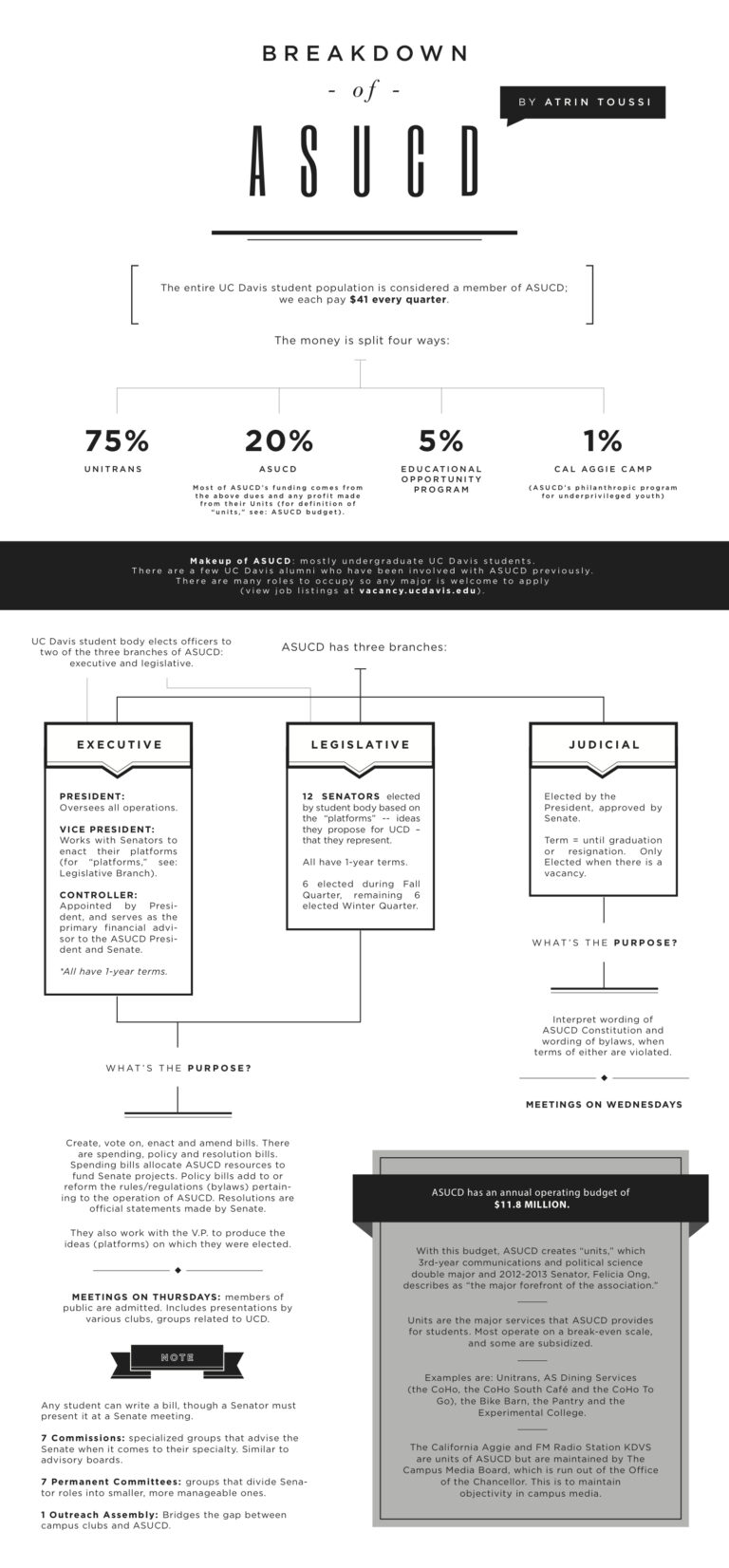
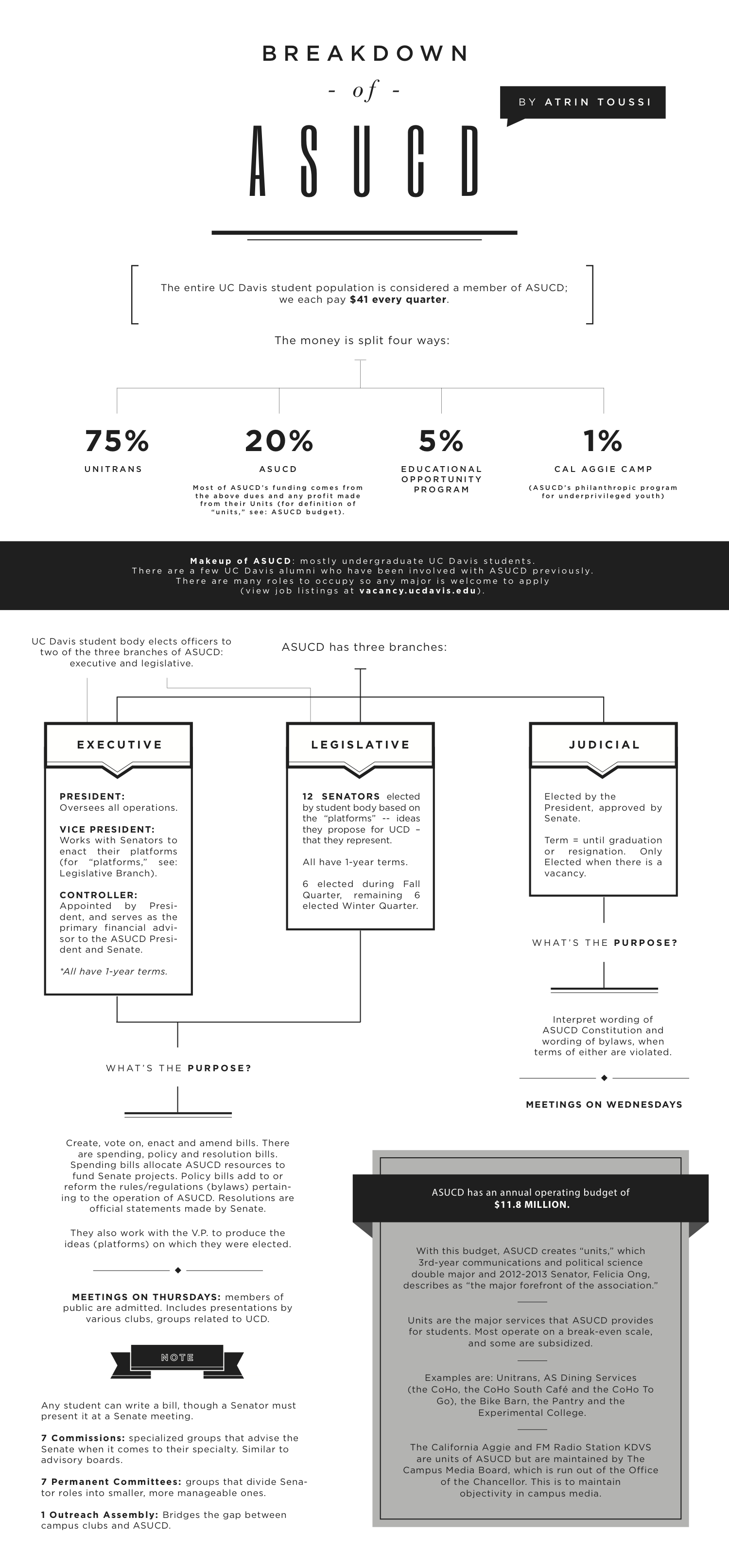
There are many great reasons to run for Senate. First, our student government has an $11.8 million budget. Senators approve the budget yearly and influence where our money is allocated.

Second, senators see important legislation that affects other students. Senate meetings are frequently filled with many people voicing opinions to their student representatives. By running for Senate, YOU have the opportunity to be that student representative!

Lastly, it is a great work experience to talk about with future employers. Being a senator signals that you are a leader, an advocate for students, and able to communicate well with others. This may be the final time you have such an incredible opportunity to demonstrate all of these traits at once, unless, of course, you become a politician.

A reason that people conjure up for not running is that the pay is low. To be fair, $49/week won’t allow you to be “poppin’ bottles.” But that money can pay for your weekday lunch the entire time you are on Senate.

Being a student representative is not about the money. It’s about standing up for issues you believe in, accomplishing things you would not have done otherwise, and having fun at your weekly Thursday night Senate meetings. The money is just a bonus.

You should really consider taking out a petition and running for Senate if you made it this far. Any undergraduate student, first-years included, can run for Senate (unless you are on academic probation).

Browse through daviswiki.org/ASUCD to view the craziness that is our student government. Check out elections.ucdavis.edu to get an idea of where you could be in just a few weeks. And after you are convinced to run for Senate, take out a petition from SGAO on the third floor of the Memorial Union, room 348, starting at 10:00 AM on Oct.15. Give it a shot!

ERIC RENSLO is a senior political science major currently applying to law school. When he is not furiously refreshing his LSAT score report page, he can be reached for questions at emrenslo@ucdavis.edu.

Column: Trying to understand…

0

Have you ever seen someone lose themselves in a battle against humor? From what I’ve witnessed and personally experienced, laughter can possess a person. It takes over — distorts the face, makes limbs flail in all directions, dominates your desire to actually breathe properly and sometimes it can even literally bring a person to the floor.

But what stumps me is what exactly distinguishes a joke or scenario from being “funny” or “hilarious.” Something funny might produce an LOL but something hilarious can generate a full-out ROFL.

The answer might rest solely in the reasoning that laughing itself can cause more laughter. Many people say things that are on the verge of “funny” but I think we all have at least one friend that expels this horrific type of noise that is funnier than the original joke, story or what have you.

That friend who bursts into hysterics for no specific reason, leaving all surrounding people entranced, and inevitably causing a chain reaction of crowing.

Laughter, at its simplest, is just a quick and automatic response to something funny, but certain people take it levels beyond laughter. Their responses can be more amusing than the original joke or story itself. I’ve noticed that if one is willing to relinquish themselves of all shame when laughing, then the power will be an undeniable force.

For example, my friend and I could be considered the crazies in any given room, based on the reality that the smallest thing could send us to the ground, laughing on our knees in public, or flopping in a ball on the floor of our room like idiots.

It seems like these types of laugh attacks are involuntary and uncontrollable.

On more than one occasion in the past two weeks, we’ve reached what some might consider public humiliation because of what laughter does to us. I kid you not, the look people have given us seems to read as: “Wow, should I go help those drunken fools out there? They don’t really look capable of biking home in the dark.”

This leaves me wanting to prove my insane levels of sobriety.

Even if a humorous occurrence deserves more than a casual recognition of humor, some people seem to be incapable of escaping the tamed version of self, and releasing themselves into the world of unrestrained amusement.

Does this mean that your ability to ROFL is rooted in how crazy you are in the first place? If so, then sometimes laughter can be a response to the acknowledgement that you are deranged and that you might (unknowingly or not) seek to physically show that through exaggerated sounds and gestures.

Maybe it’s because the people who can shriek and jump for joy at the smallest things are simply the ones who don’t mind that others might seriously question their mental stability.

But really, aren’t we all insane to begin with? The normal people are the ones who truly freak me out.

For those of you who have never succumbed to the force of extreme laughter, the struggle must be real. Because after all, laughter is the best medicine.

So next time you see someone struggling to survive because laughter is consuming them, don’t just stand back and watch — find something to laugh at yourself.

SAVANNAH HOLMES can be reached at skholmes@ucdavis.edu or find (and join) her ROFLing around Cuarto.

UC implements changes to service workers’ pay

UC service workers are experiencing a decrease in take-home pay due to the recent enactment of UC’s latest proposal for AFSCME 3299 service workers.

The AFSCME service workers include custodians, gardeners, food service workers and facilities maintenance staff. The workers are now required to contribute a larger percentage of their paycheck to the pension fund. This change follows a series of negotiations between the service workers and UC at the bargaining table, which failed to result in compromise.

“The cuts amount to a 1.5 percent decrease in take-home pay for workers making an average of $35,000 per year, and up to $124,000 in higher health costs for each worker over their lifetime,” the AFSCME press release stated.

UC maintains that the changes are part of pension reform, and the wages of service workers compare favorably to those in public and private sectors.

Much of the outrage expressed over the pay cuts involves the fact that they were imposed on a unit comprised of over 8,000 of UC’s lowest-paid workers. According to AFSCME, 99 percent of the service workers are currently income-eligible for some form of public assistance. The high level of pay and recent raises for some of the top-earning workers and executives in UC has only added fuel to the fire.

“As far as executive compensation goes, it is a very small percentage of the overall budget that UC has,” said Shelly Meron, a media specialist in the UC Office of the President. “The compensation package that we give service workers is very competitive.”

Some service workers disagree with UC’s insistence that they are providing the unit with reasonable compensation.

“Working at UC Davis, as a father of two, I can’t even afford to live in Davis,” said Ruben Santos, a senior custodian in the UC Davis Facilities Management Department. “If the pay was competitive we wouldn’t be living paycheck to paycheck.”

Santos also expressed his concern that he will be unable to pay for his children to someday attend the institution that he works for.

“This is not what a public university is supposed to stand for. They are supposed to build ladders to the middle class, and right now they are destroying those ladders,” said Todd Stenhouse, communications director with AFSCME 3229.

Other service workers are also struggling to support their families on their current income. Eugene Stokes, a senior building maintenance worker at UC Berkeley, spoke about the difficult financial choices he was faced with recently.

“Yesterday, I had to choose between paying the mortgage or helping my daughter with her tuition. On other days, that choice is between medicine and food,” Stokes said.

The changes were implemented one week before UC President Janet Napolitano began her term on Sept. 30. Many are looking to her for resolution on this issue.

Ten California state representatives recently signed an open letter to Napolitano addressing their concerns about UC’s treatment of the service workers.

“Whatever the reason, whatever the recent history, singling out the University’s largest population of minority workers for the harshest treatment at the bargaining table sends a deeply disturbing message.  Nothing could be less consistent with the values that you have embodied throughout your career,” the letter stated.

AFSCME and the service workers are currently deciding what steps to take next.

“What workers are worried about right now is our families and our futures. We love working for UC. We love the students and the faculty.  All we’re asking for is to make a fair wage and be respected,” Santos said. “We are ready to fight until we get something that’s fair.”

LAUREN MASCARENHAS can be reached at campus@theaggie.org.

Men’s Soccer Preview

0

Teams: UC Davis at Cal State Fullerton; at UC Riverside

Records: Aggies, 5-5-1 (1-1-0); Titans, 4-6-0 (1-1-0); Highlanders, 0-2-0 (5-4-2)

Where: Titan Stadium — Fullerton, Calif.; UC Riverside Soccer Stadium — Riverside, Calif.

When: Friday, Oct. 11 at 7 p.m.; Sunday, Oct. 13 at 2 p.m.

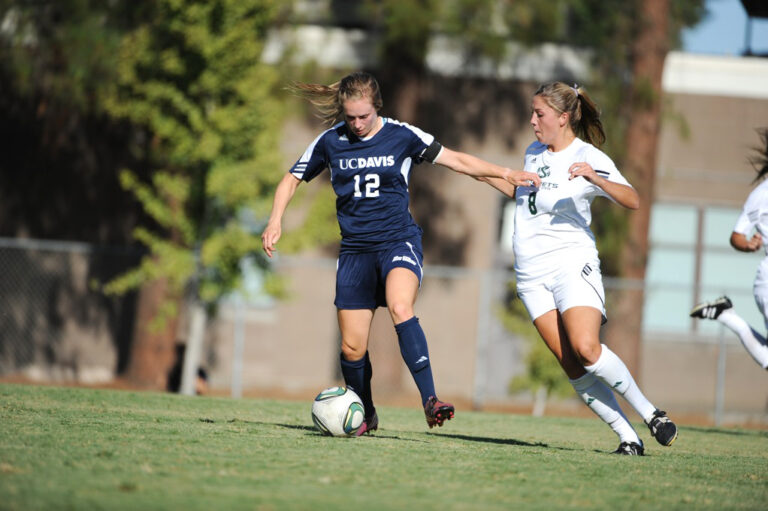
A tough loss to sixth-ranked Cal State Northridge may have ended the weekend on a sour note for the UC Davis men’s soccer team, but the Aggies started the weekend series on a high note with a victory against another nationally ranked team, UC Irvine.

Redshirt freshman forward Dashiell MacNamara struck first, 28 minutes into the Oct. 4 afternoon matchup against the Anteaters. MacNamara’s first goal as an Aggie came at a crucial time.

“I knew Ryan Gross [could] make that long throw-in, he’s been making that pass all season and can get [the ball] in the penalty area,” MacNamara said. “Matt Sheldon cut in front of me and went in for the header, I just drifted behind him and flicked it in.”

The goal gave MacNamara his first goal of the season and earned sophomore midfielder Ryan Gross his first assist of the year with his on-point throw-in.

Later in the match the Aggies would strike again, with a goal coming from the foot of junior forward Matt Wiesenfarth in the last three minutes of the game. After breaking past defenders, Wisenfarth beat Anteater goalie Michael Breslin for a goal at the near post. The goal doubled the Aggies’ lead and guaranteed an upset victory for UC Davis.

Not to be ignored on the other end of the pitch, senior goalkeeper Omar Zeenni also continued his dominance in the match against UC Irvine, earning his fourth clean sheet of the season, giving him a program-high 17 career clean sheets, tying him with alumni Nic Platter for the all-time record. Although Zeenni gave up two goals on the Oct. 6 match-up against the mighty Cal State Northridge, he still holds a solid 0.98 goals allowed per game average this season.

After a tough 0-2 defeat at the hands of Cal State Northridge in their Oct. 6 matchup, some might think that the Aggies have lost their mojo. However, with their 2-0 victory against the 25th-ranked UC Irvine on Oct. 4 and their 2-1 win over nationally-ranked New Mexico, the men still have plenty of confidence heading into this weekend’s games against Cal State Fullerton on Oct. 11 and UC Riverside on Oct. 13.

The Aggies will square off against the Titans under the lights in Fullerton, then travel to UC Riverside on Sunday. With the Titans holding a current overall record of 4-6, UC Davis should feel good about their chances of coming out of Fullerton with a win in their first away game of the weekend.

Having to play in such a high-pressure position, senior goalkeeper Omar Zeenni maintains that level-headed persona on and off the pitch.

“I feel confident about our chances,” Zeenni said. “We definitely shouldn’t be worried about them.”

Going on to describe what the team needs to do to come out 2-0 this upcoming weekend, Zeenni stressed focusing on their game, and not worrying about the Titans or the Highlanders.

“If we just come out and play our game we’ll come out 2-0 this weekend,” Zeeni said. “Continuing to have trust in the system and exploiting their weaknesses will be key.”

The Aggies hope to continue their impressive play in this weekend’s matchup against Cal State Fullerton and UC Riverside. A good road trip would help UC Davis’ standings in the Big West.

– Sloan Boettcher

Calendar

0

Thursday, October 10

Conversations with Writers: Sam Freedman
4 to 6 p.m.
Voorhies 126
Attend the first lecture of this year’s Conversations With Writers Series, hosted by the UC Davis University Writing Program. Author, journalist and Columbia University Graduate School of Journalism professor Sam Freedman will speak about his new book. The event is free.

Education Abroad Information Sessions
1 to 4 p.m.
Felder Room, Memorial Union
Three information sessions will be held to address affordable study abroad, financial aid for study abroad and the opportunities for interning abroad.

Friday, October 11

Pajamarino
Davis Amtrak Station, 840 Second St.
5:15 to 8 p.m.
Kickoff Homecoming Weekend by greeting alumni at the train station in your pajamas. There will be a pajama parade starting at 5:15 p.m. from Central Park to the station, as well as games and free food.

Prelude to a Kiss
8 to 10 p.m.
Wyatt Deck
Common House Productions and the Friends of the UC Davis Arboretum present this slightly dark but touching comedy featuring a whirlwind romance. Tickets are $10 for adults and $8 for seniors and students.

Saturday, October 12

Bike Auction
8 to 10 a.m.
Pavilion Parking Structure on Hutchinson Drive
Check out over 400 bikes. The bike preview begins at 8 a.m. and the auction begins at 9 a.m.

Cool Davis Festival
9 to 1 p.m.
Central Park
Attend the fourth annual festival for entertainment and information about reducing your carbon footprint. The event is free.

International Festival
12 to 6 p.m.
Veterans Memorial Center, 203 E. 14th St.
Attend this event and celebrate unity in diversity. The festival incorporates music, dance, food and educational presentations about cultures around the world.

Homecoming Game
4 to 7 p.m.
Aggie Stadium
Attend the Homecoming Game against Montana.

Prelude to a Kiss
8 to 10 p.m.
Wyatt Deck
Common House Productions and the Friends of the UC Davis Arboretum present this slightly dark but touching comedy featuring a whirlwind romance. Tickets are $10 for adults and $8 for seniors and students.

Sunday, October 13

Prelude to a Kiss
8 to 10 p.m.
Wyatt Deck
Common House Productions and the Friends of the UC Davis Arboretum present this slightly dark but touching comedy featuring a whirlwind romance. Tickets are $10 for adults and $8 for seniors and students.

Monday, October 14

Pub Quiz
7 to 9 p.m.
DeVere’s Irish Pub, 217 E St.
Attend Doctor Andy Quizmaster’s weekly celebration of knowledge, strategy and raucous company. Teams can have up to six players and are encouraged to arrive by 6 p.m.

Tuesday, October 15

Salsa Tuesday
The Graduate, 805 Russell Blvd.
9:30 to 11:30 p.m.
Learn to dance salsa with lessons at the Grad. The event is $6 and 18+.

Wednesday, October 16

Fraud Awareness Fair
10 a.m. to 2 p.m.
City Hall Galleria, 1110 West Capitol Ave., West Sacramento
Attend the fair and learn about how to recognize and avoid getting tricked out of your money.

Museum Career Talk
12 to 1 p.m.
Everson 157
Dr. Rachel Teagle, director of the new Jan Shrem and Maria Manetti Shrem Museum of Art, will meet with students to discuss museum careers and her own career path as a curator and museum director. Students are encourage to bring their own lunches.

Jazz and Poetry Night
6 to 8 p.m.
Multifaith Living Community, 433 Russell Blvd.
Come enjoy an evening of jazz, poetry and other activities with the residents of the Multifaith Living Community (MLC). Dinner will be served. Everyone is welcome.

Column: Stay tuned

0

Our generation, in my opinion, has the most convoluted ideas about meeting people. We congregate in the most pungent bars, scour internet chat rooms, spend hours in dark coffee shops reading a clever book conspicuously held up to our faces for passersby to inspect.

Love though, does not conform to meticulously crafted schemes, and instead rides the ebb and flow of chance. It is the same with music. Inspiration itself seems elusive enough, and finding your musical inspiration in the form of another musician can feel impossible.

To be clear, this is not a story of boy meets girl. This is a story of melody meets harmony, of strings meet percussion. I am not interested in the story of John and Yoko. I am interested in the story of John and Paul.

My quest for a musical soul mate started around the time I had begun to branch out from my background in classical guitar. I had grown up listening to those who stood solidly on their own: Bob Dylan, Joan Baez. But I wanted to find the Simon to my Garfunkel.

I used to think this was about finding someone with great talent or similar music tastes. But really, it’s all about chemistry, as I learned from playing with some incredibly talented and driven musicians, who I have zero interest in playing with again.

When I was a freshman in high school, a boy who knew I played guitar asked if I wanted to come over after school and “jam.”  Maybe this was it, maybe the combination of our skills would produce something unique and inspiring. I had never been propositioned to “jam” before, but to my socially awkward 14-year-old self, it had that same cool ring to it as “chillin’ out” or “hanging” (two things I never did), and I enthusiastically accepted.

On the bus ride to his house, he explained to me why the Rolling Stones were completely overrated, and I agreed because opinions are a scary thing to have during puberty. When we arrived it was straight to business. He passed me a guitar and sat down at his impressive piano.

“Ready?” he said, as if we were about to take off. He looked over his shoulder as if to check if I was wearing a seat belt.

“Ready?” He asked again. I nodded because “no” didn’t sound like the appropriate answer here.

He began to play, his hands a blur as he busted into a tune that to my anxious ears sounded like a mix of jazz and ragtime. I wasn’t sure when to go, what to play. I felt like I was in second grade watching the jump rope swing by at an alarming speed while my friends waited for me to jump in.

I looked at my fingers, clasped tightly to the fret board. Do something I willed them, but they remained stubbornly clamped in the shape of a G chord, one of the five chords I knew. Eventually the rush of piano slowed and then stopped.

“Why didn’t you play?”

This felt like a trick question.

“I play mostly classical … and some chords”

“Oh … do you play any blues? Jazz?” No.

“Not really”

He stared at me for a while before deciding that we should take his dog for a walk. It felt like hours before my dad picked me up. Needless to say, I wasn’t invited over for round two.

My most wonderful music connections all came from chance and friendship. Also in my freshman year of high school, a girl with classical training was in my homeroom period. The teacher kept a guitar in the closet, and after about a week we shyly asked if we could use it.

It became routine. Every homeroom we would grab the guitar, sit outside, and for 20 glorious minutes we played and sang without restraint (or skill, for that matter). We would disturb the entire hallway as we painstakingly plucked the four chords of whatever pop or folk song we’d printed out the night before.

We began to work on harmonizing, and slowly our voices became in tune with each other, to the point where I’d sing a new song and she’d pick up harmonies after a couple tries.

We never took ourselves too seriously, so it was easy for either of us to point out when the other was off-key. To this day, she is my closest musical counterpart, and one of my closest friends. Some of my favorite songs to sing are the ones we’ve written together. All it took was four simple chords to ignite what became a four-year-long adventure.

It is chance. Serendipity. All those cliché and overused rom com themes. To find someone who is in tune with you both mentally and literally is not an easy task, but it is certainly a worthy one.


To help ELLY OLTERSDORF find her Davis musical soulmate, contact her at eroltersdorf@ucdavis.edu.

News in Brief: Change of Pace Foundation’s annual Oktobrewfest race on Oct. 12

The Oktobrewfest Race, hosted by Davis-based A Change of Pace Foundation, will take place on Oct. 12 at Central Park, on the corner of F Street and Covell Boulevard. Both the 5K and 10K course start at 6 p.m. The event is sponsored by local brewery Sudwerk.

While most people who enter the race are from the greater Sacramento region and the Bay Area, some entrants come from as far as Los Angeles, Arizona and New York state.

Last year, UC Davis was represented in the men’s 10K, 20 to 25 age category by UC Davis alumnus Mark Pepin, who came in first with a time of 32:41.40. Pepin described the event as very inclusive and welcoming of the student population.

“It is not a PR [personal record] race … it’s a great course, scenery-wise, and it is a fun way to stay in shape,” Pepin said. “It’s nice to get off campus.”

Interested participants can register online or in person at Fleet Feet Sports on Second Street. Entry fees increase as the date approaches the race so early registration is advised.

According to Trenton Yackzan and Caleb Weeks, brewers at Sudwerk, 1,500 beers were distributed at the finish line last year, which is equivalent to 12 kegs.

“[We were] pouring and handing out beers nonstop until it was all gone,” Weeks said.

Yackzan and Weeks said that this year they will serve three varieties of beers: Northern Pilsner (a light lager), Marzen Amber Lager (a traditional Oktoberfest beer) and California Dry Hop Lager, their new flagship beer.

All finishers who are over 21 will receive a complimentary beer for participating. For those underage, there will be other treats such as free snow cones.

Entry fees, registration and further information can be found online at changeofpace.com/oktobrewfest.


— Valentina Nakic

Editorial: Plastic bag ban

0

There’s a plastic bag ban coming to town, and we applaud the Davis City Council for its vote although we’re surprised that it’s only happening now.

Starting in January for major retailers, the ban will remove single-use plastic bags from the city, with the exception of produce aisle bags for sanitation reasons. We’ll still be able to purchase paper bags for $0.10, and thicker plastic bags, like the ones handed out at Forever 21, are considered reusable and will still be around.

Similar bans in other cities have generated some mixed feelings as shoppers miss the bags they previously used to line their trash cans or to pick up after their dogs. In Davis too, there may be some compromises. Students sometimes make use of the plastic to cover their bike seats on rainy days. As this helps bikers avoid unfortunately wet pants, we think it’s a fantastic way to use them, but we don’t think it’s a strong point against the ban.

In fact, the conversation seems one-sided, in part because it has already been discussed for years. Plastic bag bans are old news. Back in 2007, San Francisco became the first city to prohibit the use of plastic bags, and while others like Los Angeles may only be getting there now, we’re surprised that an environmentally conscientious like Davis wasn’t among the pioneers.

This isn’t to say that Davis has just been throwing wasted plastic into landfills. Some stores like Whole Foods and the UC Davis Stores already charge for plastic bags or have removed them completely.

This is quite sensible seeing as students generally wear backpacks on campus, and while the Editorial Board acknowledges that we don’t need legislation for changes to occur, we’re still glad the city’s finally making it official.

As for soggy bike seat problems, try investing in shower caps or switching to Forever 21 bags — the bright yellow might make you more visible on rainy days.

Cool Davis Festival in Central Park on Oct. 12

0

Cool Davis’ third annual Cool Davis Festival will take place on Saturday, Oct. 12 in Central Park, from 8 a.m. to 1:30 p.m.

According to Lynne Nittler, co-chair of Cool Davis, the Cool Davis Initiative has almost 60 partner organizations from the Davis community who focus on reducing transportation-induced carbon footprints and hosting zero waste events in the workplace.

“Changing our behavior will be an all-out effort, and we need the support of schools, churches, businesses and every other group and individuals if we are to succeed. We especially love working with UC Davis students. They have helped with projects, volunteered at our various events and offered their research skills,” Nittler said in an email.

The festival will be open to everyone of all ages, and feature live entertainment and music, exhibits, games and information about carbon footprint reduction. These varied exhibitions are centered around the idea of a greener Davis.

“The theme is actually supposed to be ‘Getting Cooler All the Time,’” said Kerry Daane Loux, Cool Davis Festival chair, in an email.

Davis was named the “Coolest City” in California this past year, but Cool Davis wants the City of Davis to keep getting cooler, keep up the progress to minimize the carbon footprint and encourage other cities to do the same.

“In July, City Council adopted the 2013 Integrated Waste Management Plan, which is a road map to achieving 75 percent waste diversion. Our recycling program received a statewide award last year as well,” said Jennifer Gilbert, conservation coordinator for City of Davis Public Works Department, in an email. “Next year, the city will be celebrating its 40th anniversary of having a curbside recycling program. There are so many different ways that Davis is green and becoming greener every day.”

The idea of global warming has been highly debated, but the correlation between climate changes or at least atmospheric fluctuations and human-influenced carbon output has been scientifically proven.

“I suspect more and more people are aware that the climate situation is serious, and each of us has to take more than just small steps toward changing our lifestyles that depend on the luxury of fossil fuels,” Nittler said.

Cool Davis aims to show Davis residents the ways in which they can minimize their waste and lead to a greener community.

“I believe that Davis is the sort of city that could model the kind of transition we need away from fossil fuels to a low carbon, clean-energy future,” said Nick Buxton, communications consultant for Cool Davis, in an email.

Cool Davis has enlisted Unitrans to give free bus rides to Central Park, as a way of encouraging public transportation.

“The most important thing we can do for the environment is educate each other,” said Libby Wolf, a City of Davis employee. “But not just education, we need to follow up with action and be a part of it.”

Additionally, Third Street between B and C streets will be closed to make way for cyclists and pedestrians traveling to the festival. Third Street will be the site of exciting cycling activities including the Bike Circus, Davis Bike Polo exhibition game and the Elected Officials Cycle Race.

“Our message is in some ways simple: start on the path of self- examination and keep going. Consider your transportation (the largest part of our collective footprint in Davis despite all the bike paths and the excellent busing system), your home energy efficiency and your consumption (including waste and food print),” Nittler said.

Nittler added that every one of their film screenings, workshops, forums, newspaper articles and competitions revolves around one or more of these three areas.

The Cool Davis Initiative aims to make Davis a healthier and happier community that works together toward practical solutions to reduce greenhouse gas emissions.

Davis was named the “Coolest City” in California by the state because of its pride in increased environmental consciousness. Additionally, UC Davis was named Sierra Magazine’s “#4 Coolest School” this year.

“I believe many people have begun the transformation, but I know we have a steep climb ahead if we are to avoid the worst consequences of global warming,” Nittler said.

SHANNON SMITH can be reached at city@theaggie.org.

Mondavi Center presents Ballet Hispanico

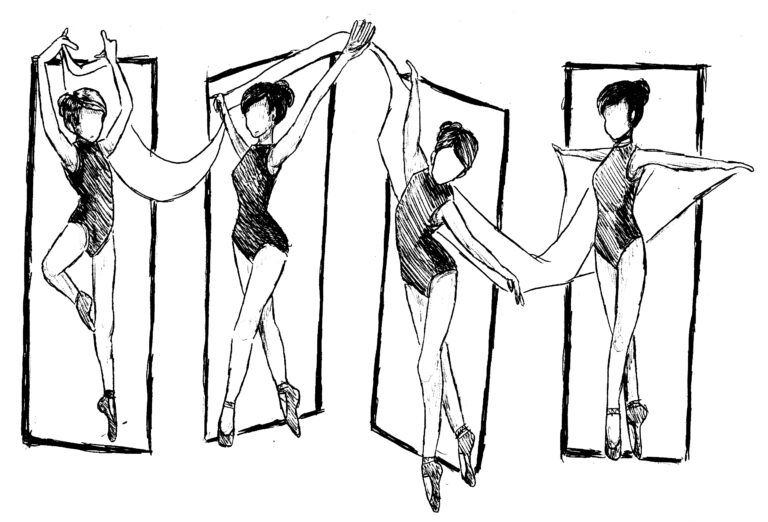
New York-based dance company Ballet Hispanico will perform at the Mondavi Center on Oct. 11. Through modern dance, the dance company explores the Latino voice, experience and tradition.

Ballet Hispanico was founded in 1970 by dancer, choreographer and National Medal of Arts recipient Tina Ramirez. The company became committed to exploring, preserving and celebrating Latino culture through dance. Since their small, grassroots beginnings, they have grown to become internationally recognized for their work.

The organization has performed for over two million people around the world and has worked with over 45 choreographers to commission 80 original dance pieces. The pieces tend to be inspired by either a specific Latino identity or a fusion of many Latino identities.

UC Davis professor and contemporary Latina/o and Chicana/o theatre scholar Jon D. Rossini is set to moderate Ballet Hispanico’s Mondavi visit. Rossini believes dance is one of the many ways people can communicate their cultural uniqueness and that it helps the audience to see the differences in each culture’s experiences.

“There are a wide range of bodies that are being represented and some of the choreographers and artists are coming from outside the U.S. and think more broadly about Hispanic identity,” Rossini said. “Others think of dance in less specific terms, especially artists from the US The experiences of Latinos in the US can be very different than those in other countries.”

In 2009, founder Ramirez retired from her post as the artistic director and was replaced by company dancer Eduardo Vilaro. Vilaro, founder of the Luna Negra Dance Theatre in Chicago, has choreographed multiple dance pieces and has been widely recognized and honored for his work.

Jeremy Ganter, director of programming at the Mondavi Center, experienced Vilaro’s work firsthand when he sat in on one of the company’s New York rehearsals.

“I was taken by Vilaro’s energy and blown away by the pieces I saw. They are looking at the past, present and future of Latino dance. Vilaro takes great joy in his work and it shows through their performance,” Ganter said.

Though the company puts great emphasis on their performance, they also offer a lot of opportunities for community involvement, especially with young people. In Manhattan, the studio holds dance classes for ages two to 18. Classes are offered for those who dance as a hobby and for others with pre-professional outlooks.

Along with the Manhattan classes, the company also holds workshops and master classes in schools around the country as they tour. Unlike many dance companies, Ballet Hispanico holds beginner classes for students who may be interested in the art, but have never had the chance to partake.

“We are interested in exposing students to working artists. We’re used to groups mostly teaching master classes for already highly-trained students, so it’s great the company is willing to work with beginners,” Arts Engagement Coordinator of the Mondavi Center Ruth Rosenberg said.

The company will be holding a class at a high school in Dixon as well as Natomas Charter School in Sacramento. As for UC Davis students interested in learning more about Ballet Hispanico, there will be a Q&A session onstage immediately following the show on Oct. 11.

Ganter believes the experience will be one-of-a-kind and is excited for Davis to welcome them.

“They show what modern dance can do all while expressing their culture and that deserves to be seen in this community,” Ganter said.

For ticket information, visit the Mondavi Center Box Office or  tickets.mondaviarts.org.


AKIRA KUMAMOTO can be reached at arts@theaggie.org.

Festival on the Green

0

On Oct. 12, Central Park will rock.

The Festival on the Green, a concert sponsored by Music Only Makes Sense (MOMS) and the Davis High School Blue and White Foundation, features nine bands performing on two stages from 2 to 10 p.m.

The bands include Midi Matilda from San Francisco, Radiation City from Portland, Cherry Royale from Atlanta and Oakland and Be Calm Honcho, a band with two Davis alumni, including vocalist Shannon Harney.

“The bassist and I both went to Davis, so we have an attachment to playing for our friends and community,” Harney said. “It’s always cool to come through and support the local public schools. Everyone in our band participated in art programs when we were kids, so we hope that Davis will come out.”

The concert, which costs $18 in advance and $20 at the door, will benefit two programs that support public schools in Davis. The profits will be split between the sponsors.
The vice president of the DHS Blue and White Foundation, Karen Mattis, said that her organization’s share of the profits will go to their Student Activity Grant Program, which aims to provide grants for students who want to participate in curricular and extracurricular activities.

“It gives financial support to students who otherwise may not receive it,” Mattis said. “They can apply for a grant for any extracurricular. This goes from a student who needs track shoes to somebody wanting to go to engineering camp for four or five days. We try to give anyone who applies something.”

MOMS, who previously organized the Davis Music Festival, will use their share of the profits to support an art grants program for public schools in Davis, according to MOMS president Danny Tomasello.

The collaboration between the Blue and White Foundation and MOMS came up during a previous charity concert.

“A former president of the Black and White Foundation, Marty Morris, brought Danny Tomasello in to help select the bands for a concert we were organizing at Wild Horse Golf Course,” Mattis said. “This year we decided to bring the concert away from the golf course and into downtown.”

Mattis feels as though her partnership with Danny is effective.

“We both have our own niche,” Mattis said. “I can do organizational work and keep things in the background going, while Danny can connect with the bands and give them what they need.”

Tomasello selected bands for the Davis Music Festival that he thought were talented and would receive positive feedback from audiences.

“We really wanted Cherry Royale and Rita Hosking, but they were not available in June, so we booked them for this show,” Tomasello said. “Be Calm Honcho and Extra Classic were really well-received, so we invited them back. We also have Kingfisher and Sea Train to show young talent, and Midi Matilda was a request from Karen, who saw them open at a concert.”

Tomasello said that he hopes people would come out to see the concert in order to see the exciting things Davis is doing.
“As far as students go, they might only think of Davis as the university, but this fundraiser will let those students see what we’re really doing,” Tomasello said. “Also, there is a cool music scene in Davis and this will help people pay attention to that.”

For more information on Festival on the Green, visit davismusicfest.org.

JOHN KESLER can be reached at arts@theaggie.org.