41.5 F
Davis

Davis, California

Saturday, December 27, 2025
Home Blog Page 941

Studio 301 Productions presents ‘Batboy: The Musical’

This month, Studio 301 Productions presents a comedic musical with themes of social acceptance, gothic overtones and a half-man, half-bat protagonist.

Batboy: The Musical tells the story of Batboy, a monster who is found in a cave in West Virginia. Batboy is adopted and educated by a local veterinarian. However, a cattle plague kills the town’s livestock, causing the locals to scapegoat Batboy, kicking off the plot.

“The musical is based in gothic literature and horror films and it gets bloody and gory, but in a fun way,” said Christopher McCoy, a performance studies Ph.D. candidate and the show’s director.

McCoy saw the original off-Broadway production in 2001 and loved it. “At the time it was so fresh and new to see a musical that was a parody of other musicals, but now we’re very used to this type of humor. I felt like it would be fun to return to one of the originals and reinvent it for our time,” he said.

McCoy showed the musical to Alexander Stalarow, a musicology Ph.D. student who had previously worked as an assistant music director on RENT.

“I gave it a listen and my first thought was that it was going to be really hard to pull off, since there are a lot of tight harmonies, meter changes, rhythmic irregularities and musical styles,” Stalarow said.

Stalarow joined the production as the musical director after being convinced by McCoy and began to work through the score.

“The show parodies other styles of musicals, and the music goes along with it,” Stalarow said. “There are numbers right out of vaudeville, country, rock and heavy metal. There are direct musical quotations from other musicals and it has been a great pleasure to find them.”

Stalarow noted that the show has appeal to audiences regardless of their knowledge of musicals.

“If you’re into musicals, you’ll have a lot of fun with all of the parodic moments. If you’re not, the music is catchy, clever and fun enough to keep you engaged,” he said. “The live musicians from the music department are very talented, the singers are wonderful and we put together something that sounds very good.”

Cheyenne Splinter, a second-year animal science major, is the stage manager for Batboy, and it’s the first time she’s held this position for a UC Davis production.

“I did stage managing in high school, and I’ve been an assistant stage manager here,” Splinter said. “The experience was different than I thought it would be, but in a good way. I expected this to be more difficult than it turned out. The cast works really well with me and each other. This is one of the best experiences I’ve had as a stage manager.”

The cast is also very engaged in the musical. Marcos Sastre III, a junior specialist at the UC Davis Center for the Mind and Brain, stars as Batboy.

“Batboy starts as an illiterate bat-child who eventually becomes an erudite literary scholar. He comes into his own and discovers how he fits into society. It has been interesting to develop this character honestly and exhibit his changes in a way that keeps to the spirit of the play’s mock nature,” he said.

Sastre has high praise for the crew as well.

“There’s a lot of stuff that goes on in this musical and both Chris and Alex provide specific guidance, which has helped me grow as an actor. I’ve been grateful to have had them and everyone else in the cast to guide me,” he said.

Sastre urges people to come and see the show.

“It’s not what you may expect. It’s really funny, it features a talented group of individuals and I’m shaving my head for it,” Sastre said.

JOHN KESLER can be reached at arts@theaggie.org.
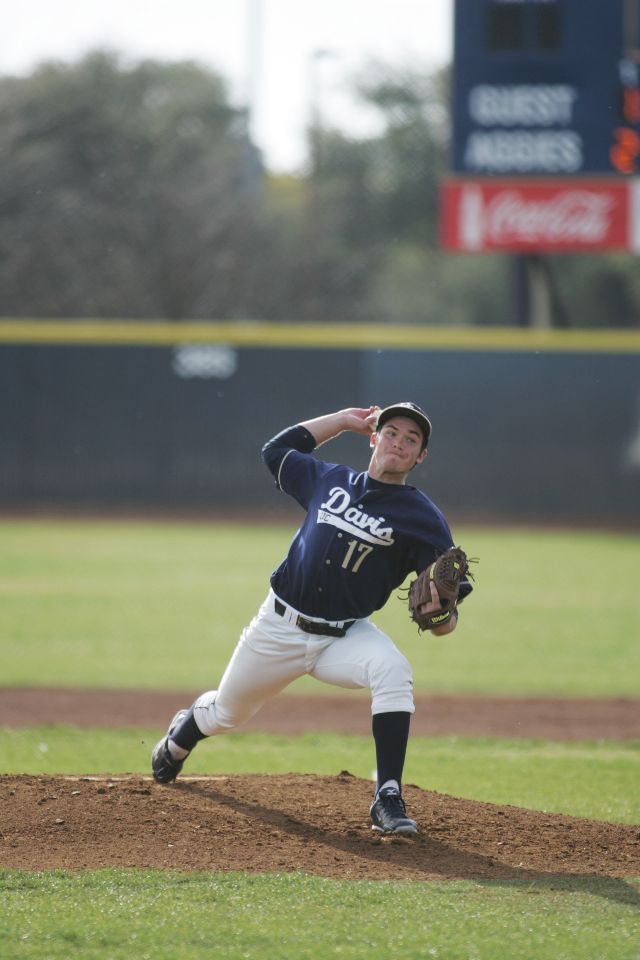
Baseball Preview

0

Teams: UC Davis vs. UC Riverside
Records: Aggies, 12-22 (0-9) ; Highlanders, 17-15 (6-3)
Where: Dobbins Stadium — Davis, Calif.
When: Friday at 2:30 p.m.; Saturday at 1 p.m.; Sunday at 1 p.m.
Who to Watch: The lack of recent run support for the Aggie pitchers cannot be blamed on junior Nick Lynch. Lynch’s batting average stood at a blistering .349 after the Long Beach series. UC Davis has struggled to hit the long ball and has only managed to hit six home runs this season. Lynch has two of those six home runs to go along with his 18 runs batted in.

The lack of recent run support for the Aggie pitchers cannot be blamed on junior Nick Lynch. Lynch’s batting average stood at a blistering .349 after the Long Beach series. UC Davis has struggled to hit the long ball and has only managed to hit six home runs this season. Lynch has two of those six home runs to go along with his 18 runs batted in.

In other words, Lynch has hit a third of the Aggies’ home runs and has driven in almost 12 percent of the Aggies’ runs. Lynch has been UC Davis’ most consistent offensive threat, constantly getting on base.

Lynch is currently sixth in the conference in batting average. He is one of three UC Davis players currently ranked in the top of the conference for any given statistic. As such, Lynch’s production is not simply impressive in comparison to the team, but in comparison to the conference as well.

Lynch bats in the middle of the order and as a result should have some great opportunities to drive in runs. However, the Aggies simply do not get on base enough for Lynch to do some damage. If UC Davis can manage to get runners on base, Lynch should be able to catalyze the Aggies’ offense against UC Riverside.

Did you know? The Aggies have a 3-0 record when they hold their opponents to two runs or less. This is a little surprising as the Aggies have had trouble bringing in runs as of late. However, it does highlight the importance of solid pitching.

UC Davis does manage to score a decent five runs per game. However, they have also been giving up around 6.5 runs a game. Thus, the Aggies’ pitching staff needs to buckle down and hold teams to fewer runs. The 5.31 team-earned run average is simply too high for UC Davis to consistently compete and win games.

As evidenced by the statistic, if UC Davis pitches well, it will win. The offense has generally been able to produce at least two or three runs a game. If the Aggies can hold their opponents to a few runs a game, they stand a good chance of turning their season around.

Preview: Good news for Aggie fans: the UC Davis baseball team recently managed to snap their seven-game losing streak against Saint Mary’s by the score of 16-15. Bad news for Aggie fans: the Aggies were swept by Long Beach State after the win against Saint Mary’s.

The Aggies are now 0-9 in conference play as they have been swept by Cal Poly, Cal State Fullerton and now Long Beach State. Of the three, Long Beach State seemed to be the most winnable game, as the Dirtbags’ record was far from impressive.

However, UC Davis must now look past their rough Big West conference start, and look toward the next series against UC Riverside. The Highlanders have a better record than the Dirtbags, but are a team which the Aggies can beat.

One of the biggest struggles which the Highlanders have faced is winning on the road. They have a 5-11 record on the road, while maintaining a perfect 11-0 record at home. Hopefully their struggles continue as they come to face the Aggies.

The UC Riverside pitching staff has struggled to keep runs off the board as evidenced by their 4.59 team ERA. This includes a starting pitching staff with an ERA of 4.71. The Aggies’ batting order, led by junior Nick Lynch and senior Paul Politi, should be able to take advantage of the weak Highlander starting pitching. The more runs UC Davis is able to score, the better the chances are of winning the weekend series.

However, senior Trevor Frank has a 4-0 record with a 0.75 ERA. The Highlander relief pitcher has more wins than any other pitcher on the pitching staff. This might not be impressive, were it not for his 26 strikeouts. Frank has one less strikeout than the Highlanders’ leading strikeout pitcher, junior Ben Doucette, but has pitched 17.2 innings fewer than Doucette. The Aggies may run into some trouble against Frank if his name is called on often to relieve UC Riverside’s starting pitching.

— Kenneth Ling

City Council postpones fire department reconfiguration

1

At a March 5 meeting, the Davis City Council voted to delay the decision to reconfigure fire engine staffing for the Davis Fire Department until June.

“We wanted to get more information and look at [it] in the greater context. At the time of the meeting, it was getting late and we didn’t want to make important decisions when so many community members weren’t present,” said Davis City Council member Rochelle Swanson.

At a fall 2012 city council meeting, former Interim Fire Department Chief Scott Kenley proposed to make changes to the fire department staffing model, in hopes of a safer and more cost-effective model.

The current model calls for 12 on-duty members with four people per engine at the West, Central and South Davis stations. The new model would instead require 11 people on duty with three people per engine, as well as an additional two medical responders at the Central Davis station.

“Ninety percent of calls the fire department receives are non-fire related. The proposed two person medical crew would allow the fire crew to stay in [the] station while the medical team could handle the medical call,” said Davis City Council member Brett Lee.

Over the past year, the fire department has been in a transitional state where many changes in addition to this proposal are being considered.

The four phases in consideration for improving the Davis Fire Department include changing the boundary lines for the three stations, changing the response time to meet national standards — six minutes for medical calls and six minutes and 20 seconds for fire calls, considering new management models and the proposal in question.

The changes being considered have been debated at various city council meetings since fall 2012.

“We are making these decisions carefully by looking at former Interim Chief Kenley’s report, the overall picture and how we do service for the entire community,” Swanson said. “It is not an anti-public safety decision, but rather it’s a long-term, sustainable service inquiry in consideration. We have to look at each factor with the budget in mind. It’s not just about cutting costs, but [seeing] what we can do with the resources that are available.”

The current interim chief of the Davis Fire Department is Davis Chief of Police Landy Black, who has been working closely with fire department division chiefs on the operational components of managing the department.

“Chief Kenley offered good statistics supporting the concept of a different model than what we’re already doing. I was convinced by the information he provided that we need to seriously consider a change. We need to find a model that provides high confidence but low enough of a cost to be able to continue providing to other city programs,” Black said.

Assistant Police Chief and Interim Fire Department Chief Steve Pierce who oversees the fire department’s administrative operations is optimistic about the upcoming changes.

“We will do our best to make whatever resources [that] the council gives us go as far and be as effective as possible. I think every model has some good and bad aspects and that’s what the council will weigh in on. The old way does have its advantages and disadvantages,” Pierce said.

Even though many decisions in regard to the future structure of the Davis Fire Department are still up in the air, council members see this as an opportunity.

“I think in some ways, it’s been positive,” Swanson said. “What’s good about this transition period is that we are getting policy in place so that when we hire our next permanent fire chief, we will hire holistically based on who fits our community ethics best.”

GABRIELLA HAMLETT can be reached at city@theaggie.org.

Picnic Day sports events

1

Women’s tennis — 11 a.m. at Marya Welch Tennis Center
The UC Davis women’s tennis team will have its last match of the regular season on April 13 against Sonoma State.

The Aggies have already finished Big West Competition and sealed a sixth-place finish in the league with a 4-5 conference record. UC Davis holds a 9-12 overall record and is coming off a split weekend.

UC Davis grabbed a 5-2 victory over Pacific on April 12 and then fell in a tightly contested match to UC Santa Barbara 5-2.

The Aggies will face off with the Sea Wolves and hope to get a win in order to swing momentum in their direction as they prepare for the conference tournament, in which they will most likely face off against UC Santa Barbara.

Women’s Water Polo — Noon at Schaal Aquatics Center
The 19th-ranked UC Davis women’s water polo team will face cross-town rival Pacific on Picnic Day, an intense matchup that has become quite a tradition for the Aggies.

UC Davis is coming off a 13-5 trouncing of Cal State Monterey Bay, improving their record to 13-15 overall. Still, the Aggies’ 0-6 conference record does not bode well for the team as they get ready for the Big West Championship tournament.

Senior Carmen Eggert put down five goals for UC Davis and leads the team in scoring this year, with 66 goals on the season. This will be the Eggert’s, as well as Jessica Dunn, Hannah Breen, Kathryn Bailey, Riane Woods and Danelle Kenny’s final game at Schaal Aquatics Center.

Baseball — 1 p.m. at Dobbins Stadium
The UC Davis baseball team will face off with UC Riverside in this Picnic Day matchup, a very winnable game for the Aggies.

The Aggies’ recent slump, in which they lost 10 out of 11 games, has them standing at 12-22 overall and 0-9 in conference. Still, UC Davis has had bursts of impressive baseball.

The Aggies just took down Nevada 10-7, the product of a six-run sixth inning that propelled the team over the Wolf Pack. UC Davis has lacked runs this season but have shown they are capable of putting up offensive numbers. UC Riverside should be a good team for the Aggies to try to get into a groove with another month of competition remaining.

Track — All Day at Toomey Stadium
The UC Davis track team will host the Woody Wilson Classic on Picnic Day. This is a chance for athletes to compete individually and prepare for the high-level meets that are approaching.

Other than displaying their strong talent in the field, UC Davis will also be warming up for the Causeway Classic Dual with Sacramento State as well as the Big West Championships that are to come in a couple of weeks.

The Aggies just finished competition at the Mt. SAC competition and the Mondo Mid-Major Challenge at Sacramento State. The women placed third and the men fifth.

– Matthew Yuen

YouTube pro

YouTube, one of Google’s most popular services and the third most popular website worldwide, offers the most features and content of any video sharing website to date. With roughly a billion unique visits every month, the company is constantly upgrading and adding features. Naturally, it is useful to know some of the tips and tricks to help improve your browsing experience.

Before watching another video, one of the first options is to opt into the HTML5 beta testing for YouTube. The setting is like a performance boost. This means less time yelling at your computer or complaining about slow internet (especially off-campus) when watching hilarious videos. This option can be enabled by going to youtube.com/HTML5 and joining the beta trials.

While many of the videos have already been encoded in this format, videos that contain ads have not yet all been converted. This feature can be enabled natively in the Chrome browser or any browser that supports HTML5, which is just about every browser available on the market.

Now that you have this performance boost for video streaming, you should know how to efficiently share your favorite videos with friends and family.

Time and time again, I receive links from friends with messages such as “go to this time and watch this part.” There’s an easier and quicker way to share the moment. Simply right-click the video at the specified time, and select the option to “copy video URL at current time.” This will allow users to share a video with a link that will go directly to the specific time, making video sharing just a little less complicated.

YouTube isn’t just meant for videos; it can also be a useful substitute for a music-streaming service. As one of the most popular music video upload sites, YouTube has virtually unlimited access to free music.

For those of you who use Pandora, Spotify or any other music streaming services, YouTube offers an alternative service called Disco. This simple-to-use interface allows people to look up songs, artists or genres and create a playlist of the searched item. The advantage of this feature is the ability to make playlists without all the commercial breaks, limited number of songs that can be skipped or data stream limit — all for free.

Another new feature for 2013 is the ability to opt out of ads. Originally, the only way to do this way to use a program such as AdBlock. Now, YouTube allows users to skip ads completely under the settings option, saving you some time when you’re on a video marathon.

These are only some of the features that help make YouTube a little friendlier to browse, but there are many more.

ALLEN GUAN can be reached at science@theaggie.org.

Women’s tennis to host Sonoma State in Picnic Day feature

0

The beating winds will blow, Picnic Day festivities will come but the tennis will not stop. The UC Davis tennis teams are entering their final weekends of competition before the Big West Conference Championships tournament.

The men’s team is coming off a tough weekend with tightly contested matches. They faced off with Cal Poly on April 12 and fell 5-2.

Three of the matches went to three sets, but only junior Kyle Miller was able to pull his out. Junior Parker Kelley contributed the other Aggie point at No. 3 singles.

The next day, UC Davis matched up with UC Santa Barbara and fell in a close battle by a score of 4-3. The Aggies lost the doubles point but bounced back to win half the singles matches.

Unfortunately this wasn’t enough, as the Gauchos’ three singles points were enough to edge the Aggies. Kelley took a three set victory at three while freshman Brett Bacharach won at four by a 6-4, 6-4 score. Senior George Horowitz took a 6-4, 4-6, 6-4 victory at six for UC Davis’ final point.

Looking forward, the 6-11 UC Davis team is 0-4 in the Big West Conference and will have three straight away matches this weekend. The Aggies will face off at Loyola Marymount on April 19 before traveling to UC Riverside and UC Irvine on April 20 and April 21, respectively.

UC Davis should get a win over the Highlanders, but traveling conditions will be difficult, with several different stops within 48 hours of each other.

The match against the Lions will be a good matchup for the Aggies, who could use all the matches they can get before the conference tournament that will take place April 25 to 28.

The Anteaters will provide a considerable challenge for UC Davis, since they have already beaten several ranked opponents this year.

Most recently, UC Irvine took down Cal Poly in a 4-3 upset that displayed the Anteaters’ strength in singles. The Aggies are in sixth place in the conference, ahead of UC Riverside, while UC Irvine is 2-1 and in third place in the Big West.

The matches this week will get progressively difficult for UC Davis, and the men will need all the focus they can muster to close out their season strong before the Big West Conference tournament.

As the UC Davis women’s tennis team steps onto the courts, they will be doing so for the last time in the 2012-13 regular season.

The Aggies will take on Sonoma State at 11 a.m. at Marya Welch Tennis Center for a Picnic Day feature.

UC Davis just recently closed out conference play with a 5-2 loss to UC Santa Barbara. The Aggies won the doubles point, but got blown off the court in singles play.

Several of the matches were tightly contested, but only junior Melissa Kobayakawa was able to grab a singles win in her 1-6, 6-0, 6-2 match in the fourth slot.

On April 12, UC Davis took down Pacific in a match at home by a score of 5-2. The Aggies swept the doubles competition to grab a 1-0 lead entering singles play, then took victories in the bottom four singles slots for the win.

Senior Lauren Curry came back from a 6-1 first set loss and took the next two 6-1, 7-6 (3). Senior Ellie Edles finished her match 6-4, 6-1 and Kobayakawa took a 6-2, 6-1 win at five.

As the Aggies play their final match at home, their seniors, Edles and Curry, will be honored for their services to UC Davis tennis. After, they will set their sights on the Big West Conference Championships.

UC Davis currently stands at 4-5 in the conference, good for sixth place as they enter competition for the Big West tournament.

MATTHEW YUEN can be reached at sports@theaggie.org.

Letter to the Editor: Give international students tuition break

0

Have you ever wondered how much you pay for tuition in comparison to your friends each quarter? Certainly, California residents pay way less than nonresidents. Yet, local students moan about the tuition hike and how much it hurts Californian families. How about nonresidential students?

Simply, if you are not a California resident, you get charged with a higher price for the same education. Although California residents pay taxes to fund California universities while nonresidents and international students do not have to, the tuition for non-residents and international students is still unfairly high. Perhaps, American students still get financial aid support. International students especially suffer the most of all.

If you took a basic microeconomics class, the case of imposing two different tuition prices is the perfect illustration to explain the abstract concept of price discrimination. From the start, UC Davis tuition discriminates into two sub-categories: California residents and nonresidents. The nonresident and international student’s tuition includes the amount that California residents pay, plus the “Nonresident Supplemental Tuition,” costing $22,878 yearly. With this $22,878, a California student can afford another year of school, including books, groceries, housing and perhaps shopping. What hurts most international students more is that there is no health insurance included, whereas some American students may have this paid by their parents.

Every year, the most exciting news for us — international students — is not who won at the Super Bowl, but whether Gov. Brown’s UC Regents budget allocation is adequate so there is no big increase in yearly tuition. Especially harsh for students who come from countries with high inflation and exchange rates, their families possibly can’t continue to support further education for their children overseas.

In conclusion, there are arguable reasons to explain why California residents should pay less. However, tuition for nonresidents and international students is still unfairly high. As Spring Quarter is starting with a new wave of bright student senators, please put more attention to help this group of silent minority — international students. In the end, we are the people who have the weakest voice on the campus.

Vy Nguyen
Third-year economics major
mvhnguyen@ucdavis.edu

Campus Judicial Report

0

Tardy for the Party
One night in the dorms, two resident advisors (RAs) were doing their routine rounds in one of the buildings around midnight. They were heading to the stairs when they heard residents talking loudly, and as they listened closer they heard some comments regarding alcohol. The RAs knocked on the door of the dorm room where they heard the talking, and after about 30 seconds of items being shuffled around and people moving, the resident of the room opened the door. The RAs stated that it smelled like alcohol and asked for the residents to take out any alcohol. However, the resident claimed that he had nothing but soda in the room. The RAs could tell that there had been alcohol in the room, but he insisted that he had none, so the RAs copied down his ID number and informed him of the documentation process. The resident received a censure, a formal warning from Student Housing, and referral to Alcohol, Tobacco, and Other Drug Intervention Services.

Loud Mouth
An evening discussion section for an upper-division course took a surprising turn when a student proceeded to interrupt the TA about a particular exam question. The professor requested that all students submit regrade requests in writing. The student disregarded this and disrupted the class loudly, using profanity and complaining about the structure of the exam. Another student then jumped on the bandwagon and continued the cursing over the exam. The TA reported that he did not feel threatened despite the bad language that was used, but the students were still referred to Student Judicial Affairs (SJA). While meeting with the Judicial Officer, the students came to realize that they had been disruptive to such an extent that they had violated University policies. Both students recognized that their behavior was inappropriate, and were warned that if such behavior were to happen again, they could face more serious consequences.

Buddy System
In a lower-division class, two students were referred to SJA for suspected cheating on a quiz and then on a midterm. During an in-class quiz, one of the students was missing and texted her friend that she was not going to make it to class and asked if she could fill out the quiz for her. The friend in class wrote the answers to the quiz on two pieces of paper, putting her name on one and her friend’s name on the other. Not long after, during a midterm the TA noticed that the student who had been absent for the quiz was looking at the paper of the same friend who had filled out the quiz for her. The TA separated them and after collecting the exams, it was apparent that there were numerous identical answers on both their papers. The student who had been copying met with a Judicial Officer who explained how copying from another student was strictly against the University’s policies. As a result, she accepted disciplinary probation and 10 hours of community service. The situation with the friend was handled separately.

New York Federal Reserve reports student debt tripled

2

On Feb. 28, the New York Federal Reserve released a report stating that student debt has tripled in the past eight years.

The federal report indicated that the increase in student debt is a result of more people attending college and graduate school, as well as staying longer in college. Additionally, discarding student debt is difficult and the balance stays with the borrower.

“Due to increasing enrollment and rising cost of higher education, student loans play an increasingly important role in financing higher education. Student debt almost tripled between 2004 and 2012, and stands at $966 billion as of 2012,” said author Donghoon Lee in the Federal Reserve’s Household Debt and Credit: Student Debt report.

Joyce Cleaver, data analyst for the UC Davis Financial Aid Office, responded with a different take in regard to debt at UC Davis.

“This [student debt tripling] has certainly not been the case at UC Davis. We feel very good about the fact that our students are graduating with far less debt than the national average, and roughly 44 percent of the undergraduates who graduated in 2011-12 did so without taking out any loans while on our campus,” Cleaver said in an email. “Each year, our campus has seen an increase in the amount of financial aid that we provide to our students.”

Ann Stevens, chair of the UC Davis Department of Economics, participated in a study group on access and affordability, again stating that UC Davis is less affected by debt than other universities.

“Students who usually get in trouble with loans are those who attend expensive private universities or for-profit schools — such as art institutes and culinary academies — where they must borrow more money. Some even borrow their full tuition amount,” Stevens said.

Steven’s study group also researched the manageability of debt among graduate students at UC Davis.

“The bottom line is that students at UC Davis, or [the] vast majority, have manageable loan amounts. The average loan debt is around $17,000, which is a repayment of $200 a month,” Stevens said. “There’s a lot of hype and scare around paying off student loans. It is easy to go to the web and calculate how much you will have to pay back. Students should not be afraid, but informed about loans.”

In Stevens’ study, it was reported that in 2009 the average California graduate student between the ages of 25 and 28 earned $45,000, which compensates for the average $17,000 loan debt. Between 2010 and 2011, 54 percent of UC Davis graduates had loan debt. Eighteen percent of those had greater than $25,000 in debt and 1.8 percent had over $50,000 in debt.

Jennifer McSpadden, a fifth-year graduate student in French literature at UC Davis, has taken out two different loans — a federal and a private loan — over her 10 years of schooling both at Texas Technological University for undergraduate studies and UC Davis for graduate school.

“The federal loans I receive here at Davis are manageable and as long as I’m in school there is no repayment. However, when I started college at Texas Tech, I was 16 and they advised me to take out a private loan from Wells Fargo, their corporate partner. This private loan has a higher interest rate and starts accruing interest before I even graduated. It runs very much like a business,” McSpadden said. “I was young and completely unaware of the consequences of this loan. When I found out all the information, I was shocked and I did a lot of grieving, but now it is just a part of my reality.”

McSpadden advised fellow students to be wary when taking out student loans.

“I have a lot of debt, which will probably take me four years to pay back. I wish I could have avoided loans altogether, especially private loans,” McSpadden said. “The ability to pay back loans is entirely dependent on whether you get a job or not after college, which does not happen easily.”

Miriam Wyatt, a first-year international agricultural development major, takes out two federal student loans — the Federal Perkins Loan and the Federal Direct Stafford Subsidized Loan. Both are need-based and subsidized, meaning that they do not accrue interest until after the student graduates. Unsubsidized loans are not need-based and begin accruing interest once the loan is taken out.

“Students are afraid to take out loans because they don’t know anything about loans,” Wyatt said. “Many assume there [are] only unsubsidized loans and that there is debt always accruing at high interest rates.”

Wyatt isn’t worried about the debt she’ll have after college, saying it’s manageable.

“I’m in a successful environment here and have more opportunities than anywhere else,” Wyatt said.

Steve Turkowski, a second-year electrical engineering major, said he has no experience taking out loans and has a more cautious outlook on doing so.

“I will probably have to take out loans eventually, but my grandma said I should never take out student loans because they are a rip-off. I [would] end up borrowing loans from my grandma since she would give me zero interest rates,” Turkowski said. “People are afraid to take out loans because it is possible that we will graduate and not get a job, and be left with only debt.”

MELISSA GAHERTY can be reached at city@theaggie.org.

Smart cells

Editor’s note: This article is part one of two in a series about the human intersection of technology and medicine.

Although the body is one single entity, it is one single entity that is far greater than the sum of all of its many interconnected parts. Look at the body as a set of systems — skeletal, neuronal, muscular, digestive, respiratory, circulatory, immune, lymphatic and many many more, all working in concert to make one lean, mean, Call-of-Duty-4-playing yet socially “successful” machine.

These systems contain parts, all moving and interacting in ways that modern science is still playing catch-up to understand. While I understand that my head bone is connected to my neck bone, until a few days ago, I had no idea that taking a bite of polar bear liver could make me die of vitamin A poisoning … par exemple. Recently, medical science took a sizable leap forward in regenerative medicine, spurred by a discovery in an unassuming, unexpected field: dermatology.

Researchers at UC Davis’ stem cell research center, the Institute for Regenerative Cures, have observed that cells and cell fragments (membranous vesicles that lack organelles and DNA) migrate in response to both naturally occurring and artificially applied electrical fields.

“The research first came from looking at wounds. When there is a wound, you would notice the cells moving and dividing directionally toward it,” said Min Zhao, a lead investigator in the study.

Let’s take a step back and look at some of the ways parts of the body get along with one another. We’ll recall that all cells have a membrane, which takes on the integral role of keeping the outside out and the inside in. Some of these units managed by a cell’s membrane are ions, particles that have a positive or negative charge that create a field that acts on surrounding charged particles, otherwise known as an electric field.

Alex Mogilner, a professor in the UC Davis Math Department and another key investigator in the study, had the following to say about how cells sense fields.

“One important thing is [that] negative electric fields cannot enter the inside of the cell, [the] same [way they] cannot penetrate any good conductor. So, all sensing of the electric field has to be done on the cell surface,” he said. “We demonstrate that it is not the flows of ions, but spatial redistribution of some charged proteins in the cell membrane dragged by the electric field to the cell edge, that is the initial sensing mechanism.”

When something goes wrong in the body, like a cut or other wound, membranes are damaged and the balance of charged bodies changes. This upsets the homeostasis of the existing electric fields in play and triggers a series of events. In response to the changed ionic field, the body restores equilibrium by preferentially producing more cells and membranes in the wounded area to restore homeostasis.

The idea is that by drawing extra materials and resources to the site of the wound, the wound would heal faster than if the same task was accomplished with local materials. It’s as if one were to build a house. You would build it much quicker if you had brought in additional lumber, rather than waiting for trees to grow and cutting them into convenient 2×4 beams on-site.

This phenomenon illustrates beautifully how no system in the body is completely autonomous and operates in a vacuum. A process like cell division has the faculties to occur on its own, but when it acts without guidance from the body’s internal stimuli, we give it another name: cancer. When cell division is applied properly and plays well with others, it saves lives and helps people grow. When left to its own devices, it becomes an almost insurmountable affliction.

Through the efforts of researchers such as Zhao and his colleagues, we understand that electric fields play a role in the direction of cell motility and growth. Theoretically, if we could better understand the mechanisms by which cells interpret these fields, we could one day manipulate the way cells move and divide in the body.

Wouldn’t it be something if there was a cheap, lightweight and effective way to produce electric fields around the body on something like a bandage, augmenting the body’s natural ability to direct cell movement?

Ric Kaner, a researcher in the UCLA Department of Inorganic Chemistry, and his colleagues have recently designed a graphene microsupercapacitor. The “micro supercap” represents a cheap, organic way of storing electricity. The brilliance of this is that the device is lightweight, theoretically cheap to manufacture and has the potential to hold a charge to power a circuit.

But wait, there’s more! As a carbon-based material, it lacks any of the hazards associated with keeping heavy metals in batteries near open wounds.

“It’s cheap, highly conductive and if you give it a high surface area, you’d have the ultimate electrode,” Kaner said.

So how are tiny organic batteries and directed cell replication related? See part two in next week’s Aggie.

ALAN LIN is just filled with ions and can be reached at science@theaggie.org.

Women’s golf looks to four-peat at Big West Championships

1

While most will be complaining about standing around in the heat at Picnic Day this weekend, the UC Davis golf teams will have no time to whine as they soldier on to their respective tournaments.

The men’s golf team will co-host the Winchester Classic in Meadow Vista, Calif. from April 19 to April 21.

Last year, the Aggies finished in a three-way tie for second place and were led by current junior Matt Seramin and sophomore Mike Brockington.

Seramin played a consistent couple of rounds to tie for second in the tournament, as he never dropped out of the top-five individual competitors. Brockington put up a 68 to boost himself up eleven spots from 15th to fourth.

UC Davis has enjoyed the return of senior Tyler Raber this year, as he has been posting low numbers for the Aggies all year long.

The tournament at the Winchester Country Club, just as it has in the past, precedes the Big West Conference Championships and will act as a good warm-up for UC Davis.

Raber will bring an abundance of experience to the course for the two-time defending champion Aggies when the Big West Championships arrive. UC Davis took a young roster last year and stunned the golfing world by surging ahead to take a conference championship

The Aggies are coming off of an eighth place finish at the ASU Thunderbird Invitational, where junior Jonny Baxter fired a 212 total to stand in 11th place overall. Raber followed that up with a 215 over three rounds to tie for 23rd.

On the women’s tees, UC Davis has enjoyed considerable success this season as expected. The Aggies will compete in the Big West Championship tournament on Sunday April 20 through April 23.

UC Davis has taken the past three Big West titles and shows no signs of slowing. The Aggies are currently ranked 16th in the country, led by No. 22 Demi Runas.

The senior is coming off of a second place performance at the Ping/ASU Invitational, which is, in fact, a step down from her performance at the tournament last year despite a lower score this year. Runas shot a 209 this past weekend, a couple strokes more than in 2012, when she shot a 212 and placed first.

Still, the Aggies are more than just a strong top-player. Their depth is truly what has gotten them far in these tournaments. Though Runas has led UC Davis in most of the competitions this year, the Aggies have had substantial contributions from every player playing in the subsequent spots.

From senior Amy Simanton, sophomores Blair Lewis and Bev Vatananugulkit, freshmen Andrea Wong, Betty Chen and Raegan Bremer and junior Jessica Chulya, all have gotten playing time and all have put up impressive numbers.

This will provide some safety and relieve some of the pressure on the players, knowing they can depend on anyone that gets the call to play.

This well-balanced attack will be difficult for other teams to overcome at the Big West tournament, where the Aggies have had considerable success in the recent past. Last year, it was Vatananugulkit that posted the top score for UC Davis with a 220 en route to the Aggies’ first place finish.

If the Aggies are to four-peat as Big West champions and continue their dynasty-in-the-making, they just need to play how they have been all season.

MATTHEW YUEN can be reached at sports@theaggie.org.

Police briefs

0

WEDNESDAY 4/10
The perfect crime
An unknown suspect entered a home through an unlocked door and stole three MacBook Pros on Apple Lane.

THURSDAY 4/11
Extreme couponing
A customer swung at the manager of a restaurant because he was upset over not being able to use a coupon on G Street.

SATURDAY 4/13
Footloose and fancy pee
An intoxicated guy urinated on his vehicle on Second Street.

SUNDAY 4/14
Joyride
Two adult males with overstuffed backpacks and shaved heads were riding small pink bikes on Second Street.

A+ signaling
Someone driving a white pickup swerved, flipped people off and threw a drink at the vehicle behind her on Fifth Street.

MONDAY 4/15
Distractions can be taxing
Somebody complained that she couldn’t focus on her taxes because some officers had a suspect detained in front of her house, and her dog was going crazy on Olympic Drive.

Police briefs are compiled from the City of Davis daily crime bulletins. Contact EINAT GILBOA at city@theaggie.org.

Column: Now you see it …

Most people are familiar with the image of corporate America. An image of men in business suits in a very tall building comes to mind. We associate these images with wealth and status, which have always been very important societal values. Wall Street, Fortune 500 companies and other big business, and even many scientific fields all exhibit discrimination characteristic of the glass ceiling.

We don’t tend to think about it too often, but I pose the question: Why is it that when we think of wealth and status in regards to careers, women take the backseat? Although corporate businesses have admitted there is still a glass ceiling, you will find that the invisible ceiling is present in more than the corporate world, and science, renowned for prizing facts over bias, is no exception.

One may argue that the statistics for women look great right now. More women are attending college than men, and more of these women are moving forward to successful careers than ever before. The recession is finally starting to subside and females are moving into the working world. Women like Marissa Mayer, the CEO of Yahoo, and Sheryl Sandberg, the COO of Facebook, have beat the odds, becoming two of the most powerful women, and two of the most powerful people, in the country. However, even though these women have become successful, the fact that there are only a handful of women in similar positions throughout the country is indicative of an ongoing problem.

A report recently came out from UCSD, examining professions in law, medicine, science and engineering. These fields were chosen based on two characteristics; they are traditionally male-dominated fields, and they contain some of the highest-paying jobs. It turns out that women only comprise 21 percent of the science and engineering fields and only 34 percent of medical doctors. In the field of law, the percentage seems a bit more promising at 45 percent, but of that percentage, only 15 percent are senior (equity) partners.

The report also examines the gender pay gap, taking into account work time, specialization and experience. Women earn at most 86 percent of what their male co-workers earn. For female surgeons and physicians, the percentage is 79 percent. Keep in mind this is just a pay gap between genders; it gets even uglier when delving into categories like race.

If you believe in equality at all, you will probably agree that this is not fair. If you are like many Americans, you will probably also shrug your shoulders and say there is nothing you can do about it. There is no such thing as a one-(wo)man army, but there is such a thing as combating apathy. Perhaps you are wondering why anyone should care; after all, the problem is swept under the rug so often, it has become a disappearing act.

While some discrimination is due to men in power preventing women from taking controlling roles in their fields, much of the remaining discrimination is due to innate cultural practices that have yet to conform to modern society. For example, in the last decade, women have gone from a major minority in receiving scientific degrees, to receiving a majority of all scientific degrees. However, despite the growing number of women in scientific fields, they are still dramatically underrepresented in the high-level positions of those fields.

At UC Davis, four out of the five nominees for the U.S. Presidential Awards are men, nine out of 13 members of the National Academy of Engineering are men and 19 out of 22 UC Davis members of the National Academy of Sciences are men.

Many factors are responsible for the way society has seemingly blocked women from high-level positions, but the main culprits are prejudice, leadership style demands and resistance to female leadership — the latter of which I can personally relate to. We may point the finger at the big bosses for these issues, but we really should be pointing fingers at ourselves. No matter how progressive the world is becoming compared to decades past, many people are still unaware of how they personally contribute to the perpetuation of social stereotypes.

A father and a son get into a car accident. The father escapes with cuts and bruises. but his son is badly injured and unconscious. The paramedics quickly rush him and his son to the hospital operating room, but when the surgeon sees the man’s son on the gurney, the surgeon stops and says, “I’m sorry, I cannot operate on this patient; he’s my son.” Figure out the riddle yet?

If it seems like nonsense, you just proved my point. The first step to making everything a level playing field is acknowledging that there is a problem, and it needs to be fixed. Sheryl Sandberg, the COO of Facebook summed it up pretty well: “The blunt truth is that men still run the world.”

The next step is to change; easier said than done. Changing hundreds of years of culturally ingrained stereotypes is no small feat. Only 50 years ago, African Americans were not allowed to vote or drink from the same water fountains as Caucasians. Only 60 years ago, women were expected to be baking in the kitchen in a homemade sundress while ironing their husbands’ shirts. Needless to say, we have a long way to go.

NICOLE NOGA says the answer is the Mom. She can be reached at science@theaggie.org.

Sports cuts reexamined in light of increasing athletics debt

1

In April of 2010, Chancellor Linda Katehi and former Athletics Director Greg Warzecka announced that UC Davis would be cutting women’s rowing, men’s swimming and diving, men’s wrestling and men’s indoor track and field. The decision came at the cost of athletes’ careers and sporting legacies, but it was expected to save an estimated $2.4 million.

The intention was to ease the Intercollegiate Athletics (ICA) debt, but instead, the deficit has doubled.

Some question if the reasoning behind cancelling teams was as financially pressing as reported, especially in light of the application of sex equality laws and administrative silence toward the directly impacted student-athletes.

With a newly appointed Athletic Director in place who stresses more transparent proceedings, some see the future of UC Davis sports as a positive one. But others fear facing the same closed doors and questionable motives that were experienced in 2010.

ICA and students’ wallets
As the department continues to forge ahead in National Collegiate Athletic Association Division 1, Athletics Director Terry Tumey envisions having UC Davis’ academic and athletic prestige on level ground.

However, this dream will not be realized unless the budget crisis within the athletic program is resolved.

According to the UC Davis Athletics 2011-12 financial review and 2012-13 budget, the net deficit increased from to $1,429,858 to $3,612,220 in one year.

The athletics department blames accounting discrepancies for a portion of the high numbers.

“We had an accounting shift this last year where the NCAA revenues we receive are now accounted for in the following year, so it makes [the deficit] look a whole lot worse than it actually is,” Tumey said. “That being said, it means no excuse. The [athletics department] needs to go out and do more in the way of raising revenue.”

Although the 2010 cancellations were expected to save the university $2.4 million, the ever-increasing deficit raises serious concerns as to where the supposedly saved money is going, and why the teams were eliminated if their removal did not make a significant impact on the debt.

“The lion’s share of the costs are due to scholarships, the P.E. program, and salaries and benefits,” Tumey said. “[In regards to the 2010 cuts] there was a definite effect on the financial bottom line.”

UC Davis students support 75 percent of ICA’s budget through various student fees paid along with tuition — $18 million. Athletics takes a share of the Student Activities and Services Initiative (89 percent), the Campus Expansion Initiative (36 percent), the Facilities and Campus Enhancements (22.47 percent) and the Student Services Fee (6.96 percent) paid by each student, for a total of $654 per year. With the cancellation of sports not effectively negating the debt, some are concerned that these fees will increase with the ICA deficit.

“Student fees are not expected to increase — students are the reason why we are succeeding as a department and as a university, and we don’t [want their athletic fees to increase],” Tumey said. “Instead, we are looking to cover the deficit through fundraising and fostering corporate sponsorships with those who share our value system.”

Funding is more likely to come as UC Davis receives more nationwide attention, like the recent ESPN-televised CSU Long Beach basketball game, he added.

Sacrificing interest for equality
While the four teams were never provided a detailed explanation as to why they were singled out to be cut, university officials noted that Title IX compliance had to be upheld no matter what.

Title IX requires that public schools allocate proportional spending — for both the team’s expenses as well as scholarship dollars — on male and female sports based off of demographical populations, as well as to provide proportionate numbers of male and female positions on teams.

Public education institutions must be in compliance with the Title in order to continue to receive funding from the government.

“First, a school can comply by offering male and female students athletic opportunities that are substantially proportional to the percentage of undergraduate male and female students who are enrolled at the institution,” said Title IX Chief Compliance Officer Wendi Delmendo in an email interview. “Second, a school can comply by demonstrating continuing expansion of its athletic program for the underrepresented gender … Third, the university must survey its student body about the athletic interests and establish that it is providing opportunities that satisfy those interests for the underrepresented gender.”

UC Davis only needs to uphold one of the criteria to be in compliance with law, but instead upholds all three. While this can be a cursor to the administration’s own progressive, firm stance against sexism, some see upholding all three prongs of the title as an unnecessary amount of legal red tape.

“Things like this have a tendency to work themselves out based on interest level. If nobody shows up to try out for a sport, [and] if the interest level is low, then it makes sense that it would get cut. That just wasn’t the case with wrestling,” said Morgan Flaharty, a fifth-year exercise biology major and art minor and former wrestler.

Administrators stand by the law and the decision to uphold all three criteria.

“Title IX was not set up to minimize opportunities for men, it was put in place to allow women the same opportunity and access as men … It is unfortunate that financial burdens have been so widespread across the country and athletic departments are not immune from that. Both men and women’s programs have been affected, so to say that it is detracting from male opportunities is a common misconception,” said Nona Richardson, senior associate athletics director, in an email interview.

Some say this forced numbers-game may suggest why men’s swimming and diving, wrestling and indoor track were chosen to be dropped: the combined 80 men could balance the 73 women on the rowing team.

The cuts
Although there was some indication that budgetary cuts were expected in 2010, the manner in which players and coaches were notified continues to confuse those involved to this day.

“The way my teammates and I were told that wrestling was getting cut was that on Picnic Day, we got a text message,” Flaharty said. “We all thought we were safe; we had a really big alumni community, UFC world championship backers, and we were successful in our league. It just didn’t make sense.”

The women’s rowing team was especially surprised at their discontinuation, considering the recent growth of the sport.

“Most schools are actually adding rowing teams. They use that as one of the ‘big women’s sports’ to balance [the rosters]. It was unusual that we were cut. It was unheard of,” said Emily Neary, president of the club women’s rowing team, which formed following the 2010 cut.

The players were not the only ones kept in the dark regarding the Athletics Department’s proceedings.

“I found out that wrestling was being cut ten minutes before the press release,” said former head coach Lennie Zalesky, who now coaches wrestling at California Baptist University.

The cuts were not due to athletes’ lacking talent. In 2007, the wrestling team had a NCAA Weight Class Champion, and Scott Weltz from the men’s swimming team went on to compete in the 2012 Olympics after graduating in 2010.

“I never would have made the Olympic Team going to any other school. I loved my time at UC Davis, and I still love being a part of the Davis community,” Weltz said in an email. “I would not have attended Davis without a swim team because swimming in college and being a student athlete was very important to me. Without a swim team at Davis, I would have gone somewhere that had one.”

Zelsky said the wrestling team wasn’t given the option to fundraise.

“We attempted to save ourselves financially, but there was not a whole lot of talk. The doors got shut on us,” he said.

Swimmers said they raised enough money to self-sustain, but were also barred from continuing their program independently.

“The athletic department didn’t like that style [of independent fundraising]; they said it wasn’t a sustainable way to keep the program going,” said Alex Daneke, who transferred to swim at CSU Bakersfield. “We just wanted to raise enough to play until everyone on the team graduated.”

University officials didn’t confirm or deny Daneke’s and Zelsky’s versions of what happened in regards to fundraising.

Aftermath
Although the 2010 cuts continue to cause distrust and bitterness toward the perceived intentions of administration, Tumey is committed to bettering the future.

“We are still paying for the cuts. People were hurt, we saw some financial relief, but it was at the cost of student opportunities. In moving forward, we need to be smart and find solutions to maintain our current [teams],” he said.

Tumey said that he has no plans for more teams to face cancellation, and that the topic of conversation needs to change.

“The concentration on deletion of sports has been such a continually picked on and such a sensitive subject. It isn’t productive, and it doesn’t allow for growth to continue,” Tumey said. “I understand that a lot of people are still impacted by the cancellations. Although ICA tried to mitigate the impact it had on students [by] ensuring that scholarships were still honored, nothing can really lessen the blow or make it less of a traumatic experience.”

Following the cuts, administration made strides to ensure that scholarships awarded to athletes were still honored and that opportunities to continue on a club-team level were made.

However, the reality of the situation turned out to be very different for some. Daneke said he left Davis because he lost a scholarship that he was set to receive his sophomore year. However, the 2010 cuts happened at the end of his first year, meaning his promised scholarship was nullified.

“I wasn’t financially prepared for that money to be gone,” he said. “I tried going to the athletic department with the email that said that the scholarship would still be honored, but it was no use. I love Davis, but I couldn’t afford to go back.”

Even with women’s club rowing experiencing success, the transition was difficult for many. There is not a single women’s rower from the ICA team currently on the club team.

“There is still a really big group of passionate players out there, but the transition from being paid to play a sport to paying an upwards of a thousand dollars a year per player [on club] was hard [for former rowers],” Neary said.

Others wonder how future students will react to the decrease in available sports programs.

“I do not feel bitter, but I feel sad the others might not ever get to experience what I did at UC Davis,” Weltz said.

HANNAH KRAMER can be reached at features@theaggie.org.

Column: Fantasy fantasy sports

0

If there was a fantasy sport where you got points for being loyal, I think I’d be a key player. I’m not sure what makes me buy into the whole “‘till death do us part” with everything in my life.

That being said, you already know Derek Jeter is staying as my starting shortstop on my fantasy team. Yes, he was my first-round draft pick. Yes, he may not come back until June. And yes, to answer the question you already know the answer to, I am in last place in my league.

Either way, the new generation of baseball players is coming up and I am hopelessly behind in the baseball world. The realm of sports is changing so fast and so often that the only player whose stats I can reel off right now are Derek Jeter’s. Partly because he’s my favorite player, but mostly because he has stepped into the batters box this season as many times as Mulan’s father talked about his son Ping.

I think I need to add a fantasy category, one that won’t change as the old replaces the new.

If there was a fantasy category for players that have the best names, I’d really have to give it to sophomore John Williams. Not only is it an incredibly uncommon name, but it is also the name of the greatest movie composer of all time.

This is the father of Star Wars, Jurassic Park, Indiana Jones, Superman and Jaws, to name a few. That sort of prestige puts Williams at the top of any stat category as a dependable top performer.

A safe second-round draft pick would be sophomore Beverly Vatananugulkit from women’s golf. She definitely packs a lot of punch and is a good power player to have on the team.

As I continue here, I realize why I’m not the one who makes the statistical categories for fantasy sports. I’ll stop there before things get too foolish.

I’m aware that it’s all my fault, my refusal to adapt to the times, to change my strategy as the game changes. As my favorite players start getting older, so do I. In terms of fantasy baseball, I keep drafting them and, for some reason, my team seems to get worse every single year. The big issue with sports is that when your players end their careers, you have to replace them. Because you continue to love the sport, but they cease to play it.

It makes me wonder whether, when I graduate, I will still feel the need to live vicariously through college athletes, or whether I will just feel like Simba once his father dies. One second he can’t wait to be king, but when he is removed from that environment, it’s the last thing on his mind.

But that’s beside the point. Being loyal can be one of the hardest things about being a fan. But it’s also most rewarding.

Even if the fantasy stat categories remain the same, I’ll still be choosing Derek Jeter. Even when he’s on the disabled list. Even when he’s retired. Even when I don’t even play fantasy anymore.

I can’t be saying goodbye to him because Jeter’s a trooper and I’m sure he’ll play until he’s using his bat as a cane more than to hit balls. But the fact that he’s sitting out the first half of the season is a bit of a wake-up call that I’m going to have to find someone else to root for; his career may end eventually, but I know I can’t just stop loving baseball.

The game is changing, as are the players, which is probably why I’m currently dead last in my fantasy league. But I could never live with myself if I started with someone instead of Derek Jeter in my shortstop slot.

And what an applicable time to be talking about this. As my fourth year ends … This is what happens when you listen to Jurassic Park music while writing. Darn you John Williams. I’ll stop now. There’s still a long season ahead of us. Interpret that as you may.

MATTHEW YUEN got sunburnt for the very first time in his life this weekend in Arizona. He’ll be staying inside for the rest of the year, so reach him at sports@theaggie.org.