


45.8 F
Davis

Davis, California

Saturday, December 27, 2025
Home Blog Page 942

City responds to amended water rates lawsuit

0

On March 29, the City of Davis was served an amended lawsuit over the city’s water rates.

The new suit alleges that the city’s wastewater and water rates are in violation of Proposition 218, which states that a ratepayer cannot be charged more than the cost of supplying water to their property. Additionally, the lawsuit states that the City of Davis has not been charging itself for its water and wastewater usage.

The plaintiffs, Yolo Ratepayers for Affordable Public Utility Services (YRAPUS) and John Munn, the former president of the Yolo County Taxpayers Association, are represented by former Davis City Council member Michael Harrington.

“We’re going after them for the wastewater rates because they treat themselves like they do water,” Harrington said. “The rates, we think, are illegal and in fact, the city knows it.”

The plaintiffs believe the wastewater rates are illegal because monthly fees are based on potable water usage rather than the actual amount of water that enters the city’s wastewater system. Wastewater rates are calculated from November to February because that is when the least irrigation takes place.

A press release from the City of Davis stated that “the city firmly believes the water and sewer rates are legally valid and the lawsuit is without merit. This is based on legal analysis by statewide experts on rate structure legalities.”

Deputy City Manager Kelly Stachowicz said that the city doesn’t know what other aspects of the lawsuit were changed in the amended suit.

The city sent a response to Harrington and the plaintiffs, denying every allegation made against them regarding the water and wastewater rates.

“As part of our research into the rate structure, we uncovered problems with the wastewater treatment rates,” Harrington said. “We became convinced that the rate structure doesn’t comply with [Prop.] 218.”

The amended lawsuit retains the original allegations regarding the city’s water rates to be in violation of Prop. 218.

YRAPUS filed the original lawsuit in January and city officials answered and acknowledged not paying for their water consumption.

The city’s statement in response to the original lawsuit said “the city does not separately account for water used at city facilities, [but] the city also does not charge the water division rent for its use of city park space where some wells are located, and the reimbursement of other city services and facilities is overdue for reconciliation and an update.”

Interim Public Works Director Bob Clarke said the city has already budgeted its water consumption for the 2013-14 fiscal year.

As a result of Measure I, water rates are expected to increase starting May 1. Measure I was approved by the Davis City Council on March 19. The lawsuit states further rate increases will be in violation of Prop. 218.

Measure I will raise water rates over the next five years to pay for Davis’ share of the $245 million Woodland-Davis Clean Water Agency surface water project. By 2018, water rates are expected to triple.

In light of the rate increases, the City of Davis has created an effort to help residents reduce their water consumption.

“Rates are going to increase and we want to give an added incentive for people to conserve,” Stachowicz said.

The city teamed up with San Francisco-based WaterSmart Software to create a program with which residents can monitor their water consumption. Residents can sign up on the city’s website to view their water usage online and receive water reports by email.

“The residents of Davis are eager to do their part to conserve water,” said City Manager Steve Pinkerton. “WaterSmart Software has provided us with a cost-effective way to do just that. With WaterSmart, water customers in Davis can track their water use, compare their usage to similar households and learn about simple ways they can do their part to conserve.”

The city is moving forward with the rate increases and implementing new programs related to water consumption.

“It is unfortunate that the Yolo Ratepayers for Affordable Public Utility Services group are not satisfied with the outcome of the Measure I election. Based on the Measure I vote, the city has a duty to move forward and meet the city’s future water needs,” the city stated in a press release. “The city will vigilantly defend itself and the ratepayers against this lawsuit. Regretfully, the Davis ratepayers will bear the cost of defending this lawsuit.”

PAAYAL ZAVERI can be reached at city@theaggie.org.
Student dance groups to compete for $1,000 prizes

0

One of the more popular Picnic Day events, the annual Davis Dance Revolution (DDR) will feature 14 student-run dance organizations competing for two $1,000 prizes this Saturday, April 20.

DDR began nine years ago as an event to allow student-run dance organizations to perform for audiences and showcase diversity through modern and traditional dance, upholding UC Davis’ Principles of Community.

Seven dance groups compete under each category, modern and traditional, with each category offering a grand prize of $1,000.

“It’s important to see the richness of the diversity of our campus, and the event shows the power of dance through showcasing the talents of our students,” said Lori Fuller, DDR coordinator. “The performances speak volumes to who we are as a community on this campus.”

Due to the popularity of the event for both performers and audiences, DDR has expanded this year, adding Agape, SoNE1 and Salsa Adiccion to the lineup.

“This year we have 14 groups performing, and there were many other teams that wanted to participate but there was no more space in the show,” Fuller said. “It’s a show that’s growing, and it’s a show that people are interested in.”

In its ninth year, dance clubs continue to up their game in hopes of wowing the crowds and winning the highly coveted grand prizes.

Groups under the traditional dance category include Davis Ballet Company, Golden Turtle Lion Dance Association, FILAH: Filipinos in Liberal Arts and Humanities, JASS: Japanese American Student Society, Na Keiki ‘O Hawai’i, PASE: Pilipino Americans in Science & Engineering and SoNE1.

Bryan Ramirez-Corona, one of the main choreographers for Na Keiki ‘O Hawai’i and a fifth-year genetics major, discussed the group’s preparations for this year’s tough competition.

“‘O Hawai’i club has competed every year of DDR. Our DDR performance is a subset of one of the several different dances that we perform for our main annual event, the Luau,” Ramirez-Corona said. “For DDR, we perform one of our Tahitian dances. We start preparing for DDR very early on in the year; we have tryouts in the fall, we start practicing right away and we put a lot of effort into our preparations because a $1,000 prize is at stake.”

‘O Hawai’i is frequently one of the top three finalists and has won first prize under the traditional dance category in 2010 and 2011. This year, Ramirez-Corona hopes the group will take the prize by demonstrating their talents and adherence to Polynesian heritage.

“Every year, we try to have a ‘wow’ factor. In past years, we’ve incorporated sticks into the choreography, had a giant banner drop and increased the difficulty of our dances. This year’s dance is the most traditional choreography we’ve had in five years, and we are excited to use music I found in Tahiti,” Ramirez-Corona said.

In addition to using authentic music and choreographies, part of ‘O Hawai’i’s effort to uphold tradition is the incorporation of elaborate, hand-crafted costumes and Polynesian body painting.

“What separates us from other groups is that we are very hard-core about being traditional. We make all of our costumes by hand. We have costume-making parties where we will all sew together pieces of real grass and greenery, beads and shells — and I paint animal symbols on each of the dancers for the performance,” Ramirez-Corona said.

Groups competing under the modern dance category are Agape, Breakdance Club, MK Modern, Mobility, Popping Club, Salsa Adiccion and Released Contemporary Dance Company (RCDC). RCDC co-director Elyan Shor, a fourth-year animal science major, discussed RCDC’s experience with DDR.

“Released is a fairly new company to Davis, and we’ve only been competing in DDR for the past four years. It’s a really exciting experience, and we start putting together our piece in January,” Shor said. “It’s a great opportunity for members of the group to contribute their ideas to the choreography.”

As one of the only non-hip hop groups in the modern dance category, RCDC uses its unique style to stand out for the audience.

“Contemporary dance is hard to define, but it’s a bit like a mixture of jazz and modern dance. It’s not as structured as jazz, and it’s a lot more free. It’s tough to compete against the talented hip hop and breakdance groups, and one challenge is our size — we’re a smaller group compared to the others, and we try to stand out by putting something creative out for the audience to respond to while still staying true to what we’re good at,” Shor said.

Never having won first place in the competition, RCDC revamps its performance strategy by having a clear thematic focus and strengthening their technique for this year’s event.

“It’s a showpiece, so you need to have a theme to make your piece cohesive. When it comes to DDR, we try to focus on a theme or emotion to convey. In the past we got carried away with more complex themes that took away from our performance, so this year we wanted to have a really strong dance piece while using a simpler theme to tie it all together,” Shor said.

Davis Dance Revolution presents a unique opportunity to view the talent and cultural diversity of many of Davis’ student-run dance groups. Tickets are available at the Aggie Stadium ticket office, tickets.ucdavis.edu and at the door.

CRISTINA FRIES can be reached at arts@theaggie.org.

Letter to the Editor: Response to “Capitalism and the poor”

2

In Tristan de Liege’s April 11 Op-ed, “Capitalism and the poor,” an attempt is made to justify laissez-faire capitalism. The justification rests on two faulty premises: that capitalism is justified by the alleged benefits it brings, and that in a capitalist society wealth is distributed on the basis of voluntary choice.

Firstly, economic and political systems cannot be justified solely on the basis of the benefits they bring. Even if we were to accept, as de Liege asserts, that capitalism will improve the standard of living for the majority of individuals, this is no justification. Slavery certainly “improved” the standard of living for slaves and their masters. It is common knowledge that immediately after slavery was abolished in the South, many former slaves found themselves worse off than they did when they were still slaves. Does this justify slavery? Certainly not.

Secondly, wealth has historically not been distributed on the basis of voluntary choice in capitalist systems for multiple reasons. First, capitalist systems ignore past involuntary wealth transfers. Even Robert Nozick and other radical libertarians agree that history has been so full of unjust involuntary transactions such as colonialism, slavery and wars of aggression that in the short term a radical redistribution of wealth would be justified. Second, the fact that one needs wages for human survival means that contracts cannot be considered voluntary. If one is completely dependent on wages for his or her own survival, as many in society are, employment contracts can reasonably be seen as a form of compulsion.

Evan Sandlin
Political science graduate student

Editorial: Pull up a stool

0

There have been some rumors circulating recently that there will be a new pub opening at UC Davis. We just want you all to know that this is, in fact, true, and it will be located in the East Wing of the Memorial Union where the Post Office is currently located. Soon, instead of sending a letter to a loved one, you can drink the pain away like a true adult.

While many of the Aggie staff members are thrilled to have a bar so close by — even Hemingway said to write drunk and edit sober — we had a few questions about some of the important details of the new pub.

Looking at the popularity of the current pub on campus, Gunrock Pub, we have to ask ourselves: Will anyone actually go to a bar on campus? We think yes. It will just be harder and harder to find time for all these classes between beer breaks.

Will the new pub be open on weekends? That would be nice. It would take some of the crowds away from the ruckus of downtown. Who will perform at the entertainment venue? Will there also be live music on the outdoor patio where we can soak in the sun while we sip on the suds?

There should definitely be an 18-and-over trivia night. Just make sure that you don’t give any embarrassing answers in front of your hot TA.

In all seriousness, however, a pub on campus would be a great resource for students who are looking for a study spot slightly more lively than the 24-Hour Room. The pub could play soul music, while the 24-Hour Room only sucks out your soul.

There are a few other semi-important questions that need to be answered before the pub opens, such as how to prevent minors from drinking. Where will the financing come from, and where will the profits go? Will there be pub food, and who will be making it? Can Professor Charlie Bamforth create a new Aggie beer for us? And of course, most importantly, will the basement dwellers get a discount?

We just hope that no one will try to sing karaoke while we are trying to study.

Hot topics in global warming

Day in and day out, the U.S. population is bombarded with controversial opinions and claims about global warming.

As with many mainstream scientific issues that implicate mankind of wrongdoing, there appears to be a split in popular belief. There are even those who simply have no desire to acknowledge different arguments.

Some people are of the opinion that global warming is a hoax generated by the scientific community. Others have concluded that global warming is an entirely natural process that the earth experiences in cycles (and is in no way, or is insignificantly influenced, by human action). The third hypothesis is that global warming is a natural process accelerated by man-made industry.

By what is a seemingly inevitable process, most people find themselves caught somewhere between these three schools of thought with no idea as to what is fact or fiction.

Global warming is literally defined as “the rise in the average temperature of Earth’s atmosphere and oceans.” It is a process that has been observed since the late 19th century and is under scrupulous investigation by a congregate of the world’s leading scientific institutions, including UC Davis.

The William Horwath Biogeochemistry and Nutrient Cycling Lab at UC Davis is focusing on aspects of global warming influenced by soil-dwelling microorganisms.

“CO2 (the main greenhouse gas) concentration today is almost double what it has been for the last 600,000 years until about 100 years ago, and the increase of its concentration is accelerating,” said Martin Burger, a researcher at the UC Davis Department of Land, Air and Water Resources, and a member of the Horwath Lab team. “The changes occurring in many ecosystems because of global warming will be dramatic. Climate change will also impact how and where we grow food on the planet. In some areas, it will be very difficult to live.”

This study also investigated the role of ammonia-based fertilizers and the process of nitrification in the fashioning of the highly potent greenhouse gases nitric and nitrous oxide. UC Davis researchers found that nitric and nitrous oxide production, via the process of nitrification, increases with decreasing oxygen concentration.

Nitrification is a metabolic process carried out by microorganisms that live in soil-based environments. It was previously believed that as the availability of oxygen in the soil decreased, the process of nitrification (and the resulting production of the greenhouse gases nitric and nitrous oxide) would decrease in similar fashion. However, UC Davis researchers were able to amend this previous assumption.

“The main findings of this study show that nitrous oxide (N2O) and nitric oxide (NO) production via ammonia oxidation pathways increased as oxygen (O2) concentrations decreased,” said Xia Zhu, a researcher in the UC Davis Department of Land, Air and Water Resources and the Chinese Academy of Sciences, in an email interview.

The results of the team’s research pointed to some areas of agricultural practice that have a particularly heavy influence on these soil-based microorganisms.

“Our results show that we must pay more attention to the soil conditions when nitrogen fertilizers (most are ammonia based) are applied,” Burger said. “We also found that some fertilizers result in more nitrous oxide than others.”

UC Davis Department of Land, Air and Water Resources researcher Timothy Doane asserted that the study conducted would potentially help to set standards for what soil conditions, fertilizers and industrial practices should be utilized in order to decrease the production and dispensation of such volatile nitrogenous compounds.

“[This study] may help to reinforce exactly what soil conditions favor more or less emission of nitrous oxide and nitric oxide, as well as why this happens,” Doane said in an email interview. “Management decisions may then be modified to take this into consideration.”

Ultimately, regardless of whether or not industry contributes to the process of global warming, it is crucial that the scientific community continues to seek the answer to two very pressing questions. First, does human-derived industry in fact contribute to the process of global warming? And second, how can industrial practices be altered in ways that diminish the potential impact these industries may have on global warming?

To the groups that acknowledge the reality of global climate change, this study will help to enlighten potentially contributing industries on the importance of soil and fertilizer management. In doing so, these industries can begin to take measures to mitigate any possible impact they may have on global warming.

EMILY SEFEROVICH can be reached at science@theaggie.org.

Softball Preview

0

Teams: UC Davis at UC Riverside
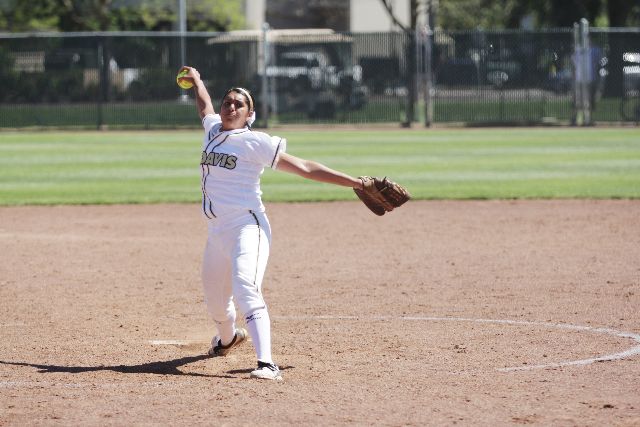
Records: Aggies, 17-21 (4-7); Highlanders, 16-24 (0-9)
Where: Amy S. Harrison Field — Riverside, Calif.
When: Saturday, April 20 at 12 and 2 p.m.; Sunday, April 21 at 12 p.m.
Who to Watch: Freshman Christa Castello has been a terror on the base paths this season. She is tied for sixth in the Big West for stolen bases, with 11 steals. This, along with her impressive .287 batting average and 11 runs batted in after the UC Santa Barbara series, will definitely cause UC Riverside’s less than stellar pitching staff some problems.

With the Highlander pitching staff prone to giving up home runs, the addition of Castello on the bases gives the UC Riverside pitchers something else to think about. Thus, the Highlander pitchers may not be as focused on making the best pitch and could make a costly mistake leading to big hits for the Aggies.

UC Davis needs to find consistent run production, and the series against UC Riverside seems like the perfect opportunity. Castello should be able to help spark the Aggies’ batting order in the weekend series.

Did you know? Senior Kelly Shulze has been hit by a pitch 15 times this season, taking the phrase “take one for the team” to a whole new level. Shulze’s resiliency to keep getting in the batter’s box is impressive. She has also shown impressive patience at the plate, drawing 14 walks this season.

Her propensity to draw walks and get hit by pitches has earned her an impressive .433 on-base percentage. This is the fifth highest in conference. Her ability to get on base should prove helpful for the Aggies as they attempt to jumpstart their offense against the Highlanders. Hopefully this does not involve Shulze getting injured.

Preview: The UC Davis softball team has had an up-and-down year so far. They have had impressive wins this season, such as the 14-1 stomping of Santa Clara. However, they have also struggled mightily this year, as evidenced in Arizona State’s 12-3 rout of the Aggies.

However, the Aggies do have hope heading into the weekend series in Riverside against the Highlanders. Though UC Davis lost the past weekend’s series against UC Santa Barbara, the pitching was stellar. They held the Gauchos to only two runs the entire series. Such impressive pitching has been a recurring theme this season as the Aggies have a combined earned-run average of 2.40.

The pitching staff is led by sophomore Justine Vela who, as of the series against UC Santa Barbara, owns an 11-6 record as well as an outstanding 2.14 ERA. In her recent performance against the Gauchos, Vela pitched a complete game shutout, only allowing three hits and striking out five. Such dominant pitching displays will make winning the weekend series against UC Riverside a lot more attainable.

The real challenge for the Aggies is consistent hitting. In the last series against the Gauchos, UC Davis scored an impressive eight runs in the first game. However, they were subsequently shut out by UC Santa Barbara in the next two.

The bats of sophomore Amy Nunez and senior Kelly Schulze, which have produced five of the Aggies’ eight home runs this year, may prove crucial in the series against the Highlanders.

UC Riverside’s pitching staff has given up a total of 34 home runs this season and as of their game against San Diego State, hold a team ERA of 5.37. Obviously, pitching is not one of the Highlanders’ strengths. The Aggies must take advantage of this, and could possibly have a field-day jumpstarting their offense.

The Aggies should head into the weekend series with a sense of confidence. The Highlanders are a very pedestrian team and should give the UC Davis’ offense the spark which they have needed this season. Hopefully, the Aggies can turn their season around starting with UC Riverside.

— Kenneth Ling

Neighborhood Court to be established in Davis

0

In May, Yolo County will become the second county in California to employ Neighborhood Court, a method of restorative justice, in Davis and on the UC Davis campus.

This program, a partnership between Yolo County District Attorney (DA) Jeff Reisig, the Davis Police Department and the UC Davis Police Department, will handle low-level, nonviolent adult criminal offenses that would normally proceed through the criminal court system. There will be a separate neighborhood court for the UC Davis campus and another for the Davis community.

According to Reisig, the process of establishing a Neighborhood Court in Yolo County began in January, although he first began to consider the idea after a conference with other district attorneys about a year ago. Inspired by the success of the neighborhood court implemented in San Francisco by District Attorney George Gascon, Reisig believed a neighborhood court would be suitable for Davis as well.

“What intrigued me about it was that it’s a total alternative to the criminal process for low-level crimes,” Reisig said. “I was an undergrad at UC Davis, lived in the Davis community and knew it would be a good fit for Davis. It’s a diverse community, a sophisticated community, and there are a lot of people who would be interested.”

According to UC Davis Chief of Police Matt Carmichael, the neighborhood court process would begin like one for a typical misdemeanor: The offender is either cited or arrested for a low-level misdemeanor such as vandalism, theft, public drunkenness, loitering or being a minor in possession of an open container of alcohol and is issued a ticket with a court date.

“These are victimless crimes, but the victim is the community,” Carmichael said. “With a typical misdemeanor, the victim doesn’t have a role in the process.”

However, starting on Picnic Day, April 20, when the program officially begins, the offender will also receive a notice to contact the district attorney’s office within two weeks if they are interested in participating in the Neighborhood Court. If contacted, the district attorney’s office will determine the eligibility of the offender. The incident must be a first offense, and the offender must participate voluntarily.

“This is not a venue where people will go to determine guilt or innocence,” Reisig said. “The guilt of the offender is already established and the goal of the process is to make the victim whole. However, it is also a huge opportunity for the offender. The DA won’t file a criminal complaint, it won’t go on their record and they won’t have to live with the stigma of a criminal offense.”

The restoration of the victim, according to both Reisig and Carmichael, is the overarching goal of restorative justice. In the Neighborhood Court, this restoration is achieved through community service, to be agreed upon by the panel and the offender. Depending on the nature of the crime, this may include actions such as writing letters of apology or volunteering in the UC Davis Arboretum.

“The aim is to make the community whole and to fill in the gap created by the offender,” Carmichael said.

Annually, there are approximately 5,000 misdemeanors in Yolo County, 1,000 of which are issued in Davis, Reisig said. In addition to saving the time and money incurred through the court process, the Neighborhood Court has further benefits as well, according to Reisig.

“The problem with the traditional system is that the penalties are not meaningful for the parties involved,” Reisig said. “Davis is a college town with a young population base, and most of the offenders in crimes such as these are not ‘bad’ or destined for a life of crime. These are often just stupid decisions, and it [the Neighborhood Court] gives them the opportunity to make it right and avoid the stigma of a criminal offense.”

Neighborhood Court panelists are screened volunteers and receive approximately 20 hours of restorative justice training before participating. Neither the Davis panel nor the UC Davis panel is intended to be an unbiased decision-making body such as a jury — on the contrary, the UC Davis panel is composed of UC Davis undergraduate and graduate students, faculty or alumni who are part of the community.

“These are confidential hearings,” Reisig said. “They’re not open to the public or the media and are really a dialogue between the offender and the community. The program has proven successful in San Francisco from talking to the panelists and participants involved there.”

According to Reisig and Carmichael, the Neighborhood Court will never consider serious or violent crimes such as assault or rape. The goal, they say, is to ensure it is safe for everyone involved to participate.

“We’re primed for this,” Carmichael said. “I’m impressed we’re moving forward and am excited to be a part of it.”

Anyone interested in volunteering on a Neighborhood Court panel can apply at yoloda.org, which receives applications on a rolling basis.

The program has been met with positive reception by the UC Davis and Davis communities thus far, according to Reisig and Carmichael.

“The only criticism so far is that it should have started sooner,” Reisig said.

MEREDITH STURMER can be reached at city@theaggie.org.

Doctor’s orders

0

People love doctors. And, more importantly, people love TV shows about doctors. “ER” ran for 15 seasons, launching George Clooney’s career. “Grey’s Anatomy” introduced M.D.s nicknamed McDreamy, McSteamy and Katherine Heigl. She doesn’t need a nickname; she’s perfect the way she is.

These TV doctors solve so many problems: Gregory House, for example, can deduce in a trivial 45 minutes that Patient A does not have an antibiotic-resistant strain of Ebola, but suffers from hypochondria. Yet for all their knowledge of disease, doctors — real and fake — are not able to solve the most diseased part of our healthcare system: its costs.

Earlier this year, Steven Brill published a special report in Time Magazine to answer one question: Why does health care cost so much? Essentially, he found out, because it does.

Hospital prices are based on a centralized document called a chargemaster, which lists prices for every procedure or service. But I’m a vibrant, youthful 18 to 25-year-old, you say. This doesn’t affect me.

I thought the same thing, until the healthcare system touched me — literally and figuratively — when I dropped what I was doing to drop my pants in the doctor’s office for a physical exam.

Over spring break, I had a physical exam because I like to be told that 135 pounds is a healthy weight for a 20-year-old, 5-foot-9 male. It’s the opposite of what I get told in the ARC weight room. After the exam, I needed to get a human papillomavirus (HPV) vaccination.

A few days later, I saw the physical cost $50 and the vaccination was $150. If syringes cost that much on the free market, heroin addiction would drop to zero; no one would ever again be forced to see Jared Leto’s infected arm in Requiem for a Dream. Seriously though, that was almost as gross as watching Kevin Ware break his leg.

Because of the sticker shock, I decided to research the UC Davis chargemaster. Luckily, California has a law requiring hospitals to disclose their chargemasters, which you can now search online. It’s called the Payers’ Bill of Rights. As White Goodman said, “The hippies finally got something right! Just kidding. But not really.” The chargemaster for the UC Davis Medical Center provides insight into and evidence of the broken healthcare system in the United States.

An arm cast from UCDMC costs $1,273. If you choke in the ER and a nurse performs CPR to save your life, that’s $1,400. Men, if your, ahem, “syringe” becomes engorged with fluid (and not the wink-wink-nudge-nudge type), incision and drainage will set you back $1,800. Women, you might receive a bilateral magnetic resonance imaging (MRI) to screen for breast cancer; but at $7,439.50, the procedure requires too many Benjamin Franklins to pay for to fit into any size cup.

My recreational drug and makeshift poker chip of choice, aspirin, costs $1 per pill. Compared to Amazon.com prices (4 cents per pill), UCDMC marks it up 2,500 percent. The other 96 cents must get you great service.

A power gradient exists between doctors and patients. Katherine Heigl can run a line down my throat to administer feeding fluid; I can run Google to look at pictures of Katherine Heigl. I’d like to think that they require the same level of skill, but they don’t.

Consequently, we defer to M.D.s and don’t question them as we should. But we need to. Doctors don’t grace us with their presence: They work in a service industry. Just like we have a right to ask for fries with that at Mickey D’s, we should have a right to assert ourselves with our healthcare providers. At $1 a pop, no, I don’t want aspirin with that.

For $50, I’d like more out of my annual “turn-and-cough” exam. A hearty red wine and rib-eye steak would be nice. So ask more of your doctors and accept your role as a patient with rights, not just responsibilities.

We need to demand more transparency from healthcare providers and less from their latex gloves. I implore you to hear my cry to action, because the $95,760 cochlear implant that could help you hear it is probably out of your price range.

If you would like BEN BIGELOW to turn and cough for you, contact him at babigelow@ucdavis.edu.

Event sparks free speech debate among campus community

0

On April 11, a forum featuring Elan Journo, fellow and director of policy research at the Ayn Rand Institute; Daniel Pipes, writer, founder and director of the Middle East Forum; and Larry Greenfield, political commentator and columnist, was held in 1001 Giedt Hall to discuss conflicts in the Middle East and their stance on current issues on Islam.

The event, titled “Islamists Rising in the Middle East: Where next for America?” was hosted by the Ayn Rand Society at UC Davis. Students, faculty and staff gathered in the audience and were able to submit written questions as well as stand up and pose verbal questions to the forum speakers.

Speakers stated that extremist Muslims aim to exercise their right over non-Muslims and women.

Organizers and audience members had concerns of potential disruptions or quarrels involving speakers, but the event ran smoothly.

Among the audience were Arab and non-Arab students, including fourth-year biological systems engineering major and former president of the Arab Student Union Ahmed Desouki.

“I am extremely offended. [The speakers] were talking about my country and my state as if they are experts on it. Everything was misinformation, false,” Desouki said. “I definitely feel that we are misrepresented on campus and by the administration.”

Speaker Journo told TheBlaze.com before the event that the speakers relied on the University and security to uphold the freedom of speech of the panelists by preventing any potential disruptions from audience members.

“It is ludicrous, if it were not so sad, that public discussion of the Islamist movement is somehow a taboo. This is the ideological movement behind al Qaeda, Taliban, Muslim Brotherhood and Iran. Surely the more people learn about it, the better,” he said.

The Ayn Rand Society did not receive any funding from the campus for this event, according to a letter by Ralph J. Hexter, provost and executive vice chancellor.

In response to letters from the campus community, Hexter sent out a letter on April 11 on behalf of Chancellor Linda P.B. Katehi. In the letter, he stated that the administration abhors “hateful” speech based on individuals’ religion and national origin, including that directed at students of Middle Eastern descent or Muslim and Jewish students.

“We want you to know that the University is deeply committed to providing a safe educational environment that is free of unlawful harassment for all of our students, and has been proactive in addressing the event this evening,” the letter stated.

Hexter also said that there would be staff from Student Affairs, the campus engagement team and Aggie Hosts in attendance to address any concerns, disagreements or violations of campus protocol.

Four ASUCD senators, Alyson Sagala, Armando Figueroa, Reuben Torres and Yee Xiong, submitted a letter to the Chancellor on their concerns about the event.

“We acknowledge that free speech is a cherished civil right, but hate speech and racist mischaracterizations of demographics’ entire cultures and life histories are not conducive to an academic environment that promotes a safer campus climate,” the letter stated.

JESSICA GRILLI and MUNA SADEK can be reached at campus@theaggie.org. KELLEY DRECHSLER contributed to this article.

Editorial: Happy 99th

0

This Saturday, April 20, is Picnic Day, and like all red-blooded UC Davis students, The California Aggie editorial board is stoked for a full day of campus celebration and cheer. Since many of us have gone through the wringer a few too many times, we would like to give fresh-faced freshmen (our main reader base) a full 7 inches of tips, tricks and protocol to make 98 years of past Picnic Day-ers proud.

Since past editorials have focused on campus safety and behavior, we won’t waste too much space reminding you that under no circumstances should you hang out with visitors from Woodland. Do not invite these people into your apartment. Do not tell them “where the party’s at,” and do not, DO NOT get into a friendly brawl with these visitors on Third Street. This rule applies to visitors from nearly every regional suburb, though is especially true for citizens of any town that can be reached via Hwy 113.

If you want champagne with your orange juice, buy it early. Over 50 local businesses that serve or sell alcohol have pledged to alter their offerings — they’re limiting sales before 11 a.m. and are not having special alcohol promotions. Not to mention, by April 19, liquor store shelves will be stripped of college student budget-friendly drinks, such as plastic handles of vodka.

While it may be tempting to leave room in your stomach for rage cage losses and soon-to-be-expelled bile, nothing beats Picnic Day in the dining commons, or a long, indulgent brunch with your friends. Please eat, or risk becoming a woo-girl. (This applies to everyone.)

Once you’ve eaten your weight in cereal, explore! The best times may be had at some North Davis megacomplex. But other really fun times can be had in Wellman, where there are often kittens, student films and kittens.

Be sure to bring cash. You never know when the ASUCD Coffee House registers will go down, or when you’ll need to be Pedicabbed across town. Unitrans charges $1 on Picnic Day, too.

If drinking isn’t for you, and the date 4/20 means nothing to you, Picnic Day is still a lovely time to sit on the grass and listen to live music. If “drinking isn’t for you,” do not choose Picnic Day for your first time on hallucinogens. Not only will the crowds be overwhelming, you will regrettably be awake during the citywide 3 p.m. siesta.

More tricks and tips can be found in our Picnic Day insert. But if you read it, don’t do anything we wouldn’t do.

Community members advocate breaking cycle of gun violence

1

As a result of numerous incidents of gun violence across the country, the City of Davis hosted a Feb. 19 forum on ending gun violence.

Renowned gun violence researcher Dr. Garen Wintemute from the UC Davis School of Medicine spoke at the forum, along with Amanda and Nick Wilcox from the California chapter of the Brady Campaign to Prevent Gun Violence.

The forum prompted a group of Davis officials and community members to submit a letter to state and national legislators expressing support for a change in gun control and safety in order to reduce incidents of gun violence, said Susan Lovenburg, a member of the Davis School Board.

A group of officials who signed the letter attended the California Senate Public Safety Committee’s public hearing on April 16 for the LIFE (Life-saving Intelligent Firearms Enforcement) Act. The LIFE Act is a set of eight bills aimed at improving firearm safety and protecting the community from gun violence in California. The LIFE Act was passed by the Senate Public Safety committee by a 5-2 vote against Republicans objections on April 16. The legislation will now advance to a second senate committee for further consideration.

“We are closing loopholes in our current laws regarding assault weapons and high-capacity magazines,” Amanda Wilcox said. “There’s a bill that would regulate ammunition. [There are] bills to keep firearms out of dangerous hands, [which] would add to the list of people who are prohibited from owning a firearm and provide more funding for the Department of Justice to disarm dangerous people who own a gun. There’s also an education piece that states that to get a firearm, you have to take a safety test.”

Davis is working to start a Yolo County chapter of the Brady Campaign as a result of the February forum.

According to a press release distributed by the Brady Campaign, California is one of the top states when it comes to gun control legislation and the state already has some of the firmest gun laws.

The gun legislation debate
Support for the new legislation is not unanimous. There are many California citizens who disagree with the eight bills in the LIFE Act.

Sim Sangha, a third-year sociology major, disagrees with the new legislation. Sangha is studying to become a police officer and has had internships in law enforcement for many years.

“Personally, I think it’s OK to have them because it is a part of our constitution,” Sangha said. “I purchased all my firearms legally, so I should be able to own them. However, when new owners come and buy firearms, I definitely feel like there should be some kind of training that comes before they are able to purchase it. Just because we have the Second Amendment, doesn’t mean you should be able to purchase them right away.”

Currently in California, prior to purchasing a firearm, individuals are required to take a 30-question test beforehand. Afterwards, there is a 10-day waiting period when an extensive background check is conducted. Additionally, owning firearms in California is considered a privilege and people who fail to pay bills and taxes on time lose their right to purchase a gun.

Debates over gun legislation are often polarizing because both sides feel very strongly about the issue. However, many of those who disagree still talk of the need for laws to regulate gun purchase and ownership.

“There are a lot of classes out there that teach safe gun ownership, but they are really expensive,” Sangha said. “There are gun safety classes offered for free that a lot of people just choose not to go to. A lot of people take guns and think they are toys, and they are definitely not.”

Finding common ground
Groups like the Brady Campaign and Moms Demand Action support common sense gun laws that are acceptable to both sides. The definition of what those gun laws might look like differ on opposing sides of the issue.

Moms Demand Action is a grassroots campaign movement started by a mother in Indiana after the Sandy Hook Elementary School shootings in Connecticut. They are a nonpartisan group and aim to find a balance in opinions that is difficult to achieve when discussing gun legislation, said Melissa Bauman, a member of Moms Demand Action.

“Our focus is at the federal level,” she said. “We feel that state laws are a good stepping stone, but if some states have weak gun laws, it just means that guns can be purchased in those states and then transported across the border.”

On the state level, Connecticut and New York recently passed new gun control legislation. On the national level, the Gun Violence Prevention Task Force appointed by President Barack Obama has met with people on both sides of the issue to come up with a set of laws that they feel respect the Second Amendment and would help protect the community.

However, on April 17, the U.S. Senate defeated that set of bills aimed at increasing gun control. The set of bills included a ban on assault weapons, a ban on high capacity magazines, and a bipartisan compromise to expand background checks for all gun purchasers.

According to The New York Times, Obama called it “a pretty shameful day” when he spoke at the White House after the votes.

Linking mental health
The National Rifle Association (NRA) opposed these federal bills and said in a statement that “the last thing America needs is more failed solutions to our nation’s most pressing problems. Congress should instead focus its energies on the things that will actually keep our families and communities safer — prosecuting criminals who misuse firearms, securing our schools and fixing the broken mental health system that keeps dangerously ill people on the street.”

Bauman and Amanda recognized that mental health and gun control are overlapping issues, and making changes in gun control requires working just as hard in making changes in parallel with mental health.

Wintemute discussed the public health aspects of gun violence, including mental health, at the forum. His research focuses on the nature, determinants and prevention of firearm violence.

“Mental illness, by itself, is not a major risk factor for violence,” Wintemute said in an email. “Mental illness combined with alcohol or controlled substance abuse, or with a prior history of violence, is an important risk factor. But we should note that alcohol abuse, controlled substance abuse and a prior history of violence are important risk factors whether mental illness is present or not.”

Wintemute said in an op-ed article in The Sacramento Bee that although California has done a lot in the area of gun control, there is still more that can be done. Over 3,000 people die from gunshot wounds in California each year.

“A college campus is not immune to gun violence, and a weapon in the hands of a dangerous person, whether it’s in a movie theater or a first-grade classroom or a college campus, presents a danger,” Amanda said.

PAAYAL ZAVERI can be reached at city@theaggie.org.

This week in science

Medicine:
Medical researchers have recently developed a “nano-sponge” that can enter your bloodstream and soak up deadly bacteria like MRSA that are resistant to conventional antibiotics. The nano-sponge, which measures about 1/300,000th of an inch, is surrounded by a membrane that mimics a red blood cell. The harmful bacteria attach harmlessly to the sponge and then get transported to the liver for removal. The new method was developed at UC San Diego.

Physics:
The best place to try to figure out the origins of the universe is not on top of a mountain with a telescope; it is deep underground. These caves contain some of the most sensitive scientific instruments ever created and form the Cryogenic Dark Matter Search (CDMS) project. The sensors at CDMS have recently detected three “WIMPs,” or weakly interactive massive particles, that could shed light on the nature of dark matter and the origins of the universe. The CDMS project is located in the Soudan Mine in northern Minnesota. It is a collaborative project between Stanford University, and the University of Minnesota.

Biology:
It turns out that life is very much like a computer in the way that it increases in complexity. By using Moor’s law, or the idea that computing power will double every two years, computer scientists regressed the equation for the human genome, and calculated that life in our universe originated somewhere between eight and 10 billion years ago … more than twice the age of the Earth itself. Whereas computing power doubles every two years, gene size doubles every 367 million years. This was calculated by looking at the number of base pairs in human DNA, comparing it to the number of base pairs in the DNA of other animals on Earth whose evolutionary age we know and creating a linear progression backward in time. The research comes out of the National Institute of Ageing in Baltimore, and the Gulf Specimen Marine Lab in Florida.

Genetics:
April 2013 marks the 10th anniversary of the completion of the Human Genome Project. Ten years ago, an international team of researchers succeeded in decoding the 3 billion letters in human DNA. Sequencing the first DNA strand cost $1 billion and took months, but after 10 years of fine-tuning the algorithms, software and hardware, that same strand of DNA can be decoded for between $3,000 and $5,000, and in only two days. This research has saved many lives with the treatments that have arisen from it. Last year, the entire catalog of known genes and their functions was published online on the ENCODE (ENCyclopedia Of DNA Elements) project.

Psychology:
A group of doctors at the Indiana University School of Medicine recently discovered that in patients with addictive personalities such as alcoholics, simply tasting beer is enough to release a flood of rewarding dopamine in the brain. The surprising part is that the beer the researchers had patients test was non-alcoholic. The researchers conducted brain scans on men after they had tasted Gatorade; they then conducted a second test after the patients had tasted the non-alcoholic beer. The differences were especially pronounced in patients whose families had a history of alcoholism.

Social Media:
A new study from The Miriam Hospital in Rhode Island recently showed that female college freshmen spend nearly 12 hours a day interacting with some form of social media, be it Facebook, YouTube or even talking on the phone and texting. Heavy online media use was linked to a lower average GPA. The researchers tested 483 freshmen women for the study. They also found that reading newspapers and listening to music was linked to a higher average GPA.

Evolution:
Opponents of evolution love to point out the inability of natural selection to produce structures like the eye or brain. Biologists have recently proposed an alternative theory; instead of these complex structures emerging bit by bit and becoming more complex, they instead became complex by subtraction. This means that the structures started out inefficient and unwieldy, and were winnowed to their most efficient form through natural selection. Using a computer program that mimics the process of inheritance, mutation, recombination and reproduction, the researchers created a simulation of simple black and white squares that followed simple rules to create a structure. Over time, the squares learned how to become more efficient at their task, enforcing the theory behind this new idea. This research comes from researchers at Duke University and the Phylogenetics lab at the University of Lausanne in Switzerland.

HUDSON LOFCHIE can be reached at science@theaggie.org.

Tech Tips

You have to give a presentation. Whether it be for class, for work or in a desperate attempt to try to convince your parents of something, presenting an idea can be a daunting task. In such a situation, nearly everyone turns to their trusted friend: PowerPoint. It’s the simple, standard way to organize ideas and ensure that there is a coherent flow to a presentation.

Unfortunately, therein lies the problem: nearly everyone chooses it.

Put yourself in your professor’s shoes and imagine their excitement level as yet another student loads a PowerPoint presentation — it’s going to be pretty low, and nothing will bring your grade down like putting your professor to sleep.

The Solution:

Prezi. Prezi is a free, online presentation software that allows you to escape from the one-dimensional timeline format of powerpoint. Prezi allows you to turn your boring timeline presentation into something more like a navigable map that can easily jump between points using visually stimulating transitions.

Although it may not sound like a big change, adding an extra dimension opens a plethora of options, including zooming and rotating within your presentation.

Most Prezi presentations will start with a large-scale overview and zoom in from there, allowing a visual representation of your argument’s flow into more in-depth analysis.

Points at each level of analysis can be physically connected to one another with arrows and lines, allowing the viewer to visually follow the progression of ideas. Even the background and color scheme can be custom-made to fit the subject of your presentation. You also have the option of choosing from the site’s pre-made themes.

Although in the end Prezi and Powerpoint are very similar on the most fundamental level (both can be used to make presentations), Prezi is far more visually striking and will break your audience out of whatever daze they have fallen into by the time you present. I have even heard rumors of professors granting extra credit points out of gratitude for the change of pace.

Mere words cannot encompass the possibilities that Prezi offers. To see some samples, head to Prezi.com and watch their demo video. There is even an iPad app to take your presentations with you on the go.

KYLE SCROGGINS can be reached at science@theaggie.org.

State representatives, students promote four student debt bills

0

A press conference was held on the South Steps of the State Capitol on April 8, where State Representative Bob Wieckowski (D-Fremont), State Controller John Chiang (D-Torrance), members from the California State Student Association (CSSA) and other California higher education students expressed support for several bills focusing on reducing the $1 trillion student loan debt. There were around 150 people in attendance with five speakers.

According to College Board Trends in Student Aid for 2011-12, undergraduate students received an average of $13,218 per full-time equivalent (FTE) student in financial aid, including $6,932 in grant aid from all sources and $5,056 in federal loans. In addition, students borrowed about $8.1 billion from private, state and institutional sources to help finance their education.

Wieckowski’s four bills — Assembly Bill (AB) 233, AB 391, AB 534 and Assembly Joint Resolution 11 — use a dual approach to the student debt issue that focuses on preemptive financial literacy education as well as alleviating the financial stress from paying off student loans for graduates, according to Wieckowski.

Student Bill of Rights
AB 233 was approved by the State Assembly on April 11 with a vote of 50-22 and will go to the State Senate. The other bills are still moving through the Legislature.

AB 233, also known as Student Loan Wage Garnishment, would require creditors to work out a repayment plan with debtors to prevent a maximum of 25 percent of a student’s disposable income garnished by a creditor.

AB 391, also known as the “Common Cents Curriculum,” would increase financial literacy by adding economics curriculum standards to K-12 education.

AB 534, the “Know Before You Owe” bill, would require entrance and exit loan counseling to students and would be applied to all private loans.

Assembly Joint Resolution 11, the “Financial Fresh $tart Act,” would allow students to file for bankruptcy for private loans.

Information about the assembly bills was compiled from the Student Bill of Rights package summary.

“This is a crisis that is getting worse. A college education is supposed to improve your financial security, not destroy it. That is why I have introduced a Student Bill of Rights,” Wieckowski said in a released statement.

Progressive support needed
Supporters at the rally said there needs to be change soon before the student debt issue worsens.

“We are one small recession from the student debt being an urgent issue again. What we saw from 2006-08 in terms of the banks’ practices in private student loans didn’t ease up when the economy got better in the way health loans got better, so all the practices are still there waiting,” said rally volunteer and former instructor at UC Santa Cruz Tamara Belknap.

The bills are supported by the CSSA, a nonprofit student association governed by a student board of directors composed of the officially recognized representatives of each of the 23 CSU campuses that address issues affecting students statewide and system-wide. There were around 100 CSSA-affiliated students in attendance at the rally.

“I think Wieckowski’s bills address an important piece of the puzzle,” said CSSA executive director Miles Jason Nevin. “We need to do a better job earlier in student life for financial literacy education. If it’s mandatory in the K-12 curriculum, we should see better financial decisions being made.”

Student advocates from the CSSA spoke at the rally, sharing personal stories of their own experience with private student loans and debt.

“Financial literacy is certainly part of the problem. I think the bills are one way to address the issue but they aren’t going to answer the whole problem. A lot of students don’t understand how debt and the whole financial system works,” said CSSA Vice President of Legislative Affairs Pedro Ramirez.

Ramirez said the bills address the rights issues within California, but the problem stands on a much larger scale.

“It needs to be addressed federally. Student debt is a national issue. That being said, I do think California is leading the way and protecting its students,” Ramirez said.

Challenges accepted
Some individuals foresee some challenges that will come along with Wieckowski’s bills.

“There will be challenges because the bills will require some funding from the public system. [Wieckowski] will have to find resources through the appropriation committee. However, the economic payoff is so much greater that we don’t see it as an expense but rather as an investment to provide students the tools to be conscious consumers,” Nevin said.

The student debt problem is prevalent among UC Davis students as students must deal with private student loans very often. One student shared her experience.

“By the time I graduate, I’ll have $20,000 in loans. It’s something you don’t really think about while you’re in college but as soon as you’re done you have to think: Well, how am I going to pay this back? I had some background on student loans education in high school. My teacher showed us how to calculate compound interest and how to manage funds. I still find it helpful so I support [Wieckowski’s] financial literacy bill,” said third-year environmental policy and planning major Ashley Goldlist.

Supporters of Wieckowski’s bills believe this issue is gaining support and can benefit from widespread student advocacy.

“A call to your local assembly member will truly build a lot of momentum,” Belknap said. “It is astonishing how much attention gets paid to the calls, letters and emails in support and in opposition to bills. I encourage all students to get involved and take part in the decision that will directly affect their futures.”

GABRIELLA HAMLETT can be reached at city@theaggie.org.

Cherry pop

0

When I write the word “virginity,” you won’t reach for the dictionary in confusion. The word is well-known, and most people assume they know what a virgin is: one who has not had sex.

And for many, the proof of one’s virginity lies in an intact hymen.

This assumption raises a myriad of issues. For one, it places the importance of virginity solely on the woman, the keeper of this mysterious membrane. In many societies, women are expected to retain their virginity until marriage. For men, on the other hand, this expectation is far less extreme.

The importance of an intact hymen also objectifies women who are to be married, like checking a horse’s teeth before buying it. In this case, a woman’s worth is only as good as her ability to prove that she is “pure.”

Defining virginity with the hymen also creates a very narrow (and very heteronormative) definition of sex. Many people, especially in our generation, hold the view that oral sex does not “count” in regards to virginity. But what about oral sex between two women? It seems silly to define all lesbians as virgins just because a penis isn’t involved.

Is “sex” defined as an act that induces orgasm? In this case, does one lose their virginity when they masturbate to completion? Most of the gay men I know count their virginity as “lost” when they have anal sex for the first time — but does anal sex in a heterosexual couple have the same meaning? Hardly, if the hymen remains untouched.

Virginity is a social construct, not a physical state.

But perhaps the biggest issue I have with this cultural obsession is the myth surrounding the hymen itself.

Arguably the most popular euphemism when discussing virginity is the act of “popping the cherry,” or “breaking” through the hymen. Personally, this kind of language makes me imagine stabbing through the film of a microwavable meal, or dropping an anvil on a trampoline. It’s violent, it’s nerve-wracking and it’s definite. This sort of thinking facilitates the distinction between “virgins” and “non-virgins,” erasing the gray areas I described above.

In reality, the hymen cannot be “popped” or “broken.” Hymens come in all shapes and sizes, but the most common are circular (hollow loop) and annular (half-moon shaped) membranes on the fringe of the vaginal opening. Come puberty, the increased estrogen in a woman’s body prepares her vagina for penetration by making the hymenal tissue (which has estrogen receptors) more elastic.

For the most part, penetrative sex does not break or puncture these types of hymens; instead, they stretch. Most of the anecdotal discomfort is a result of nervousness or inexperience, like rushing or not being relaxed enough to be fully turned on (which would provide more natural swelling and lubrication). In these cases, sometimes tiny tears can form in the hymen, which would cause the tell-tale bleeding.

Other, less common types of hymens can also result in more discomfort than normal. For example, some women have microperforate hymens (with only a pinhole-like opening), while select others have cribriform hymens (which have many small holes, but extend across the vaginal opening).

Even after a hymen has been stretched or torn slightly by penetration (or horseback riding, or gymnastics, or traumatic fence-jumping incidents), over time the hymenal tissue can re-form if it is left alone. Some women are even born without hymens.

In many cultures, not having hymenal “proof” of one’s virginity can be life-threatening. This has led to websites like hymenshop.com (which sells artificial hymens which leak red fluid when broken) and surgical procedures like hymenoplasty (in which the hymen is reconstructed with dissolving stitches, often advertised to “restore virginity”). Though we may not think it, U.S. culture is not immune to the hymen myth. In fact, most orders from the Hymen Shop come from the U.S.

In short, there is no definitive way to “prove” one’s virginity. This is especially true as we come to understand that it is not only our traditional understanding of sex that is antiquated, but our understanding of the hymen as well.

MARISA MASSARA wants to know your personal definition of virginity. She can be reached at mvmassara@ucdavis.edu.