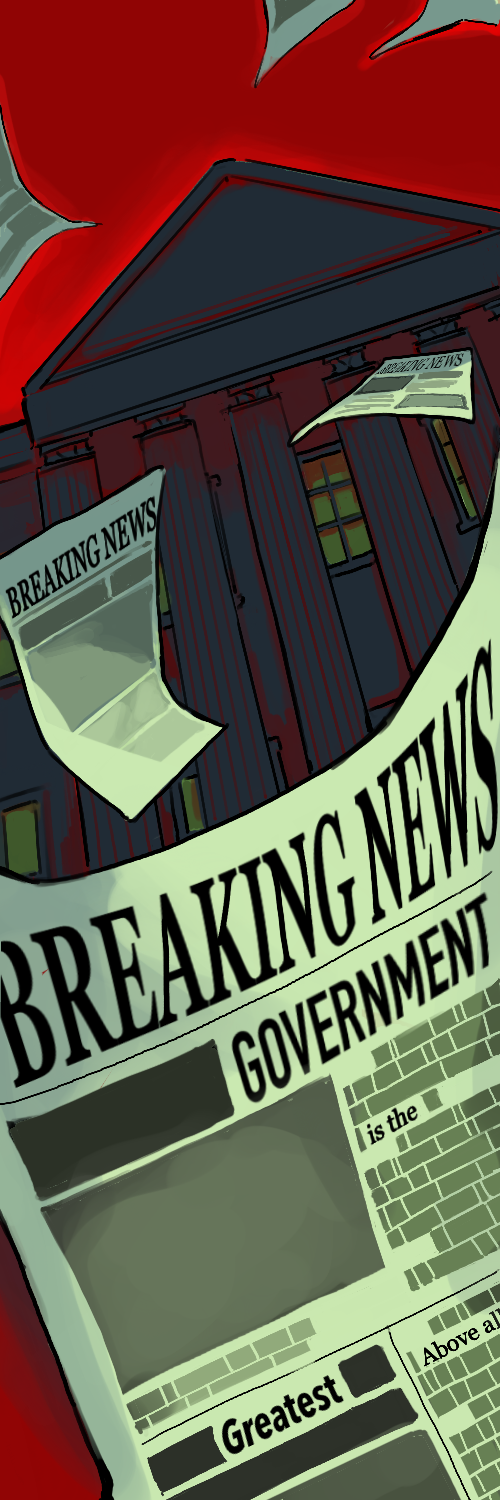
American history is wrought with censorship
By MOLLY THOMPSON – mmtthompson@ucdavis.edu
The road of American history is twisted, gnarled and winding. In the nearly 250 years since our official founding, we have traversed hills and valleys, glorious victories and bitter losses, periods of peace and periods of instability.
Throughout it all, the relationship between the American people and our government has shifted, morphed and developed just as our narrative events have. One of the most important linkage institutions — connection points between citizens and government — that shape our nation is the media: newspapers, books, radio, television, the Internet and beyond.
Media, especially journalism, allows our population to hold the people in charge accountable, spread news and important information, communicate with each other and our administrations and express our needs and desires to our government. Media is unquestionably crucial to democracy.
The influence of the media is intrinsically cemented in the very fabric of our U.S. Constitution; The First Amendment states that “Congress shall make no law […] prohibiting the free exercise thereof; or abridging the freedom of speech, or of the press.”
Given the importance of unrestricted speech and the fact that our government recognizes it, it stands to reason that our leaders would uphold the promise made on that ruling document. And yet, our history is just as rooted in censorship as it is in freedom.
One of the earliest and most notable examples of censorship in American history is found in the Sedition Act (1798), which essentially outlawed public opposition to the central government. Anyone who dared to “write, print, utter, or publish […] any false, scandalous and malicious writing against the government” was at risk of fines and imprisonment. The Sedition Act was in blatant violation of the First Amendment, having preceded the establishment of judicial review — a check on central power that gave the Supreme Court the authority to consider the constitutionality of laws.
Therefore, there was little to stop the Sedition Act’s censorship until the act was repealed, following the election of 1800. As one of the first major instances in which the limits of First Amendment rights were challenged, the event set a precedent for future controversies.
Dating back to our nation’s conception, there are many examples of postal restrictions that call into question the First Amendment. In 1873, Congress passed the Comstock Act, which made mailing information, advertisements or materials deemed “obscene” (which included information about contraception and abortion) a crime. Many such restrictions were later removed, but those that remained came back into relevance when Roe v. Wade was overturned in 2022 and reproductive freedom was put in jeopardy.
The 20th century brought forth a slough of censorship. During World War I (1918), the American Library Association and the United States Department of War sent lists of titles deemed too pro-Socialist, pacifist or pro-German that needed to be removed from military camp libraries. Around the same time, it was not uncommon for public libraries to refuse to allow people of color through their doors or to stock periodicals curated by minority cultures. Book bans as a whole have consistently recurred for various reasons throughout American history, each with different resolutions.
During the Red Scare (1917 to 1920), government censorship was a prevalent response to widespread panic — President Woodrow Wilson pushed for multiple laws limiting free speech in the name of a national emergency. The Espionage Act of 1917 criminalized conveying information meant to interfere with World War I. The Sedition Act of 1918 cast a broad net over what forms of expression were legal during the crisis, penalizing speech against the government, the U.S. Constitution, the military and even the U.S. flag. While these restrictions were removed in later decades, the presiding Supreme Court upheld them as valid, even though they were clear violations of the Free Speech clause.
A powerful but quiet form of censorship that the government often uses to its advantage is the simple act of gatekeeping. The White House controls how much of its inner workings it releases for journalists to publish, meaning that they can withhold what they don’t want the public to know. This occurs for multiple reasons, and, while it is certainly true that officers restrict information for diplomatic efficiency, administrative confidentiality and public defense, it has also been used insidiously. This can be difficult to parse, given that the line between restricting information for the sake of safety and restricting information for the sake of power is razor-thin.
For example, journalists were not allowed to follow and cover U.S. troops as they invaded Grenada in 1983. The government’s rationale was in the name of protecting the reporters themselves, but it also resulted in limited (and arguably less substantive) public coverage of the event.
Our modern governments have rolled the dice on their own forms of censorship more frequently than is generally realized by the public. Today’s efforts tend to be more difficult to spot, though this is not always true — the Nixon Administration’s attempt to withhold the Pentagon Papers, for example, became mainstream news.
Though Trump’s new administration claims to prioritize “freedom of speech and ending federal censorship,” some of their actions tell a different story. Already, he has pardoned over a dozen individuals charged for attacking journalists during the Jan. 6, 2021 coup attempt, directly counteracting his goal of protecting the merits of the Free Speech clause. Only time will tell how those claims unfold.
The bottom line is that freedom of speech and freedom of press are both invaluable and fundamental to democracy. Already, the United States has declined from a 10 to a five (between 2012 and 2020) on the Polity Democracy Index (on a scale from -10 to 10). Continued censorship is a surefire way to further this decline. Our country is no ingénue in the face of government media restrictions, but this behavior is never a sign of national health — censorship is a symptom of crisis.
Written by: Molly Thompson — mmtthompson@ucdavis.edu
Disclaimer: The views and opinions expressed by individual columnists belong to the columnists alone and do not necessarily indicate the views and opinions held by The California Aggie.