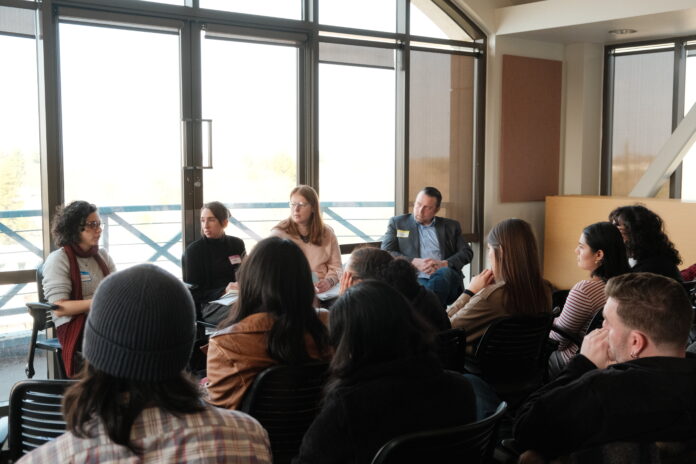
The first of four UC conferences brought together students and faculty to engage in meaningful dialogue
By MEGAN PUSL — campus@theaggie.org
The UC Davis Human Rights Studies Program hosted a conference on Jan. 30 and 31, inviting students and faculty from across the University of California system to hold conversations about human rights. This first conference was titled “The Role of Memory and Historical Consciousness in Understanding Regional Violence, Conflict and Peacemaking.”
The conference consisted of three parts including a graduate student symposium, a Human Rights Film Festival and conversations among UC faculty, according to their website. The three events each provided unique opportunities for attendees to learn about human rights through the lens of memory and historical consciousness.
The conversations on human rights, humanity and peacemaking were made possible through the efforts of Keith David Watenpaugh, the professor and director of Human Rights Studies at UC Davis, along with Undergraduate Student Conference Leads Angelina Cicchini and Gabriella Violett.
Cicchini, a fourth-year sociology major and human rights minor, shared the most rewarding part of planning the conference series.
“Witnessing the debate and conversation between scholars was so interesting because every single person there was from such a different walk of life,” Cicchini said. “All of these people coming with their own specific, niche, personal [and] intimate human rights-based topics that coincide somehow with their lives, their family history [and] their background.”
The graduate student symposium took place on Jan. 30 from 12 to 4 p.m. in Sproul Hall. Four Ph.D. students from across the UCs were given the opportunity to share their experience and research, focusing on how memory contributes to human rights and resistance.
Hannah Bacchus, a fourth-year UC Irvine Ph.D. student in English, shared her paper on black consciousness that highlights the novel “Native Son” by Richard Wright.
Camellia Haghverdian, a UC Merced Ph.D. student in sociology, shared her research and personal experience of how memory influences women’s resistance in the Middle East.
“Women’s resistance, in whatever shape it comes, forms the way [that] a huge portion of social memory or collective memories are created,” Haghverdian said. “The way we remember things is going to inform the way we are going to resist in the future. It’s a constant loop that happens.”
During the second panel, Eliana Fonsah, a UC Merced Ph.D. student in sociology, spoke about the role of historical consciousness and memory in the Cameroon Anglophone Movement.
Sekou Jabateh, a UC Berkeley Ph.D. student in comparative politics, shared his research about the memory of the civil war in Liberia and Sierra Leone.
The conversation among the graduate students was guided by UC Davis Spanish and Portuguese graduate students Emily Nelsen and Chandler Thompson, along with UC Davis History Professor Adam Zientek.
The Human Rights Film Festival was hosted in Cruess Hall on the evening of Jan. 30 from 7 to 9:30 p.m. The 2024 film “So Surreal: Behind the Masks” was presented to the many students and faculty in attendance. The documentary highlighted the history of Indigenous ceremonial masks belonging to the Yup’ik and Kwakwa̱ka̱ʼwakw nations of North America. The documentary follows the quest to locate the Raven Transformation Mask, bringing together different people to join the search in many locations across the world.
After the film screening, special guest Chuna McIntyre, a prominent figure in the highlighted film, as well as a Yup’ik artist and master storyteller, presented to the audience. McIntyre performed a traditional Yup’ik song to the audience, shared pieces of his culture and answered questions from the audience.
“Our masks were created to appease the spirits of the sky, the land and everything in between,” McIntyre said. “We still have our language. Within our language is locked in the secrets of our masks.”
The last event, the University of California Faculty in Conversation, took place on Jan. 31 from 12 to 5 p.m. in the International Center. The first panel of the day featured four professors from across the UC System.
The faculty in this panel included UC Davis Professor of Human Rights Studies Lucia Luna Victoria, UC Santa Cruz Professor of Critical Race and Ethnic Studies Alice Yang, UC Merced Professor of Anthropology and Heritage Studies Robin DeLugan and UC Irvine Assistant Professor of History Kevin Antonio Aguilar.
The conversation and audience questionnaire was guided by UC Davis Professor Marian Schlotterbeck of the History Department.
Three UC professors participated in the second panel, engaging in conversation about the preservation of culture, the role of memory and the act of resistance.
Mark Levine, UC Irvine professor of modern Middle Eastern history, talked about the importance of protecting culture, specifically in the examples of Palestine and Chiapas.
“The production of culture is crucial to keeping communities whole and allowing them to survive,” Levine said. “Culture is like a weed. It always survives. It always finds a new way. So how is culture going to be expressed within the devastation that Palestinians, at least for now, are returning to?”
Watenpaugh exemplified the role of memory with a story from his time spent as a graduate student at the University of Damascus in Syria. When visiting a mosque in the city of Hama, he explained the horror of seeing bullet holes covering the walls.
“When the people in the city of Hama, the survivors of this terrible massacre, went to pray in that mosque, they knelt in prayer not just in the direction of Mecca,” Watenpaugh said. “But they knelt in the direction of the public memory […] that they had resisted, and that the price of resistance was being executed. As you prayed you were forced to remember that act of violence.”
Jennifer Mogannam, UC Santa Cruz professor of critical race and ethnic studies, spoke about her piece on the act of resistance and the reframing of violence through people-centered research.
“For colonized peoples, the act of resistance is the act of resisting disappearance,” Mogannam said. “It’s the act of becoming human in the face of dehumanizing machines.”
The conversation and audience questionnaire in this panel were guided by UC Davis Professor Michael Lazzara of the Department of Spanish and Portuguese.
This conference is the first of four in the human rights conference series on the UC Davis campus. The second conference is set for Feb. 27 to 28 focusing on “Artistic and Literary Freedom and the Destruction of Culture, Education and Heritage in Times of Mass Atrocity.” The third conference will take place from March 6 to 7 focusing on “Reparative Responsibility in the Face of Discrimination and Hate.” The fourth conference will be from April 24 to 25 and will highlight “The Human Rights Framework and Global Solidarities.”
Written by: Megan Pusl— campus@theaggie.org