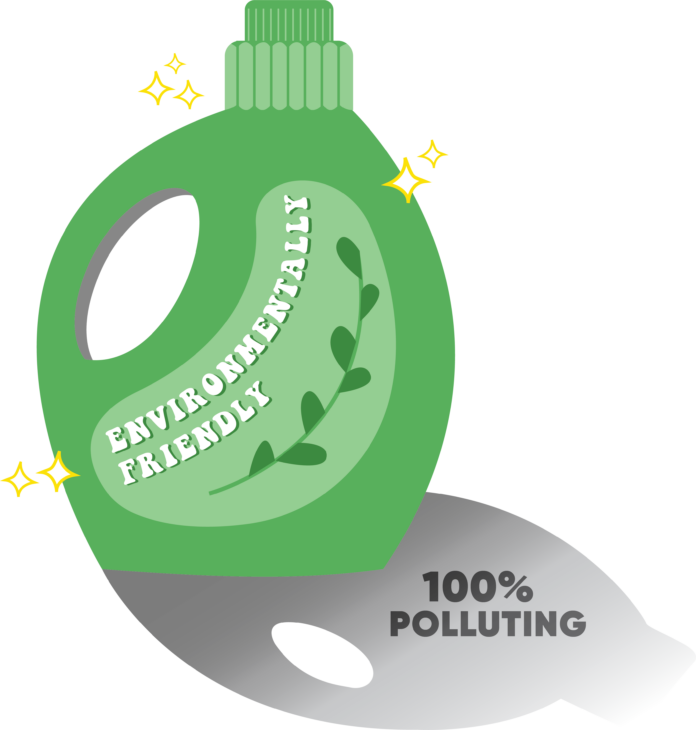
The looming rise of greenwashing and how to recognize it
By ELLIE NOH — eenoh@ucdavis.edu
Many individuals, especially in companies, recognize the detrimental impacts of climate change caused by human activities. While some organizations have corporate goals to improve sustainability in production and distribution, others might not truly be using environmentally friendly practices — or may be harming the environment through other means. This corporate facade of sustainability, which is used to mislead the public about a company’s true environmental impact, is known as “greenwashing.”
Because of consumerism, the impact of waste has grown more dire and the use of green advertising has not been effective in mitigating such practices. One such case is fast fashion, which has one of the worst environmental impacts to date. 10% of carbon dioxide emissions worldwide are due to the fast fashion industry, according to the Center for Biological Diversity. If fast fashion continues to rise, greenwashing slogans and messages platformed by certain companies may cause consumers to believe that they are contributing to sustainable fashion when they are not.
To further this idea, in recent years, there has been a growing awareness for sustainability, with more individuals trying to implement environmentally conscious day-to-day actions — especially those popularized on social media. Environmental advertising is a tool that often gives companies an advantage since more people might be inclined to purchase products that seem to be eco-friendly.
While some forms of greenwashing are more obvious than others, companies use many subtle tactics to make their products seem more environmentally friendly. This includes using ambiguous words such as “eco-friendly” — which is a term subject to various interpretations — thereby influencing consumers to believe they are contributing to a greener future. Another common method is to utilize images that contain aspects of nature, like plants or animals, in order to give the impression that the overall theme of the brand is focused on conserving nature.
However, while it is important to be critical of advertising messages, it is also important to note that, while some companies may be using these greenwashing strategies to increase consumer purchases, it doesn’t mean that other companies use similar ideas to reliably market their products. Thus, there exists an individual need on the side of the consumers to do their own research and buy products that are actually sustainable. Companies regularly release sustainability reports which people can freely peruse to analyze the environmental impacts and identify a company’s true goals.
Additionally, some organizations aim to help with this ongoing issue of greenwashing. For example, the Federal Trade Commission’s Green Guides are established sources that provide assistance with marketing truthfully, encouraging companies to ensure that their products are as sustainable as they sound.
As the fight to decrease the human impact on climate change continues onward, it is essential to have these truthful measures to help implement environmental change. Given that these changes can take time, it is fundamental that we do our own research and recognize which companies are being truthful and which are not. While many organizations are working toward clear-cut, reliable marketing, existing greenwashing tactics and the widespread nature of consumerism necessitate that consumers think twice before purchasing a potentially “green” item — it may not truly be as sustainable as it seems.
Written by: Ellie Noh — eenoh@ucdavis.edu
Disclaimer: The views and opinions expressed by individual columnists belong to the columnists alone and do not necessarily indicate the views and opinions held by The California Aggie.