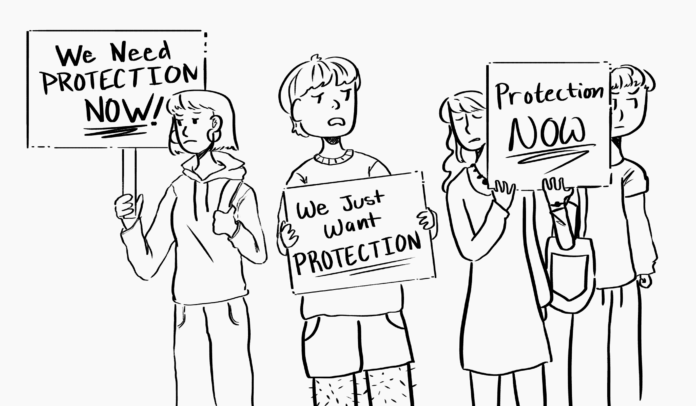
Political statements that start and end with “protection” and “acceptance” reinforce targeted communities’ positions as a “victim” or an “other”
By GEETIKA MAHAJAN — giamahajan@ucdavis.edu
In early 2021, a video of Missouri father Brandon Boulware went viral. In the video, Boulware is condemning a ban against transgender athletes in Missouri by citing his own experiences raising his daughter as a trans woman. Ostensibly, it’s a heartwarming premise — a father desiring to defend his children’s rights by protesting a transphobic bill. The video was reposted by the American Civil Liberties Union (ACLU), and the father was hailed for his acceptance and kind regard toward the trans community.
However, the speech contained a quiet confession: Boulware admitted to not being as accepting of his daughter’s identity throughout her childhood.
“Truth be told,” Boulware said. “I did it to protect myself. I wanted to avoid those inevitable questions as to why my child does not look and act like a boy.”
The video did not go viral because it questioned the premise of the transphobic bill or because it offered any serious insight into the experiences of trans athletes. Most of those who watched the video on Twitter, now X, may not even know the outcome — the bill itself had passed, 100 to 51, in favor of banning transgender students from participating in sports teams that matched their gender identity.
There’s nothing wrong with the contents of the speech. Nothing wrong, even, with parents and children alike finding comfort in its contents. The issue arises when this kind of rhetoric — the kind that simply pushes for “acceptance” and “protection” — becomes politically charged. Personally, I think that the speech itself was very brave; It’s not easy to admit that you were in the wrong or to platform yourself to encourage others to not make the same mistakes. Even so, reformed bigots being hailed as paragons of social change distorts the root causes of homophobia and transphobia, shifting the axis of what true allyship is meant to achieve.
The issue with acting as though a lack of acceptance is the start and end of discrimination is that it can turn into a constant cycle of pushing for visibility: note Boulware’s message that “[he] learned to accept [his] daughter, and now it’s your turn to do the same.” This dialogue is unproductive because it circumvents the real issue.
Reframing basic acceptance as allyship and progress allows anyone to paint themselves as allies without doing any actual work in terms of questioning the systems that allow discrimination to persist. This is where the idea of protectionism comes in, a concept that has been widely adopted in social justice spaces. The phrase itself is problematic in how open-ended and ambiguous it is, because the natural response to a phrase like “protect trans kids!” is: protect them from what exactly?
Turning protection itself into a political act implies that the socially constructed threats against the existence of queer communities are and will be omnipresent. The key word “protect” is vague and unaccusative; it makes allyship accessible by not demanding more than a statement of solidarity. And, while this may seem like a good thing — of course, why shouldn’t anyone from companies to celebrities be able to express their support toward marginalized communities? — it’s also a very flimsy surface for equality. Proclaimed solidarity isn’t policy; it’s not anything, really, unless there’s actual action behind it.
The core of the problem with protection politics is that it makes it very simple to look like an ally and even easier to backtrack when it’s unfavorable. In the mid-2010s, every company was changing their Instagram profile pictures for Pride Month; now, several have removed their diversity signifiers from their websites. When social acceptance alone is used as a metric for equality, it allows the root cause of discrimination to go unexamined.
Within his speech, the Missouri father does two things: He emphasizes that he is there to protect his daughter’s rights, and he implores the acceptance of her identity as a woman. He does not question why it was assumed that his daughter would behave a certain way just because she was born a certain way. Nor does he rebut the bill itself, which assumes that children’s capacity in sports is primarily and most importantly determined by their sex assigned at birth, rather than their age, height or weight.
These are the assumptions that allow homophobia and transphobia to take root — constantly searching for acceptance within a society that operates within parameters that are inherently hetero and cisnormative yields no actual quantifiable victories because the core issues remain. A father goes viral because he stopped stifling his daughter’s identity and is now imploring lawmakers to do the same, but the transphobic bill still passed with two-thirds of the vote.
Political statements that start and end with protection and acceptance do no actual work when it comes to pushing the needle toward positive change — they just reinforce such communities’ positions as a “victim” or an “other.”
Written by: Geetika Mahajan — giamahajan@ucdavis.edu
Disclaimer: The views and opinions expressed by individual columnists belong to the columnists alone and do not necessarily indicate the views and opinions held by The California Aggie.