The pros and cons of non-traditional schools
By MOLLY THOMPSON – mmtthompson@ucdavis.edu
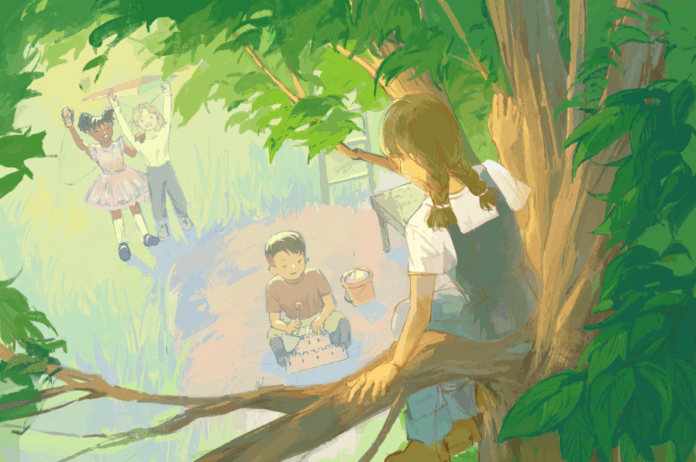
I grew up attending school on 14 acres of hilly, renovated farmland. I went to art and music classes in a repurposed dairy barn with one corner full of drums and recorders, one with long, stained wooden tables, wide rugs in the center and unicycles and stilts piled along the back wall. I learned algebra in “the math cabin” which was poised at the long, winding entrance to the “redwood grove” and I started each language arts class sitting cross-legged on the floor of the “rug room” in a brief, guided meditation.
Each morning at 9 a.m., when the bell was rung by hand, myself and my 60 peers would gather at “the circle”: a ring of benches made by laying roughly cut wood slabs on top of stumps (we could take the slabs down and lean them against the stumps to make an arena in which to play “ga ga ga”). At recess, we’d run into “the willows” — a lush grove of trees and blackberry brambles in which we’d carry out the most elaborate scenarios of make-believe politics and scandal: no concrete, no physical education, no loudspeakers, no buses, no standardized curriculum, no hall passes and no computers.
When I transferred to public school in sixth grade, I felt like a small-town girl in the big city for the first time (New York City? Never heard of it. My concrete jungle was Valencia Elementary School). I wasn’t used to an automated bell system, I’d never called my teachers “Mrs.” or “Mr.” before and I couldn’t touch-type. I ended up fitting in well (I wasn’t completely inept), but it was definitely a bit of a culture shock. Both types of education have their benefits, but they also have their drawbacks. So, as someone who’s experienced both sides of the coin, I feel qualified to compare them.
One thing that Orchard School (which I attended from kindergarten through fifth grade) got right is that they truly emphasized the facilitation of socialization. While we go to school with the primary goal of academic learning, equally important are the social lessons we inherently learn through the process of education itself. At Orchard, academics weren’t the priority. We had four classes each day, each one hour long and each with a short recess period in between. Yes, we had recess between every class. The priority was gaining independence, learning how to form and foster relationships, understanding nature and the environment, emotional development and teamwork. I learned how to read and write and do basic geometry, but I also learned how to be an effective leader, a good friend and to trust the natural world.
Orchard also gave me some opportunities I never would have otherwise had. We had alpacas, chickens, a pig and a full garden on campus — grade levels would take turns caring for them, which instilled in us a pretty solid sense of responsibility and self-sufficiency. As students, we helped stage and rehearse our own plays in drama class. We had a small archery range, where the older students could take elective classes or go practice shooting during recess.
During my last year, I taught my own baking elective (under supervision) to a sizable cohort of my peers. I was able to switch between classes and grade levels on my own schedule (we had combined classes with two grades each, so I ended up doing my second-grade work in first grade and formally skipping second grade, then completing sixth grade a year early and repeating it at Valencia — it’s complicated). Essentially, Orchard allowed for much more flexibility and adventure than public schools offered.
What can be difficult, though, is that the rest of the world doesn’t operate with those same priorities as the specific environment you’ve grown accustomed to. The work day never starts late because the principal lost track of time and forgot to ring the bell. You don’t always get a combined hour of break for only four hours of work or class. In high school and college, you receive objective grades rather than annual qualitative evaluations. While the kind of alternative education at Orchard can yield a lot of benefits that are often overlooked by conventional schools, it can also fall short when it comes to preparing kids for later schooling and the working world.
That became evident when I switched to Valencia Elementary for sixth grade. In the end, I did just fine. I acclimated quickly, settled into a group of friends and passed all of my classes without too much turmoil. But I was definitely in for a rude awakening when I was suddenly faced with homework every day, online assignments and the Accelerated Reader (AR) test. I’ll never forget being asked to stand up and say the Pledge of Allegiance on the first day (nobody told me about that!), I had to sort of lip sync it and mumble the words — I had no idea how it went and it was embarrassing.
While Valencia was much more detached, strict and rigorous than Orchard, it had its own advantages. I learned how to succeed in a system that was much more synonymous with most of the world — organized schedules, hard deadlines, assigned seats, objective grades and more general rules of conduct. I finally memorized my times tables, learned to type on a computer, opened my first Google Doc (it took a few tries; I typed my first assignment in my Notes app on my iPad mini) and learned how to navigate Google Classroom. I got used to the specific genre of authority that elementary school teachers command, took the bus every day and found my place in the playground hierarchy. The experience, as a whole, definitely helped me assimilate to life as most of America knows it.
Before Valencia, I had never been subjected to most of the classic American elementary school experience. That means I’d never had to run the mile, and I really took umbrage with that when I finally had to face it. It’s honestly a wonder that I even survived — at Orchard, we didn’t have physical education. Instead, we had circus arts. Yes, instead of running, we learned how to juggle, walk on stilts and ride unicycles. So if nothing else, Orchard gave me that skill (I can still ride a unicycle). Maybe it didn’t teach me how to write an essay or do regular multiplication (I can still only do the lattice method), but, at the very least, I have a fun fact that will serve me in every ice breaker for the rest of my life.
At the end of the day, both systems have benefits and drawbacks. I’m lucky because I got to have both, and I can definitely thank both experiences for the skills I have to this day. Orchard School taught me who I was and how to exist as a prominent member of a very diverse community; Valencia Elementary taught me how, as that person, to succeed in the conventional academic scene. I truly am who I am because of both, and I wouldn’t change that for anything.
Written by: Molly Thompson — mmtthompson@ucdavis.edu
Disclaimer: The views and opinions expressed by individual columnists belong to the columnists alone and do not necessarily indicate the views and opinions held by The California Aggie