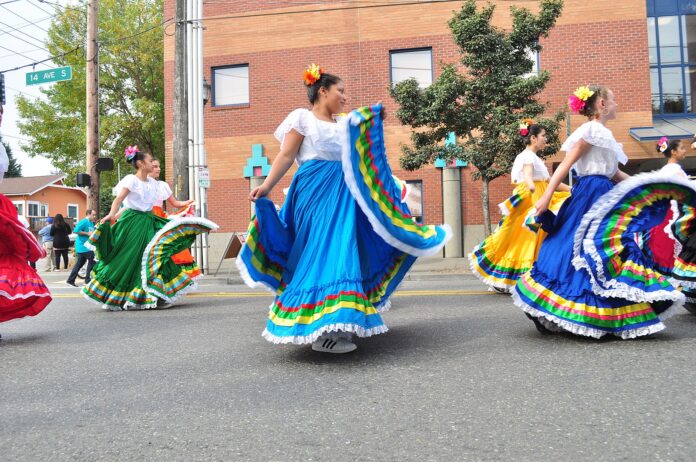
Davis community reflects on the celebration of the month while acknowledging current political climate
By KATYA OKS — city@theaggie.org
Sept. 15 marked the first day of National Hispanic Heritage Month. The month stands as a national acknowledgement of Hispanic and Latino communities and serves to “give extra recognition to the many contributions made to the history and culture of the United States,” according to the National Museum of the American Latino.
Currently, the Latino population in the United States is over 65 million, making up almost 20% of the total population according to the U.S. Census Bureau.
Associated Students, UC Davis (ASUCD) Senator Luis Leonardo Garcia, a third-year political science and Chicano studies double major, shared what National Hispanic Heritage Month means to him.
“Despite our community endur[ing] so much discrimination, underrepresentation and many more systemic barriers, […] we’re still thriving,” Garcia said. “Regardless of whatever barriers are put in front of us, we’ve always found a way to go around them and figure out other ways to continue being present in our community. So, celebrating this month shows that despite everything, we bring so much beauty, strength and excellence.”
National Hispanic Heritage Month calls for not only acknowledgement, but also celebration of the achievements, impacts and individuals of the Hispanic community. However, neither President Donald Trump, nor any other members of the current presidential administration, have issued a proclamation or mentioned the month on any official White House social media pages.
Garcia shares what a lack of acknowledgement communicates to individuals of the Hispanic community.
“[Trump] not acknowledging [National] Hispanic Heritage Month communicates to us that our achievements don’t matter — that’s the kind of message he’s putting forward,” Garcia said. “But, for me personally, him not recognizing us […] leads me to wanting to do more. He might not recognize our accomplishment[s], but we’re still working each day. We’re still doing all these great things.”
This lack of acknowledgement differs from President Trump’s first term in the Oval Office, during which “he issued a proclamation recognizing Hispanic Heritage Month at least one day in advance of Sept. 15 for each of his four years in office,” according to Forbes.
In Trump’s 2020 proclamation of National Hispanic Heritage Month, which was his last acknowledgement of National Hispanic Heritage Month, he stated that “Hispanic Americans embody the best of our American values, including commitment to faith, family, and country” and called “on public officials, educators, librarians, and all Americans to observe this month with appropriate ceremonies, activities, and programs.”
The silence from the Trump administration this year follows its immigration policies, including Immigration and Customs Enforcement (ICE) raids and mass deportations.
Bradford Jones is a UC Davis political science professor whose work focuses on perception of Latinos in the U.S., specifically focusing on issues such as immigration, voting rights and discrimination, according to the UC Davis Global Migration Center website.
Professor Jones shared his thoughts on relations between the current presidential administration and the Hispanic community.
“The Latino community is under siege,” Jones said. “We’re seeing unprecedented immigration enforcement that’s almost exclusively targeting Latino communities — and not just undocumented immigrants, [but also] naturalized citizens, including U.S. citizens.”
On Sept. 8, the Supreme Court ruled 6-3 in a case known as Vasquez Perdomo v. Noem. Their ruling allows immigration officers to detain individuals “based on the following factors or combination of factors: (i) presence at particular locations as bus stops, car washes, day laborer pickup sites, agricultural sites, and the like; (ii) the type of work one does; (iii) speaking Spanish or speaking English with an accent; and (iv) apparent race or ethnicity,” according to the official Supreme Court website.
Professor Jones reflected on the outcome of such a ruling.
“What the court decided in this unprecedented case is that racial profiling is absolutely permitted,” Jones said. “I know from personal experience, a lot of Latino [community members and students] are very worried about their family and friends, and so a court case like this does nothing but exacerbate that fear.”
Garcia also shared his own thoughts on possible consequences and his own experiences.
“Not everyone’s parents had the privilege or time to learn the [English] language,” Garcia said. “I know many parents who are scared of getting groceries [due to having Spanish accents]. And that’s something that’s so simple to do, but this [ruling] adds another level of insecurity and fear.”
Jones also spoke about how the recent ruling will impact celebrations that might take place to commemorate National Hispanic Heritage Month.
“One thing that we see over and over, all across the country, in locations where there are large Latino populations, is that […] cultural celebrations have been canceled,” Jones said.
And they’ve been canceled because of the fear that ICE may use them to target [Latinx individuals.] […] What the Supreme Court did has a chilling effect on these kinds of celebrations.”
Garcia also explained how it is important to still celebrate Hispanic and Latino achievements despite the current political climate.
“Celebration of our accomplishments is active resistance,” Garcia said. “Hispanic Heritage Month isn’t just about celebration, it’s about recognition, resilience and responsibility. It is [important to] just keep pushing for that justice and visibility, long after the month ends or the year ends.”
Written By: Katya Oks — city@theaggie.org