






Photography exhibit at Shields Library highlights history and livelihoods of Northern California farmworkers
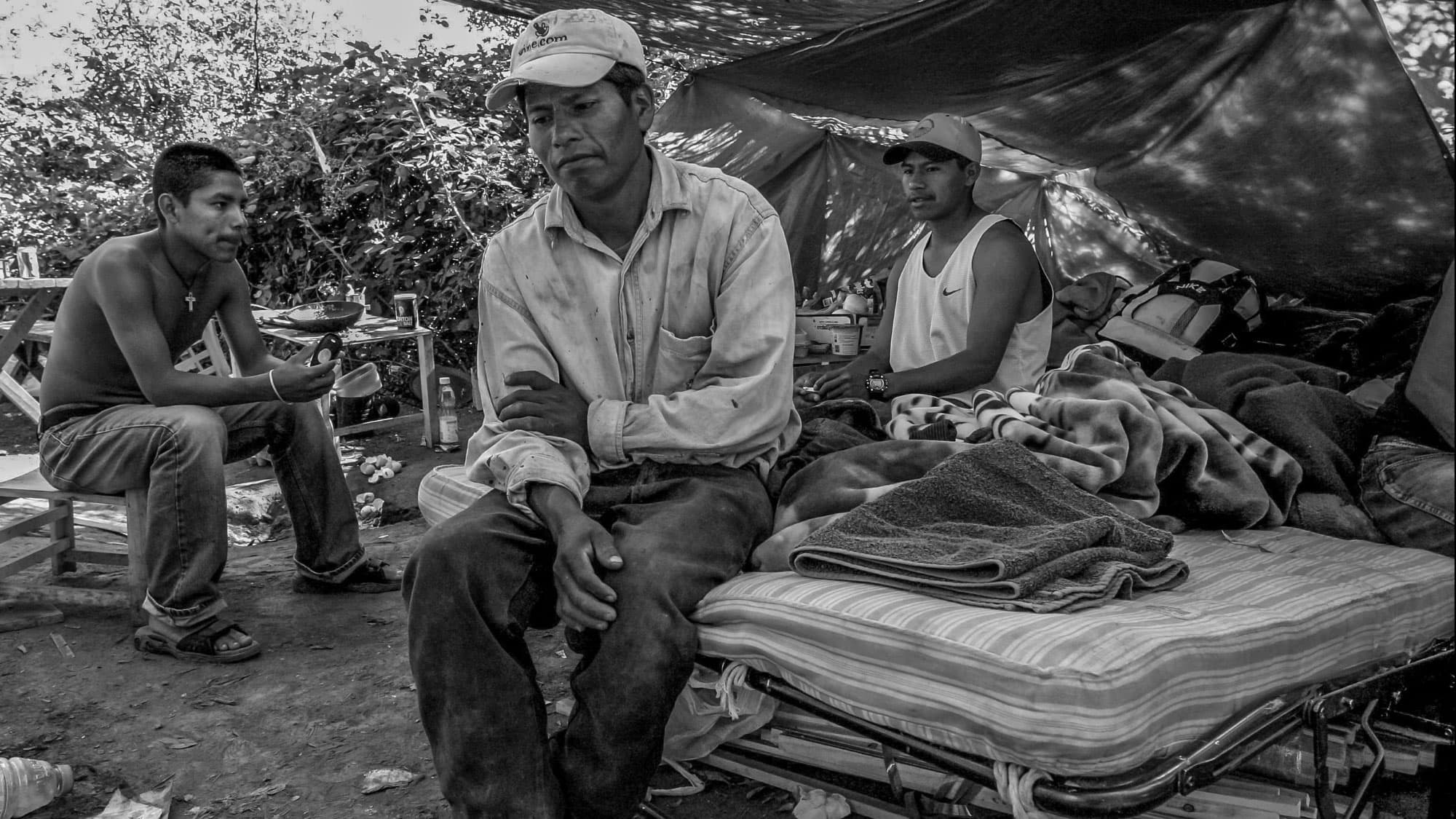
UC Davis Labor and Community Center presents new David Bacon collection
By SAVANNAH ANNO — arts@theaggie.org
On view from Sept. 13 to Dec. 14, Shields Library will be exhibiting “In Camps, Under Trees and Evicted: Farmworkers Living Close to the Line in Northern California,” a collection of almost 90 photographs taken by union organizer and photojournalist David Bacon.
The exhibition is a product of the UC Davis Labor and Community Center of the Greater Capital Region (UCDLCC), a subgroup of the UC Davis School of Law, co-directed by Professor of Law Leticia Saucedo and Professor Emeritus Robyn Magalit Rodriguez.
“We were established to develop labor-centered, community-engaged, policy-relevant research, education and public programming that serves the labor movement and social justice struggles in Northern California,” Saucedo said. “We were fortunate to be able to collaborate with documentary journalist David Bacon [on this exhibit], who shares our values and mission, and who has been documenting the struggles of farmworkers for over 35 years.”
Raised in Oakland by a mother and father who were labor union organizers themselves, Bacon became familiar with labor struggles and movements at a young age, according to a 2019 interview with People’s World. After finding a job in a printing factory, Bacon began to organize his very first union — a worker-led group created to self-advocate for better work conditions, fair wages and overall stable treatment from their employers.
Bacon continued this work for over a decade, and it wasn’t until the 1980s that he began to take photographs.
“The beginning was utilitarian in a way — to publicize strikes, give prints to people on the picket line to take home to their families,” Bacon said via the People’s World interview. “Then I began to realize that the photographs themselves had a meaning beyond what I was using them for, in that they were a documentation, especially at that point, of the changing demographics of the workforce.”
Transitioning into more photojournalist work, Bacon was first tasked with documenting the United Farm Workers (UFW), one of the most well-known labor unions in the country. Founded in the 1960s, UFW continues to work to protect farmers through advocacy, sponsoring labor laws and promoting education.
“In Camps, Under Trees and Evicted: Farmworkers Living Close to the Line in Northern California” works to commemorate not only Bacon’s work as a photojournalist, but the effort and daily lives of farmworkers across generations. Making its first stop at Shields Library, the UCDLCC hopes to bring the collection of almost 100 photographs to various locations within the United States. Prior to his exhibition at UC Davis, Bacon’s work has also been featured at other University of California campuses, the Museum of Mexico City, the Oakland Museum of California and even various locations across Europe.
Chronicling stories that span a period of 35 years, Bacon aims to humanize farmworkers, bringing their stories to audiences who he feels may often take them for granted. California alone employees roughly 500,000 to 800,000 farmworkers each year, with over 90% of them identifying as Hispanic.
“It was especially important to highlight the lived experiences of farmworkers on our campus because Davis is located in and around many of the workplaces we see in the photos,” Saucedo said. “We thought the exhibit might be a powerful way to include the voices of workers in our campus conversations, and we hope it exposes UC Davis students to different ways to engage with the realities of worker experiences.”
While farmworkers are responsible for growing and harvesting the food we consume every day — not only for Californians, but for our entire national and global populations — Bacon’s photographs show their labor being rewarded with hostile living conditions, low wages and a life on the outskirts of society. Longer descriptions throughout the exhibition feature organizers’ speeches, condemning unfair treatment and socioeconomic disparities while fighting for basic human rights.
Bacon’s work documents farmworkers in various cities and towns, from Sonoma to Healdsburg to Fresno, as they work, rest and organize. Each photograph description includes the subject’s name and hometown, with workers coming from not just Mexico, but Guatemala, India, Pakistan and the Philippines. Honoring the farmworkers’ diversity, each label and description within the exhibition is translated into English, Spanish and Tagalog.
Out of the hundreds of thousands of California farmworkers, over 70% are undocumented immigrants. As a result, much of Bacon’s coverage of UFW and farmworkers’ strikes has overlapped with immigrant rights movements. Along with his photographs, Bacon has authored multiple books and articles surrounding undocumented workers, the impact of the North American Free Trade Agreement (NAFTA) on life along the U.S.-Mexico Border, transnational communities and more.
Bacon aims to plant seeds and ideas with his photographs. If he can shed light on the real people behind these movements and how government policies are impacting them, Bacon believes their stories will be able to inspire tangible change.
“If we’re going to talk about immigration laws or migration or the workplace, let’s look at who’s there,” Bacon said. “What do those situations look like? Let’s listen to the people who are there, and then try and figure out what to do based on that. […] So now what [I’m] trying to do is to draw a picture of the world, or part of it, in an accurate way, in a fair way.”
Today, farmworkers continue to face poverty, mistreatment from employers, ineffective heat-safety laws and Immigration and Customs Enforcement (ICE) raids. Still, as Bacon highlights through his photos, they continue to build communities, support their families, celebrate their culture and organize for a brighter future.
“We’re hoping that the exhibition demonstrates the ongoing nature of farmworker experiences, [along with] their resilience,” Saucedo said. “While the photos span 35 years, they capture not just the past, but the present, lived experiences of some of our neighbors. They provide examples for the current atmosphere of uncertainty in immigrant communities throughout the region and the state and worker responses.”
While the exhibition is on view, Bacon will also be working in partnership with the UCDLCC to host an upcoming photojournalism workshop on Nov. 12. During the workshop, Bacon will take students through his documentary journalism process and discuss how it’s evolved into his present-day career. The workshop will take place at Shields Library and an upcoming registration link will become available through the UCDLCC’s website in October.
“The Labor Center’s mission is to disseminate information about the issues that working people face through research, scholarship and programming, but also through art and the documentary process,” Saucedo said. “We’re really fortunate that David Bacon agreed to work with us on this inaugural programming because it exemplifies the marriage between art and documentation that is necessary to tell enduring stories about workers in our state.”
Written by: Savannah Anno — arts@theaggie.org