






UC Davis-designed payload to be launched into space this November
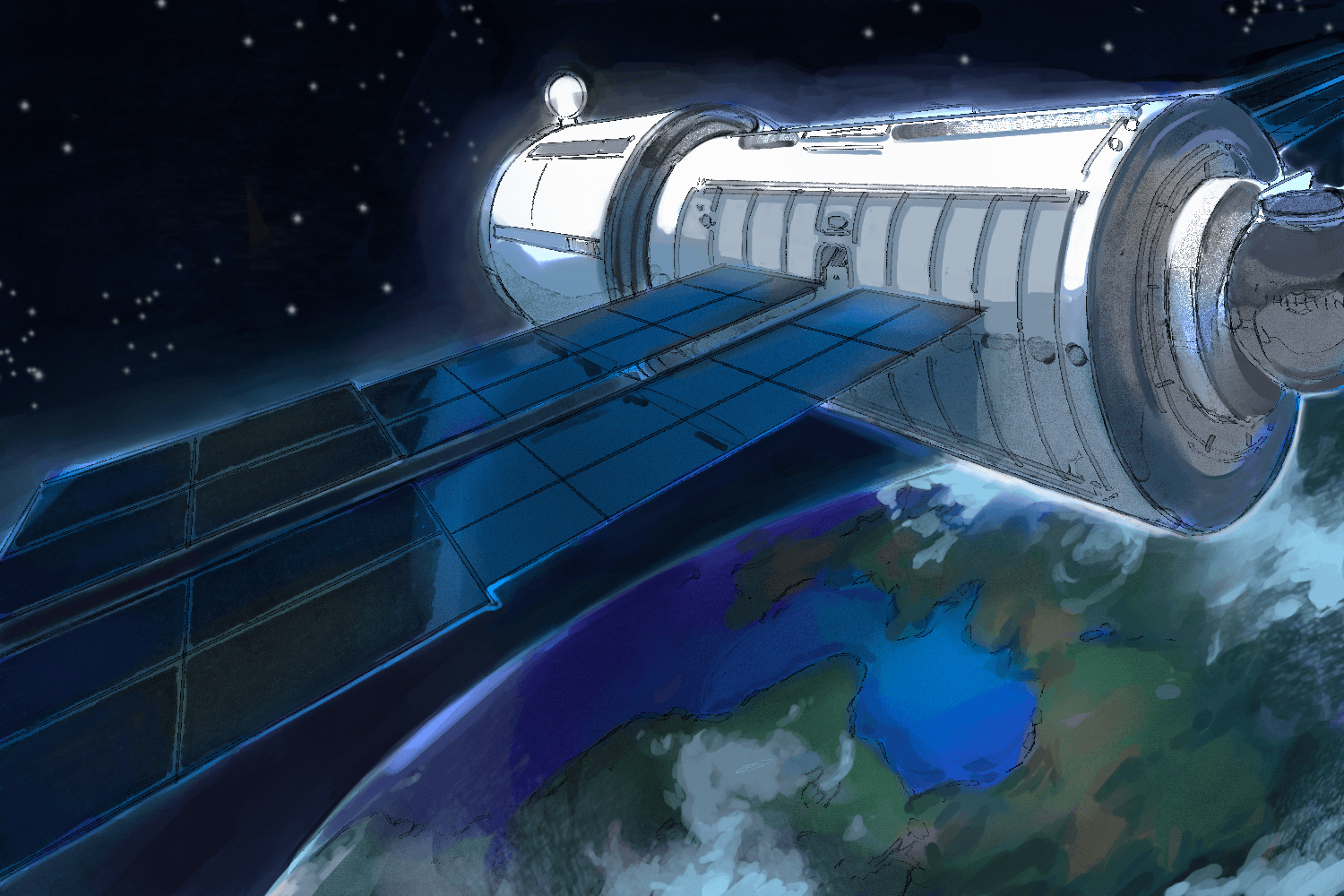
UC Davis team partners with Proteus Space to send the first-ever satellite equipped with a digital twin into orbit
By EKATERINA MEDVEDEVA — science@theaggie.org
When is your computer battery going to fail? Most people wouldn’t know an answer to this question — it could be in two years or two weeks. The most damage that you would incur if it were to suddenly fail would most likely be a couple of hundred dollars in expenses and maybe some missed assignments in the time it takes you to replace it.
However, in systems of greater scales where the stakes are much higher — in satellites, for example — knowing the answer to this question is crucial, and so is figuring out how one can adapt the manner in which the battery is used to address anomalies and prolong its performance.
This is where digital twins come in. The idea behind a digital twin is to create a virtual representation of the battery. The collected real-time data — such as electrical data (i.e. voltage), thermal data (i.e. cell temperature), performance metrics (i.e. energy efficiency) and environmental data, coupled with predictive models — enables monitoring of the physical battery’s health and performance, along with forecasting of its future conditions, according to an Amazon Web Services for Industries blog post.
Over the past year, a group of four graduate students at the Center for Space Exploration Research, led by Stephen Robinson, a professor of mechanical and aerospace engineering, along with Associate Professor Xinfan Lin, whose laboratory researches intelligent battery systems, collaborated with Proteus Space on a United State’s government-sponsored project to launch a satellite with a digital twin payload of the satellite’s battery.
“This project is the first time, at least publicly, that a digital twin has been flown in orbit,” Adam Zufall, the coordinator of the project on the UC Davis side, said.
Jackson Fogelquist, an UC Davis alumnus with a Ph.D. in mechanical and aerospace engineering, and Ayush Patnaik, a third-year Ph.D. student in Lin’s lab, developed algorithms of the digital twin that combine physics-based mathematical and data-driven empirical models to simulate the behavior of the battery. The team also includes Ansha Prashanth, a master’s student in computer science, who created the software to gather the battery data and allow the payload to communicate with the satellite.
“Oftentimes the power system is the determining factor of how long the spacecraft is going to last in orbit,” Zufall said. “So, if you can do a better job at managing your batteries by making better predictions and models, you will get more value out of your spacecraft, which is why we created this digital twin. But, in theory, it could be applied to other parts of a spacecraft as well.”
The payload harnesses machine learning capabilities in order to make a more dynamic model of the battery that learns from collected data over time, changing the weights it assigns to different factors and its calculation methods, resulting in more informed and accurate predictions about potential problems.
“The spacecraft was just handed over to the launch provider [two weeks ago], which is an exciting time,” Zufall said.
For the past four months, the spacecraft, which carries multiple commercial and research payloads along with UC Davis’ digital twin, underwent various kinds of tests, including environmental, vacuum and thermal testing to ensure it will survive its ride up to the orbit and will be able to operate in space as designed.
The launch is now scheduled to take place in November from the Vandenberg Space Force Base. The outcomes of this project have potential for applications to power systems beyond satellites, and the project itself is a testament to the fruitfulness of partnerships between researchers and enterprises.
“All the technologies we are working on, especially on the battery modeling side, could actually be useful for people working on electric cars, electric aircraft[s] — really anything with a rechargeable battery that could have higher levels of performance,” Zufall said. “I think it is a very good example of how universities and private companies can partner together. […] The U.S. government has a few different funding opportunities to support activities just like this, and I think it works well when you have universities doing science, because that’s what we like to do — we like to do things that people haven’t done before — and then have private companies use their resource of professional engineers to build a product.”
Written by: Ekaterina Medvedeva — science@theaggie.org