






We are paying the price for AI
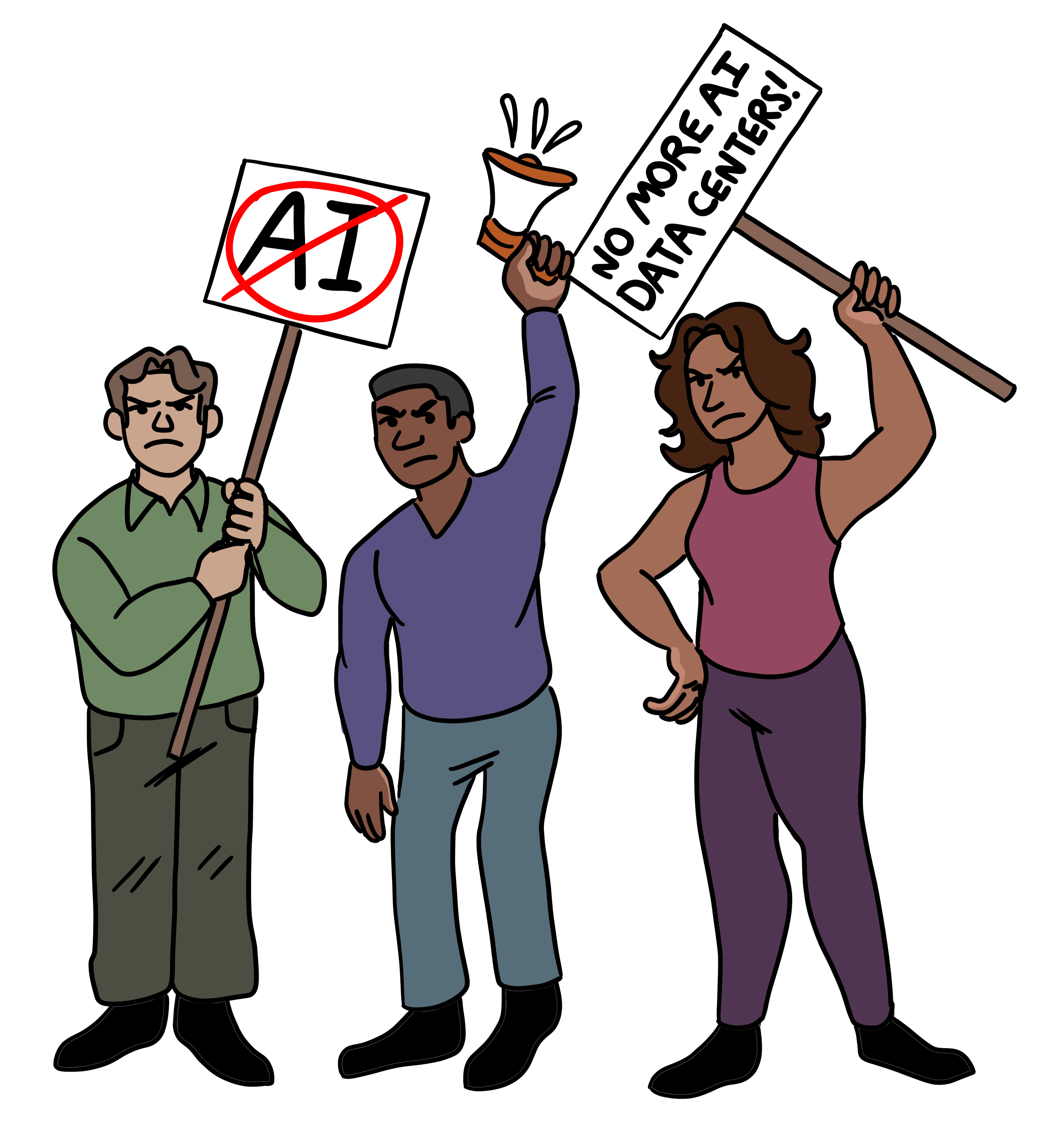
Grok, is this true?
By SABRINA FIGUEROA — sfigueroaavila@ucdavis.edu
From asking ChatGPT to write an email to directing xAI’s Grok to fact-check a Pop Base post on X, artificial intelligence (AI) has us in a chokehold.
Since the first launch of ChatGPT-3.5 in November 2022, generative AI has been integrated into our lives — willingly for some and forcibly for others. It was initially branded as magic, looped in with wizards and witches that can create anything out of thin air. The reality is that AI has as much magical power as the Wizard of Oz — with only a man behind the curtain operating a complex system, trained on our own data, that keeps the illusion of magic, novelty and power. Still, if tech companies continue their quest to sell it as so, let it be known that magic has its conditions and often comes with a price.
We don’t have to wait to find out what that looks like: It’s already here, and it’s affecting small, low-income and Black communities first, many of which lack the political power to significantly change the operations of tech companies and their data centers. It’s another wave of environmental racism — a regression in the name of “progression.”
Tucked-away in Southern Memphis, Elon Musk has built “Colossus:” a giant supercomputer that he utilizes to power his company, xAI, and the chatbot, Grok. In June 2025, the Southern Environmental Law Center found that Musk was operating 30 unpermitted methane gas turbines without any notice or regulation. Turbines such as these emit formaldehyde and smog-forming pollutants, increasing risk of asthma, heart disease and cancer.
If that isn’t unethical enough, the surrounding area is predominantly made up of Black communities that have historically experienced environmental injustice and industrial pollution. The city closest to the xAI data center, Boxtown, for example, already has an average cancer risk four times the national average.
Luckily, both the National Association for the Advancement of Colored People (NAACP) and Southern Environmental Law Center (SELC) have decided to sue Musk over this. However, a recent study from scholars at the California Institute of Technology (Caltech) and UC Riverside found that other communities all over the U.S. are still suffering from the emissions of fossil fuels burned to power AI.
Carbon emissions travel from one area to the next, affecting communities, people and ecosystems beyond those local to the data centers. If we do not enforce limitations upon these Big Tech companies and we continue to use AI like a harmless toy, the consequences will soon catch up to us. Although society may discriminate, climate change does not. One minute it’s directly affecting people in a far-away community, the next minute it’ll directly affect you.
The high energy demand, along with the mass amounts of water consumption necessary to sustain data centers, are expensive. Not for the tech companies, but for community members in the surrounding areas.
Tech giants like Google, for example, are securing deals with utility companies that help them save money and make more profit. Just last year, Google scored a deal in South Carolina that allowed them to “pay less than half the rate that households pay for electricity,” according to an article by Capital B. This “deal” forced local households to cover the remaining cost through their own utility bills.
Every year, generative AI has the potential to drive a racial economic gap by $43 billion, with low-income and predominantly Black communities having to pay for AI’s giant mess — both environmentally and financially. Generative AI has become an environmental issue, a public health issue and a social issue. As we continue to use AI as a search engine, an artist for lack-luster art, a writer for discussion posts we’re too lazy to write and more, we must ask ourselves: Is it worth it?
Big Tech and billionaires, like Musk, sell us magical supercomputers designed to help us, but it’s all a facade to make them more money at the expense of our health, critical thinking and literacy skills, communities and financial well-being. If you think for a second that companies in a capitalist society only have the goal to help the masses, think again. Their main concern is not people, it’s profit.
Before it’s too late, we must demand regulations on AI and Big Tech companies and hold ourselves accountable for abusing generative AI as more than a tool; for the sake of human lives and the planet. AI can’t save us time if there isn’t any more time left to save.
Written by: Sabrina Figueroa — sfigueroaavila@ucdavis.edu
Disclaimer: The views and opinions expressed by individual columnists belong to the columnists alone and do not necessarily indicate the views and opinions held by The California Aggie.