






For one night and one night only
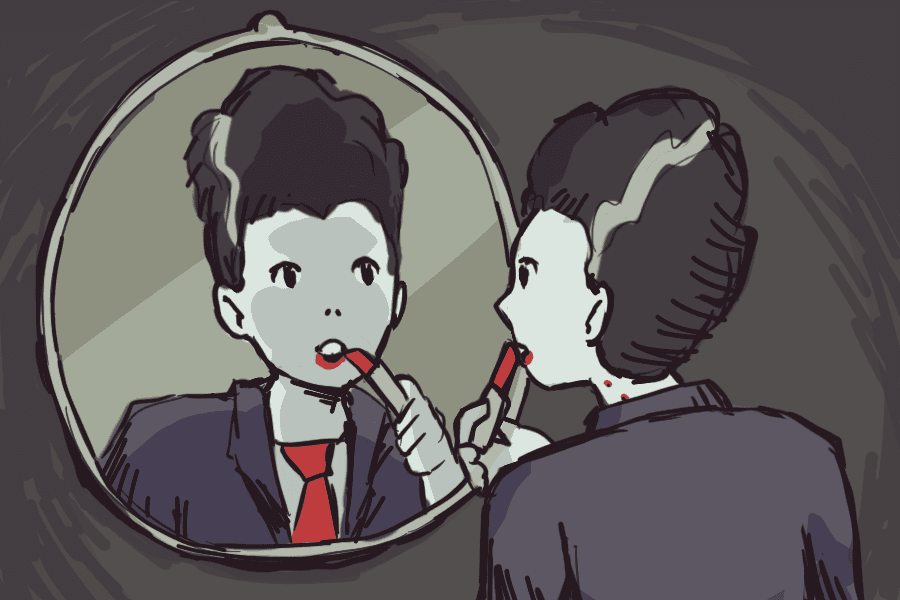
Halloween costumes as a space for positive escape
By VIOLET ZANZOT — vmzanzot@ucdavis.edu
Lately, I’ve been thinking a lot. One might even say I’ve been overthinking: If I could escape this perpetual noise, if I could cease the racing thoughts, what would I be? Who would I be? How would I transform?
My character could wear high heels, angel wings, a witches hat — she could be anything and everything. That is the power of costume. My theory about this magic is rooted in something real.
For one day every year, our society has decided that it is socially acceptable for a boyfriend and girlfriend to be Brennan Huff and Dale Doback from the “Step Brothers,” for Heidi Klum to be the ogress Princess Fiona or even a UC Davis student (me, in my first year) to be Captain Underpants. Of course, we can be anything we want on any day (or that’s at least what some optimistic mothers may say), but there’s something special about Halloween. Our only limits are our creativity and our own inhibitions.
This one day — dedicated to the outrageous, the gory, the fanciful, the whimsical, the horrifying, the beautiful, the royal, the dainty, the bold, bashful, sleepy, dopey and everything in between — is a gift we should treasure: just like the pirate you dressed up as for your very first time trick-or-treating treasured their precious riches.
Annually, Halloween provides a unique chance for you to become something entirely different from your everyday persona and explore a new part of yourself by donning elaborate attire. In childhood, the appeal of the holiday lies in the candy hunt kids engage in before the classic, and almost war-like, candy exchange. Once you graduate from the age where the best part of the night is swapping Hershey’s bars for Sour Patch (or vice versa, if you’re anything like me), the excitement centers more around the chance to become something new; even if just for one night. In this way, a costume is an avenue for transformation.
Anthropologist Hilda Kuper explored the connection between costume and identity. She explains how costumes have historically been deliberately used to indicate status and identity. She broadly connects social changes over time with changes in style and fashion. The narrative she substantiates explains a connection between dress and attitude, behavior, public perception and perception of the self — all of which come together to demonstrate why clothing is symbolic of identity. Kuper writes: “given the critical importance of clothing as an expression of an individual’s social identities, origins, commitments, and allegiances, it is no wonder that persons should view their clothing almost as an extension of themselves.”
Clothes create qualities. They build personas. They wear us as much as we wear them — they symbolically tell the world the same story we tell ourselves. What we wear changes how we think about ourselves and how others think about us. These phenomena seem to be correlated and causative of each other: wearing high heels might make a person taller, but more importantly, high heels have the ability to make a person stand tall — to be confident as they strut every step as if on a runway.
The deep importance of costuming has been lost in collegiate culture. There’s an expectation that girls need to use Halloween costumes as a time to cater to the male gaze, and in an attempt to fulfill this standard, we start to miss the point of dressing up in the first place. It’s not that there’s anything wrong with wanting to look attractive, but Halloween gives us an opportunity to adopt a character that we don’t get to embody everyday — to really be creative with our dress and tell a unique story.
This is why I think the goal of Halloween should be to become something we can’t be in our everyday lives. Be hot because that’s how you always are, but dress in costume to take on a new identity that serves and empowers you; not anybody else.
Written by: Violet Zanzot— vmzanzot@ucdavis.edu
Disclaimer: The views and opinions expressed by individual columnists belong to the columnists alone and do not necessarily indicate the views and opinions held by The California Aggie.