






Why and how do we look for alien life?
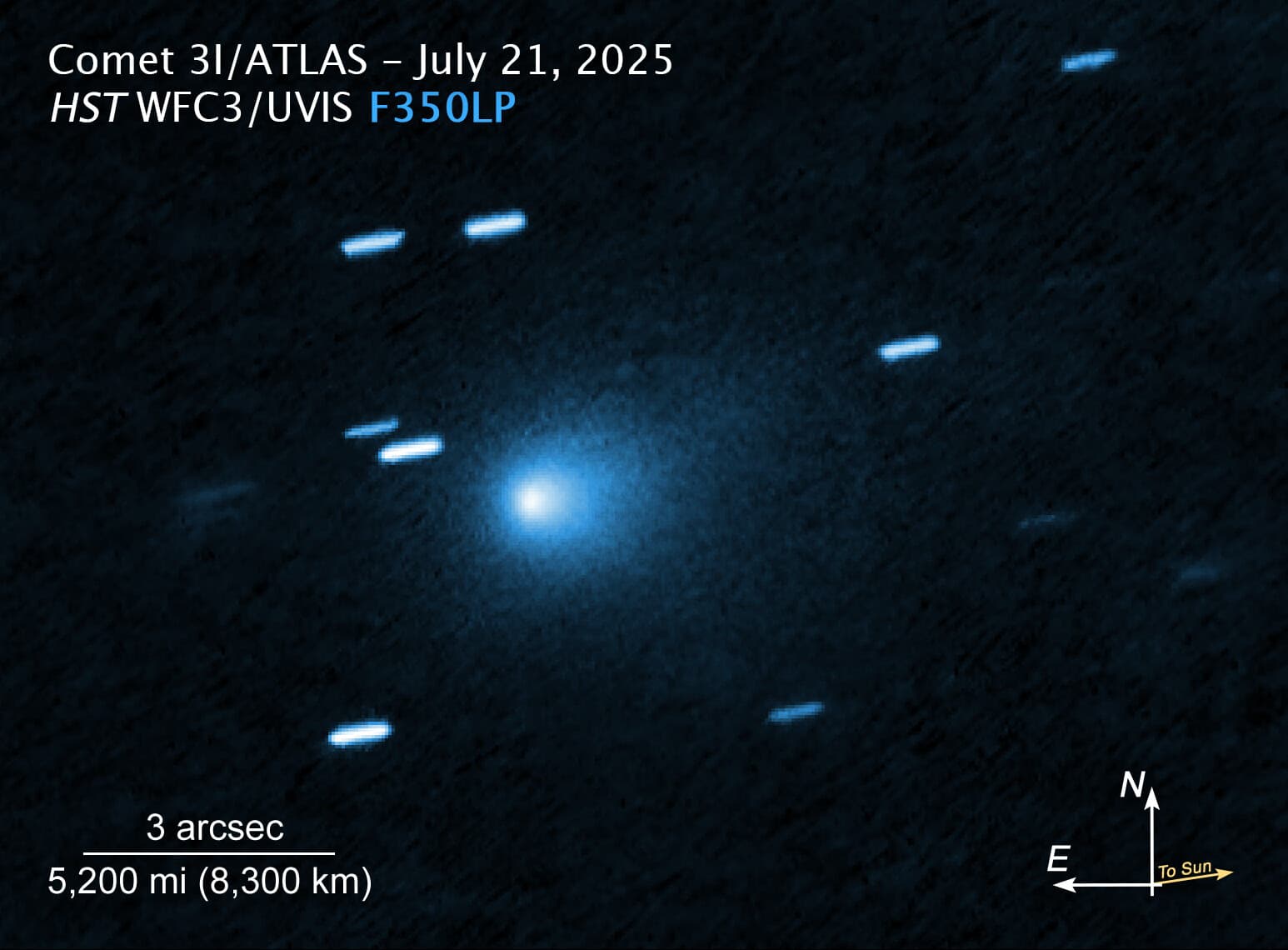
Unidentified objects appear in the sky, like 3I/ATLAS, offer insight into the key signs of life that scientists look for
By EMILIA ROSE — science@theaggie.org
We have insects, birds, fish and even intelligent, bipedal mammals right here on Earth. But what could be beyond Earth? The likelihood of extraterrestrial intelligent life has been subject to the Drake Equation, a formula calculating the probability of intelligent life in the Milky Way. On the other hand, the fact that we haven’t found anything has been subject to Fermi’s famous Paradox, which highlights the dissonance that is found in the absence of extraterrestrial life. However, what if extraterrestrial intelligence has been closer than we thought?
In July, scientists detected a massive interstellar object, designated 3I/ATLAS, on an orbital path towards the Sun. Harvard Researcher Avi Loeb and his team have published a paper, not yet peer-reviewed, discussing the idea that this object could be an alien probe. Is there any truth to that?
To determine the answer to this question, we need to look at the methods we use to detect alien lifeforms and their possible spaceships. In an article from Science Daily analyzing Loeb’s findings, the author, Sara Webb, detailed some of the ways we might detect an alien probe.
“Because a natural origin is most likely, we would look for evidence that no aliens were involved. One clue in this direction might be if the object were emitting a ‘tail’ of gas in a way that comets do,” Webb’s article reads. “One very strong piece of evidence would be any kind of radio waves coming from the probe […] Another dead giveaway would be signs of maneuvering or propulsion.”
In regards to 3I/ATLAS, although he covers many sides of his argument, Loeb notes a few reasons why the object might be of natural origin, rather than an engineered probe.
“The object must be around 20 kilometers in diameter […] and as of writing, the Minor Planet Center does not provide estimates of non-gravitational accelerations for this object,” Loeb said. “It should be noted that for interstellar objects, we have a sample size of only three, therefore rendering an attempt to draw inferences from what is observed is rather problematic.”
Thus, it is unlikely that 3I/ATLAS is an alien spacecraft. It is not only the size of a small moon, but it has shown no signs of artificial propulsion and it is difficult to compare it to other objects that come from beyond our solar system with only a couple of known cases.
If 3I/ATLAS isn’t a sign of life, what is? How do we look for extraterrestrials in our universe? Dr. David Gold, a professor of geobiology at UC Davis, speaks on the key things we analyze when looking for alien life.
“You need the building blocks of life […] You need things like proteins, you need amino acids. Those things need to be present,” Gold said. “You need water because water drives the chemical reactions that drive life […] And those are common in many places throughout the solar system and throughout the universe.”
Even though many are curious about large spaceships that could be coming in Earth’s direction, the same basic building blocks that scientists assume make up life on Earth are what really guide the search for life elsewhere. Among the things scientists consider are atmospheric composition, temperature and many other indicators. Yet, another question remains: What do we do, and how would we react if we actually detect something? How can we even know if the evidence we find is legitimate?
One such tool to categorize evidence in terms of the likelihood of alien life, and what the organization Search for Extra Terrestrial Intelligence (SETI) would use to notify the public if alien life were found, is the RIO scale. In simple terms, the RIO scale uses final values from zero (no significance) to 10 (extraordinary) to determine the likelihood of an observed event caused by intelligent extraterrestrial life. When the calculation was performed on 3I/ATLAS, it yielded a one (insignificant) on the RIO scale.
Based on several factors, 3I/ATLAS is unlikely to be anything more than an interstellar asteroid. However, Loeb’s initial reaction to it is enlightening for all of humanity; we continue to form fascinating questions about the objects we observe in our universe.
Written by: Emilia Rose — science@theaggie.org