






Artist Felipe Baeza discusses the complexities of his work and identity with UC Davis Assistant Professor Ruben Zecena
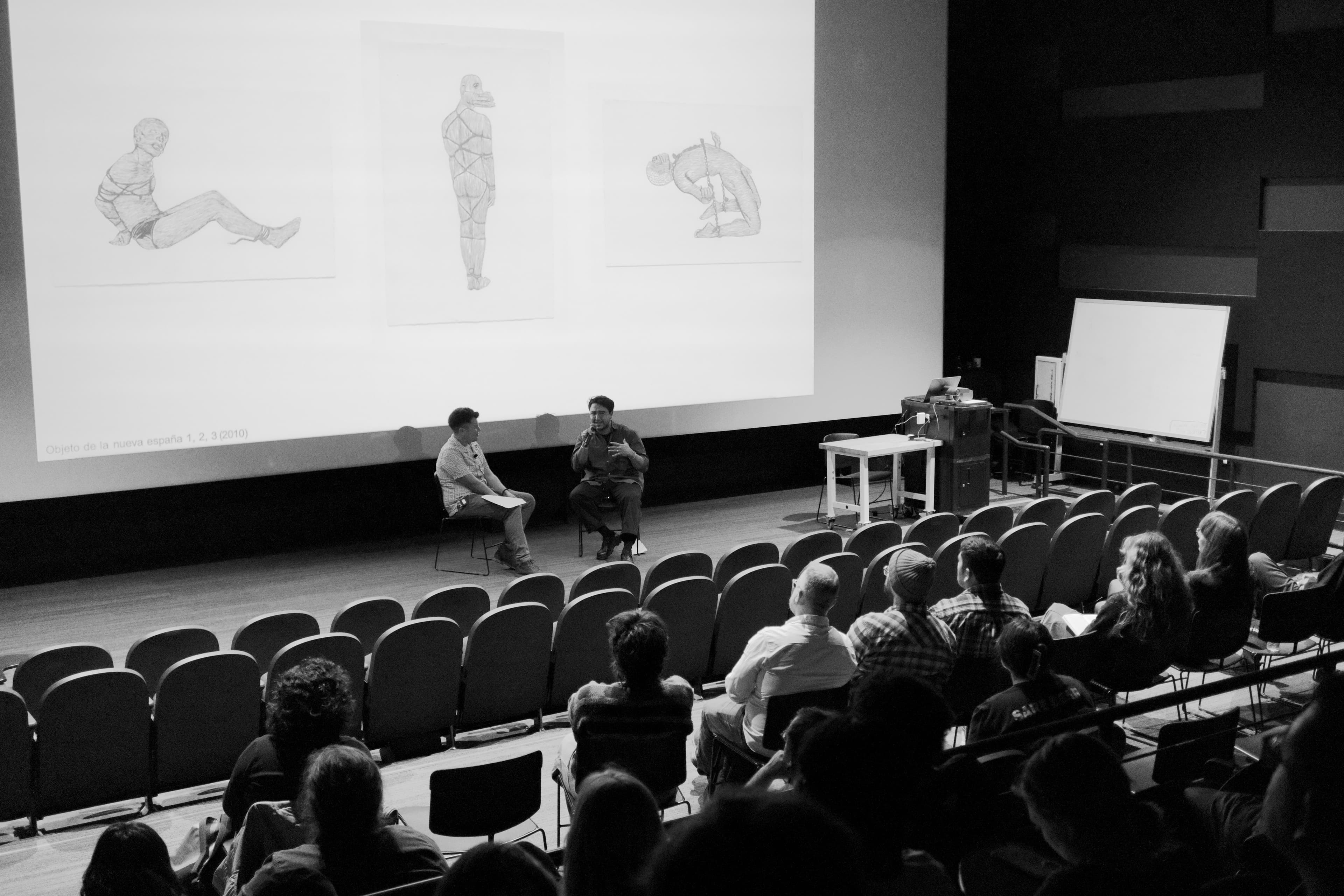
The Brooklyn-based artist describes his career and creative process at the November Visiting Artist Lecture
By JONAH BERMAN—arts@theaggie.org
On Nov. 6, the Maria Manetti Shrem Art Studio Program hosted its latest installment of its annual Visiting Artist Lecture Series, bringing Brooklyn-based artist Felipe Baeza to Davis for a discussion with Assistant Professor of English Ruben Zecena at Cruess Hall.
Baeza’s work combines a variety of media to create layered, fragmented pieces that are visually arresting. With seven solo exhibitions under his belt, Baeza’s works have been showcased at museums such as the Los Angeles County Museum of Art and the Whitney Museum of American Art. Born in Mexico and raised in Chicago, he received a Bachelor of Fine Arts (BFA) from The Cooper Union for the Advancement of Science and Art and a Master of Fine Arts (MFA) from Yale University.
Zecena’s research focuses on contemporary Latinx literature and culture and is influenced by his experience as a formerly undocumented queer migrant. Zecena explained the process by which he became acquainted with Baeza and his work.
“I actually start my book [‘Impossible Possibilities: The Unruly Imaginaries of Queer and Trans Migrants’] by writing about one of Felipe’s pieces,” Zecena said. “In the process of publishing the book, I need[ed] to obtain an artist’s permission, so this summer I emailed Felipe.”
When The Art Program approached Baeza about giving a talk on campus, he suggested having an open discussion with Zecena, rather than a more traditional lecture.
“Felipe’s work is really unique, particularly [in] what it does with its medium,” Zecena said. “In terms of queer migrant artists, it’s not always often that they are included in art spaces.”
During the event, one topic of discussion was the role of art in challenging American norms and structures. Art engages in its own form of “worldmaking” and “embraces the refusal to belong” according to Baeza. Baeza’s work challenges norms about the body, queerness and nationality.
Along these lines, the pair discussed the “queer migrant imaginary,” a concept covered in the work of both speakers. Baeza specifically said that while he didn’t want to glorify the challenges that immigrants in the United States face, it was important to focus on the ways in which they are able to thrive, even in the face of hardship.
“I don’t want to run the risk of romanticizing those conditions, but that’s the reality of many of us, that we have to continue to find joy under these moments of threat,” Baeza said.
Simultaneously, many of Baeza’s pieces resist one singular interpretation. Baeza and Zecena thoroughly discussed the frequent pitfalls of “lazy” art analysis, which they feel minimizes work, often by minority artists, into only having a singular meaning. Ignoring the intricacies a work might depict, viewers may solely focus on the content they can get out of a piece.
Baeza also mentioned his interest in how museums and galleries across the U.S. describe him differently, reflecting on the various perceptions of him and his art that exist.
“The work has now gone to institutions, and they’re trying to figure out what this is,” Baeza said. “Is this a print? Is this a work on paper? Is this a painting? And I like that conversation.”
The variety of meanings and analyses that can be applied to Baeza’s work mirrors itself in the physical attributes of the art. Trained in printmaking, Baeza’s oeuvre contains many works with a plethora of physical layers.
“Every surface you see is made through a monoprint process that then is collaged together,” Baeza said.
One subject, which Zecena noted frequently reappeared in Baeza’s work, is commentary on the body and fleshiness. For example, Baeza’s “Unruly Forms” series centers on the depiction of humanoid, yet supernatural, bodies situated against abstract backgrounds.
“I’m depicting figures that are vessels and containers of these histories,” Baeza said. “I work primarily on paper, and I love how paper functions, sometimes, as skin.”
Furthermore, Zecena and Baeza both cited their affinity for the work of Gayatri Gopinal, a queer and feminist studies scholar who formerly taught at UC Davis before taking her current position at New York University. Gopinal’s concept of “states of suspension” worked as a useful companion to ideas presented in his work, according to Baeza.
Zecena, who teaches a course titled “Ghosts and Racial Hauntings,” inquired about the influence and meaning of the supernatural and spiritual in Baeza’s work. The artist cited his Catholic upbringing as an influence, and one that often crept up on his work without him realizing.
“I found them fascinating,” Baeza said. “I think [about] the role of how the body was portrayed, how flesh was portrayed. For a long time, I didn’t see the connection, and unconsciously I think that’s been [shown] in [my] works.”
The pair also discussed the importance of community and care networks in contributing to their accomplishments.
“From the outside it might look like I got here by myself, but that’s not the case,” Baeza said. “There’s been collective care since the beginning that [has] allowed this to happen. But I think it’s also showing up for other people too, right? And that’s where I speak about these architectures of care that sustain me and sustain the work.”
Specifically, Baeza spoke about how immigrant care networks allowed him and his community to thrive both during his time in Chicago and presently in Brooklyn.
Before the talk, Baeza had also spent time discussing his work with UC Davis MFA art studio students. With many budding artists in the audience, Zecena asked Baeza what helped him develop his unique style and perspective. In a time when the ways in which others perceive art is so critical, Baeza noted, it’s vital to make some art that is solely for oneself. Baeza also spoke significantly to the importance of failure, even when that may not result in immediate gratification.
“If I have one piece of advice to students, it’s to stay weird and fail productively,” Baeza said.
Written by: Jonah Berman—arts@theaggie.org