





What makes Donald Trump’s rhetoric so effective?
UC Davis professors and students discuss Trump’s persuasive techniques
By GRACIELA TIU — features@theaggie.org
Throughout both his campaign and his presidency, President Donald Trump, arguably one of the most polarizing figures in America, has proven his ability to appeal to his base: drawing support from his followers while alienating those outside of it.
His rhetoric often draws on populist themes, portraying himself as a representative of the people in opposition to an established elite. He highlights himself and his supporters as victims of various political opponents and establishments, consistently reminding his followers of the various grievances he faces. In a nationalist sense, he emphasizes patriotism, a sense of national identity and a specific air of American exceptionalism.
Critics argue that his rhetoric taps into themes of authoritarianism, centralizing his own authority above the institutional and democratic norms of American politics in order to suppress his perceived opposition and maintain control. These overarching concepts of populism, nationalism and authoritarianism are present within each and every one of his speeches, social media posts and actions, and can help explain why his rhetoric resonates so deeply with his supporters and how it supports his media strategy as a whole.
Trump also uses specific psychological and emotional drivers to persuade his audience, including fear, anger, pride and loyalty. Utilizing fear as a political tactic works especially well because it can motivate a sense of urgency in the public, thus influencing their behaviors and opinions.
UC Davis Communication Professor Supreet Mann, who teaches the course “Theories of Persuasion,” discussed the role of fear in political campaigning strategies.
“Fear, in order for it to effectively persuade, really needs to fit into a kind of ‘Goldilocks zone’ of fear,” Mann said. “Too much fear, and people will be too focused on calming themselves down. Too little fear, and they just don’t care enough. One thing that Trump does very well is bring in [a] kind of a perfect Goldilocks [zone] of fear campaign and provide really clear and tangible solutions for how to combat the fear.”
The use of anger also works well for Trump, as it energizes his voters and encourages media engagement — especially when he invokes it to discuss threats or opposition. Pride and loyalty function similarly when he uses language emphasizing nationalist or patriotic ideas, creating a sense of belonging and reinforcing collective identity.
Audience identification can also work well as a psychological driver and rhetorical strategy. UC Davis Professor Emeritus of English Don Abbott, who specializes in rhetoric and rhetorical theory, explained the concept.
“I think he’s had a good feel for what his audience wants — their prejudices, their fears, their hatred,” Abbott said. “[There] is the notion of identification — that you are persuasive if you can identify your ways with other people’s ways, so you identify with your audience. And again, Trump is very good at that, which is strange because he’s really not like his primary audience.”
Trump also consistently reminds his audience of his authority, dominance and power, which can also work to further his credibility. Mann explained how the two concepts of audience identification and authority can work together.
“Authority is a really fundamental element of credibility, but credibility has so many elements,” Mann said. “There’s goodwill and social attractiveness. I don’t know if he has every other element, but I think authority is one that’s really relevant for some audiences, depending on how they view authority. […] What really matters then, from an audience perspective, is what matters to his audience — and how he shows authority in those spaces.”
The president, whether intentionally or intuitively, incorporates these broader themes of populism, nationalism and authoritarianism — along with the psychological drivers of various emotions and his audience appeals — into his messaging and rhetorical techniques.
Trump’s signature style is both aggressive and confrontational, using violent language, interrupting interviewers and mocking his opponents, according to Abbott. These choices reinforce his anti-establishment narrative and aim to invoke feelings of anger in an attempt to remind his audience of his self-perceived dominance and authority.
“Part of it is it deflects criticism,” Abbott said. “Instead of answering, he always engages in some kind of personal insult and gets people to defend themselves rather than continue to ask him questions. I think that’s been particularly effective for him. And once again, I suspect it’s more intuitive than strategic.”
Trump also uses simple language, repetition of slogans and branding as rhetorical devices to promote a sense of pride and loyalty and identify with his audience, according to Mann.
“Slogans overall are most effective when they are easy to understand, are repeated in a way that helps solidify them and don’t require a lot of cognitive energy,” Mann said. “They’re not very cognitively complex; they don’t require a lot of effort to break down and understand the message. The more it’s repeated, the more likely we are to recall it, and the more likely we are to think favorably upon it.”
Another common aspect of Trump’s media presence is his tendency to use hyperbole and dramatic framing. This can tie into the simplified messaging and also work as an attention-grabbing tool, according to Abbott.
“I think it becomes entertainment for [his audience],” Abbott said. “And I also think now he’s become so established as this kind of character, like a clown. I don’t think they expect anything else. They don’t go expecting a clear political presentation. They just go for reinforcement — to see what he does and be reminded of the kinds of dislikes he has.”
A particularly important aspect of Trump’s rhetoric includes his efforts in othering and scapegoating, according to Abbott. This concept can manifest in xenophobia and the use of hate speech, stereotypes and harmful tropes.
“I think the one that he relies on, the one that’s often quoted or cited in rhetoric studies, is the concept usually called scapegoating — identifying a particular enemy, placing all of a group’s problems and ills on that one group,” Abbott said. “Clearly, the primary scapegoats are immigrants, particularly Latino immigrants, although other immigrants will do. […] But that seems to me probably may be his dominant strategy. And again, it’s, as I say, a very old and common one.”
Abbott detailed how identification and scapegoating can work in tandem, and how he sees these devices in Trump’s rhetoric.
“I think the biggest part is — I heard someone say this after he was elected the first time, explaining why he was popular, and the line was: ‘He hates who they hate; And I think that’s true. I think that’s part of the identification,” Abbott said. “You know, he can tap into this latent racist tendency in American life and say, ‘Okay, these are the bad people. They’re doing it to you. It’s not your fault.’ And that’s obviously appealing to people who think they’re not doing as well as they should be doing.”
Trump also frequently makes false claims about opponents, elections, policy and the media as a whole, often delivered confidently and simply. Spreading misinformation works to reinforce fear in his base, allowing Trump to display his control over the narrative through his perceived authority and pull in media coverage and attention.
“I think the main thing I see is he’s stating a lot of things as facts that, if you did some further digging, or just a simple Google search, you would find out are untrue,” Eliana Shor, a third-year managerial economics major, said. “I think people go to him as a news source, so he has a lot of power, and he’s misusing that.”
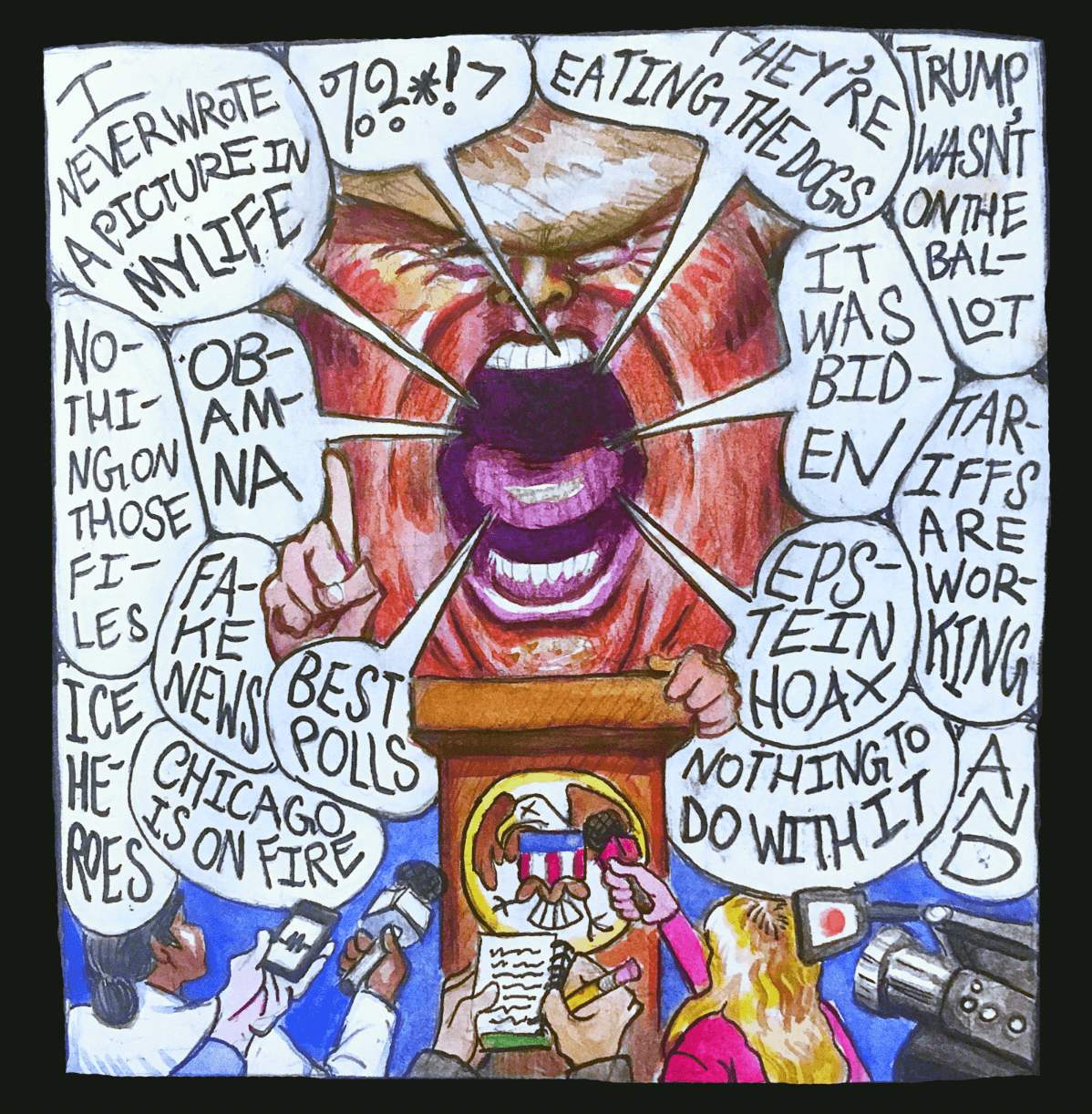
A final, yet especially prevalent, feature of his rhetoric is his frequent rule-breaking and his unorganized messaging structure, which some refer to as “the weave.” An Associated Press News article, written before the 2024 election, described the typical formatting of this speech style.
“Trump’s speeches, while never the same, all employ consistent devices and themes,” the article reads. “He wields humor, braggadocio, anecdotes, grievances and grand promises. There are non sequiturs, fantastical falsehoods and withering attacks on opponents. He sprinkles in vulgarities and superlatives. There are even the occasional stints read from the teleprompters he mocks when any other politician uses them — and then claims that he doesn’t use teleprompters or doesn’t need them.”
Mann described how this break from the typical expectations of political rhetoric can actually work in Trump’s favor.
“Because he’s not viewed by his audience as a typical politician — because he had success outside of politics — there’s a sense that he’s chosen to come into this space and break the mold of what it means to be president,” Mann said. “And that’s what’s so appealing to his base — [Trump is] not like every other president. Because he doesn’t have that experience, he’s seen as something new and different. That’s part of the appeal.”
All of these rhetorical themes, drivers and techniques serve a greater political strategy, which can be referred to as “flooding the zone,” according to political scientists. With the constant, seemingly never-ending controversy surrounding the president — whether through statements, speeches, actions or posts — the media and his opposition can become overwhelmed and distracted, often struggling to cover the sheer amount of content at hand. This can lead to topics being remembered for shorter periods of time, and eventually being forgotten.
“You can’t really track all those points in any reasonable way,” Abbott said. “I think [Trump has] always been undisciplined like that. I can’t tell if it’s really a strategy or just the way he operates. But it clearly works.”
Analyzing Trump’s rhetoric can help voters understand the underlying forces of his political influence. Studying his methods of political communication can clarify why his message resonates with so many, challenging both his supporters and critics to question their own responses to his statements. It also raises important questions about how the media can best report on the president in an unbiased way, while still recognizing the intention and impact of his language.
Written by: Graciela Tiu — features@theaggie.org