






From songbird to falcon, bird siblings help teach one another new techniques
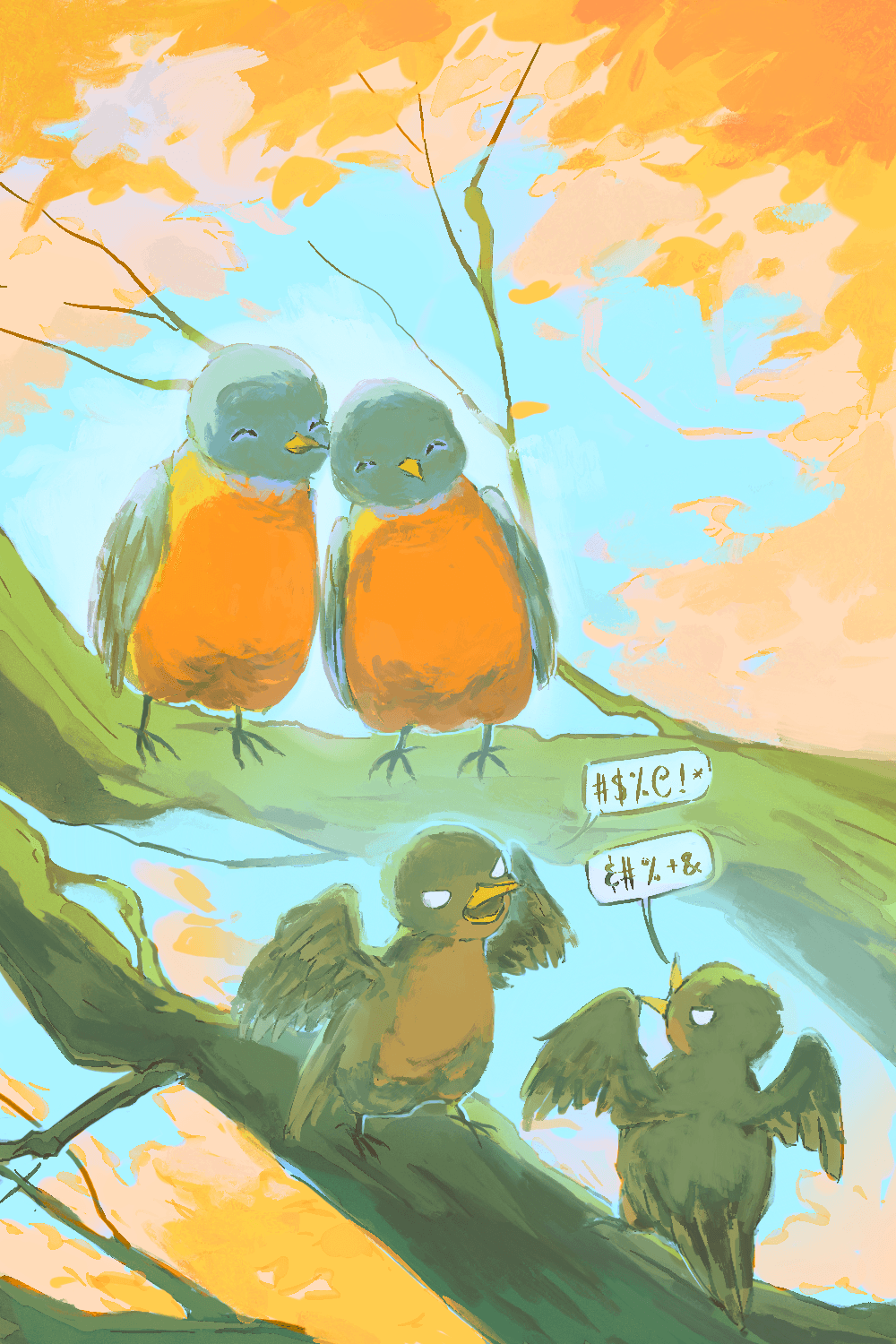
Recent research highlights a songbird species’ beneficial relationship with their siblings, a trait that also presents in falcon sibling relationships
By KATELYN BURNS — science@theaggie.org
While cooperative relationships with siblings aren’t always the norm, in a study published in peer-reviewed journal Public Library of Science (PLOS) Biology on Oct. 9, 2025, a songbird species’ relationship with their siblings was found to benefit their foraging skills.
The great tit, or Parus major, the species the study looks at, makes for a good model species. The bird is well-researched, receives limited parental care and has observable social networks — an important trait for studying social learning. Social learning is any learning through observation, and involves strategies on when, who and what to copy.
The author of the study, Dr. Sonja Wild, is a behavioral ecologist and research associate at UC Davis. She explained what she found regarding the great tit’s sibling relationships.
“In a previous study looking at how social associations change during transition to independence in this species, we have shown that juveniles initially continue preferring to associate with siblings, even after they have become independent from their parents,” Wild said via email. “Our current study extends these findings, demonstrating that the close proximity among siblings provides opportunities for them to learn behaviors from one another.”
Of course, sibling relationships vary greatly. Not all bird species will have cooperative interactions; some might be more antagonistic. Lynn Schofield, a biologist for the Institute for Bird Populations, was able to comment on some of the different ways birds interact with their siblings.
“There is a very broad variety of relationships that birds can have with their siblings; there are some species where the norm is siblicide [where one sibling kills another],” Schofield said.
For most raptor species, sibling relationships are antagonistic and siblicide is common. Falcons — one of the species Schofield has spent the most time interacting with — are a notable exception, being uniquely close to their siblings.
Falcons are very different from the great tits. They have smaller clutches and receive more parental care, which also impacts their sibling relationships.
“In species with extended parental care, parents are often preferred sources of information, leading to stable intergenerational transmission of knowledge,” Wild’s study reads. “However, little is known about transmission pathways in species with limited periods of parental care.”
Great tits are species with limited parental care. There are other differences between great tits and falcons, despite both displaying cooperative — but still unique — sibling relationships. For example, unlike the great tits’ foraging behaviors, falcons’ basic hunting behaviors are innate.
“[Falcons] that are raised in captivity, and do not have an adult that actively taught them to hunt, will learn to hunt,” Schofield said, with regards to falcons’ ability to learn hunting behaviors without parents or other adult birds.
The falcon’s basic hunting strategy is to locate a target and drop on it at high speeds. While their basic hunting skills might be innate, siblings can help one another perfect those skills. Falcons have been recorded playing with their siblings in ways that mirror hunting behaviors.
For great tits, their siblings help them learn foraging skills via social learning. In Wild’s study, puzzles were used to represent foraging behaviors. Wild explained how puzzle boxes correspond to natural foraging behaviors.
“During foraging, great tits often have to move foliage aside and sort through leaves with their beaks to find food items such as seeds or insect larvae,” Wild said. “In urban settings, they are also often required to modify the motor patterns they use for foraging in natural settings to access anthropogenic food such as trash or garden feeders.”
Different species and goals require different learning strategies. Whether experiential learning through practicing hunting with siblings or social learning through observing siblings’ foraging skills, these relationships are certainly something to consider.
Written by: Katelyn Burns — science@theaggie.org