Artists Diane Williams and Maryann Steinert-Foley investigate persistence and the human experience
By IQRA AHMAD — arts@theaggie.org
From Dec. 12 to Feb. 1, “The Realm of Possibility” is on display at the Pence Gallery, located on 212 D Street in Downtown Davis. Featuring works by Diane Williams and UC Davis Alum Maryann Steinert-Foley, the exhibition explores themes of “persistence, generosity, and unseen forces that sustain both nature and humanity,” according to The Pence Gallery website.
The Pence Gallery — which is celebrating its 50th anniversary this year — has long served to present exhibitions by both emerging and established artists, featuring works that engage with various contemporary issues.
Previously hosting exhibitions like Erica Norelius’ “Natural Places and Urban Spaces,” which showcased the intrusive presence of man in various landscapes, and Darrci Robertson’s “Playful Awakening,” which highlights the various roles of women, the Pence Gallery is no stranger to displaying works that examine the complexities of the human experience.
“The Realm of Possibility” continues this tradition through the pairing of two artists whose works differ in form but converge in their efforts to explore a multitude of themes; ranging from how femininity weaves nature’s story across time to the presence of politics in shaping society.
With 30 years of exhibition experience, Williams’ pieces are marked by their fluidity, which is created through a vibrant color palette and expressive, masterful brushwork. Working across a variety of mediums — including paint, oil sticks, ink, textiles, book pages, pencils and collage — Williams creates layered, multidimensional works.
“Multiple layers chronicle what is concrete and what is illusive,” Williams wrote in her online artist biography. “Erasures remind us that nothing is permanent, yet everything leaves an impression.”
Through these techniques, Williams aims to abstract the complex human emotions that people experience and connect it to nature — to the roots and branches of society — which she believes is crucial to creating her work.
“It’s important to put your hands into the Earth,” Williams said. “My attention has turned to roots and branches; roots are the quiet, essential structures that anchor and reach, whereas branches stretch toward the light. They remind me of the hidden networks that sustain life both in nature and in community. This series draws from the concept of grassroots and the power of ordinary people to grow and change from the ground up.”
Her process embraces accumulation and erasure, revealing traces of what has been added, altered or removed. When in the process of creating something, Williams emphasized that she has a conversation with her work, listening to what speaks to her.
“The work is pulling me along, guiding me,” Williams said. “The paint takes me on amazing journeys. I make a mark and I respond to the mark and then I make another mark, it becomes a dialogue.”
Through this approach, Williams encourages viewers to wonder about what can be known or fixed, encouraging reflection on the ways memory, perception and conversation continually change over time and space.
Williams also mentioned that her pieces are heavily inspired by travel and the power of listening, both of which shape the trajectory of her work.
“I had a trip to China in 2001 and that was a huge influence on my work; the empty space and tension between the objects became really important to me,” Williams said. “I [also] lived in Jamaica for 10 years, and I listened to Reggae music that instilled a colorful rhythm into my work. You ride on the rhythm, it doesn’t follow a rigid beat and I use that change of direction with painting.”
Williams’ works focus on using the canvas to express generational stories and accounts.
Her paintings present the role of women and elders as “holders of our collective intuitive lineage,” according to Williams.
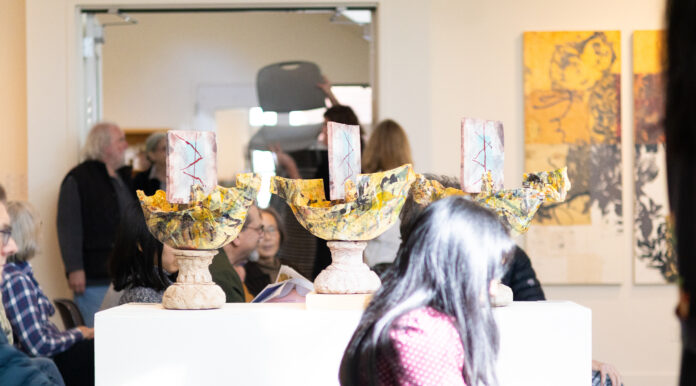
Steinert-Foley’s work, meanwhile, takes on a more conceptual approach. Although Steinert-Foley is best known for her clay sculptures, she also creates paintings and drawings. Her work often conjures manifestations of social issues into provoking, tangible figures.
“When I was making ‘My Choice Not Yours,’ I was heavily influenced by politics and the news to start a conversation with my audience,” Steinert-Foley said.
Steinert-Foley aims to address the influence of religious doctrine on reproductive choice and bodily autonomy through her sculpture series, “My Choice Not Yours,” which is featured in the exhibition as a three-dimensional work.
“Its more important to me when the viewer tells me what they get out of the work that I do,” Steinert-Foley said. “When an elementary school visited, a boy went up to the piece ‘Blue Strider’ and I was floored by his observation of the piece as this ocean, moving forward, going from one shore to another.”
These observations by viewers reflect the emotions and physicality Steinert-Foley places into her work through movement and tension.
“When I paint, my hands are in it, I have to find a tension and I have to find a shape,” Steinert-Foley said.
The two artists met at an Arts Benicia event, where they cultivated a collaborative partnership that now includes shared exhibitions.
“Our philosophy about art and how art can really encourage change in people and society, as well as our rustic styles, just connected at heart,” Williams said.
Williams and Steinert-Foley take a lot of inspiration from each others’ works; their hopes to connect their message with their audience truly transcends through their pieces.
“I think our messages are very similar, but the way we convey those messages are very different,” Williams said. “Maryann will hit you over the head with a message, whereas I will just seduce you with a flower.”
“The Realm of Possibility” brings to life conversations surrounding the impact of societal structures on shaping individual and collective human experiences. It remains on view through Feb. 1, and is open to the public during regular gallery hours at the Pence.
Written by: Iqra Ahmad — arts@theaggie.org