






UC Davis AI Student Collective aims to bring AI education and accessibility to students
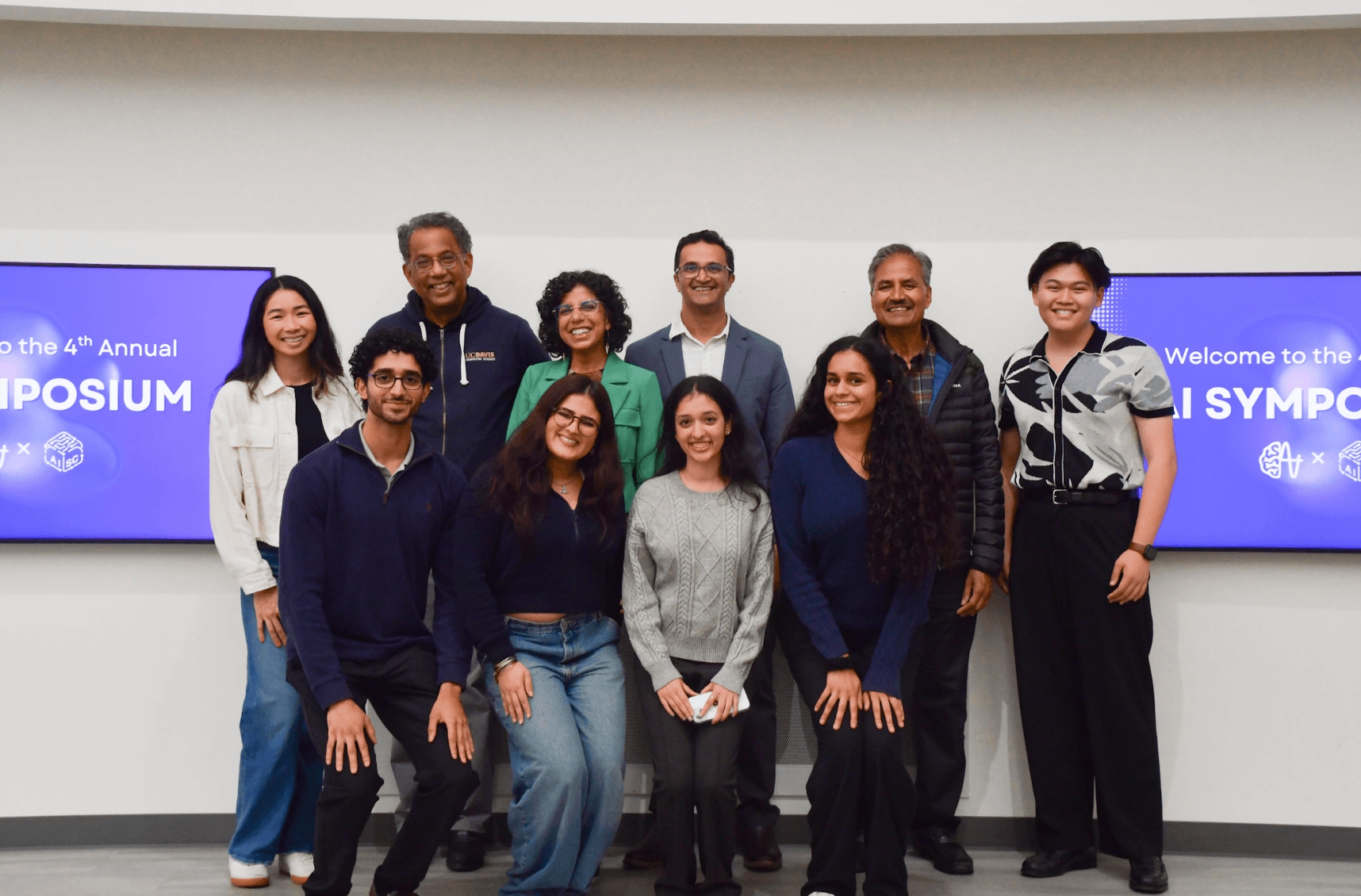
The AISC helps students engage with artificial intelligence amid global technological development and controversy
By GRACIELA TIU — features@theaggie.org
As artificial intelligence (AI) technology rapidly expands, its presence is increasingly felt in academic and professional settings. At the same time, it also represents one of the most controversial topics of campus discussion, as many community members have concerns about issues such as environmental impact, academic integrity and data privacy.
With this context, students are left to determine how to engage with such a powerful yet contested technology. In 2025 alone, the AI market reached approximately $244 billion, showing a 31% increase from 2024; it is expected to continue rising in the coming years.
In response, UC Davis students established the AI Student Collective (AISC), a campus group aiming to bring access and education about the technology directly to students.
“The AI Student Collective is a global student-run organization focused on making artificial intelligence accessible to all,” Prati Mehta, AISC vice president of operations and a third-year cognitive science major, said. “It was created to help lower the barrier of entry into tech, as many students at UC Davis felt a gap in existing opportunities. We wanted to build a community where anyone, regardless of technical experience, could learn how AI works, experiment with it hands-on and understand its real-world impact.”
With the speed at which AI has been evolving, students feel pressure and a sense of urgency to keep up with the field’s advancements. 88% of organizations reported using AI for at least one business function in 2025, compared to the 78% reported in the previous year, according to a McKinsey & Company survey.
“There’s just so much happening right now, and it’s all moving incredibly fast,” Sathvik Parasa, AISC vice president of membership development and a third-year computer science and engineering major, said. “So, it’s important to have an on-campus resource to turn to for exposure to this rapidly-evolving landscape. There is a growing gap between what the industry expects from new grads and what students learn in coursework.”
Parasa noted how student-led organizations can help connect students with the tools to meet the demands of industry expectations.
“AI-centered student organizations like AISC bridge that gap,” Parasa said. “Because we’re student-led, we have the flexibility to move quickly, expose members to novel topics and adapt as the field evolves. This ensures that students stay close to the frontier of innovation, instead of playing catch-up with the rest of the world.”
The club’s adaptability allows it to serve students from all backgrounds and help them engage with AI meaningfully. Mehta explained how the club’s methodology provides students with hands-on experience.
“We design everything around learning by doing,” Mehta said. “Instead of starting with heavy theory or advanced coding, we begin with real problems students care about, and then introduce the AI tools that can help solve them. Our workshops focus on simple-code platforms, practical demos, collaborative projects and peer mentorship.”
In structuring the club, the leadership team has worked to address a variety of areas that target student development.
“We always gear our activities toward three things: technical development, professional development and social development,” Isha Rawal, AISC vice president of innovation and a third-year applied mathematics major, said. “We want our members to come away with useful technical skills and also equip them to enter the professional world. I personally joined AISC largely with the intention of finding a group of good friends.”
Parasa described how he thinks of the club in terms of two core tenets: building and teaching. When thinking about the building aspect of the group’s activities, the AISC gives students the chance to work on their own extended projects.
“On the building side, we have two long-term initiatives,” Parasa said. “Our software engineering projects are year-long cycles where students work on highly technical projects with experienced mentors. We also run R&D [Research and Development] projects with professors on campus as mentors, where students get exposure to real academic research in AI and ML [Machine Learning].”
Along with those long-term projects, the club also offers short-term activities that help meet the club’s teaching objectives. While UC Davis offers a few computer science engineering courses surrounding AI, the AISC offers more versatile learning opportunities outside of the classroom.
“There’s our shorter-term initiatives on the teaching side,” Parasa said. “We run workshops every quarter that focus on new and emerging technologies in a hands-on way, so that students can keep up with the pace of the industry. We also have an education initiative where we go out to middle and high schools to teach students about AI [and] how to use it responsibly.”
Though the club offers various projects for advanced and technically experienced students, it also provides learning and building opportunities for beginners. Parasa outlined how the club’s entry point exists between the two core goals of teaching and building.
“There’s a middle ground between teaching and building, which is where a good chunk of students actually fall under,” Parasa said. “This is where our beginner projects come in: fast-paced, 7-week sprints, where students focus on learning a specific technology or framework by building something concrete. This gives beginners a chance to learn while also allowing more experienced students to lead and mentor.”
Rawal gave an example of an AISC project and the ways in which it represents different aspects of the club’s goals.
“One of our teams is working on an app to decrease clothing overconsumption,” Rawal said. “The goal is for users to catalogue clothing they own, and the app will tell them if a new item is similar. […] I’m excited about this because the project hits the core goal of innovation: using AI to solve real-world problems while improving the technical skills of our members.”
The club not only exists amidst the quick expansion of the AI industry, but also amidst the skepticism surrounding the technology in academic and work settings.
“One trend I’ve noticed is a growing skepticism toward AI-assisted projects among students,” Parasa said. “Many are hesitant to use AI when building, and instead take pride in coding entirely by hand or sticking to traditional workflows. I’d say a big part of that comes from the academic environment, where there’s a strong emphasis on individual authorship and correctness. […] The concern is valid — we don’t want to be perceived as lazy, but it comes at the cost of falling behind in development speed.”
Parasa expressed his appreciation for the growth he experienced in participating in the club, which not only aided him in his professional development and helped him land more jobs, but also gave him a strong community to rely on.
“I found mentors who genuinely invested in my growth, peers who pushed me to be better and lifelong friends,” Parasa said. “Being surrounded by people who are ambitious and hungry to grow professionally has shaped not only my career goals, but also who I am as a person.”
Written by: Graciela Tiu — features@theaggie.org