The animated children’s film is a simple reflection of the ways that narratives can be manipulated to promote injustice
BY JULIE HUANG — arts@theaggie.org
“Zootopia” (2016) was one of the defining animated children’s films of the 2010s, introducing young audiences toa world of anthropomorphic animals living in eye-catching habitats like deserts, rainforests, tundras and, most notably, big-city streets.
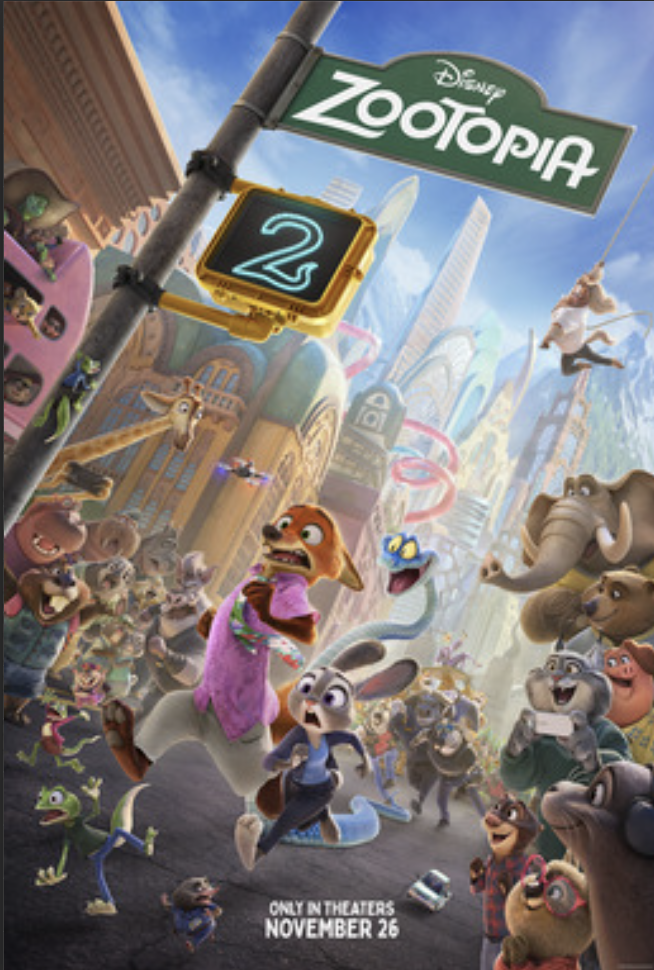
Released on Nov. 26, 2025, “Zootopia 2” returned to that world of supposed harmony, through the eyes of the familiar rabbit and fox duo: idealistic police officer Judy Hopps and smooth-talking, reformed small-time criminal Nick Wilde.
In the previous film, Hopps and Wilde navigated the diverse city of Zootopia to solve a missing-persons case, working together begrudgingly at first, then gradually setting their differences aside as the case spiraled into a conspiracy mired in prejudice from prey animals towards predators.
The start of the second film establishes that the two are now partners on the Zootopia police force and each other’s closest friends. Though things are looking up for the pair, their successful dynamic has not translated into city-wide acceptance and harmony for all animals.
“Zootopia” was unsubtle in its portrayal of themes such as systemic racism, prejudice and state-sanctioned propaganda. Using the dichotomy of predator versus prey animals as allegorical commentary on widespread hatred toward marginalized groups, the film’s vivid backdrops became a colorful canvas for a relatively bleak discussion of prejudice and discrimination while remaining palatable enough for younger audiences.
Not content to leave its viewers stewing in the unsavory realities that often accompany the experience of belonging to a marginalized community, “Zootopia” balances its more solemn themes with a positive example of overcoming differences through Hopps’ and Wilde’s budding friendship.
As the pair grow closer across the first film, they learn how to understand and bond over each other’s parallel struggles. Their trust in each other becomes the critical tool to defeating the film’s major antagonists, underlining the central message that differences and diversity are something to be celebrated, not feared.
“Zootopia 2” picks back up on the themes of its predecessor, expanding on how fear of real or perceived differences between groups of people can lead to self-perpetuating harm and unfounded hatred. Like the plot-twisting villain of the first film, new character additions, pit viper Gary De’Snake and lynx cat Pawbert Lynxley, continue the trend of toying with narrative expectations for their characters.
De’Snake’s species, and reptilian characters in general, are notably lacking from the first film. The second film diegetically explains the reptilian absence as a socially imposed exile from Zootopia, which began after widespread circulation of an incident where a snake supposedly attacked a mammal with deadly venom.
Meanwhile, Lynxley hails from the prestigious family whose ancestor, Ebenezer Lynxley, purportedly helped found Zootopia as a diverse haven for all animals. Feeling spurned by and disconnected from his family, Lynxley partners with De’Snake to restore reptilian reputation in Zootopia.
This stereotypical narrative of “evil” reptiles and “innocent” mammals mirrors the first film’s dichotomy of “dangerous” predators versus “hapless” prey animals.
It is thus unsurprising when the story of Ebenezer Lynxley is revealed to be a lie. The Lynxleys are outed as frauds, upholding a falsified version of historical events for decades to maintain their own power at the expense of slandering the guiltless snake population and uprooting reptiles from their lives.
Admittedly, the film does not deviate from the simplistic understanding that, though characters may misrepresent themselves, some individuals are inherently well-meaning, whereas others are malicious.
Perhaps too ambitious a message for a children’s film with a runtime of an hour and 50 minutes, there are only hints that in a society where systemic discrimination runs rampant, even those with good intentions may become unwilling, unconscious participants in promoting prejudice or biases.
Nevertheless, the film does important work in acknowledging and unveiling the process through which systemic exclusion of marginalized groups can be justified through propaganda that appeals to basic emotions like fear.
Once again, Hopps and Wilde’s interpersonal dynamic serves as an opportunity for growth amidst the harsh truths of systemic failures. Throughout the film, the tensions in their personal relationship form the emotional core of the film, coming to a head when both declare how much they mean to each other, without their previous uncertainty or hesitation.
This persistent care for each other becomes the vessel of the film’s primary theme. Fear and misunderstanding can become a habit, easily and thoughtlessly perpetuated, while empathy and understanding are something that require active work, over and over again. Yet, putting in the effort to stand in front of someone and see them for who they are is always worth it.
Box office numbers do not correlate to the artistic or thematic quality of a film, but they may imply that audiences resonated with the work. If that is so, then “Zootopia 2” was undeniably resonant with viewers — it attained the highest worldwide box office opening for an animated film since 2002.
Its unique role as a children’s film, intended to be both entertaining and educational, allowed it to imbue a sense of levity to the unyielding notion that justice is often found outside the limits of legal frameworks that have been compromised by corrupt authorities and enforced by misleading narratives.
Films like “Zootopia 2” are never willing to leave their audiences without hope, so its protagonists, Hopps and Wilde, become representatives of the ways that divisions can be overcome. As two different species and individuals with very different upbringings, their trust and care for each other are not intuitive or natural.
Rather, it is an active and continuous choice to see, listen to and accept each other, reflecting what it truly means to embrace our differences and celebrate our shared experiences.
Written by: Julie Huang — arts@theaggie.org