The Vietnamese-American poet discussed familial influences in her Oscar-shortlisted documentary short film and book of poetry, ‘Becoming Ghost’
BY JULIE HUANG — arts@theaggie.org
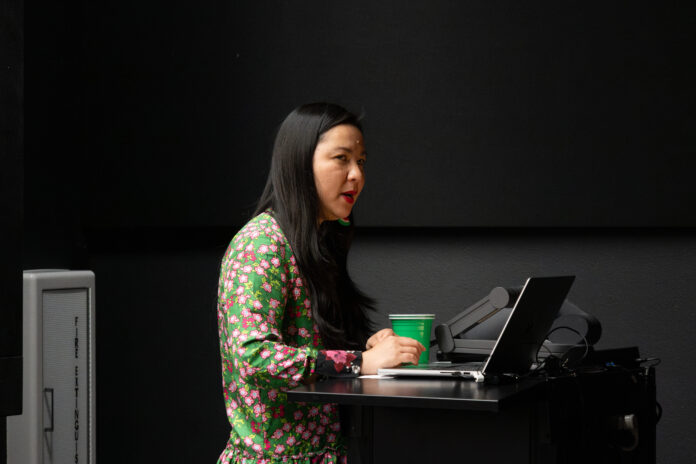
On Jan. 14, the UC Davis Department of English hosted Vietnamese-American poet and multidisciplinary artist Cathy Linh Che for the latest event in their annual Creative Writing Series. The event featured a film showing, followed by Che reading from her second and latest poetry collection, “Becoming Ghost” (2025), which became a finalist for the 2025 National Book Award in Poetry.
The event began with the documentary short film “We Were the Scenery” (2025), which features the experiences of Che’s parents as Vietnamese refugees. While living in a refugee camp, they became background actors for Francis Ford Coppola’s “Apocalypse Now” (1979).
“They had no lines in that film and were not credited,” Che said. “[‘We Were the Scenery’] shows more about the process of them joining that set. It was not something they had a choice over, stuck in a refugee camp, and the whole film centers around my parents’ voices as they narrate their memories.”
During the process of filming “Apocalypse Now,” Che’s mother was 22-years-old. One of the roles she played as a set extra included a faceless Viet Cong fighter, just after she had recently left her home to escape the Viet Cong.
“We made this film in order to restore faces and voices into a story where they are essential but erased,” Che said. “This is a restorative act. It is a dream come true to be able to share this story with others, and means a lot to me.”
Directed by Christopher Radcliff, “We Were the Scenery” was shortlisted for “Best Documentary Short Film” for the 98th Academy Awards. Unfamiliar with the technical aspects of filmmaking, Che understands her primary role in the film’s creation as a storyteller, whose narrative was being realized in a medium that was new to her.
“I wanted to make a movie, but I didn’t have the skills to, nor a strong sense of short nonfiction films and I don’t know how to edit — but I am familiar with the story,” Che said. “ It’s amazing what collaboration can do.”
“We Were the Scenery” makes the aesthetic choice to completely forgo any video clips of Che’s parents speaking, instead layering their narration as subtitled text on top of other video footage.
“I wasn’t particularly interested in doing a talking-head documentary, which strikes me as journalistic and dry,” Che said. “I wanted to make something that was a story. Emotive, lyrical and from the heart.”
Throughout its 15-minutes of runtime, her parents’ voices often overlap, eager to recount their memories to each other and add detail to the other’s account when necessary.
At times, they laugh at each other’s statements. One especially memorable segment, where Che’s father mocks Coppola for eating mangoes with the skin attached, becomes a running joke. For many, Coppola is an esteemed filmmaker and influential figure in Hollywood. For Che’s parents, he is a man whom they saw eating mangoes without peeling the skin off.
Visually, “We Were the Scenery” includes Che’s father’s home videos of her as an infant. Che traces her affinity for poetry back to this familial impulse to tell stories.
“My parents are amazing storytellers, and my father’s home videos are beautiful,” Che said. “The poems in ‘Becoming Ghost’ are a kind of collaboration between me and my family, in the sense that so much of its content is a blend of my own voice and their voices, translated from interviews into English.”
The spectral title of Che’s book refers to the inherent quality of storytelling as a way to keep things alive even when their subjects are no longer accessible.
“Voices that are no longer here, such as my grandmother, are alive in me,” Che said. “You listen, and the voices move through you.”
Closing off her discussion of “We Were the Scenery,” Che revealed a more complicated familial relationship. During the process of putting together the short film, she was also disowned by her parents.
“It’s a common thing that happens to Vietnamese-American writers, because writing is a kind of speaking, and part of speaking as a child is perhaps disagreeing,” Che said. “After I was disowned, I was thinking, ‘What has happened to us?’ We’re different because we are imagining each other in entirely different ways. He’s become a ghost father, and I’ve become a ghost daughter.”
Che explored this experience through the process of writing poetry from multiple points of view. Some of the poems in “Becoming Ghost” are written in her father’s voice, while others invoke her mother’s perspective. When read in conjunction, the book reveals itself to be a collection of Che’s family’s experiences, both real and imagined, joining her voice with those of her family members.
The role of Che’s imagination came into sharper focus when she read aloud a poem written from her grandmother’s perspective, exploring how she may have felt giving her infant son to a German convent, who today would be Che’s 50-year-old uncle.
Neither Che nor her family knows where her uncle is or if he is alive; Che expressed interest in finding him in the future.
“I’m obsessed with time, and the idea that what we do now can heal the past,” Che said. “I can address a past erasure so that it never exists again, which will shape our future, and spotlight what has been missing from the archives.”
For Che, poetry is a tool which has the power to confront topics and issues that previously went unacknowledged. She described her first book of poetry, “Split” (2014), as being about sexual violation, war and taboo spaces for which people often employ the term “unimaginable” to describe.
“When someone uses the term ‘unimaginable violence,’ I think that it’s not unimaginable, it’s real,” Che said. “People have a hard time naming uncomfortable realities and feelings, and I want language to be a space where we can actually start naming these things.”
In one sense, “We Were the Scenery” appears to have achieved Che’s desire, as the film has inspired many different reactions.
“It’s been interesting to read the Letterboxd reviews,” Che said. “You get a lot of film-literate people who understand what you are trying to do, and then you get a different set of people’s reactions; and then your creation belongs to the world.”
Musing on the simultaneously individual and collaborative nature of storytelling, Che spoke further about the nature of telling stories about one’s personal experiences for public consumption.
“I’m speaking from a space of intimate access, and anybody who looks in gets the pleasure of what they can see from their vantage point,” Che said. “I’m not trying to explain, expose or be an ambassador. I’m trying to communicate with someone like me, who wanted this story and didn’t see it on the bookshelves.”
In Che’s work, the historical, familial and personal merge. The resulting effect is the formation of a unique perspective that embodies her experience, but has the capacity to resonate with others. Ultimately, Che’s stories, like most others, shift and grow around the perspectives of those who receive them.
“People like to imagine that history is very objective, but it’s extremely subjective,” Che said. “It’s a slice of knowledge. The knowledge that I have is a slice; the knowledge my parents have is a slice. We all have different pieces of a story, and within them, all of these complexities are revealed.”
Written by: Julie Huang — arts@theaggie.org