






Review: Comedy and satire collide in killer thriller ‘No Other Choice’
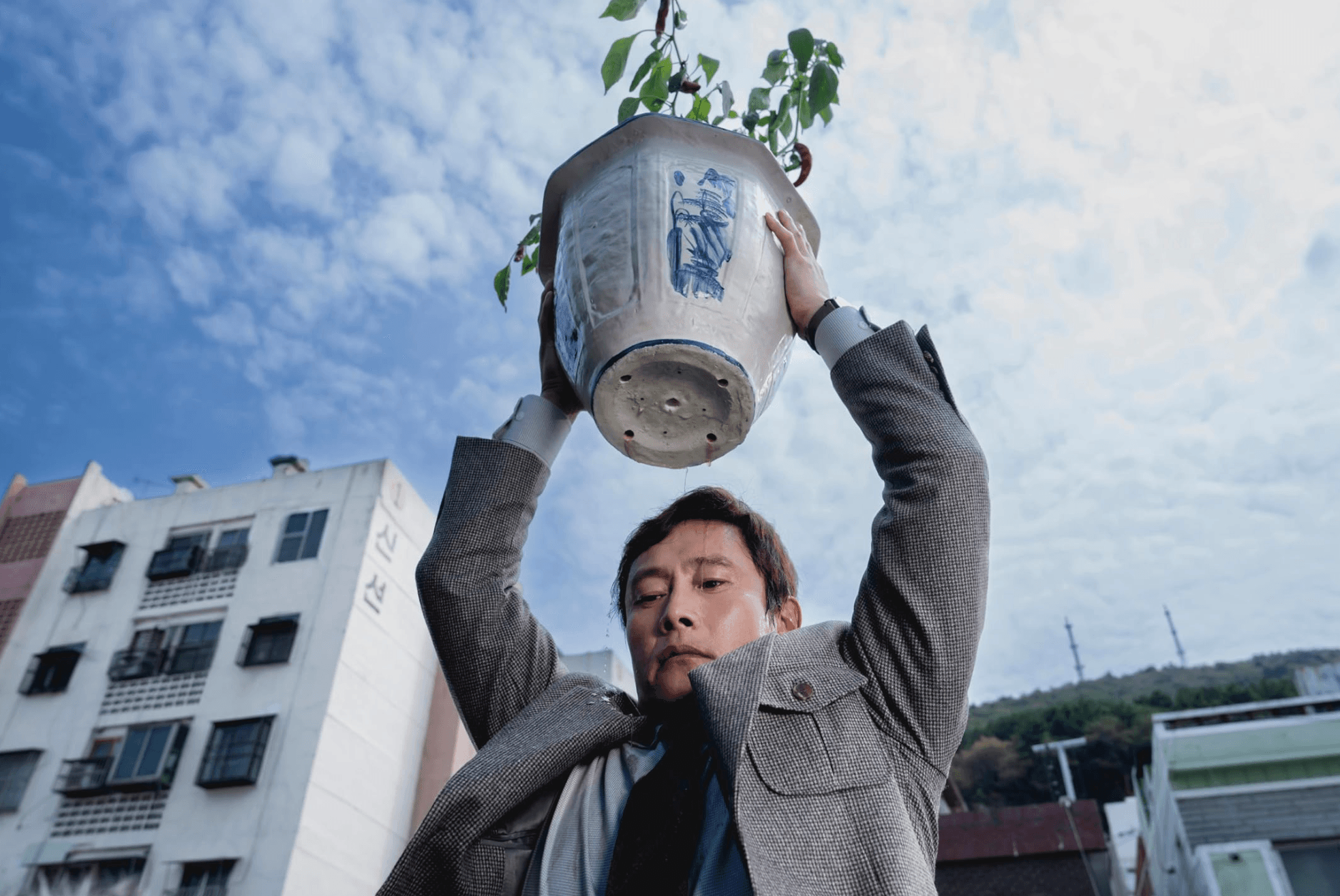
Park Chan-wook’s newest film delivers a one-of-a-kind blend of distinct tones
By JONAH BERMAN — arts@theaggie.org
For college students and seasoned professionals alike, the job search has never seemed more daunting. One well-intentioned scroll through LinkedIn is tantamount to entering a surreal alternate reality of toxic positivity and painful insecurity.
Throughout the world, people’s identities are often inextricably tied to their careers, and when they lose that, it can feel as if they’ve lost a part of themselves. The juxtaposition of personal devastation in the face of an uncaring corporate behemoth has become a hallmark of modern life, and few films of recent years have captured this absurd feeling better than Park Chan-wook’s “No Other Choice.”
Over the past 25 years, Park has cut his teeth by crafting intricately detailed thrillers such as “Oldboy” (2003) and “Decision to Leave” (2022), which have earned him critical acclaim in his home country of South Korea and across the rest of the world. “No Other Choice” carried on this tradition, receiving three Golden Globe nominations in December.
In this deliciously morbid comedy-thriller, upper-class paper mill manager Yoo Man-su is laid off from his job after the firm is purchased by an American company, leading him, his wife and his two children down a path of economic hardship.
In his anguish, Yoo arrives at what he believes to be the only reasonable solution: murdering his occupational competition. What follows is a tantalizing series of twists and turns that could only be delivered by a filmmaker at the top of their game.
Adapted from Donald Westlake’s 1997 novel “The Ax,” the film switches the setting from 1990s America to present-day South Korea, while maintaining the story’s grisly shocks and witty satire. The film provides wry commentary on capitalism, which was also highlighted in the advertising campaign; NEON, for example, invited every Fortune 500 chief executive officer (CEO) to a “special screening” of the film — and no one showed up.
Yoo’s choice of target is critical to the plot of the film and conversation centered around industry environments. Rather than seek retribution on the people who fired him, he instead decides to eliminate his perceived opponents for a new job.
This decision, which lays the bedrock for the rest of the film’s chaotic plot, is imperative for the audience to notice. After all, the film’s title is inaccurate; Yoo does have other choices, but the hustle-first culture in which he has been socialized leads him to a brutal solution. Importantly, Yoo’s anger is misplaced: the actual cause of his strife is the group of corporate owners who prioritize the bottom line over caring for their workers.
Lee Byung-hun (Yoo Man-su) provides a knock-out performance, and one that was necessary for the film’s idiosyncratic tone. This caps off a stellar year for Lee, who recently appeared in both “Squid Game” Season Three and “KPop Demon Hunters.” Through frightening line deliveries and slight non-verbal cues, Lee masterfully embodies Yoo’s transformation from an upstanding family man to a paranoid killer. However, the screenplay’s slow trickle of information to the audience ensures that we are always left second-guessing our assumptions about his character.
Another performance that shines opposite to Lee’s is that of Son Ye-jin, who plays Yoo’s wife, Lee Mi-ri. While the film remains remarkably light on its feet, their marriage provides an emotional core that allows us to care about the decisions Yoo makes in the name of his family. Together, the two brilliantly portray the kind of marital conflict that can be caused by financial strife.
Perhaps most admirably, the film achieves something many brilliant auteurs have shied away from: depicting modern technology, especially through cell phones. The film’s references to Netflix don’t feel hamfisted and are even used for comedic ends; FaceTime calls are also featured prominently. Depicting these calls in an emotionally poignant way presented a challenge to the cast and crew, but they worked to great effect and solidified the present-day setting.
The film’s vibrant production design also allows for both textual and subtextual richness. For example, Yoo is very frequently placed near plants or in nature. This scenery can be juxtaposed with the ultra-industrial world he seeks to re-enter, while also representing a primal urge to kill his enemies.
Putting most modern American films to shame, Kim Woo-hyung’s digital cinematography showcases a brilliant array of colors and intricately constructed frames. The fact that this was shot with the same technology as some Netflix romantic comedies — “No Other Choice” and “My Oxford Year” (2025) were both filmed with an ALEXA 35 — just goes to show that the camera only matters as much as the hands that hold it.
The film’s occasional flaws lie in an imperfect structure and some overambitious choices. The fast pace works well for violent confrontations, but could leave some viewers confused watching more character-driven moments. In addition, while Park is a masterful filmmaker, the showy editing can occasionally distract from the story’s powerful emotional beats.
Somewhat losing its momentum, the ending to the film feels anticlimactic considering where the plot was seemingly leading. Conversely, Park’s chosen conclusion is alarmingly prescient for the future of capitalism as artificial intelligence grows in scope.
“No Other Choice” manages to successfully balance non-stop entertainment with biting social commentary: that’s no easy feat. While the film is only showing in select theaters, audiences should seek it out for a viewing experience that captures our absurd present like little else can.
Written by: Jonah Berman — arts@theaggie.org