






‘My funny Valentine’
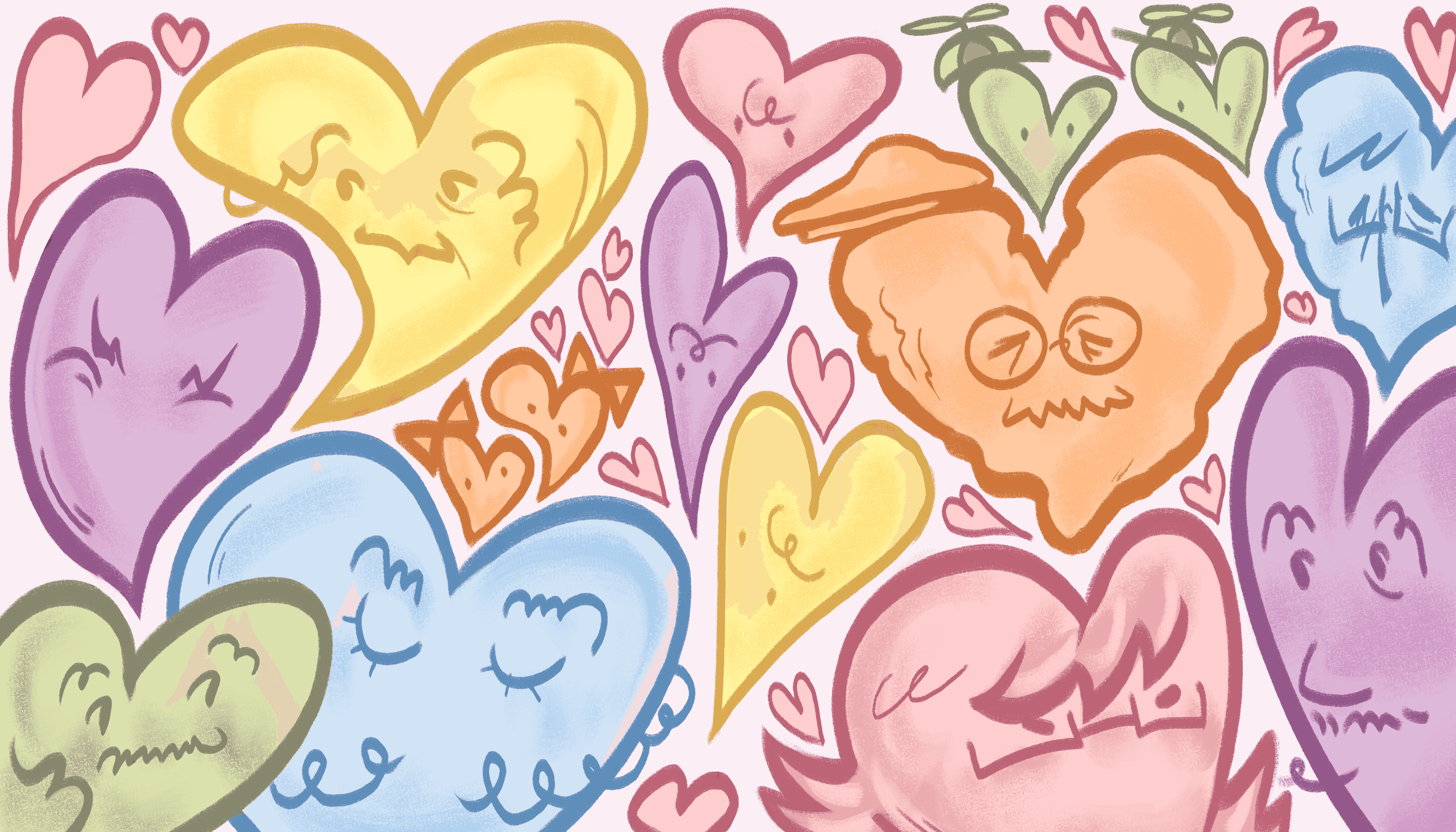
How funny is too funny?
By VIOLET ZANZOT— vmzanzot@ucdavis.edu
How absolutely, unbelievably, unequivocally romantic was it when Frank Sinatra said: “Your looks are laughable, unphotographable yet you’re my favorite work of art”?
Undoubtedly, there is no other man who could call someone funny-looking and have it sound so very sweet.
The thesis of Sinatra’s message is that the imperfections of the woman he treasures make her all the more perfect to him — his “funny valentine.” What makes this kind of love so good is his reverence for everything about her that is messy: to love her because of her flaws, rather than in spite of them.
If it is the quirks we are prompted to appreciate, does there ever become a uniqueness that exceeds capacity for regard? When does the observer notice something that goes beyond the scope of appropriate adoration? When does a pattern or a preference become a fetish or a kink? When does desire become disgusting, taste become tacky or fondness become fraught?
Socially, we seem to know there is a line that exists when a preference in attraction becomes perverse. We see these questions play out all around us: TV shows and movies that feature an older guy with his young, hot wife; red rooms and Romeos and Juliets. In those moments, we seldom ask ourselves: Is this a fetish — a kink or a type that is repeated? Do they only like each other because their families don’t? We know there is a line between “dirty” and “wrong,” but it isn’t always so defined.
We, as a society, tend to understand that being “into older guys” is generally acceptable, but dating your married professor isn’t. There is a clear difference between saying “A lot of the girls I’ve dated are Asian” and “I like Asian girls.” There is a clear difference between saying you “Live on the edge romantically” and you’re “Dating someone to upset mom and dad.” These distinctions almost feel innate. When you hear of instances that are off from the norm, you feel forced to flinch, just slightly, and make a face like you smelled something rotten.
I believe that context is often the difference between what is uncouth and what is permissible — context can cushion the blow, if you will. Using a less abrasive example, I was once asked why girls only like tall guys. I argued the premise of this question relies on a false pretext; girls, in fact, do not only like tall guys. Personally, I like to feel small. Feeling small, for a 5-foot-4-inch girl does not always require a 6-foot-5-inch giant (though it can). When given the rationale behind my preference, it’s easier to understand. I like to think I’m not weird for preferring taller (or maybe just stronger) guys because I want to feel small relative to my partner — if you contextualize my preference, you can sympathize with me.
That being said, context alone cannot be the hero for every kink or socially unacceptable preference. There are, of course, the preferences that are too “taboo.” I think a lot of that stems from internalized messaging that forbids us from rationalizing our desires, because sometimes things are wanted inexplicably. Sometimes the only thing that stops someone expressing a specific want is knowing that if they said it out loud it would sound wrong — it is this “wrongness” that I find to be so fascinating.
Through writing this, I was hoping to understand it more: to better understand the social constraints that police sexuality and romantic desire. Some things just seem bad to want, but then you watch shows and movies that feature these odd-ball couples that work because of (not in spite of) all of their quirks. You see age differences and gendered power dynamics and sex toys and still feel like it’s all romantic because… it’s romantic. The love of Harold and Maude, Anastasia and Christian, Elio and Oliver (to name a few quirky couples) feel pure because of the emotions behind them.
Passion can often make up the difference when desire lacks good reason. When people are driven by a sense of real, true love, it’s easy to excuse a lot that might feel unacceptable otherwise — and maybe that’s okay. Maybe there is no valentine too funny if there is genuine care behind it. Kinks are only creepy when they’re rooted in untold traumas and emerge from depravity, but they’re kind of beautiful (in a sick, twisted… funny way) when they’re motivated by love. I guess the moral of the story is that this Valentine’s Day, don’t be a creep: Lead with love.
Written by: Violet Zanzot— vmzanzot@ucdavis.edu
Disclaimer: The views and opinions expressed by individual columnists belong to the columnists alone and do not necessarily indicate the views and opinions held by The California Aggie.