Reading skills, like muscles, need to be exercised
By VIOLET ZANZOT— vmzanzot@ucdavis.edu
I find reading and running to be similar: not in a literal sense, but rather in their application (or lack thereof). In other words, while we do not learn to run in the same sense that we learn to read, we unlearn both of them in the same way — by forgetting to care.
As part of my New Year’s resolutions, I resolved to stay off of social media, which has given me ample time to rediscover the basics. In giving up Instagram, Snapchat and TikTok, I find myself halfway through February reaching for a book in most spare moments (all the times I would have otherwise spent doom scrolling). Considering that — and I’m embarrassed to admit this — I haven’t read a book in quite some time, this change of pace is rather fascinating.
In just this short stint of reading, I’ve gained a great deal of appreciation for the activity. Beyond that, though, it’s taught me that reading must be practiced simply because it provides entertainment, produces sympathy and gives rise to action.
Just as with running, reading becomes difficult when we forget to practice. Because we know we always could, the thought that we could do it better seems to fade — if we were being chased or happened upon a menu without pictures, we could surely run or read. So, why go for a jog or pick up a Jane Austen novel? Practicing may not feel necessary, but people say that “practice makes perfect” for a reason: it makes you both enjoy reading more and makes you better at it.
My current book of choice is “Franny and Zooey” by J.D. Salinger. Just like aspiring English teachers and moderate psychotics, I loved reading “The Catcher in the Rye,” also by Salinger, so this seemed like a natural choice for a new novel. I’m also reading it because I realized that, without social media, I missed drama. I missed hearing about someone else’s adventures and going on a vicarious journey at any moment of the day. Without having TikTok to hold my hand through every moment I wanted to escape, I needed a new fix.
Historically speaking, interpersonal drama has been critical to teaching sympathy to the masses. For instance, “The History of Mary Prince” provides a biography of Prince’s encounters as an enslaved person with the most inhumane factions of humanity. Her detailed description of the subjugation and degradation of basic mind and bodily autonomy made people understand that flesh makes humanity, rather than skin color; it literally took reading her personal account for people to understand that. Without being forcibly transported into someone else’s mind, people stayed comfortably in their own narratives; there came a hysteria caused by the realization that the “other” is just another revolutionized abolitionism. Reading provided a vehicle into other people’s lives and minds that otherwise did not exist.
It is not just sympathy we are forced to reconcile from reading, but also a call to action. Books have the power to change our perception of the world if we give them the opportunity to reveal new truths to us. Size doesn’t matter — even a small book can cause change. Mao Zedong’s “Little Red Book,” the book that set ablaze China’s cultural revolution, is just one example of a philosophy that drove the people to act. Reading drives people to envision a different world, and as a result, people mobilize.
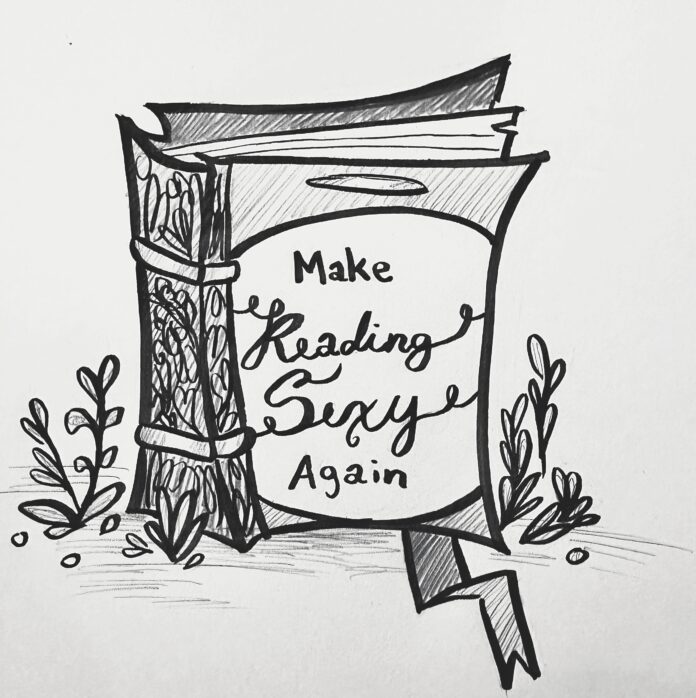
Just as with running, we often think of reading as reflexive. We do it without thinking — like unintentionally reading a street sign, a road designation or the name of a restaurant — but reading is so much sexier than we give it credit for. The role reading has played in our lives has changed through history, but people have been and can be moved by nothing more than the words on a page. We ought to give words new life. We ought to make reading sexy again, because anything less would be shortchanging society the chance to escape themselves, feel with others and find inspiration for action.
Written by: Violet Zanzot — vmzanzot@ucdavis.edu
Disclaimer: The views and opinions expressed by individual columnists belong to the columnists alone and do not necessarily indicate the views and opinions held by The California Aggie.