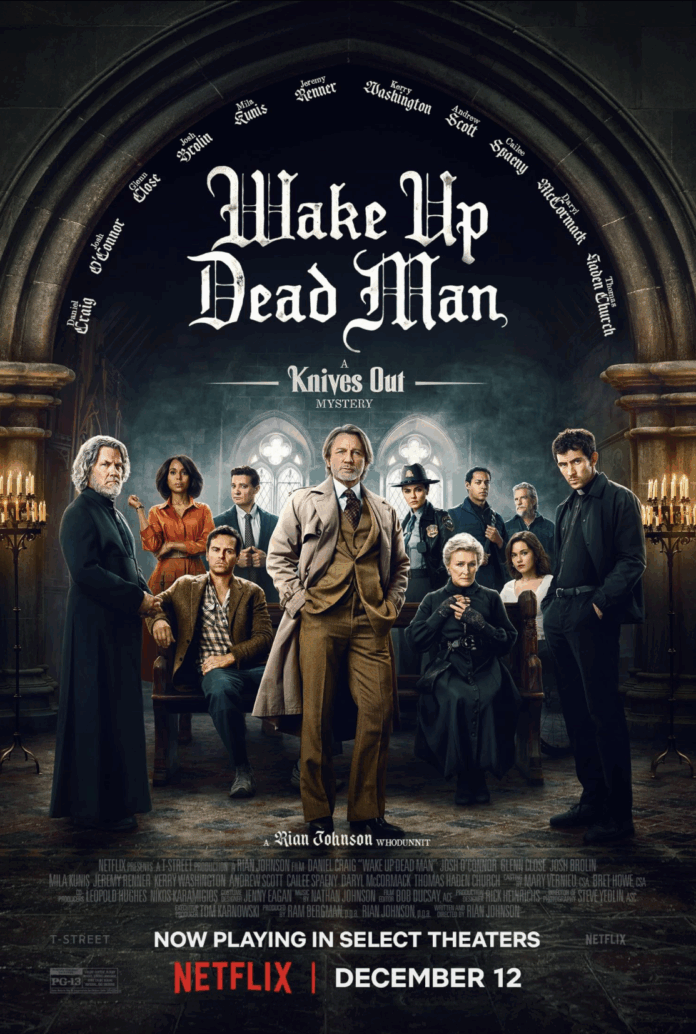
The latest installment in the ‘Knives Out’ series muses on faith, logic and the compassion we give to others
By NATALIE SALTER—arts@theaggie.org
Rian Johnson’s “Knives Out” films, though mysteries on the surface, have always been keenly interested in interrogating the landscape of their times. Outwardly, each one operates on a simple premise: the whimsical, highly intelligent detective Benoit Blanc (Daniel Craig) is paired with a diverse ensemble of characters, all tethered by one mysterious crime.
Yet, it’s hard to miss the core message of each film. The 2019 film of the same name took aim at the disaffected upper-class echelons of America and those whose labor their comfort depends on; 2022’s “Glass Onion: A Knives Out Mystery” spoke to the superficiality of the famous and fabulously wealthy. Now, in 2025’s “Wake Up Dead Man,” the central theme is religion — and the corruptible systems of power that it functions within — that Johnson places under the microscope.
The film centers on Father Jud Duplenticy (Josh O’Connor), a hopeful young priest with a complicated past. When an altercation with another clergyman results in him being sent to a church in a corner of upstate New York, what he sees as a serendipitous opportunity to connect with a new community soon takes a dark turn.
Very quickly, it becomes apparent that the optimistic Duplenticy (described by his wizened future self as “young, dumb and full of Christ”) has wandered straight into a den of wolves. A tight-knit group of locals have banded around the Monsignor Jefferson Wicks (Josh Brolin), whose contentious, aggressively hateful dogma runs pointedly counter to Duplenticy’s unfettered belief in understanding and forgiveness.
A cold war of ideologies inevitably forms: Wicks’ wildly intolerant bellicosity versus Duplencity’s earnest selflessness. The battle of wills comes to a head when the former falls dead in the middle of a Holy Week service. This event leads Blanc to try to unravel the conspiracy; he establishes an unlikely coalition with an overwhelmed Duplenticy, the unlucky scapegoat chosen by Wicks’ followers.
Like the past two “Knives Out” films, “Wake Up Dead Man” offers a twisting, thrilling mystery steeped in delightfully outlandish schemes. It’s exceedingly funny at times, heart-racing at others, but above all else, surprisingly emotional. While it wields the same self-aware wit as its predecessors to mock its own villains (who are ever-relevant to the current sociopolitical landscape), the film’s most successful moments are its most serious and introspective ones.
Much of this success can be credited to O’Connor’s outstanding performance as Duplenticy, bringing immense emotional depth and nuance to the character. The priest’s gentleness and good intentions are made vastly more meaningful by his visible anger with the cruelty and intolerance he sees around him; O’Connor captures the character’s turmoil and resilient hopefulness masterfully.
Craig’s eccentric detective Blanc is as charming as ever, and his sharp wit pairs brilliantly with Duplenticy’s earnest naivete. Compared to previous films, the ensemble cast is less the focus of the film than these two. Still, standout performances are given beyond Blanc and Duplenticy, especially that of devout church secretary Martha (Glenn Close) and disillusioned lawyer Vera (Kerry Washington).
Nevertheless, the decision to focus on Duplenticy and Blanc in particular is especially important to the film’s emotional core. Just as he functions as a foil to Wicks’ fervid belligerence, Duplenticy is continually contrasted with the pragmatic Blanc, who has an unfavorable view of the church to which the young priest belongs. In spite of their differing beliefs, however, the pair’s circumstantial partnership offers sincere, carefully crafted musings on faith and rationality.
While a surface-level perspective suggests that Duplenticy’s path as a man of faith gives him more in common with Wicks than with the self-proclaimed “proud heretic” Blanc, the film quickly disrupts this assumption. Differing as their faith (or lack thereof) may be, at heart, Blanc and Duplenticy are both driven by kindness and a genuine desire to help those around them.
In their first interaction, when confronted with Blanc’s adversity to institutional religion, Duplenticy concedes that the system he belongs to is often inherently theatrical.
“It’s storytelling,” Duplenticy admits. “I guess the question is, do these stories convince us of a lie? Or do they resonate with something deep inside us that’s profoundly true, that we can’t express in any other way except storytelling?”
Indeed, in a later scene, Duplenticy’s own words ring true when he pauses his and Blanc’s investigation to pray for a woman’s ailing mother. The mode of the interaction — the words and gestures of the prayer that they share — is less important than the deeper, profoundly true part. It’s the compassion and care that Duplenticy gives her that matters: a deeply human gesture which transcends boundaries of faith and non-belief.
In this, “Wake Up Dead Man” gently reminds audiences that in an era so strongly marked by tremendous intolerance, the act of listening to and understanding those around us is both profoundly healing and endlessly valuable. Not only does this unfettered belief in the value of compassion and curiosity give the film its heart, but it feels like an especially important reminder in an era where our capacity to empathize with and care for each other seems more vital than ever.
Written by: Natalie Salter—arts@theaggie.org