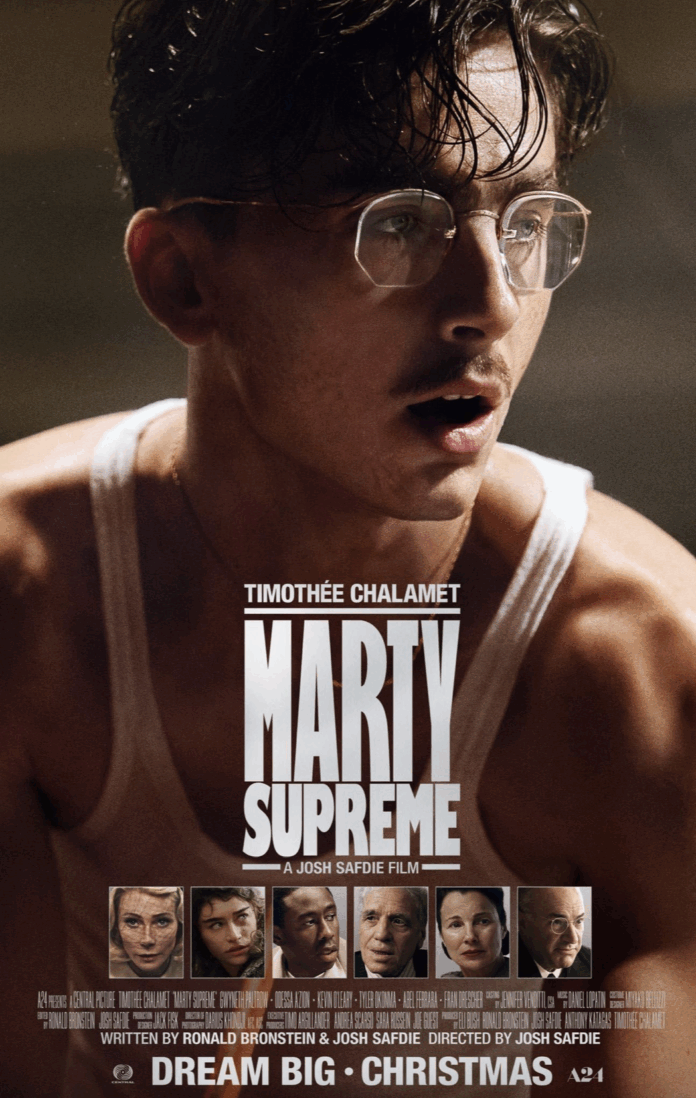
Timothée Chalamet shines in this cinematic thrill-ride
By JONAH BERMAN — arts@theaggie.org
Cringe-inducing Zoom meetings, confusing interviews, rap song features and appearances on the Las Vegas Sphere — what do these have in common? They’ve all been part of Timothée Chalamet’s press run for “Marty Supreme,” a film as eccentric and unpredictable as its lead actor.
“Marty Supreme” tells the story of the shoe salesman Marty Mauser (Chalamet) and his chaotic yet singularly determined journey toward his goal of becoming the greatest table tennis player in the world. Along the way, he crosses paths with his lover and childhood friend Rachel Mizler (Odessa A’zion); ink magnate Milton Rockwell (Kevin O’Leary) and Rockwell’s movie-star wife Kay Stone (Gwyneth Paltrow); and his companion and former hustling partner Wally (Tyler Okonma). The film is loosely based on the life of Marty Reisman, a two-time United States table tennis champion.
It’s the seventh film by director Josh Safdie and the first since his creative split with his brother Benny, who directed “The Smashing Machine” starring Dwayne Johnson earlier this year. Together, the pair directed “Good Time” (2017) and “Uncut Gems” (2019), both of which were acclaimed for their anxiety-inducing style.
While “Marty Supreme” differs from those two in premise, it represents a continuation in tone with a wide array of cortisol-spiking moments. This film’s plot is easy to comprehend but nearly impossible to explain, with a structure more resembling a nuclear reaction than a straight line.
The film is indisputably anchored by Chalamet, who fully immerses himself in a role that’s equal parts ingenious and infuriating. Few viewers will root for Mauser, who quickly reveals himself to be predatory and manipulative in his quest for greatness.
Nevertheless, Chalamet seamlessly walks a tightrope of charisma with his performance. Mauser is often reckless and repulsive, but the audience can still understand why our supporting cast is so often charmed into doing his bidding.
“Marty Supreme” is not just a star vehicle, however. All members of the ensemble provide superb performances, which immerse the viewer into the world of 1950s New York City. Notably, Safdie extensively cast non-actors — including filmmaker Abel Ferrara, businessman O’Leary and musician Okonma, better known as Tyler, The Creator.
Perhaps the best of these choices was the casting of Japanese table tennis player Koto Kawaguchi as Koto Endo, Mauser’s most significant opponent within his sport. Like the character he plays, Kawaguchi is deaf. His calm demeanor and unassuming physicality provide a brilliant foil to Chalamet, whose energy throughout the film remains ruthlessly frenetic.
Behind the scenes, the film’s crew worked just as hard to ensure the film’s authenticity and quality. Darius Khondji’s excellent 35 millimeter cinematography ensures that the film is always a treat to watch. The choice to shoot on film stock, rather than digital, is critical for the throwback look the film successfully evokes. Veteran Production Designer Jack Fisk, whose work includes “Mulholland Drive” (2001) and “There Will Be Blood” (2007) also brings his A-game, crafting elegant scenery from locations like bowling alleys and shoe stores.
An intensely scintillating score is provided by Daniel Lopatin, an electronic musician who also performs under the name Oneohtrix Point Never. Unorthodox yet stirring, the soundtrack imbues everything from table tennis bouts to violent confrontations with a sense of urgency that excellently complements Safdie and co-writer Ronald Bronstein’s hyperactive screenplay.
In addition to the original score, Safdie chose to add a plethora of anachronistic needle-drops, featuring a who’s-who of 80s synth-pop icons. This aural time warp allows “Marty Supreme” to be more than a 50s period piece; instead, the music aligns with the postmodern screenplay to result in a truly timeless final product.
However, the film falters in its attempt to bridge the gap between its Safdie-patented second act, fraught with chaos and contrivance, and the ping-pong conceit which supposedly ties the film together. Almost all of the film’s greatest scenes have next-to-nothing to do with Mauser’s passion for table tennis — even if they are the result of his poor choices.
The film’s breakneck speed, while engaging the viewer temporarily, leaves some questions unanswered. While Chalamet’s performance convinces the viewer that Mauser is immensely ambitious, we are often left to assume how Mauser and the supporting characters react to the plot’s shocking events.
The emotionally poignant but tonally misguided ending (and accompanying needle drop) is sure to leave some viewers on an ambivalent note rather than a cathartic one. “Marty Supreme” is not a perfect film, but it’s not supposed to be. Safdie and Bronstein did not set out to write a perfectly trimmed script; after all, the film is two and a half hours long. Instead, they took a massive risk on a story that blurs the line between the sports dramas of the past and the filmmaking of the future.
Despite its flaws, it provides entertainment not grounded in intellectual property (IP) but in earnest emotions. “Marty Supreme” isn’t for everyone, but that’s what makes it so special; more than ever, we are drowning in content but starving for originality. We need movies that dare to be audacious. We need movies that dream big.
Written by: Jonah Berman—arts@theaggie.org