The new plastic containers for meals hope to make campus promote sustainability and environmental consciousness
By RACHEL TRAN and KATELYN BURNS— campus@theaggie.org
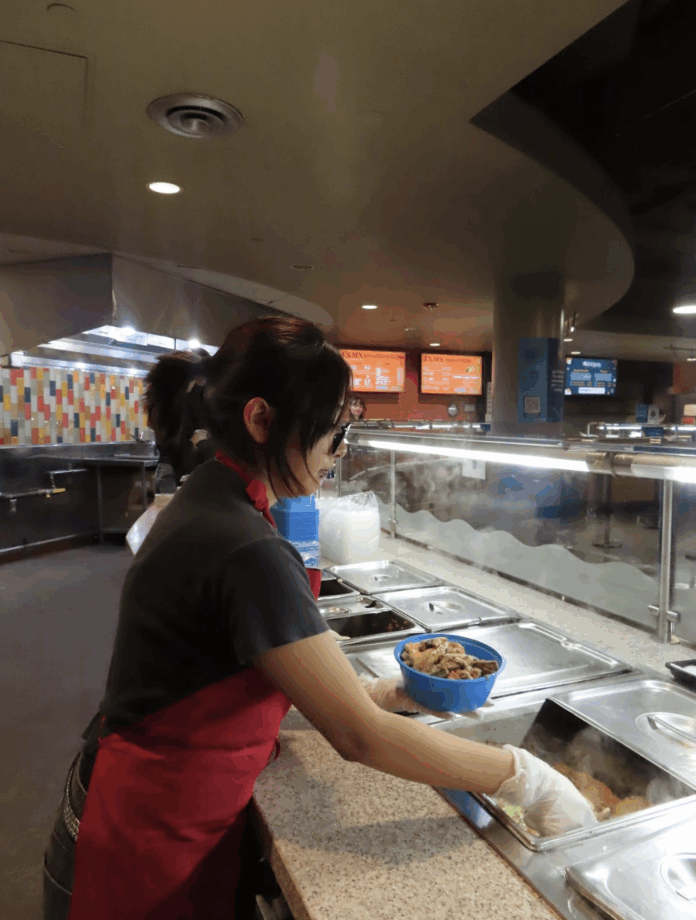
The ASUCD Coffee House (CoHo) has introduced a new reusable to-go container system at their food service stalls, in hopes of making their food service operations more sustainable.
Launched with food container company Friendlier, the program now has containers available with purchases at Cooks, Ciao, TxMx Grill, Chickpea and Fickle Pickle Deli.
When students purchase a meal served in the containers, they will pay a 50-cent deposit and receive a deep sky-blue container made from food-grade polypropylene. Each is reusable up to 100 and has a QR code on its bottom that takes students to the Friendlier app, through which they can earn their deposit back within one to two weeks.
Students can also choose to give their deposit forward as a donation, namely to the ASUCD Pantry, before clearing the container and putting it into the collection bins located across the CoHo. The bins are later brought to Friendlier’s facility in West Sacramento, where they are sanitized and cleaned before they are sent out for reuse.
Associated Students Dining Services Foodservice Director Darin Schluep says the CoHo is piloting the program for six months, with only 20% of their current menu offerings using the reusable packaging.
“We are hoping we will see a reduction in our single-use packaging impact on the waste stream,” Schluep said. “After the six months, we may determine we can expand to more items or look at other locations to add more of this packaging. It really depends on the acceptance rate for the consumers and what kind of feedback we get on the program.”
Disposable take-out containers are familiar and convenient, yet single-use plastics are responsible for billions of tons of waste. While reusable containers are assumed to be a better alternative, reducing climate impacts and waste, reality is a little more complex.
Recent life-cycle assessments (LCAs), such as the 2024 assessment published in the Journal of Cleaner Production, made one thing clear: Reusable containers are only better when reused enough times. With higher reuse rates, the benefits of reusable containers rise. However, inefficient cleaning or low return rates can significantly impact that.
Friendlier was founded in 2020 by University of Waterloo graduates Kayli Smith and Jacqueline Hanton, who were looking at how individuals can make a positive impact on climate change daily.
“Custom equipment was designed to ensure high-quality sanitation and drying with each reuse,” Hanton explained. “By offering off-site washing, schools have the ability to scale the program across campus without the operational burden of dishwashing.”
Friendlier’s containers are also designed to be lightweight and stackable, to reduce storage requirements and transportation emissions.
Since the benefits of reusable containers rise as reuse rates do, the return rates of the containers are important for measuring the impact of the program. Friendlier tracks this using unique identifiers on every container.
“We can track where the package was sold, and when the package returns back to the Friendlier location for washing,” Hanton said.
Users can even see their own environmental savings data by scanning the QR codes on the packaging.
“[Our] system does not require consumers to sign up or know about the Friendlier program prior to getting the container. There is no POS integration or friction,” Hanton said. “Our convenience-focused strategy makes returning easy for everyone — even those who don’t care about their environmental impact.”
The UC Davis pilot is structured as a six-month data collection effort to determine whether the program is having positive impacts on the campus, environment, operations and customers.
“We’ll be tracking return rates, waste stream reductions and customer satisfaction in order to determine whether we make this program a more permanent part of our operations,” Schluep said. “We’re hoping for a 20% reduction in waste stream volume and at least a 50% return rate on the containers.”
With the Friendlier partnership providing the support that was missing from past programs, the pilot takes steps in bringing reusable containers to campus.
“Small individual actions actually add up,” Friendlier Director of Customer Success Derek Vollebregt said. “It has been really cool to talk to all the different students and staff about their excitement. It may seem like a small action, but added up, it contributes quite a bit. We’re excited for all the support across campus that we’re seeing.”
UC Davis expects that 2,500 containers will be used per week, and Vollebregt says that if half the containers provided to UC Davis are reused over the six-month pilot period, it would mean 30,000 containers avoid going to the landfill. He estimates that the emissions from those containers would be the same as driving a gas-powered car from Los Angeles to New York six times.
UC Davis was recently ranked No. 1 for campus sustainability in the United States for the 10th year in a row, and No. 7 internationally for its 13th year, according to the 2025 UI Green Metric World University Rankings. Friendlier leaders present their packaging as a way for UC Davis to bring further environmental consciousness to its food operations.
The Friendlier app also tracks each student’s overall impact on the environment, how much carbon dioxide emissions they’ve saved and how much plastic waste they’ve helped reduce.
“This project helps continue our role as a leader in sustainable food service,” Schluep said. “It helps us accomplish some of the objectives of the University of California (UC) Office of the President and the whole UC system wants to see a move away from single-use containers to more reusable packaging.”
While the program may have some drawbacks as customers adjust, CoHo Cashier Yujia Liu, a third-year human development major, shared her opinion about the reusable initiative.
“It is a little bit of a hassle to download the app,” Liu said. “I do like the idea of reusing these packing containers though. It’s a lot more environmentally conscious and is helpful in terms of reducing the amount of plastic we use.”
Written by: Rachel Tran and Katelyn Burns— campus@theaggie.org