We are lonelier than ever and our t-shirts aren’t helping
By MILES BARRY — mabarry@ucdavis.edu
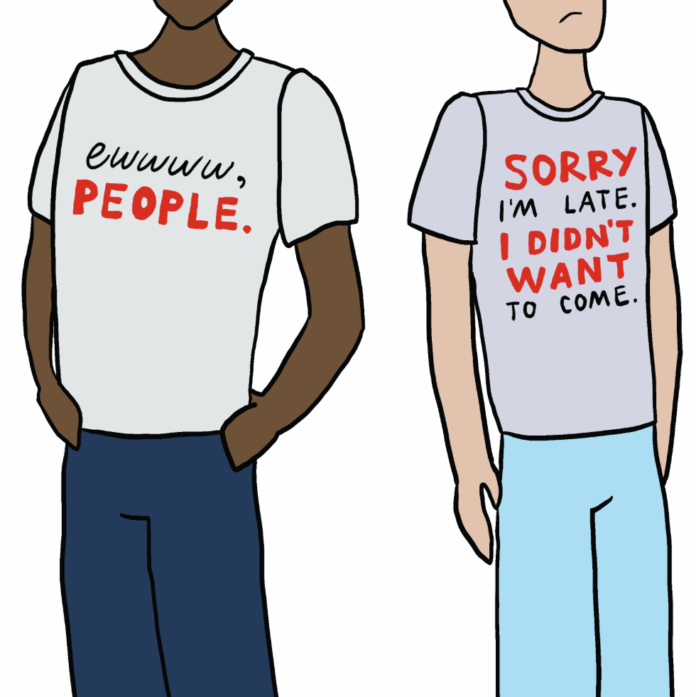
Walk through any American airport, thrift store or mall, and you’ll encounter a peculiar genre of clothing: the antisocial t-shirt. To name a few: “You Read My Shirt. That’s Enough Social Interaction for today”; “Rules for Monday: don’t talk to me, don’t look at me, don’t even breathe in my direction”; “I’m not an a**hole. Oh wait, yeah I am. I should probably warn people about that”; and “Ewwww, people.”
The grammar of the antisocial t-shirt is always in the first person. It’s almost always negative. It positions social interactions as unwanted and tedious. It often references chemical mood shifters (“Don’t talk to me before my coffee” or “Just here for the wine”). Antisocial shirts are a defense mechanism; the wearer has (however unwillingly) entered a public space — a place to find love, make new friends, compliment a stranger or overhear interesting conversations. But every time someone looks at them, their attire blatantly announces that all interaction is unwelcome.
This pessimism represents a shift in the tone struck by modern t-shirts. While slogan t-shirts were officially introduced to the world by the United States military shortly after World War II, they exploded in popularity in the 1960s with Michael Vasilantone’s invention of the multi-color garment screen-printing machine. This gave nearly anyone the ability to produce wearable art, which — alongside fashion’s move in a more casual direction — led to a dramatic increase in the expression of personal beliefs across one’s chest. Examples of this include John Lennon’s “War is Over!” campaign against the Vietnam War and Katharine Hamnett’s “58% don’t want Pershing” shirt, used to display poll numbers against Margaret Thatcher’s policies while Hamnett shook her hand.
Then something happened. Somewhere between “Choose Life!” and “I don’t do Mondays. I don’t do Tuesdays either,” the American t-shirt underwent a tonal shift. The message stopped being directed at the world and started being directed at anyone who might approach the wearer: the t-shirt became defensive.
Some might consider this to be a useful boundary; a way to communicate that the wearer shouldn’t be approached, like a porcupine’s quills. And, as a guy with a sort of creepy mustache, I do understand that people aren’t obligated to talk to me in public. But, one wears a t-shirt all day! Their whole 10 hours on campus are spent advertising “Here’s how tired I am, and I don’t want to talk to you even a little.” This projected exhaustion or disinterest can be perceived as aggression. When you look through your dresser in the morning, and decide between your “I’m Only Talking To My Dog Today” shirt, and your “Sorry I’m Late. I Didn’t Want To Come” shirt, can you really be confident that you’ll feel that way all day?
The fact of the matter is, people are lonelier than ever. In 2023, young Americans spent 45% more time alone than they did in 2010. Americans are spending less than half as much time with friends as they did a decade ago. Under the Biden administration, the Surgeon General identified this as a major health concern, noting that the “mortality impact of being socially disconnected is similar to that caused by smoking up to 15 cigarettes a day.” As our daily lives become more unhealthily antisocial, so does our daily wear.
But are these shirts really keeping everyone away? Paradoxically, these antisocial shirts serve a social purpose; their text is useless without an audience. The t-shirt that says “Don’t talk to me” is actually a form of communication to other people. Maybe its wearer is reaching out by pushing away, and the slogan becomes a filter for a very specific form of social interaction. It says “Overthinking, overstimulated, overwhelmed” — beneath that, the subtext asks “Are you feeling this way too?” This tacky expression of antisocialness might be read as a plea for connection or a desire to meet people who are in the same boat.
Despite this alternative interpretation, I can’t help but feel concerned that we have supplanted outward expressions of beliefs with outward expressions of inwardness. While the protest shirt said “Here’s what I think the world should be,” the antisocial shirt says “Here’s why I can’t deal with our world now.” One imagines a future; the other barely survives the present. While everyone has days they’d rather spend alone, I worry that we’re moving towards a world with silent coffee shops and zero spontaneity.
Written by: Miles Barry—mabarry@ucdavis.edu
Disclaimer: The views and opinions expressed by individual columnists belong to the columnists alone and do not necessarily indicate the views and opinions held by The California Aggie.