57.2 F
Davis

Davis, California

Monday, December 22, 2025
Home Blog Page 148

Spring quarter horoscopes

100% guaranteed. You can sue UCD if these don’t come true. 


By ANNABEL MARSHALL — almarshall@ucdavis.edu 


Aries: Your utilities will be about the same as last quarter. Maybe a little more.

Capricorn: Childproofing your house isn’t just for expecting parents. It’s also for idiots who come home drunk and walk into the dinner table. Put some bubble wrap on those corners.

Scorpions: Stop stinging people.

Leos: Are any leos named Leo? That would be crazy. Ahaha.

Everyone I follow on Instagram: Don’t buy tickets to Italy just because everyone is going to Italy. We can’t all go to Italy. Who will stay to drive the buses?

Opinion Editor Owen Ruderman: Let me say f**k.

Aquarius: Try to be a little more upbeat these last few weeks. I know life can be difficult, but it’s not like your dog died. Except for one of you, your dog will die.

Statistics majors: Buy a lottery ticket.

My neighbors: If you don’t stop having loud conversations at two in the morning I’m going to write a strongly worded letter. Then, I’m going to attach it to a brick and throw it through your window. That’s not legally a threat because this is only a humor article.

Third-year human biology majors: Have you seen “Succession?” Me neither. I heard it’s good.

Ethel Cain fans: Uh oh! Not as unique as you thought you were, huh? It’s too late to “discover” an artist on the cover of multiple Spotify playlists.

Hardcore Christians: I thought you weren’t supposed to read these kinds of things.

Gary May: Listen into the woods at darkest night. The trees will speak to you, three words by the way of the great Earth power. Cover yourself in dirt and open your screaming mouth to the moon.

People who are allergic to bees: Freeze. Don’t move. Oh my — just be very still.

Lizas, Lisas and Elizas: Check your mail. Spoiler alert: it’s jury duty!

Pharmaceutical chemistry: Due to a typo in the University of California, Davis bylaws, your degree is technically a Bachelorette of Sciences.

People who braid ribbons into their hair: Can any of you give me a ride to boygenius?

Ellyn Paris: Hi Ellyn!


Written by: Annabel Marshall — almarshall@ucdavis.edu 

Disclaimer: (This article is humor and/or satire, and its content is purely fictional. The story and the names of “sources” are fictionalized.)
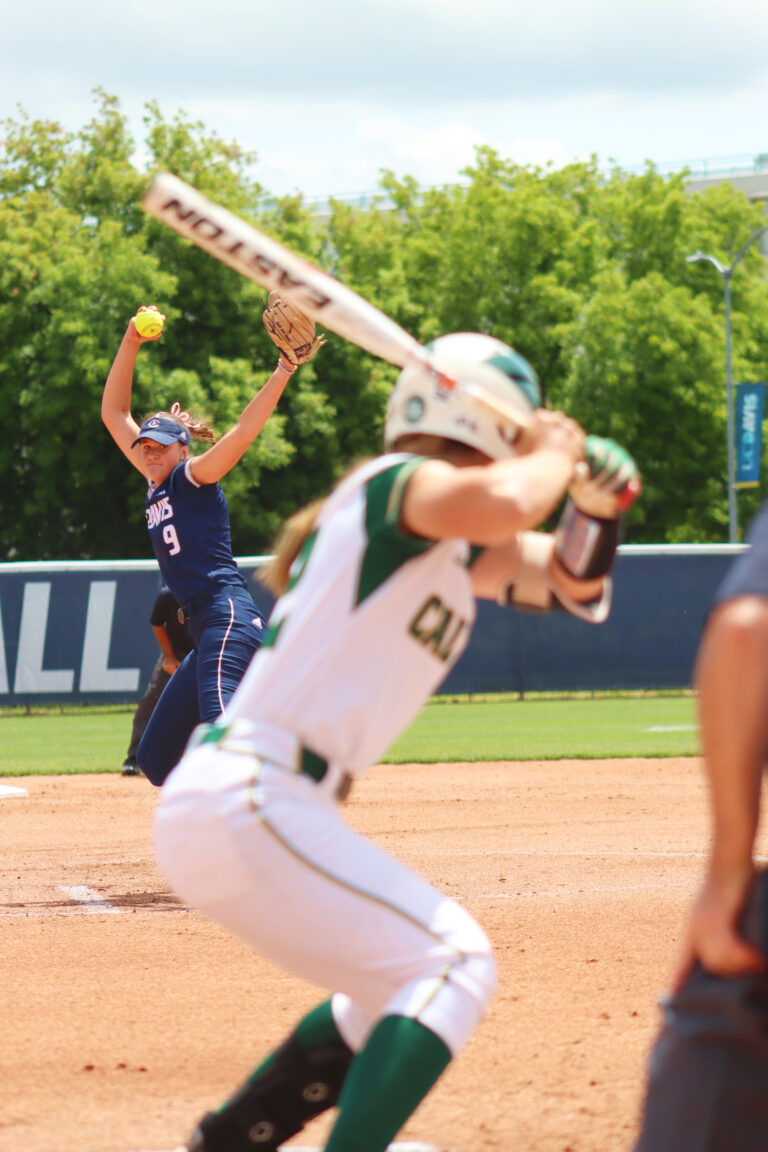

UC Davis softball celebrates senior night

Aggies suffer tough doubleheader loss to Cal Poly on senior night


By EVA MACHADO — sports@theaggie.org


The UC Davis women’s softball team celebrated their four graduating seniors, Delaney Diaz, Taylor Fitzgerald, Alyssa Ito and Sommer Kisling, on May 7 following their doubleheader against the Cal Poly Mustangs.

The Aggies held a short ceremony for the seniors, wishing a happy farewell to their departing teammates. 

Friends and families gathered on and around the women’s home softball field following the doubleheader against Cal Poly. Head Coach Erin Thorpe shared that she hopes the graduating players take away from their time on the team the ability to “know what it feels like to battle with another group of people in order to accomplish a goal.”

Thorpe went on to describe the camaraderie she has seen from these players and knows they will continue to show in their lives. 

Delaney Diaz was the first to be celebrated in the ceremony. Diaz plans to attend nursing school and become a pediatric oncology nurse after leaving Davis. She has been a massive presence on the team, “playing 92 games and starting [in] 68” during her five years in the program.

Diaz showed her capability as a player during the day’s doubleheader, pounding a hit in game one that scored third-year Sarah Starks right to center. This run was the second and last for the Aggies in the first game against Cal Poly.

Taylor Fitzgerald was the second celebrated senior of the day. Fitzgerald has made 70 appearances in the circle as a UC Davis pitcher and “holds the best two single-season efforts in program history,” which were both shutouts.

During the doubleheader, Fitzgerald allowed five hits, three runs and struck out one batter in the first game against Cal Poly. In the second game of the day, Fitzgerald continued to support her team outside the circle.

Alyssa Ito returned to the Aggies for her final two seasons following one season with the team in 2020. Ito has played in 69 career games and started in 18 games. Ito will be studying for the CPA exam while working as a corporate auditor after graduation.

Ito’s announcement stated that she will cherish the small memories she has made with her friends at UC Davis and while on the team the most.

Sommer Kisling was the final senior to be celebrated by the Aggies on their home field for the 2023 season. Kisling has played with the team for the past five years, holding the record in the school’s division one history for the number of games played at 217. Kisling is also ranked second in all-time at-bats and third in hits for the team. This record reflects Kisling’s consistency on the team. 

The senior celebration followed the Aggies’ last home game of the regular 2023 season. Cal Poly beat the Aggies in back-to-back games, both with scores of 5-2.

In the first game of Saturday, the Aggies came out strong, scoring two runs in the bottom of the first. They held this lead until the sixth inning, when the Mustangs scored three runs, followed by an additional two runs in the seventh. 

Game two followed a similar trajectory. Again, the Aggies came in hot, scoring two runs in the first inning, but the Mustangs answered these runs with one of their own. 

The Mustangs and Aggies fought throughout the next three innings. Cal Poly scored one more run to level the score, and in the third inning, they took off, scoring three runs. The Mustangs held off the Aggies for the remainder of the game and ultimately defeated the Aggies with a final score of 5-2 again.

Saturday’s losses for the Aggies followed a win against Cal Poly on Friday, May 6. 

Leading players in Friday’s game included third-years Anna Dethlefson, Leah Polson, and Sarah Starks. Starks was also named student-athlete of the week. Starks earned this title in part because of a powerful home run during the doubleheader. Starks’ abilities shined through in both Friday’s win and Saturday’s games. 

What’s next for the Aggies following this tough loss against Cal Poly?

Following this three-game homestead, UC Davis headed to the University of Hawai’i for the regular season’s finale. The Aggies played the Rainbow Warriors on Thursday, May 11, followed by a doubleheader on Friday, May 12. The Aggies rallied from behind in the sixth inning of Thursday’s game but ultimately lost 2-3. On Friday, the Aggies beat the Rainbow Warriors in both games, winning the first 6-1 and the second 5-2. 


Written by: Eva Machado — sports@theaggie.org


UC-AFT, students call for reinstatement of music professor Erik Peregrine after new candidate hired for tenured music department role

The professor cited gender discrimination as one of the reasons for the hiring decision, which the department denies


By RACHEL GAUER— campus@theaggie.org


Choir students and members of the UC-AFT union are calling for the reinstatement of Erik Peregrine, who currently serves as the director of choirs and as a lecturer in music at UC Davis. Peregrine, who identifies as transgender and uses they/them pronouns, initially signed a two-year contract in 2022. However, when the department gained permission and funding to create a tenured faculty position for the role, they terminated Peregrine’s contract and conducted a national search for the new position, eventually selecting a different candidate.

Peregrine first began as a lecturer in the Music Department at the beginning of fall quarter 2021. According to a timeline created by Katie Caceres, who is a second-year environmental policy analysis and planning major and a student of Peregrine’s, Peregrine initially worked under a one-year contract that was meant to be reevaluated at the end of the academic year. At this time, according to Caceres, the university then granted them a two-year contract that was set to last from 2022-2024.

This past January, Peregrine was notified that the position was going to be turned into one with a tenured track. As a result, Peregrine would have to re-apply for the position alongside the other candidates, effectively terminating their original two-year contract because of the nature of the new position being offered.

Laurie San Martin, a professor in the Music Department and the Chair of Music at UC Davis, provided a comment on the situation. She noted that when hiring for a tenured faculty position like this, the department is required to conduct a national search and open the role up to other candidates. 

“Erik Peregrine has done a wonderful job with the choirs at UC Davis these past six quarters,” San Martin said via email. “Last fall, the dean’s office granted permission for the music department to conduct a search for a tenure-track faculty member, who would serve as director of the choirs. […] The final four candidates (one of whom was Erik Peregrine) were all very impressive. The search committee ultimately chose Nicolás Dosman for the position, and the department agreed with this choice. ”

Caden O’Flaherty, a third-year sociology major who identifies as transgender, has participated in choir courses with Peregrine for the past four quarters. O’Flaherty said that they sent a recommendation to the department chair to encourage the rehiring of Peregrine on Jan. 28, but said that their email recommendation received no direct response. 

Later in the interview process, Peregrine was asked to present their research at a presentation that was open to students. Caceres said that the student turnout and student support for the professor were significant. 

“A bunch of other students and I all attended,” Caceres said. “It was so full, to the point where we had to bring in extra chairs.” 

At the event, students were asked for their contact information to be involved in the remainder of the hiring process. Caceres and several of her classmates provided the department with the information. 

“A staff member came up to us and asked us to put our names and emails on a notepad if we wished to be involved in the rest of the hiring process,” Caceres said. “I put my information down and later heard nothing.” 

The department said that it was very open to receiving and considering student feedback during the search process, and received a variety of responses, which it says it took under consideration.

In mid-February, shortly after the hiring process began, Peregrine was notified that they were not going to be rehired for the position. The students within the department were not notified until Peregrine informed their students on April 12. 

Throughout both their career at the university as well as throughout the hiring process, Peregrine cited experiencing various instances of misgendering and transphobia within the department. In April of 2022, Peregrine said that their pronoun sign by the door of their office was vandalized. 

“My ‘they/them’ pronouns were scratched through with a thumbtack, ” Peregrine said. 

“I reported a hate crime through Harassment & Discrimination Assistance and Prevention Program (HDAPP) and never received any follow-up from the university.”   

Peregrine also attributed not being rehired for the position primarily to “discomfort” surrounding Peregrine’s gender identity from Mika Pelo, the chair of the search committee. 

[Pelo] misgendered me in multiple settings during the process, including the final interview with the full faculty,” Peregrine said. “No one else in the room — all my current colleagues — interrupted him to correct, so I did. I believe that his discomfort with my gender is a primary reason that I was not offered the position.” 

In response to Peregrine’s accusations, Mika Pelo acknowledged his misgendering of Peregrine but denied the accusation of this being a recurring problem.  

“I did misgender them once during the interview, and immediately emailed them to apologize,” Pelo said. “They accepted the apology. […] That I misgendered them multiple times, is an outright lie. […] I would never mean any mal-intent by mistakenly using the wrong pronoun. I think many like me, with English as a secondary language, would understand why this unfortunately can happen.”

Previously, Peregrine used both he/him and they/them pronouns, and Pelo said that prior to the interview process, he had read an outdated online biography for Peregrine which listed both sets of pronouns. However, Peregrine said that their Music Department biography was, at some point, changed to include these now incorrect pronouns without their knowledge or consent. 

Peregrine commented on their initial reaction to the termination of their contract and how they believe the decision will affect other lecturers in the union at the UC. 

“I was shocked when my contract was terminated early and without any conversation involving me about my future at UC Davis,” Peregrine said. “My union (UC-AFT) fought so hard to finally win multi-year contracts for lecturers beginning this academic year. My layoff is a direct affront to that agreement between UC-AFT and the University of California, and it sets a very dangerous precedent for all lecturers teaching at a UC campus.” 

Within the timeline Caceres compiled, she recounted the treble ensemble’s general reaction to Peregrine’s announcement. 

 “[Their students] were shocked, and some immediately started asking what they could do to help, or even reverse the decision,” Caceres wrote. “This is a testament to how loved Dr. Peregrine is, and what an amazing director they are.”

In response to Peregrine’s dismissal from the university, UC-AFT, the union that represents Unit 17 and Unit 18 throughout the UC system, published a petition that calls for the reinstatement of Peregrine. The petition says that the alleged issues of contract violation and gender discrimination-related incidents have not been “properly address[ed]” by the university. As of May 15, 1,577 signatures were collected on the petition in support of Peregrine’s reinstatement. 

  Mika Pelo provided a concluding statement regarding the backlash he has received from the university’s hiring decision, and gave Peregrine well wishes for the future of their career. 

 “Anyone can slip up, and I did, and then I apologized,” Pelo said. “I think this says more about Erik than me, unfortunately. I wish Erik all the best for the future, and harbor deep respect and gratitude for [their] work.”

O’Flaherty commented on the way they feel the university has handled the rehiring process from a student perspective. 

“There is something inarguably wrong about the way that the university has conducted this whole process,” O’Flaherty said. “We as a community have been asking for answers from the department chair and the chair of the search committee and have gotten nothing. There has been so much ambiguity as to why this is happening and why Erik wasn’t chosen.”

Peregrine commented that they feel speaking about this situation may help other lecturers and specifically transgender people in academia in the future. 

“Regardless of the outcome, I hope that awareness of my situation can contribute to illustrating a larger picture of how both lecturers and transgender people are mistreated within the UC system,” Peregrine said. “If we stay quiet, if we let our voices go unheard, it will remain extremely difficult to identify system-level problems for what they are. Lecturers deserve the job security we’ve been promised, and trans people deserve supportive, or at the bare minimum, non-hostile, work environments. I feel an ethical responsibility to use my experiences here to create greater accountability, equity and positive change.”

Written by: Rachel Gauer  — campus@theaggie.org

UCD to offer Frat Boy classes

So the frat boys can frat better!


By CARMEL RAVIV— craviv@ucdavis.edu


After a superintendent meeting discussing the vitality of fraternities at UC Davis, Chancellor Gary May realized that we need to do better to accommodate them. After all, they have done so much for campus social life and student alcoholism, without doing any real work at all. 

After evaluating the difficulty that frat bros have to endure balancing a stressful course load in Managerial Economics and attending fraternity-related events while also being involved in consequential activities such as bicep curls in the ARC, playing spikeball and badgering their friend with a med card, the committee has developed a plan to bring on change. 

UCD will be adding the School of Bruhhh, a fifth college that consists of classes that will enhance the skills, critical thinking and bright futures of Davis frat boys. Some classes that will be instructed are:


BRO 002: The Biochemistry of Alcohol Circulation

BRO 003: The Biochemistry of Alcohol Circulation While Crossed af

BRO 015: The Morals and Ethics of “They weren’t that drunk!”

BRO 032A: Constructional Engineering: Beer Pong Table

BRO 032B: Constructional Engineering: Die Table

BRO 072: Women’s Studies: What Zodiac Sign to Tell Girls You Are

BRO 069: Relationship Psychology: Coz these b*tches crazyyy

BRO 099: Creative Writing: Party Themes and Canva Invites

BRO 113: Sound Engineering: How to Mix “Pursuit of Happiness” and “No Hands” on a Loop

BRO 120: The American History of the Backwards Hat

BRO 150: Business Networking Strategies: Getting that Deloitte Internship

BRO 420: Aaaahhaahhahaa

FRS 125: How to Tell a Group of Dudes to “gtfo” While Working Security


All majors are welcome to strengthen their Frat Boy understanding by taking these classes. 


Written by: Carmel Raviv — craviv@ucdavis.edu

Disclaimer: (This article is humor and/or satire, and its content is purely fictional. The story and the names of “sources” are fictionalized.)

Harry Potter and the colonialist fantasy

While some may advocate for separating the art from the artist, Rowling’s regressive views have always been present within the text


By GEETIKA MAHAJAN — giamahajan@ucdavis.edu


Even before the “Harry Potter” book series was complete, it began to transcend the kind of popularity typically associated with works of children’s literature. Describing it as a “bestseller” didn’t really encompass the full extent of its reach — it was practically a cornerstone of early 2000s culture. However, as the author of the series, J.K. Rowling (JKR), became more vocal about her anti-trans views, people became more hesitant about expressing their love for the series. Some even called for a boycott of anything that would put money in J.K. Rowling’s pockets (and rightfully so — as she has gone on record to say that many of the royalties she receives go directly toward organizations that actively work to limit transgender rights.)

Rowling’s sudden shift from beloved children’s author to transphobe seemed shocking to many ardent fans of the series, but a more careful reread of the books themselves demonstrates that her regressive, Blairist politics were always apparent within her work, manifesting in the way that the Harry Potter books themselves function as a sort of colonial fantasy. 

The Harry Potter books contain not just magical humans but a variety of various human-adjacent magical creatures — werewolves, centaurs, goblins, house elves and giants, to name a few. Though they all, to some extent, possess the same ability to perform magic as the wizards themselves, none of them are present as students of Hogwarts or are even seen in the wizarding world outside of the roles that have been predetermined for them. That is to say, all goblins appear as bankers and are apparently content to remain bankers forever; all house elves appear as docile workers who actively resent anyone who attempts to free them. The wizarding world seems to function as “a place for everyone and everyone in their place” — and this hierarchical structure may sound familiar, because it is. 

It mimics the sort of stratified society that colonists would salivate over, in which the colonized do not resist inferiority, or even seem to prefer it. There are very few examples of non-human magical creatures being accepted into wizarding society; two prominent examples — Remus Lupin, a werewolf who was introduced as the Defense Against Dark Arts teacher in “Harry Potter and the Prisoner of Azkaban,” and Firenze, a centaur who became a Divination professor in “Harry Potter and the Order of the Phoenix.” These are noteworthy exceptions because they are recognized in the text as particularly outstanding members of their species, more tolerable than their savage counterparts. This too, is an extension of the colonial fantasy, wherein inferior members of society can aspire to a certain level of assimilation that will grant them access to the world of the colonizer. Of course, even then, they are not recognized as true equals; both Lupin and Firenze rely on the benevolence of those in power to maintain their positions and are still subjected to prejudices that even their elevated status cannot dispel. 

If Rowling had wanted to write “Harry Potter” as an anti-colonialist text, she could have easily done so. Throughout the seven novels, she lays out the framework of a society that is, essentially, stratified by class. She even discusses the prejudices that non-human wizards face in this society — yet the “resolution” does not bring about any sort of justice for them. Harry’s defeat of Voldemort, which has supposedly saved wizardkind, does nothing but preserve this stratification. Voldemort himself advocates for the subjugation of a certain class of wizards, claiming that those who were born to non-wizards should not be allowed the same level of access, education or privilege that pureblood wizards are granted. This is, essentially, what wizards themselves have been doing for centuries — classifying certain creatures as the “other” and restricting their rights on that basis. 

It was not so much about the atrocities that the death-eaters and Voldemort were committing, but the fact that the atrocities were being leveled against humans, rather than the house elves, werewolves, goblins and other magical creatures that the atrocities were previously reserved for. When Voldemort is defeated, no efforts are made to create a more inclusive society, nor is there any indication that there is a demand for change. Such is the colonialist fantasy: the biggest threat to social order is never the liberation of the lower classes, because the lower classes do not even consider liberation a possibility.  

It could be argued that the portrayal of certain characters in the series resist the stereotype of the colonist. In fact, Rowling makes it a point to demonstrate just how benevolent Dumbledore is in particular. Multiple magical creatures extol upon his kindness for “accepting” them into the wizarding world — but the acceptance is simply tolerance, not complete inclusion. Often, the characters who are offered this kindness have something to offer to the wizards in return. Titular character Harry Potter’s compassion is less conditional, but he fits into the colonialist narrative in a different way; throughout the course of the series, the reader learns that Harry himself has been born into a position of power. Even if he had not defeated Voldemort as a baby, he would still have been the son of two wizards who were highly respected in society; the books do not chronicle the tale of some underdog who has no place in the world of wizards, but describe how Harry is able to return to his place at the top of this hierarchy. In Rowling’s world, the good guys are people born in positions of power and privilege, and the bad guys are people also born in positions of power and privilege but who abuse their elevated status. The only struggles are between these two groups, the former always emerges triumphant, and the subjugated classes around these dueling, privileged groups, are content to remain inferior forever. 

HBO has recently announced that they plan to develop a Harry Potter reboot — a declaration that has been met with everything from positivity to indifference, to outrage. Already, people have been discussing the moral implications of watching a show knowing that some of the royalties JKR earns will go directly towards anti-trans organizations. But it’s important to remember that it was not her transphobic tweets that ruined the series post-factum — it is the fact that colonialist-like regressiveness has always existed throughout the novels.   


Written by: Geetika Mahajan — giamahajan@ucdavis.edu

Disclaimer: The views and opinions expressed by individual columnists belong to the columnists alone and do not necessarily indicate the views and opinions held by The California Aggie.

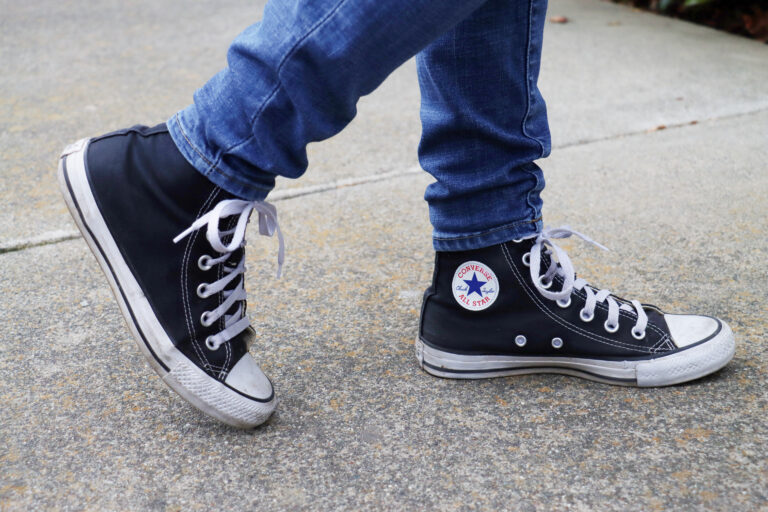
The history of Converse

Taking a look into how the iconic shoe brand changed the fashion game


By SARAH HAN — arts@theaggie.org


From tying your outfit together to working out, Converse makes some of the most timeless sneakers in the shoe industry — the classic All-Star logo, polished toe cap and numerous styles all contribute to their revolutionary design. Here is a rundown on how this versatile shoe came to be.

In 1908, Marquis Mills Converse launched the “Converse Rubber Shoe Company” in Malden, Massachusetts. The first Converse “All-Star” was an elite basketball shoe that was made with the original canvas and rubber, both materials that are still used for production today. At this time, Converse shoes were made for functionality.

Thirteen years after the launch, American basketball player Chuck Taylor joined the Converse team, which revolutionized the company’s design and ultimately led to increased sales. Taylor pitched unique designs and marketing ideas, one of which centered around spreading awareness about basketball: He held basketball clinics in schools nationwide, taught basketball to kids and shared shoes and Converse yearbooks. Due to his tremendous contributions, “Chuck Taylor” was imprinted on the All-Star logo.

In 1936, the partnership with Taylor also increased the shoe’s popularity among basketball players, especially when he helped design the white high-top model with the red-and-navy rim for the USA’s 1963 Olympic basketball team. This particular design resonated with the players and the fans because of an increased sense of patriotism as a result of World War II. The white, red and navy-colored shoe was also worn by the United States Armed Forces.

After World War II, Converse designed the black-and-white high-top model, which was added to the basketball teams’ collection. Players, from the NBA to college and high school, all wore either white All-Stars or black All-Stars, making Converse one of the most popular, unique shoes in the industry.

Following the high-top’s massive popularity, Converse introduced the “Oxford” model — a low-top version of the iconic style. This model was particularly tailored toward consumers who wanted an every day, leisure-friendly shoe. Various colors and prints also debuted with the Oxford, attracting millions of athletes and regular consumers nationwide.

In 1969, Taylor passed, and in the years that followed, Converse lost its title as one of the most popular shoe brands. Nike and similar companies began dominating the basketball shoe industry, introducing high-performance technologies and sleek designs. However, Converse poured its efforts into targeting regular consumers by characterizing the shoes as comfortable, leisure-friendly and casual.

Fortunately, this change in marketing strategy appealed to a whole new group: musicians. In the ‘80s and ‘90s, punk-rock musicians hopped on the bandwagon and started to wear Converse sneakers, which paved the way for the company to create funky and fresh colors and patterns. Soon enough, millions were on board with the shoe’s effortless and minimalist style.

In July 2003, Nike bought Converse. It was assumed that Converse’s popularity would plummet, but it did the exact opposite. The sneakers became a fashion statement for pop artists and daily shoes for skateboarders. By 2012, the company had generated $450 million from Chuck All-Stars.

Today, Converse has made over $2.3 billion in revenue, with millions of children, teenagers, athletes and adults wearing its products. The well-known shoes also became popular among celebrities, politicians and influencers, from Michelle Obama to Millie Bobby Brown.

However, the most appealing aspect of the company is its consistency. It has been operating for over 100 years and has yet to change its timeless design. Collaboration after collaboration, the company remains true to its wardrobe-staple roots.


Written by: Sarah Han — arts@theaggie.org

The Oakland Athletics agree to purchase land for new ballpark in Las Vegas

The rich history of the Oakland A’s may be coming to an end with potential relocation to Las Vegas


By PATRICK FIGUEROA — sports@theaggie.org


On April 19, sources confirmed to the Nevada Independent that the Oakland Athletics (A’s) agreed to purchase land in Las Vegas to build a new, long-awaited stadium. This news came out shortly after the A’s completed a six-game homestand, during which they lost all six games and their record fell to 3-16. In a city that has already lost two of its professional sports franchises in recent years, the A’s relocation would end an era of professional sports in Oakland.

Just five years ago, Oakland had three professional teams: the A’s, the Golden State Warriors and the Oakland Raiders. Each of these teams had a rich history embedded within the city of Oakland. The Warriors went to five straight NBA finals and won three between 2015 to 2019 while in Oakland. The Raiders won two Super Bowl championships in 1976 and 1980, and, even in the years when they struggled to maintain their “commitment to excellence,” fans packed the Oakland Coliseum. Still, neither of these teams match up to the A’s history in Oakland. 

Unlike other Oakland franchises, the A’s are exclusively tied to Oakland. The Warriors were more associated with the Bay Area than Oakland itself and the Raiders moved from Oakland to Los Angeles in 1982 before eventually moving back over a decade later. But the Athletics, arriving in 1968, have built a rich baseball history exclusive to Oakland. 

Notable moments from Oakland A’s history include their “three-peat,” in which they won three consecutive World Series championships from 1972 to 1974. The only other franchise in MLB to ever match such a feat is the New York Yankees. The A’s 2002 season was also memorable as they broke an MLB record for winning 20 consecutive games. In 2011, a blockbuster movie, “Moneyball,” starring Brad Pitt and Jonah Hill, told the story of the A’s historic 2002 season.

Despite this rich history, MLB Commissioner Rob Manfred is an advocate for the A’s relocation to Las Vegas. In a meeting with the Associated Press Sports Editors, Manfred mentioned that the A’s relocating would allow the team to put a “more competitive on-field product.” He also defended A’s Owner John Fisher, who many fans are blaming for the potential relocation. 

“I feel sorry for the fans in Oakland, I really do,” Manfred said. “But for the city of Oakland to point fingers at John Fisher, it’s not fair.” 

In the A’s first home game since the agreement to acquire land in Las Vegas, over 6,000 fans showed up to chant, “Sell the team!” Others also hung signs on the railing in right field with phrases like “Fisher out” and “Sell.”  

Fisher has been criticized for allegedly tanking the A’s on purpose in order to alienate fans and expedite the move out of the Oakland Coliseum. Despite having the sixth-largest media market in MLB, the A’s have the lowest payroll out of all teams. They had merely six wins through the first month of the 2023 season. They also traded away young, talented players, like first baseman Matt Olson and catcher Sean Murphy, in previous offseasons to save money. As a result, A’s fan attendance is reaching record lows. 

There was discussion of building a new stadium near Oakland called the Howard Terminal project. In early April, the city prevailed in a court case deeming that the project’s environmental impact report was sufficient. This was significant progress for the A’s to get a new ballpark in Oakland, but Fisher still decided to buy land in Las Vegas, which apparently “blindsided” Oakland Mayor Sheng Mao.

“Based on the A’s desire to achieve certainty in 2023, we laid out a detailed and specific plan to bring the project forward to city council vote this summer,” Thao said. “But it has become clear that we are not able to reach acceptable terms and that the A’s are not good partners in the effort.”

Still, the relocation is far from finalized. In a recent article from the Nevada Independent, Nevada Assemblymember Steve Yeager revealed that the state’s legislature could “run out of time” on a potential deal to use public money to help construct the A’s new ballpark in Las Vegas. For the funding to be included in this year’s state budget, the deal would need to be finalized before June 6.

“If something was going to happen, it really should have been in place last week,” Yeager said about getting a deal done for the A’s new ballpark. 

If the A’s and Nevada do not come to a deal by June 6, there is still an opportunity to do so in a “special session” after the deadline. However, Yeager said he would prefer to have a deal done during the regular session. 

Despite this, it seems doubtful that the A’s will stay in Oakland. 

“I think [my] overall reaction is just sad,” Oakland A’s fan Jonah Pelter said when asked what he thought about the potential move. “I really think that Oakland deserves better and the Oakland sports fans [too]. The fans there are die-hard [fans], and they really care about the team and the team’s history, so it’s really sad. I think it is important to note that it’s not official yet, but I think it’s probably 70/30 that they move to Vegas given that the MLB supports the move.”  

The A’s will be in Oakland for the remainder of this season and next season at least, as their lease in Oakland Coliseum will not expire until after the 2024 season. Yet, this remaining time in Oakland seems like it will merely be a shell of what once was as the A’s continue to perform poorly and their fans refuse to support an owner that they feel is abandoning them. 


Written by: Patrick Figueroa — sports@theaggie.org


What your favorite ‘70s band says about you

Disclaimer: If you listen to any of these bands, you have great taste


By YASMEEN O’BRIEN — yjobrien@ucdavis.edu


Fleetwood Mac

You have a flair for the dramatic, great hair and lots of rings. When you were a kid you dressed up as a witch for Halloween. You shop exclusively at Trader Joe’s. If it weren’t for your commitment issues you’d totally get a tattoo.


Simon & Garfunkel

You’re pretty chill. You’re a quiet intellectual who can seriously groove. You probably have a crush on your best friend. Also, you should apply to write for The Aggie next year.


The Beatles

Oh you like the Beatles? Name every beetle. Your taste is basic but solid. You most likely have a lot of hobbies and probably don’t listen to old music much. You own a record player but never use it. Your parents are your best friends. <3


The Rolling Stones

You don’t stand out in a crowd but you have the best one-liners. You’re down-to-earth and actually listen to KDVS. You can’t get no satisfaction.


ABBA

You love a good dance party and sequins. You most likely learned about ABBA through “Mamma Mia.” You have a great sunglasses collection and a beach cruiser. You’re probably in a sorority. 


Queen

You make a great first impression. There’s also a pretty good chance you haven’t had your first kiss yet. You buy band T-shirts from Amazon. You’re a social butterfly and could recite “Ferris Bueller’s Day Off” word for word.


Led Zeppelin

You’re pretty cool but a little pretentious. You love the open road and probably prefer to read non-fiction. You know how to make the best out of a bad situation. 


Grateful Dead

You’re definitely going to the Whole Earth Festival. You’re probably a stoner. And also vegan. And you’ve been getting really into slack-lining. You think you’re pretty cool.


Joan Jett & the Blackhearts

You cut your own bangs last week. You also smoke cigarettes to look cool. You don’t know how to be vulnerable but you’re great in bed.


Pink Floyd

You’re pretentious with a tortured soul and only hang out at Mishka’s. You have a great appreciation for technical music skills and love World War II documentaries. You’re also into rock-climbing.


AC/DC

No one has ever seen you without headphones. You say yes when people ask if you play guitar, but only know one song. You give everything 100% and you’re probably a good kisser. You never respond to text messages.


Written by: Yasmeen O’Brien — yjobrien@ucdavis.edu

Disclaimer: The views and opinions expressed by individual columnists belong to the columnists alone and do not necessarily indicate the views and opinions held by The California Aggie.

The Backseat Lovers provided a lively, intimate performance at Oakland’s Fox Theater

Concertgoers matched the indie music act’s energy


By ANA BACH — arts@theaggie.org


On April 24, The Backseat Lovers, an American alternative rock band, performed at the Fox Theater in Oakland, California as part of their North American tour.

The Backseat Lovers are based out of Utah, and according to their Spotify page, their music focuses on “the feelings at hand.” The band consists of four members whose music feels like an indie take on modern rock. 

At their performance in Oakland, the band’s setup consisted of a few asymmetrically patterned carpets spread across the stage and white sheets as the backdrop behind their instruments.

Three members of the band started the show by collectively tuning their guitars and segueing into a riff. Each member slowly built up the tune by adding their own unique play on the initial chords. This part of the show wasn’t immediately transitioning into any particular song, but rather, was improvised. The assortment of melodies and beats was drawn out, building up anticipation until ultimately resolving into a song familiar to the audience. This showcased not only the abilities of the musicians but also their chemistry with one another as they were able to build a cohesive sound. 

Throughout the show, the band played many of their more popular songs, most of which come from their album titled “When We Were Friends.” One of their most well-known hits (and a viral TikTok sound), “Kilby Girl,” is on this album, along with other fan favorites such as “Maple Syrup,” “Pool House” and “Watch Your Mouth.” 

Throughout the concert, melodies and even little strums of the guitar here and there were never fully sedentary. Each transition into a new song consisted of the same energy as the initial build-up, during which the band members would re-adjust their instruments and seamlessly move into the next song based on a little improvised melody. 

When the band began to play “Pool House,” the white sheets used for the backdrop showed colorful projections and lighting. The visuals were relaxing and simple, showing shadows of leaves and trees on the colorfully lit stage.

The atmosphere felt intimate, with the carpets, colors and rawness of the music creating a comforting and personal experience for the audience. 

The band performed “Kilby Girl,” and — as expected — the energy of the performers and the audience response matched the hype surrounding the track. During the main guitar riff sequence, the general admission area appeared lively and engaged.
The band closed with “Snowbank Blues,” a song from their most recent album, “Waiting to Spill,” which was softer and more folk-like than their other music. Ending with this song felt similar to a campfire sing-along, stripped to just the guitar strums and the lead singer’s vocals. 

As someone who was only somewhat familiar with The Backseat Lovers before attending their show, the live performance surpassed any expectations I had from purely listening to their recorded music. They sounded even better in person because of the clear notes coming from their instruments and microphones. 

Throughout their performance, The Backseat Lovers truly showcased their ability to make each attendee a part of the musical experience. 


Written by: Ana Bach — arts@theaggie.org 

City of Davis begins pavement rehabilitation project

Pole Line Road project starts construction in May


By ALMA CULVERWELL city@theaggie.org 


On May 1, the city of Davis broke ground on its Pavement Management Program, which is intended to improve pavement condition by repairing streets and bike paths that have been damaged over time to make them more usable and prevent future damage. 

The program includes a combination of lower-grade maintenance projects as well as complete rehabilitation and reconstruction ones. The first area that the project plans to repair is on Pole Line Road from the north end of Covell Boulevard to the city limit just past Moore Boulevard.

The project also aims to address several other areas including West Eighth Street between Sycamore Lane and Anderson Road, Fifth Street between Explorit Science Center and Alhambra Drive, Mace Boulevard between Covell Boulevard and Alhambra Drive (known as Mace Curve), Pole Line Road between the I-80 overcrossing and Cowell Boulevard, Third Street from the B Street to just west of the railroad tracks as well as various bike paths. These projects have yet to be scheduled. 

The project was originally advertised for bids in January 2023 and was awarded by city council in March. The contractor is still in the process of providing necessary planning documents to the city for review and is starting to set up material and equipment staging areas within the city, as well as placing construction signage ahead of the upcoming work. Construction work should commence within the next upcoming weeks.

The city described the possible effects that the ongoing construction might have on local businesses and community members in an online announcement.

As with all construction work, there will be temporary disruption to daily routines, noise and dust and inconveniences,” the announcement reads. “We hope to minimize these inconveniences as best as possible by working with the business community, taking input and responding with a construction effort that minimizes impacts to the businesses. The city has been in continued communication with businesses along this area regarding this work.

The city decided to implement these changes after its most recent Pavement Planning Report, which is created every six years. Barbara Archer, the city of Davis’s communications and customer service manager, shared the process of making these changes.

“Using the pavement condition data from these surveys, which identifies the level of deterioration, the city uses a software to also consider other prioritization factors,” Archer said. ”The prioritization considers the city’s available budget, the city’s overall pavement condition goals, the presence of bike lanes on a street, safe routes to school, proximity to police stations, fire stations and hospitals and maintenance and service request history. In addition, staff works with stakeholders throughout the city to determine if there are upcoming utility projects, maintenance or development projects that may require a shift in project scheduling.”

The project hopes to upgrade accessible curb ramps at various intersections and improve safety features like shortening the crossing distances at the intersections of Pole Line Road and Donner Ave and Pole Line Road and Picasso Ave intersections, which will reduce the amount of time pedestrians and cyclists will be in the street when crossing. 

“Following the project, the community can expect improved quality of travel through all modes of transportation as street failures and defects are repaired, there is a smoother road surface, new striping and enhanced safety features,” Archer said.

The project is funded by existing city funds and SB 1 Local Streets and Roads funds. Construction is expected to last into late fall. 

Written by: Alma Culverwell city@theaggie.org

New GymBuddy App launches at UC Davis

Two UC Davis students introduce new app in hopes of connecting students who need workout buddies


By EVA MACHADO — sports@theaggie.org


Working out, especially at the gym, can be intimidating. GymBuddy is an app engineered by two UC Davis students in hopes of diminishing that fear and opening up the gym community to everyone. 

GymBuddy is a new app available for all UC Davis students looking to expand their workout circles and gym experiences. Through GymBuddy, gym-goers can connect with other workout enthusiasts who may be searching for a new workout partner and friend with similar interests. 

UC Davis students may ask, who are the creators of GymBuddy and what prompted them to create the app?

Eugene Liu, a third-year at UC Davis’s King Hall School of Law and Matthew Bagale, a fourth-year undergraduate student majoring in communication, created GymBuddy together at the end of winter quarter. Liu and Bagale met after becoming roommates this past year and have formed a friendship based on their love of going to the gym. Both Liu and Bagale would often go to the gym together in their free time, solidifying not only their new friendship, but also their shared passion as gym enthusiasts. 

Liu and Bagale described a predicament they found themselves in when one night, Bagale was too tired to work out, leaving Liu wishing he could find another gym-goer who would be able to work out with him. This led Liu to come up with the concept for GymBuddy.

Following Liu’s lightbulb moment, he went straight to Bagale, sharing his idea for an app that could immediately connect gym-goers looking for workout partners. Bagale loved the concept, and he and Liu began working on the app that night. Liu and Bagale created and coded the app. 

“I had previous experience coding a website that helped fashion designers raise money (as seen on WWD and CBS),” Liu said. 

With this experience, he was able to code the first version of GymBuddy in two weeks.

Then, GymBuddy was successfully launched through a presentation to one of Bagale’s classes at UC Davis and has taken off since.

GymBuddy is currently only directed toward UC Davis students. All UC Davis students can sign up for the app using their UC Davis email address, which ensures that they will be matched with other UC Davis students and meet people from within the Davis community. 

The app has two central ways of finding gym buddies around Davis. To start, you can match with people through their profiles, which describe their interests and gym goals. Specifically, users can look at others’ uploaded pictures, level of gym experience and preferred workout times in order to find people with similar preferences. GymBuddy’s profile feature is similar to dating apps like “Tinder” in that you can choose to match with other users based on their profiles.

The second function of GymBuddy is for users looking for quick matches to workout with.

“Quick Pair” is the second and newest feature of GymBuddy, which allows users to be paired with another user looking for a gym buddy within an hour based on their profiles. This feature is key in the main concept of connecting students in immediate need of a workout partner much like Liu was the night GymBuddy was created.

So far, GymBuddy has paired over 100 UC Davis students with gym buddies and over 200 students are current users of the app. 

Liu and Bagale have plans to make GymBuddy available on other campuses and in other areas, in hopes of connecting more gym buddies everywhere. This expansion may be a slow process, as the app focuses on only UC Davis students right now, but it will possibly include other universities in the future. Liu and Bagale have also discussed expanding to geographical areas outside of universities by making the pairings location-based; however, that will likely occur much further in the future.

As of now, GymBuddy is a student-made resource for UC Davis students to not only find like-minded gym goers but also people with similar recreational activity interests. Since it includes the ability to add photos to your profile, users can find others with similar workout interests outside of the gym too, such as spikeball or rowing. 

Bagale said that his and Liu’s main focus is to create “the best experience for the students.”


Written by: Eva Machado — sports@theaggie.org


Taylor Swift: A pop icon, lyrical mastermind and remote plant photosynthesis sensing machine

How the new Plant Optics Lab machine “TSWIFT” could help isolate climate-resilient crops


By SONORA SLATER — science@theaggie.org


Taylor Swift isn’t a stranger to things being named after her — from the millipede species dubbed Nannaria swiftae in 2022, to the entire city of Glendale, Arizona being temporarily renamed Swift City in honor of the kick-off of her Eras Tour this year, it’s safe to say that she’s left a legacy on the world. But in spring 2023, she added a new honor to the list with the creation of the remote sensing instrument for plants known as the Tower Spectrometer on Wheels for Investigating Frequent Timeseries — or for short, TSWIFT. 

Troy Magney, an assistant professor in plant sciences at UC Davis and one of the senior authors on the report about the new technology, is a well-established fan of both plant science and pop music. He worked at NASA Jet Propulsion Laboratory as a research scientist developing satellite imaging technology to analyze photosynthesis and carbon dioxide in the atmosphere before becoming curious about how this technology could be repurposed for plant research.

“I got interested in building some sensors [for UC Davis] that could measure similar things to satellites but at a smaller scale; that’s sort of how TSWIFT came about,” Magney said.

Magney said that the UC Davis Plant Optics Lab, which was behind the creation of TSWIFT, uses “optical techniques” to look at plants. In other words, they measure how well the plants are reflecting light, which is tied to how much photosynthesis the plant is doing. 

“The ways that plants reflect light […] can tell us about their health and their stress and their productivity,” Magney said. “We can bring [TSWIFT] out to a field and put it on a tower, and it can look down at the ecosystem and collect data throughout the day and throughout the season so that we can look at the performance of these plants [in response to stress].”

We know the toll stress can take on a person: say, Joe Jonas breaks up with you over the phone in a 27-second phone call, or the masters of your first six albums are sold without your knowledge. Maintaining your productivity and focus would understandably be difficult. But what does it mean for a plant to be “stressed?”

“Basically when I say stress, I mean anything that reduces the plant’s ability to do photosynthesis,” Magney said. “Stress from drought if there’s not enough water in an ecosystem, […] different pathogens, […] stresses coming from temperature, […] bark beetles, wildfire smoke. Stress could come from any number of things […], but normally, I would say drought is the big one in California.”

Essentially, the machine looks for any increase or reduction in photosynthesis for a plant and then the researchers try to understand why that’s happening. 

While it can be used to analyze real-world fields, TSWIFT is primarily meant to be used in experiments: researchers simulate stressful conditions — such as drought — in a field and see which plants perform the best in these subpar conditions. 

“We’ll impose drought stress, for example, by turning off the irrigation for the rest of the season,” Magney said. “Then we’ll be able to track which of these plant genotypes is performing the best under the water-limiting conditions. If you’re trying to choose a genotype of wheat that might be the most productive under future climate change scenarios, the idea is that we simulate what the climate change scenario might be by imposing drought in the controlled field study, and then track which genotypes of wheat would perform best.”

Taylor Swift is also known for planning things out far in advance, from the perfectly curated Reputation-era social media rebrand to planting lyrics from her album Midnights in a speech she gave at NYU months before the album’s release. If plant researchers are able to do the same sort of forward-thinking planning when it comes to preparing crops for climate change, the agriculture-dependent California economy would likely benefit.

TSWIFT builds on previous work UC Davis researchers have done to try to preemptively adapt agriculture to changing climate conditions. The main advantage of the new technology is that it saves time, and allows for data to be collected on both a day-to-day and long-term basis. 

“We can begin to see when a plant might be undergoing stress, and we can see that at a daily resolution,” Magney said. “Historically, you would assess the performance of plants just by walking out in the field every day and making some measurements of photosynthesis on the plants, which is very time-consuming and labor intensive, and the idea with TSWIFT is that we can just deploy the instrument and monitor it all remotely.” 

In future versions of the technology, Magney said that he hopes the technology will be able to take measurements at night or in cloudy conditions by using blue LEDs to shine light on the plants. Eventually, he plans to equip TSWIFT with a thermal imager to measure how much water plants are using by analyzing their temperatures. 

Magney worked on the project and the paper alongside Chris Wong, Taylor Jones, Devin McHugh, Matthew Gilbert, Paul Gepts, Antonia Palkovic and Thomas N. Buckley. In a highly relatable move, he streamed ‘folklore’ on repeat while building the machine. But his true favorite Taylor song?

“Well, I’m not sure if it’s appropriate for print,” Magney said. “But it would have to be Vigilante Shit.”


Written by: Sonora Slater — science@theaggie.org

El grupo del Arboretum invita a la comunidad a experimentar la alegría de la música folclórica

Cada viernes, los lugareños de Davis y estudiantes se reúnen con instrumentos en el “Wyatt Deck” para una sesión abierta de “jam”


Por MIA BALTIERRA — features@theaggie.org

Traducido por JOSÉ HERNANDEZ

Read this article in English.


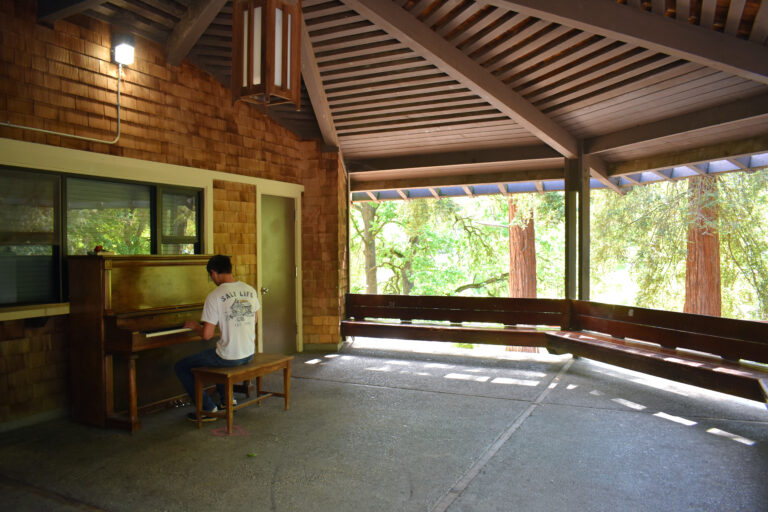
El Arboretum de Davis es conocido por su extenso paisaje herboso, secuoyas y arroyos pacíficos. Pero cada viernes a mediodía, uno podría encontrar los sonidos del violín, la guitarra, el ukelele y el canto, unirse al susurro de las hojas y el flujo del arroyo, mientras miembros de la comunidad se reúnen en el “Wyatt Deck”, justo al otro lado del Edificio de la Música, para una sesión de “jam” de música folclórica.

Los asistentes regulares componen un grupo de alrededor de 10 músicos y cantantes, compuesto de lugareños y algunos estudiantes de UC Davis. A las 12:10 p.m., las sillas, son puestas en un semicírculo, se montan atriles y se afinan instrumentos. Varias guitarras, un ukelele, un violín y una armónica están listos para cantar, y pronto, la música empieza. 

La estructura algo fluida de la sesión le da la bienvenida a los asistentes y a miembros de la audiencia por igual. A cada miembro del grupo se le da la oportunidad de escoger una canción para que el grupo toque. 

“No tenemos reglas en cuanto a qué tipo de música,” dijo el asistente regular Rick Hein. 

“Si tú quieres tocar música excéntrica, lo intentaremos. Tienes que darnos algunos parámetros; tú sabes, dinos qué cuerdas tocar o que metro estamos tocando, pero lo intentaremos”.

La selección de música en su mayoría es folclórica, pero también incluye rock, country e incluso canciones celtas. Los asistentes pueden escoger de una amplia colección de partituras o traer las suyas.

Las sesiones de “jam” de música folclórica ha sido una tradición en el Arboretum por más de una década y fueron empezadas por Elaine Fingerett, un coordinador académico del Arboretum, quien ya falleció. El grupo comenzó cada dos semanas, pero los últimos años se ha convertido en un evento semanal.

Las operaciones del grupo se detuvieron durante la pandemia del COVID-19 y tuvieron que cambiar de ubicación al parque “Chestnut” cuando el “Wyatt Deck” estaba en construcción, de acuerdo a Hein. Una vez que la sede “Wyatt” se abrió al público el invierno pasado, el grupo reanudó las reuniones regulares. 

Las sesiones de “jam” se anuncian en línea en el sitio del campus, así como también en un señalamiento en el piso inferior de la ubicación de “Wyatt”. Simita Ananda, estudiante de primer año en microbiología y asistente por segunda vez, dijo que fue ese simple letrero que la llevó a unirse al grupo. 

“Solo pase, y estaba como, oh hay una sesión de música de “jam” folclórica; escucho mayormente música, así que dije, está bien, vendré”, dijo Ananda. “Yo canto y toco algunos instrumentos”.

En su primera sesión, Ananda, quien principalmente toca la lira, ofreció una canción celta que le gustaba, le dió al grupo las cuerdas y cantó mientras tocaba. Desde entonces, el grupo le ha pedido la canción para que ella la cante de nuevo.

Los miembros recurrentes han establecido una atmósfera alentadora, y Hein dijo que le dan la bienvenida a todos para probar el grupo. 

“Incluso si no eres bueno, está bien”, dijo Hein. “Te ayudaremos, y es divertido”.

El grupo le ha proporcionado a Hein una actividad semanal que espera realizar en su retiro. Hein dijo que cuando él estaba aún trabajando, él miró un anuncio en el periodico para el grupo, pero no podía unirse debido a su horario. Ahora, ha estado tocando con el grupo durante más de ocho años tocando la guitarra

“Me encanta tocar música”, dijo Hein. “Cada día que tocas música es un buen día para mí. No tengo ningún género establecido, pero me inclinó por el rock and roll. Los Rolling Stones son mi banda. Me encanta AC/CD [y] ZZ Top; Pondré un poco de Bob Dylan [y] algo de música country. Toco cualquier cosa si me gusta como suena. [Si] se siente bien, lo haré”. 

Su pasión por tocar es lo que llevó a Hein a su primera sesión, pero el rápido aprendió que tocar como parte de un conjunto es una experiencia muy diferente a lo que estaba acostumbrado. 

“Toque hace, mucho, mucho, tiempo pero no tan bien para tocar con otras personas”, dijo Hein, “Pero una vez que empecé a venir aquí, empecé aprender como tocar con personas, lo cual es muy divertido”.

Lauren Wesling, una estudiante de tercer año estudiando ciencias biológicas y tocadora de violín, dijo que está muy agradecida por el espacio que las sesiones de “jam” las cuales  ofrecen tocar música en el hermoso ambiente del Arboretum. 

“Extrañaba tocar música con la gente”, dijo Wesling. “Me uní a una banda cuando vine a Davis […] y ellos tocan mucho metal, y no pude seguir el ritmo. Me divertí mucho la última vez que vine”.

El grupo también ha atraído un número justo de miembros de audiencia cada semana, incluyendo transeúntes caminando por los senderos del Arboretum que se detienen un momento para escuchar los sonidos de una canción de los Rolling Stones, una melodía clásica de John Denver o incluso trabajo original de un miembro. 

“Recientemente, ha habido mucha gente ahí”, dijo Hein, señalando al “deck” inferior. “Una niña vino una semana, y ella quería que tocaramos una canción. Ella dijo, ‘Estas son las cuerdas’, e hicimos eso mientras ella cantaba. Fue lindo, y muy improvisado”. 

Durante este tiempo en las sesiones de “Jam”, Hein ha estado impresionado por los estudiantes que tocan y su sabiduría de música más antigua. Él espera que con su lista de reproducción en constante cambio, más estudiantes se unan al grupo y continúen con la tradición. 

“Tengo 70 años”, dijo Hein. “No vamos a estar aquí en 40 años, así que alguien tiene que empezar a venir aquí y hacerlo para que siga funcionando [y] para mantener viva esa música”.


Escrito por: Mia Baltierra — features@theaggie.org

Traducido por: José Hernandez

Arboretum group invites community to experience the joy of folk music

Every Friday, Davis locals and students gather with instruments at the Wyatt Deck for an open jam session


By MIA BALTIERRA — features@theaggie.org

Lea este artículo en español.


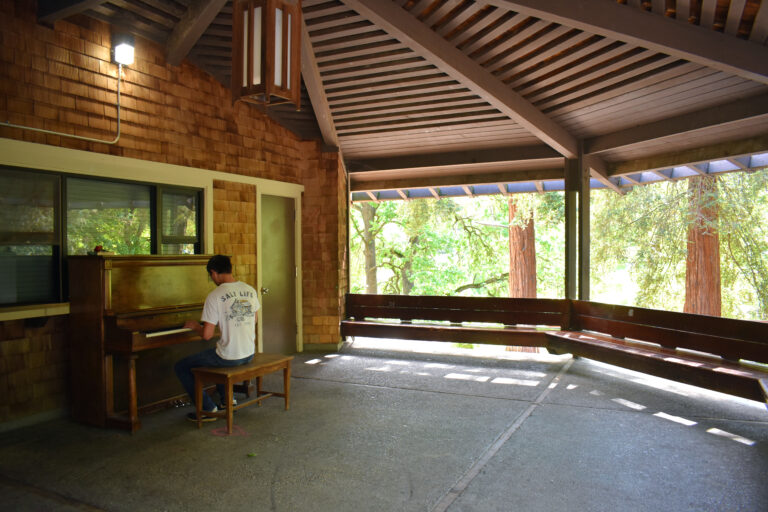
The Davis Arboretum is known for its sprawling grassy landscape, redwood trees and peaceful stream. But every Friday at noon, one may also encounter the sounds of fiddle, guitar, ukulele and singing join the rustle of leaves and flow of the stream, as community members gather at the Wyatt Deck, just across from the Music Building, for a folk music jam session. 

Regular attendees make up a group of around 10 musicians and singers, composed of locals and some UC Davis students. By 12:10 p.m., chairs have been placed in a semicircle, music stands are set up and instruments are tuned. Several guitars, a ukulele, a violin (or fiddle, depending on your style) and a harmonica are poised for song, and soon, the music begins. 

The somewhat free-flowing structure of the session is welcoming to attendees and audience members alike. Each member is given the opportunity to choose a song for the group to play.

“We don’t have any rules as far as what kind of music,” regular attendee Rick Hein said. “If you wanna play some oddball music, we’ll try it. You have to give us some parameters; you know, tell us what chords to play or what meter we are playing in, but we’ll try.”

The music selection is mostly folk, but also includes rock, country and even Celtic songs. Attendees can choose from a large collection of sheet music or bring their own. 

The folk music jam session has been a tradition at the Arboretum for over a decade and was started by Elaine Fingerett, an Arboretum academic coordinator, who has since passed away. The group started on a bi-weekly basis, but within the past few years, it has become a weekly event.

Operations of the group halted during the COVID-19 pandemic, and they had to move locations to Chestnut Park when the Wyatt Deck was under construction, according to Hein. Once the Wyatt venue opened back up to the public this past winter though, the group resumed regular meetings. 

The jam session is advertised online on the campus website, as well as on a sign on the lower deck of the Wyatt location. First-year microbiology major and second-time attendee Simita Ananda said it was that simple sign that led her to join the group.

“I just passed by, and was like, ‘Oh there’s a folk music jam session; I listen to mostly folk music,’ so I was like, ‘Okay I’ll come by,’” Ananda said. “I sing and I play some instruments.”

At her first session, Ananda, who mainly plays the lyre, offered a Celtic song she liked, gave the group the chords and sang while they played. The group has since requested the song for her to sing again. 

Recurring members have established an encouraging atmosphere, and Hein said they welcome everyone to try out the group.  

“Even if you aren’t good, it’s okay,” Hein said. “We will help you, and it’s just fun.”

The group has provided Hein with a weekly activity he looks forward to in his retirement. Hein said that when he was still working, he saw an ad in the paper for the group, but couldn’t join due to his schedule. Now, he has been jamming with the group for over eight years, playing guitar. 

“I love playing music,” Hein said. “Every day you play music is a good day to me. I don’t have any set genre, but I gravitate to rock-and-roll. The Rolling Stones are my band. I love AC/DC [and] ZZ Top; I’ll play some old Bob Dylan [and] some country music. I’ll play anything if I like the sound of it. [If] it feels good, I’ll do it.”

His passion for playing is what first drew Hein to the jam session, but he quickly learned that playing as part of an ensemble is a much different experience than what he was used to.

“I played a long, long, long time but not good enough to play with other people, really,” Hein said, “But once I started coming here, I started learning how to play with people, which is a whole lot of fun.”

Lauren Wesling, a third-year biological sciences major and fiddle player, said she is grateful for the space the jam session provides to play music in the beautiful environment of the Arboretum. 

“I missed playing music with people,” Wesling said. “I joined a band when I came to Davis […] but they played a lot of metal, and I couldn’t keep up with it. I had a lot of fun the last time I came [to the folk jam].” 

The group has also attracted a fair number of audience members each week, including passersby walking the trails of the Arboretum who stop for a bit to take in the sounds of a Rolling Stones song, a classic John Denver tune or even original work from a member. 

“Recently, there have been a lot of people out here,” Hein said, motioning to the lower deck. “One girl came by one week, and she wanted us to play a song. She told us, ‘These are the chords,’ and we did that while she sang. It was nice, very impromptu.”

During his time at the jam sessions, Hein has been impressed by the students who play and their knowledge of older music. He hopes that with their ever-changing playlist, more students will join the group and continue the tradition.

“I’m 70,” Hein said. “We aren’t gonna be around 40 years from now, so somebody’s gotta start coming down here and doing it to keep it going [and] keep that music alive.”


Written by: Mia Baltierra — features@theaggie.org

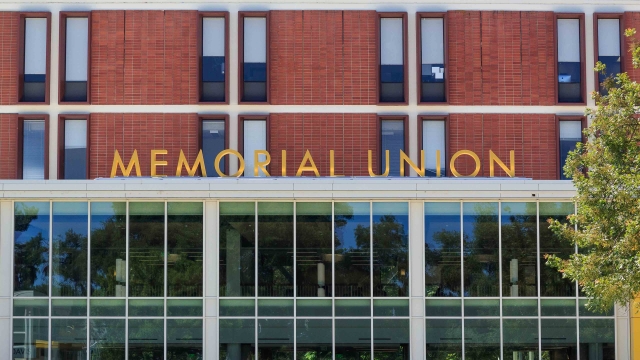
Innovation and Research Lab created to increase STEM representation in ASUCD

The new unit was introduced to both analyze data and develop software for UC Davis students and organizations


By LILY FREEMAN — campus@theaggie.org


A new unit within ASUCD, the Innovation and Research Lab (IRL), was established through ASUCD Senate Bill #96 at the April 27 Senate meeting. This bill was co-authored by two ASUCD senators, first-year computer science major Shrey Gupta and fourth-year cognitive science and computational statistics double major Stephen Fujimoto. 

Gupta outlined the purpose of IRL.

“We want to build robust applications that apply software developments to the evolving needs of ASUCD bodies,” Gupta said. “We are developing software for the students. We see other UC schools making really nice software, and that’s something that we don’t have at UC Davis. That’s the kind of stuff we want to see, and we want to be the top UC that is making technology and leading the change in software.”

Gupta said that IRL will not only create applications and software in collaboration with various ASUCD units but also plans to hold luncheons, hackathons and technology events to increase the representation of the STEM community within ASUCD. 

IRL is also going to integrate the work that the Research and Data Committee (R&DC) currently does into the new unit, according to Fujimoto. R&DC is an ASUCD committee created in 2020 that will be absorbed by IRL.

“[R&DC] was established to incorporate and elevate more student voices into the ASUCD student government by providing data to student representatives on issues that impact the student body,” Fujimoto said via text. “The committee has worked to obtain student input through surveys on a variety of issues, including but not limited to the prevalence of equitable access, the prevalence of food insecurity and physical accessibility of campus for students with disabilities.” 

Gupta talked about how R&DC’s work will be included in IRL moving forward. 

“We are essentially taking what the Research and Data Committee did in the past, and giving them more autonomy and more freedom,” Gupta said. “We will generate and analyze data from different sources, and use that to elevate student voices and provide recommendations as to topics of interest for ASUCD bodies. The two operational parts of this unit connect, where we want to hear back-and-forth and understand how we can use technology to improve the everyday lives of students.” 

Nitin Kanchi, a first-year data science major and a previous R&DC committee member, shared his thoughts on IRL. 

“It’s a fantastic initiative,” Kanchi said. “I am thrilled to witness the transformation of R&DC into IRL, as it broadens the horizons and capabilities of our committee. The IRL establishment allows us to exercise creative control in building applications and analyzing data. By combining computer science with data science, we unlock a powerful synergy that can drive a significant impact.” 

Fujimoto also said that he and others are hoping that by IRL becoming a unit, R&DC’s projects will be able to receive more financial support, increasing the amount of paid students working on STEM projects in ASUCD and growing the group’s marketing capabilities. 

IRL will employ students in a variety of positions, including a unit director, as well as associate directors, software developers and researchers. Applications for these roles will be available on the ASUCD vacancy website soon, according to Gupta.

“We are going to be hiring for a unit director at the end of this year,” Gupta said. “I think that anyone should apply if [they] have experience in the research and data aspect or the software development aspect. The researchers and software developers are going to be hired late summer or early next year.”

  The unit will officially begin operations during the 2023-2024 school year.

“This unit is essentially a look into the future of ASUCD with technology,” Gupta said. “It’s time that we invest into the technology that we’re using every day as a university, as a student association and as people.” 

Written By: Lily Freeman  — campus@theaggie.org