

Drawn by: Priscila Jiménez Corrales — pjimenez@ucdavis.edu
Disclaimer: (This cartoon is humor and/or satire, and its content is purely fictional. The story and names of “sources” are fictionalized.)

Drawn by: Priscila Jiménez Corrales — pjimenez@ucdavis.edu
Disclaimer: (This cartoon is humor and/or satire, and its content is purely fictional. The story and names of “sources” are fictionalized.)

Davis Phoenix Coalition, Moms Demand Action, Davis Police Department and the university organized the talk
By LA RISSA VASQUEZ — city@theaggie.org
On Nov. 16, the International House, which has been a space for cultural learning for more than 40 years, hosted an event at which Dr. Garen Wintemute, professor of emergency medicine and director of the Violence Prevention Research Program at UC Davis, educated the Davis community about gun violence and hateful ideologies.
Gloria Partida, a Davis City Council member and chair of the Davis Phoenix Coalition, organized the event with the UC Davis Director of Campus and Community Engagement Vickie Gomez. Partida spoke, opening the event.
“Our organization does a lot of work around diversity and inclusion, and we do a lot of awareness raising for vulnerable populations,” Partida said. “And vulnerable populations are often the targets of violence and so our mission is to prevent hate-motivated violence, [and] in promoting this event, to have this conversation before rather than after.”
Gomez said that Davis isn’t exempt from violence and hateful ideologies.
“Understanding that because Davis is a college town that it’s not immune to extreme thinking [and] extreme views, and we are grateful that it hasn’t exploded into violence and gun violence,” Gomez said. “But I think it’s really critical for people to understand what that is and what that looks like.”
The Davis City Council took a step towards proactive gun safety this year by enacting the Safe Storage of Firearms Ordinance on Aug. 30. Davis Police Department (PD) Lieutenant John Evans spoke about the gun safety ordinance at the event and gave out gun locks, provided to the Davis PD by Project Child Safe.
“If there is a firearm of any type left unattended or stored in a home or a vehicle, it has to be locked up in a container, like a safe or a strong box of some sort, or it has to have a fire safety device on it like a gun lock or trigger lock with the idea being that the firearm cannot be accessed by a child or someone else who is not allowed access to firearms for some reason,” Evans said. “We have partnered with Moms Demand Action and we’ve been to several different community events to educate people about the ordinance, pass out gunlocks and basically promote firearm safety.”
Evans encouraged people to visit the Davis City Police Department on Mondays through Thursdays from 10 a.m. to 5 p.m. to pick up free gun locks.
Davis PD organizes public awareness campaigns with Moms Demand Action, a national grassroots movement advocating for gun safety and reform at all legislative levels. Emily Ault, California state legislative co-lead for Moms Demand Action from the Yolo County Chapter, talked about the current unrest in the Davis community.
“As you probably know, we are not immune to extremism in Davis and Yolo County,” Ault said. “We have had members of Proud Boys show up to Davis [Board of Education] meetings and harass parents and students. We have had [Proud Boy] members show up at events on the UC Davis campus and cause havoc. There is nothing more deadly than hate armed with a gun.”
During his presentation, Dr. Wintemute described the deadly dynamic of hate equipped with firearms.
“Here is the research question we’re all set up to answer,” Wintemute said. “What happens when you take a society that is fearful of its future, mistrustful of its institutions, polarized, angry at itself and you throw a bunch of guns in the mix?”
Partida said that the Davis community can fight gun violence and extremism by staying involved.
We can donate to programs that provide intervention and lobby for gun policies,” Partida said. “We can support youth and programs that target creating safe inclusive spaces. I hope people can see that the root of all violence starts in intolerance.”
Written By La Rissa Vasquez — city@theaggie.org

How the instruments play an important role in community-building
By RUMA POUDELL — arts@theaggie.org
In Western culture, drums are often connoted for their use in bands and other musical organizations. But within many South Asian communities, various drums play a much more intimate role, often responsible for bringing people together in different ways.
To start, there are the tabla, dhol and madal. These drums all belong to the regions of Nepal and Punjab.
The tabla is a hand-drum played in pairs using the pressure of palms to produce different notes. The smaller section of the drum, also known as tabla or dayan, is used to produce treble and tonal sounds. The larger section, known as dagga or baya, is the bass.
Tarnpreet Singh, a professional Punjabi dhol and tabla player from Sacramento, explained the historical significance of tabla in the Punjabi region.
“The word tabla is originally an Arabic word and instrument,” Singh said. “It entered India through Islamic invaders, and over time, it was taken over entirely by the Indian and Punjabi regions.”
Throughout the invasions, tabla was used as a way to take power back from the invaders and empower South Asian people as they used it to connect with religious beliefs for the purpose of hope.
“In our community, music is attached to religion, as we sing the praises of God,” Singh said. “We call it kirtan — the main attraction for our holiest temples and a pathway to be acculturated to God.”
These traditions have lasted to this day; Singh himself learned to play tabla at the age of four, and similarly, many others are raised surrounded by kirtan. Even in communities formed by immigrants outside of Punjab and broader South Asia, the tradition of playing tabla and kirtan has been kept up. According to Singh, playing one of the instruments is considered to be very prestigious, and “parents want their kids to learn kirtan and tabla.”
The dhol is a single, larger, double-sided drum played using the power of your wrists and two sticks. The sticks are called dagga (bass) and tilli (treble). It is worn with a strap over your neck or shoulders and can be played while standing.
South Asian weddings are known for being extravagant, and the dhol is one of the many reasons why the function is so lively. When the bride and groom enter, a line of dhol players is typically playing to welcome the couple. Later on in the reception, different beats, such as chaal, are played.
“You know it’ll get everyone to dance,” Singh said of the beats. “Dhol is the way you get everyone’s attention.”
Even in formal settings, “if there is an announcement to be made, in India that was the way to do it. You have four to five dhol players playing, everyone would hear from far away, and then they would come gather around,” Singh said.
Then, branching out of India and Punjab and into Nepal, there is the madal.
The madal, like the dhol, is a double-sided drum, but it is much smaller and often played while sitting. Like the tabla, the player uses their hands, but instead of just palms doing the drumming, it involves the whole hand and fingers.
The madal is used casually in gatherings to sing folk songs. It is also a staple in the religious and traditional events of Dashain and Tihar, where you play games such as Dhusure (a game of forming songs).
Dinesh Pokhrel, a Nepali doctor and madal player in the Sacramento Nepali community, has been familiar with the instrument since he was a young boy.
“I randomly learned without any coach or books,” Pokhrel said. “I watched other older people play and learned that way.”
In his life, “the madal has been a source of great fun and entertainment with family. It always brings harmony to the community as we gather for these folk songs and beats.”
The ways that the madal, dhol and tabla are used show the different roles music can play in our lives — from delivering hope to war-torn communities, bringing the hype at an event and calling for everyone’s attention to having some good old karaoke sessions with your family — these drums showcase a wealth of tradition in South Asia.
Written by: Ruma Poudell — arts@theaggie.org
Correction: A previous version of this article incorrectly spelled “madal” as “nadal”. This article has been corrected with proper spelling.
The best study tunes for finals, courtesy of The Editorial Board
By THE EDITORIAL BOARD
With the quarter coming to a close, the Editorial Board shares their favorite songs to get you through the hectic next few weeks. You can listen to our 27 (wildly varied) selections in “The Editorial Board’s Study Tunes” Spotify playlist.
Sophie Dewees — Editor-in-Chief
Whether I’m sitting on the Quad flipping through notes from my history class or poring over economics textbooks at Shields, my go-to study artist is Aoife O’Donovan. She was one of my most-listened-to artists this year, and I always seem to be in the mood for her soothing voice and soft harmonies. Her songs such as “Passengers” or “B61,” in particular, are the perfect backdrop for both casual and intense study sessions.
Katie DeBenedetti — Managing Editor
‘Tis the season — for the holidays, finals and Spotify Wrapped (in no particular order) — which means it’s the perfect time to reflect on some of the best songs of the year to fuel you through the end of the quarter. Currently, I am pretty much exclusively listening to Noah Kahan’s new album, “Stick Season,” but since I must narrow it down, I would have to suggest “All My Love.” Kahan’s music is perfect for cozy, fall study vibes and turning up this song on my airpods always calms me, even when I have three papers, two tests and just far too little time.
Sonora Slater — Campus News Editor
A disclaimer: the following song suggestion is given by someone who grew up with a younger brother, and therefore has the ability to study unfazed through any given noise level. AKA, this song is not lo-fi, but it does absolutely come through every time with the serotonin I need to continue gaslighting myself into thinking I care about partial derivatives. “2/14” by The Band CAMINO has been the soundtrack of the writing process for several A+ essays over the years, and if you study to it, I can pretty much guarantee you the same result. (Note: this is not a binding contract).
Chris Ponce — City News Editor
I won’t pretend to be a music expert, because the truth is, I only listen to the same three or four artists regularly. However, as finals approach and papers pile up, I’m finding myself listening to “Show Me How” by Men I Trust. Music by Men I Trust manages to have a compatible balance of jazz, indie and electro-pop. “Show Me How” is perfect for any study playlist for its calming instrumentals and angelic vocals. The song isn’t distracting and doesn’t interrupt my train of thought, an essential aspect for me when I write papers.
Owen Ruderman — Opinion Editor
The chaos of finals week consists, at least for me, of nearly nonstop stress. My days are filled with writing papers or doing homework, and the little time I have to myself is usually ruined by thoughts of how screwed I am for my upcoming exam. Luckily, I’ve been able to find some respite in music. Listening to familiar and relaxing instrumental songs seems to work best for me when I need to focus, and “Minecraft” by C418 is the perfect dose of non-intrusive nostalgia that helps me make it through long study sessions. Yes, the song is from the video game of the same name, and no, you don’t have to be familiar with the game to enjoy the soundtrack. Give it a chance, and you’ll find that the soothing piano will carry you through the final moments of this quarter.
Levi Goldstein — Features Editor
My picks may be a little different than the rest of the playlist (sorry for ruining the chill vibes). I personally need hype music to study, something to encourage me to keep going and get through the night (or week, as it may be). The songs need to make me feel like I’m awesome, I’m capable and I’m going to absolutely crush that test. The test should be afraid of me. “Deceiver” by The Beautiful Monument has an incredible melodic chorus with reverberant backing vocals that will inspire and uplift you. Plus, the heavy guitar riffs in “Bulls In The Bronx” by Pierce The Veil and “Himalaya” by New Found Glory will keep the energy up into the early hours of the morning.
Clara Fischer — Arts & Culture Editor
When it gets to the time of the quarter when I need to hunker down and dive into a serious study mode, I like to keep things light in terms of music to counter the crushing amount of stress that I’m likely experiencing. One of my current top picks for an afternoon at Shields is “Leaning on You” by HAIM. The song’s bouncy guitar beat, soothing harmonic vocals and uplifting lyrics make for an easy, mood-boosting listen to help me focus on my work. Plus, the album the track stems from, “Women in Music Pt. III,” features many equally as groovy bangers, such as “3 AM,” “Gasoline (feat. Taylor Swift)” and more.
Marlon Rolon — Sports Editor
I listen to different types of genres depending on the situation and since finals are nearing, stress levels are high. To calm my nerves I like to listen to songs that are relaxing and calm me down such as “I Ain’t Worried” by OneRepublic. Another song that is relaxing and helps me stay positive is “Don’t Worry Be Happy” by Bobby McFerrin. This song is comforting and makes me feel like no matter what happens everything will be alright. Last but not least, sometimes I just like listening to relaxing music, also known as instrumental meditation sounds. Just a soothing beat without any lyrics really does the job in terms of helping me focus.
Brandon Ngyuen — Science & Tech Editor
What better way to destress during long hours of studying than by listening to a song that combines relaxing lo-fi beats, a soothing voice and a food item for its title? That’s right, I’ve been listening to “Flaming Hot Cheetos” by Clairo, which combines undertones of soft rock, indie pop and lo-fi to help me get into a rhythm of work. Similarly, when I find myself in the 24-hour study room, songs like “split” by georgee as well as “Butterfly Rain” by Tori Templet have been on the top of my list since they aren’t distracting, but leave you in a groovy rhythm to maintain your focus for long periods of time.
Written by: The Editorial Board

The Arts Desk’s weekly picks for music, movies and more
By Adhithi Anjali — arts@theaggie.org
Book: “Vita Nostra: A Novel” by Maryna and Serhiy Dyachenko, trans. Julia Meitov Hersey (2007)
The Dyachenkos, a pair of married authors from Ukraine, warp conceptions of time and space by sending readers through the unsettling study at the Institute of Special Technologies, which remains a mystery until you are enlisted to go. The protagonist, Sasha, is tested by a looming patron, a man whose ethics and power remain shrouded in secrecy while pushing the limits of body and mind to achieve success in her college. “Vita Nostra,” a title which references the Latin phrase “Vita nostra brevis est, Brevi finietur” (“Our life is brief, it will shortly end”), envelops you in an academic slaughterhouse — a place of uncanny horror. Sasha and her peers enter with no indication of what they are studying, only that they must pore over impossible geometric scenarios and unintelligible grammar until they make sense. The Dyachenkos and Hersey craft a wondrously abstract yet visceral mystery of language and perception that questions the place of audience and character. (Content warning: body horror)
Song: “DOWNTOWN” by Deva Rani (2022)
The only constant in my life so far has been that I discover the most fun songs through friends. Playing Deva Rani’s 2022 single on a night drive across long stretches of dark road really heightened the electronic bounce of the song, and through the car speakers, it feels like the song even moves around you. Rani departs from the more blissful, summery sound heard in her 2018 single “Blue Raspberry,” and crafts a soundboard portrait of a city night with sparse lyrics and popping synths. “DOWNTOWN” sounds like a fishbowl has been placed over your head; as if you can feel your steps rhythmically reverberate through your body, but the world outside of you is bouncing off the glass walls. It’s a strange yet exciting experiment for a new artist that promises much to come should she decide to release an album.
Movie: “Plague Dogs” dir. by Martin Rosen (1982)
There was a tiny era, between the 1954 release of the animated adaptation of George Orwell’s “Animal Farm” and the 90s, that saw the creation of 2D animated solemn and tragic films about small animals. Examples include “Felidae” (1994), “Watership Down” (1978), “The Animals of Farthing Wood” (1993-1995) and “Plague Dogs” (1982). Rosen’s film truly takes advantage of the medium, allowing the low budget and awkward 2D stills to make you feel anxious and unsettled. The premise is a little unstable, following two dogs, Rowf and Snitter (Did I mention this is a British film?), who are being hunted down by all forms of government agencies, from local police to the military. They escape from a research and testing facility which housed the Black Plague and, still suffering from the trauma inflicted on them, they try to navigate a new, wild life as the human world encroaches on them. Adams’ novel is firmly meant to be read as an condemnation of animal testing in all forms, truly accentuating its most extreme possibilities, but the film appears very invested in concepts of helplessness and imprisonment through the use of animals. You can make your own judgment on the matter, but Rosen’s adaptation applies a signature take on dystopia through the eyes of animals. (Content warning: animal cruelty)
TV Show: “The Bear” (2022)
A perfect show for the folks who loved “Catcher in the Rye,” this Hulu original brings us to a struggling Chicago deli, left to Carmen “Carmy” Berzatto after the death of his brother. Through performances by a stellar cast, we see their world inhabited by noise and action, bodies moving, eating, yelling and leaving. Left with debt and grief, Carmy’s world is saturated with a rainbow of repressed emotion, incredible creativity and community. When we aren’t focused on Carmy, we see the other chefs break down under pressure, yet cement their place at “The Original Beef of Chicagoland” (Chicagoans, right?). Though, be warned: The Atlantic and Rolling Stone both label it firstly as an exercise in stress-inducing television — even I had to pause to cool off while watching.
Written by: Adhithi Anjali — arts@theaggie.org

No cups, the pledges just hold the beer in their cupped hands
By ANNABEL MARSHALL — almarshall@ucdavis.edu
Kappa Phi Sigma Beta Gamma Phi is UC Davis’s fraternity, but it’s much more than a social club. The frat, conveniently abbreviated as “Cap-fi-sig-bee-gam-fi” to those in the know, has prepared members for impressive roles outside of college such as: perpetually-high assistant manager of local burger joint, the entrepreneur of a company that “is too complicated to get into right now” and guy-who-graduated-six-years-ago-but-still-attends-college-parties.
Obviously, as a registered student organization, KPSBGP would never engage in anything that could be construed as “hazing” (those pledges collectively decided they wanted to blindfold themselves on the side of a highway), but it’s no secret that the frat occasionally engages in drinking activities — most famously, beer pong.
The sport is not to be confused with beer bong, the invention that frat President Bryce Hunter believes “shows a lot of promise.” Also not to be confused with spear pong (where upperclassmen throw long sticks at freshmen).
The Kap Phi Siggys are famously sticklers about their beer pong rules. So, finally, for all the world to see, here is a comprehensive list of the lesser-known rules and regulations of beer pong.
Written by: Annabel Marshall — almarshall@ucdavis.edu
Disclaimer: (This article is humor and/or satire, and its content is purely fictional. The story and the names of “sources” are fictionalized.)

International cinema can allow you to experience other cultures through media
By MAYA KORNYEYEVA — mkornyeyeva@ucdavis.edu
Foreign cinema is a unique way to experience another culture through a distinctly human lens. You can immerse yourself in the language and customs of another country virtually — no plane ticket required.
In fact, foreign films involve an active process of deciphering nonverbal communication clues while also reading subtitles; and admittedly, this is no easy feat. Imagine your usual dinner routine, which for me at least involves turning on a show in the background while preparing a meal. You watch your ramen noodles spin in the microwave, listening to the clear and comforting English audio coming from the television. You don’t really need to watch the scenes on the screen to understand what is going on, you can hear and understand everything just fine.
However, watching a movie in a foreign language is not as casual of a viewing experience. Although it does involve a bit more effort, like reading the subtitles while simultaneously keeping an eye on the screen, watching these films, in my opinion, is crucial to expanding one’s worldview and perception of the world.
From French filmmaker François Truffaut to Swedish Ingmar Bergman to Federico Fellini in Italy, each country and filmmaker has an original approach to designing a motion picture. Stepping out of the “Hollywood comfort-zone” and diving into the realm of new landscapes, cuisine, music, art and interaction can spark the imagination, and be a truly educational experience.
This is not to say that Hollywood does not produce spectacular movies — it does — but they are often predictable. The beauty of foreign films is that many dive deep into existential issues that American blockbuster movies tend to gloss over. Foreign cinema offers a fresh and unique perspective on life, and lets the viewer experience the unfamiliar and sometimes rare aspects of being human. For example, “Parasite” by Korean Filmmaker Bong Joon-Ho deals with class issues and capitalism in a way that I’ve never seen in a Hollywood blockbuster.
But the fostering of unique perspectives isn’t the only benefit to watching foreign media. There is now increasing evidence that language learners can improve their comprehension skills, pronunciation and grammar through watching TV. Hearing the language used in an informal and interpersonal context, rather than a strictly educational setting, can improve conversational communication in that language.
In my experience, I practiced my first language, Russian, by watching Russian and Ukrainian films on a regular basis, with the goal of reconnecting with my Eastern European roots. Through this method, I was not only regularly exposed to the language, but I was also able to learn about the areas where the films were set and the customs of the people native to those regions. Even though the plot line was often not based on real events, the movies still drew inspiration directly from the culture of the surrounding area.
During my sophomore year of high school, in Spanish 3 Honors, my teacher assigned a similar project; watch one episode of a Spanish telenovela each week and write about what you understood each time. Initially the process was difficult, and I began with Spanish audio and English subtitles. But a few weeks later, I felt comfortable moving to Spanish audio and subtitles and then finally to only audio.
Additionally, many foreign films contain beautiful cinematic moments. From the distinct animation style in Japan to the moving dialogue captured in many French films, there are so many surreal moments that can change your world view.
Some unmissable foregin films include the “Mad Max” (1979) quadrilogy from Australian filmmaker George Miller, “Amour” (2012) by French director Michael Haneke and “Seven Samurai” (1954) by legendary Japanese filmmaker Akira Kurosawa. “Seven Samurai” in particular has been greatly influential to many modern films around the world, with similar motifs seen in “Avengers: Endgame” and “Dirty Dozen.”
Whether you are learning a new language, practicing one that you already know, or simply interested in the wide range of cinematic elements world film has to offer, you can only benefit from immersing yourself in the many cultures that exist on our planet. With winter break rapidly approaching, now is a great time to think about renting a movie or streaming a show in another language.
Written by: Maya Kornyeyeva — mkornyeyeva@ucdavis.edu
Disclaimer: The views and opinions expressed by individual columnists belong to the columnists alone and do not necessarily indicate the views and opinions held by The California Aggie.

New construction and potential housing projects discussed at recent City Council and DJUSD 2×2 meeting
By JILLIAN MARCH — city@theaggie.org
On Nov. 16, members from the Davis Joint Unified School District (DJUSD) and Davis City Council met for their monthly 2×2 meeting on Zoom to discuss ongoing city and district projects. Davis Vice Mayor Will Arnold opened the meeting at 5:15 p.m. and introduced the participants in attendance, which included Tom Adams for his final city/district 2×2 as a DJUSD School Board Trustee.
The first discussion item included the various ongoing site projects. DJUSD Superintendent Matt Best reported on the projects the district has recently completed or is in the process of completing. One of the spotlighted projects was the newly unveiled Tech Hub at Da Vinci High School, which is dedicated to beloved long-time educator and founding principal, Pamela Mari.
Alain Contreras, the DJUSD facilities project manager, discussed plans for new pathways to be added to the Career Technical Education (CTE) center, which included transportation, agriculture and engineering for Davis Senior High School. These projects are set to be completed by February 2024.
As for the city, Assistant City Manager Kelly Stachowicz updated the committee on several ongoing projects, the largest being crossing improvements on Tulip and Ponteverde. These changes include newly-added midblock crossing zones, flashing beacons for visibility and new striping and speed bumps, which should slow down vehicles as they approach the intersection.
Following construction updates, the meeting proceeded to the second discussion item, housing. Best first addressed this item by introducing the concept of workforce housing. DJUSD Trustee Joe DiNunzio followed up and discussed the importance of the district undergoing a project of this nature.
“This is something we’ve looked at historically, even in just the four years that I’ve been on the board,” DiNunzio said. “Districts that have tried to do it, there have been some struggles. I am eager to get an expert on board to help us with this. At the end, it has a real opportunity to provide housing for our workforce and in a way that especially teachers that are earlier in their careers or other educators may not be able to access.”
During the prior school board meeting on Nov. 3, teachers, parents and other community members emphasized that housing for educators within the city was one of the biggest challenges that the DJUSD was facing. Workforce housing is being presented by the DJUSD as a potential solution to this issue.
“This is rapidly becoming a community issue,” Adams said while recounting a recent high school classroom visit during which students were asked to propose solutions to community issues. According to Adams, many of the students he spoke with believed housing was a large issue for the city.
Council member Josh Chapman also commented on the concern for affordable housing in Davis, claiming that there are members of the public safety staff in Davis who do not live within the community because of the cost of living. Chapman explained that the city is looking into available properties and discussing potential routes a project like this could take.
“It’s great to hear that those discussions are happening,” Chapman said. “[It’s important] for us to step back and look at properties that we own and the ways that we can create affordable housing options for folks in our community. It’s one of the ways that we, as two separate bodies that govern separately and have totally different interests, can work together on this issue.”
No official plans have been proposed in terms of workforce housing; however, there are no current objections to the onboarding of an expert to assist in the design and planning of a potential housing project.
Written by: Jillian March — city@theaggie.org

Proper representation starts with getting the narrative right
By MICHELLE MENDOZA — mimendoza@ucdavis.edu
For as long as I can remember, my parents have told me I can do anything if I put enough hard work into it, so It’s no surprise that I adopted these beliefs along with the other American Dream motivational propaganda. Coming from immigrant parents and being first-generation, getting into university was incredibly meaningful; it became possible for me to pursue my dreams and make something of myself.
However, striving for something is hard when it seems like you’re doing it alone. In media and academia, Latinos remain underrepresented. Latinos account for 19% of the U.S population but make up less than 12% of the media workforce and 4% of the industry’s management. About 12% of graduate students were black and about 11% Hispanic in the fall of 2017. Even though numbers have been steadily rising since then, it is clear there is a disparity between Latinos and others in academia and in the media industry.
Why is this important? Even though 19% of the U.S population consists of Latinos, they are present in only 3% of media. In the U.S., 8% of roles in American movies go to Latino actors. We make up a large portion of the population but are only given a small amount of time on screen. The small portion we see reinforces negative stereotypes and inaccurately portrays our culture and people. These messages translate negatively to popular culture and affect how we are treated. It is important to portray these voices or stories from the people who live it and experience it.
Recently, accurate representation has taken a positive turn. The most popular movies in America are superhero movies. Salma Hayek and Xochitl Gomez, Mexican actresses, play a key role in “Eternals” and “Doctor Strange in the Multiverse of Madness.” In the new “Black Panther: Wakanda Forever” film, Tenoch Huerta played Namor, a major newcomer in the Marvel Cinematic Universe.
Jenna Ortega has made her mark on the horror movie genre. She not only appears in “X” and “Scream 5,” but she also reinvents the infamous character Wednesday Addams in Netflixs live-action “Wednesday.” She has proven and altered the meaning of the final girl in horror films.
Stories like “Encanto” and “Coco” connect not only with the people they represent but with others who feel similarly. Connection is the beginning of understanding.
I know more of these stories and characters will appear in the future, and they will influence the next generation of little Latin kids. Representation not only means getting ourselves on the screen; it is to be seen and understood. Our stories, experiences and ideas are equally interesting and desired. Latino representation in the media must become a priority.
Written by: Michelle Mendoza — mimendoza@ucdavis.edu
Disclaimer: The views and opinions expressed by individual columnists belong to the columnists alone and do not necessarily indicate the views and opinions held by The California Aggie.

Upsets, injuries and bad starts through 11 weeks of the regular season
By PATRICK FIGUEROA — sports@theaggie.org
While the 2022 NFL season has been as expected in some ways, like the Kansas City Chiefs being one of the best teams in the AFC, there have been many other things that fans likely did not expect. In fact, the 2022 NFL season has arguably had more surprises than previous seasons.
Two anticipated NFC contenders likely to miss the playoffs
One of the most surprising revelations during this season is that the Green Bay Packers and Los Angeles Rams are having unsuccessful seasons so far.
Last season, the Rams won Super Bowl 56 after a good regular season in which they had 12 wins and five losses. This season, the Rams currently have three wins and seven losses through 11 weeks. Football Outsiders projects the Rams to have a 1% chance of making the playoffs this year. For believers of the Super Bowl hangover — a curse that says that teams who appear in the Super Bowl will have an unsuccessful following season — the Rams serve as confirmation.
Meanwhile, the Packers had the best record during the 2021 NFL season, with 13 wins and four losses. Despite losing in the divisional round of the 2021 playoffs and trading away star wide receiver Davante Adams, the Packers were still expected to be one of the best teams in their conference during the 2022 season. However, through 11 weeks, the Packers currently have four wins and seven losses. Football Outsiders projects them to have a 8.6% chance of making the playoffs. The 2022 season has definitely been a disappointment for reigning back-to-back MVP quarterback Aaron Rodgers and the Packers.
Many surprising teams likely to make the playoffs
There are also teams exceeding their preseason expectations and are likely to make the playoffs in their respective conferences. These teams include the Seattle Seahawks, Miami Dolphins and Tennessee Titans.
The Seahawks were expected to be one of the worst teams coming into the 2022 NFL season. However, they have six wins and four losses through 11 weeks, giving them a 85.4% chance of making the playoffs, according to Football Outsiders. A large reason for their success has been quarterback Geno Smith’s performance. Despite being a backup for most of his career, Smith has thrown for 2,472 yards, 17 touchdowns and only four interceptions, putting his name into the MVP and Comeback Player of the Year conversations.
Meanwhile, the Miami Dolphins have seven wins and three losses through 11 weeks, giving them a 86.6% chance of making the playoffs. Dolphins’ quarterback Tua Tagovailloa has been crucial to their success. Despite the fact that the Dolphins were involved in rumors to acquire other quarterbacks, such as Deshaun Watson, Tagovailoa has silenced the doubters. Tagovailoa has 2,265 yards, 18 touchdowns and a 71.5% completion percentage in eight games, leading one of the best passing offenses in the NFL. It also helps when star wide receivers Jaylen Waddle and Tyreek Hill have combined for 10 touchdowns and over 2,000 receiving yards.
The Titans traded away star wide receiver AJ Brown this past offseason. A move like this usually means that the team is aiming to save money and rebuild their roster. However, the Titans have seven wins and three losses and a 98.1% chance of making the playoffs through 11 weeks. Titans’ head coach and the 2021 Coach of the Year Mike Vrabel deserves lots of credit for another successful season that will certainly put him in the conversation to win another Coach of the Year award.
What is even happening here?
While these teams may have had some hope at the beginning of the year, the Indianapolis Colts, Denver Broncos and Las Vegas Raiders have had quite disappointing seasons so far.
The Colts made headlines when they fired their head coach Frank Reich, who had a winning record (40-33-1) before he was fired. Despite a disappointing beginning of the season — the Colts had three wins, five losses and a tie before firing Reich — he was in a tough situation with a young starting quarterback, Sam Ehlinger, a below average offensive line and star running back Jonathan Taylor dealing with injuries. However, NFL fans were most shocked when Colts’ owner Jim Irsay appointed former Colts’ offensive lineman Jeff Saturday as head coach, despite the fact that Saturday had no coaching experience at the collegiate or professional level.
When the Broncos acquired quarterback Russell Wilson from the Seahawks, and signed him to a contract extension before the season even started, fans believed that this would solve the team’s quarterback problem. However, the Broncos have only three wins in comparison to seven losses through 11 weeks. First-year Broncos’ head coach Nathaniel Hackett has also had a rough start. His questionable clock management caused the Broncos to hire a “helping hand” to assist with timing. The season, which previously looked promising for the Broncos, now looks like a disaster.
Similarly, when the Raiders acquired Davante Adams and signed him to a contract extension during the offseason, fans expected them to compete for a playoff spot. Unfortunately, they have three wins and seven losses through 11 weeks. Despite the poor season and many fans calling for Raiders’ first-year head coach Josh McDaniels to be fired, Raiders’ owner Mark Davis stood by his head coach, saying that McDaniels is “doing a fantastic job.” For a team that has not won a playoff game since 2002, it is hard to see this trend ending anytime soon.
While many of these surprises have been unpleasant for different NFL fanbases, the surprises are what makes the NFL entertaining. Anything can happen in any given matchup in any given season. It would help NFL fans to begin expecting the unexpected if they plan to continue watching professional football.
Written by: Patrick Figueroa — sports@theaggie.org

Gary May responded to several questions from members of the public about the ongoing academic workers strike
By SONORA SLATER — campus@theaggie.org
Vice President JT Eden called the Nov. 21 meeting to order at 6:01 p.m., before calling roll and reciting the UC Davis Land Acknowledgement. The meeting was held on a Monday rather than a Thursday due to the scheduling conflict of Thanksgiving break.
Next, UC Davis Chancellor Gary May presented to the Senate table and the approximately 20 members of the public who attended the meeting. He first gave a short introductory speech before taking alternating questions from senators and members of the public for the next half hour.
Joshua Mason, a fifth-year Ph.D. candidate in the Department of Sociology and a teaching assistant, asked May if he would be willing to make a more direct statement in support of the ongoing academic workers strike, as compared to the statement he released on Nov. 18.
“I love what I do,” Mason said. “Every day, I get the chance to teach students the things that I find truly important and that I think make people better. But unfortunately, I don’t like my pay. I was kind of disappointed [that] I didn’t see a substantive statement on where you stand as a public official on the strike.”
May said that he stands by the statement that he made previously and recognizes the right of UC workers to strike, but that he believes making a more biased statement as a leader on campus “could interfere with or undermine the negotiations that are ongoing.”
Sarah Gooding, a sixth-year Ph.D. candidate in neuroscience and a graduate student researcher, referenced her current condition as a pregnant woman and asked May to consider the difficulty of simultaneously doing research for the university and starting a family.
“I [contribute] a ton to this university, and I would like to continue doing that,” Gooding said. “But I am 36 weeks pregnant. We came to Davis because it was sold to us as a wonderful place to start a family, but the realities of the current costs of childcare and the general cost of living are making it potentially impossible.”
In response to Gooding, and as a general statement, May said that he hears the concerns of the student workers, but that he doesn’t have much power in negotiations.
“I wish I was a little more empowered to make a decision,” May said. “But I’m not. I’m really the middleman in this situation.”
To close out the presentation, May encouraged students to reach out to him with other concerns or questions they might have.
“We don’t have to wait for opportunities like this to have conversations,” May said.
At 6:44 p.m. the questioning period ended, and the Senate took a break.
Eden called the meeting to order again at 7:04 p.m. and called roll. Next on the agenda was the confirmation of a new member of the Judicial Council, but as of the meeting time, the role had not been filled.
There were applicants for the position, but interviews had not yet taken place, according to Senate President Pro Tempore Gaius Ilupeju. Ilupeju went on to say that the seat would be filled by the next Senate meeting on Nov. 31.
The Senate then moved into public comments.
Senator Stephen Fujimoto encouraged the Senate table to continue showing up to the picket line for the duration of the strike. President Radhika Gawde said that she has been in talks with the Academic Senate about adjusting undergraduate course formats and requirements in response to the strike.
The Senate table next moved into hearing quarterly reports. Third-year political science major and Chairperson Mehalet Shibre gave the quarterly report for the Ethnic and Cultural Affairs Commission (ECAC) and the DREAM Committee.
This quarter, ECAC has been focused on hiring commissioners, according to Shibre, as well as holding a decompression painting event. In the future, ECAC is planning to post a vacancy for a DREAM Committee Chairperson soon and work toward bringing an Ethnic Studies course requirement to campus.
The Student Health and Wellness Committee (SHAWC) quarterly report was next on the agenda, but as the presenter for SHAWC was not there yet, the Senate instead heard the Housing Advising for Undergraduate Students (HAUS) quarterly report, given by second-year gender, sexuality and women’s studies major Annette Gutierrez.
HAUS completed several interviews this quarter to help grow their team, according to Gutierrez, and met with Davis property managers about the 2023 Housing Fair, which will take place on Feb. 8. The committee’s main goals for next quarter are to successfully plan and run the Housing Fair, Gutierrez said, as well as work on a storage unit project that would offer space to students to store their belongings temporarily while they move.
The Senate table then moved into elected officer reports, where they were given the option to either give a report or simply pass due to the modified meeting schedule, as only two work days had passed since the previous meeting.
Fourth-year economics major and Chairperson Hibah Shafi then gave the SHAWC quarterly report. According to Shafi, the committee has been working on several projects throughout this quarter, including getting safer sex product dispensers installed in the MU, working with the mayor of Davis to write an ordinance updating the definition of stalking to make airtagging a crime and working within Greek Life to promote consent.
Due to a vacancy on the Judicial Council persisting for more than four weeks, the Senate had no previous legislation to review and did not vote on any legislation.
After approving past meeting minutes, the Senate moved into open forum, where Fujimoto encouraged Senators to be more involved with supporting their respective adopted committees.
Eden adjourned the meeting at 8:21 p.m.
Written by: Sonora Slater — campus@theaggie.org

The health of eelgrass communities, a marine plant forest in the Pacific and Atlantic oceans, are of concern due to the changing global climate
By YASH RATHI — science@theaggie.org
On Aug. 1, a new collaborative study between UC Davis and other research institutions was published in the Proceedings of the National Academy of Sciences journal (PNAS). Researchers worked with a community of species called eelgrass, which is a marine plant at the bottom of many coastal food webs specifically found on the North Atlantic and Pacific coasts.
According to the study, eelgrass is commonly found in shallow water and in the tropical regions of Baja California, reaching as far as Alaska. This species not only provides food and shelter to marine organisms found in that area but also provides a plethora of services to humans, which include absorbing carbon from the water, protecting coastlines from storms and reducing harmful bacteria in the oceans.
“Here, we explore how the growth form and associated community of the coastal foundation species eelgrass (Zostera marina) are shaped by current environmental conditions and a complex history of evolution and dispersal,” the study reads. “Eelgrass inhabits shallow marine waters across the Northern Hemisphere, from warm temperate regions to the Arctic in both the Atlantic and Pacific oceans.”
However, researchers have seen a sudden disappearance of eelgrass from many areas due to the rising temperatures in oceans. A very recent example is seen in Portugal’s southern region, where the eelgrass is moving toward the north to colder water. The Atlantic species has less genetic diversity than the Pacific species, which makes it more difficult to adapt to this sudden change in the temperature of the water.
Jay Stachowicz, Ph.D. is a co-author on the study and a professor in the Department of Evolution and Ecology at UC Davis. He highlighted the importance of the diversity that is evidently lost in the Atlantic species.
“Diversity is like having different tools in your tool belt,” Stachowicz said. “And if all you’ve got is a hammer, you can put in nails, but that’s about it. But if you have a full complement of tools, each tool can be used to do different jobs more efficiently.”
Through analysis of genetic data, Stachowicz and his collaborators discovered eelgrass’s ancient genetic history, which helped them to determine its size, placement, structure and potential organisms that lived among them in the past. Specifically, the genetic data pointed out how eelgrass survived multiple periods of climate change.
About half a million years ago, eelgrass started its journey to the Atlantic from the Pacific. However, not even half of the organisms could make it to the Atlantic. Further, due to the Pleistocene Epoch, a time during which multiple ice ages occurred, not even 20% of the plant species survived.
The surviving eelgrass population found in that region has some signatures left in its DNA due to this long-lasting struggle during its migration. One of these differences is a vivid genetic difference in the grasses in the Pacific and Atlantic, according to researchers.
Emmett Duffy, Ph.D., who is the lead author of the study and a marine biologist from the Smithsonian Environmental Research Center, provided further insight into the migration of eelgrass.
“The ancient legacy of this Pleistocene migration and bottleneck of eelgrass [or decrease in its population size] into the Atlantic has had consequences for the structure of the ecosystem 10,000 years later,” Duffy said.
The researchers were concerned about this sudden disappearance of eelgrass and its health. Therefore, they created a global network called Zostera Experimental Network, or ZEN, which comes from the eelgrass’ scientific name Zostera Marina. With this network, the researchers hoped to unite scientists worldwide who study eelgrass to develop a clearer global picture of the species’ health.
Studying the eelgrass community at 50 different sites across the Atlantic and Pacific, the researchers conducted 20 sample plots per site and came up with 1,000 total eelgrass plots to make inferences. The team collected data including the species’ sizes and the nutrition available to them.
The most common difference observed in the two regional species of eelgrass was a difference in height. The Pacific coast variant presented like an underwater forest that was three to six feet tall. On the other hand, the Atlantic species were more like meadows that rarely reached the height of three feet.
Further, while only genetics played a very important role in the Pacific species’ survival and growth, the Atlantic species’ was influenced by both environmental and genetic factors.
Jeanine Olsen, Ph.D., is a co-author on the study and an emeritus professor at the University of Groningen in the Netherlands. She talked about the sudden decrease in eelgrass population from rising pollution over the past decade.
“I don’t think that we’re going to lose [eelgrass] in the sense of an extinction,” Olsen said. “It’s not going to be like that. It’s got lots of tricks up its sleeve. Climate warming by itself is probably not the primary threat to eelgrass. Pollution from cities and farms, which can cloud the water and lead to harmful algal blooms, also endangers seagrasses. That said, the vast array of environments eelgrass can survive in testifies to its hardiness.”
Written by: Yash Rathi — science@theaggie.org
The student-run radio station’s student DJs, producers and radio hosts create a diverse variety of shows to listen to on the air
By REBEKA ZELJKO — features@theaggie.org
The biggest public music and media collection west of the Mississippi is right here in Davis, California. KDVS is a student-run and operated radio show that has been around since the 1960s, according to their website.
What started as a small broadcast station in a laundry room of the all-male Becket Hall eventually became what it is today: “a laboratory for learning broadcast, production and managerial skills, [providing] its listening audience with diverse, challenging, noncommercial, freeform radio.”
Andy Carson, a fourth-year music composition major, is one of the many student DJs that work for KDVS. He’s been DJing for over a year and is also involved in training new DJs at the station.
“I got involved with KDVS last year when a couple DJs who were in my ethnomusicology class told me I should check out the station,” Carson said. “The community at KDVS is what makes it unique. Everyone there is so amazing, and they all just love music and want to share their tastes.”
Embracing different music tastes and genres to promote creativity is a key component of the way KDVS operates.
“No one is judgemental or anything; everyone just uplifts each other through music,” Carson said. “It’s a really one-of-a-kind place.”
KDVS catches the attention of students who simply have a knack for music, like Carson, whether they are into DJing, producing or even just cataloging their large collection of media. Sabrina Colacion, a third-year plant biology major, initially joined KDVS because of her shared affinity with a fellow UC Davis student.
“I got involved with KDVS because of a random UC Davis student I met online,” Colacion said. “I bought Dead Kennedey’s tickets off of him and we became friends over our similar music taste.”
KDVS brings together students with a shared interest in music of any genre with any level of experience. Positions are open to anyone.
“I chose KDVS because they provide a safe place for people like myself,” Colacion said. “We have a zero hate tolerance policy and welcome people of all backgrounds.”
KDVS advertises its broadcast by hosting live shows for students and community members to attend. Basira Dadajan, a fourth-year psychology and sociology double major, was initially exposed to KDVS through these live shows hosted by fellow staff members.
“I got involved in my winter quarter of my third year and I joined with my best friend […] after going to a KDVS house show,” Dadajan said. “I love being on the scene, and it’s just a community I feel I could be myself and feel safe.”
The shared musical interest held by all staff and volunteers also makes for a diverse selection of shows to tune in to. With tens of thousands of vinyls and CDs to choose from, students are given the opportunity to air any and every type of music available.
“My favorite part would just have to be the opportunity to share my musical tastes through the music at KDVS to listeners,” Carson said. “I just hope that they like what I have to share.”
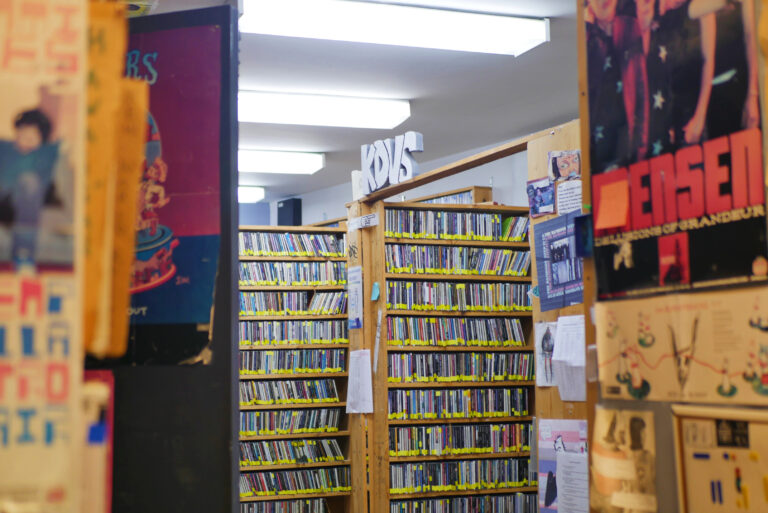
Over the decades, KDVS has been home to thousands of students, all with unique tastes in music. The station is reflective of this great variety in taste. Posters, art and stickers plaster the walls surrounding the stacks of media, commending the hundreds of students and shows that were there before them.
“The selection of physical media and music is literally world-class,” Carson said. “You could spend multiple lifetimes trying to listen to everything in the stacks, and I personally play a lot of jazz records, some of which are close to 50 years old, all kept in immaculate condition.”
KDVS has been operating for decades, and so the collection of CDs, vinyls and media is also decades in the making. Located in the basement of the MU, over 100,000 vinyls and CDs fill the neverending shelves, color-coded by genre.
“The best part of KDVS is getting to consistently contribute to history myself,” Colacion said. “We’ve been active since the ‘60s and have never stopped since then. Because I am one of the people responsible for training new DJs, I feel like I’m constantly increasing the longevity of our station’s history.”
The progression of bands and musicians that have contributed to KDVS creates a rich history and culture. The layers of posters and photos of performers and show hosts engulf every surface at the station, including the ceilings.
“Our history and how we formed KDVS is what makes us stand out,” Dadajan said.
KDVS has amassed an impressive media collection and a long-standing reputation in the over 50 years it has been on the air.
“KDVS is unique because we have the largest broadcasting range of any college radio station,” Colacion said. “I’m pretty proud of this. We are a completely student-run radio station, so all of our core staff members are currently at UC Davis. We are also home to the largest public physical media collection west of the Mississippi, which is primarily made of music community members and record labels [that] have donated to us.”
Tune in to KDVS at 90.3 FM, and enjoy the decades of history, thousands of selections and hours of work each student dedicates to keep the station alive. If you are interested in working or volunteering for KDVS, refer to the KDVS website.
Written by: Rebeka Zeljko — features@theaggie.org
Snobbish characters, disarmingly bold satire and endless culinary humor: Mark Mylod’s recipe for the perfect dark horror-comedy
By VIVI KIM — arts@theaggie.org
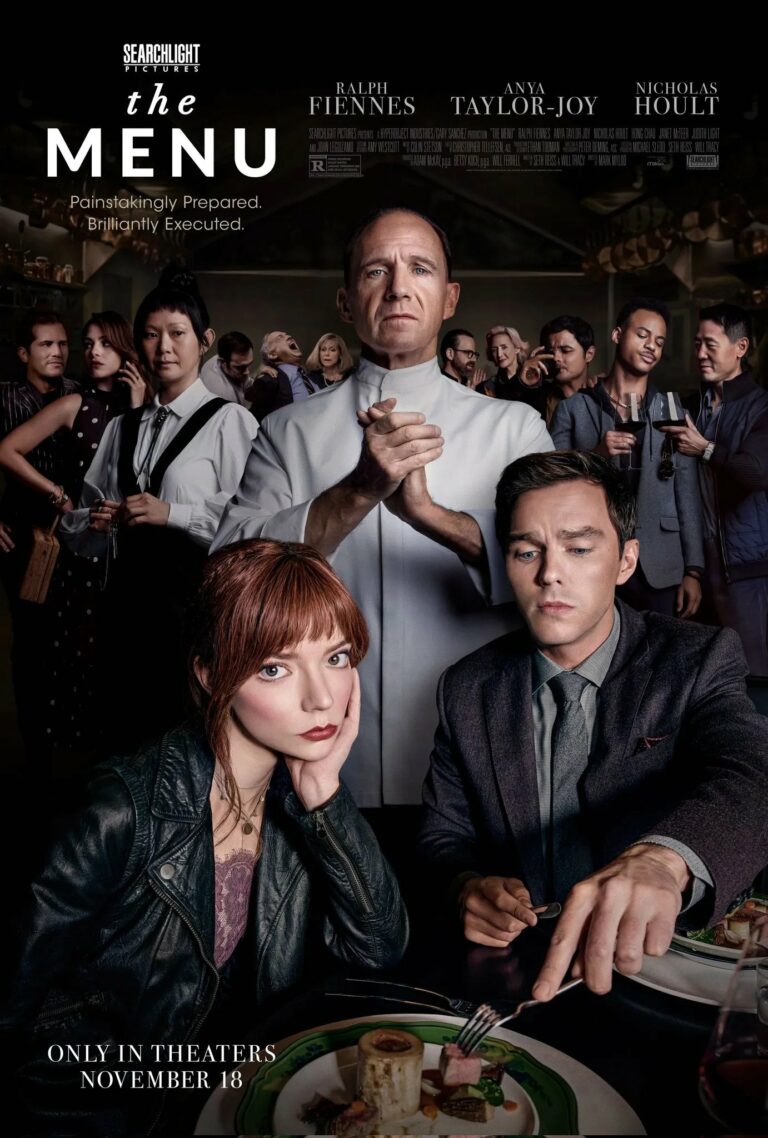
“The Menu,” starring Ralph Fiennes as an intimidating high-profile chef and Anya Taylor-Joy as his unimpressed customer, is a playfully dark commentary on class and restaurant culture.
A majority of the film takes place in a lavish restaurant on the made-up island of Hawthorn, where twelve customers are taken for an exclusive dining experience. Chef Julian Slowik, the host of this upscale event, is an acclaimed chef who takes his craft very seriously. He introduces each course on his carefully constructed menu with a speech detailing its creative significance and a piercing stare over his guests.
Whether it’s due to the dramatic visual composition of the film itself or the evidently threatening remarks made by the kitchen staff, there is a heightening sense of catastrophe and doom that blankets this movie. Yet, most of the characters are so comically pretentious that it’s hard to sympathize with their all-too-predictable fate. Among them is Tyler, a devout Julian Slowik fanatic, his unenthusiastic date Margot, a haughty food critic, a movie star and a trio of obnoxious tech bros.
Each of these guests has paid $1,200 to get a taste of Chef Slowik’s prized menu, only to become increasingly disappointed with their dining experience. From a bread plate with no bread to a dish with portions smaller than the rock it’s served on, the food itself appears as a mere decoration compared to the overly-abstract descriptions served with it.
However, the only one consistently displeased with their meal is Margot, whose skepticism and disdain for the whole experience is clear from the beginning. Her unapologetic distaste for the food, the chef and her fellow diners is the perfect ingredient to spoil an elaborate evening.
The film succeeds at creating suspenseful tension between Slowik and Margot, showing the frightening dynamic between a reputable chef and his solely unsatisfiable customer.
In addition to his stiff and meticulous demeanor, Slowik exercises complete authority in the kitchen. With a single deafening clap, his devoted team of chefs is immediately called to attention, responding with loud cries of “Yes, Chef.” This unwavering devotion becomes progressively more terrifying as Chef Slowik’s demands become increasingly unnerving.
Fiennes does an incredible job of portraying this slow-burning intensity and a chef whose love for food has become lost in artistic vision. As a result, it is enjoyable to watch Slowik unveil his disturbed and vindictive character motivations as the film progresses.
Although its over-the-top deliverance may arguably subtract from the film’s substance, its purpose is to poke fun at snobby upper-class foodies, which it does effectively. Just like the menu dishes that it portrays, “The Menu” proves that a movie doesn’t have to come packaged with profound insight in order to satisfy its audience.
Written by: Vivi Kim — arts@theaggie.org
After their first joint session on June 28, the latest meeting offers resolutions on remaining commission concerns
By ANTHONY W. ZAMMIKIEL — city@theaggie.org
On Nov. 15, members of the Davis City Council and the Planning Commission attended a second joint discussion session to resolve the commission’s remaining questions on how to best align with council priorities. The joint session comes less than five months after the first joint session was held on June 28, where the Planning Commission first approached the council with recommendations about how the commission could best act to advance city council agenda items in a timely manner.
“The City Council held a Joint Discussion with the Planning Commission at the Council meeting on June 28, 2022. This meeting is a continuation of that discussion,” the staff report written by Community Development Director Sherri Metzker reads. “Joint discussions are a chance for the City Council to provide direction to the Commission and share with the Commission thoughts about potential projects/advice the Council wants or needs from the Commission.”
The staff report included two attachments, with the first outlining the Planning Commission’s ongoing challenges with determining how to be as productive as possible in following through with the city council’s recommendations. The second attachment outlines the current status of the planning documents that both the commission and the council use.
According to the report, topics to discuss included affordable housing, trees, transportation and plans for Downtown Davis.
“What are Council’s priorities among these items, and how do you envision advancing these items to get them completed and provide guidance to the Planning Commission in a timely fashion?” the report asks. “Until these items are completed, how should the Planning Commission be proceeding with our work evaluating projects in the absence of updated policy guidance on these topics?”
Greg Rowe, the chairman of the Planning Commission, first spoke to the attending city council members about the issues he wanted to address.
“The presentation given in June really summarizes the challenges the Planning Commission has had in providing recommendations to the council because of a number of outdated policies and plans, including the General Plan, and things like the Housing Element, Circulation Element, Affordable Housing Ordinance,” Rowe said in his opening statement to the council. “In our view, this forced the Planning Commission to look at projects on a one-by-one basis and make judgment calls on projects in isolation from any kind of overarching context in many cases.”
Vice Mayor Will Arnold was directing the response from the city council on behalf of Mayor Lucas Frerichs, who was not present during the beginning of the meeting. Arnold talked about collaboration between the council and commission.
“There appears to be a broad agreement among our bodies about the importance of continuing to build a community that is welcoming and inviting to folks and that we address and we recognize that a housing crisis exists, and we recognize our role in being a part of addressing it,” Arnold said. “That is not a universally shared viewpoint, I would say, in our community if I can put it lightly, and so that baseline level of common understanding, I think, is a critical starting point to the work that we do together.”
Davis City Council meetings are scheduled for the first and third Tuesdays of each month. The schedule for upcoming meetings and the agendas for each meeting can be located on the City Council page of the City of Davis website. The council can be contacted via email at citycouncilmembers@cityofdavis.org.
Written by: Anthony W. Zammikiel — city@theaggie.org

©2021, ASUCD. Designed by Creative Media.