57.6 F
Davis

Davis, California

Tuesday, December 23, 2025
Home Blog Page 193

Exploring the forgotten instruments of the orchestra

UC Davis faculty members offer insight on what makes often overlooked instruments unique

By Sarah Han — arts@theaggie.org


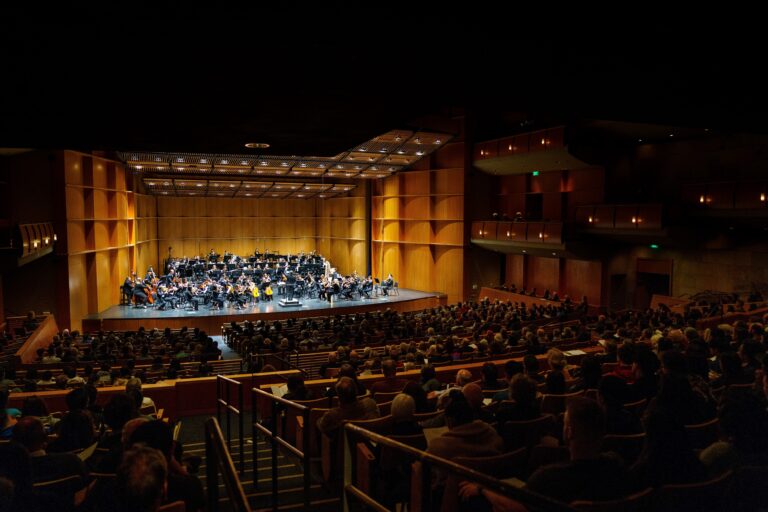
Although orchestras are composed of musicians playing a large variety of instruments, the violin and cello seem to shine the most. But beyond these two, others also play a significant role in the group’s layered sound.

Meet the double bass, considered the largest instrument of the string family. Oftentimes, the “double” part of the name comes from basses doubling the cello parts; however, it is also known as the contrabass, string bass, upright bass or stand-up bass.

Michael Schwagerus, a professor of double bass in the UC Davis Music Department, explained why the instrument has so many different names. 

“It’s a very diverse instrument, it presents in so many genres; [therefore] it has all these confusing, different names,” Schwagerus said. “[Bass is] in bluegrass, jazz, wind band — which is European music and African American music blended in Louisiana in the early 1900s — string band, concert band and pop music.”

In addition to playing a lower register of the cello parts, the double bass has unique characteristics of its own. 

“The bass has a wide range of interesting sounds that it can make harmonics, double stops and percussion-wise,” Schwagerus said. 

 Harmonics are specific places on the strings that produce a higher, more delicate sound. Oftentimes, the notes are a higher octave of the open string notes (G, D, A and E), but they can also be the fifth of the open string note or simply any notes for higher position harmonics.

Despite the bass’s ability to project through harmonics, the overall deep sound of the instrument can prevent it from standing out in the orchestra, according to Schwagerus.

“In my opinion, it’s because of the way harmony is layered, and how sound projects through the layers of harmony,” Schwagerus said. “Because it’s doubling down and it’s in such a low octave, it’s difficult for the instrument to project and present.” 

Beyond projection, Schwagerus explained some other reasons why the double bass is more unpopular than the violin and cello.

“Well, all of our orchestral solos generally retain the bass, change the strings and use solo tuning, which moves our pitch up a whole step and helps the instrument to project,” Schwagerus said. “This is why all the repertoire has to be in the thumb position very high up ,so that the melody needs to present towards the top of the harmony to be heard well and to work well. Because of that reason, I believe that our solo repertoire is kind of thin compared to the cello, [which] naturally can project quite well. The relationships between the size of the string and the size of the box for cello and violin are more resonant.”

Additionally, the massive size of the double bass is often seen as unfavorable to the smaller and more manageable violin and cello.

“It’s difficult for a composer to help the instrument project because of its awkward size,” Schwagerus said. “[Moreover], families don’t want to deal with the enormous instrument that’s very expensive. It’s easy to break when you have doors [and] things, and you need a big car.”

However, despite these challenges, the double bass is a diverse instrument that can be played in various genres and is essential to many of an orchestra’s works. Schwagerus has performed on the double bass in a triple Concerto, a Mahler piece, a contemporary version of the national anthem and more. 

Another consistently overlooked instrument is the bassoon — the largest wind instrument in the orchestra. Dr. David A. Wells, the Department of Music’s applied faculty member for the bassoon, explained how it works.

“The bassoon is a woodwind instrument, [a section] we can divide up into the flute and reed subfamilies,” Wells said. “[The bassoon] uses a double reed, [where] two reeds [are] strapped to each other that then vibrate.”

The double-reed aspect of the bassoon contributes to its unique history. According to Wells, the instrument is “quite ancient… they go back many thousands of years.”

In addition to the reed, the complex functions of the bassoon also distinguish it from other woodwind instruments. It’s more physically demanding than some other instruments, as it requires all 10 fingers to be used. 

“The bassoon [is] more complicated [and] expensive to construct and maintain,” Wells said. “Double reeds are fiddilier, and take more care and attention than single reeds.”

The bassoon lacks history compared to other instruments, making it more difficult to stand out.

“The clarinet, for instance, you can find all over the place; [they] were a regular member of what were otherwise known as brass bands in the 19th century,” Wells said. “And that goes for some of the other woodwinds as well.”

However, the bassoon has a diverse set of characteristics, along with a signature sound, that gives it a purpose within an ensemble. 

“Usually, the principal bassoonist is playing more melodic and harmonic roles, adding the unique tone color of the bassoon to woodwind chords and things like that,” Wells said. “So we really have lots of roles within the orchestra.”

The classical sound of the french horn is another often forgotten player. One of the main brass instruments in the orchestra, it can be identified by its subtle yet broken-up tone, which is generally used to sustain chords for other melodies.

Pete Nowlen, the director of concert bands and horn instructor at UC Davis, described the primary role of the french horn in an orchestra.

“[The horn is] kind of a moderator between the brass and the woodwinds, because the horn can be a very mellow, soft instrument and a very lyrical instrument; therefore it can work very well as a soloist or woodwind instrument or with the woodwinds, but then also can be very, very powerful and fill out the brass color,” Nowlen said.

The french horn also has a noted orchestral background.

“ [In the 1700s] it came in with the purpose of playing just for hunting scenes in operas, because horn was the instrument of the hunt,” Wells said. “And so […] when they brought out a hunting theme, they brought in the horn players to play the hunting calls.”

Wells said that as a wind instrument, the horn works very differently from the strings in the ensemble.

“Playing a wind instrument feels a lot like singing,” Wells said. “We actually have the feeling of the sound in our body and [we feel the] impact of the sound.”

Moreover, the horns offer a plethora of different roles in the orchestra as well as in non-orchestral ensembles, playing a role in woodwind quintets, brass quintets, brass choirs, woodwind octets and large woodwind ensembles. 

The popularity and need for the french horn has also increased with technical innovations.

“The big change for the horn that made it function and be able to accommodate more users was when the valve was invented in the 1820s and then, over about 50 or 60 years, it caught on and the horn went from being a very diatonic instrument to being a chromatic instrument,” Wells said. “So by the time of Wagner and Strauss, most of the possibilities of the horn existed.”

Finally is the viola, informally known as a compromise between the cello and the violin — it takes a violin shape and is played like a violin, but has the same strings as the cello. Oftentimes, the viola plays accompaniments to the melody by itself or with the second violins, cellos and double basses.

Ellen Ruth Rose, a lecturer of viola and chamber music at UC Davis and UC Berkeley, the violist of Empyrean Ensemble and a member of the new UC Davis music ensemble, explained the viola’s primary role.

“In the orchestra, the viola adds color, texture and the inner-workings of the harmonies,” Rose said. “It kind of fills in below the melody to give it color and also above the bass to give it a context.”

But Rose said that beyond this, the most poignant part of the viola lies in its mimicry of the human sound.

“[The viola] has a unique sound because its range is very connected to the range of a lot of human voices like tenors, sopranos and even baritones,” Rose said.

Although somewhat similar in sound to the violin, the viola doesn’t project as much due to its lower resonance — which may be just what gives the instrument its unique qualities.

“It has a more human voice, a more vulnerable voice,” Rose said. “It’s not acoustic, it’s more personally expressive. And that plays out a lot in the new music of our times.”

Rose also mentioned that violas and many other accompaniment instruments “internalize” melodies, which requires tremendous multitasking and focus. This practice requires viola players to listen to music from the “inside out,” or hear the piece starting from the middle sounds and moving outwards to the melody and the baseline.

“I think the type of person who gravitates towards the viola is somebody who, regardless of their technical skills, would rather be part of music from the inside out than just kind of the soloist or the melody on top,” Rose said.

Needless to say, the orchestra involves a diverse range of instruments and each plays a crucial role in producing beautiful music — regardless of how popular or unpopular it is.


Written by: Sarah Han — arts@theaggie.org
 

City of Davis to host festivities for all ages this Halloween weekend

Events hosted by Davis Downtown and other local groups include trick-or-treating, skydiving and stand-up comedy 

By CHRIS PONCE — city@theaggie.org

As Halloween approaches, the City of Davis will have multiple Halloween festivities for residents and students to participate in. On Oct. 4, Davis Downtown announced a list of planned seasonal events on Instagram, including the annual Zombie Bike Parade, “Zombie Mash” after-party and “Treat Trail.” 

Autum Foss, the event coordinator for Davis Downtown, is excited to increase community engagement in Davis through these events. She said that the organization has been making efforts to provide fun events for the city this fall. 

“We have our grand finale for the Thursdays in the Davisphere [on Oct. 27], and that is going to be an ‘80s-themed night,” said Foss. “We have a pretty big band coming in from San Francisco called Tainted Love. They’re going to perform at 7 p.m. The event starts at 5 p.m., and we’re going to have some cool openers like ‘The Spokes’ performing. So we have some local bands opening up for them.”

Foss encouraged students to attend the last Davisphere event, which will be happening in Central Park. As one of the first series of fall events hosted by Downtown Davis this year, it will lead into the Halloween-themed “Davis Spooktacular” festivities happening on Oct. 30 and Oct. 31.

The first event of the Davis Spooktacular is the Zombie Bike Parade, hosted by The Davis Odd Fellows and The Bike Campaign. According to the Zombie Bike Parade website, residents can expect to see a Halloween marching band, “Skydance Skydiving” zombies and more. Bikers can join the bike parade anytime between 12 p.m. and 3 p.m. as the route circles most of downtown Davis. 

The Zombie Bike Parade’s hosts, The Davis Odd Fellows, will also be hosting a comedy show fundraiser with comedian Brent Pella. Pella is a former Davis resident who is a cast member of MTV’s Wild ‘N Out. The comedy show is on Oct. 30 at 7:30 p.m. and tickets can be purchased on the host’s Eventbrite

The Zombie Bike Parade will also have an after-party, called the “Zombie Mash,” sponsored by Davis Downtown. It will be located at E Street Plaza, 228 E St. after the ride concludes. 

“Every year, the Downtown Davis Business Association (DDBA) sponsors the after-party,” Foss said. “So after they do the Zombie Bike Ride, the “zombies” and families will head to E Street Plaza, and from 4 p.m. to 6 p.m., there’s a free DJ, music [and] fire dancers.”

On Oct. 31, the DDBA will also be hosting its annual Treat Trail. The event will be from 2:30 p.m. to 5:30 p.m. and businesses will be giving out candy to trick-or-treaters that follow an interactive map. The map, listing local businesses that are participating, will be posted on the Davis Downtown website closer to the event. Trail participants can expect lots of treats from participating businesses as well as the chance to meet UC Davis’ Princess Pals. The Princess Pals will be available for pictures at E Street Plaza according to Foss. Foss said that this family-friendly event will be bigger than ever this year.

“This year, I think we probably have the most businesses that we ever had signed up to hand out candy,” Foss said. “We have over 50 right now [and] it’s still open for signups so other businesses can still sign up.”

More information regarding all festivities that will be a part of the Davis Spooktacular can be found on the Davis Downtown website and the details regarding the Zombie Bike Ride Parade can be found on their website

Written by: Chris Ponce — city@theaggie.org

BioBrew announces permanent closure in light of staffing shortages

0

Students, staff sign poster in support of bringing back the SciLab coffee stand 

By SONORA SLATER — features@theaggie.org


Imagine, at 8 a.m. on a rainy day in October, damp fog seeping through your clothes, you slip inside the Sciences Lab Building (SLB) for your morning class. The door makes a dull thud as it closes behind you, echoing through the empty building and shutting out the brisk wind, allowing warmth to slowly begin to seep back into your fingers and toes. 

Half-asleep after staying up too late the night before finishing an assignment, you walk over to the northwest corner of the building where you serve yourself a cup of BioBrew coffee. With the comforting warmth of the cup in your hands and the sound of rain clinking on the roof above, you head to your lecture hall fueled by caffeine and prepared to take on organic chemistry.

BioBrew, a secondary location of the ASUCD Coffee House, alongside CoHo South, closed in March 2020 due to the pandemic. At the time, it was meant to be a temporary closure while on-campus operations ceased. The coffee shop, which opened in fall of 2005, was located in the SLB on Hutchinson Dr. and brewed Starbucks coffee before switching to ecoGrounds in 2018. They also served pastries, fruit, tea and more, and had a small dining and studying area with a few tables and stools under the nearby stairway.  

When the main CoHo location and CoHo South reopened in Sept. 2021, it was reported that BioBrew would most likely remain closed until the spring due to staffing shortages — but there were still plans to reopen the cafe when it was possible to do so. 

Earlier this quarter, signs were still up in the area that indicated plans to reopen BioBrew, according to Jill Oberski, a sixth-year PhD candidate in the Entomology Department. However, during the week of Oct. 10, Oberski said that a new sign was put up in the area announcing that BioBrew was closing permanently.

“I thought for sure BioBrew would come back after it closed for the pandemic, but it kept being delayed more and more,” Oberski said. “I still haven’t been able to get a clear reason about why they’re closing it.” 

Lolly Dull, a fourth-year English and biological sciences double major and the CoHo South student manager, explained that while they can’t say exactly who made the call to close BioBrew, the reason for its closure is continued staffing shortages. 

“As we’ve been getting staffing numbers up during this quarter, we’ve been focusing on staffing the locations that get the most business, which are the main and South CoHo,” Dull said. “Since CoHo South employees solely man BioBrew, we needed to focus on getting our staffing up first.”

However, according to Dull, there aren’t currently any plans to use the space for something else, and should staffing significantly increase in the future, the “permanent” closure might not be so permanent. 

“For the time being, it’s going to be permanent,” Dull said.

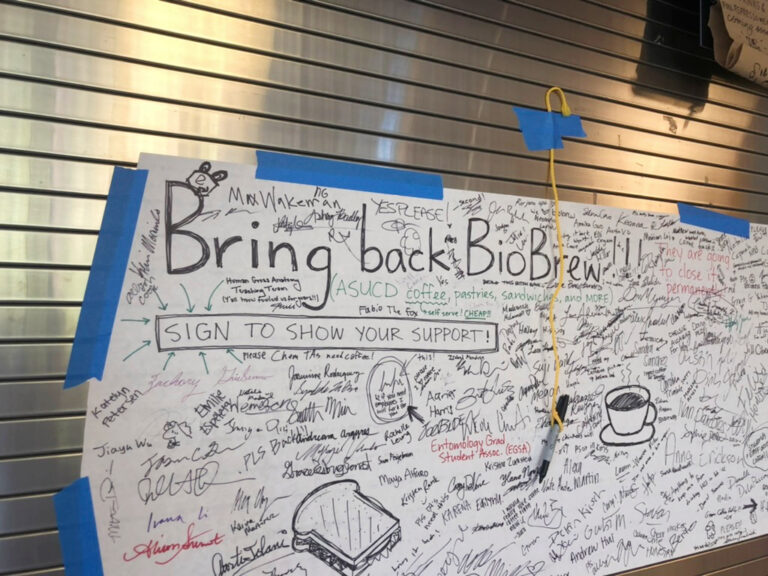
After the sign announcing the closure was posted, Oberski hung up a piece of butcher paper nearby for students and staff to sign in order to show their support for bringing back BioBrew.

“For the first two years of my PhD, BioBrew was a staple,” Oberski said. “Being able to buy a serve-yourself cup of coffee for super cheap right across the street from my building — I took it for granted.”

Some of the dozens of messages on the sheet read, “Your uncaffeinated scientists cannot perform at their best without BioBrew,” “All my homies love BioBrew,” “Y’all have fueled us for years” and even “If you need employees I will work for you.”

BioBrew’s singular Yelp review, posted in April 2019 by user David E., reads, “This is still one of my favorite places on campus to grab coffee; […] give the strange coffee stand inside an academic building a chance if you’re in this part of campus.”

Oberski said that because BioBrew has been closed since the pandemic began, many of the students on campus now have never been to the coffee shop.

“So many people don’t know what they’re missing,” Oberski said. “We miss it every single day!” 


Written by: Sonora Slater — features@theaggie.org


Everything you need to know before buying grapes

Professors at the UC Davis Postharvest Technology Center provide some useful tips to better select and preserve grapes

By YASH RATHI — science@theaggie.org 


Researchers at the UC Davis Postharvest Technology Center recently discussed improving the quality of post-harvest produce and how to prevent it from rotting. Specifically, two professors from the UC Davis College of Agricultural and Environmental Sciences provided some useful tips to preserve, wash and choose grapes in order to prolong the freshness and shelf life of the fruit. 

Dr. Elizabeth Mitcham, the director at the UC Davis Postharvest Technology Center, said that the first step is to choose the right grapes at the grocery store. Choose a bunch that is firmly attached to the main vine, a green, strong stem and has no visible deterioration around individual grapes. Grapes with brown stems indicate that they are ahead in the ripening process and have lost a lot of moisture due to evaporation and ripening. 

It is generally advised to buy and store grapes that are still on the vine. However, when buying loose grapes in a packed box, make sure that they are refrigerated or consumed quickly. The preservation of grapes is important, especially for loose grapes, according to Mitcham. 

“The grape off the vine will have a shorter shelf life due to small injuries from removing stems,” Mitcham said.

Dr. Irwin R. Donis-Gonzale, an assistant professor at UC Davis who specializes in biological and agricultural engineering, said that temperature is key to keeping grapes fresh — and you can tell if they’ve been stored at the proper temperature a few ways. 

“When it comes to grape growth and preservation, temperature management is really important,” Donis-Gonzale said. “It should be around 32˚C to grow grapes. The stems of the grapes are a good indicator. If they lose moisture before the fruit is dry [brown], then they haven’t had proper temperature management while they were cultivated.” 

It is also important to look for locally-grown grapes rather than imported ones, as they have the shortest route from the farm to the store, so they are usually fresher and of better quality.

You can also assess grape freshness by looking at the color of grape skins. Green grapes’ skins should have a slight yellow tint, black grapes’ should be a rich purple color and red grapes’ should be a purple-red color with no green tint. Buy local grapes rather than imported ones because they have the shortest route from the farm to the store, making them fresher and of better quality. 

“Shininess does reflect a higher-quality product,” Donis-Gonzale said. “Moisture loss and shriveling causes grapes to lose shininess” 

Some buyers believe that if a powdery white coating, called “bloom,” is on the grapes, it means that they are fresh, Mitcham said. 

Once you get home, storing grapes properly is crucial. Usually, one should wash any fruit or vegetable before storing it, but this method should not be applied to grapes. According to Mitcham, washing grapes before storing them leads to quicker deterioration. Especially if the grapes are not fully dried before being stored, it can activate the process of degradation at a faster rate. Per online suggestions, rinsing the fruits with vinegar before storing them in an air-tight container may help in the preservation process. It’s also advisable to simply wash them right before you eat them.

Mitcham further advised storing grapes in a high-humidity environment, which can reduce water loss due to evaporation.  Putting them in a plastic bag with pencil-sized holes in it, for example, will maintain the proper humidity level with the environment, preventing the grapes from deteriorating. 

Once grapes are stored in the refrigerator, they can last up to a week. The exact amount of time they will stay fresh mostly depends on when the grapes were harvested, purchased and stored. If they are deep-freezed, they can last up to three months, provided that they were washed and dried right before they were freezed. 

Following the above steps and tips, as recommended by Mitcham and Donis-Gonzale, can help your grapes last longer while tasting just as fresh and juicy at any time.


Written by: Yash Rathi — science@theaggie.org


MLB 2022 Wild Card and Divisional Series recap

National League bottoms seeds make it to conference Championship Series, while top seeds prevail in the American League

By PATRICK FIGUEROA — sports@theaggie.org


After two weeks of MLB playoff action, four teams remain. Competing in the National League (NL) Championship Series are the fifth-seed San Diego Padres and the sixth-seed Philadelphia Phillies. The American League (AL) Championship Series will feature first-seed Houston Astros and second-seed New York Yankees. 


Wild Card Recap 

The Philadelphia Phillies beat St. Louis Cardinals, 2-0:

The Phillies were able to sweep the Cardinals in the best-of-three Wild Card round. Despite a slow offensive start in game one, the Phillies scored six runs in the ninth inning to beat the Cardinals 6-3 from behind. Game two featured a great performance from Phillies’ pitcher Aaron Nola and a home run from outfielder Bryce Harper, resulting in a 2-0 win that eliminated the Cardinals from the postseason. 


The San Diego Padres beat New York Mets, 2-1:

This was the only series where the teams played three games in the 2022 Wild Card Round. Game one featured a Padres’ offensive onslaught, aided by Mets’ pitcher Max Scherzer’s worst playoff start in his career, leading the Padres to a 7-1 victory. However, the Mets bounced back and won 7-3 in game two, thanks to a four-run seventh inning. In game three, the Padres dominated, winning 6-0. Padres’ pitcher Joe Musgrove gave up just one hit through seven innings — but what stood out more was the Mets’ request for the umpires to check Musgrove’s ears for a foreign substance.


The Cleveland Guardians beat Tampa Bay Rays, 2-0: 

This series featured elite pitching performances from both teams, but the Guardians swept the Rays in two games. Game one highlighted Guardians’ pitcher Shane Bieber and Rays’ pitcher Shane McClanahan, who faced off for seven innings. Ultimately, a two-run home run by Guardians’ third baseman Jose Ramirez in the sixth inning secured the Guardians’ victory. Game two was scoreless for 14.5 innings until Guardians’ outfielder Oscar Gonzalez finally hit a game-winning home run in the bottom of the 15th inning, advancing the Guardians to the next round. 


The Seattle Mariners beat Toronto Blue Jays, 2-0:

In a battle of two young teams, the Mariners came out on top. Game one featured yet another dominant pitching performance by Luis Castillo, who pitched over seven scoreless innings, helping the Mariners to their first win of the series. In game two, the Mariners rallied back after being down 8-1 in the fifth inning. With a four-run sixth inning, a four-run eighth inning and an Adam Frazier go-ahead double in the ninth, the Mariners completed the comeback and won a playoff series for the fourth time in franchise history. 


Division Series Recap

The Phillies upset defending champion Atlanta Braves, 3-1: 

The Phillies’ underdog story continued after they upset the defending world champion and 101-win division rivals, the Atlanta Braves. They shocked the Braves and their ace pitcher Max Fried in game one by scoring seven runs in the first five innings, winning 7-6. They lost game two but won games three and four in Philadelphia to win the series. Both of these games featured impressive offensive performances, including a three-run home run by Phillies’ first baseman Rhys Hoskins that extended the team’s lead to 4-0 in game three. 


The Padres knock out first-seed Los Angeles Dodgers, 3-1:

Another upset occurred when the Padres beat the 111-win division rival Los Angeles Dodgers. The Padres lost game one, but they proceeded to win the next three games, clinching the series. Game two featured Padres’ relief pitcher Robert Suarez getting the team out of a tight inning when the Dodgers had runners in scoring position, which helped them secure a 5-3 win. The Padre bullpen, which did not give up a single run in the series, was also integral to keeping the score low in game three, resulting in a 2-1 win. In game four, the Padres had a five-run seventh inning to come back and take a 5-3 lead. They will advance to the NL championship series (NLCS) for the first time since 1998. 


Houston Astros sweep the Mariners, 3-0:

The Astros are in the AL championship series (ALCS) for the sixth year in a row after sweeping the Mariners. In game one, the Astros rallied from behind with a two-run eighth inning and a walk-off home run by Astros’ outfielder Yordan Alvarez, securing the 7-2 victory. Alvarez hit another clutch home run in game two that helped the Astros win 4-2. Finally, game three stretched for 18 innings until Astros’ rookie shortstop Jeremy Peña hit a go-ahead home run in the top of the 18th inning, advancing the Astros to the next round. 


New York Yankees edge out the Guardians, 3-2: 

The most competitive series of the divisional round was between the Guardians and the Yankees. The Yankees won game one, but the Guardians were able to bounce back and win game two and game three. With elimination on the line, Yankees’ ace pitcher Gerritt Cole pitched seven innings, leading the Yankees to a 4-2 win in game four. In a win-or-go-home game five, the Yankees came out on top with a 5-1 victory thanks to outfielders Aaron Judge and Giancarlo Stanton, who both hit home runs. 

The ALCS began on Oct. 19, featuring the Astros and the Yankees. As of Oct. 23, Houston led the series 3-0. The NLCS wrapped up on Oct. 22 with a win by the Phillies, who took the series 4-1.


Written by: Patrick Figueroa — sports@theaggie.org


UC Davis women’s volleyball team falls to Long Beach State

Despite considerable performances by Light, Webb and Radakovic, the Aggies extend their losing streak to six games 

By GABRIEL CARABALLO — sports@theaggie.org

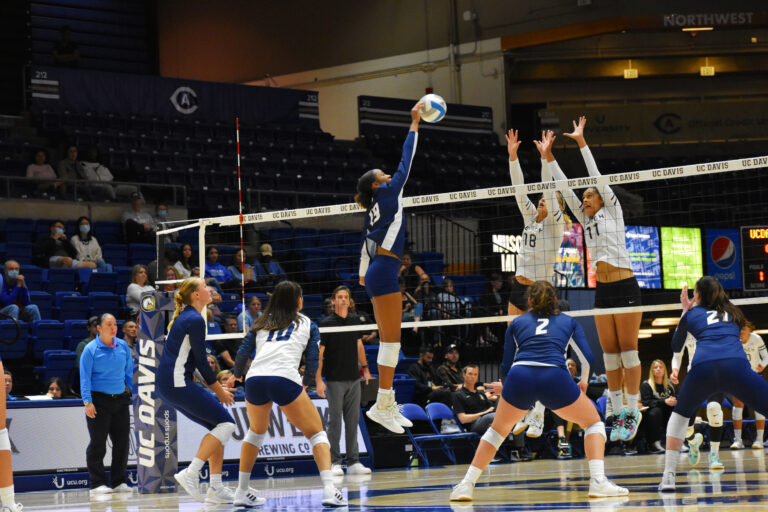
The UC Davis women’s volleyball team entered the University Credit Union Center to play against Long Beach State on Oct. 22 hoping to end a 0-5 losing streak. However, Long Beach State dominated the game, beating the Aggies in four sets.

The Beach earned the first points of the first set with a kill by fourth-year middle-blocker Callie Schwarzenbach. UC Davis retaliated with a kill of their own courtesy of first-year outside-hitter Jade Light and secured a second straight point with a kill from fourth-year middle-blocker Josephine Ough. 

The score of the first set was 2-1 when Long Beach countered back and tied the score with another kill by Schwarzenbach assisted by first-year setter Zayna Meyer, her first of many contributions. 

With a 2-2 score in the first set, the Aggies aggressively secured another two straight points to take a 4-2 lead thanks to a kill from third-year Demari Webb, who had four total kills in the first set. After this, UC Davis began to dominate the first set until the end. The Aggies captured the set 25-20 with three service aces courtesy of third-year Shira Lahav and second-years Oliva Utterback and Julia Ng. In the set, UC Davis had 17 total assists, 14 of which were set up by second-year setter Cassie Newman, while the Beach had 12. The Aggies also tallied 18 total kills, eight of which came from Light, who delivered the set-ending kill. 

After UC Davis won the first set, they started the second on a 4-0 scoring run; however, this sparked a fire in Long Beach that would last the rest of the game. 

The Beach’s counterattack started with a 5-0 scoring run that included two service aces from second-year defensive specialist Savana Chacon. The Aggies then tied the score at 5-5 with a kill by third-year middle-blocker Lana Radakovic. However, Long Beach continued to dominate with a second 5-0 scoring sweep, including a third service ace of the set from third-year outside-hitter Morgan Chacon. Despite the Aggies’ attempts to battle back, the Beach maintained the lead for the rest of the set, barring tied scores at 18 and 22, and secured a 25-23 win. 

It was a competitive set as each team had 16 total kills and similar numbers in assists; UC Davis had 15 and Long Beach had 14, 13 of which were courtesy of setter Meyer.

The match was tied one set to one as the third set began. After a quick exchange of single points, the Beach went on a 4-0 scoring streak, making the score 5-1 and quickly taking control of the set. 

There would be no ties or lead changes for the remainder of the set, as Long Beach would go on another 4-0 scoring streak and later a 5-0 run. Long Beach won the set 25-19, thanks to a set-leading five kills from Morgan Chacon and a service ace and a set-leading 15 assists from Meyer. 

Going into the fourth set, Long Beach was in position to secure the game. To start the fourth set, the Beach went on a 3-0 run that included another service ace from Savana Chacon. Even after that, the Aggies continued to fight and tied up the score 3-3. However, the Beach retaliated with another 3-0 run and another service ace from Morgan Chacon, which made the score 6-3. 

After this, Long Beach never looked back, playing a dominant fourth set, ultimately winning 25-16. In the final set, the Beach had five service aces, as well as 17 kills compared to UC Davis’ 12 and 14 assists compared to UC Davis’ 11. 

“We have to work harder in practice; we need to play better defense than we did tonight,” UC Davis Head Coach Dan Conners said about his team’s performance.

The leaders of the game were Light and Webb with 18 kills each, Meyer with 46 assists and Radakovic with 4 blocks. 

This match brought UC Davis to an 8-12 overall record. The Aggies were on the road on Oct. 25 to face the University of California, Riverside, and will return home on Oct. 29 to play against the University of Hawai’i. 

Written by: Gabriel Caraballo — sports@theaggie.org

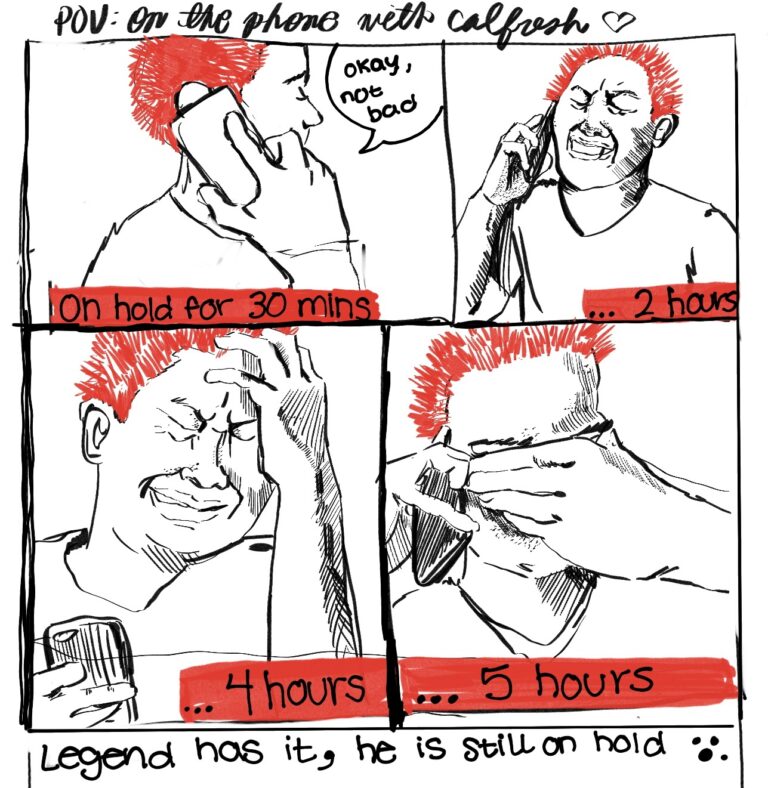
Cartoon: On the phone with Calfresh

0

Drawn by: Priscila Jiménez Corrales –– pjimenez@ucdavis.edu

Consider working for ASUCD

Staffing shortage problems limit the ability of ASUCD units to provide essential services

By THE EDITORIAL BOARD


The Associated Students of UC Davis, or ASUCD, is the on-campus association that, with a $17 million budget, seeks to serve the student population through student government, various units, committees and commissions. Most of these are entirely student-run (including us at The California Aggie).

The units cover a wide span of student needs and interests, including food services, entertainment, bike repairs, transportation and much more. These units are designed with Davis students in mind, so affordability, convenience and flexibility are at the forefront of their operations. For example, The Pantry seeks to address food insecurity on campus by “providing non-perishable, high-protein foods to students free of charge,” according to ASUCD’s website. Likewise, Unitrans provides transportation for undergraduate students free of charge, with routes that cover a vast majority of campus and downtown.

In addition to providing useful services to the campus community, ASUCD also employs hundreds of students across its 16 individual units, and even more are involved in its seven commissions and 12 committees. Several benefits come with working for an organization largely run by students. Job hours are known to be flexible, as student managers know how chaotic college life can be, so class schedules and extracurriculars are taken into consideration when schedules are created.

The job locations are also convenient, with most being located directly on campus — or, in the case of The California Aggie, just off campus on A Street. There truly is a place for everyone on campus who wants to get involved, however that may look to them. 

The association also encompasses the official student government of UC Davis. Composed of three branches (Executive, Legislative and Judicial), the leadership system is a fantastic way for students seeking careers in politics, law-making or related fields to get hands-on experience in a personal way. Even for students not particularly interested in these career fields, joining any of the committees or commissions provides an opportunity to advocate for issues that are pertinent to Davis students from various walks of life.

Moreover, units such as Entertainment Council, KDVS, Picnic Day and Whole Earth Festival are a crucial part in the organization of much-loved on-campus events. Entertainment Council, for example, is coordinating SunsetFest on Oct. 28; the outdoor concert will feature Remi Wolf as the headliner, and is completely free to all. They have also put on similar events in the past, such as Lawntopia, and provide an opportunity for students who want to be involved in creative affairs to explore their passions. 

However, ASUCD can only grant these services for us if we are willing to support them in return. Virtually all units are experiencing staffing shortages that have been an ongoing issue since the start of the pandemic

The Coffee House, affectionately known on campus as the “CoHo,” was forced to temporarily halt operations on Fridays for much of the 2021-22 school year. Many of the food stations in the CoHo, like TexMex, are not currently available due to a lack of employees. More recently, the CoHo’s secondary location in the Sciences Lab Building, “BioBrew,” was permanently closed. Unitrans has also announced reduced service levels for the 2022-23 school year.

If you’re looking for a job, consider applying to work for one of the many ASUCD units we have here on campus; it may benefit you as much as it would your fellow students.

Written by: The Editorial Board


How to make the best of your alone time

Having ample time to yourself is a great opportunity to broaden your horizons

By JENA TUFAIL — jjtufail@ucdavis.edu


Remember high school? For most, this was a time where it was easy to find a niche, to make friends and develop bonds with those in the same grade as you. We all had the same set schedules and often had free time at the end of the school day. 

However, the transition to college can be difficult. Everyone has different schedules, usually no one you know is in your classes and you have to make time for work and extracurriculars. For most undergrads, school is a place to focus on your goals, but it can be lonely and hard to enjoy if you don’t have many friends to provide a support system. 

However, being alone is not always a negative thing. If I’m honest, I struggled to make friends my first year at UC Davis. Not only was I commuting to campus, but between class, homework, internships and sleep, I had forgotten how to socialize.

For many, the pandemic has had lasting effects on us mentally and socially. However, spending time on your own can sometimes be beneficial. 

Instead of focusing on others and fostering new friendships outside of your responsibilities, you can use that time to figure out exactly who you are, what you are passionate about and what you are excited to do with your future. Getting involved in on-campus activities or working directly with professors to broaden your skills and knowledge are great opportunities, even though they are not inherently “social” or focus on meeting new friends. 

Although it is always fun to partake in activities with friends, spending time alone can sometimes be freeing. When in groups, it can be hard to be just “you.” When alone, you can take part in activities and pick up new hobbies you like. This can be a great time to find something separate from your schoolwork and responsibilities that you can enjoy, which can help you manage your stress and allow you time for self reflection.

If you’re still worried about not having a friend group in college, just know that you’re not alone. College is completely different from high school, and it can be difficult for everyone to adjust. Letting friendships come naturally is sometimes the best way to meet new people, and that can take time. Not worrying about how long a friendship might last could even lead to some of your closest relationships in college. 

Always remember: quality over quantity. It is so easy to still feel alone in a group full of people. Finding one or two friends that you can have meaningful and genuine bonds with is more fulfilling than having many shallow relationships.

Don’t feel like you ever need to force yourself to make friends or to fit in with others. It took me time, but I’ve finally been able to find the “niche” I always wanted in college, and I believe this is possible for everyone.


Written by: Jena Tufail — jjtufail@ucdavis.edu 


Disclaimer: The views and opinions expressed by individual columnists belong to the columnists alone and do not necessarily indicate the views and opinions held by The California Aggie.


My love-hate relationship with health food grocery stores

Examining Erewhon’s expensive empire 

By NADIA ANEES — nsanees@ucdavis.edu


Early on a Friday morning in Silver Lake, a neighborhood in Los Angeles, I walked through shiny, sliding glass doors painted with big letters reading “EREWHON.” It would be my first time inside the full-service organic produce market-cafe and the hottest influencer hangout in L.A. 

Upon entering, I could see the “tonic bar” to my left, where a line of baristas were whipping up vibrant green smoothies and iced lattes with organic raw sprouted almond milk. Ahead of me was a fridge stocked with rows of multi-colored, fresh-pressed juices in Erewhon’s signature glass bottles, and further down, the famous Erewhon hot bar brimming with every veggie and meat option you could think of. Scents of fresh, tri-color roasted carrots, kale and white bean salad and tender salmon filets filled the air. In line stood many people with matching yoga sets and thick sunglasses. I felt I did not belong here, but I was loving every second of the experience.

Erewhon is known for having attracted a cult-like following of customers who are passionate about maintaining a very clean and active lifestyle. Walking around its narrow, tall aisles is an enlightening experience. You’ll find the latest trends in various wellness concoctions, like sea moss gel and ashwagandha-infused matcha powder. You will leave with a snack and interesting beverage in hand before realizing you’ve just spent $50. 

Erewhon has declared itself as more than just a grocery store — it’s a lifestyle. As someone who is passionate about nutrition and healthy eating, I felt like I was standing in a little health food utopia — after all, that feels like the intent of the store. Although I certainly can’t shop for the bulk of my groceries from a store as expensive as Erewhon, walking around the store — or really any health food store (think Nugget Market, Sacramento Natural Foods Co-Op or even Davis Food Co-op) — brings about a euphoric feeling for me. It’s one of my favorite pastimes.

I also love Erewhon’s values. I agree that healthy, nourishing food can heal communities. But which communities are Erewhon really healing? There is a very specific, and frankly, privileged, demographic of people who can enjoy its luxury. This same demographic is perpetuating the narrative of what healthy ought to look and feel like.

While those who can afford the Erewhon lifestyle are being nourished and supercharged by organic kale and celery juices, others are being pushed lower and lower into food disparities. Take a look south of downtown L.A., and you’ll encounter a region classified as a “food desert” — an area with a 20% or higher poverty rate and in which one-third of the population lives more than a mile away from a supermarket.

I receive lots of joy and fulfillment through my health food store visits — but this access itself is a privilege. What about the people who don’t even know that a store like this exists, or who couldn’t imagine ever stepping foot inside?

The rise in popularity of healthier lifestyles and health food grocery stores is exciting — it means that there’s increasing energy and passion around building stronger, healthier, happier communities. But the trendiness of health food stores like Erewhon makes me pause and think about which communities are benefiting from these standards.


Written by: Nadia Anees — nsanees@ucdavis.edu


Disclaimer: The views and opinions expressed by individual columnists belong to the columnists alone and do not necessarily indicate the views and opinions held by The California Aggie.


Davis Cemetery to host annual Día de los Muertos celebration 

Fresh marigolds and a public alter will be available for Davis community members to honor loved ones

By LA RISSA VASQUEZ — city@theaggie.org


From Oct. 31 to Nov. 2, the Davis Cemetery District and Arboretum will host its annual Día de los Muertos celebration. A public “ofrenda,” or altar, will be set up outside of the cemetery’s administrative office located at 820 Pole Line Rd., and people are encouraged to leave pictures and mementos for loved ones who have passed at the ofrenda when they visit the cemetery.

Fresh “cempasúchil” (marigolds), “pan de muerto” (bread of the dead), paper flowers, a small offering of water, salt and candles will also be available for residents to set at the ofrenda or at their loved ones’ graves.

Signs with QR codes that guide visitors to a welcome address provided by Yolo County Supervisor Jim Provenza, as well as a playlist recorded by a local mariachi band, will be located around the grounds. Visitors will also be able to read about the history of Día de los Muertos on educational signage placed throughout the cemetery ground walkways. 

Jessica Smithers, the Davis Cemetery District Superintendent, is in charge of organizing the event which began in October 2011.

The Davis Cemetery District is pleased to host a variety of public events on our grounds,” Smithers said. “We are always looking for community groups and/or individuals to plan community outreach events.”

Volunteer forms can be found on the Davis Cemetery District’s website for anyone who would like to plan an event or volunteer at one. Smithers said that having volunteers and community members at events like this is important, as they are opportunities to both educate people and celebrate. 

“For community members that don’t have loved ones buried here, I think it’s really nice for those community members to come out and really witness how families honor their loved ones,” Smithers said.

Juan Carlos Galindo, a fourth-year aerospace engineering and Spanish double major, explained the two-day celebration and its historical relevance.

“The first day is [the] day of all saints,” Galindo said. “Nov. 1, people celebrate children who passed away, people who are not adults. The second day is the day of the dead, when people celebrate and commemorate [all] people who pass away.” 

All offerings are made and candles are lit on Nov. 1, and those flames are not extinguished until midnight on Nov. 2, when Día de los Muertos officially concludes. 

Fernanda Serna, a fourth-year statistics and economics double major and student intern at the Cross Cultural Center, talked about the impact of Día de los Muertos in the U.S. 

“We don’t see celebrations like this in American culture,” Serna said. “So for non-Mexican students, just having the opportunity to celebrate their loved ones in this way is respectful of the culture, and it is really meaningful.” 

Día de los Muertos is a multicultural celebration, and many people incorporate their own traditions, or build new ones, into the festivities. One such person is Judy Catambay, a local art teacher who painted a mural for the Davis Cemetery’s celebration two years ago. Catambay shared how she celebrated the holiday.

“It’s not part of my background growing up, but I try to honor it every year and try to teach it,” Catambay said. “Initially, I was going to do [a mural for] Mother’s Day because my mother was going through lung cancer, and I wanted to do something to honor her, and then she passed. The mural was trying to incorporate the holiday and her life.”

Catambay said that 2020 was a difficult year for people losing loved ones, and that the timing partly inspired her work.

“I wanted to capture my mom’s legacy,” Catambay said. “Through her life, she showed me a lot of perseverance and kindness, and I really wanted to capture that. So that was my main objective, to honor my mom because that was a recent loss at the time, and it was right at 2020, so there was kind of [a] loss for the whole world. So to me, it was a way to have a meaningful experience because it was a hard time for everybody.” \

Día de los Muertos begins Nov. 1, but the cemetery will have the public altar and educational signage displayed for three days, from Oct. 31 through Nov. 2. More information about the event and future community celebrations can be found on the Davis Cemetery District website.


Written by: La Rissa Vasquez — city@theaggie.org


UC and Teamsters collaborate on a four-year contract for clerical and administrative staff 

The tentative agreement addresses fair compensation, salary progression and affordable health insurance

By KAYA DO-KHANH — campus@theaggie.org


On Oct. 3, UC officials announced a tentative agreement with the Teamsters Local 2010 union for a four-year contract that will seek to address issues such as fair compensation, salary progression and affordable health insurance for its members, according to a recent press release. The new contract will affect 11,000 clerical employees, library assistants and other administrative staff represented by the Teamsters. 

The UC Clerical and Allied Services (CX) Unit of the Teamsters is made up of around 12,000 administrative support workers in the UC system who joined the Teamsters in 2010 and formed the Teamsters Local 2010. The Teamsters work toward winning better wages, benefits and working conditions. 

Aimee Baror, the communications director for the Teamsters Local 2010, said that the negotiation process for this contract took almost a year and involved 47 formal bargaining sessions with the UC.

“Many times it’s a tug of war, so thousands of members took action in the form of rallies, they signed petitions, they signed digital letter campaigns and they taped leaflets to the doors of the campus chancellors,” Baror said. “It shows the university that the membership is united and that they are willing to take action […] That visibility and that willingness by the membership really made a difference in what the bargaining team was able to negotiate in the contract.”

The tentative agreement includes guaranteed across-the-board raises, annual step increases that are not based on merit or performance, gains on overtime and more, according to the Teamsters Local 2010 website.

“The pay steps were very important because many workers were not being moved up their pay scale even after they had worked for the university for five years, 10 years,” Baror said. “Sometimes people worked there even longer than that and they are still below the median of their pay range.”

The tentative agreement also includes a change to the UC’s health benefits system that will prevent increases to employee contributions for monthly health insurance premiums from exceeding $25 per member for the length of the contract, according to the UC network website. All bargaining unit members will also now receive annual across-the-board pay increases totaling 15% over the life of the contract.

Jenny Hodge, a Special Collections assistant at Shields Library and a CX bargaining unit team member, said that being on the bargaining team, she was able to learn about clerical workers’ experiences across campus. The team presented examples of UC employees’ work over the past two years, which was part of the reason the Teamsters were able to successfully negotiate a contract, according to Hodge.

Hodge said that she believes the new contact is, in part, recognizing the work that clerical employees did to keep UC Davis running through the pandemic. She worked at Shields Library, which was one of the facilities on campus that remained open during most portions of the pandemic. 

​​“It’s important because this contract speaks to people’s wages — this is how people are able to live their lives and support their families,” Hodge said. “Working toward this contract is about the UC system valuing their employees, and that’s by paying [us] wages that, frankly, we deserve.”

On Oct. 21, the contract was ratified with a 98.3% vote in favor, according to a post on the Teamsters Local 2010 website. The contract is effective through June 30, 2026, and the full tentative agreement is available on their site as well.


Written by: Kaya Do-Khanh — campus@theaggie.org


Culture Corner

The Art Desk’s weekly picks for movies, books, television and music

By LEVI GOLDSTEIN — arts@theaggie.org


Song: “This Is Why” by Paramore (2022)


Paramore is back, and Hayley Williams is once again rocking the iconic orange hair that we all know and love. Paramore’s new single “This Is Why,” which is also the title track for their next album set to be released in February 2023, is a perfect blend between the pop-punk of “Riot!” (2007) and the synth-pop of “After Laughter” (2017). According to NYLON Magazine,“This Is Why” is an account of the band’s frustrations that arose during the COVID-19 pandemic. Because of its relatable lyrics and stellar guitar riffs, I have been listening to this funky anthem on repeat since its release. 


TV Show: “Dead End: Paranormal Park” (2022)


Who says cartoons are just for kids? This whimsical comedy has quickly become one of my favorites. Struggling to find a place where they feel as though they fit in, Barney and Norma start working at an amusement park themed around actress and movie star Pauline Phoenix (voiced by drag persona Miss Coco Peru). But they soon discover the park is haunted and full of ghosts, vampires, witches, demons and more, such as Courtney, a demon banished to the mortal plane just trying to find her way home. The three friends (plus Barney’s talking dog, Pugsley) soon uncover an evil plot that could flip their worlds upside down. “Dead End” gets an A+ for representation, with transgender, neurodivergent, Pakistani American, Iranian American, Vietnamese American, Muslim and Jewish characters, as well as multiple on-screen queer relationships. The best part? The second season is already out on Netflix!


Book: “The Good Daughter” by Karin Slaughter (2017)


“The Good Daughter” perfectly blends an exciting plot with exceptional writing to make it the very definition of a page-turner. When sisters Charlotte and Samantha were young kids, they were forced to witness their mother’s murder. Now, 28 years later, Charlotte is assigned to be the defense lawyer for a girl accused of orchestrating a school shooting and must prove her innocence in a case everyone seems to think is open-and-shut. But when the trial begins to reveal the truth about the attack that tore their family apart, Charlotte and Samantha must revisit traumas they would rather keep buried. This mystery thriller will have the gears in your brain turning from cover to cover. Plus, when I read the book’s major plot twist, my jaw literally dropped; I genuinely never saw it coming. (Content warnings: graphic depictions of violence and sexual assault)


Movie: “Let Me Fall” dir. by Baldvin Zophoníasson (2018)


This Icelandic film expertly grapples with the hardships of substance abuse. Fifteen-year-old Magnea is introduced to a life of sex, drugs and crime by friend Stella, whom Magnea is harboring a crush on and would follow anywhere. The pair quickly become lovers, but the facade of a peaceful future together fades as they discover the difficulties that accompany a life of drug use. Eventually, they are arrested and forcefully separated from one another. When they meet again as adults — Stella fully recovered and Magnea falling deeper into her addiction — they must come to terms with their tangled past. “Let Me Fall” is not a lighthearted movie by any means, but the moving story and important message make it worth the watch. Bring an extra box of tissues because you’ll need it. (Content warnings: suicide; sexual, emotional and verbal abuse; graphic depictions of substance abuse)


Written by: Levi Goldstein — arts@theaggie.org

Daily parking rates to increase for on-campus residents who will no longer receive affiliated rate

Residents of on-campus housing will now return to paying the nonaffiliated rate of $15 per day

By SYDNEY AMESTOY — campus@theaggie.org


On-campus residents who drive to campus, including those who live at the Green at West Village, can expect a price increase in their Parkmobile daily parking bill, according to information on the Transportation Services (TAPS) website.

This change comes as TAPS has switched on-campus resident drivers from the affiliated rate of $3.50, which they received access to during the pandemic, to the nonaffiliated rate of $15 that they paid pre-pandemic. Those living in residence halls and in on-campus apartments were informed of the switch through their student email accounts before the change occurred. 

On-campus residents paying the nonaffiliate rate is a policy that is not new, but was only temporarily changed, according to the executive director of the service, Dr. Perry Eggleston.

“Since the campus was on reduced operations due to the pandemic, University leadership allowed Transportation Services to offer affiliate rates to residents these past two years,” Eggleston said via email. “Now that the campus population and vehicles have returned, the University leadership asked us to reinstate the policy.”

TAPS encourages students to use alternative transportation to get around campus to avoid the daily charge, according to Eggleston.

Resident students have access to Unitrans, biking, walking, and other travel amenities,” Eggleston said. “Thus, storing their cars on campus only adds to the traffic congestion with the return to ‘normal’ operations.”

The ASUCD Senate had this issue brought to their attention by Senator Vaneza Gonzaga during the open discussion period of the Oct. 6 senate meeting

A lot of students have gone into this academic year planning on driving everyday, so that’s the investment they’ve made with their cars and such, so if it’s going to be $15, that’s extremely expensive,” Senator Gonzaga said. “Bikes are also expensive, which is one of the solutions they offered as an alternative.”

Senator Zeph Schnelbach also shared their thoughts during the discussion. 

“[Transportation Services] sees it that if you live on campus, you don’t need to have a car, but I would like to remind the table that the Green is over a mile away from campus,” Senator Schnelbach said during the meeting. 

Senate discussion continued on the topic during the Oct. 13 meeting regarding what, if any, action the senate would take about the reinstatement of the policy. 

“I asked the internal vice president [JT Eden] for an update on the plans, and we are currently planning for some reps from transportation services to come to a meeting so we can ask them questions about the increase,” Senator Gonzaga said. “[We want] to see if there are solutions that work with TAPS and are still fair for students living on campus.” 

As defined by UC Regents and State of California documents on UC auxiliaries, which TAPS is according to their website, an auxiliary must be self-supporting without state budget support. The TAPS website also states that parking citations and passes help the service afford to continue functioning and providing service on campus. 

Increasing rates was a financial necessity to manage Transportation Services’ revenue losses during the pandemic,” Eggleston said. “The rate increase partly stems from the success of our long-term strategy to reduce vehicle trips to campus by encouraging all modes of sustainable transportation, including biking.”


Written by: Sydney Amestoy — campus@theaggie.org


Fight among protesters leads Turning Point USA to cancel event on campus

Protesters and counterprotesters knock over barricade, use pepper spray outside of Mondavi Center

By SYDNEY AMESTOY AND SONORA SLATER — campus@theaggie.org

On the evening of Oct. 25, an event at the UC Davis Conference Center organized by registered student organization (RSO) affiliate, Turning Point USA at UC Davis, was canceled before speaker Stephen Davis began his remarks, according to a recent statement from the university. 

The event was canceled by the student who organized the event due to “concern for safety,” according to the release, after around 100 protesters and counterprotesters, including some who wore apparel labeled Proud Boys, began to fight amongst themselves. 

The original protest was planned by the UC Davis Cops Off Campus group, who posted on Instagram on Oct. 20 with a call to students to “Show up and make it clear that [Turning Point USA isn’t] welcome on our campus,” before listing further information about the protest’s time and location at 6 p.m. on Vanderhoef Quad. Flyers for the protest were posted on doors around campus for a few days leading up to the event.

After the protest began, participants knocked over the metal barricade that was set up and began to pound on the glass doors of the Conference Center in order to get the attention of the people inside. About an hour into the event, counterprotesters, including some wearing Proud Boys attire, arrived. Pepper spray was used against people in the crowd, and physical altercations broke out.

The university’s statement goes on to say that UC Davis police were not deployed to the incident, and no UC Davis staff members used pepper spray. However, security was present from the private Sacramento-based security firm Members in Black (MIB), according to Aggie staff writer Anthony Zammikiel, who was present at the event. 

According to Zammikiel, security personnel declined to state who was responsible for hiring MIB security for the event. MIB staff remained at the entrance of the Conference Center and did not participate in the physical interactions between demonstrators.

Some spaces on campus were closed down after the protests began, according to third-year clinical nutrition major and employee at the Student Community Center (SCC) Diana Li. Sometime after 8 p.m., according to Li, the SCC posted a sign on their door that read “This facility is locked down/closed due to an emergency situation.” 

The statement from the university said that it was “unfortunate the event could not proceed as planned.”

“We affirm the right of our students — in this instance, Turning Point USA at UC Davis — to invite speakers to our campus, just as we affirm the right of others to protest speakers whose views they find upsetting or offensive,” the press release said. 

Anthony Zammikiel contributed to this report.

Note: This story is developing. Check back for updates.

Written by: Sydney Amestoy and Sonora Slater — campus@theaggie.org