57 F
Davis

Davis, California

Monday, December 22, 2025
Home Blog Page 246

Pfizer-BioNTech COVID-19 booster shots now offered in campus vaccine clinics

Eligible employees and students can make appointments through Health-e-Messaging

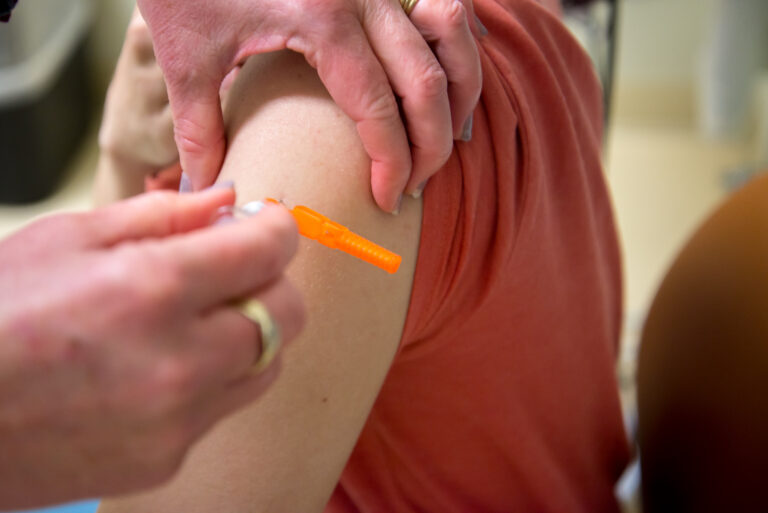
Following the U.S. Food and Drug Administration’s (FDA) authorization of a third COVID-19 vaccine dose, the UC Davis vaccine clinic began offering Pfizer-BioNTech shots to eligible students and employees at the end of September.

The Centers for Disease Control Statement on Pfizer-BioNTech COVID-19 encourages booster shots for individuals 65 years and older in long-term facilities, people aged 18-64 at increased risk for contact through their occupation or other environments and people within that age group with medical conditions.

Individuals in these demographics are able to receive the third dose if they were administered the two Pfizer-BioNTech vaccinations at least six months ago. Appointments can be made through the Health-e-Messaging website. Proof of immunization will be required along with completion of the Daily Symptom Survey. 

“We just started a few days ago, but it has picked up a lot since we started offering the third one,” Andrea Long, a kiosk worker and lab helper for testing and vaccinations at the UC Davis campus vaccine clinic, said. “I think for a lot of older people and those with conditions, it’s a good thing that we’re offering that especially for staff and students because it’s convenient on campus.”

The decision to offer booster shots is a part of a continued effort to mitigate and ensure a healthy campus environment.

“98% of UC Davis students are vaccinated,” Jeffrey Hoch, a professor of health economics in the Department of Public Health Sciences, said via email. “Having booster shots accessible on campus will facilitate this trend of protecting our community through prevention.”

According to Hoch, the work of Aggie Health Ambassadors and Healthy Davis Together have been successful in educating and strengthening the Davis community. The university has also employed the use of mandatory frequent asymptomatic testing and contact tracing in an effort to keep students, staff and faculty safe.

Through the mask requirement and testing of thousands of students, the campus has reported a 0.15% positive rate since Sept. 14 and 7% of on-campus isolation and quarantine housing in use.

“Prevention is the key to public health, and getting the vaccine is the key to beating [COVID-19],” Hoch said via email. “Offering the booster shot continues this tradition of helping our community stay safe.”

Written by: Christine Lee — campus@theaggie.org
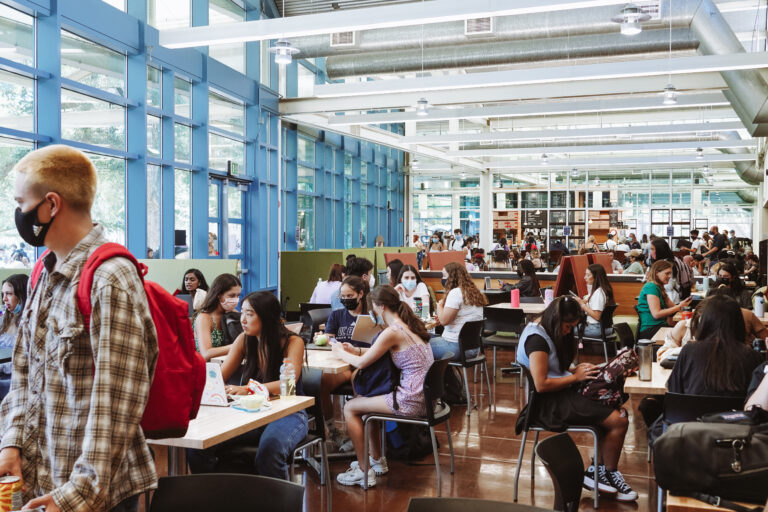
Staff shortages force the CoHo to close on Fridays

The campus-wide student employee shortage has led the CoHo to decrease operating hours

Due to an ongoing shortage of student workers on campus, the CoHo announced that they will be closed on Fridays for the time being.

“The decision to close the operation on Fridays wasn’t an easy one, but in discussions with the Coffee House management team and student leaders, it was clear that with our current staffing challenges a 5-day operating schedule was not sustainable,” the official announcement stated.

The CoHo is actively looking for more employees to join their team.

“We have been supported by ASUCD Marketing in primarily reaching out on our social media channels and on site with signage,” Darin Schluep, the food services director of Associated Students Dining Services, said via email.

In addition, Schluep mentioned the CoHo’s presence at Aggie Job Fairs and the work of the communications team to advertise vacancies. 

“We have approximately 50 new employees currently in the onboarding process, and we continue to collect applications on the ASUCD Jobs website,” Schluep said.

According to the announcement, the reduction in service days will ideally be temporary as more student employees are hired. With staff shortages, the management team at the CoHo has put in effort to address the “workload, morale and mental health” of their student employees.

“We have discussed a variety of employee morale-boosters that we’re hoping to start next week, including an employee-only coffee station, a ‘goodie table’ with snacks and candy that they can take at the end of their shift, and ‘pizza day’ where we order out pizza for the employees,” Schluep said.

In the future, Schluep hopes to raise the employee discount to thank employees for continuing their work and persevering through these staff shortages. 

According to Schluep, employees at the CoHo can build skills in time management, customer service and communication that can be used in future employment. Schluep also mentioned that there are opportunities for advancement in supervisor or student manager positions.

“Since it started in the late 60’s, the Coffee House has a proud tradition of student-focused food service that has elevated it to becoming the most popular place to eat and drink on campus,” Schluep said. “We’re looking for the next group of students to be a part of that tradition.”

Written by: Emily Redman — campus@theaggie.org

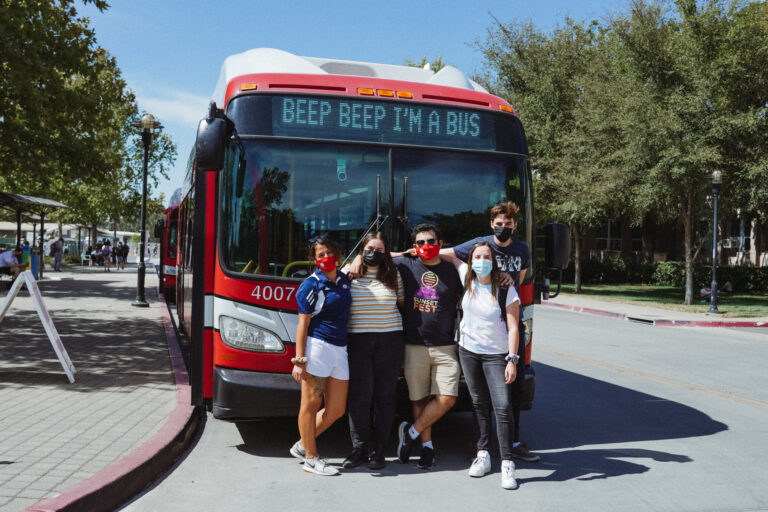
Unitrans faces severe shortage of student drivers

The campus bus service remains operational while it experiences staff shortages

While many employers on and off campus have been experiencing staff shortages, the Unitrans driver shortage in particular has been deeply felt among students who rely on the service for regular transportation. 

According to third-year electrical engineering major and Unitrans driver Maximus Rusi, Unitrans has yet to reach the same operational status as before the pandemic.

“The driver shortage has definitely been rough on service,” Rusi said via email. “Unfortunately we haven’t been able to get back to full ‘pre-pandemic’ service due to the lack of drivers.” 

The lack of sufficient employees puts stress on both drivers and supervisors, but those most affected are students and patrons who use Unitrans, according to Rusi. 

“While this affects drivers and supervisors, […] I feel worse for our community that uses public transportation,” Rusi said via email. “Those that live in West Village or North Davis specifically feel it the worst.”

The shortage of drivers means that buses run less frequently, some only running once per hour, which leads to larger crowds on the buses that are in service. Two bus lines are also being temporarily operated by the Yolobus service. 

“During the normal year we would normally run busses to them every 15 minutes but right now we can just barely manage to run [highly-frequented lines] every 30 minutes,” Rusi said via email. “You would think that’s not a big deal, however it’s actually leading to buses being over packed and running super late.”

Jeffery Flynn, the general manager of Unitrans, recommended that students planning to take the bus leave earlier than they otherwise would to get to class. 

 “Please be patient and expect crowded buses and delays,” Flynn said. “We recommend trying to get to classes at least 30 minutes before you need to arrive. As more students apply and finish driver training, we will add more service.” 

Flynn encouraged students who may be looking for on-campus employment opportunities to consider working for Unitrans. 

“We have a lot of room for job opportunities and growth,” Flynn said. “All of our frontline supervisors are undergraduates and most of our managers are undergraduates.”

     Until these positions are filled, however, students who commute to school via bus will continue to feel the effects of the driver shortage. 

    Fatima Alvarez, a fourth-year managerial economics major, explained that the reduction in Unitrans services has affected her daily commute. 

    “The reduced service meant I had to look for other forms of transportation,” Alvarez said via email. “I’m grateful that Yolobus took over the service of the line I would have to take to campus.”

Alvarez said that she hopes bus services will increase sooner rather than later. 

“Maybe it’s too early to have the lines that were suspended back, but I would like them back,” Alvarez said via email. “Some lines are only running once per hour and I would like to see them running twice an hour as regular service.” 

According to Rusi, Unitrans’ present concern is providing all students who need one with a ride. 

  “We haven’t been able to keep up with the demand for more buses on the road,” Rusi said via email. “Right now, making sure everyone can get a ride is our biggest goal. I just hope we will have the capacity to improve service for our community as soon as possible.”Written by: Yan Yan Hustis Hayes — campus@theaggie.org

Logos Books: Davis’ one-stop shop for affordable books

A volunteer provides insight on the used bookstore selling donated books at accessible prices

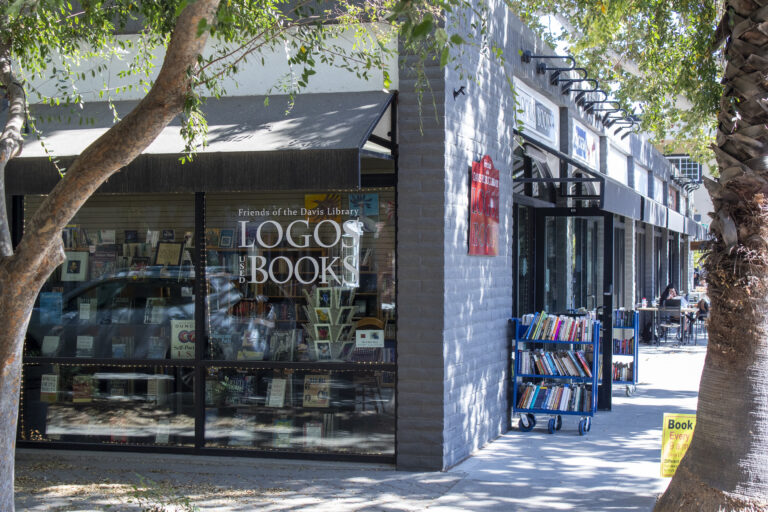
Logos Books, a long-standing Davis institution acquired by Friends of the Davis Library in 2017, is Davis’ one-stop shop for affordable books. The store has a wide selection of genres and styles, ranging from poetry to thrillers to fiction and everything in between. 

Every book that’s for sale has been donated — a practical method of reducing waste that also keeps costs down. 

“There were [used book] sales at the library every other month, but with an actual store, we could be selling books every day,” said Paul Takushi, the acquisitions manager and cashier at Logos. “We have so many books donated to us… This way, we could funnel the best of the best through the bookstore.”

The library is another great option for getting access to books for relatively cheap, but there are definitely situations that require readers to possess their own copies, and Logos provides an easy, accessible way for this to happen. 

 Davis is a college town, which naturally means that many of its residents live on a college-sized budget. Combine that with the academic nature of Davis’ demographic, and it becomes very clear that there is a need for cheap access to literature. 

And this is not an issue unique to Davis — literacy rates have shown to be a strong indication of financial success, regardless of where the population is surveyed. Quite simply, affordable access to literature (especially in childhood) is a telltale sign of success later in life.

Of course, if there’s any town that will welcome a used bookstore with open arms, it’s Davis. Logos fits right in among the many other quirky, hole-in-the wall establishments that reside in Davis and are frequented by the equally unique population.

“It’s really gratifying to see more books going into the community, plus more money [going into] the Friends of Davis Library for literacy programs,” Takushi said.

Check out Logos Books at 513 2nd Street next time you need a book, feel like browsing or even just want to chat to their friendly cashier. 

Written by: Clara Fischer — arts@theaggie.org

UC Davis offers many transportation options for students, community members

Campus commutes are back with an emphasis on sustainability

After more than a year of distance learning, the return to campus also means the return to daily commutes. While many students may already be familiar with the different transportation services available to them, new students face the challenge of learning how to get around on and off campus. 

For many students, this means a new bike. ASUCD Bike Barn senior mechanic Oscar McBain said that the Bike Barn is a key resource for new and experienced bikers alike.  

“The ASUCD Bike Barn has been on campus for 50 years,” McBain said via email. “Our goal is to empower students for success at UC Davis by providing helpful service to keep you on the road.”  

The most important thing for prospective bike owners and bike riders is to find a bike that fits their specific needs, according to McBain. 

“Think of your bike as an investment and a tool; when selected and maintained correctly, it will save you lots of time, money and effort,” McBain said. “This means something 

different for everyone…consider your options and let the Bike Barn’s mechanics help empower you to enjoy your ride.” 

    McBain said that this is an exciting year for the Bike Barn both because of the return of students and new programs.

“We had an awesome move-in week and the start of school — we sold out of almost all our bikes,” McBain said. “We will be launching…our mobile repair service using our TGIF-funded e-cargo bike to meet students where they are to provide assistance and spread the word about our services.” 

    While biking is the most common mode of transportation in Davis, those who do not bike also have convenient transportation options available to them, notably ASUCD Unitrans, which is free to all undergraduate students. 

ASUCD Unitrans general manager Jeffery Flynn explained that the Unitrans bus system is a great resource for students and community members alike. 

“We’re one of the very few public transit systems in America that is operated by students,” Flynn said. “We are the city’s bus system, we’re the campus bus system and it’s very, very rare to see a city and campus bus system that is totally operated by students —

I think this makes it more fun, more friendly and more approachable.” 

    Flynn explained despite the fact that Unitrans is operating with fewer student drivers than what is typical. Multiple lines are operating with service running semi-frequently.

“We have 18 lines that go to almost every single place in Davis and while we’re not quite back at full strength for service levels, service is relatively frequent,” Flynn said. “Right now we’re running 30-60 minute service and as we get more student drivers we’ll be at 15-30 minute service.” 

Like the Bike Barn, Unitrans has new plans to update its services in the coming years. 

“Our goal is to never buy a fossil fuel powered bus ever again,” Flynn said. “We have about 50 busses and our plan is to start retiring those busses and replacing them with electric buses and within the next two to two and a half years we’ll have replaced about 25% of our fleet with electric buses.” 

Another useful on-campus transportation resource is UC Davis’ Transportation and Parking Services (TAPS) which is the general transportation department for the campus. TAPS manages a variety of services including but not limited to parking, demand management, the bicycle program and the UC Davis airport. 

TAPS Transportation Demand Manager Ramon Zavala explained that preparing for this school year was very different to prior years.

“Given the ongoing COVID pandemic we’ve put a lot of work into facilitating no-touch/minimal interaction with our services,” Zavala said via email. “We were pretty certain that with the reduction of transit options (reduced Unitrans and Yolobus trips per day due to the driver shortage) and with people not feeling 100% safe in mixed household carpools, we were going to get a lot more vehicles on campus than normal.” 

Because of this increase in the number of individuals commuting via car, Zavala explained that TAPS encouraged people to use alternate modes of transportation both because of the impact that would have on the availability of parking on-campus and because of the importance of choosing sustainable transportation options. 

“Thus far it looks to have reduced week 1 parking demand 7-10%, so that was genuinely effective,” Zavala said. “Transportation Services is, at our heart, we’re a sustainability organization. We want you to ride your bike, take the bus, and do whatever to not bring a car. If you get fed up paying for parking and decide to carpool with your roommates instead, that’s a success.” 

Written by: Yan Yan Hustis Hayes — city@theaggie.org

UC Davis students’ return to campus revives downtown Davis businesses

Businesses are optimistic about potential expansions

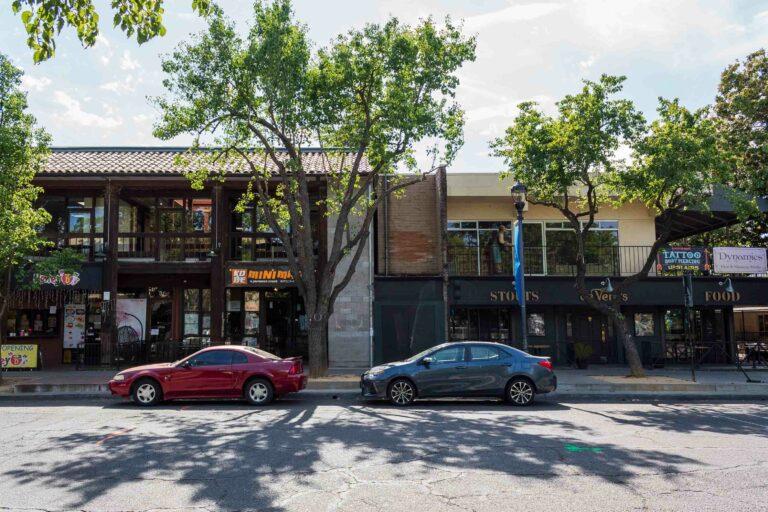
    As school enters full swing, UC Davis students have been descending upon the city of Davis in droves, often going to places in downtown to satiate their appetites. Many students and parents go out for dinner after moving, according to My Burma manager Anne Guidici.

    “We’ve had an influx of students returning to campus,” Guidici said. “A lot of our bigger groups in the past couple of weeks have been parents and students going out to dinner after moving in, or just getting to know the area before heading back to their respective homes.”

    Handheld Davis co-owner Michael Sutton expressed a similar sentiment, stating that foot traffic has gone up for his food truck.  

    “I’m definitely seeing a lot more foot traffic,” Sutton said.  “The majority of our business involves foot traffic. We did just start about three weeks ago, so it’s hard to compare, as we have only really had one week to compare with.”

    Handheld has also benefited from having some local connections, according to co-owner Stephanie Maroney. 

    “The majority of our customers are local Davisites,” Maroney said.  “Michael has worked in food service in Davis for the last 10 years, so a lot of our first customers were people who have supported us in the past and who know us and who have found out about our business from the Davis Enterprise.”

My Burma, on the other hand, has been open throughout most of the pandemic, Guidici explained.

    “We had to make a lot of adjustments for ever changing regulations,” Guidici said. “We stayed as solely takeout for a while, and when the restrictions lifted, we had minimal outdoor dining. But with everything going on with the Delta virus, it’s kind of wishy washy on what we’re supposed to do. Currently we are open as dine-in and dine-out, and we continue to offer take-out, DoorDash and UberEats. We’re just making efforts to reach as many customers as we can.”

    Guidici emphasized the role of friendly service in My Burma’s success, despite the lack of dine-in options throughout the pandemic.  

    “We strive for the friendliest service possible,” Guidici said. “They know all the stations, so if they need to food run, if they need to bartend, they know how to do it. Knowing our cuisine, knowing our full menu, it’s just the staff, the service, the food.”

    The recent good business has inspired My Burma to consider expanding to new locations, according to Guidici.  

    “We are hoping that we can open more locations, not necessarily in Davis, but in Sacramento too, to serve that community,” Guidici said. “A spot in downtown is ideal because it’s closest to the college in Sacramento.”

    Handheld is a small family business, so it has limited hours. Even so, Maroney said that they eventually hope to expand the business’ hours and do more events downtown.  

    “We’re open from Fridays to Saturdays from 11 a.m. to 7 p.m., and we also work with the Davis craft fair,” Maroney said. “We have only done Fridays and Saturdays because it is a family business run only by me and Michael and our kids, so Fridays and Saturdays are the only days that work for us right now.  We anticipate opening more hours in the future and also doing more special events around town; we are excited to work with other small businesses and support different causes in our community and try to just be a good neighbor in downtown Davis.”

    The decision to open My Burma amid the pandemic may have seemed to be a bold move, and Guidici speculated that the owner was very confident about the quality of his cuisine.  

    “I have talked to the owner and he was pretty confident that his cuisine would be popular here,” Guidici said. “Davis is a very diverse place with a lot of very open people who are willing to try different things.”

Written by: Rachel Shey — city@theaggie.org

St. Vincent’s “The Nowhere Inn”: A five star stay

St. Vincent and Carrie Brownstein’s new mockumentary shows us the greatness that follows from creatives coming together and combining their strengths into something new

The mockumentary is a sacred genre, and while “The Nowhere Inn” does honor the art, it definitely blurs some lines with its avant-garde absurdity (that is somehow not pretentious). The film is co-written by and starring Annie Clark (St. Vincent) and her real-life friend Carrie Brownstein, who many might recognize from the TV show “Portlandia” or her band Slater-Kinney. This mind-bending, meta and visually pleasing movie is marketed primarily as a mockumentary in which things go horribly awry when two friends try documenting life on the road with St. Vincent, and while it definitely is that, these creative artists deserve a little bit more credit than that. It’s the kind of absurdity that encompasses the entire movie—as in you never know who’s acting or which version of the story is being seen at any given moment—that takes the weight of figuring out the “deeper meaning” or finding the clues right off your shoulders. 

Clark is almost as talented an actor as she is a musician, which (as is dissected in the film) is not surprising considering how dedicated she is to her ‘persona’ as St. Vincent during live performances, as well as music videos, and her success in creating entirely new eras and aesthetics with each album. Brownstein brings just as much to the performance, being the only one throughout the entire story to question what is really even going on. She goes from being the slightly inconsiderate director/friend desperate for a “more interesting” story to what was essentially a victim of St. Vincent’s metaphysical madness. 

Clark and Brownstein were able to create an incredibly creative and innovative take on what can often become a fairly repetitive genre of movies. The two main facets that made this absurd film a success were the fact that they did not take this artform too seriously — evidenced by it being a mockumentary — and the fact that neither of them completely disregarded one medium for the sake of creating another, in regards to their own artistic backgrounds as a musician and comedian. 

For a movie (or any art form for that matter) to be good, it does not need to be deep or function as a reflection of the state of the world. This is often a danger when creatives come together to create something at such a great scale, but “The Nowhere Inn” avoids the minefield of moralistic or overly-existential tropes by adding just the right amount of self-aware comedy and absurdity to let viewers know not to take it all too seriously. This is not to say the movie has no actual storyline or message, because it certainly does have something to say about the severed identity of the performer, friendship and just generally the dangers of fame, but it does not present these themes as if they were revolutionarily insightful ideas. 

 Clark brought with her the signature “art-rock” aesthetic as well as her amazing live vocals, and Brownstein provided the signature witty and off-the-wall comedy style you might recall from her characters in “Portlandia.” “The Nowhere Inn” functions as a culmination of these two women’s varied strengths and presents the potential of what could be made when creatives work together and are not afraid to combine mediums to make something new. Essentially, this movie has the creativity behind it to make it genuinely fun to watch; Clark, Brownstein and the rest of the great cast felt like they were all being themselves (always a good sign for something that is supposed to resemble a documentary). 

I’d also like to give one final shout-out to Dakota Johnson, for her role as Dakota Johnson in the film—she really did a great job however brief her time on screen. 

Written by: Angie Cummings — arts@theaggie.org

Superstitions, a sports tradition

0

Even though they may not have any effect on the game, superstitions and rituals have always been a huge part of sports

As an athlete, game day is the most important day. These days usually consist of routines that become habits — also known as superstitions and rituals. In sports, these rituals can often seem odd from an outsider’s perspective, but athletes and their fans believe that accomplishing certain repetitive tasks can enhance their performance or else they may face a mental block. Many sport fans and athletes believe that these habits and routines will give them better luck to have a successful competition. 

A ritual — similar to superstition — in sports can be defined as “a certain behaviour or action that a sports performer [or fan] carries out with the belief that these behaviours have a specific purpose, or power, to influence their performance; many sports performers believe that performing a specific ritual before a competition improves the outcome of their performance.” Such performances are normally played out before every single game.

Some of the world’s most famous athletes perform specific routines before a game. Sometimes they prepare weeks prior to their performances — whether that’d be a baseball player wearing his lucky socks, a soccer player blessing themselves before stepping foot on the pitch or a basketball coach chewing on a towel. 

That is to say, baseball is one of the sports with the most superstition. According to Deborah Minter, a writer from “How They Play,” there are as many superstitions as there are baseball players. Every baseball player has their own unique rituals. Some common ones include never stepping on the chalk lines, never talking about a ‘no-hitter’ or ‘perfect game’ when a game is in progress, using repetitive batting stance and using lucky bats and gloves. 

Notoriously known for having numerous superstitions was Wade Boggs — also known as ‘Chicken Man’. Boggs played for the Boston Red Sox as a third baseman in the 1980s and 1990s. Before every game, he ate large amounts of chicken which led him to become the author of a poultry cookbook titled Fowl Tips. He also wore the same socks on every game day, and he fielded exactly 150 ground balls at every practice.

 These rituals eventually propelled him to the National Baseball Hall of Fame during his 18 year career, and he firmly believed it was because of his daily routines. Boggs famously said during one of his speeches, “Believe me, I have a few superstitions, and they work.”

Not only is the world of baseball filled with superstitions, but so is tennis. One of the world’s most famous tennis players, Rafael Nadal, is said to have 19 superstitions which begin as soon as he enters the court before the start of the game. These habits are almost like step by step guide on how to be a great tennis player. Nadal insists on not calling them superstitions, but rather mechanisms to help him focus. 

Nadal always enters the court with a single racket in his hands, makes sure the logos from his water bottles are facing the court and before his games, he takes freezing showers. “I do this before every match,” writes Nadal in his 2011 autobiography about his showering ritual. “It’s the point before the point of no return. Under the cold shower I enter a new space in which I feel my power and resilience grow. I’m a different man when I emerge. I’m activated. I’m in ‘the flow’.”

Athletes are not alone when it comes to superstitions. As for sports fans, once they become invested in a team, they believe they have the power to control the outcome of any competition.

For example, various types of ritual activities have been developed by fans, such as wearing team colors and celebrating patriotism at international games by decorating their bodies with national flags.

Many fans of the NFL admit to sitting in the same spot the entire game, eating the exact same foods during every game and wearing a lucky outfit. These routines seem intense but with a season so short, NFL fans believe every game is crucial and by committing to these rituals, their NFL team could possibly win. 

Anirudh Shenai, a fourth year cognitive science major at UC Davis and a fan of the English soccer team Arsenal has superstitions.

 “My big superstition is, [before they play against] Chelsea, I will never google ‘Chelsea vs. (opponent)’ for team news. NEVER. Everytime I did that, Chelsea lost,” Shenai said. 

Many people tend to develop superstitions when they are under a lot of pressure — especially in high levels of competition — because it reduces anxiety. Within a sport, superstitions have been shown to reduce tension and provide a sense of control over unpredictable, chance factors. 

What this comes to show for athletes is that superstitions can provide reassurance and help reduce anxiety. Without these daily routines, athletes wouldn’t have the comfort to guide them in every game so that they can perform to the best of their ability. 

Written by: Katherin Raygoza — sports@theaggie.org

Fire broke out at a house near Cambridge House Apartments in Davis

Nobody was hurt or injured

On Sept. 24, a fire broke out near Cambridge House Apartments, according to a post by the City of Davis Fire Department (DFD).

“Last night at 10pm Davis Fire responded to a structure fire on Adeline Place,” the post reads. “The fire was quickly upgraded to two alarms due to its size and potential for spread to nearby structures.”

The post added that the fire was able to be contained.

“DFD, with support from @westsacfire, @ucdavisfire and @woodland_fire were able to contain the fire and prevent serious damage to surrounding structures,” the post reads. “No injuries to firefighters or civilians were reported and the cause is currently under investigation.”

Brionne Kirkwood, a fifth year animal science and management major, was at her friend’s house at the time the fire broke out. They got a bang on their door around 10 p.m..

“We walked outside and everyone was running around frantic, and we’re like ‘what’s going on?’” Kirkwood said. “This girl yelled out ‘there’s a fire!’, and I was like ‘where?’, and we turned around and it was right behind the apartment. There was the Cambridge House Apartments, and there was this big hedge, and then the fire was on the house right next to the apartment.”

Soon after, everybody was told to evacuate.

“We were told to evacuate immediately, not even by the apartment but by residents that lived there,” Kirkwood said. 

The situation lasted about one and a half hours, Kirkwood stated.

“I think the firefighters stayed at the house though — they stayed at the house all night — to make sure nothing else sparked I guess,” Kirkwood said.

Kirkwood later received a text letting her know that nobody was injured.

“Thankfully I got a text that the residents were okay, and the people and the neighbors, everything was okay,” Kirkwood said. “They evacuated, no one was hurt. The inside of the house was probably pretty bad. I don’t know how it started though, they just said everyone was okay and that was what I was kind of worried about.”

Despite the suddenness of the fire, nobody was hurt.

“Just a freaky thing to happen on a Friday, literally right next to the apartment,” Kirkwood said. 

Written by: Shraddha Jhingan — city@theaggie.org

Third season of UC Davis podcast ‘Unfold’ features curiosity-driven research

The new season dives into exciting research happening at UC Davis and offers a hopeful perspective on today’s science world

After a year and a half of increasingly disheartening science news — from pandemic coverage, to wildfires, hurricanes and other environmental catastrophes — the third season of UC Davis’ podcast “Unfold” seeks to offer a more hopeful outlook on the science world by featuring “curiosity-driven research” happening at the university.

According to a UC Davis press release announcing the new season, the first episode was released on Tuesday, Sept. 28 and tackles the question, “Why do songs get stuck in our head?” Episodes will continue to be released weekly through Nov. 23.

Amy Quinton, the manager and host of “Unfold,” explained that the podcast was built around the idea of the “pillars” of what makes UC Davis great. Among these include food and agriculture, sustainability, global health and research. The first two seasons covered the first two pillars, but plans for a third season centered around global health were halted when COVID-19 came into the picture. 

“We were going to do health this season, but I think after the pandemic, people really wanted a break, so hopefully we can tackle health next season,” Quinton said. 

Instead, they shifted the focus to what they call “curiosity-driven research.”

“We want to showcase UC Davis expertise and research,” Quinton said. “Curiosity-driven research, it’s sort of a large bucket — social science, engineering, earth and planetary sciences, history and so on.” 

The press release dove further into this concept and how it will be showcased in future podcast episodes. 

“Curiosity can lead to some of the greatest discoveries, like why songs get stuck in your head or what real-world engineering concepts you can learn from comic book superheroes,” the press release reads. “This season, we examine an archaeological discovery that raises new questions about the sexual division of labor in early hunter-gatherer societies. UC Davis researchers reveal what they found by peeling back the layers of a fish’s eye and by studying cute, pink, baby-faced axolotls.”

Kat Kerlin, the co-host for “Unfold” seasons two and three, has a career largely focused around environmental journalism and reporting on climate change. Kerlin said that for her, this season was a welcome break from often dismal environmental coverage. 

“I love covering climate change, but it’s a downer, and it’s been so refreshing to look at some of the other stuff happening at UC Davis,” Kerlin said. “It’s not COVID, it’s not climate change, it’s just the wonder and the excitement of life. These people are at the top of their field — they’re experts — but we also had a lot of fun.” 

Crystal Rogers is one of the experts who was interviewed for the podcast. Her lab focuses on “the molecular mechanisms that control early development in vertebrate embryos,” including the embryos of axolotls, a type of salamander. In her episode, Rogers talks about one Twitter-famous axolotl in particular: Chonk. 

“I had a bunch of little tadpoles, and Chonk was just so much larger than the others so quickly — she kind of ate one of her siblings, so we had to separate her,” Rogers said. “And then I tweeted about her, so she really took on a life of her own, and it honestly helped me to get through the pandemic.” 

Rogers went on to describe the experience of being interviewed for an audio medium.

“It was kind of interesting because I’ve been interviewed by video before, but this time, I had to think about how I could show the sounds that the animals make and how I could be descriptive with my words instead of showing what we do with the animals,” Rogers said. 

Quinton, who has extensive experience working in public radio, explained her take on the unique benefits of using audio mediums to tell stories. 

“Ira Glass, who is the host of the podcast ‘This American Life,’ said that ‘audio is the most visual medium,’ because it allows you to create images inside peoples’ heads,” Quinton said. “You can hear peoples’ emotions, and you really can’t in print.” 

She went on to emphasize that podcasts in particular also offer flexibility in terms of length. 

“In public radio, you might have three minutes for your news story,” Quinton said. “Science stories are really complicated. There’s a lot to unfold, which is where we got our name from.” 

Kerlin said that more than anything, she hopes that the podcast is a refreshing and inspirational break from the challenges of recent years.

“We made this podcast because we needed this, and we really thought maybe everybody else needed this too,” Kerlin said. “Of course we need to know about these things, these huge life-threatening things, but we also need to hear about our amazing, beautiful world.” 

Rogers added her thoughts on the importance of the project and podcasts as a whole. 

“I think one of the things we recognized through the pandemic is that scientists don’t always do a great job of communicating with the public, and so multimedia platforms are really necessary to communicate our research and what we’re doing,” Rogers said. 

Kerlin offered some final reflections on the frequently dispiriting reality of science journalism and how “Unfold” is a reminder that science can also be a beautiful, heartening and curiosity-driven place. 

“I look at the world differently because of my work, and it can be good and bad,” Kerlin said. “I guess the way I cope with it is […] by talking to other people, to scientists who are trying to figure out the problem and how to fix it. It helps me to see all of the people who are trying to help. It feels like it’s important, and I like being a part of that.”

To Rogers, curiosity-driven research is at the heart of what science is all about. 

“I love the allure of answering questions that no one has the answer to,” Rogers said. “And that’s what science is. Yes, there’s a lot of pressure in this career to discover something, but really it’s about the joy of discovery.” 

Written by: Sonora Slater — science@theaggie.org

Chancellor Gary May speaks with ASUCD senate about new school year

ASUCD held a special session to discuss with May the resources and plans for students this year

The senate met in person at the Memorial Union for a special session dedicated to Chancellor Gary May and his messages to campus.

This special session was called to order at 5:46 p.m.

ASUCD Vice President Juliana Martinez began the special session with the UC Davis Land Acknowledgment.

The senate moved for an interim senate president pro tempore election, where an interim senate president is appointed. Senator Kabir Sahni was confirmed for this position with no objections.

 The senate called a five minute break while awaiting the chancellor’s arrival.

At 5:54 p.m., May arrived, and the session was called back to order.

May began his presentation by sharing his excitement for the upcoming year. He attributed many of the successes this past year to ASUCD.  

“Your leadership has been crucial to our success,” May said. “You give voices to our students, make sure they’re a part of the governance of the campus.”

May acknowledged ASUCD’s participation in the Healthy Davis Together Initiative which has been recognized by the New York Times and NBC News as a potential guiding program for other universities.

He gave updates on the current state of COVID-19 on campus.

“We’ve conducted more than 460,000 tests of asymptomatic people in the Davis community since September 2020,” May said. “The positivity rate has been consistently below 1%.”

Next, he discussed the Aggie Public Health Ambassadors located around campus responsible for checking symptom surveys at highly-trafficked buildings across campus. May informed the senate that there are still positions open on Handshake for health ambassadors.

He then spoke about the record admissions statistics from the past year, noting that the university saw a 12% increase in freshman admissions. He also celebrated the high rankings UC Davis has received in the recent weeks from Forbes, and U.S. News and World Report.

Next, May expressed the importance of the UC Davis Principles of Community.

“These values foster a community of belonging and vibrancy,” May said. “They reinforce our commitment to diversity and inclusion.”

May then discussed the three task forces that have been put in charge of affordable housing, food insecurity and mental health. These challenges can be addressed at the Aggie Basic Campus Needs Center located inside of the Memorial Union.

“When it comes to food insecurity, there’s no better support on campus than the ASUCD Pantry,” May said.

Next, May spoke about the current construction projects happening on campus.

“You might have heard that UCD now stands for: under construction daily,” May said.

An estimated 4,300 beds have become available to students in recent housing projects including Shasta Hall and The Green. May stated that UC Davis is close to being able to house half of the student population.

May then provided an outline of upcoming events on campus including sporting events, the first performance at the Mondavi center in 19 months and the 2020 commencement ceremony. 

“We haven’t forgotten about the class of 2020 which had commencement postponed due to the pandemic,” May said. “That class will have a make-up celebration planned for December 10.”

The chancellor then fielded questions from the senate.

The first question addressed safety concerns on campus due to the high number of students.

“There is quite a bit underway,” May said. “One example is more blue lights you can see at night. The goal is to put enough of those so that anywhere on campus you can see one from where you are standing.”

The next question expressed concerns about international students and the percentage of students able to attend classes in person after a year and a half online.

“I don’t have a percent definitely yet, but what I can say is that we have not had a great deal of concerns expressed from international students,” May said.

He added that if any students did not have access to a vaccine in the country they were living in, then they were vaccinated upon arrival in Davis.

A senator then asked about the location and shortage of health ambassadors. With their placement only in highly-populated areas, the senator was concerned about the possibility of students purposefully avoiding the daily symptom survey.

May said that they are hiring more staff for the public health ambassador program, and he encourages all students to adhere to the safety protocols available on campus.

May then addressed a question about students’ basic needs on campus. According to May, to break the stigma of asking for help, the Aggie Basic Needs Center is centrally located so it is easy to find and access. There are also initiatives underway that work to eliminate food insecurity at UC Davis.

Next, May responded to concerns about the over admission of students and the impacts this may have on class sizes.

“Making the class larger is not always the pedagogical thing to do,” May said. “So, I think more sections and bigger sections is the approach.”

A senator asked about the resources that are being provided for LGBTQ students on campus as they return from being distanced from their peers.

May responded that there is the LGBTQIA Resource Center which provides support, and a dozen more positions have been approved in counseling and psychiatry to address mental health and suicide. UC Davis has also been developing more telemental health resources that are available to students. In response to a similar question later on, May added that UC Davis counseling services are covered by campus-approved health insurance plans.

The next question regarded the diversity and inclusion initiative and how they are supporting new students.

“There’s literally dozens of things that the Diversity Equity and Inclusion office is working on right now,” May said. “The antiracism syllabus is a pretty big initiative, there’s a number of events that are being planned for all different demographics within the institution.”

A senator asked about parking on campus and how the administration plans to accommodate students who do not have access to the necessary technology for reserving parking.

May stated that there are some accommodations in place for students without smartphones although he is not certain what they are. 

In response to a question about the price of new student housing and how administration will make it more affordable for students in the future, May said that as more supply is created, they project prices will go down.

The final question was about how the administration and ASUCD can work together to communicate more efficiently to better support the UC Davis student population.

“I meet with your leadership regularly,” May said. “If you want something more than that, I’m certainly happy to come to these meetings as often as you’ll have me, as well as my team.” 

The meeting was adjourned at 6:32 p.m.

Written by: Emily Redman — campus@theaggie.org

Cotton totes do not solve the plastic bag problem

Collecting cotton tote bags is not as eco-conscious as you think

Plastic bag bans are becoming more common worldwide, which is a change for the better. It’s a wonderful thing that we are slowing their spread, since plastic bags dispense endless amounts of forever-around plastic particles into the environment. With the litany of problems our environment is currently facing, I am proud of how parts of the world have mobilized over about two decades to pivot away from the mass use of plastic bags. Still, some of our current innovators have taken the goodwill from the changes a few steps too far. 

One of the most trendy replacement options for the traditional plastic bag is the tote bag, and while decidedly not plastic, they aren’t the be-all-end-all solution to carry things around in an eco-friendly way. Tote bags have their upsides, but it’s not all sunshine and rainbows, so make sure to think a little longer when savvy businesspeople and clever marketers are trying to thrust them into your hands at any and every opportunity.

While the plastic bags that hold groceries at the convenience store or food at the take-out restaurant don’t biodegrade, they don’t drastically affect our environment because little energy and resources are used to create them. Technically called low-density polyethylene bags (LDPE), if you use them for your food and then once more for your waste before disposing of them correctly, the impact they have on the environment is low (a correctly disposed of LDPE bag is incinerated). 

On the other hand, most tote bags, depending on material, are far worse for the environment because of the resources used to create them as well as the difficulty to recycle them. Organic cotton tote bags, the most trendy and “green” option for tote bags, are the worst of all common tote materials. You need to reuse an organic cotton tote 20,000 times for its creation to be better for the environment than just using plastic bags (normal cotton is 7,100). Cotton uses so much water and labor that it’s not efficient for bags, and the fact that cotton tote bags aren’t compostable doesn’t help (unlike green single-use bags or many brown paper bags).

In addition, most cotton tote bags are a lot less recyclable than they let on, especially when they work as fashion statements. The actual bags themselves are usually recyclable. However, every single drop of dye pressed into each bag hurts their recyclability. The logo-covered flashy tote bag that inflates its carrier’s ego to the max is probably covered with so much ink that most of it goes straight to the trash bin. Recycling cotton is so inefficient that it’s almost as good for textile mills to start from scratch in the first place, so as far as impact goes, maybe they should head to the rubbish anyway (please recycle them if you can, some reuse is always better than none).

Sadly, businesses aren’t going to be part of this solution. “Green” bags are great for the company image, and totes are basically walking billboards. The value a company gets from a person toting around their organic cotton bag (20,000 times reused, otherwise inefficient) is so much that any marketer worth their salt will be begging for customers to take them. This problem is not getting any smaller.

We are stuck choosing the lesser of two evils. The best piece of advice I can give is to stop taking or accepting more bags and reuse the ones you already have. Nobody needs a tote bag for every outfit (lots of people have totes they never use, which is the worst), and maybe next time you are in line at checkout, think twice about whether you need a bag or bags for your items. Try and make do with all the bags, plastic, cotton or any other material you already have, and avoid taking more. Until there is an awakening and the bags used by the mainstream are plant-based and undyed so that they can be thrown into the compost at the end of their lifespan, there is no greater option than carrying your groceries in your own hands.

As a last aside, I wanted to put this issue into perspective and note that every small lifestyle change a person can make does have an impact in the world, so there is more action anyone can take in addition to forsaking their massive tote bag collection. If you are trying to lower your impact on the environment even more, something like electing to bike instead of drive or forgoing airplanes whenever possible will make a much larger dent in your emissions. To make a long story short, doing the little things to help the environment does add up, and reusing bags as many times as possible before disposing of them correctly is a very easy way to make a positive impact.

Written by: Alex Motawi — almotawi@ucdavis.edu

Disclaimer: The views and opinions expressed by individual columnists belong to the columnists alone and do not necessarily indicate the views and opinions held by The California Aggie.


Consider getting a flu shot this fall

0

College campuses are especially vulnerable to flu outbreaks, so protect yourself and others with a flu shot

Flu vaccines should be a routine part of every autumn, like pumpkin spice lattes and flannel sweaters. But this year, flu shots are even more important than usual, since last year’s flu season was practically nonexistent due to social distancing and other pandemic precautions. Many people’s immune systems are out of practice when it comes to the flu, so all UC Davis students and staff should consider getting the safe and effective flu shot in order to keep our campus healthy. 

Even during normal flu seasons, influenza can spread rapidly through college campuses due to high population density in the dormitories, lecture halls, cafeterias and sporting events. This is exacerbated by the fact that less than half of college students in the U.S. get yearly flu shots. 

Flu symptoms typically last from five to seven days, which means a week or more of missing classes, tutoring and club meetings. In the quarter system, it would be incredibly difficult for a student to make up for missing that much material. People shouldn’t have gone to school sick before the pandemic, but now sick individuals won’t be able to access campus at all without lying on their Daily Symptom Survey for that day, which they shouldn’t do. Even if it’s not COVID-19, students shouldn’t come to school sick.  

Wearing face masks indoors, being honest on Daily Symptom Surveys and washing hands frequently are all helpful in decreasing flu transmission on campus, but the best way to reduce the likelihood of catching and spreading influenza is by getting a flu shot as soon as possible. Nobody wants to miss a week of school or infect their entire friend group, so get a flu shot if you’re able to — I got mine last week. 

Written by: Eden Winniford — opinion@theaggie.org

Disclaimer: The views and opinions expressed by individual columnists belong to the columnists alone and do not necessarily indicate the views and opinions held by The California Aggie.

California Institute of Regenerative Medicine awards funding for UC Davis research to cure Angelman Syndrome

Angelman Syndrome is a rare neurogenetic condition that leads to developmental delays and motor and speech impairments

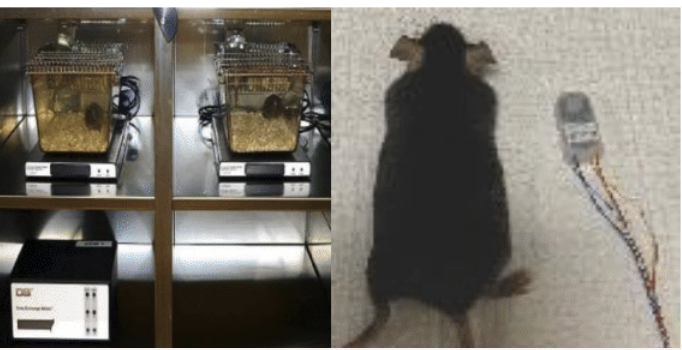
The California Institute for Regenerative Medicine (CIRM) recently awarded David Segal, a professor from the Department of Biochemistry and Molecular Medicine at the UC Davis School of Medicine, with the Discovery Stage Research Project (DISC2) award for his research on a rare neurogenetic disease called Angelman Syndrome. 

CIRM’s unique and competitive Quest Awards Program promotes the “discovery of promising new stem cell-based and gene therapy technologies that could be translated to enable broad use and ultimately improve patient care,” according to their website. For Segal, this grant is crucial in facilitating the translation of his research — along with the collaborative efforts of the labs of Jill Silverman and Kyle Fink — from the lab bench to the patient bedside for a disease with no current treatment in place.

Silverman, a professor in psychiatry and behavioral sciences at the UC Davis Mind Institute, described the rarity of the Angelman Syndrome.

“The Angelman Syndrome is a rare disorder that occurs in about one in 15,000 to 20,000 births,” Silverman said. “When you combine them, the overall effect becomes one in 7,000. Altogether they’re not actually rare anymore; they’re common. And the key is we just have to figure out one cure that we hope will be able to help.”

For a disease that is rare, yet occurs frequently enough to demand attention, Segal, Silverman and Fink set out on the forefront of gene editing technology to find one cure that may pave the way for finding cures for other rare diseases. 

Angelman Syndrome is a rare condition that leads to severe developmental decay, motor impairments, difficulty with ambulatory movements and emulation of speech due to the loss of ubiquitin ligase E3A (UBE3A) gene expression in the brain. To restore such gene expression, Segal and his colleagues are employing a cousin of the CRISPR-Cas9 gene editing technique widely used in mouse models to be translated in clinical therapy. 

“We are using a member of the CRISPR-Cas family, and many people have heard of CRISPR-Cas protein as a nuclease that edits DNA, and that’s mostly done with the so-called Cas9 proteins,” Segal said. “We’re using a cousin of that, the Cas13, and instead of working on the DNA, it looks to target a piece of RNA. There’s an RNA that’s kind of holding that gene back from being expressed so if we could target that RNA with the Cas13, we think that UBE3A can then be turned on and expressed in the brain.”

Fink is an assistant professor in the UC Davis Department of Neurology, and his lab specializes in translating what Silverman and Segal test in mouse models into usable technology in potential clinical trials. Testing the gene editing approach Segal has delved into, Fink is working with pluripotent stem cells to be turned into neurons for patients with the Angelman Syndrome.  

“We’ve been working with the stem cells for a while and understanding the duration of how long we have to maintain them and what are the necessary factors to push them into neurons,” Fink said. 

Segal expressed gratitude for a grant that is difficult to come by: the $1.4 million, which the three labs are trying to receive in order to fund the Angelman Syndrome project.

“CIRM is a special resource that we have here in California that just really supports stem cell research,” Segal said. “In this latest version, they are also supporting gene therapy as well, so they’re really focused on translating these kinds of molecular research and molecular therapies to treating diseases in California and across the world. We applied to that and were ranked as the top grant in the state in that category across over 100 grants.”

The future for Angelman Syndrome and gene editing technology is ever evolving. Silverman echoed these sentiments in her work with her colleagues as an opportunity to inspire other companies and researchers to support research for rare diseases like Angelman Syndrome.

“The idea and enthusiasm around gene editing and gene-based therapies and stem cell-based therapies is that we sort of just need one success story,” Silverman said. “Things aren’t so easy as copy-paste or copy and replace, but if […] we’re able to get one, which we have one molecular therapy now in a clinical trial, that’s a success story for one rare disease. There’ll be one in 7,000 people, as opposed to one in 20,000 people. And that paves the way for all rare disorders and many neurodevelopmental disorders.”

Written by: Brandon Nguyen — science@theaggie.org

Kicking off on the right foot

Almost halfway through conference play, the UC Davis women’s soccer team has already surpassed their win total from 2019

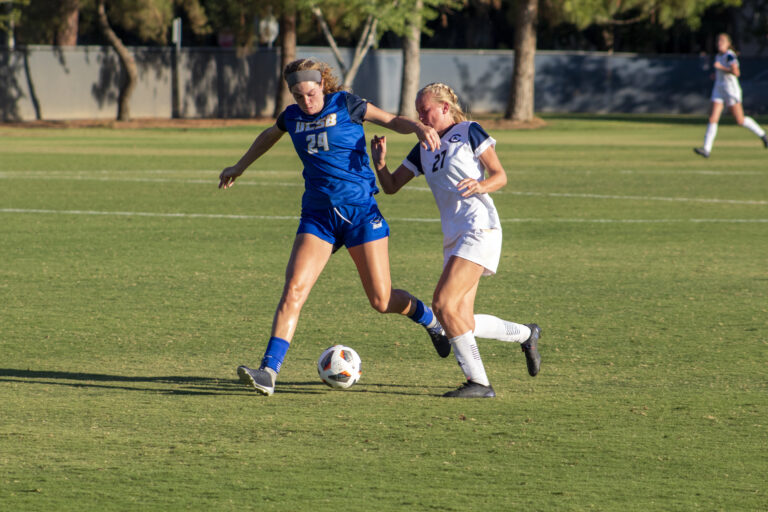
In her third year at UC Davis, head coach Tracy Hamm and her women’s soccer team have enjoyed success early on. Already surpassing the win total from 2019, the Aggies have had their fair share of great results thus far. With a current record of 8-4, this young team has its eyes set on something bigger as they tread their way through conference play.  

“I think we’ve just been really consistent and tried to focus on establishing a winning mentality,” said Hamm. “With a young team, you really want to try and get as much experience on the field as possible and learn how to win games. So far we’ve done a good job.” 

Having had their 2020 season canceled due to COVID-19, their first game in almost two years came at the Las Vegas Invitational against the University of New Mexico on August 19 — a game in which they held onto a narrow 1-0 win. Their second game of the invitational was against the host UNLV, and despite falling in a 3-0 deficit, the Aggies clawed their way back to make it interesting, scoring two goals in the second half to cut into the Rebels’ lead. Unfortunately for UC Davis, they would come up just short, but the resounding takeaway was the grit of the young team — which consists of only three upperclassmen — to never quit. 

Coming home for their first games at Aggie Soccer Field, UC Davis took on New Mexico State on Aug. 27. After conceding an early penalty, the two teams went back and forth before a second goal put them away for good. On a quick turnaround just two days later, they hosted once again, this time against the University of Texas, El Paso. Jumping out to a 2-0 first half lead, the Miners from El Paso stormed back to tie the game. But, a late rebound and putback by freshman forward Emma Vane in the 80th minute gave the Aggies their second win of the season.

After a pair of road games against Boise State and Idaho State — games they split — they rapidly approached Big West Conference play. A home Causeway Classic against Sacramento State on Sept. 12 awaited them however, and as expected, the game was hard fought. After opening the scoring in the 35th minute, the Aggies held on to win against the rival Hornets, setting up their final non conference game in Moraga, CA against Saint Mary’s. In a game that saw Saint Mary’s take the lead in the first half, time was running out late for the Aggies. Yet, as they had shown time and time again, the upstart Aggies scored two goals in the final 16 minutes to flip the score and hold on to the big win. 

Entering the season ranked 8th in the Big West preseason coaches poll, not much was expected from UC Davis. After winning just two conference games in 2019, the program had not had a lot of success for a couple of seasons. Starting conference play on the road, their first test came against the Cal State Bakersfield Roadrunners in Bakersfield on Sept. 23. A pair of first half goals from Vane and sophomore scorer Leslie Fregoso proved to be all the Aggies needed, as they started conference play with a bang. Just a few days later, UC Davis went into Northridge to face Cal State Northridge. After a scoreless first half, the second saw a goal scoring barrage from both sides. Although Northridge made two, the Aggies responded with four of their own, winning by a final score of 4-2.

The conference home opener came against a powerful Big West opponent, the Santa Barbara Gauchos — who were tied for third in the preseason poll. Regulation proved to not be enough for these two, as they moved to overtime in a back and forth matchup. But, the Gauchos capitalized a little over midway through the first overtime with a powerful shot that made its way in, spoiling the Aggies’ home opener. 

Although the loss stung, the team had no time to dwell on it, as they hosted the leader of the conference, the Cal Poly Mustangs. Once again, Aggies pounced on the opponent in the first half and kept that momentum going, as a brace by sophomore Risa Yamada gave them a 2-0 shutout win, putting them tied for 2nd in the conference table, only behind the favorites Long Beach State. 

With six games remaining before the conference tournament, UC Davis has their work cut out for them if they want to make their first postseason in the Tracy Hamm era. The team will travel to Southern California to play away games against Cal State Fullerton and UC Riverside, on Oct. 7 and 10 respectively. From there, they will come back home to Davis to play the leader in the Big West Long Beach. In the highly anticipated matchup, the home field advantage factor could be the determining factor in this game between highly ranked teams. On Oct. 17, the team will once again visit Southern California as they will play in Irvine against UC Irvine, before returning home and finishing the regular season against Hawai’i and UC San Diego on Oct. 21 and 28 respectively.

“At this point in the season, it’s not really about tweaking anything, it’s about trying to get injured players back on the field and staying healthy,” said Hamm. “We’ve had to move a lot of players around and look at different tactics based on injuries. Just trying to make sure we stay as healthy as possible and get as much rest as we can.”

Looking to get back into the Big West Tournament for the first time since 2018, this Aggies team has new life that has propelled them to their success thus far. As a young team, they are continuing to build confidence as the season progresses, and with the hope of key players returning from injury, their hopes to make a deep run could come to fruition. Yet and still, the Big West is once again proving to be one of the better conferences, and the Aggies will need to continue to improve in their final six games in order to have a chance. 

Written by: Omar Navarro — sports@theaggie.org