55.7 F
Davis

Davis, California

Monday, December 22, 2025
Home Blog Page 263

Commentary: The worst Academy Awards decisions over the years

0

With viewership on the decline, here’s a look into some of the Academy’s past oversights and mistakes

Viewership of the Academy Awards has hit an all-time low in 2021. Just 9.85 million live viewers tuned in, a decrease of 59% from 2020, which was already the low point in Oscars viewership since the turn of the 21st century. Reasons are legion—studios delaying notable releases due to COVID-19, the strange closed-off feel of the ceremony (also partially a product of COVID-19) and, maybe most importantly, a general decline in the number of people who want to watch millionaires pat themselves on the back for making substandard movies.

The decisions made by Academy voters have always trended toward dubious. As of 2021, there are more than 9,300 eligible Academy Awards voters, and to this day, there remains no requirement that voters actually watch the nominated films. 

While there’s no way to know if voters watch the movies they vote on, we do know for a fact that they’ve routinely shut out brilliant foreign and independent films pretty much from the Awards’ inception in favor of things like “Crash” (2004). Here are a few memorable decisions:

“Crash” Winning Best Picture: Have you ever seen “Crash”? No? Good. It’s melodramatic, self-fellating and imbued with the quiet subtlety of a Cannibal Corpse album. But the Academy deemed it deserving of three awards, even beating out the much better films of “Brokeback Mountain” (2005) and “Capote” (2005) for Best Picture. “Crash” (2004) also took the title of the far more challenging and interesting “Crash” (1996), which is perhaps worse than the film winning Best Picture.

Neither Alfred Hitchcock Nor Orson Welles Winning Best Director: The Academy Awards never recognized two of the most influential and virtuosic American filmmakers to ever live for their talents. If that doesn’t tell you something deep and dark about the Academy Awards, nothing will. While Welles at least won Best Screenplay for “Citizen Kane” (1941) despite being snubbed of all eight other nominations for that film, Hitchcock never won anything. 

Any of These Getting Nominated For Anything—“Patch Adams” (1998), “Suicide Squad” (2016), “Norbit” (2007): Terrible, terrible movies. Seemingly getting a wide release is enough to put your film into the same echelon as classics of cinema regardless of how inept and actively lamentable it may be. There is nothing redeeming about any of these movies and they should all burn.

“Going My Way” (1944) Over “Double Indemnity” (1944) for Best Picture: “Double Indemnity” is a veritable masterpiece, rich and nearly flawless and armed with some of the most memorable characters in noir. “Going My Way” is whimsical and unchallenging. But of course “Going My Way” somehow won best picture, which at this point in the list should not be surprising.

The Existence of the Best Foreign Feature Category: When your award system is designed so that the absolute best movies from around the world are more or less sequestered into one little category and in all but the most extreme cases (like the 2019 film “Parasite”) excluded from the competition for Best Picture—and allows despotic governments to choose what films are even eligible—something has gone wrong. In the case of the Academy Awards, it may well be by choice that movies are suppressed simply for being made in another country—American viewers typically don’t watch many foreign films, so allowing these great movies into proper competition would likely hurt interest in the ceremony. But if the Academy Awards aren’t designed to select the best movies then why does anyone care?

It’s tough to say what the future of the Academy Awards will look like. If viewership trends are anything to go by, interest in the ceremony is dwindling, and without the expectation of other eyes on the Awards, there’s little reason for anyone to tune in. The real test will be next year’s awards, probably. If viewership bounces back, the Oscars may retain their cultural importance. That is, however, a big if.

Written by: Jacob Anderson — arts@theaggie.org

UC Davis students and staff voice concerns over Accellion nationwide cyber attack

0

Recent breach of private information leaves many UC Davis employees and students in a state of paranoia and questioning if their private information is truly confidential

The entire UC system, including UC Davis, fell victim to a nationwide cyber attack in which there was a breach in the private information of many employees and students. On Wednesday, Mar. 31 2021, the UC system released a statement and sent an email to the UC community regarding the Accellion cyber attack and the precautions students should take in order to protect themselves. Potential stolen private information include students’ names, birth dates and social security, as well as bank account information.

The UC advises students to sign up for a free, one-year credit monitoring program, Experian IdentityWorks, courtesy of the UC system. Experian IdentityWorks helps protect students’ and employees’ private information by notifying them if their social security, phone number or email addresses are published on the dark web. 

Marlem Reyes, a second-year biological sciences major, expressed her concerns regarding these findings. 

“I do not think the Accellion cyber attack was properly addressed; a lot of students found out through social media,” Reyes said. “The email sent to us did not thoroughly explain the situation and its consequences. [It] lacked accountability for them not having appropriate security measures in place to protect our private information, including my email and social security.”

To ensure the security of private information, UC Davis officials advise students to take precautions such as watching out for suspicious emails, monitoring bank alerts, placing a credit fraud alert and considering a free credit freeze. 

Andrea Medina, a third-year Chicana/Chicano studies major and student employee for UC Davis Student Housing and Dining Services raised concerns over the fact that individuals have to take it upon themselves to handle the UC system’s mistakes.

“I had to call Experian, my bank, social security and the credit bureau,” Medina said. “I pay all this money, and I expect my privacy. The UC system just informed us and expected us to handle everything on our own. It’s not fair.” 

The Accellion cyber attack is still under investigation, so further information has not yet been released by the UC. Students and staff still remain unsure of the measures being taken to ensure that this will never happen again. 

Many members of the UC community have expressed their concern that one year is an insufficient amount of time for free credit protection and have started a petition that demands free credit monitoring for life from the UC system. This petition has over 6,000 signatures and counting.  

UC Davis students shared similar sentiments to the creators and signatories of the petition.

“The University of California should make sure the program Experian is life long, not just temporary,” Antonio Fernandez-Arias, a second-year clinical nutrition and Chicana/Chicano studies double major said. “This is not going away, information is out there now, and the least the institution can do is extend this program.”
Written by: Emmanuel Fonseca — features@theaggie.org

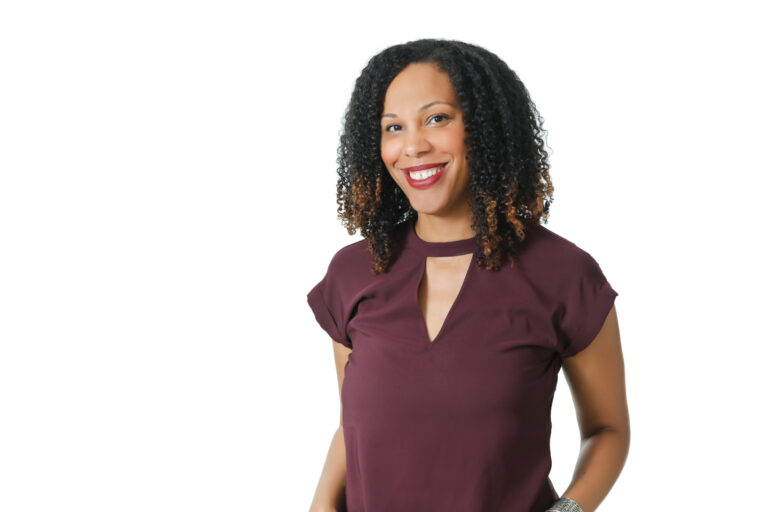
Dr. Theanne Griffith, principal investigator at the new Griffith Lab of the UC Davis School of Medicine, shares her story

A researcher, author and mother explains the educational path that led her to publish children’s books about science

In the labyrinth of overcrowded lab offices that is the fourth floor of Tupper Hall, there is one more lab squeezed in: the Griffith Lab. Dr. Theanne Griffith is one of the newest faculty members in the Department of Physiology and Membrane Biology at the UC Davis School of Medicine. Her new lab is devoted to determining the molecular and cellular mechanisms of the transmission of thermal sensation in the body. 

Griffith’s interest in science, like so many other scientists, began in high school when she was taking AP Biology. 

“I was first introduced to the world of neuroscience as a junior in high school. It was, believe it or not, the sodium-potassium pump and action potentials that did it for me,” Griffith said. 

Her introduction to neuroscience led her to earn a double major in neuroscience and Spanish at Smith College. Throughout her undergraduate degrees, Griffith was able to participate in research thanks to an underrepresented science student’s scholarship. 

“It was a pretty new program at the time. I was able to then train in work-study hours in the library or something like that with actual time in the lab. So I got paid work-study/financial aid in order to do this work [in the lab],” Griffith said. 

After earning her Ph.D. in neuroscience from Northwestern University, Griffith moved to Columbia University to be a postdoctoral researcher. While working full time as a researcher, Griffith decided to pursue another childhood ambition: to become an author. 

“I’ve always really loved storytelling. I’m an only child and I tell stories in my head—I’ve always been a storyteller,” Griffith said. 

Griffith recalled being asked by a high school teacher what she dreamed of doing, to which she responded, “I want to write a book that will be in Oprah’s book club!” 

While on maternity leave with her first child, Griffith decided to write her first book. Griffith’s passion for science inspired her to write children’s books encouraging children to go into science. To date, there are now three books in her “Magnificent Makers” series with two more books set to come out in the next year. The books are designed to encourage children’s scientific curiosity and inspire them to work toward becoming scientists. Importantly, Griffith chose to feature children of color as characters in the books, as she felt that it was important for children of all backgrounds to see that they could achieve their scientific dreams. 

“When I was a kid, most of the books that featured Black voices were about racism or slavery or pain or something like that, which are important but not the full story. We are more than that,” Griffith said. “People see the importance of these books to the community, to future little scientists, that we can create a more inclusive diverse representation of what a scientist can be.”

As Griffith transitioned to her new position as an assistant professor at UC Davis, it was important to her to be able to continue writing these books and supporting the scientific community. UC Davis, having recently been ranked a leader in diversity, continues to support Griffith and her efforts to create a diverse and inclusive image of science. 

In fact, the diversity and inclusion of the Davis community is a key reason that Griffith ultimately chose to move her family to Davis and start her lab at UC Davis. 

“I’m not the only Black PI [principal investigator] in my department!” Griffith exclaimed. 

This is something that Griffith hadn’t experienced before at the previous universities she had worked at. 

“You just feel that the message isn’t just lip service,” Griffith said. “UC Davis is trying to be a leader on many fronts, with one of those being diversity, equity and inclusion.”

Although the Griffith Lab is just getting started, they are already producing promising data in temperature sensing pathways, though the data is not currently ready to be shared. 

“My favorite aspect of working with Dr. Griffith is our similar enthusiasm for science makes our lab a fun place to conduct research,” said Cyrrus Espino, a Ph.D. student in the Griffith Lab.

Griffith continues to foster that supportive environment in her lab, as her junior specialist Cheyanne Lewis explained.

“The thing about starting a new lab is that we are all learning together. When one person learns a new technique or has experience using specific equipment or software, we are able to teach each other and help,” Lewis said. “I love how passionate she is. Even on days when experiments don’t work or if I’m just having an off day, her energy always lights up the room. She encourages us to do our best, and she gives great advice and guidance. Honestly, it’s nice to see someone who looks like me doing amazing science. She is also the jack of all trades: a neuroscientist, an author, a mentor, a mother and most recently, a plant mom. How she manages everything on her plate, I have no idea, but I admire her a lot for it.”

Even after achieving so much, Griffith still looks to others for inspiration. She follows the motto of “put in work and be good at it.” Whether that is applied to her research, being a professor, writing her books or being a mother, Griffith is going to be putting in good work.
Written by: Justin Weinerscience@theaggie.org

Chardonnay grape residue has been found to contain human health benefits

Recent study finds the oligosaccharides in pomace could contribute to intestinal health

Chardonnay pomace, which is the solid remains of wine grapes after juicing, has been found to increase health benefits in humans, according to a study written by a food science research team at UC Davis. 

Oligosaccharides are a type of carbohydrate characterized by 3-10 simple sugars linked together. Chardonnay pomace (or marc) consists of the seeds, flesh and skin of the grapes that are classified as waste and benefit one’s health. The bioactive compounds responsible for the health benefits were uncovered through a seed extract.

The pomace has been identified to be a product of winemaking that is about 30% of the grape’s original mass. Along with having health benefits, Chardonnay pomace can also be an ingredient for making grape seed oil, a source of food for livestock, and can be used to produce alcoholic beverages such as grappa.

Dr. Daniela Barile, a professor and chemist at the UC Davis Department of Food Science and Technology, was one of the authors of the study. Barile is the principal investigator of the Barile Lab, an analytical chemistry lab that focuses on identifying small molecules in food with a bioactive function. According to Barile, having a bioactive function means that the molecules are not in the food for nutritional purposes, such as calories, but are beneficial for health like feeding the bacteria in a gut.

Amanda Sinrod, the lead author on the published paper and a master’s candidate and graduate student researcher in the Barile Lab, led the carbohydrate portion of the research.

This consisted of conducting a gross characterization of the grape marc to find the protein, fiber, fat and total carbohydrates, including analyzing the medium-sized carbohydrates called oligosaccharide compounds. Sinrod partnered with the Wang Lab, led by Dr. Selina Wang in the food science department at UC Davis. Dr. Wang’s lab manager, Xueqi Shirley Li, MS, Food Science and Technology, conducted the phenolics research. 

The main finding of the study was that Chardonnay marc has other properties besides being extremely rich in phenolics, which are well-studied health compounds. These phenolics have antioxidant, anti-cancer and anti-inflammatory properties, according to Sinrod.

According to Sinrod, the researchers also discovered that the Chardonnay pomace has really diverse and complex oligosaccharides that could potentially improve gut health by encouraging good bacteria to grow.

Since wine is a major industry in California, a large quantity of grape marc is being produced each year. These grape marcs are filled with bioactive compounds that could benefit human health and help feed people. 

“Food waste is a tremendous issue that the food industry is facing right now,” Sinrod said.

The research started in this study is going to continue for another year. Now the researchers have a method to fractionate the two types of bioactive compounds, phenolics and oligosaccharides. 

“The next step is to analyze one fraction of purified oligosaccharides, another fraction of phenolics and then study the two together in vitro in collaboration with microbiologists in our department […] and understand what is the contribution of oligosaccharide and phenolics,” Barile said.
Written by: Francheska Torres — science@theaggie.org

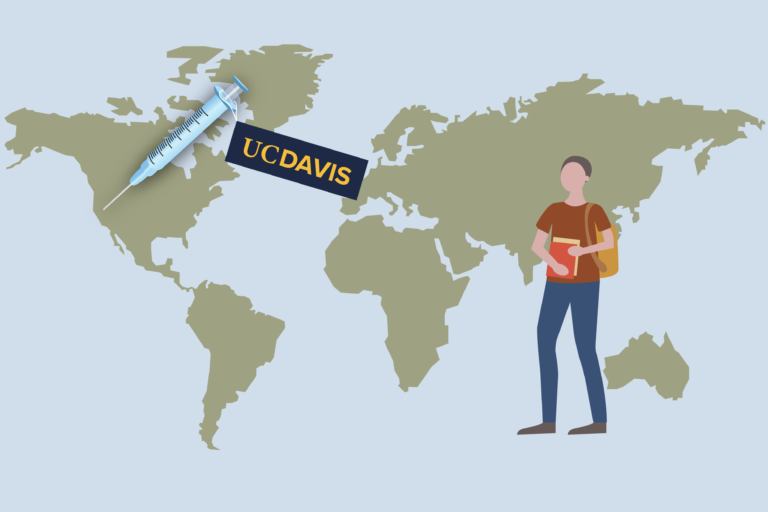
International students encounter obstacles returning to campus in the fall

Visas, time differences, travel restrictions and vaccine availability all create barriers for students living overseas who plan to return in the fall

International students discuss challenges with access to vaccines and difficulties getting back to campus or maintaining visa status for the upcoming in-person Fall Quarter.

Charlene Lujan Vega, a third-year doctoral student in anatomy, physiology and cell biology at the school of veterinary medicine, moved to Peru for what she thought would be a short-term field research project. 

“I was going to come back in spring of last year, but then the pandemic—of course, I couldn’t come back,” Lujan Vega said.

Peru is listed as in a state of emergency related to COVID-19, but does not currently have a travel restriction. 

As of today, the U.S. has a travel ban on several countries including India, China, Brazil and the U.K. as well as the European Schengen area

Lujan Vega is acting as a caregiver for her two elderly parents in Peru, both of whom have now received their first round of vaccine, but Lujan Vega is still waiting. 

“Here, I don’t think I will have any chance to get the vaccine because I’m 36,” Lujan Vega said. 

Jinguang Chai is a second-year mathematics major and Chinese international student currently living in Davis. Both of Chai’s parents have received the vaccine, however they received a different vaccine than is available in the U.S. called CoronaVac

Julia Ann Easley, a news and media relations specialist at UC Davis, said via email that the administration addressed the circumstances of international students in an announcement on the Fall Quarter campus plan on April 26

“We recognize that some courses may need to modify their instruction modes to support students impacted by travel and visa restrictions and to accommodate specific faculty needs,” said Chancellor Gary May and Provost Mary Croughan in the announcement. 

Wendon Song, a second-year computer science and philosophy double major, said his experience at UC Davis as an international student has been mixed.

“At the beginning of the [pandemic], a lot of people were anti-foreigner or anti-immigrant—it was kind of stressful,” Song said. 

Anca Barcu, a first-year horticulture and agronomy graduate student, has been living in Romania since they started their courses at UC Davis. 

“Given the 10-hour difference, it has been challenging because some seminars were as late as three in the morning,” Barcu said. “Although I’ve adjusted my sleep schedule that way, I’m not as productive as I would wish at three in the morning.”

Lujan Vega said she created a make-shift lab in her home with her parents. Her original plan to present at local universities was disrupted by the COVID-19 shutdown in Peru. 

“Everything collapsed, and I said ‘Okay, I need to do something,’” Lujan Vega said. “I can work on my samples here, and I tried to create a small lab here with the resources that I had.” 

Song said he has concerns about the ability to get back to China.

“I don’t know about the visa or I-20 document policy currently,” Song said.

Since specific restrictions vary, UC Davis Services for International Students and Scholars (SISS) provides resources on their website for international students. 

Barcu said they are moving to the U.S. in two weeks, but difficulties with their partner getting a visa due to COVID-19 restrictions caused delays. 

“I’m not traveling alone,” Barcu said. “For my partner, getting their visa has been very difficult because they weren’t processing that kind of visa at all. So that has been very challenging and very stressful.”

Chai said he does not have issues with his visa right now. 

“But some of my friends, Chinese students who are living in China, may have difficulty flying back,” Chai said.

Barcu said their sister, who lived in the U.K., died of COVID-19 and that has impacted their studies.

“You get used to [the time difference], but losing my sister, not so much,” Barcu said.

For students who do not have access to the vaccine in their home countries, Chai suggests that incoming students should be given priority for vaccine appointments. 

“For other countries, especially in India, I heard COVID-19 is bad,” Chai said. “So, especially for students in these places, the school should give them priority.”

May and Croughan said in their April 26 announcement that they are looking for ways to assist students in getting the vaccine who have been unable to get their vaccines prior to campus arrival, however the policy is not finalized. They also said there should be updated information provided in May.

Vikram Rao, the president of the Indian Graduate Student Association, said via email that he has been working with Wesley Young, the director of SISS to collect concerns from students in India.  

Lujan Vega said that though she is still stuck in Peru, she is glad she was able to help her parents during the pandemic.

“I remember the last day before I took the flight, I was leaving the lab in Davis on my bike and I felt something strange, like a feeling saying ‘I will not come back,’” Lujan Vega said.  

Written by: Kathleen Quinn — campus@theaggie.org

In memoriam, financial corruption

0

Bernie Madoff is dead

Bernie Madoff, the prince Ponzi pusher and embodiment of financial corruption is dead at age 82. With his death, the financial industry, America and the entire world can breathe a sigh of relief, because with the death of Madoff comes the death of the corruption in the financial industry.

Madoff left a trail of destruction and misery for the people he preyed on. His actions brought great shame to the Wall Street warriors who do business with honor and dignity. One of his victims was quoted saying, “Death is too good for him.” Madoff may have not been deserving of his own passing, but the financial industry certainly deserved to finally have some respite from the only black mark remaining on their spotless public record.

Some may contend that at best, the financial industry was acting in an extremely risky manner and at worst, an incredibly unethical manner in the run up to the 2008 financial crisis—which they caused. How else were they going to expose Madoff for his crimes? Madoff was the root cause of all the evil in their hearts, so he had to be stopped at all costs. So what if a few people lost their homes? These heroes did it for nothing but billions of dollars in a publicly provided bailout

Did the GameStop saga show that financial markets are nothing but a house of cards that can be manipulated for cynical interests? Is there currently an issue with commercial loans similar to the infamous liar’s loans? Sure, but this was all before Madoff died. His existence infects the souls of financial folk daily. With Madoff’s death, all wrongdoing left the financial markets, so I’m sure this has all been resolved. 

The financial industry is finally free of corruption with Madoff’s demise. The “real” productive members of our economy, by providing many jobs to all the working class chart designers out there, are finally unshackled from the burden of Madoff and all the financial corruption in their hearts.

The sins of the Great Recession have died with Bernie Madoff. 

Written By: Ean Kimura — etkimura@ucdavis.edu
Disclaimer: (This article is humor and/or satire, and its content is purely fictional. The story and or names of “sources” are fictionalized.)

Are action stars wasting a political moment?

Updates from the Newsom recall

The effort to recall California Gov. Gavin Newsom has finally prevailed in its quest to trigger a statewide vote. In the weeks since the effort became official, many people have added their name to the growing list of candidates attempting to replace the carbon-hair, gel-based lifeform that we call Gov. Newsom. 

This list includes former San Diego Mayor Kevin Faulconer, respected member of Team Wheaties Caitlyn Jenner and former gubernatorial candidate and businessman “The Beast” John Cox, along with his 1,000-pound Kodiak Bear. There is a noticeable absence from this list forcing us to ask: “Where are the action stars?”

If no action star throws their name into the hat, it will be a troubling sign for the effort to recall Newsom. Looking at the numbers, 100% of successful gubernatorial recall efforts in the U.S. that did not involve a candidate named Ragnvald A. Nestos resulted in an action star winning the recall effort.

What happened? There are many ideas out there. One campaign strategist, who wishes to remain nameless in order to avoid associating with myself or the humor section of The California Aggie, believes action stars were just not ready for this.

“They don’t have a PAC or anything like this, I guess,” they said. “They also are probably recovering from Arnold Schwarzenegger knocking up a maid and Clint Eastwood talking to an empty chair. This isn’t a real political issue.”

It’s hard to imagine any of our modern day action stars jumping into the race at this point. The Rock might have bigger political goals. Are any of the MCU actors actually bankable action stars? Tom Cruise is a Scientologist. Jason Statham is English. Who knows, we’ll have to see if Vin Diesel can give it a run.

If this recall effort prevails, it will be against the odds. If this recall effort fails, we know why. Let’s hope one day action stars will be a viable force in our political system because at least they’re upfront about pretending to save the world. 

Written By: Ean Kimura — etkimura@ucdavis.edu

Disclaimer: (This article is humor and/or satire, and its content is purely fictional. The story and/or names of “sources” are fictionalized.)

Editorial Board meets with Chancellor May, UC Davis administrators

0

May, administrators discuss fall quarter plans, recent UC-wide data breach and continued COVID-19 precautions

Chancellor Gary May, Provost Mary Croughan, Vice Chancellor Pablo Reguerín, Vice Chancellor Kelly Ratliff, Associate Chancellor Karl Engelbach, Chief Marketing and Communications Officer Dana Topousis, Campus Counsel Michael Sweeney, Director of Athletics Rocko DeLuca 

Below is a transcript of the meeting that has been edited for length and clarity

The California Aggie: How is UC Davis preparing for in-person classes this fall?

Gary May: That’s a great question that is on many people’s minds. There are many people contributing to preparing for the fall. But, the campus lead for classes has been Provost Croughan so I’m going to let her answer that question.

Mary Croughan: A lot of preparation for the fall. The primary factors that influenced our ability to actually resume in-person instruction was the potential for a vaccine mandate, having the case rates come down on COVID and honestly just how well all of you have done as students in wearing your face coverings, doing your weekly asymptomatic testing and so forth. So we’re feeling quite confident in our ability to return to full in-person instruction that is 100% capacity and classrooms and laboratories, studios, field work taking place and so forth. More than likely, face coverings will be required in all those settings still because going through the fall, the situation will still not be ideal and the pandemic will still not be completely over and actually through ASUCD they’ve made that request as well. For students who are not able for medical reasons to be vaccinated there will be a process where they can apply for exemption for that. That’s one of the reasons ASUCD has asked for continued face coverings, so any student sitting in a classroom knows that either the other students in the classroom are fully vaccinated or everyone has a face covering that can reduce transmission that could occur. Last but not least, in looking at all aspects of fall instruction, we are still a little challenged for our international students. The consulates across the world have still largely not reopened to have international students able to receive these. Thankfully, the chancellors and the president of UC have submitted letters encouraging the state department to open consulates but also to place student visas at a higher priority. 

Gary May: You know, we actually had this concept—quarter in the cloud—that we were developing even before the pandemic, and the pandemic gave us a chance to test it, and I think we’ll be prepared to accommodate students who need to be remote still. 

TCA: How is UC Davis deciding which classes will be in person, which classes will be hybrid and which classes will be entirely online? 

Gary May: I think that’s another one for Provost Croughan. We have a pretty rigorous review process in place to make those decisions. 

Mary Croughan: The mode of instruction for every class is actually a decision made by the Academic Senate as an overview over the entire campus. Traditionally, if the class wanted to be held remotely they had to go through a review process with the Academic Senate. We’ve been given a variance to offer classes remotely this whole year by our accreditor and the Academic Senate. While we still are working out the details, more than likely what we’ll be doing in the fall is the reverse of what we did this year. For this whole year of 2020-2021, everything was expected to be offered remotely and if it was going to be offered in-person, then we had an application process and a review process to do so, to make sure there was pedagogical justification to offer it in-person. In other words, a good reason to do it and also to make sure it met the safety guidelines. What we’re exploring right now is the reverse for the fall. The expectation is everything would be offered in person and we would have a review process for things to be administered remotely instead of the process we used last year where the committee were predominantly experts in education and not so much a senate review process because it was just looked at from a safety standpoint. In the fall, we would need to do that together with the Senate. So, a faculty member would ask their department if they could offer something remotely would be one option, and the other is if we have international students in large numbers that are not able to come, then we would ask the department to offer one course or a selection of courses remotely. Individual students can work with their academic advisors as well, so if they are not able to attend in-person for medical reasons, we will do our best to also offer the course in a hybrid fashion. In other words, recorded lectures that are offered to the students afterwards. So, it will be a combination, but it will be predominantly in-person instruction in the fall. 

TCA: Besides classes, are there going to be guidelines established for clubs and student organizations to resume in-person activities? As we all know that’s a really vital part of our college life, so is there anything established in regards to that?

Gary May: This question sounds like it’s in the wheelhouse of Vice Chancellor Reguerín.

Pablo Reguerín: Sure. I’m going to ask for Kelly, she has the operational aspect of some of the activities and I’m sure there will be something I’m missing there. Let me just start with overall, our student affairs and student services, we’re planning on having our offices be able to provide hybrid services so if you walk in, there are full services continuing like the Zoom waiting rooms and different ways of contacting offices if you are not in person. That’s just overall across our teams and offices. We’re looking for that to be our new standard in terms of how we’ll do work at least for this year. There’s a lot to figure out, what worked well in a remote environment, what are those innovations, how can we capture them and fold them into our plans, we’ll continue to do experimentation with that. We’ll want to hear from students like we’ve seen some really interesting things with academic support in our tutoring area, workshop attendance, things that are more accessible remotely. But of course, we’ll continue to have those services in person. In terms of student organizations, we’re anticipating going back to our normal activities and services. We will continue to provide guidance to student organizations around staying safe and events. They’ll get guidance from CSI, from their advisors around that. 

Kelly Ratliff: I think a general theme for fall is we are going to try to do things as close to how it used to be as possible. We’re going to have mitigations in place that we need to have. But, generally our goal is to just be as much back to full capacity, full speed of services as well as we can. That’s the goal and public health guidance has to support that and again, like Mary mentioned, we might have things like masks and so forth. But generally speaking, we want folks to come back and find the services that they were used to having here before the pandemic.

Gary May: I will mention one thing that we’re planning that’s kind of easing students back in. All the 2020 students had their orientation virtually and never got to know the physical campus. So, for 2021 students, they’ll have a physical orientation to walk around and know where things are. We’re going to have a mini re-orientation for the 2020 students that didn’t get a chance to do that, which would be an abbreviated version of the full week of orientation. That’s something we’re planning to do for the fall.

Mary Croughan: One of the things we’re looking at as part of that. Students have not been in a position to really be together. In general, people who are freshman or new transfer students, those students we are going to give a $5 gift card to the CoHo, and advise them to sit down with some of their classmates and get to know each other because now they can.

Pablo Reguerín: One other thing. This is early in this development so we don’t have it figured out yet, but building off of what we saw with the Aggie Public Health Ambassadors and having folks visually be present around campus, we’re trying to focus on way findings, so how do you find services and great resources. We’re looking at having a student group where students are employed to be our connectors, wearing a common shirt or something that’s visible. Particularly for the 2020 students, there’s going to be a lot of wayfinding fall quarter. We haven’t figured it out exactly but what we do know is it’s going to be students who are mobilized to connect students more pronounced than in the past. I’ll be happy to share that as the idea develops further and we know what it’ll look like, but big focus on connecting students and wayfinding. 

TCA: At the moment, what is the plan for COVID-19 testing once classes resume in person and campus is at full capacity?

Gary May: We expect to continue our testing program, at least until the end of this calendar year. So, through December of 2021 and then maybe evaluate at that point. 

Kelly Ratliff: As Gary said, our intent is to continue testing. You may be familiar with guides from the CDC that suggest if you’ve been vaccinated, you don’t need to continue to participate in testing, but here we feel strongly that because we have such a robust program, it’s easy, staffed and prepared that we have occurrence of variants in our community so we’re seeing some of the COVID variants arise and we’ve seen some vaccine breakthrough. It’s rare, but it happens when somebody who’s been vaccinated tests positive and we expect that we’ll have a mix of students who are vaccinated and not vaccinated. So, what the CDC recommendation probably doesn’t take into account is the community like Davis that has this robust testing available at a relatively low cost. And because we have that tool available and we want to continue adding to the knowledge base and keep our community as safe as possible, we have the opportunity with Healthy Davis Together for everyone else to continue with the testing as well. That’s really the goal and the emphasis. 

Mary Croughan: It really does allow us to identify variants, if and when they arise because they are arising. We have our own here in Davis and Sacramento. It allows us to identify anyone who’s been infected very quickly, so we can keep others from being infected by them as well. The chancellor is right on the timeframe, but we’ll actually probably go two weeks into winter quarter because then we can have people tested when they return from winter break if they’ve been traveling and just prevent any outbreak in the winter break. 

Gary May: By the way, I don’t know if anyone checks the positivity rate every week like I do, but I think we had three positives last week, a positivity rate of 0.2% so we’re doing really great. I know Rocko has a bragging point on this issue that he probably wants to share. 

Rocko DeLuca: It’s more of a universal bragging point but we’ve had over 120 competitions on campus this spring since January and we haven’t had a single COVID impact for our student-athletes, which again, we give a lot of credit to the student-athletes for making good social decisions and coaches for support. It’s a universal group win for the Aggies. 

TCA: Are students who volunteer in research labs and for other on-campus organizations required to go through sexual harassment training? I know on-campus employees have to go through certain training but we were wondering more about volunteers. 

Michael Sweeney: There’s a state law that mandates training for employees and supervisors. In regards to volunteers, I don’t think there’s a law that mandates training for volunteers. I don’t believe there’s a policy that mandates training for volunteers. I think that would be a very great practice to require volunteers to participate in our program to understand the rules. But I don’t believe there’s a mandate. 

Gary May: Isn’t there something done in orientation though? For all of our students on sexual violence. 

Michael Sweeney: Oh yeah. All students participate in training. But to be a volunteer in a new lab, that doesn’t trigger a new round of training obligations. There’s base training for everybody.

TCA: Will there be more information released about the extent to which the widespread data breach affected UC Davis students? When? For UC affiliates who had their data stolen in the UC-wide data breach, what do you recommend they do? 

Gary May: There’s an FAQ that’s pretty good on the UCOP website for everything related to the data breach including an email by now, offering to sign up for the Experian protection service which is free for one year for all students, faculty and staff. I would encourage you to do that if you haven’t. It’s a very useful thing to have. I think there’s 142,000 people that have signed up UC-wide, so we’re getting a pretty good uptick in that. The breach itself was about 20 gigs of data, which is not a lot of data. My wife is a software developer so she says that at her company, if it’s less than a terabyte, they don’t pay attention. But I know it’s a scary thing for someone. The FAQ is pretty good telling you what to do if certain things happen. I’m not aware of a huge number of UC Davis affiliates who’ve been affected, but we handle those on a case by case basis. 

TCA: What are you most looking forward to in terms of in-person instruction this fall?

Gary May: We all probably have our own answers but I’m looking forward to people being here again. Bikes, bike wrecks, getting food at the Silo and all those kinds of things. There’s a lot of things we can do remotely well but there’s a lot of things that aren’t optimal remotely. As one example, I had my job shadow program that we started when I came and we can’t do things like that remotely well, so I’m looking forward to be able to do those things again.

Mary Croughan: Especially having been a student on campus, it is so bizarre to have it so quiet and empty. Like the chancellor said, you can walk across the street and probably not even look across the street before you cross because it’s unlikely somebody is going to be there to run into you on their bike. I’m looking forward to dodging traffic and having the MU full, the Coffee House full and everyone back. The vibrancy of the campus will feel quite different with the students returning en masse. 

Pablo Reguerín: I want to echo that, being around folks. Yesterday, I bought my bike on campus and ready to start when we’re all back to get to meetings, going around, so I’m looking forward to everyone. Similar to Mary, I started during the pandemic, so I have not been in this role with a full campus. I’ve been doing a lot of work to get ready and excited about the fall. 

Rocko DeLuca: I’m definitely looking forward to having the energy of campus back again, obviously with athletics specifically. With the few games we’ve had, like the track meet the other day, there were people on top of the parking structure cheering on from afar, so it gives me a lot of hope that the energy around some of the social pieces that make college so fun in addition to learning is going to be back, so I’m excited. 

Gary May: We actually had our first chancellor’s leadership council in-person meeting yesterday, first one in person since last March. You could kind of feel everyone was giddy with excitement, happy to be around other people and talkative. 

TCA: How are the administrators and instructors preparing to ease students back into the rigorous tendencies of in-person instruction and exams?

Gary May: We’ve had some discussion with the Academic Senate. We don’t have a representative here, but we have had those discussions about what sort of flexibility and accommodations should continue, and how we phase it back into regular order over time. Those also have mental health implications. 

Mary Croughan: I agree with everything the chancellor just said. One of the requests the Senate has specifically asked for is to have all testing if possible return to being in person. I’ve also heard that from a lot of students who don’t like the electronic or online proctoring of exams. They feel uncomfortable being watched on Zoom and so forth, so that’s the number one thing we’re really looking at right now. We do have student participation on every one of the fall planning group committees so there has been an opportunity through ASUCD, GSA and others to give input. Plus, we have a portal for all the fall planning workgroup activities and that portal is on the website on Campus Ready under Fall Planning Workgroup, so you can also give us information there if there are any issues or concerns you have. But, I think it’s quite real for students and faculty and staff. There are people who have been, in some cases, lived in social isolation or close to it for a year, and for some folks, that’s been quite welcome and for others they are just really anxious to get out and be with people again. We’re going to need to be able to address all those differences and approaches that may arise from people. 

Pablo Reguerín: I’m very happy to share that we are increasing the number of our therapists. We’re also working to hire a psychiatrist because of the market and the challenge of it being a hard to staff area in general for high education and even more broadly. But, we are currently filling six positions for therapists and there will be another seven added in addition to that. I’m trying to get prepared. We have a number of specialty areas that they are going to be covering as well, multiple languages across different student communities. We are ramping up and looking forward to having a comprehensive and very diverse set of therapists to support students who need that as well. One of the areas of stress that we’re focusing on is being connected. I’m just going to call it the student connector idea right now. It’s having students be very visible, having students be out and about and connect students to resources. The scale of it hasn’t been worked out, but we do think that social connection is going to be really important.

TCA: Just a follow up to that. I know that one of the issues a lot of students face is the long wait times for mental health counselors on campus, so I was wondering with the addition of these new counselors, do you have a goal in mind for a decreased wait time or how quickly you are planning to connect students to therapists when they are in need? 

Pablo Reguerín: One of the things that is often misunderstood is that students in crisis, we can see them right away. The appointment when you’re not in crisis, in terms of our ramp up, it was more centered around the number of therapists and the ratio of students. Our goal is to be at 1:1000. That is what we are planning and that would have an impact on the wait time and we also have our CAN counselors where it’s kind of a preset to a more traditional therapeutic model, so we continue to have that program in place. So yes, it will have an impact on our wait time, but I can’t say exactly. Those depend on what point in time you measured the wait, but it is a metric that we look at regularly. So it will have an effect, but I can’t say to what degree. 

TCA: Since the testing requirement is currently every seven days to be on campus for fully-vaccinated students and employees if there’s any plan to decrease that requirement on the symptom survey just because, as you mentioned, CDC guidelines does say you don’t need to be tested at all once you’re asymptomatic if you’re fully vaccinated. 

Gary May: I don’t think we plan currently to change that. We’ll continue to revisit it and if it looks like we’re overdoing it or it’s not necessary, we can make the timeframe longer or something to that effect. Right now we’re going to stick with once a week. 

Mary Croughan: The chancellor is exactly right. The conditions in which we would stop doing it would be something like zero cases, zero positive cases in both the Davis community and the Davis campus for something like four weeks. We’ve actually had a couple times where we’ve approached that. We’ve gotten two or three weeks with zero cases and then something happens again. But, the numbers of people are going to be considerably larger this fall obviously and everyone will be in closer quarters. The dorms will be full, so I would be very surprised if we stopped screening in the fall. It’s much better to keep us all healthy.

TCA: What led to the UC-wide decision of mandating the vaccine for the fall?

Gary May: Well, several other private universities have already taken that step and after contemplating for a while, we think that’s the best public health decision to have everyone vaccinated. The Academic Senate by the way is very much encouraging this step. The president and chancellor of CSU got together and said we should do this announcement together. That’s where we landed. 

Michael Sweeney: It most definitely is legal. We mandated the flu vaccine in the fall and there was a legal challenge that was dismissed. I think this mandate, I don’t know if you’ve had an opportunity to review it. It’s very thoughtful and allows for appropriate exceptions required by law and it doesn’t become effective at least until one of the vaccines has been approved by the FDA. It’s a very thoughtful mandate designed to make our community safe so we can engage in lots of fun activities in the fall. 

Gary May: To my understanding, the Pfizer vaccine has been submitted or will be submitted in the next day or two for full approval. We expect that to happen in the next several weeks. 

TCA: Why are student athletes and other student employees not allowed to speak to the press?

Gary May: Rocko can take that. First of all, let me dispel that notion. No students are excluded from speaking to the press. We do give advice of encouragement but there’s no rule against it. 

Rocko DeLuca: I don’t know if maybe given the remote nature of some of our staff working with their teams this year there was some error in messaging, but we have a full-time communications team that supports all of our 25 support programs and what we ask is that the media contact them as the timing to make sure that they help arrange and make sure the interviews don’t interfere with practice time or class time. That’s really why a courtesy request is done. If anyone is denied access to student athletes, oftentimes coaches like to pick certain students and spread that opportunity around so everybody gets a chance to speak with the media. But we don’t have any rules that preclude student-athletes from speaking with media. 

Michael Sweeney: I’ll just add, there’s no rule or policy prohibiting student employees from speaking to media. Indeed, people speak all the time, every day. It’s very common. 

TCA: I’ll just be very specific. I actually was a tour guide for a while here and one of our stories in the fall was to talk about campus tours on campus and I received an email as a tour guide saying we do not respond to requests for comment from individual tour guides. It’s a system in place where they need to contact admissions directly, so that was specifically from my supervisor. I do have record of being told as an employee not to speak to the press about a very minor article that talked about adjusting to campus tours. Additionally, there have been multiple other articles from my desk that have to do with the ARC and closing/reopenings in which ARC employees have been given interviews and have been told by their supervisors that they are not allowed to have interviews. That is specifically what I am talking about. Whether it’s a campuswide policy—although it seems like it’s not—it seems like there’s been a lot of pressure from supervisors to have their employees not speak to the press. 

Gary May: Sometimes what we’ll do is, if there’s a particular issue, encourage one point of contact and often that’s Dana’s office. We tell other employees and faculty that if they were to receive an inquiry, direct it to Strategic Communication and let Dana’s team or one of her teammates answer those questions. That happens fairly regularly. I can’t really speak to the examples that you gave because we don’t have a campus policy like that but there may be some reason why those supervisors thought it was important to control the messaging and make sure there was one voice or one point of contact. 

Dana Topousis: I just want to echo that because there’s not a policy from my department at all in that regard and I think it is sometimes supervisors just get nervous. I think some people just get nervous of media generally. I’m sure you’ve all experienced that when you’ve talked to people. People just get nervous about media and I think sometimes they put in extra obstacles. But, I will just say if you ever had an issue, you can contact any one of these leaders. Please reach out to me if you feel like you’re getting an obstacle put in your way or someone being told they can’t do something because that just goes against our transparency that I think everybody here agrees on and we hope that no one thinks that that’s a policy because it isn’t.

Pablo Reguerín: I don’t know about the specific cases but I’m just going to pick on the specific example like at the ARC. It’s not uncommon that we’re making a statement at a single point of contact. It’s different from students speaking on behalf of the ARC or giving their opinion on a situation like what it feels like that the ARC is closed as a student. Those are very different situations. The single point of contact is so that there’s one common message that’s the official position. I know sometimes that can get confusing but I think Dana is a good expert on this and I’m happy to also follow up on any potential issues in my area. 

TCA: Thank you. That’s a good point that you’re making. Just to be clear, to Chancellor May and the other administrators here, do you agree that supervisors should be instructing their employees in certain situations at least to not directly speak to the media?

Gary May: No, I wouldn’t say it that way. I would say that we encourage people to make sure that there’s a clear, unambiguous message that’s coming from the campus on a particular issue or policy. If there’s any doubt about that, there should be a designated point of contact that everyone should use for a particular issue. I don’t think that the examples you gave, if a student has a question on a tour about something, please answer it. I don’t think that’s a problem or if someone wants to know about how you feel about the ARC being closed, please feel free to answer that. That’s not something we would try to regulate.  

Michael Sweeney: I’ll just add, we have a robust community in terms of freedom of expression. Every employee, student has the right for freedom of expression and people understand that the administration should not interfere with that freedom of expression. I’ll just echo what the chancellor said. If we want to have a clarity of communication about what the policy is or what precisely are the rules, we may want to have a single spokesperson speak about that. Every single day, people express their opinions and we’re very comfortable with people expressing points of view that we cannot agree with. 

TCA: Just to clarify, I was wondering if there was a similar type of process mandated for students like volunteers for example since most students volunteer in some kind of research on campus. 

Gary May: I will add that for employees, faculty and staff, we do have an annual training that we have to recertify every year, so anybody who’s supervising a student lab will have their annual training certified. 

Michael Sweeney:  A manager that doesn’t do their training cannot manage. 

TCA: What are the steps the university takes when a graduate student is inappropriate and engaging in sexual harassment? How would an undergraduate report that?

Gary May: We have a couple of offices where that can be reported depending on what actually happens. 

Michael Sweeney: So, there’s many routes to how a student can report. Everybody working on the screen are the responsible employees, so a student can report that to any university employee and then a university employee can report that to the Title IX office. A student can also report that anonymously through our harassment and discrimination program or they can contact the discrimination officier or Title IX officer. Upon receiving those reports, they in real time receive those reports and commence the appropriate corrective action. Typically, there’s an immediate communication with the manager of the program to assess what’s the situation like in that lab or wherever it may be. If there are fears that the student is at risk, the alleged harasser is away from that community until there’s appropriate fact finding. If the allegations are serious and would be a violation of policy, it would be initiated by the compliance office. The victim would be informed of what their rights are. A full understanding of the process, including the opportunity to have a victim advocate through our CARE program. 

Gary May: There has been some policy changes in Title IX from the previous administration that is being changed again, back to what they were. It may be a little confusing. I don’t know if that’s part of your question but we could delve into that if you’d like. 

Michael Sweeney: We could also schedule a time for all of you to meet with the folks who operate these programs. They’d volunteer to meet with you.

TCA: How will safety precautions (i.e. mask-wearing, COVID-19 vaccine and test confirmation) be enforced at this spring’s commencement?

Gary May: Karl has had the pleasure of sort of permutations of commencements since March, so I’ll let him take this one. 

Karl Engelbach: In terms of precautions, we’re going to be ensuring that every participant in the graduation ceremony, both the graduates as well as the guests, bring with them a vaccination card or a test indicating that they tested negative within 72 hours of the commencement or exercise that they are participating in. Everyone will also be required to wear masks. The only time you can take your mask off is when you’re actually crossing the stage for a photo. Otherwise, we’re going to be requiring everyone to wear masks. We did meet with the Yolo County Health Officer about our plans. She was supportive and comfortable with the plans we proposed. We’re going to have many people on sight to ensure people are social distancing and there will be lots of space. Most of this will occur outside. We are still determining the exact location of the stage which potentially will be inside in order to improve both the livestream capabilities and for the most all of the public health guidance that you’ve heard repeated over and over and over again over the past 13 months. So, we’ll be following all of that and there will be a lot of focus on the staff involved and volunteers trying to encourage everyone to follow it. I’ll be honest, our students are great at Davis. They’ve been great at following the rules and I have no doubt all of you and all of your friends who are graduating and their parents will continue to do so we can celebrate safely. 

TCA: What do you think will be the future of the new rapid COVID-19 test that was recently developed at UC Davis?

Gary May: This is a really cool story. I know Mary will want to comment but I think it’s a great partnership between industry and our UC Davis Health neurology and biology experts to develop using spectroscopy and artificial intelligence as a point of care test. What point of care means is you take the test as you’re entering the movie theater and it tells you if you’re positive or not and if you’re negative you can go in. So imagine if we had this test last March, we would have had very minimal disruptions to our lives because we would’ve been able to isolate people who had the virus easily. But, I think it will still be useful for COVID going forward. It will also be useful for the next virus—which there will be one—and the beauty of it is that the algorithm is tunable. You can tune the algorithm to detect whatever peaks in the spectroscopy signature. I know I’m getting a little scientific here but you can turn the algorithm to recognize whatever signature that the virus produces and I think this is going to be very successful for our law as well as some really noteworthy publicity and our experts. 

Mary Croughan: The one thing I will add is that it’s still at the FDA for full review. Safe to say the FDA is swamped these days. There’s a lot of people working on things related to COVID-19, let alone all the usual things that get brought to the FDA. We’re hopeful this will be approved fairly soon. Maury Gallagher, who was our partner and funder on this, owns Allegiant Airlines and is also the named Allegiant football stadium in Las Vegas where the Raiders play, the ones that used to be the Oakland Raiders and are now located in Las Vegas. So, the pandemic hit literally that week when the stadium was supposed to open and so you had an airline company and a football stadium both hit with the pandemic. He looked at this as there’s gotta be a better way we can do this to keep everybody safe and healthy. I really do think this can provide this type of opportunity. So very happy we were able to be helpful. If you recognize the name it’s because it’s the Maurice Gallagher Graduate School of Management. Same person, so he is an Aggie. 

TCA: I just want to go back to the data breach issue real quick. As far as I’m aware, every single member of our Editorial Board now has their data on the dark web after we initiated the Experian service. I don’t know if it impacted more student employees. Obviously, it’s not a representative sample of the campus but it is a bit odd that all nine of us have had that happen. So, I’m just wondering why UC affiliates only get one year of free Experian service and if you know whether or not the service will be extended for who’s data has been found to be breached. 

Gary May: Let me just say a couple of things. First, it’s highly likely your information was on the dark web before this breach. Mine is as well. It’s not a small fluff. There are many ways that miscreants get data and put it out on the dark web. As to whether we will extend the Experian protection, that’s really a decision for the office of the president. I know that they are thinking about that. They’re also thinking about making it a normal benefit of employment and being a UC affiliate, so that you automatically get this when you become part of the UC. That hasn’t happened, it’s just something being discussed and considered. I would not be overly distraught about your social or something else being on the dark web because it’s pretty common. […] It’s highly likely that the credit protection that you get with the standard credit card protection will keep you protected. So make sure you pay attention to those texts that could be annoying but helpful. 

TCA: What advice do you have for incoming freshmen and transfer students next fall as well as students who may not have been on campus this past year? 

Gary May: Well I’d tell students to try and get acclimated or reacclimated quickly, learn where your resources are, in terms of academic resources as well as facilities, mental health and all things that you might need to be successful. Join an organization, make some friends, have some fun, all those sorts of things. 

Mary Croughan: I’m going to go with Rocko’s thing. Go to athletic events. You can actually go now to many things and I just enjoy being back in person with friends and family and people you care about in your life. 

Gary May: Take a selfie with the chancellor.

Michael Sweeney: We have over 800 student clubs and 50 plus sports clubs. Join a club, participate in activity, get out and enjoy being an Aggie. 
Transcribed by: The Editorial Board

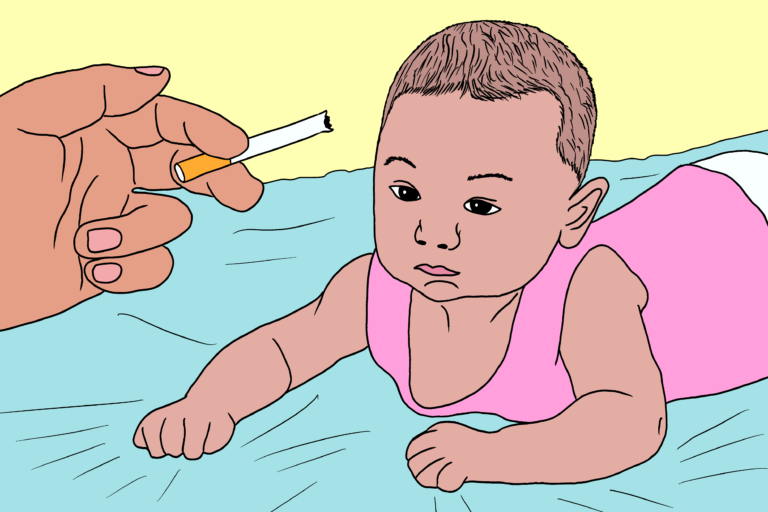
Researchers discover the implementation of the California Tobacco 21 law is associated with a decreased prevalence of daily smoking in youth

Raising the purchasing age of tobacco presents potential to discourage tobacco use in adolescents, according to research from the UC Davis Comprehensive Cancer Center

In 2016, California implemented the Tobacco 21 (T21) law that raised the age for purchasing tobacco from 18 to 21 years old. A recent UC Davis study by the UC Davis Comprehensive Cancer Center discovered just how impactful this law was—the prevalence of daily smoking in 18 to 20-year-olds in California decreased to 0.4% in association with this policy.  

Melanie Dove, an assistant adjunct professor in the Department of Public Health Sciences at UC Davis Health and first author of the study, explained that tobacco is the single most preventable cause of disease and a serious problem in youth. The T21 policy presents the potential to reduce tobacco initiation and addiction in young people, according to Dove.

Despite the significant reduction in 18 to 20-year-olds in California’s daily smoking rate, the study did not find such an association between the policy and non-daily smoking in youth. Dove explained that this is because daily smokers are more likely to buy cigarettes from a store, whereas non-daily smokers are more likely to receive cigarettes from friends or other social sources. 

In order to help target these non-daily smokers, Elisa Tong, the Stop Tobacco Program leader and medical director, explained that it is important to offer free cessation support along with implementing policies to help support people who smoke. She also expressed the importance of educating the general public about the significant risks associated with non-daily smoking and secondhand smoke. 

“Reducing the availability of tobacco with T21 may have contributed to reducing daily smoking and consumption of cigarettes,” Tong said via email. “The hope is that an environmental change will encourage and support individual behavior change.” 

Dove expressed that in order to continue preventing tobacco initiation and use in youth, it is important to continue enforcing T21 policies and researching what factors would be helpful in improving such enforcement, such as educating tobacco retailers or monitoring retailers to make sure they are not selling tobacco products to underage youth. 

In addition to the T21 policy, Tong explained that California has passed a ban on the retail sale of flavored tobacco products. In addition, the Food and Drug Administration has recently made a ruling to start taking menthol—a kid-friendly flavor—out of cigarettes and cigars. Dove emphasized the need to research the effectiveness of these new policies as well as find ways to enforce those policies. Since the law has been passed across the entire U.S., Tong also identified the implementation of the T21 policy across the country and its national impact as a future area of research.

However, this issue cannot simply be solved with the implementation of policies. Cari Shulkin, a national certified tobacco treatment specialist at the UC Davis Comprehensive Cancer Center, emphasized that nicotine is a highly addictive substance that can be as difficult—if not more difficult—to quit as alcohol, heroin or methamphetamines. In addition to the substance being highly addictive, she added that those with comorbidities, such as mental health issues, may struggle even more with quitting. Shulkin expressed the need for a combination of medications and counseling to ensure patients are given the highest chance to stop smoking. 

“For me, if they’re a light smoker or a daily user, [it] doesn’t matter,” Shulkin said. “We’re going to get them connected to resources and medication use, whatever it takes to make sure that they become smoke-free or tobacco-free.”

Dove also expressed that in addition to policies such as T21, youth need to be educated on the harms of smoking behaviors and provided with evidence-based cessation tools to help them stop smoking. In addition, she emphasized a need to change the social norms surrounding smoking behaviors such as vaping. Dove explained that while smoking cigarettes used to be considered “cool” by society, this standard has slowly faded. Similarly, she believes equivalent public health strategies need to be applied to help reduce all other smoking behaviors.  

“It’s not just going to take one policy such as the Tobacco 21 policy or one city banning flavors from e-cigarettes,” Dove said. “We really need a whole comprehensive approach to tackle this problem.”
Written by: Michelle Wong —science@theaggie.org

Research conducted by UC Davis associate professor reveals consequences of DDT usage in first human three-generational study on toxicity of environmental chemicals

UC Davis partners with the Public Health Institute’s Child Health and Development Studies

Michele La Merrill, an associate professor in the UC Davis Department of Environmental Toxicology and a co-leading author of the recent study, explored the effects of widespread chemical exposures in the 1960s on individuals born during the time of use, as well as on subsequent generations. 

This study specifically focuses on DDT, a persistent organic pollutant (POP).

“In our past work, we’ve shown that in humans and in mice, DDT exposure during pregnancy can have effects on the risk of obesity and breast cancer in the female offspring,” La Merrill said. “Another group of individuals did work where they showed that pregnancy exposures to DDT in rats caused obesity in even further-out generations of the rats.” 

 DDT is a commercial product consisting of p,p’-DDT, an insecticide, and an o,p’-DDT, a low-level contaminant, according to the study. 

“There are multiple chemical structures that are related to DDT exposure,” said Barbara Cohn, the director of the Child Health and Development Studies (CHDS) at the Public Health Institute (PHI). “These different DDT-related compounds have different structures, which have different endocrine actions.” 

The researchers measured o,p’-DDT levels because it “may be the best biomarker for perinatal exposure among these related compounds in humans,” according to the study.

“One of the implications is that even though our country banned the use of DDT in the early ‘70s, its effects are still with us as a country as its legacy continues to shape our health risks,” La Merrill said. “Another area of our research has been showing that people who migrated into the U.S. from areas where DDT has been in use for manufacturing have much higher levels of DDT in their body.”

Overall, the researchers’ findings support their initial hypothesis. The data suggests that “ancestral exposure to environmental chemicals, banned decades ago, may influence development of earlier menarche and obesity, which are established risk factors for breast cancer and cardiometabolic diseases,” according to the study. 

“We were able to do one of the very first three-generation studies that actually looked at exposure during the critical window of development,” Cohn said. 

O,p’-DDT levels in the grandmother generation were associated with an increase in obesity and earlier menstruation cycles. Additionally, an egg’s exposure to o,p’-DDT can alter the risk of breast cancer across generations. 

“A synthetic man-made chemical that was used for good purpose—no one was trying to hurt anyone—had unintended consequences, including cancer, reproductive problems and obesity,” Cohn said. “The idea that [DDT] would be the only chemical in the whole planet that could do that never particularly would be a reasonable assumption. It is really hard to figure out which the others are.” 

La Merrill said that researchers are actively working on answering how this multigenerational observation is biologically plausible. 

“We’re currently pursuing research to see if there are common biological mechanisms that come up throughout this,” La Merrill said. “One of the mechanisms that we’ve looked at seems like DDT exposure makes it harder to burn calories, to keep our body warm. It basically slows our metabolism.” 

Alternatively, Cohn said that next steps include finding a biomarker of risk that could be reversible.

 “The question is, could we find a marker like that, that we might be able to change even in the people who have these ancestral exposures that couldn’t be avoided,” Cohn said. “It’s a simultaneous problem of protecting the next generation, but also trying at least to look at or find a way to intervene on the problem in the current generation.” 

As Cohn explains, high levels of cholesterol—defined to be a “waxy, fat-like substance” by the Centers for Disease Control—is an example of a biomarker. Over time, people have developed methods to reduce these levels, which have resulted in a decreased risk of heart disease. 

“One of the ways we could avoid this going forward is to screen chemicals that are meant to be used by people, or released in the environment, for their ability to influence the way we burn calories as an indicator for this risk in the future,” La Merrill said. 

The National Institute of Food and Agriculture (NIFA) was among one of the organizations that supported this research. 

“The knowledge generated by the research will be valuable to regulatory agencies and policy makers responsible for ensuring that agrochemicals needed to maintain agricultural productivity do not have adverse health and environmental impacts,” said senior science staff members in the NIFA’s Institute of Food Production’s Plant Protection Division, via email. 

In their statement, NIFA said that they will continue to invest in research that develops agricultural management strategies that not only protect profitability for farms and ranches, but decrease human health and environmental risks. 

“The legacy [of DDT] not only continues from the perspective that all the people in America who had ancestors that lived here when DDT was actively used they’re at risk, but also people who are immigrating from other countries where it’s been more recent probably have even higher risk,” La Merrill said. 
Written by: Aarya Gupta — science@theaggie.org

Culture Corner

0

The Arts Desk’s weekly picks for movies, TV shows, books and music

TV Show: “Shadow and Bone” 

This Netflix series is based off of author Leigh Bardugo’s book series, which gives us an entrance to what fans call the Grishaverse. The series is centered around the fictional country Ravka, which is split between the East and West by a darkness called the Shadow Fold which is inhabited by carnivorous winged creatures that terrorize anyone that dares attempt to cross. The country’s only hope of ridding themselves of this darkness is the mapmaker Alina Starkov (played by Jessie Mei Li), who only recently discovered her power to create light, giving her the potential to destroy the Shadow Fold. 

I loved “Shadow and Bone” so much, I tried to convince everyone I know to watch it. I binged the entire eight-episode series on a Saturday, happily watching our main protagonist struggle with her self-doubt and conflicted feelings. While the story could have played out a lot better if there were a few more episodes to give the characters an opportunity for more substantial character development, this one flaw doesn’t undercut the series. With a beautiful and immensely talented cast that match the characters perfectly, it seems like this series was given to us on a silver platter after the rush of midterm season where we can wind down before a hectic finals week. 

Movie: “Detective Pikachu” dir. by Rob Letterman

When a well-known detective is presumed dead after a car crash, his estranged son and Pokémon partner riddled with amnesia team up to discover what went wrong in the investigation of his car crash. I’ve repeatedly and unabashedly told everyone that the movie “Detective Pikachu” is criminally underrated. It is one of those children’s movies that deserve to be watched by everyone because the jokes walk the line between being entertaining for kids and giving adults a nice laugh. You don’t have to be a fan of Pokémon to enjoy the colorful world and appreciate this movie.

Book: “Lore” by Alexandra Bracken

Every nine years Greek gods are thrown to roam on Earth as mortals for a week and be hunted by their ancient bloodlines who strive to kill them and take their power and immortality in an event called the Agnon. After the brutal murder of her family, Lore Perseous wants out of the Agnon, deciding never to go back to the rituals and ignoring the idea of revenge. Years later, she finds herself at the start of another Agnon with the goddess Athena asking her to bind their fates together, giving Lore her ultimate chance to leave the world behind. But teaming up with one of the last original gods means going back into the world she swore never to return to.

Bracken takes me back into the Greek gods universe that author Rick Riordan once threw me into as a middle schooler falling in love with the Percy Jackson series. “Lore” is one of the more mature books that Bracken has written, but it was a nice addition to her worlds. I read this book before bed, giving me something light to take my mind off of things. It’s a lot easier to read about Greek gods trying to keep their immortality than it is to think about all of the lectures I have yet to watch.

Album: “Hollywood’s Bleeding” by Post Malone

Post Malone’s third studio album was released in 2019 and won two awards: the Billboard Music Award for top rap album and the American Music Award for favorite album rap/Hip-Hop. I blame my roommate’s constant blasting of Post Malone while in the shower for getting me into his music. But I couldn’t help it; the subtle hints of pop in his most recent album made me listen to it on my own and now we both enjoy it. This album has heart wrenching break-up songs mixed in with dance tunes. 

Written By: Itzelth Gamboa — arts@theaggie.org

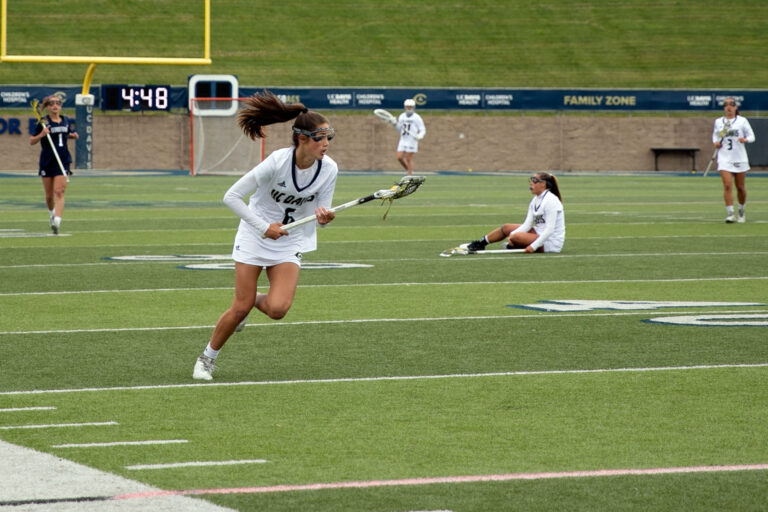
UC Davis Women’s Lacrosse clears championship hurdle

0

After heartbreak in years past, the Aggies finally overcome them to win the MPSF title

The UC Davis Women’s Lacrosse team’s season was not ordinary this year. After having last season cut short and only being able to play six games, the Aggies were determined to make this season count. Throughout the entire offseason, however, the team did not know if they would even get their shot—setting up their most uncertain season yet. 

“Starting the summer and the fall not really knowing what we were preparing for and how to prepare was the biggest challenge for all teams,” said UC Davis Women’s Lacrosse head coach Suzanne Isidor. “The approach we took since the fall was ‘We are going to be prepared for it.’ We would rather be prepared and then have the crushing blow that it’s not going to happen than it to happen and we look back and think we didn’t do everything we could.”

The ability to train individually in small or large groups was something that took a lot of time and progressed gradually. Despite the rigorous routine of class, training for an uncertain season and constant COVID-19 testing and safety precautions, the team took that challenge and remained focused—something that would pay off in the long run. Still, one of the biggest challenges in the pandemic was growing relationships and team camaraderie—an element that would play a large role in a normal year. With the addition of nine new freshmen, the team knew they had to work together with what they had. 

“It was definitely challenging in the beginning because our team is so close,” senior NPB major Sorana Larson said. “It was especially hard to keep up the chemistry with the freshmen we had never met before, but we put our focus into doing what we could in our small groups. If we could meet in groups of five, we did, or had dinner outside [while] socially distanced. We really tried to work on getting to know each other outside of practice.”

From freshmen to upperclassmen, each member played a big part in sticking together even if they didn’t know what the future held. The team did not get the green light for the season until the month of January following their return from break. Now with a season to look forward to and months of training, the Aggies set out to get back what they lost last year due to the cancellation. 

“We had a great season going last year and then everything got cut short,” Larson said. “We knew we were good, and we knew we could reach new heights that we had never reached as a program before. Especially the four [players] that decided to come back for an extra year, we wanted to create the best year possible for our coaches and teammates.”

Kicking off their season on Valentine’s Day, the Aggies did not miss a beat. Hosting the Fresno State Bulldogs on opening day, UC Davis came out firing, winning by a score of 20-12. Showing off their high-powered offense and fine-tuned defense, the team was firing on all cylinders as if they had never stopped playing. The following week—still at UC Davis Health Stadium—they were able to cruise to an 11-goal victory over the visiting Oregon Ducks. After an impressive win on the road in Berkeley, the Aggies suffered their first loss of the season against No. 22-ranked Stanford. For the next four games, the team alternated wins and losses. 

With the season in full swing, it was still much different than what the team was accustomed to in years past. Throughout the year, they had to get tested three times a week, but one of the bigger changes came through travel. Precautionary measures were taken on the road, as the team depended more on buses than airplanes as a way to limit the chance of contracting the virus. What were once team dinners at restaurants turned into takeout food at a park or even eating inside their own hotel rooms. But despite the changes, the team looked at it from a different perspective—one of gratitude. 

“It doesn’t sound that exciting but just to be able to travel and be together on the bus, stay in a hotel and take all the precautions we needed to take, it was still great,” Isidor said. “We were so grateful to still be able to do it. We got to travel, leave Davis, be safe and compete against somebody else.”

Sitting with a record of 7-3, UC Davis had their April 4 rematch against Stanford postponed due to COVID-19 concerns. As a replacement, they were able to schedule a date with the Colorado Buffaloes. After a slow start, the Aggies rallied back but came up just short, falling to Buffaloes by a score of 13-16. 

Following the loss to Colorado, the Aggies entered what would be the final stretch of the regular season. With two of the final four games remaining against Mountain Pacific Sports Federation (MPSF) rivals, UC Davis knew they had to win those games in order to clinch an automatic bid in the conference championship game. After knocking off the conference for San Diego State, they were able to handily beat both Oregon and UC Berkeley once again, to set up their final game of the regular season against Fresno State. Having already beat the Bulldogs twice earlier in the season, the third time was no different, as they dominated throughout, winning by a final score of 27-13. 

At 11-4 and one win away from the MPSF Championship, UC Davis was close to the goal they set out at the beginning of the season. Waiting for them was, once again, Fresno State—who edged out San Diego State to book their spot in the championship. The Aggies were no stranger to the MPSF Championship Game, as they lost their only two appearances. This was their first championship matchup against Fresno State, and they would not be denied another conference title. 

Behind big games from the MPSF Tournament Most Valuable Player Sorana Larson, seniors Maddie Myers, Anna Hofgard and junior Kendall Seifert, UC Davis was able to capture its first MPSF Conference Championship in a big 23-13 win. The Aggies also achieved their most wins in a season since 2004, finishing with a final record of 12-4. Led by an experienced group of upperclassmen, UC Davis would not be denied this attempt at the conference championship. 

“I think from the beginning, we knew we had a special team,” Isidor said. “We had the leadership, we had strong attackers, midfielders, defenders, goalies. We had everything we needed so I think that helped us stay focused. We just kept wanting more. This team was never satisfied. It was always what we would do next. I think that’s what made that championship so satisfying.”

The changing landscape of the pandemic during the fall made it hard to predict whether the Aggies would even have a chance at the championship. Now with the title in Davis, the team achieved the goal they set for themselves. Plus, finishing the season with zero positive COVID-19 tests on the team was another accomplishment in itself. Although it wasn’t what UC Davis was used to, the team made the most of it and was able to send the seniors out on a high note. 

“There’s so much that went into [the season],” Larson said. “We had to work through things that we had never faced or never imagined. But we knew if we put in the work and put in the time, we would reach the goals that we wanted to—and ultimately we did.”
Written by: Omar Navarro — sports@theaggie.org

Commentary: Elon Musk hosted SNL, but why?

0

The Tesla CEO has nothing to do with SNL, and is another example of the show’s controversial clout-chasing

The announcement that Elon Musk was to host Saturday Night Live (SNL) on May 8 was the straw that broke this particular camel’s back. This has more to do with my extreme disappointment in SNL and Lorne Michaels’ (the producer and creator of the show) integrity than my own personal hatred for Musk. First, we must ask, why did SNL, a sketch comedy show where hosts often go on to promote their newest entertainment endeavor, have a CEO with no background in entertainment or comedy—unless you count his Twitter account—host the show? The only logical explanation for having a tech-based billionaire who is constantly shrouded in controversy on the show is Michaels’ clout chasing—it seems that man will do anything for ratings. 

The show has been experiencing a significant dip in ratings for the past few years, and having people like Musk and then-presidential candidate Donald J. Trump on the show are just one of the many tricks to get ratings up, no matter how unfunny the content of the show is. Just as in Musk’s case, there was no other reason for Trump to be on this liberal-leaning, NBC-owned comedy show other than getting some of the best ratings in years. Are the views and publicity worth abandoning any morality the show might have had, and making much of the cast incredibly uncomfortable? Apparently to Micheals it’s all worth it. 

Among those in the cast who signaled at their disinterest in having the Tesla CEO on the show are Bowen Yang, Aidy Bryant and Andrew Dismuke—who all took to social media commenting on Musk’s “eccentric” tweets, or calling his wealth a “moral obscenity.” If anyone is somehow unaware of Musk’s antics on the internet, and particularly on Twitter, brace yourselves. He has done it all on that app, from making fun of people who provide their pronouns on their profile, questioning and belittling the severity of COVID-19 and a myriad of middle-school level jokes that led him to be removed as Chairman of his company. 

While some may applaud Musk for addressing his controversy on Twitter during his SNL monologue, it was clear that this was in no way intended to be an apology, nor some form of ownership or understanding of all the harmful things he has said to his 53.7 million followers. Musk did just what he was there to do—get the show’s ratings up, not to prove himself as an actor or likable public figure. The entire internet and countless news outlets were buzzing leading up to his episode’s premiere, and that only intensified as it aired, with little to no focus on the actual content of the show, as that was in no way newsworthy. 

No matter how hard it was, I truly attempted to ignore the entirety of the context surrounding Musk on SNL as I watched the episode. Needless to say, it was not good let alone funny. The best way to describe every time Musk was involved in a skit was tense, as the acting was extremely sub-par (trying my best to be nice) and the premise of some of the skits were extremely tired—most notably, the “Gen Z Hospital” jab at internet slang, which is simply an appropriation of African-American Vernacular English (AAVE), but that’s a whole different story. This was the kind of SNL episode where one hopes and prays that Weekend Update might have some good guest characters to perhaps save the show from its host—and Ego Nwodim did just that with her sad Disney adult segment on an otherwise yawn-inducing Weekend Update (looking at you, Colin Jost). 

This brings us to perhaps the clearest and most consistent form of “clout-chasing” the show’s producer has given into: keeping Pete Davidson as a cast member for the past 7 years. It is clear to anyone who has seen any of Davidson’s skits, cameos in other shows or movies and of course his semi-autobiographical starring role in “King of Staten Island” that he is only able to play one thing—himself. Davidson adds little to nothing as a comedian on SNL, but what Davidson lacks in talent, he makes up for in controversy and tabloid cover-making drama. Davidson began as the Weekend Updates “Resident Young Person,” and has not grown much past that dazed “Chad-bro” aesthetic, so maybe it’s time to move onward and upward (and away from SNL). 

Perhaps the most upsetting thing about the lingering of Davidson on the show is not Michaels’ desperate attempts to keep ratings up, but the persistence of white male mediocrity within this cast—cue Weekend Update co-host, Harvard-alumni and husband to Scarlett Johansson, Colin Jost. The entire point of this show is to make audiences laugh, and it has stood the test of time because it evolves and adapts as the years go on, but something about those types of cast members who produce more laughs with their controversy and awkwardness with risky subjects (Jost and Michael Che’s joke swaps) doesn’t sit right. Jost has skidded by with his fratty demeanor and bland punchlines, just as Davidson has made it by breaking almost every time he is in a skit, while there are exceptionally funny cast members getting entirely overshadowed by these mediocre, outdated dudes. 

Perhaps I just have far too much of an emotional investment in SNL, and a personal vendetta against Lorne Michaels, but I feel it is necessary to ask the bare minimum of this show; which is to simply be funny. Save the hosting for those within the entertainment industry, prioritize having a cast that brings in laughs over tabloid stories (yes, this is a jab at Pete Davidson), and maybe even get a fresh face running the show (this is a big request). Billionaire CEOs, presidential candidates or any other unfunny public figure who is constantly in the news do not belong on Saturday Night Live. 
Written by: Angie Cummings — arts@theaggie.org

UC Davis study shows COVID-19’s disproportionate negative effects on caretakers

0

UC Davis Health’s Family Caregiving Institute studies caretakers’ ethical dilemmas during pandemic

During the COVID-19 pandemic, many people have had to step up as caregivers for family members—especially for elderly people—whose support services were shut down as nonessential services in March of 2020, according to Dr. Terri Havrath, the director of the Family Caregiving Institute at UC Davis Health. Havrath said that the lack of resources for the elderly during the pandemic has put a strain on their families who have had to step in as caretakers in the interim.

“Community services that had been available to support them closed their doors when the pandemic struck and the stay-at-home orders were implemented,” Harvath said. “Families who had been using senior centers or adult day healthcare were suddenly cut off from those services. Families who are in the middle, who have children at home and are caring for aging parents suddenly have double duty at home and are torn between: how do you keep your kids engaged and having opportunities, and how do you protect your parents?”

This strain has been a point of interest for Harvath and her colleagues at the Family Caregiving Institute, including Dr. Mark Fedyk, an associate professor at the Betty Irene Moore School of Nursing. Fedyk has launched research examining the ethical dilemmas that these family caretakers have faced and continue to face amid the pandemic.

“[The motivation for this research] comes out of a broader tradition of research that you can basically summarize as ‘Please don’t forget about caregivers,’” Fedyk said. “A lot of health outcomes are driven by stuff that happens outside of the hospital, outside of the clinic, stuff that happens at home and is usually the responsibility of the family.”

Fedyk’s goal has been to come up with a way to ask caregivers how they have been affected by ethical dilemmas during the COVID-19 pandemic. He explained that these family caregivers are an often under-recognized component of the health system.

“[Fedyk’s] research is really groundbreaking in that it recognizes family caregivers as ethics workers, as frontline individuals who are called to make ethical decisions,” Harvath said.

Fedyk first tried to gather data from caregivers via a few different forms of survey, but he said the response rate was “not great.” While gathering this data and doing preliminary research, however, Fedyk said that he and his team found online forums where caregivers were discussing the dilemmas he was trying to learn about.

“In the process, we came across a couple of online forums in which caregivers were talking in great detail about how the pandemic had impacted them,” Fedyk said. “We did a preliminary analysis of some of these online discussion boards and we had over 15,000 data points, and we found that we could organize [a sample of] them into […]16 different themes that began to uncover what caregivers had been experiencing.”

He and his team are now examining those data points to determine how many of them contain moral or ethical dilemmas, which as of now, they estimate is about 8-10%. As a part of this process, they are organizing these dilemmas into different themes. Fedyk said that the most common themes that they have identified are burnout, validation seeking, increased financial burden and guilt.

Fedyk said that the goal of conducting this study is to learn more about the issues caregivers are facing and to come up with programs that could provide solutions.

“The hope is that this will give us a small but useful database that can serve as a foundation for further research to the world’s difficulties and the solutions that caregivers come up with to those difficulties,” Fedryk said.

One such program that Fedyk and Harvath have been collaborating on is a decision support service for caregivers. 

“[Fedyk] and I are developing […] a ‘decisional support for caregiving dilemmas’ program that will offer consultation to family caregivers who are struggling in making decisions that put their concern for the safety of their older relatives with concerns about quality of life,” Harvath said. “Families are called to make these difficult decisions without very much training, either in the clinical aspects of the decisions they’re making or in the ethical aspects. Dr. Fedyk’s research will inform the clinical services that we want to develop for families to give them some support and help them identify ways in which they can think about the dilemmas they are facing and make more informed decisions.”

In addition to this service, Harvath and other employees at the Family Caregiving Institute are using Fedyk’s research, as well as their own findings, to address other dilemmas affecting family caregivers during COVID-19, including family caretakers worried about taking elderly family members to the hospital and being unable to accompany them due to COVID-19 restrictions. 

“[Hospitals have] made exceptions for parents who have minor children and partners of pregnant women, which are appropriate exceptions, but they did not extend those same exceptions to caregivers for frail, older adults,” Harvath said.”That meant that [for] older adults—some with Alzheimer’s disease or for whom English is not a language they speak, much less their second language—if they got ill and had to go to the hospital, they were there by themselves with no one to advocate for them.”

Harvath has lobbied with UC Davis Health to change this policy successfully, so now any patient who comes to the hospital is allowed to have a support person come into the facility with them. She said that the Family Caregiving Institute is also working in partnership with the American Association of Retired Persons (AARP) to develop services and educational programs to further support family caregivers. 

“We’ve helped them develop a number of videos that teach family caregivers how to do things like managing continence or help somebody with mobility problems or do complex dressing changes,” Harvath said. “We’re developing consultation services through the clinic, and we hope to be able to implement caregiver support groups. On my big wish list is to develop workshops where family caregivers can come and learn how to do some of the things that I went to nursing school to learn how to do: transferring somebody in and out of bed, on and off the toilet, helping change a bed when somebody is still in it. I think if we offered some workshops for family caregivers, that might help them feel more confident in some of the care that they provide.”

Fedyk said that the pandemic has been especially challenging for family caretakers and that his research has exposed the important role that they play in the health system and how they have had to adapt. 

“The optimistic [takeway] is that caregivers are very creative,” Fedyk said. “Caregivers, almost by definition, are having to compensate for the absence of formal support by creating all sorts of informal solutions. The pessimistic thing is just seeing how it wasn’t too soon after the pandemic became the pandemic […] that caregivers really started to get impacted. They ran out of the usual tools and the usual strategies and solutions. They had to balance working full time and being a full-time caregiver.”
Written by: Katie DeBenedetti — features@theaggie.org

Accurate coloring pages

0

Drawn by: Rushi Tawade –– rntawade@ucdavis.edu 
(This cartoon is humor and/or satire, and its content is purely fictional. The story and names of “sources” are fictionalized.)