55.5 F
Davis

Davis, California

Tuesday, December 23, 2025
Home Blog Page 264

Social media’s mental health advocacy needs to change

0

One-size-fits-all solutions to mental health conditions need to stop

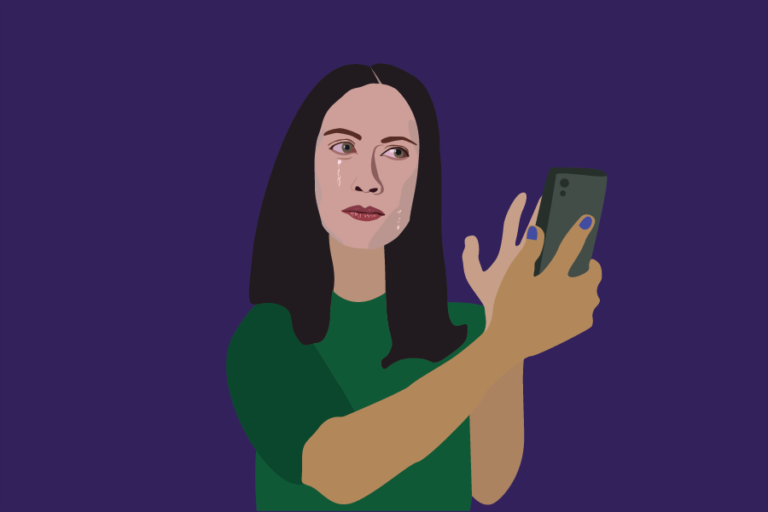
Whenever I choose to forgo my responsibilities and open Instagram I am greeted by one of three things: an exciting, yet impossible makeup tutorial, a picture of an old friend from middle school or posts regarding any of a few mental health conditions.

I used to ignore these mental health posts. “10 Signs of Depression” didn’t catch my eye because I didn’t feel like I had depression and “Six Things You Can do to Cope With ADHD” didn’t seem to apply to me either. These posts seemed to flit in and out of my span of attention, but I’ve noticed an increased prevalence in the past year.

Infographics have been experiencing an intense revival that began in 2020. Ever since the pandemic began, our lack of in-person contact has led users to explore different ways to interact and spread information online. The eye-catching design and simplicity of infographics was a breath of fresh air compared to the dense language of infection rates and death tolls. 

One could say that having all of this information at our fingertips is beneficial. After all, there’s no harm in knowing about how mental health can manifest in our lives and how we can combat the negative effects of mental illness. There’s also something to be said about accessibility too, not everyone can afford to have an official diagnosis with a psychiatrist (one of the many qualms of the American healthcare system)—the internet can be a helpful tool in allowing people to learn about symptoms and treatments. 

Social media, however, has completely botched these efforts, mainly because of the tendency for reduction and generalization in mental health posts.

There are infographics for everything from aesthetic note-taking habits to critical race theory. According to what we see on Instagram, if a concept exists, it can be condensed. This reductionism, however, can be incredibly harmful. There’s simply not enough context for these very complex conditions in a 1089-pixel frame. Mental health conditions are also not a “one size fits all” type of thing, and the information in these posts give off that feeling. 

Posts that specifically outline symptoms of mental health conditions can also be very triggering. Unfortunately, the individuals who create these posts seem to follow the standard “get viral quick” method that most Instagram users try to emulate: eye-catching colors, in-your-face fonts and catchy slogans. The other day, I stumbled across a post titled “Eight Ways We Self-Sabotage.” The post was designed to look like a checklist, with statements like “telling yourself a negative story: ‘I will never be good enough,’” being paired with a cheery and affirmative checkmark. It felt like the post was a checklist of self-sabotage techniques.

The design of this post shows a complete lack of knowledge on the right way to present this information. We can criticize the content and layout of these posts all day long, but there’s something that we don’t always see on first glance: the creators. Who has decided that they’re the authority on these topics? Who decided that they were the ones to make these posts? Oftentimes, mental health accounts on Instagram are completely anonymous. There’s no personal Instagram account attached to whoever makes these posts. For all we know, it could be a random high schooler writing these posts or anyone else who’s simply not qualified. 

These accounts also tend to create a sort of mental health “umbrella” in their theme. Depression, eating disorders and ADHD posts could all sit alongside each other in one row of posts. This generalization of mental health conditions is incredibly harmful by implying that all folks who suffer are the same and, therefore, can be treated the same. This just isn’t true. Mental health conditions are not a “one size fits all.” We can’t help people who suffer from these conditions if we don’t know how they are distinct from one another. 

There are plenty of ways we can amend how we discuss mental health on social media. One way that I find to be particularly helpful are folks that use their accounts to reflect on their specific experiences with their mental health. Actor and podcaster Marc Maron, for example, suffered a devastating loss in the middle of the pandemic and chose to document his grief through frequent Instagram live videos. Creating a space where we can relate to each other and understand that there are unique ways to process emotions is a great way to support those who are suffering and give solace to those who are experiencing similar feelings. 

The world of social media isn’t perfect, but putting a human face to a human experience without implying any sort of expertise is much more helpful than a faceless, sourceless and sans serif post. 

Written by: Isabella Chuecos –– ifchuecos@ucdavis.edu 

Disclaimer: The views and opinions expressed by individual columnists belong to the columnists alone and do not necessarily indicate the views and opinions held by The California Aggie.
Vandals remove Black Lives Matter artwork from Central Park Solidarity Space

0

The community comes together to replace missing artwork

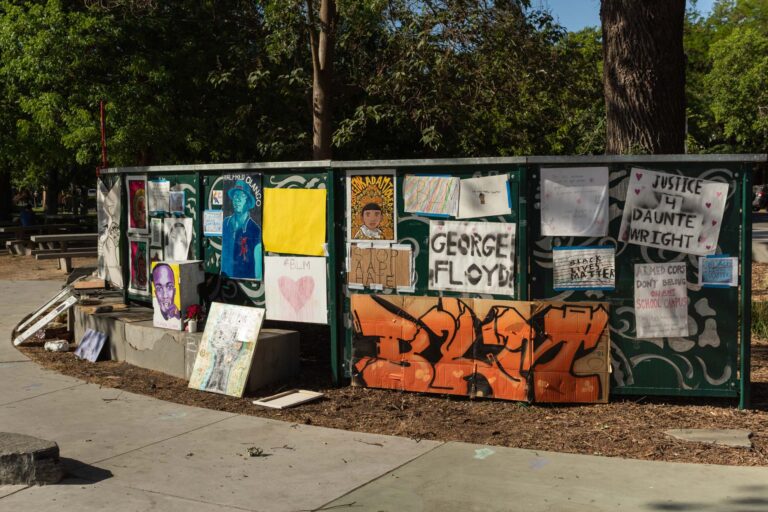
On April 20, activists noticed that the art display in the Central Park Solidarity Space had been removed just before the guilty verdict was announced in Derek Chauvin’s trial. Since then, community members have gathered to replace the missing pieces.  

The Solidarity Space was founded last summer by UC Davis Outcomes Advisor Sule Anibaba and community organizer and artist Kate Mellon-Anibaba after George Floyd’s death. After seeing how her husband Anibaba was profoundly affected by Floyd’s death, Mellon-Anibaba decided to “take up space in Central Park.” 
“I made some portraits of some folks that had been murdered by the police recently and brought some candles and flowers and asked people to come over and hold this vigil for George Floyd,” Mellon-Anibaba said. “I thought maybe a few people would show up, but it turned into a huge thing.”

Mellon-Anibaba described how the Solidarity Space changed and grew as more people started visiting it. 

“It became a meeting space; it became a social justice learning space,” Mellon-Anibaba said. “Some other amazing people in the community took this space and did educational radical forums and brought more art to the space. You could see white families having hard conversations with their kids because they had to, because it was in their face.”

According to Mellon-Anibaba, the Solidarity Space also received a grant from the city and was “reactivated” over the past few weeks as the weather became more suitable for putting out public art. Some speculated that the pieces were removed to protect them from the weather, but Mellon-Anibaba stated that this was untrue. 

“Nothing’s been returned,” Mellon-Anibaba said. “The timing of it was not lost on us. The space was completely erased. Things were cut from the back panel—there were wires holding it up, zip ties—so obviously it was a multiple-person job in the middle of the night so nobody would see it, and they just took everything. They wanted to make a statement, I feel.”

Mellon-Anibaba had archived certain pieces at her house over the winter when the weather wasn’t suitable, but was slowly putting everything back with the return of spring. 

“As things got nicer outside and the anti-Asian hate vigil happened, more people started bringing more art,” Mellon-Anibaba said. “It started getting filled up, and art was showing back up the same way it was showing up last summer. It was like another freedom summer, another chance for folks to come together and talk about the next steps forward. Then right before the results of the trial, everything was erased.”

Despite this setback, it is clear that the Solidarity Space is here to stay, having secured both a nonprofit fiscal sponsor (International House Davis) and grant funds from the City of Davis. 

International House Davis Executive Director Shelly Gilbride further explained that the role of a nonprofit fiscal sponsor is to manage funds granted to the initiative.

“In order to sustain the space, International House started talking about what needed to happen on the back end administratively,” Gilbride said. “We are the nonprofit fiscal sponsor for the space—a fiscal sponsor is an administrative entity that has the fiduciary responsibility for the initiative. We take care of accounting practices and we hold the Solidarity Space bank account so it can have the administrative backing of an existing nonprofit organization.” 

Gilbride described why the long-term existence of the Solidarity Space is important for the community. 

“After the space began, the organizers of the space started thinking about how it can be sustainable for the future and recognized that this isn’t just a one-time need that the Solidarity Space is satisfying, but an ongoing need to support people who may not always feel a sense of belonging in the community,” Gilbride said. 
Written by: Rachel Shey — city@theaggie.org

Cops Off Campus walk out commences Abolition May

0

The Davis group, composed of students, faculty and staff, gathered on the Quad calling for the abolition of campus police

The UC Davis Cops Off Campus group participated in a nationwide day of refusal on May 3 to demand the removal of campus police, kicking off Abolition May. The walkout was the first event of a series of Abolition May events.

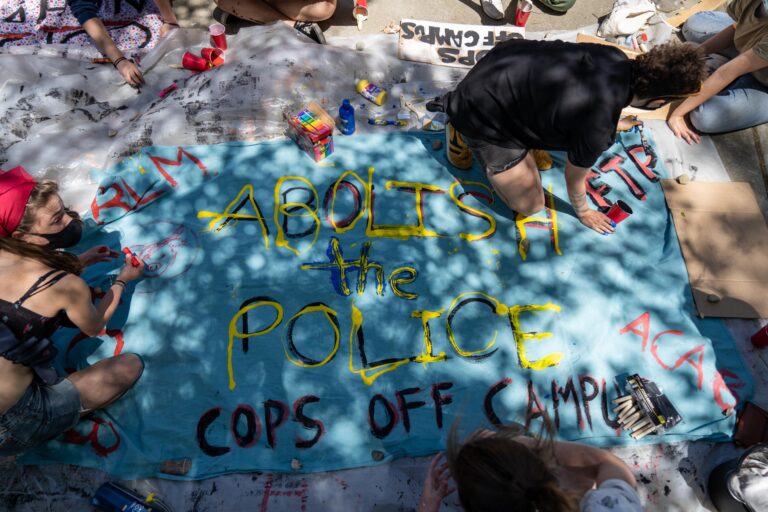
In lieu of class and work, about 100 students, faculty and staff attended a gathering on the Quad where attendees made signs for the upcoming May 24 rally, according to Amanda Kong, an English Ph.D. candidate and Cops Off Campus member. Beyond conversations about abolition and community safety, there was music, screen printing and zine swapping.

The national Cops Off Campus Coalition, which spans over 40 campuses “across Turtle Island” suggested a variety of other local direct actions to engage in Abolition May, according to their website. Among the suggested actions are street puppet theater performances, holding a town hall (without administration) and letter writing to the administration.

The UC Davis group stuck to zine distribution and dancing on the transnational day of refusal in which participants withheld all university-based labor including attending Zoom lectures, teaching and corresponding via email.

Chancellor Gary May said that he was aware of the walkout. May has previously addressed faculty demands for immediate abolition, referencing the plan as “not necessarily a constructive or complete one,” and endorsing the Next Generation Reforms to Advance Campus Safety Task Force. The task force will make their final recommendation in June.

Joshua Clover, a UC Davis English literature professor and Cops Off Campus member, participated in the walkout. Clover said that he doesn’t care what the current administration thinks, asserting that abolition is certainly achievable as opposed to merely a lofty ideal.

“If Gary May is going to try and stop this movement and repress it […] and not take part in a serious reconsideration of whether we need police to have campus be safe, or the reverse, then Gary May is going to go,” Clover said.

Kirin Rajagopalan, a cultural studies Ph.D. student and Cops Off Campus member, stressed solidarity as being a critical component of organizing. 

“Most importantly, refusing work and class actually strikes a tangible blow at the university as an institution,” Rajagopalan said. “I think it sends a powerful message, just like wildcat strikes from last year sent a message, that we can come together and we can act without being mediated by a union or a task force.”

According to May, the walkout had no impact on campus operations.

Despite the UC Davis Cops Off Campus group’s distaste for task forces, Joseph Farrow, the UC Davis police chief, said abolitionists have actively participated in May’s task force and the UC Office of the President’s Campus Safety Symposium.

“I know people who are calling for abolition have been well-represented in a lot of those meetings,” Farrow said. “So their voices are certainly being heard. I think people are very keenly aware of the position which they represent.”

Many students received mass emails from the UC Davis Cops Off Campus group advertising the walkout and other upcoming events including the May 24 rally. The UC Davis rally and noise demo precedes the culmination of Abolition May with national action among Cops Off Campus groups on May 25, the anniversary of the murder of George Floyd. 

Karan Brar, a fourth-year managerial economics major and chairman of the Davis College Republicans (DCR), said he and his fellow DCR associates were surprised to have received emails from Cops Off Campus.

“I think their ideology is definitely destructive and detrimental to communities,” Brar said. “If there is a conversation to be had about policing reform and certain tactics, I think we can have that conversation, but abolition is just an extreme proposal. Even many progressive senators like Bernie Sanders and Elizabeth Warren—they’re not for it.”

Clover recounted that most Americans disapproved of Dr. Martin Luther King Jr. during the civil rights era—noting that in a poll of U.S. citizens, a mere 30% indicated that they supported Dr. King. 

“People have this weird fantasy that things only happen because the vast majority of people support them,” Clover said. “Changes don’t happen because of massive majoratian struggle. They happen because a committed group of people who were right keep fighting.”

Cops Off Campus is peaceful and non-destructive, according to Kong.

“It’s not divisive or harmful,” Kong said. “I think a lot of people are like, ‘It’s so harmful to us as a community.’ The police have literally harmed members of our community.” 

The UC Davis Police Department (UCDPD) has described itself as unlike a traditional law enforcement unit. Farrow said that campus police are not on campus to police students, faculty and staff.

Kong said that she is skeptical of UCDPD’s self-described progressive approach. 

“If they were progressive, then why aren’t they acknowledging the very valid arguments that we are making,” Kong asked. “If they were progressive they would say ‘yeah these kinds of things have happened in the past. They are racist. They are bad.’”

Farrow said that UC Davis is in a new era of policing since the pepper spray brutality incident. He advocated for discussion among all parties and taking small steps.

“Policing is different today at UC Davis than it was 10 years ago when pepper spray happened,” Farrow said. “It’s just totally, totally different. I don’t know if I’d ever get to the point where I’d actually accept or tell people that abolition is the answer. Certainly on the road to abolition there are meaningful conversations that could take place and we could deal with things in small steps.”

UC Davis, along with five other UC campuses, increased UCPD’s 2020-2021 budgets despite summer 2020 protests calling for divestment and reallocation of funds.

The greater Cops Off Campus coalition demands that UC and CSU campus police are gone by fall 2021. UC Davis Cops Off Campus organizers said they want to see police off campus immediately, but some acknowledged their vision isn’t one that can be fulfilled overnight.

 “We are not really setting a timeline on this. We know that it is a long project,” Kong said. “That’s the whole point because abolition isn’t just about getting rid of the police. It’s about getting rid of things that are bad for us and replacing them with systems that are good for us.”

Campus police departments are not standard at colleges and universities in other parts of the world, according to Clover. 

Within the U.S., only 38% of private universities housed a campus police department (compared to 92 percent at public institutions), according to a Bureau of Justice Statistics 2011 survey of campus law enforcement agencies. 

“Given that the presence of police on campus is just a ludacris absurdity which for some reason people have gotten used to and think is natural and reasonable, I think there is a real chance of getting rid of it because ludacris absurd outliers often melt away,” Clover said. “Whether this administration will be the one that does it, I don’t know, but the point is if they won’t do it, then we’ll get rid of them.” 
Written by: Rebecca Gardner — campus@theaggie.org

Five courses to take this summer session

0

Students and professors share their favorite course offerings for summer 2021

As the second year of all-remote summer session classes approaches, students and professors share their favorite courses from last year, and even some courses unique to 2021 to add to this year’s summer class load. 

ETX 110: Toxic Tragedies and Impact

This course focuses on major toxic events, their causes and consequences and how they affect the trajectory of toxin regulation. Topics range from discussing mercury to the toxic chemicals used in medications like Accutane each week, leading up to the final assignment—a 10-page research paper on a toxic tragedy based on students’ interests. 

Kailey Flynn, a third-year environmental policy analysis and planning and economics double major, said that the course was perfect for the summertime because it covered interesting topics but also provided a flexible schedule.

“I enjoyed it because it gave me the ability to watch [lectures] whenever I wanted and enjoy summer time during the day,” Flynn said. “It was super informative, and I now realize what a large impact different toxic tragedies have had.”

ENL 177 01: Study Individual Author

This summer, ENL 177 will be studying J.K. Rowling’s “Harry Potter” series in context. The course will assess the series alongside other works like “Jane Eyre” and a detective fiction novel. English Professor Matthew Vernon, who teaches this course, said that ENL 177 will offer a deep dive into the inspirations for Harry Potter, how it is quickly becoming a new “classic” and how readers can appreciate the series while acknowledging its problematic author. 

Vernon said that this class is not just for English majors, but any Harry Potter fan or student looking for a more fun, laid back course to take this summer.

“It could be relaxing and a slight change of pace from all the other classes that people take, so I think it’s better to take it during the summer,” Vernon said. “This is one of those classes where you can get credit but not be super stressed out the entire time. I hope that this is the sort of thing that people will treat as an enjoyable experience and summertime experience rather than, ‘I have to check boxes, I have to get through a bunch of requirements.’”

AMS 130: American Pop Culture

American Studies Professor Megan Bayles, who teaches AMS 130, said that the class explores what pop culture can illuminate about the values and larger culture of the country at a given time. The course studies varying topics, like classic movies, influencer culture, Dolly Parton and more.

According to Bayles, one of the most meaningful projects students do is the “questions” project, in which each student poses a question that they cannot necessarily answer about popular culture in the U.S. Students go through a process of refining the question, but they never actually answer it. Bayles said that not actually providing an answer for the question makes most students uncomfortable, but it forces them to learn and think in a way most college classes do not. 

“[It’s really a question of], can you think about something in a sustained and increasingly complexified way if I give you space to do that?” Bayles said.

AMS 152: Children in America

Bayles also teaches AMS 152, which studies family separation in American history, specifically examining the Mexico-United States border and the changes that occurred at the border under the Trump administration. This course offers an examination of the border in its current state and what has transpired there over the past five years, in addition to looking back in time at the history of family separation in the U.S.

“We look at child slavery and the kind of intentional disruption of kinship structures amongst enslaved people,” Bayles said. “Then we go to Native American boarding schools and the forced removal of Native kids from their families and their cultures and language as a way of trying to force assimilation. [We look at] Japanese internment during World War II and the use of fear of revoking citizenship or making people stateless as a way of containing people but also looking at how intergenerational trauma is produced.”

Bayles said that this course is more intense than AMS 130, but it is a way for students to learn about a topic that is complex and can be difficult to navigate on their own.

“It can be really hard when you’re in college to also be keeping on top of what’s going on in the world,” Bayles said. “I remember really distinctly being like, ‘I don’t know what’s going on kind of outside of my bubble of my undergraduate experience.’ I think […] when many people are also entering into the world, it’s also important to know what’s going on in the world.”

WMS 070: Sexualities

WMS 070 will discuss sexual identity, gender and their intersection, as well as their relation to race, class and ethnicity. 

Emma Talbot, a second-year sustainable agriculture major, said that even as a STEM student she felt the class was helpful and relevant to her studies. It served as a way to learn about gender and sexualities while earning general education credits.

“After taking [WMS 070] I realized I wanted to minor in gender, women and sexuality studies,” Talbot said. “I felt empowered taking WMS 070, and I felt I could use what I learned in these classes to empower all different types of folks I encounter in my career as a sustainable agriculture major.”

Written by: Katie DeBenedetti — features@theaggie.org

Editorial Board meets with Chancellor May, UC Davis administrators

0

May, administrators discuss fall quarter plans, recent UC-wide data breach and continued COVID-19 precautions

Chancellor Gary May, Provost Mary Croughan, Vice Chancellor Pablo Reguerín, Vice Chancellor Kelly Ratliff, Associate Chancellor Karl Engelbach, Chief Marketing and Communications Officer Dana Topousis, Campus Counsel Michael Sweeney, Director of Athletics Rocko DeLuca 

Below is a transcript of the meeting that has been edited for length and clarity

The California Aggie: How is UC Davis preparing for in-person classes this fall?

Gary May: That’s a great question that is on many people’s minds. There are many people contributing to preparing for the fall. But, the campus lead for classes has been Provost Croughan so I’m going to let her answer that question.

Mary Croughan: A lot of preparation for the fall. The primary factors that influenced our ability to actually resume in-person instruction was the potential for a vaccine mandate, having the case rates come down on COVID and honestly just how well all of you have done as students in wearing your face coverings, doing your weekly asymptomatic testing and so forth. So we’re feeling quite confident in our ability to return to full in-person instruction that is 100% capacity and classrooms and laboratories, studios, field work taking place and so forth. More than likely, face coverings will be required in all those settings still because going through the fall, the situation will still not be ideal and the pandemic will still not be completely over and actually through ASUCD they’ve made that request as well. For students who are not able for medical reasons to be vaccinated there will be a process where they can apply for exemption for that. That’s one of the reasons ASUCD has asked for continued face coverings, so any student sitting in a classroom knows that either the other students in the classroom are fully vaccinated or everyone has a face covering that can reduce transmission that could occur. Last but not least, in looking at all aspects of fall instruction, we are still a little challenged for our international students. The consulates across the world have still largely not reopened to have international students able to receive these. Thankfully, the chancellors and the president of UC have submitted letters encouraging the state department to open consulates but also to place student visas at a higher priority. 

Gary May: You know, we actually had this concept—quarter in the cloud—that we were developing even before the pandemic, and the pandemic gave us a chance to test it, and I think we’ll be prepared to accommodate students who need to be remote still. 

TCA: How is UC Davis deciding which classes will be in person, which classes will be hybrid and which classes will be entirely online? 

Gary May: I think that’s another one for Provost Croughan. We have a pretty rigorous review process in place to make those decisions. 

Mary Croughan: The mode of instruction for every class is actually a decision made by the Academic Senate as an overview over the entire campus. Traditionally, if the class wanted to be held remotely they had to go through a review process with the Academic Senate. We’ve been given a variance to offer classes remotely this whole year by our accreditor and the Academic Senate. While we still are working out the details, more than likely what we’ll be doing in the fall is the reverse of what we did this year. For this whole year of 2020-2021, everything was expected to be offered remotely and if it was going to be offered in-person, then we had an application process and a review process to do so, to make sure there was pedagogical justification to offer it in-person. In other words, a good reason to do it and also to make sure it met the safety guidelines. What we’re exploring right now is the reverse for the fall. The expectation is everything would be offered in person and we would have a review process for things to be administered remotely instead of the process we used last year where the committee were predominantly experts in education and not so much a senate review process because it was just looked at from a safety standpoint. In the fall, we would need to do that together with the Senate. So, a faculty member would ask their department if they could offer something remotely would be one option, and the other is if we have international students in large numbers that are not able to come, then we would ask the department to offer one course or a selection of courses remotely. Individual students can work with their academic advisors as well, so if they are not able to attend in-person for medical reasons, we will do our best to also offer the course in a hybrid fashion. In other words, recorded lectures that are offered to the students afterwards. So, it will be a combination, but it will be predominantly in-person instruction in the fall. 

TCA: Besides classes, are there going to be guidelines established for clubs and student organizations to resume in-person activities? As we all know that’s a really vital part of our college life, so is there anything established in regards to that?

Gary May: This question sounds like it’s in the wheelhouse of Vice Chancellor Reguerín.

Pablo Reguerín: Sure. I’m going to ask for Kelly, she has the operational aspect of some of the activities and I’m sure there will be something I’m missing there. Let me just start with overall, our student affairs and student services, we’re planning on having our offices be able to provide hybrid services so if you walk in, there are full services continuing like the Zoom waiting rooms and different ways of contacting offices if you are not in person. That’s just overall across our teams and offices. We’re looking for that to be our new standard in terms of how we’ll do work at least for this year. There’s a lot to figure out, what worked well in a remote environment, what are those innovations, how can we capture them and fold them into our plans, we’ll continue to do experimentation with that. We’ll want to hear from students like we’ve seen some really interesting things with academic support in our tutoring area, workshop attendance, things that are more accessible remotely. But of course, we’ll continue to have those services in person. In terms of student organizations, we’re anticipating going back to our normal activities and services. We will continue to provide guidance to student organizations around staying safe and events. They’ll get guidance from CSI, from their advisors around that. 

Kelly Ratliff: I think a general theme for fall is we are going to try to do things as close to how it used to be as possible. We’re going to have mitigations in place that we need to have. But, generally our goal is to just be as much back to full capacity, full speed of services as well as we can. That’s the goal and public health guidance has to support that and again, like Mary mentioned, we might have things like masks and so forth. But generally speaking, we want folks to come back and find the services that they were used to having here before the pandemic.

Gary May: I will mention one thing that we’re planning that’s kind of easing students back in. All the 2020 students had their orientation virtually and never got to know the physical campus. So, for 2021 students, they’ll have a physical orientation to walk around and know where things are. We’re going to have a mini re-orientation for the 2020 students that didn’t get a chance to do that, which would be an abbreviated version of the full week of orientation. That’s something we’re planning to do for the fall.

Mary Croughan: One of the things we’re looking at as part of that. Students have not been in a position to really be together. In general, people who are freshman or new transfer students, those students we are going to give a $5 gift card to the CoHo, and advise them to sit down with some of their classmates and get to know each other because now they can.

Pablo Reguerín: One other thing. This is early in this development so we don’t have it figured out yet, but building off of what we saw with the Aggie Public Health Ambassadors and having folks visually be present around campus, we’re trying to focus on way findings, so how do you find services and great resources. We’re looking at having a student group where students are employed to be our connectors, wearing a common shirt or something that’s visible. Particularly for the 2020 students, there’s going to be a lot of wayfinding fall quarter. We haven’t figured it out exactly but what we do know is it’s going to be students who are mobilized to connect students more pronounced than in the past. I’ll be happy to share that as the idea develops further and we know what it’ll look like, but big focus on connecting students and wayfinding. 

TCA: At the moment, what is the plan for COVID-19 testing once classes resume in person and campus is at full capacity?

Gary May: We expect to continue our testing program, at least until the end of this calendar year. So, through December of 2021 and then maybe evaluate at that point. 

Kelly Ratliff: As Gary said, our intent is to continue testing. You may be familiar with guides from the CDC that suggest if you’ve been vaccinated, you don’t need to continue to participate in testing, but here we feel strongly that because we have such a robust program, it’s easy, staffed and prepared that we have occurrence of variants in our community so we’re seeing some of the COVID variants arise and we’ve seen some vaccine breakthrough. It’s rare, but it happens when somebody who’s been vaccinated tests positive and we expect that we’ll have a mix of students who are vaccinated and not vaccinated. So, what the CDC recommendation probably doesn’t take into account is the community like Davis that has this robust testing available at a relatively low cost. And because we have that tool available and we want to continue adding to the knowledge base and keep our community as safe as possible, we have the opportunity with Healthy Davis Together for everyone else to continue with the testing as well. That’s really the goal and the emphasis. 

Mary Croughan: It really does allow us to identify variants, if and when they arise because they are arising. We have our own here in Davis and Sacramento. It allows us to identify anyone who’s been infected very quickly, so we can keep others from being infected by them as well. The chancellor is right on the timeframe, but we’ll actually probably go two weeks into winter quarter because then we can have people tested when they return from winter break if they’ve been traveling and just prevent any outbreak in the winter break. 

Gary May: By the way, I don’t know if anyone checks the positivity rate every week like I do, but I think we had three positives last week, a positivity rate of 0.2% so we’re doing really great. I know Rocko has a bragging point on this issue that he probably wants to share. 

Rocko DeLuca: It’s more of a universal bragging point but we’ve had over 120 competitions on campus this spring since January and we haven’t had a single COVID impact for our student-athletes, which again, we give a lot of credit to the student-athletes for making good social decisions and coaches for support. It’s a universal group win for the Aggies. 

TCA: Are students who volunteer in research labs and for other on-campus organizations required to go through sexual harassment training? I know on-campus employees have to go through certain training but we were wondering more about volunteers. 

Michael Sweeney: There’s a state law that mandates training for employees and supervisors. In regards to volunteers, I don’t think there’s a law that mandates training for volunteers. I don’t believe there’s a policy that mandates training for volunteers. I think that would be a very great practice to require volunteers to participate in our program to understand the rules. But I don’t believe there’s a mandate. 

Gary May: Isn’t there something done in orientation though? For all of our students on sexual violence. 

Michael Sweeney: Oh yeah. All students participate in training. But to be a volunteer in a new lab, that doesn’t trigger a new round of training obligations. There’s base training for everybody.

TCA: Will there be more information released about the extent to which the widespread data breach affected UC Davis students? When? For UC affiliates who had their data stolen in the UC-wide data breach, what do you recommend they do? 

Gary May: There’s an FAQ that’s pretty good on the UCOP website for everything related to the data breach including an email by now, offering to sign up for the Experian protection service which is free for one year for all students, faculty and staff. I would encourage you to do that if you haven’t. It’s a very useful thing to have. I think there’s 142,000 people that have signed up UC-wide, so we’re getting a pretty good uptick in that. The breach itself was about 20 gigs of data, which is not a lot of data. My wife is a software developer so she says that at her company, if it’s less than a terabyte, they don’t pay attention. But I know it’s a scary thing for someone. The FAQ is pretty good telling you what to do if certain things happen. I’m not aware of a huge number of UC Davis affiliates who’ve been affected, but we handle those on a case by case basis. 

TCA: What are you most looking forward to in terms of in-person instruction this fall?

Gary May: We all probably have our own answers but I’m looking forward to people being here again. Bikes, bike wrecks, getting food at the Silo and all those kinds of things. There’s a lot of things we can do remotely well but there’s a lot of things that aren’t optimal remotely. As one example, I had my job shadow program that we started when I came and we can’t do things like that remotely well, so I’m looking forward to be able to do those things again.

Mary Croughan: Especially having been a student on campus, it is so bizarre to have it so quiet and empty. Like the chancellor said, you can walk across the street and probably not even look across the street before you cross because it’s unlikely somebody is going to be there to run into you on their bike. I’m looking forward to dodging traffic and having the MU full, the Coffee House full and everyone back. The vibrancy of the campus will feel quite different with the students returning en masse. 

Pablo Reguerín: I want to echo that, being around folks. Yesterday, I bought my bike on campus and ready to start when we’re all back to get to meetings, going around, so I’m looking forward to everyone. Similar to Mary, I started during the pandemic, so I have not been in this role with a full campus. I’ve been doing a lot of work to get ready and excited about the fall. 

Rocko DeLuca: I’m definitely looking forward to having the energy of campus back again, obviously with athletics specifically. With the few games we’ve had, like the track meet the other day, there were people on top of the parking structure cheering on from afar, so it gives me a lot of hope that the energy around some of the social pieces that make college so fun in addition to learning is going to be back, so I’m excited. 

Gary May: We actually had our first chancellor’s leadership council in-person meeting yesterday, first one in person since last March. You could kind of feel everyone was giddy with excitement, happy to be around other people and talkative. 

TCA: How are the administrators and instructors preparing to ease students back into the rigorous tendencies of in-person instruction and exams?

Gary May: We’ve had some discussion with the Academic Senate. We don’t have a representative here, but we have had those discussions about what sort of flexibility and accommodations should continue, and how we phase it back into regular order over time. Those also have mental health implications. 

Mary Croughan: I agree with everything the chancellor just said. One of the requests the Senate has specifically asked for is to have all testing if possible return to being in person. I’ve also heard that from a lot of students who don’t like the electronic or online proctoring of exams. They feel uncomfortable being watched on Zoom and so forth, so that’s the number one thing we’re really looking at right now. We do have student participation on every one of the fall planning group committees so there has been an opportunity through ASUCD, GSA and others to give input. Plus, we have a portal for all the fall planning workgroup activities and that portal is on the website on Campus Ready under Fall Planning Workgroup, so you can also give us information there if there are any issues or concerns you have. But, I think it’s quite real for students and faculty and staff. There are people who have been, in some cases, lived in social isolation or close to it for a year, and for some folks, that’s been quite welcome and for others they are just really anxious to get out and be with people again. We’re going to need to be able to address all those differences and approaches that may arise from people. 

Pablo Reguerín: I’m very happy to share that we are increasing the number of our therapists. We’re also working to hire a psychiatrist because of the market and the challenge of it being a hard to staff area in general for high education and even more broadly. But, we are currently filling six positions for therapists and there will be another seven added in addition to that. I’m trying to get prepared. We have a number of specialty areas that they are going to be covering as well, multiple languages across different student communities. We are ramping up and looking forward to having a comprehensive and very diverse set of therapists to support students who need that as well. One of the areas of stress that we’re focusing on is being connected. I’m just going to call it the student connector idea right now. It’s having students be very visible, having students be out and about and connect students to resources. The scale of it hasn’t been worked out, but we do think that social connection is going to be really important.

TCA: Just a follow up to that. I know that one of the issues a lot of students face is the long wait times for mental health counselors on campus, so I was wondering with the addition of these new counselors, do you have a goal in mind for a decreased wait time or how quickly you are planning to connect students to therapists when they are in need? 

Pablo Reguerín: One of the things that is often misunderstood is that students in crisis, we can see them right away. The appointment when you’re not in crisis, in terms of our ramp up, it was more centered around the number of therapists and the ratio of students. Our goal is to be at 1:1000. That is what we are planning and that would have an impact on the wait time and we also have our CAN counselors where it’s kind of a preset to a more traditional therapeutic model, so we continue to have that program in place. So yes, it will have an impact on our wait time, but I can’t say exactly. Those depend on what point in time you measured the wait, but it is a metric that we look at regularly. So it will have an effect, but I can’t say to what degree. 

TCA: Since the testing requirement is currently every seven days to be on campus for fully-vaccinated students and employees if there’s any plan to decrease that requirement on the symptom survey just because, as you mentioned, CDC guidelines does say you don’t need to be tested at all once you’re asymptomatic if you’re fully vaccinated. 

Gary May: I don’t think we plan currently to change that. We’ll continue to revisit it and if it looks like we’re overdoing it or it’s not necessary, we can make the timeframe longer or something to that effect. Right now we’re going to stick with once a week. 

Mary Croughan: The chancellor is exactly right. The conditions in which we would stop doing it would be something like zero cases, zero positive cases in both the Davis community and the Davis campus for something like four weeks. We’ve actually had a couple times where we’ve approached that. We’ve gotten two or three weeks with zero cases and then something happens again. But, the numbers of people are going to be considerably larger this fall obviously and everyone will be in closer quarters. The dorms will be full, so I would be very surprised if we stopped screening in the fall. It’s much better to keep us all healthy.

TCA: What led to the UC-wide decision of mandating the vaccine for the fall?

Gary May: Well, several other private universities have already taken that step and after contemplating for a while, we think that’s the best public health decision to have everyone vaccinated. The Academic Senate by the way is very much encouraging this step. The president and chancellor of CSU got together and said we should do this announcement together. That’s where we landed. 

Michael Sweeney: It most definitely is legal. We mandated the flu vaccine in the fall and there was a legal challenge that was dismissed. I think this mandate, I don’t know if you’ve had an opportunity to review it. It’s very thoughtful and allows for appropriate exceptions required by law and it doesn’t become effective at least until one of the vaccines has been approved by the FDA. It’s a very thoughtful mandate designed to make our community safe so we can engage in lots of fun activities in the fall. 

Gary May: To my understanding, the Pfizer vaccine has been submitted or will be submitted in the next day or two for full approval. We expect that to happen in the next several weeks. 

TCA: Why are student athletes and other student employees not allowed to speak to the press?

Gary May: Rocko can take that. First of all, let me dispel that notion. No students are excluded from speaking to the press. We do give advice of encouragement but there’s no rule against it. 

Rocko DeLuca: I don’t know if maybe given the remote nature of some of our staff working with their teams this year there was some error in messaging, but we have a full-time communications team that supports all of our 25 support programs and what we ask is that the media contact them as the timing to make sure that they help arrange and make sure the interviews don’t interfere with practice time or class time. That’s really why a courtesy request is done. If anyone is denied access to student athletes, oftentimes coaches like to pick certain students and spread that opportunity around so everybody gets a chance to speak with the media. But we don’t have any rules that preclude student-athletes from speaking with media. 

Michael Sweeney: I’ll just add, there’s no rule or policy prohibiting student employees from speaking to media. Indeed, people speak all the time, every day. It’s very common. 

TCA: I’ll just be very specific. I actually was a tour guide for a while here and one of our stories in the fall was to talk about campus tours on campus and I received an email as a tour guide saying we do not respond to requests for comment from individual tour guides. It’s a system in place where they need to contact admissions directly, so that was specifically from my supervisor. I do have record of being told as an employee not to speak to the press about a very minor article that talked about adjusting to campus tours. Additionally, there have been multiple other articles from my desk that have to do with the ARC and closing/reopenings in which ARC employees have been given interviews and have been told by their supervisors that they are not allowed to have interviews. That is specifically what I am talking about. Whether it’s a campuswide policy—although it seems like it’s not—it seems like there’s been a lot of pressure from supervisors to have their employees not speak to the press. 

Gary May: Sometimes what we’ll do is, if there’s a particular issue, encourage one point of contact and often that’s Dana’s office. We tell other employees and faculty that if they were to receive an inquiry, direct it to Strategic Communication and let Dana’s team or one of her teammates answer those questions. That happens fairly regularly. I can’t really speak to the examples that you gave because we don’t have a campus policy like that but there may be some reason why those supervisors thought it was important to control the messaging and make sure there was one voice or one point of contact. 

Dana Topousis: I just want to echo that because there’s not a policy from my department at all in that regard and I think it is sometimes supervisors just get nervous. I think some people just get nervous of media generally. I’m sure you’ve all experienced that when you’ve talked to people. People just get nervous about media and I think sometimes they put in extra obstacles. But, I will just say if you ever had an issue, you can contact any one of these leaders. Please reach out to me if you feel like you’re getting an obstacle put in your way or someone being told they can’t do something because that just goes against our transparency that I think everybody here agrees on and we hope that no one thinks that that’s a policy because it isn’t.

Pablo Reguerín: I don’t know about the specific cases but I’m just going to pick on the specific example like at the ARC. It’s not uncommon that we’re making a statement at a single point of contact. It’s different from students speaking on behalf of the ARC or giving their opinion on a situation like what it feels like that the ARC is closed as a student. Those are very different situations. The single point of contact is so that there’s one common message that’s the official position. I know sometimes that can get confusing but I think Dana is a good expert on this and I’m happy to also follow up on any potential issues in my area. 

TCA: Thank you. That’s a good point that you’re making. Just to be clear, to Chancellor May and the other administrators here, do you agree that supervisors should be instructing their employees in certain situations at least to not directly speak to the media?

Gary May: No, I wouldn’t say it that way. I would say that we encourage people to make sure that there’s a clear, unambiguous message that’s coming from the campus on a particular issue or policy. If there’s any doubt about that, there should be a designated point of contact that everyone should use for a particular issue. I don’t think that the examples you gave, if a student has a question on a tour about something, please answer it. I don’t think that’s a problem or if someone wants to know about how you feel about the ARC being closed, please feel free to answer that. That’s not something we would try to regulate.  

Michael Sweeney: I’ll just add, we have a robust community in terms of freedom of expression. Every employee, student has the right for freedom of expression and people understand that the administration should not interfere with that freedom of expression. I’ll just echo what the chancellor said. If we want to have a clarity of communication about what the policy is or what precisely are the rules, we may want to have a single spokesperson speak about that. Every single day, people express their opinions and we’re very comfortable with people expressing points of view that we cannot agree with. 

TCA: Just to clarify, I was wondering if there was a similar type of process mandated for students like volunteers for example since most students volunteer in some kind of research on campus. 

Gary May: I will add that for employees, faculty and staff, we do have an annual training that we have to recertify every year, so anybody who’s supervising a student lab will have their annual training certified. 

Michael Sweeney:  A manager that doesn’t do their training cannot manage. 

TCA: What are the steps the university takes when a graduate student is inappropriate and engaging in sexual harassment? How would an undergraduate report that?

Gary May: We have a couple of offices where that can be reported depending on what actually happens. 

Michael Sweeney: So, there’s many routes to how a student can report. Everybody working on the screen are the responsible employees, so a student can report that to any university employee and then a university employee can report that to the Title IX office. A student can also report that anonymously through our harassment and discrimination program or they can contact the discrimination officier or Title IX officer. Upon receiving those reports, they in real time receive those reports and commence the appropriate corrective action. Typically, there’s an immediate communication with the manager of the program to assess what’s the situation like in that lab or wherever it may be. If there are fears that the student is at risk, the alleged harasser is away from that community until there’s appropriate fact finding. If the allegations are serious and would be a violation of policy, it would be initiated by the compliance office. The victim would be informed of what their rights are. A full understanding of the process, including the opportunity to have a victim advocate through our CARE program. 

Gary May: There has been some policy changes in Title IX from the previous administration that is being changed again, back to what they were. It may be a little confusing. I don’t know if that’s part of your question but we could delve into that if you’d like. 

Michael Sweeney: We could also schedule a time for all of you to meet with the folks who operate these programs. They’d volunteer to meet with you.

TCA: How will safety precautions (i.e. mask-wearing, COVID-19 vaccine and test confirmation) be enforced at this spring’s commencement?

Gary May: Karl has had the pleasure of sort of permutations of commencements since March, so I’ll let him take this one. 

Karl Engelbach: In terms of precautions, we’re going to be ensuring that every participant in the graduation ceremony, both the graduates as well as the guests, bring with them a vaccination card or a test indicating that they tested negative within 72 hours of the commencement or exercise that they are participating in. Everyone will also be required to wear masks. The only time you can take your mask off is when you’re actually crossing the stage for a photo. Otherwise, we’re going to be requiring everyone to wear masks. We did meet with the Yolo County Health Officer about our plans. She was supportive and comfortable with the plans we proposed. We’re going to have many people on sight to ensure people are social distancing and there will be lots of space. Most of this will occur outside. We are still determining the exact location of the stage which potentially will be inside in order to improve both the livestream capabilities and for the most all of the public health guidance that you’ve heard repeated over and over and over again over the past 13 months. So, we’ll be following all of that and there will be a lot of focus on the staff involved and volunteers trying to encourage everyone to follow it. I’ll be honest, our students are great at Davis. They’ve been great at following the rules and I have no doubt all of you and all of your friends who are graduating and their parents will continue to do so we can celebrate safely. 

TCA: What do you think will be the future of the new rapid COVID-19 test that was recently developed at UC Davis?

Gary May: This is a really cool story. I know Mary will want to comment but I think it’s a great partnership between industry and our UC Davis Health neurology and biology experts to develop using spectroscopy and artificial intelligence as a point of care test. What point of care means is you take the test as you’re entering the movie theater and it tells you if you’re positive or not and if you’re negative you can go in. So imagine if we had this test last March, we would have had very minimal disruptions to our lives because we would’ve been able to isolate people who had the virus easily. But, I think it will still be useful for COVID going forward. It will also be useful for the next virus—which there will be one—and the beauty of it is that the algorithm is tunable. You can tune the algorithm to detect whatever peaks in the spectroscopy signature. I know I’m getting a little scientific here but you can turn the algorithm to recognize whatever signature that the virus produces and I think this is going to be very successful for our law as well as some really noteworthy publicity and our experts. 

Mary Croughan: The one thing I will add is that it’s still at the FDA for full review. Safe to say the FDA is swamped these days. There’s a lot of people working on things related to COVID-19, let alone all the usual things that get brought to the FDA. We’re hopeful this will be approved fairly soon. Maury Gallagher, who was our partner and funder on this, owns Allegiant Airlines and is also the named Allegiant football stadium in Las Vegas where the Raiders play, the ones that used to be the Oakland Raiders and are now located in Las Vegas. So, the pandemic hit literally that week when the stadium was supposed to open and so you had an airline company and a football stadium both hit with the pandemic. He looked at this as there’s gotta be a better way we can do this to keep everybody safe and healthy. I really do think this can provide this type of opportunity. So very happy we were able to be helpful. If you recognize the name it’s because it’s the Maurice Gallagher Graduate School of Management. Same person, so he is an Aggie. 

TCA: I just want to go back to the data breach issue real quick. As far as I’m aware, every single member of our Editorial Board now has their data on the dark web after we initiated the Experian service. I don’t know if it impacted more student employees. Obviously, it’s not a representative sample of the campus but it is a bit odd that all nine of us have had that happen. So, I’m just wondering why UC affiliates only get one year of free Experian service and if you know whether or not the service will be extended for who’s data has been found to be breached. 

Gary May: Let me just say a couple of things. First, it’s highly likely your information was on the dark web before this breach. Mine is as well. It’s not a small fluff. There are many ways that miscreants get data and put it out on the dark web. As to whether we will extend the Experian protection, that’s really a decision for the office of the president. I know that they are thinking about that. They’re also thinking about making it a normal benefit of employment and being a UC affiliate, so that you automatically get this when you become part of the UC. That hasn’t happened, it’s just something being discussed and considered. I would not be overly distraught about your social or something else being on the dark web because it’s pretty common. […] It’s highly likely that the credit protection that you get with the standard credit card protection will keep you protected. So make sure you pay attention to those texts that could be annoying but helpful. 

TCA: What advice do you have for incoming freshmen and transfer students next fall as well as students who may not have been on campus this past year? 

Gary May: Well I’d tell students to try and get acclimated or reacclimated quickly, learn where your resources are, in terms of academic resources as well as facilities, mental health and all things that you might need to be successful. Join an organization, make some friends, have some fun, all those sorts of things. 

Mary Croughan: I’m going to go with Rocko’s thing. Go to athletic events. You can actually go now to many things and I just enjoy being back in person with friends and family and people you care about in your life. 

Gary May: Take a selfie with the chancellor.

Michael Sweeney: We have over 800 student clubs and 50 plus sports clubs. Join a club, participate in activity, get out and enjoy being an Aggie. 
Transcribed by: The Editorial Board

International students, scholar speak out about COVID-19 crisis in India

0

The crisis has affected many UC Davis students who are from or have family in India

With a mounting death toll and COVID-19 case numbers soaring in India, international students and a postdoctoral scholar from India spoke to The California Aggie about what it’s like to be studying and working abroad as the current COVID-19 crisis worsens in their home country. 

All three interviewees have been living in Davis during the pandemic. 

“I was vaccinated completely before my 50-year-old father [living in India] could get his first shot,” said Kabir Sahni, a third-year communications and international relations double major and ASUCD Senator whose family is from New Delhi. “That in itself just shows how serious the vaccine inequity problem is globally and how drastically different countries’ vaccine rollouts have been.”

Recently, Chancellor Gary May released a statement about the events in India, encouraging students to access mental health resources and to reach out to professors with their concerns. 

Sahni recently co-authored SR #13—a resolution calling on university faculty to ensure equitable access to academic instruction for international students in fall 2021. He said that while he’s grateful for the UC Davis administration’s support, some professors have been less understanding. 

Since many Zoom classes are held synchronously, international students staying back home may be unable to meet regular, pre-pandemic course requirements that are still being enforced.

“As much as we appreciate professors being incredibly kind and lenient, there’s professors who have graded us on participation,” Sahni said. “And that just makes me think, what about people in other countries? What about people who can’t be in the United States? If you hold office hours at 2 p.m. here, that’s 2 a.m. in India. A ton of professors have not been comfortable with adapting to an online format.” 

Student senators at UC Berkeley, UC Riverside and UC Los Angeles have authored similar resolutions, urging professors to record lectures and acknowledge the specific struggles that international students have undergone during the pandemic. 

Sahni also spoke about the emotional toll the COVID-19 crisis has taken on Indian students studying in the U.S.

 “I go through my Instagram stories every day, and I see people I’ve known all my life asking for ICU beds for their fathers, or their grandmother has a collapsed lung and is at home and they don’t have a bed, or there are people asking for oxygen,” Sahni said. “Every night and every morning when I’m calling back home, I have to deal with the reality that I’m in my bubble and that is a completely different world. At this point I can only channel prayers and be glad that my family went through the virus at a time when resources were more accessible.”
Dr. Krishna Balasubramaniam, a postdoctoral researcher at the UC Davis School of Veterinary Medicine, described a similar dilemma.

“The helplessness kicks in each time we speak to our family and essentially ask them to ‘take care and stay safe,’” Balasubramaniam said via email. “Both my spouse and I come from a privileged, well-to-do background, and although our parents have gotten the vaccine, our siblings and their spouses haven’t, and don’t look like they’ll have access any time soon. The bigger, more devastating story has to be about the under-privileged… about the millions of daily-wage workers, low-income groups, and other minorities who have suffered disproportionately heavy losses.”

Balasubramaniam also said that the COVID-19 pandemic has badly strained India’s healthcare system, which was already struggling before the pandemic began.

Vikram Rao, a Master’s student in the computer science department and president of the Indian Graduate Student Association, believes that the current supply shortages in India have precipitated the increase in COVID-19 cases.

“In hospitals we are short of beds and short of oxygen and life-saving supplies and other commodities,” Rao, who is from Bangalore, said. “If we had all of the resources, I don’t think there would be such a spike in the cases.”

Balasubramian has a different perspective, however. 

“The second wave hasn’t reached its peak yet, and we still know very little about the epidemiology and evolutionary history of these new variants,” he said. “What we do know is that the public-health sector (already very poorly funded in India pre-COVID-19) faces huge challenges, not least of which is of course maintaining physical distancing with such a dense population.” 

Like Sahni, Balasubramian has found social media challenging, with bad news and worsening statistics being publicized and controversies arising about the Indian government’s response to the COVID-19 crisis. He also said that he was not aware of May’s statement about the situation in India, which provided a link to Student Health and Counseling Services (SHCS). 

Rao said he believes that problems arising for Indian international students at UC Davis tend to be solved internally and that Indian students are unlikely to approach SHCS.

“Even if you contact these [so-called] services, the person who will be helping us, counseling us, [they] might not know the background or the issue we are facing,” Rao said. “By the time we are done explaining all of the background and all of the issues, I don’t think it will be solved that easily.”

Meanwhile, as an undergraduate, Sahni is continuing to focus on advocacy for his fellow international students.
“If faculty are unwilling to budge, and there’s some faculty that are hesitant to do asynchronous courses—if that’s something that there’s hesitance on, that’s embarrassing,” Sahni said. “This pandemic is literally nobody’s fault, and I understand that, but some of us are having to deal with it so much more [severely] than other people, and it’s time for other people to accept that. That’s the only way we progress together and make it out of this.”

Sahni explained that although he appreciated the resources, he also wished international students had the kind of support that would prevent them from having to seek counseling in the first place. 

“For us, it would just be great if the campus was as flexible as can be,” he said. 
Written by: Rebecca Bihn-Wallace — campus@theaggie.org

On-campus organizations celebrate Asian American and Pacific Islander Heritage Month

0

UC Davis’s AAPI community continues to celebrate its history and culture amid lockdown restrictions and anti-Asian racialization of COVID-19

Asian American and Pacific Islander (AAPI) Heritage Month in May is a time for celebration of AAPI culture and their contributions to the U.S. To commemorate this month, students and faculty members at UC Davis have organized events to foster community and acceptance among AAPI students.

The Cross Cultural Center (CCC), one of seven UC Davis Community Resource and Retention Centers, supports a variety of student communities on campus. To kick off AAPI Heritage Month, the CCC hosted Asian Pacific Culture Week (APCW) from May 3 to May 8. 

The week’s events included talks from AAPI professors, artists, farmers and community organizers, as well as a resource fair for AAPI student organizations. According to Olivia Hernandez, the associate director of the CCC, these events aimed to look at the different facets that make up the Asian diaspora as a means to highlight creative social justice and community work and to share a virtual space with members of the AAPI community.

The CCC also collaborated with KDVS for APCW’s final event, “Lockdown Sessions: AAPI Represent.” During this event, students showcased their talents, listened to AAPI artists and celebrated AAPI heritage.

“I’m hoping that people see the graphics, attend the programs, get inspired and feel connected somehow,” Hernandez said. “I hope that students also know that, even if we continue to be hybrid, virtual or whatever it looks like in the future, the CCC will still have a space for you here.”

KDVS also highlighted AAPI organizations that students can donate to and connect with in order to show their support for the AAPI community even after APCW. Anyone who wishes to uplift the AAPI community is welcome to support these organizations regardless of racial or ethnic background. Hernandez emphasized that even though she is not a member of the AAPI community herself, she believes it is important for her to actively support the AAPI community.

“[Being an ally] is about figuring out ways to uplift without taking up space,” Hernandez said. “Then, allowing for the doors to be more open and accessible, so that more scholars can come through the door and feel empowered.”

The Asian Pacific Islander (API) Retention Initiative is the newest of four retention initiatives on campus that serve historically underrepresented student communities. According to Katherine Parpana, the interim director of the API Retention Initiative, their mission is to connect student scholars with resources to support them during their time at UC Davis.

Parpana said that her goal for the API Retention Initiative during AAPI Heritage Month is to uplift programs that are being hosted by partner departments and promote on-campus student organizations. This includes working with the CCC to spread the word about APCW and connecting with student leaders to learn about their upcoming events.

Parpana explained that there are many unique identities that fall under the umbrella of AAPI, and that AAPI Heritage Month is a time to make each of these identities more visible and celebrate their unique histories.

“Having our celebratory month in May is a great way to really think about where we have been in terms of advocacy, some of the struggles we’ve had to go through and what it means to be visible,” Parpana said. “This is going to mean something different for each of us, whether we identify as Asian, Pacific Islander or if we’re comfortable using the API acronym as a whole.”

Parpana also noted that AAPI Heritage Month coincides with Mental Health Awareness Month. According to Parpana, AAPI identity and mental health can intersect for AAPI community members in a variety of ways. One resource that she highlighted for AAPI students is the Student Health and Counseling Services’ Community Advising Network (CAN), where Dr. Tatum Phan, a CAN counselor, works closely with the AAPI community. Other resources include academic advising, Asian Pacific American Community Housing and AAPI student organizations.

“I would certainly love to offer myself as a resource because there’s so much we can tap into,” Parpana said. 

One student organization, Asian Pacific Islander American Public Affairs (APAPA) at UC Davis, promotes education, professional development and civic engagement centered around social issues impacting the AAPI community. On May 4, APAPA hosted a Unity Against Hate Webinar featuring Amy Tong, the state chief information officer and director of the California Department of Technology (CDT). Tong spoke about her role in fighting against Asian hate crimes as a lead organizer in Unity Against Hate and shared what AAPI individuals can do to support the organization.

Kathryn Nguyen, a second-year animal science major and APAPA’s social media coordinator, said that throughout May she and fellow members of APAPA will be posting educational content on the organization’s Instagram about anti-Asian hate, recent events and student resources. 

Nguyen said that AAPI Heritage Month is a very important time to recognize the community in the U.S. and educate Americans about AAPI history.

“This month is really important because, in terms of Asian Americans, I feel like we’re seen as ‘other’ in America,” Nguyen said. “We shouldn’t forget our roots and where we come from culturally.”

In light of the recent surge in hate crimes against the AAPI community, Nguyen emphasized the importance of educating others about AAPI history and celebrating the different cultures within the AAPI community while also uniting as one community.

“I’m hoping that this month shows people that we’re all united in our struggles as Asian Americans,” Nguyen said. “At the same time, I’m hoping that people see that there are different cultures and ethnicities within this community.”

Another student organization, Asian American Association (AAA), serves to unify the Asian American and Pacific Islander communities by promoting cultural understanding and self-awareness through educational, political and social events. Julia Lu, a third-year civil engineering major and co-president of AAA, shared that the organization hosted a general meeting focusing on AAPI Heritage Month on May 6. During this meeting, members will play a trivia game to learn more about AAPI history and impact within the U.S. AAA will also be sharing stories on their Instagram account each week dedicated to a notable figure within the AAPI community.

AAA also hosts an annual Film Festival, during which they screen videos that highlight contemporary issues faced by Asian Americans, such as racial stereotyping and navigating dual identities. Under normal circumstances, they would invite Asian American content creators to share their personal and professional experiences working in the media. While an in-person festival was not feasible this year, AAA will still be holding a virtual Film Festival, during which they will screen and discuss the Oscar-nominated film “Minari.” 

Lu said that even though there will be no in-person events, AAPI heritage month feels especially important this year.

“I’m greatly saddened by the increase of hate crimes directed towards the AAPI community, which is why the appreciation of AAPI Heritage Month feels to be extremely more significant this year,” Lu said. “I feel that throughout the duration of this month, it’s important to reflect on those who struggled in the past and to let that be a source of motivation to inspire us to move towards a more positive environment, where we are more appreciated and acknowledged as a community.”
Written by: Liana Mae Atizado— features@theaggie.org

UC Davis Mind Institute transitions to virtual therapy sessions in study to treat anxiety in children with autism

Specifying and Treating Anxiety in Autism Research (STAAR) study is testing cognitive behavioral therapy and the medication Sertraline to treat anxiety symptoms

Children diagnosed with autism spectrum disorder (ASD) express symptoms that can vary from one individual to another. However, one of the most common symptoms that surprisingly has little to no published research in this area is anxiety. According to the Mind Institute on the UC Davis Health website, at least 50% of children with ASD show symptoms of anxiety. 

In 2018, the UC Davis Mind Institute began the Specifying and Treating Anxiety in Autism Research (STAAR) study and has expanded its operations online to continue conducting research in response to the pandemic. The study is currently testing two different treatments, one is cognitive behavioral therapy (CBT) and the other is a selective serotonin reuptake inhibitor (SSRI) medication called Sertraline, to which subjects are randomly selected and placed. Erika Bickel, the project manager of the STAAR study primarily overseeing the medication arm of the study, described the study’s significance and purpose.

“A really common symptom and associated issue that kids on the spectrum have is anxiety,” Bickel said. “There’s just not a lot of providers or clinicians who know how to treat anxiety, specifically in this population, and so that’s one of the things we’re trying to figure out with this study. So the hardest part of autism and anxiety is that there’s just not a lot of providers who feel capable and feel ready to administer these treatments, not because they’re not trained on how to utilize things like BIACA therapy, but that they’re just very cautious about how to do it and hope that it’s beneficial in this population.”

The UC Davis Mind Institute applies a very specifically adapted type of CBT called the Behavioral Interventions for Anxiety in Children with Autism (BIACA) program. Children selected to be in the therapy group for the study will undergo weekly one and a half hour BIACA therapy sessions for 16 weeks. Kathryn King, a research coordinator for the STAAR study, described one therapy session she observed as a family reached the end of their 16 weeks. 

“I was watching a therapy session with one of our kids, and they’re nearing the end of their session,” King said. “They only have one left and it’s 16 weeks long so they were in week 15. The mom today just kind of started crying near the end when she was talking to the therapist and saying what a change she has seen in her child. It was really emotional, and she was just talking to the therapist about how she’s seeing like a 180 [degree] change in her child, and how his life is so much better because of the study and she was so glad that he did it.”

Despite the transition to online therapies, the STAAR study has not only made treatments more accessible to families who cannot travel to the MIND Institute, but also continues to deliver impactful changes for children with ASD. Concerns about potentially diminishing effects of therapy sessions becoming virtual were described as very minimal, according to both King and Konnor Davis, another research coordinator working closely with King on the STAAR study.

“Really the only way we were seeing kids every week was in person, and you can’t really do that during covid,” Davis said. “One of the main inspirations for going online which we had dabbled in before is because of COVID, and the second thing is we’ve started to modify the goals of the study. Now we’re actively researching telehealth for CBT because I really don’t think there’s stuff out there about telehealth, CBT plus autism and anxiety; I really think there are slim chances that there’s any publishable research out there on this. And that’s one of the things that we’re trying to elucidate for everyone out there.”

Along with Davis’ comment on the novel push for telehealth for CBT sessions, King further discussed the potential advantages of transitioning to online therapy.

“There was a recent paper actually published about using CBT over Zoom and when I read it, I saw a lot of the things in there that I’ve just been seeing while observing therapy in our study, mainly that it is different, but it has its benefits in it kind of has its disadvantages,” King said. “So, for example, a benefit is that the child tends to be more comfortable and can build rapport faster with the therapist. Because they’re in an environment that they’re comfortable in, they can show their pets to the therapist, they can play with their toys. A disadvantage similarly could be that they can get too distracted easily because they are in their room with all their toys and around things like that, so it definitely has very unique benefits and disadvantages.”

Bickel further elaborated on how the approaches to treating children with ASD are unique and different from person to person.

“Anxiety and autism spectrum disorders and all of that present very differently from one child to another so there’s really no general checklist that you can follow on how to treat these [disorders],” Bickel said. “It’s a very individualized plan for everyone. What’s recommended is a balancing act between the parent, the child and whoever their specialist or care providers are. And that’s kind of a very personal choice that they have to make according to the timeline of the child and as they grow and develop, and that might change what the best option is.”

Ultimately, the UC Davis Mind Institute hopes to shed light on more effective approaches to treating anxiety as a common symptom of children diagnosed with ASD. With little to no research in this area, as mentioned by Bickel and Davis, the Mind Institute is also looking at potentially combining both medication and treatment as an approach and applying different types of therapies other than the BIACA program being administered as part of the STAAR study.

“The reason we do research and clinical trials is because we want to help, not just one child, but many children,” Bickel said. “We want to help everyone that we can and so studies, like the STAAR study, and other medication trials and other research that we do here at the Mind Institute [are] really just focused on figuring out how to best help kids and how to cater treatments to them.”
Written by: Brandon Nguyenscience@theaggie.org

We need to stop publicly funding private sports stadiums

Billion-dollar franchises are taking money from right under our noses

Attending a sports game is a one-of-a-kind experience. Sitting in the stands, taking in one of your favorite pastimes along with thousands of other fans generates a feeling that’s hard to replicate. Munching on peanuts and sipping a soda at your seat while watching a game unfold is an unforgettable experience. It makes you feel like a part of something larger. However, it all comes at a cost as building a stadium for over 30,000 fans is a monumental task with unimaginable costs—ones that taxpayers should not be willing to pay. The team profits all go to a private company anyway, so why should it be the public that has to make the down payment? 

The new stadium of the Las Vegas football team, the Raiders, cost their ownership (and the city) $2 billion for the 70,000 seat stadium. In Los Angeles, Sofi Stadium, the new home of the Rams and Chargers, can fit up to 100,000 fans and cost the team owners $6 billion. These football stadiums cost such insane amounts of money that it makes the proposed $1 billion baseball stadium for the Oakland A’s pale in comparison. 

Scrounging up a sum this large to pay for a new stadium is something only the wealthiest people and companies can afford and it makes a lasting dent in the wallet of its sponsor. Like the savvy businessmen these team-owning billionaires are, why would they offer to pay for their own stadium if someone else will do it instead? That’s where the cities and their taxpayers come in.

The favorite strategy of these billionaires is to make a fancy bid to whatever county they want to play in about all the benefits the county could get by having a team play there. Of course, they always say they can only do it if the city pays a given percentage of the stadium’s cost, even if the terms are very unfavorable. Because on the other hand, teams can just threaten to move down the road if they don’t get their way.

This is effectively billionaires using their influence to get money to build privately-owned stadiums at the expense of the county and its taxpayers. Some call it capitalism, I call it exploitation. 

Counties need to stop voting to accept these outrageous proposals and be willing to stand up to these bullies for themselves and their residents. 

When counties accept these one-sided deals, whether they profit in the end or not is often a tossup. Oakland-Alameda county is still paying off loans from a deal in 1995, all while the Raiders franchise more than doubled in value over that time and now play in Las Vegas. San Diego was in a similar position, sending their taxpayer dollars down the drain to the tune of millions a year in the unprofitable Qualcomm Stadium upkeep. When the Chargers wanted to make a new stadium deal, San Diego was apprehensive, and with good reason. Their worry ended up saving the city and its taxpayers from another publicly funded disaster, making them an example of why we need to stand up to these sports monopolies.

In the deal the Chargers needed $300 million to complete the stadium and projected a $1.1 billion total cost to the city over 30 years. The Public Resources Advisory Group, however, projected the cost at $2.3 billion, far beyond the team’s estimate and any chance of making a profit for the county. When the proposal made the ballot and was defeated, it came with cheers and parade, even though all the voters had just lost their only major sports team. They escaped the trap laid by the NFL franchise and made a savvy decision of their own accord to keep the county healthy.

Publicly funding these sports stadiums for billionaires is usually a trap for counties and their residents. Voters on these proposals need to recognize that. Put your wallet and the county’s health above your sports consumption—stand up for yourself versus the ultra-rich. Make these billionaires put their money where their mouth is and pay for their own sports toys. Please make the rational decision and keep your county from signing a death note to house these billionaires and pad their wallets. 

Written by: Alex Motawi — almotawi@ucdavis.edu 

Disclaimer: The views and opinions expressed by individual columnists belong to the columnists alone and do not necessarily indicate the views and opinions held by The California Aggie.

City of Davis cancels Fourth of July fireworks display

Officials recommend that residents celebrate in small groups and light legal fireworks only in designated areas

The City of Davis announced that the annual Fourth of July fireworks and festivities will be canceled this year due to COVID-19. Management Analyst in the City Manager’s Office Carrie Dyer says the city is brainstorming ways for the community to celebrate in safer, smaller ways.

“We need to monitor our public health guidelines,” Dyer said. “But we will be looking to put out some information on our website with some recommendations as to how people can safely celebrate.”

Other COVID-19-safe events have already been announced. For example, Matchbook Wine Company is hosting an event on July Fourth where customers can enjoy a meal with local food truck Yolo Eats and dessert from I Scream Yogurt. The Listen Hear band will play live music throughout the day. 

Events and Wine Club Director at Matchbook Wine Company Anna Sargent described how they will operate outdoors to ensure safety.

“We serve people at their table; they can go up to the truck to order their food,” Sargent said. “They have to wear masks when they’re not seated at their table.”

Sargent detailed that the seatings will include 35 outdoor tables and have space for around 130 people. Customers will have a two and a half hour time limit, after which the tables will be disinfected in time for the second seating. 

“We give our staff half an hour to clear all the tables, wipe everything down, disinfect everything,” Sargent said.

Dyer emphasized that all fireworks are prohibited in Davis, unless they are in a show put on professionally. The City Council may authorize pyrotechnical displays controlled by qualified individuals, but this year the city has decided against holding a show. 

Battalion Chief of West Plainfield Fire District Fire Commission, a fire district in Yolo County, Eric L. Wilson said that all fireworks in unincorporated Yolo County are illegal. He recommended that people celebrate in safe, small gatherings with vaccinated family members only.

“Fireworks are a hazard for the things that are dry and it will burn, but they also present a hazard to completely unrelated things,” Wilson said. “Even a nuisance fire such as a small roadside grass fire takes resources away.”

Wilson pointed out that Yolo County has a number of areas that allow for safe and sane fireworks that are approved by the state of California, including West Sacramento. Safe and sane fireworks do not leave the ground or fly up in the air, according to Wilson.

Wilson asked residents to be very cautious and recommends enjoying the Fourth of July without fireworks due to fire concerns.

“This is a very dry fire season; last year was the worst fire season record in the state of California,” Wilson said.

Written by: Ellie Lee — city@theaggie.org

Stop blaming soldiers for fighting losing wars

0

Soldiers don’t get to pick their own battles, so stop treating them like they do

Being willing to put your life on the line is the ultimate sacrifice. Standing in the face of danger for your country is an incredibly noble thing to do, and veterans need to be treated like it, regardless of the cause they fought for. Whether they were drafted into the ill-advised Vietnam campaign or were defending the world against the Nazis, veterans need to be treated with respect for their efforts. Soldiers need to stop getting judged based on the cause they fought for and instead be respected for their service.

Blaming a general soldier for fighting in Vietnam is not fair. The war was not a great one, but that doesn’t diminish what the soldiers did for our country. A typical soldier doesn’t get to choose his battles. They don’t have the option of opting out if they don’t like their post. They may even agree with you that the war is not for a just cause, but there is nothing they can do about it. 

Our battles are picked by the government and declared by the president. Enlistees play no part in that decision so we should not diminish their sacrifices for our country.

The government could start the draft in the U.S. tomorrow, and all men, regardless of whether they agree with what they are fighting for, are eligible to be chosen and obligated to serve. The law forbids you from saying no (unless, of course, you have money like former president Donald Trump). You don’t get to choose the cause, and you aren’t the next Spiderman, so you don’t get to lead a heroic effort to change the cause either. You do your job for your country, even if the country made a mistake.

Just because we “lost” in Vietnam doesn’t mean that we can treat its veterans worse than others. Our current criteria for how we evaluate our veterans is whether they fought in a winning war—that needs to be recognized and changed.

When our soldiers returned from Vietnam after fearing for their lives in a dangerous jungle, were they met with the parades typical for a returning military? No, they were met with middle fingers and spit. In the short-term, we treated Confederate soldiers better than our Vietnam veterans. Okay, most soldiers weren’t met with middle fingers and spit, thank god, but almost every soldier felt like they didn’t belong after they returned. Just trying to return to their daily lives was difficult. They were often avoided by other Americans. They couldn’t even find solace with other veterans, who looked down on them for losing the battle they didn’t fight by choice. It’s no wonder we barely hear about the Vietnam War today. Every veteran who truthfully tried to talk about it was outcast and looked down upon, so bottling up their stories and emotions seemed like a great idea.

We were blaming our men on the ground for losing, not the government for picking the battle. 

It wasn’t just the general population who mistreated the veterans. Veterans often returned back to the U.S. with little to no support. The government often didn’t follow through on their promises, stripping soldiers of much-needed benefits. Some soldiers were unable to get health care for developing issues as a result of their stay in the Vietnam jungle, while others didn’t get the credit towards their studies they needed to build a post-military life. And we didn’t help them face the mental strain of the war; we completely ignored it and even made it worse by treating them poorly. 

  Disservices like this are frankly unacceptable for a country like ours. Our veterans are still feeling its effects today. While the government has finally given them their due over the years, they still have a negative stigma in today’s society that we need to squash. Our mindsets are changing and our treatment of Vietnam soldiers is slowly improving, but we still have a long way to go. Just remember for now and the future—blame the government for picking the war, not the soldiers for losing the battle.

Written by: Alex Motawi — almotawi@ucdavis.edu 
Disclaimer: The views and opinions expressed by individual columnists belong to the columnists alone and do not necessarily indicate the views and opinions held by The California Aggie

Professional networking conference Discover Your Niche goes virtual for third annual event

Discover Your Niche, organized by the UC Davis chapter of The Wildlife Society, gave students an opportunity to explore diverse wildlife career fields

The third annual Discover Your Niche Conference, a professional networking event put on by the UC Davis student chapter of The Wildlife Society (TWS), took place virtually on Saturday, May 1, 2021. 

According to TWS at UC Davis’ website, the larger organization is an international nonprofit of wildlife professionals and students. The first Discover Your Niche Conference, held in 2019, was created with the goal of giving aspiring wildlife professionals a chance to explore the broad field. 

Bruce Markman, a third-year wildlife, fish and conservation biology major and the UC Davis chapter representative of TWS, elaborated on the purpose of the event. 

“It’s called the Discover Your Niche Conference because people go into the wildlife, fish and conservation biology major not knowing what to expect,” Markman said. “Seeing what these professionals and grad students are doing [gave] undergraduates a chance to explore what they might be interested in.” 

Sophia Virata, a third-year animal science major and the vice president of TWS at UC Davis, explained that the second iteration of the event was set to take place in 2020 but was canceled due to the pandemic. 

“This year, we decided to adapt to these extreme circumstances and instead host the conference in an online format,” Virata said via email. “The event [used] the award-winning online event platform Whova, which integrates with Zoom.”

Markman explained how Whova was used to simulate as much of the experience of attending an in-person conference as possible. 

“Students [had] the ability to go from room-to-room, so they [were] free to roam like they are at a conference,” Markman said. “We [had] different rooms, a lobby, a schedule of events, and so on.”

Jenna Turpin, a third-year wildlife, fish and conservation biology major and the president of TWS at UC Davis, listed via email some of the presentations available for students to explore throughout the event. 

“Our diverse lineup of speakers [included] wildlife biologists, environmental consultants, museum scientists, non-profits, professors, graduate students, undergraduate students, librarians and career centers,” Turpin said.

Turpin emphasized that the online format did not take away from the opportunities the conference presented—in fact, it even allowed for a new diversity of attendees.

“We may have moved from Wellman to Whova, but the conference [offered] all the same opportunities,” Turpin said. “The advantage of being online is we [could] welcome attendees and speakers from all over the country.” 

Before the event took place, Markman expressed excitement about the prospect of meeting a wider range of people at this year’s conference. 

“One thing I am really looking forward to is meeting students from different schools and professionals from out of the Sac/Davis area,” Markman said. “It’s going to be a very diverse group of people.” 

Turpin detailed other benefits of the virtual platform, namely that unlike in years past, this year’s conference was completely free to attend, in part thanks to a grant from UC Davis’ Center for Student Involvement. However, attendees could choose to make a donation or buy an optional t-shirt. 

According to Virata, all funds raised during the conference were donated to Defenders of Wildlife, a conservation nonprofit.

“We decided that in addition to providing opportunities to students, we also wanted to give back and raise funds for a cause that aligned with The Wildlife Society’s mission,” Virata said via email.

She went on to reiterate what the event, as well as the club itself, seeks to accomplish.

“The conference [aimed] to provide guidance to students or people early in their professional careers,” Virata said via email. “By inviting a variety of speakers to present, attendees [could] hear about the many different paths available to them, and find potential mentors or jobs. Our club as a whole hopes to form lasting relationships with these professionals and organizations so that our members can have access to more opportunities.”

Before the event, Turpin expressed hope that throughout the conference, there would truly be something for everyone interested in a career with wildlife. 

“This conference allows aspiring wildlife professionals to get their foot in the door and hear stories from current wildlife professionals,” Turpin said. “I hope everyone who leaves the conference feels more capable of pursuing their dream job with wildlife.”

After the conference, Turpin reported the event to be a success and highlighted some of her favorite sessions.

“The conference ran smoothly and we are getting lots of positive feedback,” Turpin said. “A fan-favorite was the ‘hands-on’ session with Irene Engilis from the Museum of Wildlife and Fish Biology discussing specimen preparation and doing a live preparation of a mole. It seems like the attendees got a lot out of the diverse set of speakers at the conference, I know I did!”
Written by: Sonora Slater —science@theaggie.org

Something about David Cronenberg

0

Canada’s body horror master stands unrivaled

David Cronenberg’s films have the rare effect of inspiring total hopelessness in the viewer. Not in the way of token shock, or in the way a description like body horror might initially suggest, but in another implacable way that derives its power from first challenging the mind and body, and then defiling them. The obvious impact of scenes in which characters’ heads explode in gratuitous slow motion and car crash fetishists have penetrative sex with wounded legs doubtlessly play a key role in this overwhelming sensation of bodily uselessness that Cronenberg films create, but they alone are not sufficient. What is sufficient is the rejection of humanity that prompts and accompanies them. 

See “Naked Lunch,” from 1991 and based on the writings of William S. Burroughs, for a prime example. The film is less of a cogent narrative than a series of hallucinogenic vignettes, all vying for the viewer’s attention and tracing the protagonist’s descent at the hands of his “literary high.” Characters mainlining insecticide and typewriters morphing into hideous, fleshy beetles are some of the more obvious shocks at play, but strangely enough the most off-putting part of the film has no such visuals: it’s when the protagonist, sitting in the passenger seat of a car and half-shaded, delivers a monologue about a man who “began waking up in the morning with transparent jelly…like a tadpole’s tail all over his mouth. He would tear it off his mouth and the pieces would stick to his hands…like burning gasoline jelly and grow there. So, finally, his mouth sealed over…and the whole head…would have amputated spontaneously. Except for the eyes, you dig?” 

This piece is taken directly from Burroughs’ writing but puts the carnage that has taken place in the film up to that point into perspective. It’s not just the physical form that’s in danger in these movies, but the idea of the person—loss of identity, humanity and decency are found in every Cronenberg movie, and it is those concepts that elevate the body horror in his films from cheap gore to something genuinely unnerving. 

Cronenberg’s movies are those that form, as William Beard puts it in “The Artist as Monster,” “exactly the cannibalistic consumption of people by people…a sense that desire itself is ‘inhuman’ in its instinct for the most predatory, the most degrading, the most transgressive.” Desire in these movies, which most often takes the form of sexual desire, is so often put into these humiliating contexts—most obviously in “Crash” (1996), where characters are only able to satisfy themselves by crashing cars. But of course Cronenberg’s other films aren’t short on macabre sexuality either (see: “Videodrome” (1983) and “Rabid” (1977) for distinct examples). 

Given his status as a director whose career has been defined by clashes with the studio system, Cronenberg’s stuff is unsurprisingly non-Hollywood. What’s more surprising is that a lot of his output in the ‘80s, notably “The Fly” (1986), was actually able to turn a profit with some consistency. Flops like “Naked Lunch” and “M. Butterfly” (1993, also his worst film, probably) made it clear he was no reliable cash cow, but audiences seemed to respond to his style from time to time.

It’s on the back of (relatively) conventional stories like “The Fly” and “A History of Violence” (2005) that Cronenberg was able to make his less marketable movies, but even his strangest projects see returns on occasion. It’s totally possible that there’s something in Cronenberg’s morbid philosophy that the general public identifies with or, at the very least, finds fascinating. The practical effects in films like “Scanners” (1981) remain impressive to this day, and as dry and unpleasant as Cronenberg’s films can be, they’re possessed by no lack of technical skill.

Whatever it is that Cronenberg sees in the destruction of the human mind and body has the ability to connect with viewers in the visual, tactile way that only cinema can: Every frame appears to lurch out at you, whispering in some anomalous language. There’s something ritualistic about watching his films—like watching gruesome nature footage or news coverage of horrible tragedies—that nags from the back of the brain as you’re pressed up against the screen and never quite makes its way out. Cronenberg rarely gets the analytical treatment afforded to “higher brow” directors like Robert Bresson or John Cassavetes, but I don’t think there’s any denying that his films deserve unique distinction. Not for demonstrating what it is to be human, but for demonstrating what it is to be inhuman.
Written by: Jacob Anderson — arts@theaggie.org

UC Davis Craft Center gets creative in pandemic

0

Employees of the Craft Center share their experiences crafting online

The UC Davis Craft Center, a part of Campus Recreation, welcomes students and  community members who have an inclination toward crafting to explore their artistic talents, providing them with purchasable passes for classes, studios and galleries. 

“The Craft Center is a hidden gem on campus, there are such amazing opportunities for learning and working with tools that you may never have seen or heard of before,” said Sanne Fettinger, the administrative coordinator of the Craft Center, via email.

Because of the COVID-19 pandemic, however, the Craft Center adjusted their environment to comply with county and state health guidelines. 

Jared Tolla, the assistant director of the Craft Center, has experienced the changes they have made first-hand. Tolla shared that at the start of the COVID-19 pandemic in April 2020, the Craft Center converted their workshops into producing face shields and cloth coverings for the university. They continued mask production into the summer, creating over 6,000 face shields and close to 9,000 cloth face masks in total by the end of July.

Going into the 2020-2021 school year, the Craft Center offered Zoom classes in crafts like wire jewelry, in which an instructor would lead a group of students remotely. More recently, Tolla shared that the staff has been able to open some studios for use, with mask requirements and symptom surveys in place. 

The staff rearranged the studios to accommodate for social distancing and allowed those who have completed a virtual Craft Center orientation to book a time slot to come into the center. Additionally, the Craft Center has made use of their outside courtyard area for a socially distanced flameworking class.

Amid the evolution of the Craft Center this year, Tolla shared that the warm and welcoming environment has remained strong. 

“The Craft Center has always really thrived on an inclusive, come-as-you-are community, and at its core that hasn’t changed,” Tolla said. “If anything, the staff is just waiting to be able to reactivate that and get as many people in as possible, always hoping for more [while] understanding that you have to be careful and strategic in the reopening.”

Furthermore, Fettinger shared that the Craft Center provides the perfect opportunity to learn or perfect a skill and explore the creative side of your brain. 

“It is so healthy for us to use both sides of the brain and develop a whole self,” Fettinger said via email.

Looking toward the future, Tolla shared that as part of Campus Recreation, the Craft Center is introducing a new waiver program in which students can apply to cover the cost of their classes at the center. 

“I think one of the biggest barriers is potentially the expense, and so we’re looking for ways to remove that for the students,” Tolla said. “I hope that would just encourage more and more students to come and try it out.”

Olivia Silvera, a second-year global disease biology major and the textile studio manager at the Craft Center, began working in her position last summer. Silvera’s role was online for her first few months but transitioned to in-person last fall. Her responsibilities include keeping the textile studio up-to-date, scheduling any textile classes and monitoring the studio’s visits. 

“I think the Craft Center is just a really great resource for students because we have so many studios and we have classes, and it’s a very welcoming environment,” Silvera said. “Crafting is something that I really like to do and it’s kind of a stress reliever for a lot of people, and I just wanted to be a part of that.”

Moreover, Silvera has found one of her favorite parts of the job to be crafting live online, utilizing the digital space. 

“I do a Facebook Live on Fridays, where I get to sew, and people can watch me sew things,” Silvera said. “On Picnic Day, all of the Craft Center studio managers, we all did a Facebook live together, and we did a bunch of different crafts and that was really, really fun.”

Silvera looks forward to continuing her role at the Craft Center and welcoming students back in person if health guidelines deem it to be acceptable. Until then, the center staff will continue to be mindful and adapt to make things safe.

“There is something very satisfying about stepping back and saying ‘Look at what I’ve created,’” Tolla said. “The Craft Center provides that opportunity and in a way that really frames it as: give it a try, there’s nothing to be lost and there’s no judgment.”
Written by: Nora Farahdel — features@theaggie.org

73 questions with myself, alone in a dorm room

0

Things go south quickly

*knock knock*

“Hey Kate! We’re here to ask you 73 questions. Should we jump right into it?”

“Yeah, let’s do it!”

“Oops, would you mind removing the toaster from your doorway so I can come in?” 

“Oh, yeah, sorry about that. The cord is too short to reach any outlet other than the one by the door. There’s something super humbling about squatting to place your three-seed bread into your floor toaster—really grounds you. It reminds you that, ‘Hey, we’re all just humans floating on this rock we call Earth.’ You know, once in therapy I learned that—”

“Sorry, I’m going to have to cut you off there so that we can move into the questions. First one: If you could eat one meal for the rest of your life, what would it be?”

“Are you offering me my favorite meal? Wow, thank you. It’s just that I’ve been eating the same dining commons pasta and stale graham crackers—”

“No, just hypothetically, what is your favorite meal?”

“Oh, my bad. Ok, I’d say anything other than the Flavor Blasted Goldfish I’ve been snacking on for the past few months. Quite uniquely, the intense flavor of the goldfish has caused my taste buds to mutate. I no longer react to flavor, and have lost my ability to enunciate, as my tongue has gone numb.”

“Alrighty, moving on from that. I love what you’ve done with the decor in here.”

“Thank you! Yeah, I spent hours on Pinterest dreaming up my ideal room but eventually settled on this. I consider it to be the perfect blend of a cluttered teenage boy’s room and a cutesy suburban mom’s kitchen. A little mother-son collaboration up in here.”

“Yeah, it’s uh, really nice. Now, Kate, how does a typical day look for you?”

“Well, uh. Wow, huh, I was not expecting this question. Well at 10 in the morning, I… well I guess I do homework from 10 am to 3 pm. Actually, no. Yeah, could we move on from that question?”

“Uh, yeah sure. What’s the best gift you’ve ever received?”

“Oh, what a sweet question! Well, a few weeks ago I actually got this super cute letter from my residence hall Community Advisor (C.A). It was pastel green and was written in this adorable font—Comic Sans I think. Turns out it was a notice, warning that if I continued to get noise complaints, there would be serious consequences. I thought that 10 was an appropriate volume to rewatch the Saturday Night Live skit of Pete Davidson and Timothee Chalamet, but I fear I was mistaken. It was just sweet that the C.A. even thought of me.” 

*knock knock*

I opened the door, greeted by my C.A.

“Hey, we were just talking about you,” I said.

“We? It’s just you. Anyways, we’re getting noise complaints. Your neighbors are saying they hear you asking questions. Just please keep it down, thanks.”

Written by: Kate Harges — klharges@ucdavis.edu 

Disclaimer: (This article is humor and/or satire, and its content is purely fictional. The story and the names of “sources” are fictionalized.)