59.3 F
Davis

Davis, California

Sunday, December 21, 2025
Home Blog Page 391

Student profile: ASUCD Vice President Shreya Deshpande

0

Current vice president talks all things ASUCD — from fee referendum to UCPath and future of association

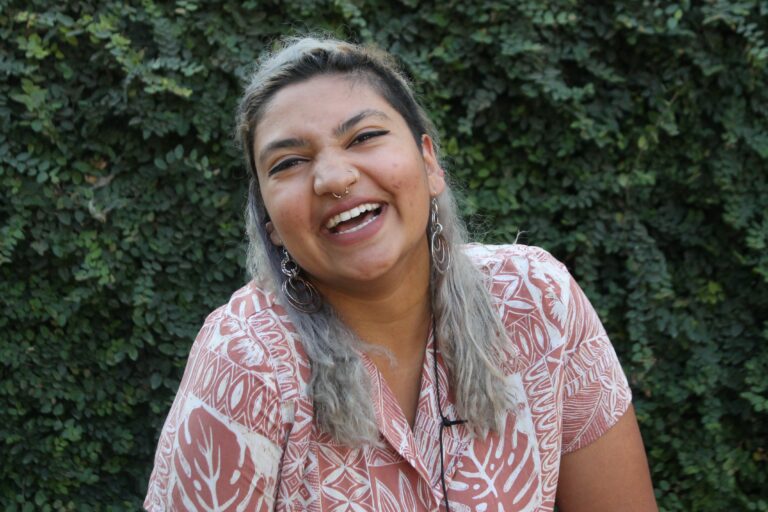
Shreya Deshpande sat on a wooden bench outside of Wellman Hall facing the quad, returning waves to students they recognized every five minutes. People come up to Deshpande, and they respond warmly, ensuring that everyone who passed by felt personally acknowledged. 

As Vice President of ASUCD, Deshpande is a people person — a skill that the position necessitates and a quality of theirs that was only further highlighted through their vice presidential position. Deshpande works to improve the lives of students, seen both in their current position and through their work in previous advocacy-centered extracurriculars — including the Whole Earth Festival, Ethnic and Cultural Affairs Commission, a fusion style dance team and Shifa, a UC Davis community-run clinic that primarily helps the Muslim population in Sacremento. 

Deshpande said they chose to get involved in these groups to work with marginalized communities, better the environment and be around people —  which were all topics that comprised their ASUCD campaign. 

They are also involved with the Mental Health Initiative (MHI), an organization that aims to educate and empower students in mental health discourse as well as offer a healing space. Desphande was unaware that the MHI fell under the purview of ASUCD when they first joined, and now they work to ensure that students are well aware of all units and commissions that ASUCD encompasses. 

“My first year I got involved with the Mental Health Initiative because I’m really passionate about mental health,” Deshpande said. “Coming from India, and a really rigorous education system, there wasn’t […] that much support from my teacher, they never really went out of their [way] to ask if students were doing okay.” 

After spending most of their formative years in India, Deshpande moved back to the U.S. their junior year of high school. Shortly after, they decided to attend UC Davis, instead of UC Riverside, which was their original plan for school. They are now in their fourth and last year of their undergraduate career, as a cognitive science and sociology double major — which was not their immediate choice.

“I came in as [NPB] because I wanted to be a doctor,” Deshpande said. “But moving through and navigating classes and feeling out what my professors were telling me about what the health field is [like], I realized that there is a lot of community-centric health care that I wanted to focus more on. That’s why I picked sociology as an add on, just to understand how different communities are disproportionately affected by these larger systems. I want to become a child psychologist for children with special needs.”

Deshpande previously ran for the vice presidential position in Winter Quarter of their second-year, but was disqualified because they missed a mandatory candidate workshop.

“I’m grateful that that happened to a certain degree,” they said. “It gave me the chance to learn a little more about how ASUCD works and I came in knowing a lot more people and knowing what different communities want and getting that year to build connections and community, which really shaped why I ran.”

In their second attempt to run for the vice presidential position, Deshpande was randomly paired with Justin Hurst — the current ASUCD president. Common interests shared between the two, such as dedication to the same slate and mutual friends, formed their relationship. 

“We had a couple of mutual friends who wanted to change up the BASED slate — the previous Gender and Sexuality Commision chair recommended that we run and we were like, ‘Sure, why not,’” they said. “Then we just started talking to different communities, we talked to different groups on campus, we were kind of everywhere to get a sense of what students really wanted to see. Especially given how toxic of a perception ASUCD had/has, we saw that there was a way to switch it up and that students who wanted to see change [should] have direct contact with executive members and Senate.”

This year, Deshpande has worked with Hurst to ensure the longevity of ASUCD, including by enacting a 10-year plan. The plan adds student manager jobs in ASUCD, roles that are typically done by an adult or administration member, to encourage more student voices and participation. 

Other highlights from Deshpande’s time in office include going completely paperless, working to resolve ASUCD’s budget deficit, proposing a constitutional amendment that would move voting to Spring Quarter and working on a fee referendum that they say would ultimately put more money into the pockets of students. 

“When Justin and I were elected, we had to find a Controller in a week and do a budget within three weeks,” Deshpande said. “We had very little time to […] learn about the $15 million budget that we have and then be able to talk to all of our units, and be like, ‘What do you want to see, and how can we best support your vision for the year and balance the budget?’ That was stressful, we don’t want to give that to the next executive team.”

Desphande also discussed the fee referendum ASUCD is currently considering, which would raise student fees allocated toward ASUCD, as these fees have not been raised in 40 years. 

“We get $8 dollars per student per quarter to pay into ASUCD, and that’s how we get our pot of money to give out to our units,” Deshpande said. “However, that [amount] has stayed the same since since 1979, when we only had 12,000 students on campus and when the minimum wage was $7 or $6. All of the money that students pay into us we give out to each of the units through the budget. We’re trying to increase that fee, which is always a concern given that we have to increase student costs. Hopefully, just talking about it will make people see that it’s necessary.”

Deshpande is also vocal about the school’s lack of communication on issues — one of the larger ones being the shift to UCPath, the UC’s new payroll system.

“I really think that the university can learn from a lot of the initiatives ASUCD and student organizations […] are doing,” Desphande said. “I get connections with campus administrators that I think so many more people should be able to get. I shouldn’t have to be the primary liaison between certain departments and the campus, especially when there are more knowledgeable people. [The payroll issue] is really big, the school needs to be communicating with students more. There are so many issues that students need to be knowing about, like when it comes to students pays and lives. Increasing transparency would be better.” 

Desphande wants students to think of them as a resource. 

“Anytime you have an idea, I’ll be down to just talk it through and hear about your experiences,” Desphande said. 

In regards to advice for the next set of executives, they suggest to simply listen and learn. 

“Talk to the previous administration, follow our 10 year plan,” Deshpande said. “Having more institutional memory is so much better for the association so we are not reinventing the wheel every time. Take what we have and grow it.”

Written by: Isabella Beristain — features@theaggie.org

UC Davis leads in innovative gene editing research with NIH grants

Researchers strive to address societal health issues through gene editing

In October, three researchers at UC Davis were awarded a $1.5 million grant to fund their project which attempts to demonstrate the effectiveness of gene editing through use of CRISPR, a powerful technology that allows alteration of DNA sequences to change gene function. 

“This kind of design can help enhance personalized medicine,” said R. Holland Cheng, a professor of molecular and cellular biology in the College of Biological Sciences. “Specific patients with specific illnesses can be treated in specific ways.”

Cheng, along with Kit Lam, a distinguished professor and chair of the Department of Biochemistry and Molecular Medicine in the School of Medicine, and David Segal, a professor in the Department of Biochemistry and Molecular Medicine, were awarded this highly competitive and sought-after grant from the National Institute of Health (NIH). 

UC Davis is part of the NIH’s Somatic Cell Genome Editing (SCGE) consortium which has awarded grants to 45 other research institutes across the nation so they can begin groundbreaking work on gene editing. Through this consortium, the NIH hopes to find an efficient and safe way to conduct gene editing. Research programs are investigating the best delivery mechanism as well as the most dynamic gene editing tool.  

The major problem with gene editing currently is the inability of cells to be edited within a living organism. It has become fairly easy and efficient to edit genes in a cell culture outside of the body but extremely difficult to do the same processes inside the body. Cheng, Lam and Segal are focused on changing this. 

“The question is how to do it inside of an animal and eventually a human,” Lam said. 

They are answering this question by utilizing Cheng’s work in engineering a non-toxic nanoparticle that they hope can transport the gene editing tool CRISPR into the cells of a living organism. Cheng has been able to create a Hepatitis E viral nanoparticle (HEVNP) that when manipulated could be a delivery system for CRISPR. They plan to take this nanoparticle and encase CRISPR inside of it, producing a mechanism for delivery of CRISPR. 

The Hepatitis E nanoparticle has the capacity to be a highly efficient way to deliver gene editing to cells in the body due to its unique nature. HEVNP is resistant to the gastric acid environment of the intestines and stomach, enabling it to survive once its entered the body. Given its resistant abilities, HEVNP can be taken orally, making it a useful form of medicine. If able to successfully get HEVNP to the target cells in the body and deploy CRISPR, gene editing abilities could drastically change. 

The addition of a cell-type specific targeting ligand to the HEVNP would code the nanoparticle to deliver CRISPR to a specific cell. The abilities of this method to be precise and safe will determine its success. 

With five years of funding from the NIH, these three researchers are eager to begin work on this project and see the strides that can be made in gene editing. They have impressive goals for this research, as it has the capacity to reshape medicine. 

“This will redefine precision medicine as currently there is broad medicine that can cause side effects to people and not be effective, yet by making it specialized it is becoming more precise and effective,” Cheng said. 

As more effective and safe tools to cure illnesses are being tested and created, the benefits to society could be expansive. With so much potential to help improve the health of society, the NIH is dedicated to coming to new solutions at a quick rate. All programs that received grants will be required to share and utilize the research occurring at other funded programs. The NIH is hoping to eliminate the private nature of research through enforcing the sharing of ideas, as scientists are often constrained by the institutions they work for. It is their hope that by having communication between the programs, positive results will arise faster.

“I think this is great because scientists inherently want to work with each other but have real world concerns especially with money,” Segal said.

The research results, when groundbreaking, can provide incredible monetary gains and credibility to the institutions that made the discovery. Ultimately, scientists collaborating with one another will serve society as people are able to benefit earlier from this innovative research.

“We want the public to know that we are working in their best interest,” Segal said. 

The NIH grant is competitive and still the third research program to join the consortium at UC Davis. Innovation has never been more prevalent than in this field at UC Davis. With three different programs researching gene editing, UC Davis stands out as a hotspot for this field of research. 

Written by: Alma Meckler-Pacheco — science@theaggie.org


Even with the best intentions, censoring books is dangerous

Censorship of ideas will always have unintended consequences

Banned Books Week is an annual campaign in which libraries, schools, bookstores and other institutions rally to show their support for books that have been censored and banned for often irrational reasons. There seems to be a very clear understanding that banning books tends to do more harm than good. Almost all the classics have been subject to censorship, even the greatest of the Great American Reads.

My interest in looking at banned books and censorship was renewed for two reasons. This past month, journalist Ronan Farrow came out with “Catch and Kill: Lies, Spies, and a Conspiracy to Protect Predators.” This book has been at the top of my to-read list since it was announced. “Catch and Kill” isn’t just a detailed account of Farrow’s experience reporting the Harvey Weinstein story for The New Yorker, for which he won a Pulitzer Prize, but also a window into the nefarious structural systems that have allowed for powerful figures such as Harvery Weinstein to remain in the public sphere with impunity. 

Then, Amazon Australia and other major Australian booksellers blocked the sale of “Catch and Kill” for all the wrong reasons.

Dylan Howard, the Chief Content Officer for American Media, is prominently featured in “Catch in Kill” for his close alliance with Weinstein. Howard’s lawyers had sent letters to Australian booksellers warning them that if they sold this book, they would also face the same legal actions as the publishers for “the defamatory imputations contained within the book.”

At the outset, this is an affront to democracy and the free press. This book was written and published with tight scrutiny for factual accuracy and the utmost journalistic integrity. But what I didn’t understand is why there was a threat to pursue legal action to get a book banned, and why there were booksellers who complied with this demand. 

Censorship and banning books are all too common among schools, parent groups and organizations looking to keep certain concepts or ideas away from children. The list ranges from “Animal Farm” to the “Harry Potter” series. The most frequent justifications for banning such books are alarmist at best and malicious censorship of unique ideas at worst.

I have always been a staunch supporter of maintaining open access to banned books in order to assure the free and open flow of words, thoughts and ideas in a democratic society. But I recently came across a new trend in which books are being banned for the purpose of inclusivity and to ensure that children won’t read material that could potentially be upsetting.

This may seem like an understandable reason to keep certain books away from children, but censorship is never that simple. Banning books because they might touch upon some difficult themes, or because they might contain damning information, is just another form of regressive censorship.  

It seems we live in a time when we have become much more concerned about the content kids and young adults consume, especially online and through different forms of media. But unlike social media posts, books are written to foster an open and frank conversation about real-life experiences so that we may understand, process and accept the raw realities of life as a part of the human experience. 

Books are meant to be openly discussed and contested in order to spark the kind of intellectual curiosity that allows for us to gain an understanding of the world in which we live. Even with the most misguided and perhaps even reprehensible content, books don’t have the same sort of virality that we see on social media. They can be openly debated and aired out in a way that isn’t possible with social media. 

I can understand the instinct that is often the drive behind banning certain books, but even if done with the best of intentions, censorship still carries unintended consequences. Often, most of the books facing censorship are the ones with diverse characters and stories.

 Books, no matter how “egregious” they may be, deserve to be circulated. In being circulated, readers are afforded the basic freedom to judge the value of a book and its meaning for themselves.

Written by: Simran Kalkat — skkalkat@ucdavis.edu 

Disclaimer: The views and opinions expressed by individual columnists belong to the columnists alone and do not necessarily indicate the views and opinions held by The California Aggie

Cartoon: Sad Blob

MARIO RODRIGUEZ / AGGIE

Davis water reaches legal limit

0

Environmental Working Group contests Davis water limit leniency

Since 2017, nearly 9% of California’s public water systems have been “out of compliance,” violating state and federal drinking water standards, according to the state’s Water Resources Control Board. While Davis has been in compliance with health standards currently, some organizations have concerns as to the safety of these regulations.

In 2016, Woodland and Davis completed a water treatment facility and intake that allowed both cities to receive water from the Sacramento River in addition to older groundwater sources. The plan was devised in 2006 in order to address water shortages and deteriorating wells. 

The project currently provides water for more than two-thirds of the urban population of Yolo County, but “in the future […] will provide approximately 85 to 95 percent of Woodland and Davis customers’ water needs in normal years,” according to the Woodland-Davis Clean Water Agency.

Residents had hoped this change would help alleviate concerns over the hardness and alkalinity of the region’s tap water, but additional issues soon arose.

The Environmental Working Group (EWG), a nonprofit activist organization that specializes in research, detected 25 contaminants — including chromium, iron, manganese, odor and boron — between 2012 and 2017 for the City of Davis. The most common sources of pollution were leaching and erosion of natural deposits. 

Davis, however, is currently within compliance “that meets or exceeds all state and federal health standards,” according to a recent City of Davis Water Quality Report

In the most recent Water Quality Report released by the City of Davis, 25 contaminants were detected and several of those were found to be above legal regulatory limits, including chromium, iron, manganese, odor and boron. The most common sources of pollution were leaching and erosion of natural deposits.

The report assured residents that corrective actions have been taken and advised: “Drinking water, including bottled water, may reasonably be expected to contain at least small amounts of some contaminants. The presence of contaminants does not necessarily indicate that water poses a health risk.”

But the Environmental Working Group (EWG) contests that the legal limits are too lenient, citing seven contaminants that currently exceed EWG health guidelines for the City of Davis. 

“The federal government’s legal limits are not health-protective,” the Environmental Working Group’s website said. “The EPA has not set a new tap water standard in almost 20 years, and some standards are more than 40 years old.”

Using data from local water quality authorities and the Environmental Protection Agency (EPA), the nonprofit organization compiled a database and created its own updated set of drinking water standards.

In its 2019 report, the EWG cited the carcinogens arsenic, nitrate, nitrite, radium, total trihalomethanes and uranium as additional contaminants of concern in the City of Davis. In addition to cancer, these contaminants have been linked to respiratory problems, birth defects, tissue damage and other serious health conditions. Children and those with pre-existing conditions are the most susceptible to these adverse effects.

To find the most recent data, monthly water quality summaries are available on the Woodland-Davis Clean Water Agency website

For more information about this report, or for any questions relating to your drinking water, please contact City of Davis Public Works at (530) 757-5686 and ask for Heather Brown. If you ever experience a problem with your water supply after hours, please call the non-emergency Police Department number at (530) 747-5400.

Written by: Megan Tsang — city@theaggie.org 

Editor’s Note: A previous version of this article stated that Davis has been a repeat offender with the most recent reports detecting high levels of carcinogens in the city’s supply of drinking water. This article has since been updated to reflect that Davis has historically dealt with contaminants, but there are no current violations. While the Environmental Working Group has its own standards to measure water quality, the City of Davis is, nevertheless, still within compliance so the article is fixed to specify and reflect the city’s current water status. The Aggie regrets the error.

Governor Newsom declares state of emergency over Kincaid Fires

0

Kincaid, Tick fires ravage California despite statewide power outages meant as proactive measure

The first flames of the Kincaid Fire were reported on Oct. 23 in the small town of Geyserville, located in northern Sonoma County. 

Calif. Governor Gavin Newsom declared a state of emergency due to both the Kincaid Fire and the Tick Fire in Southern California. The Proclamation of a State of Emergency was signed by Newsom on Oct. 25.

“A significant wind event struck California, resulting in nearly statewide red flag warnings due to extremely dangerous fire weather conditions,” The Proclamation states. “These fires have destroyed structures and continue to threaten homes and other structures, necessitating the evacuation of tens of thousands of residents” 

The Proclamation orders, moreover, that all state government agencies comply with the discretion of the Office of Emergency Services and that all citizens must evacuate when told by emergency officials. 

Five thousand firefighters worked on wildfire strike teams to put out the blazes. Tony Voight, a lieutenant engine boss for the City of San Francisco Fire Department, has worked on about 10 strike teams during his 29-year-long career as a firefighter. 

“You focus on protecting life,” Voight said, speaking about efforts by firefighters to fight wildfires against 80 mph winds. “If you protect property along the way, that’s fine. But on that first day and a half of the Kincaid Fire, it was literally just fighting the fire around the buildings, and it was going to go wherever else it goes.”

Four non-student firefighters stationed at UC Davis, along with one UC Davis engine, joined the strike teams as well, according to Nathan Trauernicht, the fire chief of the UC Davis Fire Department. 

            Longtime California resident Rick White, was evacuated from Geyserville during the Kincaid Fire. The increasingly frequent wildfires and blackouts have driven White to consider leaving not only Sonoma County but the state of California. He commented on his experience evacuating with only an hour’s notice. 

            “It was scary,” White said.  “You didn’t know whether you’d be able to come home or not. But when I walked out the back door of my house, and the fire was that close, and the wind was blowing in my face, there was no consideration to stay.”

Stress from the fires was felt on campus as well. The atmosphere was tense as the fires continued to rage and evacuation zones expanded throughout Sonoma, Lake and Mendocino counties. 

Hannah Eosma, a first-year biology major, has family located near the fires in Fort Bragg, California. Although Fort Bragg itself wasn’t evacuated, all roads to and from the town were closed, making the threat of evacuation even more daunting. Eosma spoke about how the fire negatively affected her ability to complete her schoolwork.

“Focusing was a little difficult, especially when I was trying to text my parents when the cell service was bad and when the Internet coverage was getting really bad,” Eosma said.

Eosma said classes should have been canceled for a few days so students who were impacted by the fires could spend time with family. 

 It is possible that the Pacific Gas and Electric Company (PG&E) was the reason the fire began, despite their widespread power outages at the time. Just seven minutes before the fire was reported, PG&E filed an incident report that documented a broken jumper on a transmission tower near where the fire started. 

PG&E has already been found to have started 1,500 fires in Northern California since 2014. This includes the deadly Camp Fire, which killed 85 people in Paradise, California. 

Due to the many lawsuits sparked by the fires, PG&E has declared bankruptcy.

The company stated that rolling mass blackouts could be expected for the next 10 years. 

“If [PG&E and the state] fail to reach an agreement quickly to begin this process of transformation, the state will not hesitate to step in and restructure the utility,” read a post written by Newsom on Medium over the future of PG&E.

As of Nov. 5, the Kincaid Fire was 80% contained, and all evacuation orders had been lifted. In almost two weeks, it burned 78,000 acres of land and 374 buildings. No lives were lost in the fire. 

Written by: Eden Winniford — city@theaggie.org

UCPath payment issues lead to student protests, causing administrative response

Similar issues seen when UCPath rolled out at other UC campuses in recent years 

UCPath, the UC’s centralized payroll and human resources system, completed its implementation at UC Davis in late September. Since that time, undergraduate student workers, as well as graduate student readers and teaching assistants, have reported late, incorrect or nonexistent payments. 

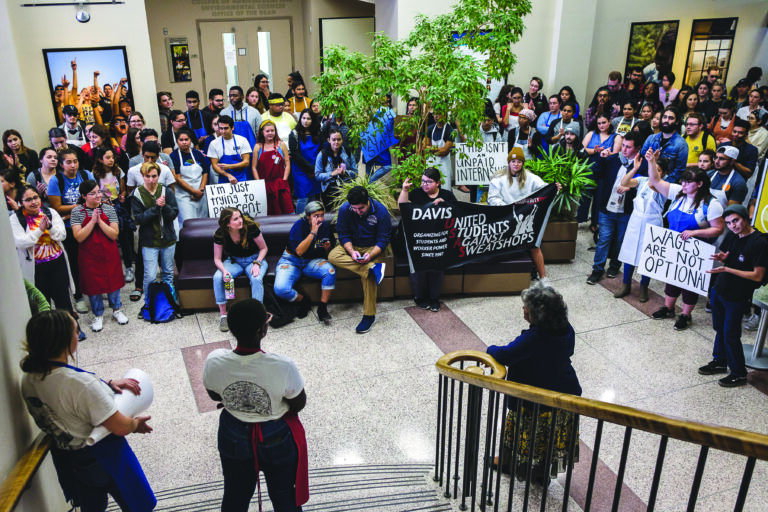
On Thursday, these issues culminated in a three-hour walk-out organized by employees at the CoHo, leading the university to announce that Chancellor Gary S. May “has directed that all student employees be paid what is owed them immediately.”

Problems with UCPath are not unique to UC Davis. Since the system was announced in 2012, it has been plagued with delays and issues at every campus it has been implemented at. The project was also significantly delayed and far exceeded the initial projected cost — while the UC claims the project cost an estimated $504 million, a state audit estimates the actual cost to be $942 million, triple the initial projected cost of $306 million.

UCPath, an acronym for the UC’s Payroll, Academic Personnel, Timekeeping and Human Resources, is an effort to consolidate the payroll systems of the different campuses into one system, headquartered in Riverside. It has been rolled out in waves, starting with a launch at the UC Office of the President in 2015. At this time last year, UCLA students were protesting payment issues at their campus. 

In March, it was announced that the UC system would compensate over 700 of its workers that had experienced payment issues — something the United Auto Workers 2865, a labor union that represents student workers, fought for. 

The union asked the university to postpone the launch date of UCPath at UC Davis, initially set for April 1, 2019, according to Thomas Hintze, the northern vice president of UAW 2865. UC President Janet Napolitano eventually announced that it would do so, citing “a large number of employee records improperly converted after several test periods.”

Despite the delay, issues with pay arose. During the CoHo’s midday rush on Thursday, the majority of employees walked out with signs and gathered outside, where they shared their experiences with spectators. Among those who spoke was ASUCD Vice President Shreya Deshpande who called it “ridiculous” that so many students had not been paid all quarter. 

Students made their way to Mrak Hall, the building that houses the UC Davis administration offices. Emily Galindo, the interim vice chancellor for Student Affairs, came downstairs to talk to the students who were shouting and chanting their complaints. She stated that out of the 3,000 students employed by Student Affairs, the majority of them are getting paid.

“Unless every student gets paid, your system is not successful,” said one of the students that organized the walk-out. 

Students called for a response from the chancellor. May, who was in Atlanta on Wednesday receiving an award for his work with Sacramento Mayor Darrell Steinberg on Aggie Square, was not present. 

Adam Hatefi, the ASUCD external affairs vice president, pointed out the fact that the administration had not communicated about the possibility of problems with payment effectively. Hintze echoed a similar sentiment, saying that “Graduate Studies could have opened up a more clear communication line with students about the issues that could happen.”

Kelly Ratliff, the vice chancellor for finance, operations and administration, spoke with students protesting in Mrak, eliciting a heated reaction when she stated, “I am UCPath.”

Before students left Mrak to continue marching through campus, they told Ratliff and Galindo that if they do not receive the next paycheck they are owed on Nov. 13, they would file for wage theft with the US Department of Labor.

 Later, in an email statement sent to The California Aggie, Ratliff said “the feedback we heard today prompted us to create a way for a student to receive emergency cash. Students can apply online for a UCPath Emergency Pay Advance. Financial Aid will expedite approval, generally the same day. Students will be notified of approval by email and can go to the Cashier’s Office in Dutton Hall to receive cash. Advances are up to $1,000, interest-free and are due on January 15.” 

Ratliff and Galindo also sent out an email to all students Thursday evening informing them of this option.

Though employees of the CoHo led Thursday’s protests, they are not the only ones affected by UCPath errors. According to Lizzie Campbell, one of the head stewards of the UAW 2865 union at UC Davis, graduate students have had a variety of issues that have led many to take extra shifts at outside jobs — taking time away from their work at UC Davis, restricting access to healthcare and leading some to borrow money from friends and family. 

Graduate students and undergraduate tutors are able to do more about the issues they face because they have a union, unlike undergraduate employees. Through the union, workers have a contract that is supposed to guarantee they get paid on time, as well as a process for filing grievances when such issues occur. The university has been more willing to work with their grievances in the past week, according to Hintze.

Hintze says he hopes the union can reach an agreement similar to the one that compensated workers last year. After seeing other campuses’ experiences with UCPath, he says the union’s aims to reach more people affected and educate them about their options has been successful. 

In addition to their education campaign, UAW 2865 also sponsored Senate Bill 698, which would ensure UC workers are paid on time. The bill was signed by Governor Newsom in October, and will go into effect Jan. 1, 2020. UC Irvine and Santa Cruz are scheduled to join UCPath before then, in December. UC San Diego is currently scheduled to implement the system in May 2020. 

When UCPath was initially announced, it was projected to be fully implemented at every campus by 2014. Issues with the system, however, have caused a significant delay in implementation.

Written by: Andrea Esquetini — campus@theaggie.org

“Art Gala” — An up-and-coming house exhibit

A trio of passionate artists making a change through their art

Beginning in Spring Quarter 2019, an inseparable artistic trio decided to make a change in the Davis art scene, starting in their own house. Creators and artists of the event, Dominic Rivetti, Axel Steeno and Gabriel Laude, who goes by the stage name Viper, will be hosting their second exhibition of “Art Gala” on Nov. 16 at 849 A Street from 2 p.m. to 10 p.m. This will be a free event, where they will be displaying, selling and creating a scene of local art that is not typically seen in town. 

“We wanted to have an event that was different from all the ones that are ‘normal’ in Davis,” Rivetti, a fourth-year anthropology major, said. “[Because of] the lack of art we found interesting around here, we felt that we had to make somewhere where people can come see art that we would want to see. We had to create what we wanted because it wasn’t here […] We’re trying to build a creative community in Davis.” 

The gala is meant to bring people out of their comfort zones — “You’ll be exposed to something different — some music you’ve never heard before, some art that nobody can just make,” Viper, a fourth-year political science major and the “motivator” of the group, explained. 

Starting at $1, artists will be selling their “hella rare” canvases and prints, according to Steeno, a fourth-year design major. With a plethora of art, music, snacks and creative people, the gala is a place for all. 

“I want it to represent youth, authenticity and creativity,” Rivetti said. “I want it to make people feel happy and vibrant. To meet friends and have a fun place to be happy and feel like there’s something really cool for them to be doing.” 

Last year’s gala was a success. While Rivetti performed his music, Steeno socialized with the crowd, explaining and displaying his art. A diverse group of people gathered in this unconventional Davis event, sharing their passion for art and creativity with one another. 

Each one of the trio have their part in making the event possible and showcasing their own creative individualism that they bring to the table. It’s ultimately a collaborative, creative and supportive experience for them all. 

“In terms of organizing it, we all just kind of do it together, brainstorm together,” Viper said. “It’s like free flow form.”

The trio has been collaborating since freshman year.

“Axel and I collaborate on almost everything,” Rivetti said. “We’ll both do our own stuff entirely, but we’ll tell eachother about it, like the methods we used, and then apply it to our own things.”

Steeno recycles old canvases from other artists and then repaints them or adds to them with his own spin. He incorporates elements from other pieces to create his own style. For example, hanging in their living room is a piece that Steeno’s mom painted, which he then added to — “[We’d] rather create than consume,” Viper said. 

“I either compose [music] using pianos, synthesizers and drums, or sample and make beats, techno or ambient music,” Rivetti said. “I just want to make people happy and be chilled out and not stressed, just have fun.”

Viper added, “You have to feel his sound.”

Art plays a vital role in all of their lives. The goal of the gala is to share that passion with members of the community. The artists stumbled on choosing one word to classify their overall genre, but then agreed on “rare” and “underground.” 

“Art you might see in cities that may not find its way to a smaller town like Davis — that’s what we want to bring,” Rivetti said. “I think if you start with house shows and start showing your art, build up from there, then start bringing it into the town of Davis itself, you can create a scene.”

The trio explained their future aspirations to progress the gala outside the comforts of their house and out into the Davis community and beyond. They hope to continue their collaborative work after graduating and travel nationwide to share their artistic talents together. 

“Davis needs a youth art scene… you want to see [an artist] who excites you,” Rivetti said. “We have styles that we found and love, we just want to share it with people, and if they appreciate it, that is really nice […] we would love to inspire people to do their own thing.”

The group encourage local artists to come to the gala, introduce themselves, show their pieces and get involved in future galas.

“If you want to be around creative energy and creative people, music and art, then come to this show,” Rivetti said. “It’s not a competition. Make a difference, try to be creative, think outside the box.”

The group highlights the importance of art in their everyday lives: How art makes them who they are, how they see the world and how they want to live. Whether it’s through classes they took at UC Davis or simply through a creative vision, they hope to continue creating and making a change. 

“Art is everything I find interesting in life,” Rivetti said. “Art makes me feel really good. It’s a way to use your energy in a really healthy way. If I’m not making stuff, I go crazy. I need it, it’s like meditation.” 

The gala is not going to be a torch they pass down to the younger generations of Davis. Rather, art is an organic process which must flow naturally, they said. If creative individuals are motivated to continue their vision, or promote their own visions, they highly condone that aspiration. 

“Everyone can look at it together, and it brings people together,” Steeno said. 

Through the promotion and continuation of the art gala in the near and distant future, “we’re going to leave our mark,” he continued. 

“If people are looking for something different to do, if people are interested in different kinds of music, art and looking to meet creative people, then come to the show,” Rivetti said. 

Written by: Sierra Jimenez — arts@theaggie.org


Comparing the live experiences of Andrew Bird and Hozier

A man and his band create intimate spaces not experienced at stadium shows 

Seeing an artist in concert is, for many, the ultimate way to honor their music and truly experience what they’ve created. The opportunity to hear a singer’s live vocals and the way they choose to convey it in person can be very special for fans, and it can add a new layer of appreciation for the artist. The production of a show is an integral part of that experience; however, the way it is executed varies a lot across genres of music. There are a wide range of musical performances one can seek out and, consequently, there is a different experience that comes along with the type of show that is put on. 

I recently attended an Andrew Bird and a Hozier concert in Davis and Berkeley, respectively. These artists can fall loosely into the indie rock and folk categories, although they both explore several other genres. The vibes of their music, however, are similar. 

In both Bird’s and Hozier’s performances, there was a fairly simple setup: the main act, the instrumentalists and backup singers in an arc behind them and a screen where images or light designs were displayed. What stuck out to me most was how central the instruments and vocals were to the show. While this seems like an obvious concept, it was strikingly intimate to me, seeing the face of each person who played an essential part in creating the music. Both artists introduced each performer on the stage and expressed great appreciation for all of them and their talents. Bird even had one of the backup singers perform one of her own songs. There was a woman playing the violin at each show as well. 

Despite the similarities between the two, they each had their own flare. Hozier’s backdrop displayed footage of protests during his protest song, “Nina Cried Power,” or black and white cartoons, while lights and colors shone across the audience for other songs. Andrew Bird stuck to geometric shapes on a screen which changed colors or patterns for every song. The visual stimulation was helpful in creating a mood for the songs being performed. People were entranced by the music and gave appropriate praise, but the energy of the concert was calm. 

That is not to say that this style of performance is better for its raw and simple nature. Artists like Beyoncé put on shows that are much more of a spectacle than a man and his band, which is an entirely different experience. Images on a screen behind the singer is a small fragment of what there is to take in at a big pop or rhythm and blues concert. 

At a Rihanna concert I attended a few years back, she sang atop several different platforms throughout the show, including a suspended glass, bridge-like structure. Justin Bieber has descended onto the stage in a cage and also performed with a group of backup dancers on a swaying stage in the air; Taylor Swift has given each audience member a light that would flash or turn on for different songs, drawing the audience into the show and Travis Scott, during his Astroworld tour, rode a real-life rollercoaster constructed in the stadium.

At these shows, the singers naturally sing the majority of the show, but dancing and captivating light effects impact the experience significantly. While the music is an essential component, there is so much more to take in other than the songs. You are watching a production, a visual arts installment, in tandem with the music. The instrumentalists are highlighted for certain songs, but they are mainly in the background. This makes sense for this type of music; a lot of it is synthesized, or not written by the artist, so it’s really just the singer who people care about. With more stimulation than a couple of instruments and a vocalist, the crowd has a vibrant energy. There are lots of screaming and dancing; people are ecstatic to be there.

Granted, the mentioned artists are all much bigger than Hozier or Andrew Bird. The size of the venue (and the budget) permits for a more elaborate show. That said, smaller artists who sing pop and hip-hop maintain a similar vibe at a show, in my experience. I’ve seen contemporary R&B singer Kehlani live a few times who, similar to Beyoncé or Rihanna, has more to offer as a performer than just vocals: she is a trained dancer as well. That, coupled with more upbeat music, creates a pulse in the audience that is also found at a big pop or R&B concert, despite there not being any hanging platforms on which to sing and dance. 

Each concert is a curated experience by artists for their audience. The personality of an artist and the genre of their music are fundamental components of their show, which makes concerts unique to each performer. With the different energy of live performances in mind, one is able to pick and choose the type of live show they want to be a part of. 

Written by: Allie Bailey — arts@theaggie.org

Humor: Unaware student blasts “Moves Like Jagger” for four hours in Shields Library

UC Davis first-year was shooting for As, but found herself shooting for the stars instead

First-year biological sciences major Anne Williams found herself in a conundrum last Thursday while studying on the fourth floor of Shields Library. 

An unknown guy materialized to take the desk behind her, wearing AirPods and basketball shorts. “Damn, it’s not playing,” she heard him whisper to himself. 

Immediately as she began to work, a familiar whistle resounded. Adam Levine soon began to serenade the shocked audience as “Moves Like Jagger” began:

“Just shoot for the stars if it feels right/ And aim for my heart if you feel like it…” 

Anne found herself checking the calendar on her phone to ensure she hadn’t been launched back to 2011.

“Take me by the tongue and I’ll know you/ Kiss me till you’re drunk and I’ll show you all the moves like Jagger…”

Anne whipped her head around, nervously looking for help. The room was empty. She knew that she should tap him on the shoulder. But he had blocked himself off from the world, nesting his head in his hands and tapping his foot to the beat of the song. It would just be rude to interrupt him. Before she knew it, it was Christina Aguilera’s verse: “You want to know how to make me smile?” 

 No, not really, Anne thought to herself. 

She sat through Adam Levine’s last command to take him by the tongue as the closing whistle signaled the song’s end. Anne let out an audible sigh of relief and realized now that she was finally able to think clearly again.

Her reprieve was short-lived as that familiar whistle began once more, a signal of her journey back to unknown horrors. “My ego is big/ I don’t give a sh-t.” 

But I do, Anne thought. She looked back at the unknown guy — he was now sending what seemed to be like a very important email. She couldn’t interrupt him. That would just be inconsiderate.

She sat through another round of the song, knowing that it would be over soon. However, the closing whistle soon bled into the opening whistle, and she started to lose track of time as one typically does when listening to “Moves Like Jagger.”
Hours passed. She wasn’t sure whether she was on the fourth or the four-hundredth listen. She had an out-of-body experience. Perhaps the last 19 years of her life were a fever dream leading up to this point.

She was aware that the sun was rising outside. She was aware that she was hungry and probably hadn’t eaten in days. But each time those thoughts came, so did “Moves Like Jagger” and she was its victim once again.

“Just shoot for the stars…”

Written by: Kelsey Stewart — kcstewart@ucdavis.edu 

(This article is humor and/or satire, and its content is purely fictional. The story and the names of “sources” are fictionalized.)

Weed is the answer to the NFL’s most glaring problem

The league owes it to its players to pursue any possibility of reducing impacts of a game this violent  

Player health and concussions are the biggest problems facing the NFL today. They limit the longevity of players on and off the field and have created a public relations nightmare for the NFL. If players are playing a sport that increases the probability of permanent brain damage and  potentially ages their brain by over 30 years, the NFL should be doing everything in its power to mitigate these issues. Luckily for the NFL, weed has emerged as a potential remedy.

Martellus Bennett estimated that 89% of NFL players already smoke weed in an interview with Bleacher Report. “There are times of the year where your body just hurts so bad,” Bennett said. “You don’t want to be popping pills all the time.”

For many players, marijuana is just a way to cope with the non-stop stress of the NFL season. Constant practicing, travel, rehabilitation and games create a hectic life for players. How are they supposed to allow their broken bodies to recover each week when they are expected to be in top shape every Sunday?

Weed, for many players, is becoming the only viable way for them to recover after their bodies break down with each game they play. After former No. 2 overall pick Chris Long retired this summer, he criticized the league’s drug policy. “We should be headed to a place where we allow players to use what I wouldn’t even call drugs.” Long said, in reference to marijuana. “It’s far less dangerous than players guzzling a fifth of alcohol and going out after a game.” 

He’s absolutely right. Countless incidents have occurred in which NFL players earn DUIs and get into bar fights from drinking, but very few have had incidents while high on weed. Alternatives to weed — like pain medication and alcohol — are far more dangerous to NFL players. For example, Aquib Talib and Plaxico Burress shot themselves in the leg while inebriated. 

Because of football’s inherently violent nature, this is a game that is always going to have a major concussion issue no matter what rules the league implements. If there is a substance that can help players reduce the effects of head trauma, then the league should pursue every opportunity to make it accessible for players.

Just last year, neurologists at the Dent Neurological Institute observed that cannabis relieved post-concussion symptoms in 80% of patients studied. The study indicates that weed can reduce the effects of concussions, so the NFL should not hesitate to act now and remove it as a banned substance. 

In a recent interview with Sports Illustrated, former Lions wide receiver Calvin Johnson revealed that he smoked weed after every game to avoid opioid prescriptions, which are frequently overprescribed to both athletes and Americans in general. The NFL has a history of fueling the country’s opioid crisis by partnering with tobacco, alcohol and pharmaceutical industries. Trainers throw opioid prescriptions at everything, with “rogue trainers” supplying Adderall, Xanax and Ambien. Football is a game riddled with pain, and as a result painkillers are celebrated in the sport almost as much as vicious hits and violence are.

The NFL’s rules on weed seem archaic, but it’s not entirely the league’s fault. These matters are discussed in every new collective bargaining agreement — the current one is up for renewal before the end of the 2020 season — between the NFL and the NFL Players Union. Current players need to start speaking out about this issue if they want tangible change instead of just skirting around the NFL’s drug testing practices. It’s only a matter of time before the NFL caves. 

Getting out in front of an obvious issue and unbanning weed could be a move similar to the NCAA’s recent endorsement decision. And the NFL would be celebrated for it. There are currently over 30 states that allow the use of legal marijuana for medical or recreational purposes — the NFL would just be joining the majority of the country.

Josh Gordon has been the poster child for weed-related discipline in the NFL. When Gordon finally got to the NFL he broke records in his second season, but his first team all-pro season would end up being the height of his achievements. Over the next two seasons, Gordon would receive two separate indefinite suspensions for failed drug tests. Gordon is the perfect example of all of the conflicting issues the NFL has right now. He is an explosive player who has talent that few receivers have ever possessed. However, because the NFL has been such sticklers against weed, the league squashed what could’ve been the prime of his career.

In a game that creates brutal violence on the field every week, it seems obvious that the NFL would do anything in its power to relieve the pain of its players. The fact that the NFL hasn’t is a major failure on its behalf. The league must limit restrictions on weed so that its players have the opportunity to recover from the brutality they face every Sunday.

Written by: Calvin Coffee — cscoffee@ucdavis.edu

Disclaimer: The views and opinions expressed by individual columnists belong to the columnists alone and do not necessarily indicate the views and opinions held by The California Aggie

A crucible in design, the evolution of campus architecture

Design professor Mark Kessler discusses history, influence of different architecture movements, from Arts and Crafts movement to the Bauhaus

Students continuously interact with the layout of campus as they bustle around, plug away at Shields Library and meander through the Death Star. Through this repetition, students can become indifferent to the architecture, as it becomes an extension of their routine during a relentless quarter schedule. In spite of this, the campus’ architecture is filled with a colorful and diverse history that illustrates the push and pull tension between different architectural design beliefs.

Campus history spans over a century and begins with the wooden conservative structures of the early 1900s like the Barn and moves to the present, showcased by the flashy, contemporary California Hall. When strolling through campus, buildings representative of a variety of architectural phases — from older wooden buildings of the anti-capitalist Arts and Crafts movement to more open ambitious structures influenced by Postmodernism — can be found.

Mark Kessler, a UC Davis Professor of Design and licensed architect, discussed the different design forces of the campus’ development, beginning with the earliest buildings and moving through his descriptions and insights chronologically as the UC Davis campus unfolded.

“The earliest buildings on campus really had a shingle style that was Arts and Crafts based,” Kessler said.

Typified by buildings like the Barn, the Arts and Crafts movement, which originated in Britain and spread to North America between the 1880s to the 1920s, utilized a wooden shingle-clad structure and welcomed embellishment. The movement sneered at the explosion of industrialization occurring at the time. In direct opposition, the Arts and Crafts touted artisanship, rather than the businessman’s efficiency.

William Hayes was a major contributor to on-campus architecture and a professor of architecture at UC Berkeley who sought to shape his buildings in the context of Californian history and culture. Hart Hall is a prime example of an ode to popular styles of years past. 

“In Hart Hall, you see a conservative architecture, regionally based and ornamented like a kind of Spanish mission revival style by the same architect William Hayes,” Kessler said. 

Kessler also commented on architects adorning their buildings with superfluous details — a popular trend at the time

“In the industrial age conservative architects continue to apply ornament to what were modern efficient structures,” Kessler said.

In 1940, Hayes embraced a more contemporary viewpoint on architecture by applying art deco principles to Peter J. Shields Library.

“[With] Shields, Hayes dips his feet into Art Deco a little bit without much conviction, but Shields represents for him and his work an advance to a more contemporary aesthetic,” Kessler said.

Hayes was inspired by Art Deco’s attraction to geometric patterns for the library’s use of rectangular shapes to frame windows and provide quirky embellishment. This is evident in the many translucent block windows at Shields — bearing a resemblance to a set of ice cube trays.

In the 1950s and 1960s, campus architecture embraced modernism, a trend sweeping the nation. Modernism, made famous by architects like Charles-Édouard Jeanneret (commonly known as Le Corbusier) and Mies Van der Rhoe, pivoted to maximizing the utility of a structure, while remaining authentic to material and function. They claimed to value the beauty of simplicity in lieu of extravagance. 

Modernism of the 1950s and 1960s assumed a major debt to the Bauhaus (Building House), a small design school in Dessau, Germany. Founded by architect Walter Gropius, the Bauhaus opened in 1919 at the close of World War I, and then closed on the eve of World War II due to political pressures from the Nazi regime. 

The Bauhaus shaped products and buildings with a high regard for function and efficiency. In its fleeting 14-year lifespan, it housed distinguished artists and designers like Paul Klee, Marcel Bruer and Wassily Kadinsky and completely reshaped how designers approach their craft.

During this time, architects chose to accentuate aspects crucial to the structural integrity of the building instead of disguising them in decorative trappings. 

“Most of the buildings on campus that express aspects that go back to European modernism, and ultimately the Bauhaus, would be buildings like Kerr or Wickson,” Kessler said. “There are many built on campus during that time that have this structure and infill expression. That is a similar tendency to find integrity in that distinction and to express it efficiently to find beauty and proportion.”

Partaking in the mass modernist movement, architects hired by UC Davis shaped buildings to reflect learning and academia.

“I think an argument can be made that these buildings signify a kind of technocratic competence in their regularity and their rationality,” Kessler said. “They mirrored what was going on inside. This was all about learning and knowledge and the application of science and the search for truth and that in creating these rational pavilions that this was the appropriate institutional architecture for a campus.”

These architects believed that imposing rationality on design would compliment and elevate students’ learning. The reliance on function and cookie cutter styles for crafting buildings can lead to lackluster final product.

“I would say that they fell short in ways that all of these buildings on campuses all over America fell short, which is that they locked into a formula, a template for an academic building and reproduced it ad nauseum,” Kessler said. “The variation is not really enough to sustain interest for the ages and really they become part of the great critique perhaps first launched by Robert Venturi, which is that it is a bore.”

Students who spend their time filtering in and out of the many modernist-inspired buildings on campus echo this sentiment. Nathan Lemus, a fourth-year cognitive science and Spanish double major, summed up his opinion of these buildings in frank terms.

“They are actually pretty horrendous to look at,” Lemus said. “I am not a fan. They all look very basic.” 

Under the direction of Venturi and other architects like Frank Gehry, contemporary styles of architecture broke away from the rigidity espoused by the Bauhaus. Architects began to further experiment with ambitious and eye-catching displays that contrasted the modernism of the 50s and 60s. Some of the more recent buildings constructed on campus attempted to be less austere and more daring. 

Kessler discussed how the patrons’ freedom was a central component to the design of both the Social Science and Humanities building and the Manetti Shrem Museum of Art.

“It was important to them to liberate the circulating wandering person and let that person discover on their own how to use the buildings,” Kessler said.

The Social Science and Humanities building — nicknamed the Death Star because of its similarity to the weaponized planet in the “Star Wars” trilogy — alludes to this new direction of freedom in design and layout. Those who have perused the building understand that navigating the concrete alleyways and winding staircases is not for the directionally challenged. The Manetti Shrem Museum also attempts to free their patrons by permitting them to explore the building without specified direction, however, it is considerably more intuitive than SSH due to its smaller size and single-floor layout.

Even though the Social Science and Humanities building is commonly equated to an unconquerable maze, Kessler still admires the ambition of the architect, Antoine Predock, in attempting to move against the grain of traditional campus administrative buildings.

“We’ve all gotten lost in that building and it’s a travesty,” Kessler said. “However, unlike most people who just say it’s a travesty, […] I acknowledge that I’m mindful of a talented architect who tried to offer an alternative vision, and it makes me smile sometimes just that someone took a risk that big.”

Students who do not care for the design intention of the building are often quite frustrated with Predock’s design decisions.

Lemus commented on his experience trying to find his way around the Death Star.

“I usually only have 10 minutes so I don’t have much time to go through your jungle gym of architecture,” Lemus said.

The Social Science and Humanities building symbolizes a design struggle persistent in time; one between an architect’s desire to give and find meaning in their building and the execution of its technical purpose. 

“Some architects would argue that buildings should reflect the complexity of our lives,” Kessler said. “It becomes rooted in the complexity of modern existence.”

Although UC Davis architecture is often seen as underwhelming by its community, it still embodies an intriguing ebb and flow of design movements. When this is taken into account, one can find a greater understanding and appreciation of the buildings that make up our campus.

Written By: Andrew Williams –– arts@theaggie.org

ASUCD elections website fails to show constitutional amendments to Tuesday morning voters

Early voters’ anonymity compromised as Elections Committee emails students directly, asking for their votes on four ballot measures

The ASUCD elections website failed to show the entire ballot for the first voters in this Fall Quarter’s elections early Tuesday morning on Nov. 12. Called a “procedural oversight” according to an email sent by the Elections Committee to The California Aggie, the webpage failed to display proposed ASUCD constitutional amendments. Voters were able to cast their ballots for prospective senators without complications.  

Following what has already been an election season with significant setbacks, including the absence of an elections chair or elections committee, this most recent misstep has compromised student voters’ anonymity and has the potential to significantly impact the outcome of the election.

In response to this malfunction, the Elections Committee’s emails to individuals affected asked them to respond with their decisions on the four proposed constitutional revisions via email. Asking students to vote via email contradicts the ASUCD Bylaws, which state, “Members of ASUCD can only cast their ballot on the official ASUCD Elections website.” The bylaws also state that any ballot measure “will be listed before the candidate listings.”

Students impacted also had the ability to go back onto the original elections website and vote for constitutional amendments once the option was added later in the day. If a voter were to vote both via email and online, they would have potentially been able to vote on each constitutional amendment twice. Further, the decision to contact voters gives the Elections Committee explicit knowledge of some voters’ ballot choices, eliminating the integrity of what should have been secret ballots.

“The Elections Committee and its members are committed to being impartial administrators of the ASUCD Elections, which includes safeguarding the security and integrity of each and every student’s vote,” said a statement from the Elections Committee via email. “To ensure maximum security all returned votes will not be opened until the day after the end of the elections, when the Elections Committee oversees tabulations.”

Beyond the anonymity of affected students’ votes on these ballot measures being compromised, this glitch has the potential to impact the outcome of the election.

Among the four proposed constitutional amendments, Constitutional Amendment #62 would create a Worker-Student Commission (WSSC). The vote on this amendment comes less than a week after student workers staged a walk-out over UCPath’s failure to deliver payments on time and also coincides with the sixth strike in recent memory organized by the AFSCME Local 3299 union over alleged unfair labor practices by the UC.

Constitutional Amendment #59 would change Winter Quarter ASUCD elections to Spring Quarter.

In order to impose more constitutionally-established checks on ASUCD elected officials, Constitutional Amendment #61 would introduce the process of impeachment and removal of elected officials from office to the constitutional framework in the case of gross misconduct or inability to perform an elected role.

Constitutional Amendment #60 would reform the structure of the Judicial Branch of ASUCD, which amendment authors hope would allow the Judicial Council to serve as both a greater check on ASUCD and give the ASUCD Bylaws more authority.

Ko Ser Lu Htoo, a third-year political science and international relations double major and chair of the BASED party, weighed in on the progression of this elections period.

Recognizing ex-officio members of the ASUCD Senate jumping into the roles of Elections Committee members at the last minute, Htoo was understanding about the many challenges this quarter’s elections have troubled through.

“These are the duties of the Elections Committee and we can say they’ve failed to do that, but this is the first time they picked up a role they didn’t even ask for,” Htoo said. “It’s imperative that we understand they are doing the best they can and they worked really hard for the past week making sure the elections go forward.”

With historically low voter turnout during ASUCD elections coupled with a lack of advertising of this quarter’s elections, this additional glitch has potentially excluded a number of early voters from exercising their right to vote on the proposed amendments and may play a role in whether or not they pass.

Written by: Ally Russell — campus@theaggie.org 


Police Logs

0

Illegal bush trimming?

October 24

“East side of the pond near [the] bird sanctuary, large tree down blocking the bike path.”

“Vehicle parked in bike lane.”

October 25

“Male on a ‘jump’ bike was stopped in area where plants are overgrown and carrying a bag. Subject looked at reporting party’s neighbor and fled on bike. Seemed suspicious.”

“Unitrans red double decker bus driving into oncoming traffic.”

“Transient man tearing apart a jump bike.”

October 26

“Transient riding a bike and pushing along another bike.”

October 28

“Aggressive Akita dog running loose on Belmont.”

“Traffic light out for past two days, cars traveling on Anderson are not stopping.”

“Reporting party was walking into the reporting party’s apartment [and] bumped into a subject, the other subject seemed very upset and has been verbally aggressive towards the reporting party.”

“Subjects yelling like having a party.”

October 30

“Male trimming bushes with a saw on the greenbelt.”

October 31

“On north side of Blanchard facing Harvest, second night in a row, vehicle is there with loud music. Subject gets out of vehicle, into trunk to retrieve a bag and enters construction zone.”

Aggies dominate Fullerton in Big West semifinal

0

UC Davis men’s soccer advances to third straight conference final game

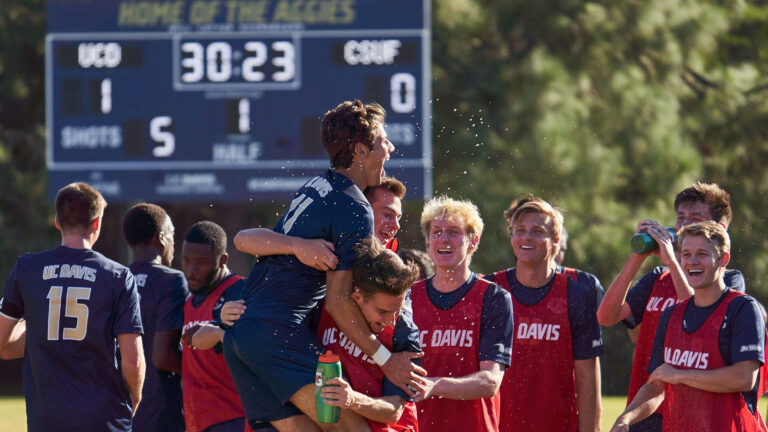
To say the Aggies were ready for their first postseason game would be an understatement. The UC Davis men’s soccer team played arguably its most complete game of the year on Saturday, completely overpowering the visiting Cal State Fullerton Titans from start to finish in a 2-0 victory. The win sends the Aggies to a third straight appearance in the Big West conference tournament final, where UC Davis will host UC Santa Barbara on Friday, Nov. 15.

Perhaps a full week of rest was just what the Aggies needed following a grueling regular season in which UC Davis managed to amass 11 wins and clinch the top spot in the Big West. The Titans, on the other hand, finished fifth in the table and had to get past a quarterfinal matchup at Cal Poly on Nov. 6 to advance to Saturday’s semifinal. 

Fullerton blanked the Mustangs 2-0 to capture its fourth victory in five games heading into the showdown at UC Davis. The only loss in that stretch was at the hands of the Aggies, when UC Davis took down the Titans 2-1 in overtime. Given the competitive nature of this previous meeting, many expected Saturday’s rematch to be another nail-biter. But UC Davis made sure that there would be little drama this time around.

In front of a lively crowd at Aggie Soccer Field on Saturday, the Aggies wasted little time to impose their will on the visiting Titans. Senior forward Adam Mickelson recorded the game’s first shot in the fourth minute, testing the Titans with a low-driven attempt that was blocked by Fullerton goalkeeper, Paul-Andre Guerin. Just over a minute later, sophomore midfielder Emmanuel Doherty curled in a cross from the right side that met senior forward Kristian Heptner, whose header forced a diving save from Guerin. 

These first five minutes were an accurate indication of what was to unfold over the course of the entire match, as the Aggies would outshoot the Titans 25-4 when it was all said and done. Fourteen of those 25 shots were on target, giving Guerin a workout he likely didn’t want. 

On just their fifth shot of the game, the Aggies found the back of the net. In the game’s 15th minute, Heptner lofted a high, arching ball into the penalty area, where junior defender Jake Haupt was able to head the ball toward the back post. Waiting there was freshman midfielder Max Arfsten, who could not have picked a better time to head the ball in and record his first goal as an Aggie.

Haupt, who assisted on both of the Aggie goals on Saturday, complimented his teammates for being in the right places.

“First of all on the set piece — being able to flick that ball on — it was a great [ball] from Kristian,” Haupt said. “And then trusting that one of my guys is going to get on the back post to get that in the net with Max [Arfsten] — and he did a great job with that.”

The early breakthrough further fueled UC Davis’ momentum and gave the Aggie defense an opportunity to truly settle into the ballgame. The Aggie backline was quite simply impenetrable. Aided by a midfield that constantly kept the pressure on the Titans, the UC Davis defense snuffed out any and all forward advancements by Fullerton. Senior goalkeeper Wallis Lapsley only needed to make two saves the entire afternoon.

“It’s a veteran group in our defense, led by Wallis Lapsely and then Jake Haupt, […] Nabi Kibunguchy and Marte Formico,” said head coach Dwayne Shaffer. “That kind of group in our defensive side of it, they’ve been great leaders.” 

Everything was clicking for UC Davis at the halftime break. And just over 10 minutes into the second frame, the Aggies broke through for the second time.

The aggressive, high-press play style of the Aggies paid off enormously, as Haupt was able to force a turnover in the Titan third and send a pass toward goal to a streaking Mickelson. Even with Guerin charging at him, Mickelson calmly lifted the ball over the keeper and into the back of the net to double the UC Davis lead.

“I knew Adam was going to make that run,” Haupt explained. “And I knew I could play a good ball over the top and I know he’s going to finish that every time.”

Instead of resting on the two goal lead, the Aggies doubled down, turning up the pressure on an increasingly desperate Titans team and recording 12 more shots before time expired. 

The 2-0 victory was the eighth time this year that UC Davis had held its opponent scoreless. It was certainly a performance that the Aggies could feel confident about heading into Friday’s showdown with the team that finished just behind them in the Big West standings: the Gauchos. 

UC Santa Barbara enters the Big West final with a regular season record of 12-3-4 and is the highest scoring team in the conference. The Gauchos’ 13 goals in their seven conference games ranks first among among all Big West teams, and their three goals allowed in conference play ties them with UC Davis for the fewest in the Big West. The Aggies and the Gauchos squared off in Davis back on Oct. 23 when the teams drew to a 1-1 tie. 

But regardless of what team they will be facing this Friday, the Aggies will be playing determined to reverse two years of heartbreak. In each of the previous two title games, UC Davis was outlasted in penalty kicks after grinding through a scoreless contest. Now, with a third opportunity to finally win the Big West championship game and punch their ticket to the NCAA tournament, the Aggies will have to perform when it matters most. 

“You know, penalties are — they can go any way,” Shaffer explained. “And unfortunately they haven’t gone our way in the final the last two years. But we didn’t talk about it. We trained a little bit on penalty kicks, but if we take care of our own performance, and we focus on ourselves and our own performance, hopefully the games won’t go that far.”

The Big West final is set to get underway at 2 p.m. at Aggie Soccer Field on Friday.

Written by: Dominic Faria — sports@theaggie.org