55.4 F
Davis

Davis, California

Monday, December 22, 2025
Home Blog Page 395

UC Davis students can engage in ethical consumption and sustainable shopping — here’s how

Thrifting, donating, sustainable options all ways to avoid fast fashion

“Fast fashion” is a term that refers to the mass-production of cheap clothing built to reflect the ever-changing trends in the fashion industry. Stores like Zara, Forever 21 and H&M market low prices for fashionable items so that consumers will continue to purchase their clothes as new trends roll around the corner.

Constantly changing trends, however, mean that the clothes consumers buy won’t be relevant for long and the terrible quality of the clothing makes them fall apart in the washing machine. Fast fashion stores abuse cheap labor and release harmful emissions into the atmosphere.

As college students, it can be difficult not to submit to the traps of fast fashion marketing — a $7 shirt from Charlotte Russe can be hard to pass up when thinking about student loans and textbook expenses. Shopping in this way, however, is detrimental to the environment and can actually cost more in the long run. 

So how can college students combat the rise of fast fashion? 

Shop Second-Hand

Thrifting is an incredibly important trend that has taken off in recent years. Not only is it an affordable way to update your wardrobe, but it also reduces the impact of the 10.5 million tons of clothing thrown away each year and eliminates the resources used and pollution emitted when making new clothing. There are websites for buying and selling used clothing, like Poshmark and Thredup, or you can shop locally at one of the many consignment shops in Yolo County. In Davis alone, there is Bohème Hip Used Clothing, the Goodwill and the Aggie Reuse Store on campus. 

Think Before You Buy

It is important to assess how necessary a new article of clothing is to your life. Clothing production uses up an incredible amount of resources — it can take up to 8,000 liters of water to make a single pair of jeans. People should pause before purchasing a brand new pair when they may already have a few others in rotation. It can be better to have fewer articles of clothing that are high in quality and will last for a longer period of time. 

Marc Bain, in an article in The Atlantic, urges people to stop and truly consider the usefulness and quality of an item before buying it.

“The next time you buy something, spend a whole lot on it,” Bain wrote. “Enough that it makes you sweat a little.”

Shop Sustainably 

When you truly do need a new article of clothing and buying second-hand is not an option, there are ways to ensure your purchases are as ethical and sustainable as possible. Kate Fletcher coined the term “slow fashion” in an article in the Ecologist. She defines the term as “a different approach in which designers, buyers, retailers and consumers are more aware of the impacts of products on workers, communities and ecosystems.” The best way to ensure that you are shopping sustainable and ethically is to research brands before you buy from them. Consider the brand’s impact on the environment and the way they treat their workers. Here is a list of some affordable brands that fall under these guidelines to get you started. 

Donate Old Clothes 

When you throw away clothes, they decompose and release landfill gases, a mixture of toxic pollutants like carbon dioxide and methane. Donating clothes to those in need is a way to give an item a brand new life. While donations to the Goodwill or Salvation Army are always accepted, there is no guarantee that they will end up being reused. One option is to donate clothes directly to those in need, such as crisis centers or women’s shelters. Women Escaping A Violent Environment (WEAVE) is a service for survirors of domestic violence and sexual assault in Sacramento that takes donations of used clothes at their WEAVEWorks Recycled Fashion center, located at 2401 Arden Way, Sacramento, Calif. 

Additionally, there are some major brands that have implemented recycling initiatives of their own. Nike, North Face and Patagonia all accept donated clothes and shoes and upcycle them. 

If major fashion brands are not going to focus on sustainability, then it’s up to the consumers to make thoughtful choices when shopping.

Written By: Alyssa Ilsley — arts@theaggie.org

Thrift shopping offers a more affordable option for sustainable clothing

0

ASUCD Aggie Reuse Store employee, members of Aggie Trading Post talk about the sustainability, trendiness of thrifting

In recent years, more and more people — such as fourth-year communications major Lee Chisholm and fourth-year design and communication major Claire Ongaro — have made efforts to minimize fashion waste and make more sustainable choices. Chisholm and Ongaro are two of the founding members of the Aggie Trading Post, a newly-registered organization on campus. 

Chisholm, the president of the Aggie Trading Post, was inspired by a friend at UC Santa Barbara who was collaborating with the Isla Vista Trading Post to reduce clothing waste. 

“I reached out to her and was so, so inspired by what she was doing and I thought we could totally have this on Davis’ campus,” Chisholm said. “So I worked with her to open the second branch — the Aggie Trading Post. It’s been really incredible.”

With articles such as “DeWanda Wise, Star of ‘She’s Gotta Have It,’ Goes Thrift Shopping” published in The New York Times and a slew of YouTube content producers posting “thrift hauls,” there has been an increase in the popularity of thrifting in 2019. This movement was bolstered by added awareness of ethical and environmental concerns surrounding fashion companies — particularly fast fashion companies, according to Chisholm. 

“I think it’s not only for monetary reasons, especially for younger people [around] our age,” Chisholm said. “I also think that we’re increasingly becoming more aware of the negative environmental and social impacts of fashion and fast fashion. I think that the more aware that people are becoming, the more they’re choosing to shop at used and recycled clothing places.”

Chisholm also said it is important that thrifting and buying recycled clothes is more environmentally friendly than shopping at more expensive sustainable stores.

“We’re at a time in the world of fashion where you don’t have to be the last person to wear your clothes,” Chisholm continued. “Even if you’re over something, you can just go and give it new life.” 

The Aggie Trading Post held one event in Downtown Davis in spring 2019 and will be having its next one on Nov. 2. Attendees who donated a piece of clothing were allowed to take three home with them — Chisholm described a scene of attendees wandering around, clutching many items, unsure of what they wanted to take. 

“My favorite part is seeing on just how small of a scale we can actually make a difference with recycling clothes,” Chisholm said. “It’s so awesome. [Our first event] created that buzz [that] used clothes can actually be really cute; they can actually be really good quality. You don’t have to just toss your clothes away after one season of them.”

Ongaro said the group was not expecting as many donations as they received. She said this was probably in part due to increased awareness of the issues surrounding fashion and the following push for thrifting and upcycling.

“I hadn’t even thought about it until last year,” Ongaro said. “I took a sustainable design class. My eyes were opened to everything that’s happening in the world and it’s such a big problem in developing countries. It’s empowering people to make a change through their everyday consumerism.”

Helping the environment is just one reason why the Aggie Trading Post recommends thrifting; every item they carry has a history which makes thrifting and upcycling that much more special.

“Secondhand pieces of clothing are always fun to think about,” said Ella Jackson, a third-year design and communication double major and the design director for the Aggie Trading Post.  “Who was the person that was wearing this before I was? You’re not only saving a little bit of money, but you’re also buying someone else’s story.”

The next step for the group is to become philanthropically involved: they hope to give clothes to organizations that help women get jobs. The organization’s philanthropy chair will be working on that initiative this year. 

“We’re thinking about donating those things that we don’t end up giving away to places in need in Sacramento,” Ongaro said. “They have a […] donation center for women who want to apply for jobs and give [them] access to free business attire.”

Also on campus is ASUCD’s thrift store — the Aggie Reuse Store. The store started in 2011 as the project of two design graduate students and became an ASUCD unit in the spring of 2011. Originally located in the MU, the store eventually moved to its current location in front of the Silo. Fourth-year animal science major and Aggie Reuse Store upcycling lead Antoinyse Chavez works to educate the community on being resourceful to minimize waste.

“My goal and objective as upcycling lead is to provide guidance and structure for the upcycling team and all of its interns,” Chavez said via email. “We do this by hosting upcycling workshops at the Eco Hub teaching folks how to upcycle, sew and repair clothing and so much more. Not only does this help the environment by diverting waste from landfills, but it’s a great way to be creative!” 

Chisholm acknowledged that it’s not always feasible to buy everything sustainably — there are sustainable brands for underwear, for example, but often they are too expensive for college students. For other items of clothing, Chisholm recommends looking at places like Goodwill first. She recalled searching for a particular style of pants online and, after she couldn’t find them, she went vintage shopping and found exactly what she was looking for.

“It just really hammered it into me,” Chisholm said. “I was like, ‘Yes, that’s right. I should have looked here first. I don’t even know why I was looking somewhere else.’ I think people find it daunting to go to thrift stores and search through everything. And of course, there’s really crappy pieces out there and it takes a long time, but there’s also places like Buffalo Exchange and Goodwill, where it’s a more curated store and they have things that are super trendy right now.”

Chisholm plans to continue shopping sustainably after college and hopes that increasing awareness of ethical and environmental issues will contribute to more change in the fashion industry. The biggest problem now is that of expense. While some companies are stepping up to have more affordable and sustainable offerings — like Patagonia through its Worn Wear program — most sustainable fashion companies are extremely expensive. 

“I think that luckily as the world is becoming more aware of the super detrimental impacts of the textile industry and fashion, it seems like more people are working towards making sustainable fashion more affordable,” Chisholm said. “I’m hoping in the next 10 years that we’ll see a huge change and a huge influx of companies, brands and ideas that are working towards that.”

Claire Ongaro also works for The California Aggie.

Written by: Anjini Venugopal and Itzelth Gamboa — features@theaggie.org 

UC Davis has seen 20 deaths by suicide over the past decade, but that number doesn’t tell the whole story

A look at the previous decade’s worth of suicide statistics at each of the 10 UC campuses

This article is the second in a multi-part investigation by The California Aggie looking at suicide statistics in the UC system. As these statistics are not maintained by the UC Office of the President, The Aggie has compiled the previous decade’s worth of suicide statistics at each of the 10 UC campuses through public information requests.

Leading mental health experts say that collecting suicide data can be a critical tool in prevention efforts — UC Davis’ Executive Director of Student Health and Counseling Services (SHCS) Margaret Walter agrees.

“Any sized college or institution of higher education would want to look at public health issues such as suicide with an eye for prevention opportunities or improving response,” Walter said when asked why a public university such as UC Davis would collect suicide data.

Yet the UC does not require its campuses to collect suicide-related data, nor does there exist a “systemwide UC policy or standard on collecting suicide data,” according to Andrew Gordon, a spokesperson for the UC Office of the President (UCOP).

“There is no systemwide definiton of suicide nor policy thresholds at which suicides must be reported by a campus,” Gordon said via email. “Though campus counseling centers typically do collect this data and share with campus leadership locally.”

In order to gain insight into student suicides on UC campuses that UCOP was not able to provide, The California Aggie submitted 20 California Public Records Act requests for the previous decade’s worth of student suicide statistics at each of the 10 UC campuses.

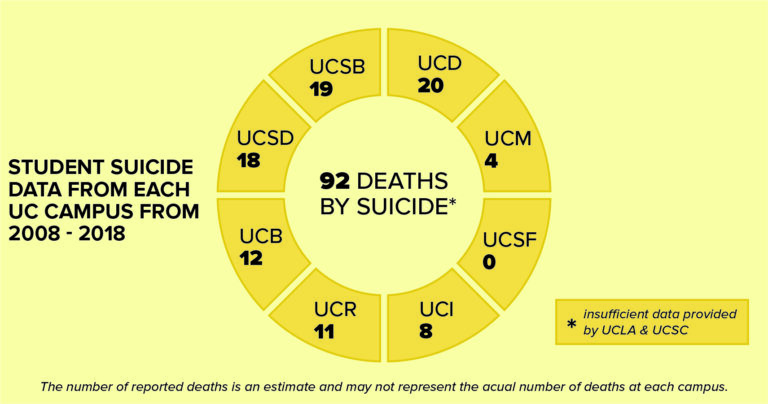
As there is no systemwide standard for collecting suicide data, the data reported by each campus cannot directly be compared. Given the responsive records submitted to The Aggie by each of the campuses, however, UC Davis was reporting the highest number of student suicides over the past 11 years — a total of 20, just one death higher than deaths reported by UC Santa Barbara and two deaths higher than deaths reported by UC San Diego. 

Some of the data provided by a few of the campuses were incomplete or insufficient, such as the data provided by UCLA that was inexplicably missing more than half of the 11 years of requested data. 

The following data is an estimate provided by officials and may not represent the actual number of suicides at a given campus.

Student suicide data from each UC campus from 2008-2018: 

  • UC Davis: 20 deaths by suicide
  • UC Santa Barbara: 19 deaths by suicide
  • UC San Diego: 18 deaths by suicide
  • UC Berkeley: 12 deaths by suicide
  • UC Riverside: 11 deaths by suicide
  • UC Irvine: Eight deaths by suicide
  • UC Merced: Four deaths by suicide
  • UC Santa Cruz: Three suicides between 2004-14. The Aggie requested data from 2008-18 and instead, a day after the print deadline for this article, UCSC officials provided data for the time period 2004-14. This was not the specific range of dates requested, and the responsive records were submitted by the university over a year after the CPRA request was officially submitted.
  • UC San Francisco: Zero deaths by suicide — a UCSF spokesperson said this estimate is correct, adding via email that “unless a suicide happens on campus, it is not included in these statistics.”
  • UC Los Angeles: University officials provided an incomplete data set, with the years 2008 through 2014 missing. There were 10 confirmed suicides from 2014 to 2018, with an additional six “possible suicides” reported during this same time period. Although numerous officials at the university were repeatedly asked to explain why the university did not provide six years of requested data, The Aggie did not receive a response by the deadline for this article.

Where is this data coming from?

As there is no systemwide standard for collecting suicide data, the data reported by each campus cannot be directly compared.

In view of the fact that the UC has no systemwide definition of “suicide,” The Aggie reached out to the Counseling and Psychological Services (CAPS) directors at each campus to request their university’s operational definition. 

Dr. Myrla Seibold, the associate CAPS director at UC Merced, sent the following response via email: “As Chair of the UC CAPS Directors I met with all the UC CAPS Directors this afternoon and everyone said that suicide is determined by a coroner.”

Once a death is classified as a suicide by a coroner, each campus has a different response protocol. At UC Davis, Student Affairs is the first campus body to receive notice from the coroner’s office and, from there, a group of campus officials is notified. 

When asked whether Student Affairs keeps a record of previous student suicides in order to document and track this information, Student Affairs Vice Chancellor Emily Galindo said via email that it only keeps a copy of the letters sent out to the families of those students listing available resources. Student Affairs does not notify families in the case of a suicide, a coroner does.

Galindo was also asked whether information collected by Student Affairs related to student suicides is used in any decision-making processes, such as in the allocation of funds for mental health services. She did not directly answer the question.

In an interview, when discussing the estimated 20 student suicides that have occurred over the previous decade at UC Davis, Walter said she does not know whether that number “really reflects the experience of our campus” because it is “simply the number that Student Affairs knows about.”

At SHCS, once officials are notified of a student suicide, they look at whether the student received services there.

“If they were served by a counselor, we would reach out to that counselor to talk to them,” Walter said. “We also do a chart review if the student was served here to look and see [if] they followed up. We just want to know if there’s any opportunity to work on prevention.”

What does this data mean?

There are a number of reasons why the data reported by the campuses varies so widely.

“If one college was more diligent than another in tracking numbers, it could appear to have a crisis on its hands when, in reality, another institution could have equal or higher numbers,” said Chris Brownson, the associate vice president for student affairs and director of the counseling and mental health center at the University of Texas at Austin, in a 2018 article from Inside Higher Ed. 

Additionally, there is no standard detailing when a university should — or should not — count a student suicide as such. This means that there may be certain circumstances, such as a school break or a leave of absence, which might disqualify such a death from being recognized by a university. 

“Not all suicides happen on site, so should they be counting that or not?” said Dr. Jane Pearson, the National Institute of Mental Health’s (NIMH) special advisor to the director on suicide research. “Do you want to count over the summer? How many months after somebody graduates? I don’t know if anybody has come to some consensus on how those should be counted.”

Officials from campuses including UC Davis and UC San Diego said that any death of a student by suicide, classified as such by a coroner, would be recognized, regardless of the circumstances. This was not the case, however, at UCSF which recognizes only deaths that have occurred on campus. In 2018, approximately 15% of UCSF’s total student population lived on campus, according to a university spokesperson.

Because there exists virtually no standards at any level regarding the collection and reporting of this data, it becomes challenging to accurately assess the importance of such information. Proponents of collecting this data, however, affirm and emphasize its importance.

“Something as simple as reporting [is] fundamental to […] understanding what happened at the end and being able to look back and figure out what happened over the rest of that time,” said Paul Gionfriddo, the president and CEO of Mental Health America, a long-standing mental health advocacy organization. “That’s how people need to look at this.”

Currently, though, if UC Davis wanted to assess the numbers it had on file, it would not be as easy as pulling up a spreadsheet. 

If pressed, Walter said Student Affairs “could probably go back and look at all of the emails they’ve sent” to assess student suicide in recent years. Adding the SHCS could, if asked, look at their files as well, but “it’s something we’d do detective work to go back and find.”

The number for the 24/7 National Suicide Prevention Lifeline is (800) 273-8255.

Written by: Hannah Holzer — campus@theaggie.org 

Suicide rates are rising. Why doesn’t the UC mandate the collection of suicide data?

Suicide data can be essential information, but public universities aren’t required to collect by any state, federal bodies

This article is the first in a multi-part investigation by The California Aggie looking at suicide statistics in the UC system. As these statistics are not maintained by the UC Office of the President, The Aggie has compiled the previous decade’s worth of suicide statistics at each of the 10 UC campuses through public information requests. 

Patti Pape lost her son Eric Pape in May 2017 when Eric, a student at UC Davis, died by suicide. Since then, Patti Pape has become an advocate for increased access to mental health resources, talking at churches and schools, attempting to influence public policy and speaking with local representatives.

Patti Pape was “horrified” to learn that the UC system has no official policy nor standard on collecting suicide data. There is also no systemwide policy on the collecting and reporting of this data nor is there a systemwide definition of suicide — information that was discovered through an independent investigation conducted by The California Aggie and disclosed by Andrew Gordon, a spokesperson for the UC Office of the President (UCOP).

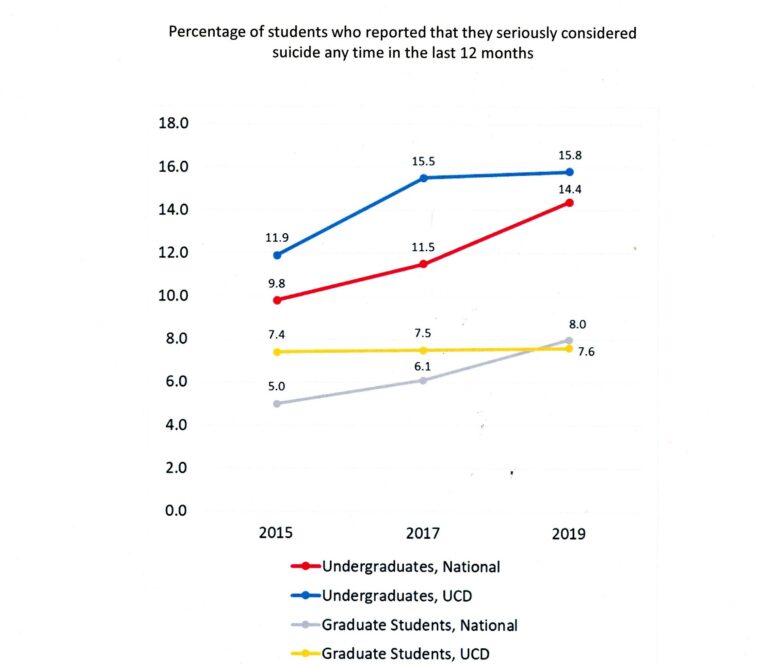
At UC Davis, 15.5% of undergraduate students had seriously considered suicide at any time over the last 12 months, according to a report from 2017. This rate is higher than the national average of 11.5% of undergraduates over the same period, according to a copy of a survey administered to UC Davis students last year as part of the American College Health Association’s National College Health Assessment. In 2019, that number rose on campus to 15.8%, compared to 14.4% of undergraduates nationally.

UC Davis has had 20 suicides in the past decade — a number obtained by The Aggie through public records requests. This number was gathered by university officials using information from the UC Davis Police Department and the Office of the Vice Chancellor of Student Affairs, according to Julia Ann Easley, a spokesperson for UC Davis.

The number may not represent the actual number of student suicides at UC Davis over the previous decade. It is based upon deaths classified as a suicide by the county coroner who then notified UC Davis Student Affairs. 

As Student Affairs does not keep a database of this information on hand, the number 20 was determined by university officials in order to complete The Aggie’s record request. When asked, officials from the university’s Student Health and Counseling Services said they had not previously heard this number, as it seems the data had not been put together in such a manner before now.

Additionally, UCOP does not have access to this information as it “does not maintain” suicide data, according to an official with UCOP’s public records office. 

For Patti Pape, the lack of a systemwide standard for collecting this data “is not acceptable.”

“It doesn’t make sense that we have this national problem with suicides and the UC doesn’t feel they should be keeping statistics,” she said. “Not knowing where we’re going, where we came from and our history is just going to cause us to make the same mistakes over and over. Reform is necessary in order to keep our children healthy and alive. If you don’t know [your history,] you’re bound to stumble and have a crisis at some point.”

Why is it important to collect suicide data?

Experts say suicide data can be invaluable information for administrators. Dr. Jane Pearson, the National Institute of Mental Health’s (NIMH) special advisor to the director on suicide research, said in order “to change anything, you have to measure it.”

“For a lot of advocates who are very passionate about wanting to prevent suicide, if they’re not measuring it, you don’t know if all that energy and passion is going in the right place and it becomes a huge opportunity loss,” Pearson said. “It might make them feel better and it might create some awareness, but if it’s not really changing somebody’s trajectory, it’s hard to say whether that’s the best investment because we have limited resources and limited time to track that investment.”

When asked if she thought schools and universities should publicly publish suicide data, Pearson said ultimately, it’s up to the insitutions.

“You can’t force them,” she said. “If you’re looking for a school that uses data to do better, that’s a good thing.”

Mental Health America (MHA), the nation’s longest-standing mental health advocacy organization, strongly supports the collection of suicide data in a standardized way.

“If we collect good data about the ultimate stage four event — which is losing one’s life to a mental health condition, usually that’s gone untreated — we can do a much better job in the future of changing trajectories of lives before people get to these crises stages,” said Paul Gionfriddo, the president and CEO of MHA. “It starts from understanding what’s happening […] in order to be able to quantify the benefits we can get from intervening earlier.”

Universities aren’t required to keep suicide data. But should they? 

There is no mandate, at either the federal or local level, requiring that public universities collect or report suicide data. 

An official with the California Department of Public Health confirmed to The Aggie that the department does not require universities to report student suicides nor does the department collect this data from universities.

Given that there is no requirement for schools to report this data, there exists, then, a discussion over whether there is any incentive for universities and schools to collect the data in the first place — as well as whether there is an incentive for them to do the exact opposite and not collect the data at all.

“Many schools are tracking this data, they just have no intention of sharing them outside of the school,” said Dr. Victor Schwartz, the chief medical officer of The Jed Foundation, a non-profit organization focused on suicide prevention for the nation’s teenage and young adult population.

Schwartz, who formerly served as the medical director for New York University’s counseling services, continued to say that this data does, for the most part, exist, but it’s just not released to the public “because there’s no incentive.”

Most of the country’s large universities don’t track this data or, if they do, they do so in an inconsistent manner, according to a 2018 investigation done by the Associated Press.

The AP “asked the 100 largest U.S. public universities for annual suicide statistics and found that 46 currently track suicides, including 27 that have consistently done so since 2007. Of the 54 remaining schools, 43 said they don’t track suicides, nine could provide only limited data and didn’t answer questions about how consistently they tracked suicides, and two didn’t provide statistics.”

Based on the findings, the 100 universities examined by the AP were split into four categories: schools that don’t have statistics or don’t consistently collect them, schools that did not provide statistics, schools that provided limited data but did not answer questions about the consistency of their tracking and schools that currently keep statistics on student suicides.

Of the six UC campuses examined for the study, all six — UC Davis, Berkeley, Irvine, Los Angeles, San Diego and Santa Barbara — were placed in the fourth category: schools that do keep statistics. 

Collin Binkley, a reporter from the AP who worked on the report, responded to a request sent by The Aggie asking how the publication decided to categorize UC Davis, among the other UCs listed, in this way. Binkley forwarded a completed CPRA request from the UC Davis public records office listing student suicides from 2006-2017 (there were a total of 25 deaths during this time period).

The responsive records Binkley received were formatted in a manner identical to the format of the responsive records received by The Aggie. In both instances, the responsive data was gathered from the UC Davis Police Department and the Office of the Vice Chancellor of Student Affairs.

“It is important to note that the Police Department only holds information on those cases to which they respond, and Student Affairs data is only noted once a death has been confirmed by a coroner,” the email sent to Binkley from the public records office stated.

By comparison, the eight California State University campuses examined for the study — Sacramento, San Luis Obispo, Pomona, Fullerton, Fresno, Los Angeles, Long Beach and Northridge — were placed in the first category: schools that don’t have statistics or don’t consistently collect them.

“We do not collect this type of data. No policy mandates it,” said Hazel Kelly, a representative from the CSU Chancellor’s Office, via email.

While there are no policies or requirements to report this data currently, Schwartz said there have been efforts on a state level to collect and publicly report this data, but there are also fears that there may be “perverse outcomes” from enforcing a mandate of this kind.

  “If schools know that they’re going to have to report the number of suicides on campus, it may change the threshold for trying to force students who have suicidal ideations out of school with the thought that, “‘Well, if a death occurs off campus it’s a tragedy, but it’s not going to be on our statistics,’” Schwartz said. “Schools might wind up spending some time trying to game the system […] by making their statistics look as good as possible rather than doing what’s in the best interest of the student.”

Indeed, a class-action lawsuit filed in 2018 accused Stanford of discriminating against students struggling with their mental health by attempting to convince them to take a leave-of-absence and return home, rather than providing treatment through the university’s on-campus resources.

Schools and universities might fear they will be blamed for a suicide, Gionfriddo said, but this fear should not be a reason for inaction. When it comes to the collection of suicide data by institutions in a standardized format, Gionfriddo believes this is an obvious and necessary action. 

“We need to press upon anybody who interacts with younger people [that] this data should be collected, it should be reported, [it] should be standardized and we shouldn’t be afraid to do that,” Gionfriddo said. 

When asked whether she believes UCOP should implement a policy requiring that UC campuses collect and report this data, Margaret Walter, the executive director of UC Davis’ Student Health and Counseling Services, said she thinks about suicide data as parallel to the collection of data responsive to the Clery Act and the subsequent confusion this information sometimes causes when it is publicly released. The Clery Act is a federal statute requiring that colleges and public universities disclose certain campus crime statistics.

“The Clery data […] would never encompass all the issues of interpersonal violence that happen to our students in a given year [and] it only reports the numbers that were disclosed,” Walter said. “Having that number highlights the need to work on prevention and response to that issue, but it also creates a lot of confusion as parents look that number up when their children are applying for school and think that it means, ‘Oh, UC Davis and UCLA are different because these numbers are different.’ When really, you can’t assume that.” 

Commenting on the university’s most recent release of Clery Act data, Sarah Meredith, director of the Center for Resources, Advocacy and Education, said in a previous article in The Aggie that statistics released through the act do not necessarily reflect the actual number of instances of a certain reportable event. For example, sexual assault numbers are not “necessarily reflective of the entire number of sexual assaults that occurred in a given year,” instead representing those campus community members who “felt they could disclose their experience to someone who happened to be a [mandated reporter].”

Walter said she believes tracking suicide data might “encourage more dialogue which could benefit prevention and response” which she sees as a positive, but because the data might always be “inadequate, it might also create confusion.” 

Suicide rates in the U.S. are rising. What role can statistics play in prevention?

Suicide rates have gone up 30% in half of the states in the U.S. since 1999, but the changes in rates of suicide and suicidal ideation are perhaps the most pronounced among college-aged individuals.

Suicides among individuals aged 18 to 25 increased as much as 56% from 2008 to 2017, according to a study published in the Journal of Abnormal Psychology which looked at nearly 8 million survey responses.

Between 2008 and 2017, suicidal ideation rose by 68% among the same 18 to 25-year-old age group. Suicide attempts increased by 87% among the 20 to 21-year-old group and, among the 22 to 23-year old group, attempts rose by 108%, according to the study. Walter said the rising suicide rates align with higher incidents of anxiety and depression among the young-adult age group.

“Within the space of mental health, we are seeing students who are experiencing loneliness [and] anger at higher rates than ever before,” Walter said.

  On a national scale, suicide rates have increased in nearly every state from 1999 to 2016 — California’s statistics, specifically, have seen an increase of 6-18% during this period, according to the Center for Disease Control. And the rates are steadily increasing: “The U.S. suicide rate increased on average by about 1% a year from 2000 through 2006 and by 2% a year from 2006 through 2016,” according to an article in Bloomberg.

Pearson said when she first started at NIMH, “we felt hopeful, and then slowly the rates have been going up.”

Internationally, other countries, including Japan, have seen suicide rates fall. In the late 1990s, Japan had some of the highest rates of suicide among industrialized countries, but around the 21st century, “Japanese citizens began to view suicide as a public health problem rather than as a personal problem to deal with in private,” according to an article from the American Psychological Association (APA).

As part of a plan to deal with rising rates of suicide, Japan mandated that detailed suicide statistics be released each month — “that step allowed suicide prevention resources to be matched to communities with the greatest needs,” the APA article states.

From the viewpoint of Schwartz, collecting suicide statistics is not the “end all be all,” as researchers have a general sense of the rate of suicide attempts and suicidal ideations on college campuses in the nation. In efforts to collect information, questions from universities should be framed from the viewpoint of: “What is it that would be helpful for the system to actually know that it doesn’t know now? And how might that better be gotten,” Schwartz said.

Generally speaking, there must be more done to help college-aged and high school-aged individuals, Gionfriddo said.

Gionfriddo was a former state legislator in Connecticut in the 1980s. He said that at that time, policymakers — himself included — were not doing enough to understand best practices for creating access to services and support systems. We’re still not doing enough, he said, but change can start with taking up the issue of reporting suicide statistics.

“If you don’t report adequately, if you don’t report properly, if you don’t report at all, it doesn’t change the fact of the death or the cause of the death, all it does is put our heads in the sand and minimize the value of that life and minimize the impact of that particular death on family, on friends, on peers, on the university community, on a broader community and on a state,” he said. “It should be a fairly easy thing to say, ‘Let’s just do this consistently, and let’s do it right.’”

The number for the 24/7 National Suicide Prevention Lifeline is (800) 273-8255.

Written by: Hannah Holzer — campus@theaggie.org 

UC Davis Children’s Hospital only ‘level one rated’ children’s surgery center in state

UC Davis Children’s Hospital achieves reverification after meeting necessary qualifications 

The UC Davis Children’s Hospital, located in Sacramento, has been recertified for the next three years as a level one children’s surgery center by the American College of Surgeons (ACS). The ACS children’s surgery verification program rates children’s hospitals and gives certifications on a scale of three, with a level one distinction being the highest. UC Davis received this verification, which lasts until Sept. 1, 2022, after the hospital met essential criteria for staffing, training, facility infrastructure and protocols for care, according to a press release from UC Davis Health Public Affairs. 

ACS is a science and education association which strives to improve the quality of care for surgery patients by setting high standards for surgical practice and education. Through their verifications, ACS aims to improve children’s surgical care, according to a press release. 

“Children are not just small sized adults; their biology and anatomy and diseases are different than in adults and to get the best care for kids one needs people who are specially trained and who focus exclusively in children,” said Diana Lee Farmer, a distinguished professor in the department of surgery at the UC Davis School of Medicine, via email.

The criteria needed to receive the distinction of a level one rating includes having specially trained children’s surgeons in every discipline that can help children of all ages, providing readily available pediatric anesthesiologists and dedicating 24/7 operating rooms to children. These centers must also participate in a national data registry that creates reports on the center’s quality of services, train future leaders in health research and education and lead the way in outreach and community service, according to the press release.

“Verification as a ‘Level One Childrens Surgical center’ allows the public to know that if they bring their child to UC Davis, they will receive the highest level of surgical care for children available,” Farmer said. “It means they will get the same level of support that they would get at any of the major freestanding children’s hospitals.” 

The verification process also helps the children’s hospital stay up to date and have the highest level of equipment and resources available for all children, Farmer said.  

“Children’s surgery is unique and requires a focused quality and safety construct that optimizes patient care and this verification solidifies our program and the excellent care we provide to kids,” said Karen Lynn Semkiw, the children’s surgery program manager at the UC Davis Children’s Hospital, via email.

The UC Davis Children’s Hospital was the first hospital on the West Coat to receive a level one distinction when it first received the rating in 2016, according to the press release. At this time, a team from ACS comprised of children’s surgeons, anesthesiologists and nurses reviewed the hospital’s structure, processes and data from patient experiences. 

“Hospitals are assessed during a site visit if they are compliant with the standards,” said Catherine Grant, ACS’s children’s surgery program manager, via email. “Standards benefit patients, consumers, and the general public. Standards ensure the hospital has the right resources to care for a child undergoing surgery [and] ensure that the right people are at the bedside caring for the patient. With standardization of care there is potential to improve surgical outcomes.”

The ACS program has been endorsed by multiple special societies, including the American Academy of Pediatrics, the American Pediatric Surgical Association and the Society of Pediatric Anesthesiology, Grant said.

UC Davis Children’s Hospital is currently the only California hospital with this designation — 21 hospitals total have received level one verification as of Oct. 21, Semkiw said. 

“This is a relatively novel program and many hospitals nationally are scrambling to meet the standards which are not easy and very detailed,” Semkiw said. “UCSF and Stanford are both seeking this verification in the coming year.”

Even though the UC Davis Children’s Hospital was verified as a level one hospital in 2016, high-quality services were offered long before then, said Eric Kurzrock, a urology professor at the UC Davis School of Medicine, in an email.

“The ACS verification is just that, a ‘verification’ of what we have been doing,” Kurzrock said. “Families should feel comfortable and confident that they have a superb, comprehensive children’s hospital in their region when their children need care. Many of our programs rank in the Top 50 nationally.”

Future goals for the children’s program include ensuring that any hospital services a child might need will be offered in Sacramento, according to Farmer. The hospital does not want families with sick children to have to leave the area because certain services are not offered. 

“It’s just too hard to drive, and park and stay in the Bay Area anymore if you have a sick child,” Farmer said. “Sacramento is large enough and growing fast enough, and serves such a diverse geographic region that it’s a moral responsibility to provide all the care that any child might need-from emergency trauma care-to cancer care for children-to fetal surgery for babies still in the womb. UC Davis, together with our partners at Shriners children’s hospital, does indeed provide the highest level and most complete array of surgical care in the region.” 

Semkiw emphasized the excellent care provided by nearby hospitals.

“Families do not need to go to the Bay for pediatric subspecialty services,” Semkiw said. “The Children’s Surgery Program elevates children’s surgical care which our Bay Area colleagues cannot compete with at this time.”

Written by: Margo Rosenbaum — science@theaggie.org

Review: Rhythm + Flow

New Netflix talent search focuses only on hip-hop and rap

If you watched television anytime between the early 2000s and now, chances are you’ve probably seen your fair share of talent search shows. From “American Idol,” “X-Factor,” “The Voice,” “America’s Got Talent” and so on, there are far too many to name them all. For the most part, it’s hard to invent the wheel for these shows. Or at least, that’s what it seemed like until Netflix premiered its own iteration, “Rhythm + Flow,” earlier this month.

This music competition features megastars Cardi B, Chance the Rapper and T.I as they engage in a nationwide search to find the next rap superstar. Yes, you read that right. This series is the first of its kind to focus solely on rap music. 

The first four episodes take viewers along for the show’s audition process starting in Los Angeles, Calif. The search kicks off with the judges calling in West Coast Rap experts Snoop Dog, Anderson .Paak and the late Nipsey Hustle to put them on to local talent. After the first episode, the judges each head to their own cities to scout and hold auditions. 

In New York City, Cardi B teams up with Fat Joe and Jadakiss to find some East Coast heat. T.I travels to Atlanta enlisting the help of Quavo, Big Boi and Killer Mike to uncover the new hip-hop mecca’s best. Finally, Chance the Rapper joins Lupe Fiasco, Twista and Royce Da 5’9 to bring along the Midwest’s finest. 

What makes the show such a hook for rap fans is that from the very first episode you get to see a diversity of rap’s sounds and artists. 

Contestants in Los Angeles were very different from those in Atlanta just like Cardi B is a very different type of artist than her co-host Chance the Rapper. Yet, it’s exactly because of these diverse perspectives that the show works. 

It would have been easy for the show to paint a narrow view of hip-hop and focus solely on finding the next social media rap sensation. Instead, the show aims to find artists who truly embody all aspects of the genre. 

Past the audition phase, the show takes contestants through every level of hip-hop artistry in its attempt to narrow down to its finalists and ultimate winner. 

The top 30 selected from across the country are immediately thrown into a cypher round that eliminates 14 competitors; the remaining 16 move on to an intense rap battle episode. Following their one-on-one face-offs, only eight remain by episode seven. 

Over the course of the series, the number of contestants further and further diminishes as they compete in shooting their own music videos, writing songs to legendary samples and collaborating with big-time rhythm and blues artists. 

The finale stage mirrors that of an award show where finalists are expected to perform their “dream” song crafted with some of the genre’s hottest producers.

Beyond just the dynamics of the show, what’s truly captivating is the stories and passion of the contestants, especially as it comes down to the top eight.

These people are school teachers, parents and spouses who put their day-to-day lives on hold to pursue their passions and tell their stories. Even with the pressures to make music that sounds good, or records that can sell, the show captures the true nature of hip-hop as a means of artistic and personal expression. 

Especially in the music video episode where contestants are tasked to shoot their videos in their hometowns, viewers truly get a glimpse into the stories behind these artists. 

Some tackled police brutality, gun violence, religion, single parenthood, homelessness, and financial hardship which may be typical for rap but pretty unprecedented in this type of television programming. 

Of course, since it is a rap show, it’s also entertaining to watch. Cardi B along with several contestants add their fair share of comedic relief, especially when it comes to rap battles or even their stage presence. 

All in all, if you like rap, “Rhythm + Flow” is guaranteed to put you on to new artists. Even if rap isn’t your thing, it’s still worth a binge-watch.

Written By: Nahima Shaffer — arts@theaggie.org

Couch Concert: Bomba Fried Rice

Local 11-member band brings elements of numerous genres to jam sessions 

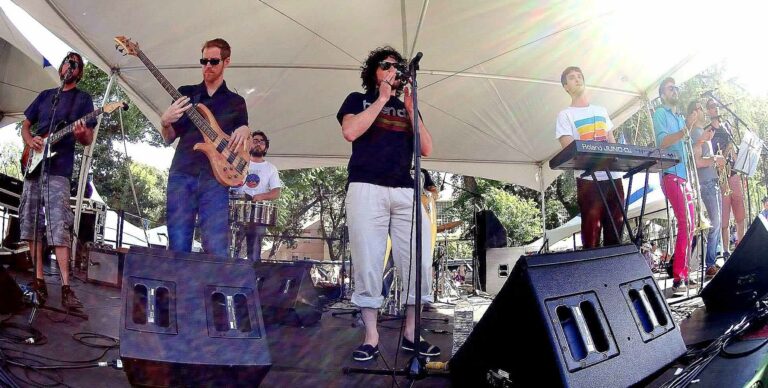
Local Davis band Bomba Fried Rice has been serendipitous since its creation. What began as a group of friends simply jamming for the sake of jamming became Bomba Fried Rice in 2013 when they were asked to play at the Davis Music Festival. 

“Another band couldn’t play, so [the festival] asked us last minute if we would,” said Juan Miranda, who does the vocals and small percussion for the band. “We had to give them a name for our group, so we started throwing around names and joking around. Bomba Fried Rice was the funniest one.”

After pressing members for a concrete reason behind the iconic band name, a myriad meanings and messages emerged.

“Bomba means many things,” Miranda said. “Bomba rice is the specific rice for paella. It also means bomb. It is also a genre of music from Puerto Rico. We’re a mix of many genres. Sometimes we will have more than one genre in a song. Maybe ‘bomba’ is the collision of a lot of different types of music.” 

Indeed, Bomba Fried Rice has taken different styles and forms based on the members who make up the band. There are currently 11 members — not all of whom are original members, but each have a distinct physical and musical background. Miranda grew up in Mendoza, Argentina; Guillaume Luxardi, who is from Normandy, France scratches on vinyls; Pauline Millard, also from Normandy, France, plays piano; James Mayoral, from Dixon, Calif. plays the trumpet; Bårt Van Der Zeeuw, from the Netherlands, is on the drums; Felipe Becerra from Colombia plays the congas; Alvar Escriva-Bou from Valencia, Spain is on tenor saxophone while Heron Scow from Davis, Calif. plays alto saxophone; Luis Avila from Peru plays guitar and, finally, Jason Burns from Hawaii is on bass guitar.

“Everyone who has played within the group is a talented musician,” Mayoral said, who joined the band in 2015 after he met Miranda, who was his teaching assistant in the Spanish department. “They all have different backgrounds, whether they were a classical musician or a jazz musician. But it’s cool because they bring those elements and creativity to the table that makes each rehearsal or performance a little different.” 

The band’s eclectic membership makes the indistinguishable quality of Bomba Fried Rice’s sound. 

“People don’t think about this: when salsa started it was in New York,” Miranda said. “It was that pot of people bringing their own rhythms and finding a common ground, showcasing their piece. They come with a set background, but people also learn their own style with what they already have.”

Similar to the conversation concerning their name, the band members could not coin the genre of their sound.

“Latin would be a very simple way to get out of the question,” Miranda said. “There are different influences, from the music to the lyrics. Everyone brings something and then [if] we like it and we keep it. I’m sure there is some stuff that we don’t even know where it came from, but it’s there. There is a lot of latin music, rock, ska, hip-hop, spoken word, salsa, cumbia and variations of it.”

According to Miranda, playing a combination of multiple styles ensures the audience doesn’t get bored: there is continuous innovation and the way they play with sound is unique to the band.

“It is more of a matter of feeling, and how it will translate with what we do with our hands,”  Luxardi said. “It’s not like the scratching that I do is ‘French.’ It’s my own feelings.” 

Bomba Fried Rice might better be described as a musical space than a band in the traditional sense. Based on availability and interest, not every person plays in each concert or gig. Yet cohesion of the band rests on the talent of each individual member. 

“You have to prepare by yourself,” Miranda said. “Coming to rehearsal to prepare is too late. If you know your part, then it is easier for everyone. These are theatrical performances of music … we have some songs we work on, or someone comes with a song and people come and build on it.”  

Their performances, therefore, are intended to showcase the different sounds of the band. While each song has a foundation, a set guitar riff or drum beat, the goal of each performance is to create a new listening experience. 

People consume music from different angles,” Miranda said. “For some, you listen to music as a chunk that makes you dance and feel good. For others who are more trained, you can separate the different sounds, know different beats, and see what everyone is doing to merge. It gives the band the freedom to express more if they want to. The public sees that in their faces. If you are enjoying what you are playing people see that and that’s contagious.”

This style of performance allows surprises to emerge.

“There have been performances where some mistakes happened, and we somehow made them part of the song,” Miranda said. “There was this one festival we played at and the [power] went out. But we were lucky and we had a lot of percussion, a lot of brass and I sang with a megaphone. We didn’t have a guitar, bass or a piano. But then the electricity came back on, you could hear the sound of the music coming back, and we finished the song with all the instruments.”

Bomba Fried Rice considers their music a matter of attitude, allowing for mistakes, allowing for discovery, allowing for fun — “You see people dancing, and it’s honorable,” Miranda said.

“We just want to have fun,” Luxardi said. “We want to share our love for the music and people.”

Written By: Caroline Rutten — arts@theaggie.org

From wine to kombucha: Exploring Davis’ zealous homebrew community

Some students take their talents, passions for brewing beyond the classroom

Northern California has matured into one of the best places in the world for upcoming and established winemakers and brewers. From the Napa Valley vineyards to the many specialized breweries scattered across Northern California, the beverage industry and experience has become an inseparable part of the “NorCal” identity. At UC Davis, students actively partake and expand this culture, maintaining and advancing Northern California’s long-standing reputation as a go-to place for tasting some of the world’s best beverages.

The UC Davis Viticulture and Enology and UC Davis Food Science programs have consistently ranked as some of the best in the world. Wine and beer aficionados flock from all over to experience Davis’ brewing programs and earn one of the most respected degrees in the industry. As these wine and beer enthusiasts become entrenched in the community, many take their talents from the classroom to the garage, implementing their skills and harnessing their passion to vinify and brew original concoctions.

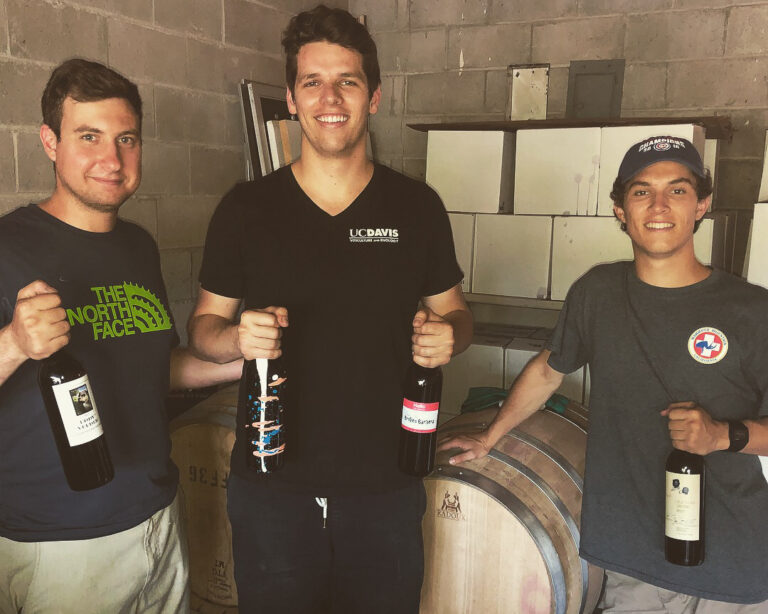
Joe Terre, a 2019 UC Davis alumni who has a Bachelor of Science in viticulture and enology and now works as a cellar hand for Sterling Vineyards in Calistoga, embraced the home wine making community during his second year at Davis through the Davis Enology and Viticulture Organization (DEVO). He plunged in, aspiring to learn the practical ropes of wine making and earn the gratification of making his own product.

“[I] joined DEVO and they provided me with the necessary equipment to get started with this cool hobby,” Terre said. “I started with Keaton Crow who introduced me to DEVO and did it a year prior. I went under his wing for the first year, second year we tag teamed it and then the third year I took the reigns.”

Terre, alongside Crow, hauled a couple barrels into Terre’s garage in Davis and got to work. While trudging through the physical labor required by the home wine making process, Terre gained valuable insight that wasn’t readily accessible in the classroom.

“There’s a learning curve with anything that involves skilled work with your hands, it just takes practice,” Terre said. “You can be the best person at taking a test in viticulture and enology and suck at making homemade wine.”

Terre discussed the skills he picked up while getting his hands dirty, singling out

his improvement in racking — the process of removing all the juice from the solids or, in less appealing terms, the dead yeast cells.

“The first time I learned how to rack wine, I did not do a very good job,” Terre said. “First I got a bunch of crud, and then I got better and better.”

Sticking with the grind in the vineyard and the garage, Terre gradually learned the intangibles demanded by winemaking. Through routine, he became familiar with the consistency and discipline needed to create a high caliber bottle of wine regardless of environmental constraints.

“The biggest thing [to consider] is how much time and commitment it takes to make a quality product,” Terre said. “It takes all year and to be diligent. [You have to] always be checking up on it and can never put it on the back burner.”

For Terre and his team of home winemakers, their commitment paid off when they submitted two Syrah wines to the California State Fair.

“To our surprise they gave one Syrah a double gold and another Syrah gold,” Terre said. “We were really proud as home winemakers to go up against others who were doing this for years on end and probably in better conditions than us.”

Camron Clifton, a 2019 UC Davis alumni with a Bachelor of Science in food science and a brewing assistant at the local 3 Mile Brewing Co. started homebrewing beer after his interest was piqued in his food science classes.

“[I] did some research on it and realized it was a pretty easy thing to get involved with as far as initial barriers to entry, so [me] and a couple buddies split the price of a homebrew set and decided to start trial and erroring our way through it,” Clifton said.

Clifton noted that the homebrew industry has made the practice much easier for beginners like himself, who use malt extract to craft their beers rather than implementing the traditional all grain process.

 “We only used extract because we didn’t want to make that additional investment,” Clifton said. “Making the step from extract to all grain is completely doable and it isn’t that much more pricey, but it is a lot more technical and it requires a little bit more knowledge to make sure everything is going correctly.”

As a food science major, Clifton had access to people who shared in his interest and readily provided support and insight into the hobby.

“They have experience, so that was a really good resource,” Clifton said.

Clifton found the practice to be a great way to solidify his interest in beer brewing and a great introduction into what’s required in the industry itself.

“Beer is made the same way in a once gallon batch as it is in a ten thousand barrell batch — it is the same kind of ingredients,” he said. “It reaffirmed that this is what I wanted to do as a career.”

Clifton also noted that it helped prepare him for undergoing the more tedious facets of brewing.

“Homebrewing is a labor of love, and so there are some things that suck about it,” Clifton said. “But after working in a commercial brewery, it’s not all just the fun parts, there are parts that aren’t as fun. There’s a lot of sanitation and cleaning, which isn’t very sexy but it needs to be done, if you don’t want the beer to taste like vinegar.”

Occasionally, through the many trials and tribulations, Clifton would make a product that impressed him, a reward for all the time and effort poured into the homebrewing process.

“Sometimes we had some beers that were absolutely awful, but when we had beers that were drinkable and it was a success, […] it was like holy s***, I made this.”

There are also less capital and work-intensive home brewing opportunities for ambitious UC Davis students. Noah Yardeny, a third-year pharmaceutical engineering major, set his sights on making his very own kombucha. Yardeny, a resourceful college student, grew tired of paying for the expensive beverage and took matters into his own hands.

“Kombucha is really expensive on the market, more so than coffee for each bottle,” Yardeny said. “Being a college student, I’m trying to be a bit riskier and see if I can do this myself.”

For Yardeny, who practiced homebrewing beer with his father, kombucha was an easy transition and a far simpler endeavor. Making kombucha is a relatively stress and cash free process: it requires only tea, some sugar, a gallon glass tank and scoby, also known as a symbiotic community of bacteria and yeast. The scoby is self-sustaining, producing a twin scoby in each kombucha batch which supplies the brewer with a never-ending source of bacterial starter.

“You brew a certain amount of tea and then you add some sugar to it and a scoby, which just eats up the sugars that are in the tea and add the .5% of alcohol content,” Yardeny said. “You add the tea into the glass jar with two cups of scoby starter, which is the old kombucha from the previous batch. It’s quite resilient.” 

As Yardeny was getting started, he found a vibrant online community dedicated to brewing and helping fledgling kombucha brewers get a hang of the practice.

“It’s really social as well, I know all these subreddits giving away their kombucha recipes,” Yardeny said.

As Yardeny continued to explore the world of kombucha, he discovered interesting kombucha facts and practices. Long lineages of kombucha brewers pass down the family tradition.

“There’s all these people that have their great-grandmothers’ scoby passed down and are keeping it as a family scoby,” Yardeny said. 

Yardeny himself got a pleasant surprise when he decided to show off one of his first batches of kombucha to his family.

 “I made this batch and surprised my family with some watermelon kombucha, which was probably my best batch,” Yardeny said. “It was sweet, it was ripe and it was this golden red color when you poured it. It was beautiful. I gave it to my grandparents and they were like this is ‘grib’ (Russian for fungus). They actually used to make homemade kombucha back when they were kids in Russia.”

For Terre, Clifton and Yardeny, homebrewing provided an outlet to explore their passions and make beverages. Their endeavors yielded new skills and knowledge, but more importantly, they all emphasized the love of sharing their work — and for Terre, sharing the quite literal fruits of his labor with friends. 

“You’re learning, you’re making wine, you get to give it to your friends for no cost,” Terre said. “They pat you on the back, and it honestly makes you feel like a thousand bucks.” 

Written By: Andrew Williams — arts@theaggie.org

Orphan Kitten Project facilitates fostering, adopting kittens

0

UC Davis Vet School organization shares special mission

The Orphan Kitten Project, fondly referred to as OKP by its members, is a non-profit, student-run organization overseen by the UC Davis School of Veterinary Medicine. The rescue organization is dedicated to providing young kittens — less than eight weeks old — with a foster home until they are old enough to be put in shelters and adopted out. Founded 30 years ago, this cause is also an opportunity to educate veterinary students on how to care for young kittens. 

Unlike the SPCA or other animal rescue organizations, OKP’s specific mission aims to rescue kittens who may have been abandoned or who were living in dilapidated conditions. These kittens, who are usually too young to survive without their mothers, are gently handled and cared for by the veterinary students. 

“Orphan Kitten Project is a non-profit rescue that specializes in neonatal kittens,” said Arielle Layman, a third-year veterinary student and president of the OKP. “[We place] them in foster homes where they receive round-the-clock care and lots of love [….] OKP provides special medical care and attention for bottle babies and young kittens that do not thrive in shelter environments.”

Veterinary students involved with the organization have the opportunity to learn to care for especially young kittens in need of extra medical help, Layman said. Some of these kittens suffer from deficiencies or maladies and may be in need of medical attention. OKP has the resources needed to nurse these kittens to a healthy state.

Layman recounted a rescue story in which OKP was able to save a kitten born with a birth defect, noting that if it weren’t for the organization, some kittens may not get proper care.

“A few weeks ago, a shelter contacted OKP about a kitten named Bean with a condition called eyelid agenesis,” Layman said. “Bean’s eyelids never developed properly, causing his fur to rub against his eyes painfully. Thanks to OKP, the ophthalmology department at the UC Davis School of Veterinary Medicine and some generous donors, Bean received surgery to repair his eyelids and now he’s ready to find his forever home!”

Once kittens are found to be stable and healthy, kittens may be put into shelters or foster homes or put up for adoption. For the fostering process, OKP trains and provides the foster home with the experience and resources, including the housing and medical costs needed to care for these small felines. And foster parents can choose their own kittens and can care for a kitten for any range of time — from a weekend to the traditional six to eight week period. Layman said.

“Each foster is paired with a coordinator who is a UC Davis veterinary student,” Layman said. “The coordinator provides medical care, advice and moral support. Coordinators visit their fosters and kittens as frequently as needed, so fosters must live in Davis.”

A kitten is ready for adoption when it is two months old. Adoption fees are $100 for one kitten and $180 for two kittens. The adoption fees go to vaccinating, spaying or neutering and microchipping the kitten prior to its adoption. 

Although the organization is relatively small, the number of veterinary students joining the organization — and the number of kittens received — has gradually grown each year. 

OKP has also been recognized as a reputable organization for fostering and adopting kittens, receiving high ratings on their active Facebook page. One testimonial, posted on Sept. 30, read “We have adopted two kittens from OKP. The kittens are so well cared for and socialized. Both times the process was seamless and the foster home was able to give us a great deal of insight into our kitties personality.”

As for the success rate of OKP, 95% of their rescued kittens have been successfully adopted and, last year, they found homes for 300 kittens, according to Layman. Currently, they are working to spread awareness to the local Davis community. 

OKP wants individuals to know that they do not need to foster or adopt a kitten to save one. The group accepts monetary donations as well as supply donations — their wishlist can be found on their website.

Written by: Linh Nguyen — features@theaggie.org

How green are California and Canada, really?

Self-proclaimed environmental champions have a ways to go

Within the span of a few days last summer, I made the trip from Davis to the Bay area three times — twice by car, once by train. Each time I had a different view of the several massive oil refineries scattered throughout Richmond, Martinez and Benicia.

Oil refineries are visually stunning, with chaotic layers of pipes, stacks spewing pollutants into the air and dozens upon dozens of chemical storage tanks. The several oil refineries in my home state of Washington are a little more off the beaten path, so I found myself mesmerized watching these oily fingerprints of the fossil fuel industry go past my window. It was a stark reminder that despite positive rhetoric and an outward appearance of being “greener” than most other states, California still has a spectacular distance to go in the fight against climate change.

Many others received this important reminder a few weeks ago when several chemical storage tanks at an oil refinery in Crockett were destroyed by a fire, sending flames and plumes of smoke into the air and flooding our news feeds with videos and images of the accident. 

As an environmentalist, it’s difficult for me to reconcile the idea of California being a global leader on environmental policy while also remaining strongly tied to the fossil fuel industry. A similar cognitive dissonance arises with Canada, another supposed leader on environmental and climate change policy that is finding it just as difficult to unchain its feet from the ball and chain of fossil fuels.

California has made a decent start by passing SB 100, which puts the state on the path to 100% clean energy by 2045. Yet, although Governor Gavin Newsom and his predecessor Jerry Brown have come under scrutiny for not doing even more right now, they understand that it’s a process.

“One cannot just turn off the switch. One cannot just immediately abut against a century of practice and policy,” Newsom said in an interview with the Los Angeles Times. 

Even so, it is disheartening to know that California remains a leading producer of crude oil, that Governor Brown wouldn’t sign a ban on oil drilling in densely populated neighborhoods and that Governor Newsom still hasn’t done so either. The countless oil derricks hiding in plain sight throughout Los Angeles are an apt metaphor for the oil industry’s ability to stay alive in California. 

Meanwhile, Canada has had difficulties of its own in trying to maintain its image as an environmental leader. Prime Minister Justin Trudeau recently approved a major pipeline from the Alberta Tar Sands to Vancouver, the day after Canada declared a climate emergency. Despite Trudeau’s inconsistencies on the environment, he managed to win reelection

Many people look at these struggles as direct evidence that California and Canada are hypocrites when it comes to the environment, believing this proves you can throw as many so-called “eco-Nazis” as possible at an environmental issue, but still can’t get anything done. 

I view it differently. I think that it’s evidence of how difficult it really is to wean ourselves off of fossil fuels. It’s also a necessary reminder that no matter how transformative and radical our ideal future sustainable energy policies would be, we still have billions of dollars tied up in the infrastructure and human capital of the oil industry.

This should not inspire pessimism; it’s simply a reality check. It serves as a necessary reminder that the change we want can’t happen overnight, and we must temper our expectations. It’s a reminder that although nobody can boast a perfect record on the environment, they will at least try to push us forward in meeting our environmental goals, moving away from dirty energy in any way they can. 

The current administration promises the exact opposite. We have an obligation as environmentalists to be pragmatic and vote against the current administration’s cynical and destructive approach to environmental policy while continuing to make progress at the state level. No matter what.

Written by: Benjamin Porter— bbporter@ucdavis.edu 

Disclaimer: The views and opinions expressed by individual columnists belong to the columnists alone and do not necessarily indicate the views and opinions held by The California Aggie.

Guest: Petition to stop paid parking in downtown Davis

Paid parking downtown will ruin businesses, deter customers 

There is a battle between the City of Davis and its constituents that many downtown businesses want UC Davis students to know about and take a stand on. City Hall has been trying to install paid parking downtown for decades but with most businesses and the public against it, City Hall has elected to diminish the outrage by implementing it in stages. 

Several locals, who were tired of the city’s intransigence even in the face of mass opposition, drafted an initiative petition. The Freedom to Park Initiative does what the city won’t: It sets a baseline for parking downtown that expands both bike and auto parking by more efficiently using existing space, and bans parking meters throughout Davis.

It may seem like a basic notion to protect and maximize a valuable resource like parking when there is a shortage of spaces, but the city has done just the opposite — in the last 20 years, it has removed over 100 spaces for aesthetics and non-essential purposes. Although demand for parking increased as the city and campus population grew, the city was reducing parking until it caused a so-called parking crisis. It now proposes to “solve” this crisis by making all the parking paid. 

But its plan doesn’t add any parking spaces. It is not increasing parking — just the cost of parking. The only way its plan provides any spaces for those who are willing to pay is by driving away those who aren’t —  namely students, the elderly and other low-income drivers.

More students are driving because they are priced out of living near campus, and now the city will price them out of visiting downtown as well. Many people have gone to great lengths to make Downtown Davis welcoming, inviting and universally accessible. This parking tax will ruin that by driving customers away to malls and out-of-town stores, causing more small businesses downtown to go under. Then the city gets what it appears to want — an empty downtown with parking for people wealthy enough to pay for it.

These problems were so obvious that before the city council vote over 50 small businesses, the Chamber of Commerce and scores of concerned citizens spoke out against the paid parking plan. The council felt the wind’s direction, but all it promised was to install the meters gradually over time rather than all at once. Faced with what they admitted was a vast majority of opposition from its constituents and the businesses that would be affected, the Davis City Council went ahead with paid parking anyway. 

This disregard for democracy and representative government is what prompted the initiative. If the city won’t listen to us in the council chamber, it can listen to us at the voting booth. If we get 4,200+ signatures on our petition, it will go on the ballot in November. Then we can vote on whether we want free parking and more spaces or stick with the city’s plan of charging more and more for less and less space. It’s a pretty safe bet on how that vote will go.

But we have to get the signatures to qualify first, and to do that we need everyone who cares about downtown to come, sign and help us spread the word to others.

UC Davis students, faculty and staff have always been friends of downtown. Now we need your help. If you are registered to vote in Davis you can sign the petition. Lots of students are registered at home, but we also need volunteers to circulate the petition — any adult can do it. Taking the petition to your club, walking it through your dorm or canvassing a bit with us would be huge. 

This is a chance to contribute to permanent positive change in our community. Together we will save ourselves the cost, hassle and fear of tickets that come with paid parking while preserving the relaxed character and casual charm of our downtown. 

If you want to help, call on me at Bizarro World. More information, volunteer sign up and a printable mail-in petition is at freedomtopark.org or you can visit these downtown locations that have the petition on hand to sign:

Farmers Market, Central Park

Akasha Yoga, 140 F St

Avid Reader, 617 2nd St

A Better Place To Bead, 132 E St

Bizarro World, 223 E St

Bohème, 409 3rd St

Cloud Forest Cafe, 222 D St

Creme de la Creme, 222 D St

Crucial Vibes, 204 E St

Hastings Back Porch, 132 E St

John Natsoulas Gallery, 521 1st St

Kaya Yoga, 612 4th St

Kobe Mini Mart, 213 E St

Luci’s Salon, 222 D St #9a

Sarah’s Alterations, 222 D St

Soccer and Lifestyle, 517 2nd St

Shu Shu’s,  227 E St

Vault Clothing & Board Shop, 227 G St

Yeti Mini Mart, 232 E St

Volley’s Tennis Shop, 231 G St

Written by: Daniel Urazandi 

Daniel Urazandi is the owner of Bizarro World located in downtown Davis. 

Recent white nationalist, anti-Semitic events on campus mimic a national trend of increased rates of white supremacist propaganda

When white nationalist, anti-Semitic incidents happen at UC Davis, they do not occur in a vacuum

UC Davis has been repeatedly targeted by white supremacist groups during the last year. White supremacist and anti-Semitic fliers were posted on campus in October 2018 and October 2019.

These actions reflect a concerted effort on the part of such organizations to disseminate their views following the fatal Unite the Right Rally in Charlottesville, Virginia, in August 2017. An Anti-Defamation League (ADL) report cited “a 9 percent increase” in on-campus anti-Semitic incidents between 2017 and 2018, according to Inside Higher Ed. In the U.S. overall, there was a 182% increase in the distribution of white supremacist propaganda between 2017 and 2018. 

While UC Davis in particular ranks as a university with higher instances of anti-Semitism, these incidents also reflect a growing national trend of white supremacists targeting college campuses. The propaganda generally include “fliers, stickers, banners, and posters” expressing “racist, anti-Semitic, and Islamaphobic views,” said an ADL report. Due to “public backlash” and “negative media coverage,” the report suggests white supremacists have sought to “maximize media and online attention, while limiting the risk of individual exposure.”

The Southern Poverty Law Center (SPLC) currently deems the “alt-right” as “white nationalism’s most recent formation,” in part instigated during the controversial election of Donald Trump as president. The alt-right is thought to be increasingly “porous,” which “allows for the inclusion of more radical elements, including a suite of Neo-Nazi organizations.” The failure of a second Unite the Right Rally and the angry reaction to Richard Spencer’s speeches on college campuses in 2017 and 2018 demonstrate the movement’s increasing desperation and inability to recoup lost ground after the events in Charlottesville.

Today’s alt-right and white nationalist movement has the same roots as previous anti-immigrant, anti-Semitic and racist movements. As noted by extremism expert Heidi Beirich, director of the SPLC’s Intelligence Project, in a phone interview, “the American hate movement is rooted in hatred of Jewish people and people of color.” 

Still, UC Davis’s history of anti-Semitism emerged well before the events in Charlottesville. In 2015, swastikas were painted on the Jewish fraternity Alpha Epsilon Pi’s house. In 2016, university printers received anti-Semitic fliers from The Daily Stormer and in 2017, a sermon given at the Islamic Center of Davis allegedly called for the annihiliation of the Jews. 

“Identity Evropa [also known as the American Identity Movement] distributed flyers and stickers at the University of California at Davis,” according to an April 2018 ADL report mapping anti-Semitic incidents nationwide. “One flyer read ‘Action. Leadership. Identity,’ and another advertised a book called ‘White Identity’ with the message, ‘Your professor is scared of this book.’”

Locally, in May 2018, the Road to Power organization “issued anti-Semitic robocalls on behalf of neo-Nazi Patrick Little that claimed Senator Dianne Feinstein was a dual-citizen of Israel and accused Feinstein of killing American children by sending billions of dollars to Israel. The call also said that Little was ‘going to get rid of all the nation-wrecking Jews from our country.’” 

In October 2018, the Daily Stormer distributed fliers throughout campus blaming prominent Jewish public figures, including Senators Dianne Feinstein and Chuck Schumer, for the controversy surrounding the nomination of now Associate Justice Brett Kavanaugh to the Supreme Court. Additionally, in October 2019, the American Identity Movement again posted fliers on campus.

UC Davis is not the only campus that has been targeted: incidents of bigotry have occurred at UC Berkeley and UCLA in previous years as well. At UC Berkeley, anti-Semitic graffiti was discovered on a bathroom wall, and in some instances, members of the student body, rather than outside organizations, have been the perpetrators of anti-Semitic rhetoric. For example, political assumptions have been made about students simply because they are Jewish. 

At UCLA, when then-undergraduate Rachel Beyda was confirmed into the student council’s judicial board, she was asked whether she would be able to maintain an “unbiased view” of campus matters due to her activities in Jewish organizations, according to The New York Times. When she left the room, the council debated whether her membership in a Jewish sorority and her participation in Hillel would interfere with her ability to handle governance questions impartially.

The controversial session was posted on YouTube and later removed. The council initially rejected her nomination in a 4-4 vote, and then accepted her and apologized following faculty intervention with a 9-0 vote. Jewish community leaders condemned the council’s initial behavior. Roughly a year later, perhaps in response to these concerns, the UC Board of Regents authored a resolution stating that, “Anti-Semitism, anti-Semitic forms of anti-Zionism and other forms of discrimination have no place at the University of California.” 

Sascha Recht, a third-year neurobiology, physiology and behavior major who is involved with several Jewish organizations on campus, described her reaction to the fliers found at UC Davis over the past couple years. 

“I have to say, it’s very disheartening,” Recht said. “I’m proud that [the Jewish community on campus] is very proactive, we see this and we immediately think about what we can do to get it removed — our response is very quick and very precise — but those are not the kind of images you want to see, you don’t want to condone hate in any way.” 

Asa Jungreis, president of UC Davis’ Alpha Epsilon Pi fraternity and a third-year community and regional development and sustainable agriculture and food systems double major, spoke on behalf of his fraternity. 

“I am disheartened by the continued presence of vitriolic fliers on campus,” Jungreis wrote in an email. “Although the school has improved in their response to the anti-semitic alt-right propaganda anonymously littered on campus the lack of repercussions faced by the responsible parties that makes them comfortable enough to continue spreading hate is frustrating and worrying […] Organizations that I’ve been affiliated with […] have faced direct anti-Semitic actions. Any and all anti-Semitic behavior, or acts of hate targeted at any race, religion, or minority group will not be tolerated.”

Recht expressed concern about the university’s response to such acts. 

“There are ways to address the student body when something like this happens and I feel like the administration hasn’t utilized those tools effectively,” Recht said. “I’ve met with members of the administration personally and it goes in a file somewhere until something else happens and so it’s unfortunate.” 

Jungreis described the nature of the university’s response to anti-Semitic actions on campus as “formulaic,” noting that he is “hard-pressed to think of anything notable beyond vague condemnations via newsletters.” 

The SPLC notes that there was significant effort on the part of white nationalists to “rebrand” following the Unite the Right rally. The fallout from the rally led to “infighting” and, as social media platforms sought to limit online hate speech, various groups began to splinter.

“Very early in [the American Identity Movement’s] evolution they started doing this campus flyering,” Beirich said. “They claim to get out their message, and they probably try to recruit smart college students. I don’t know if this works at all in terms of recruitment but it certainly gets them publicity, so that’s part of the reasoning for this, for engaging in this tactic. After Charlottesville, after Heather Heyer was murdered […] [white supremacists] were saying it was a bad idea to engage in these street protests, because it made [them] look bad.”

Subsequently, Integrity First for America (IFA), a non-profit, filed a lawsuit against 26 individuals who participated in the Charlottesville rally. Roberta Kaplan, a New York City based lawyer best known for her landmark work on the 2013 Supreme Court case United States v. Windsor which addressed same-sex spousal rights, worked on the case. 

“A lot of people named in [the IFA lawsuit] had to hire lawyers, and they were pissy,” Beirich said. “And the other thing that happened after Charlottesville is that Paypal started pulling their accounts so [these groups] couldn’t raise money and they couldn’t move money and they started getting banned from Facebook and Twitter, they were deplatformed in a big way,” she added, noting that the SPLC had been lobbying Facebook to more vigilantly monitor hate groups even before the events in Charlottesville.

Barry Klein, the co-president of Congregation Bet Haverim and a retired Vice Chancellor of Research at UC Davis, also believes that recent events in Davis mimic a national trend of intolerance happening both on and off college campuses. 

“The general issue […] is that there’s been a resurgence of intolerance in the world right now,” Klein said. “It happens from all directions. Certainly it’s very clear, and there’s the so-called right wing groups that are fostering anti-Semitism and [there’s] left-wing intolerance too. We’re at a place in the world right now where the center seems to have vanished, where the dialogue in the world has really degraded.”

Klein added that Davis “isn’t necessarily an outlier in the rise of anti-Semitism and hate things in general. The most uninteresting voice [for me to listen to] is my own. I want to listen to [other] people. We can argue in a respectful way […] to get to the place we want to be.”  

Recht has experienced assumptions similar to those made of Beyda during classes at UC Davis.

“People will assume you’re not loyal to the U.S. if you’re Jewish, that you’re loyal to the Jewish state [Israel] first,” Recht said. “It’s a very strange and unfortunate question — it will be assumed that you believe certain things because you’re Jewish.” 

Recht also mentioned protests on campus where people were chanting that “[Jews] should have learned from Germany. There’s no gray area there, that’s a blatant insult.” 

Recht made a distinction between individuals who take issue with the policies of the Jewish state and those who have problems with its existence in general. Similarly, Klein expressed concern about the conflation of Israeli policies with Jewish identity. 

“The people who have criticisms of Israel, those criticisms [sometimes] spill over into criticism of the Jews,” Klein said. “Jewish people don’t speak with one voice, on-campus or off. Being Jewish and being pro-Israel are not the same thing. The pro-Israel thing has a lot more complications.” 

Klein views the Jewish community as being in solidarity with other minority groups.

 “We’ve always been champions of the underdogs, of people who are oppressed, separate from Israeli politics,” Klein said, recalling the cooperation of Jewish community leaders and African Americans during the Civil Rights movement and Jewish involvement in labor and women’s rights movements. “You can get involved with the contemporary politics in the Middle East and you can get lost in all these political things and lose sight of the camaraderie.” 

Klein hopes to increase communication between Congregation Bet Haverim and students on campus, describing plans to create a community outreach group that will work with Hillel and other campus organizations in order to “put a face on [the Jewish community]” and “invite other groups to our synagogue.” 

Similarly, Jungreis wrote that he hoped “UC Davis [would] grant Jewish organizations greater autonomy in raising awareness regarding and responding to anti-Semitism by promoting Jewish organizations and outreach on campus. While the majority of UC Davis faculty and staff are in no way friendly towards anti-Semitic behavior, I feel that more has to be done to make explicitly clear to all students and faculty that harassment of Jews on campus can come in various forms, and is not limited to such blatant acts as the recent flyers.”

Recht also discussed the importance of interfaith unity in combating hate in all its forms.

“We stand in solidarity [with minority groups] in the sense that we understand what it’s like to be persecuted for superficial reasons,” Recht said. “We have been supported and we’re very fortunate because we have certain relationships with the Muslim and Christian communities. If something happens in one of our communities we support each other. It’s a reciprocal thing and I would like to see that be stronger. Discrimination affects all of our communities.”

Written by: Rebecca Bihn-Wallace — campus@theaggie.org 

Cartoon: Sweet Turtle Tears

MARIO RODRIGUEZ / AGGIE

Aggies drop tough meet to third-ranked Oklahoma State

0

Young riders, reigning team thrive in promising afternoon for UC Davis equestrian

The UC Davis women’s equestrian team was defeated 13-5 by the third-ranked Oklahoma State Cowgirls in a rigorous third matchup of the season. The Aggies garnered at least a point in each of the four events and outscored their opponents in reigning, but the skill and experience of Oklahoma State was enough to down UC Davis. 

This was the Aggies’ first home meet of the year, and although the home team typically has the advantage of competing on its own horses, Senior jumping seat rider and captain Stephanie Don described how there can also be less favorable aspects. 

“Home games are always really hard because we have to do all the preparation ourselves, we run the whole thing, so I’m so proud of [the team]” Don said. 

Nevertheless, UC Davis was still able to remain competitive in the defeat. Impressively, this is only the second year the Aggies have competed as an official NCAA level team, and continue to show flashes of brilliance even against the high-caliber of teams they’re already competing against. 

“I’m super proud of our girls,” Don continued. “All of the lineup girls tried really hard and we worked really hard all this week leading up to [the meet]. On the hunt seat side, we had really good rides. All of our horses were behaving, too, and they did great as well.” 

The meet opened with the fences event, where Don was able to grab a point for the Aggies with a score of 76.0 in the final draw. Sophomore Keely Laughlin and senior Sabin Marquardt were also able to put together rides that scored 74.0 and 78.0, respectively, but were outdone by the Oklahoma State riders they went up against.

Meanwhile on the outdoor arena, teams competed in the reigning event, where freshman Kendal Scheiner and junior Charlize Zuraek were both able to collect a point for UC Davis with rides of 65.0 and 68.0, respectively. Freshman Macey Newkirk scored a team-high 73.0 on her ride, but was unable to come away with a point because her OSU opponent finished with an identical score.

Two points turned out to be enough for the Aggies to outscore the Cowgirls in reigning, as two of the five head-to-head rides ended in a tie — so UC Davis took the event with a 2-1 score.

“I think that’s one really important aspect of this game is that we have huge 1200-1300 pound animals that have to do their job, too, just like how we have to,” said senior reigning rider Bobbie Piddock. “And so they all really came to play today. They all gave us their heart, and the girls did too. We laid out really good rides, really fun rides, so it was cool to watch.”

In the final two events of the afternoon — horsemanship and flat — sophomore Sarah Finkel and freshman Ella Longo had highlight rides for the Aggies. Finkel scored a 73.0 for her horsemanship ride, collecting UC Davis’ lone point of that event. In the flat event, Longo scored a team-high 75.0, but was unable to top her competitor, Oklahoma State senior Hannah Janson, who scored a 77.0 and was awarded the Most Outstanding Player for the event. 

In her second ride of the day, and this time in the flat event, Marquardt was able to earn the fifth and final point for UC Davis with a ride that scored a 64.0.

An aspect of the season thus far that the Aggies can certainly pride themselves on is their reining team, which tied a now-ranked Delaware State squad on Oct. 5 and captured a victory on Saturday against Oklahoma State.

Fortunately for the Aggies, they will have the home-arena advantage for the next two meets as well, when they host Fresno State on Nov. 15, and then Auburn at the end of January. The large time frame in between matches will be beneficial to this young, rising squad, as Don noted.

“Just as long as we continue to practice hard and work hard, we should keep doing well and getting better,” Don explained. “I think that getting better will come naturally, we’re just super young and such a young program, that good things will definitely come in the future.”

Written by: AJ Seymour — sports@theaggie.org

Folk Music Jam Session in the Arboretum

An informal gathering of musical enthusiasts jamming in nature  

From the quintessential spirit of the Farmer’s Market to the duality of tranquility and liveliness of the Quad, Davis is a melting pot of culture and people. Walking from Point A to Point B, the buzz of conversation, art, food and music fills the soul with a radiating feeling of content. The UC Davis Arboretum, a hot spot in Davis to relax and unwind in nature, has a myriad of opportunities to connect with yourself and the community. The Folk Music Jam Sessions are one of the many ways in which the Arboretum evokes this feeling of letting go and soaking up what the town has to offer.

These jam sessions are intimate gatherings of musically inspired individuals who get together and, well, jam! Musicians of all backgrounds informally congregate with their instruments every other week from noon to 1 p.m. at the Wyatt Deck in the Arboretum. A quaint wooden cottage-like structure with a homey and undisturbed feel and neighboring majestic redwood grove quietly watching over the area creates an ideal spot for channeling the rich roots of folk music. Dabbling in “a little bluegrass, old-time, blues, Celtic, klezmer and world music,” as referenced in the UC Davis Arboretum and Public Garden website, “all skill levels [are] welcome and listeners are invited.”

The environment of the jam session is relaxed, fun and inviting. The instrumentalists range in age, experience and instruments played, which creates a hospitable space for the expression of a communal passion for music. The audience is an umbrella of different individuals comprised of runners, students and families. The jam sessions act as a universal form of entertainment for both the participants and audience members. 

“I came from the suburbs of Silicon Valley… so it was really hard to meet up with other people unless you went to school with them; it’s not like here where you can just go out and meet people,” said Moises Lopez, a first-year psychology major. 

Self-taught through YouTube, Lopez has been playing guitar for five years, and wanted to get more involved with the music community in Davis. After finding the jam session on the Arboretum website, he rallied a few friends and decided to join in on the fun. 

“[It] doesn’t matter how you’re involved, you can get involved, and that wasn’t an opportunity I was given in my hometown,” Lopez said. 

The Davis community has given many people like Lopez the chance to practice their art through many platforms. It eliminates boundaries that other organizations may restrict members to, such as age and experience. 

Students were not the only ones intrigued by the open and creative environment of the jam session. In fact, the majority of those playing were not students but residents of Davis who have found their outlets for expression of musical freedom in the community. 

Casey Davis, an employee at the Student Academic Assistance and Tutoring Center for math and physics and a former Davis student, has a unique role in the jam session. For twenty-three years, he has been playing the penny whistle, also called the tin whistle, in various groups and genres. 

The tin whistle is traditionally played in Irish and English folk music; Davis has stayed rooted in those traditions to this day. Inspired by his parents, who predominantly played Irish folk music growing up, the folk genre in general has been ingrained into his identity. 

“I really like the way it sounds, the melodies and rhythms, it also feels good to have the musical connection to the past,” Davis said. “Folk music is more than just a genre to people like Davis, it is a connection to the greater community and to history — an experience you cannot gain from a textbook.”

Along with the folk jam sessions, Davis plays the penny whistle at the Dickens Fair in San Francisco, as well as for an English country dance group and Irish dance sessions in the local community. 

“[Davis is] a lovely place to just go out to a park or to the Quad and play some tunes for a while,” he said. 

This town is rich with channels for practicing one’s talents, even something as unique as the penny whistle. Formally or informally, the expression of musical talent is accepted and appreciated by other art enthusiasts in the community. 

“The importance of folk music would be the social justice side,” said Joy Apple, a former gymnastics coach and now a full-time grandmother who enjoys playing flute, guitar and vocals for leisure. 

Influenced by Joan Baez, a proclaimed folk artist and activist of the Woodstock era, Apple noted that Baez “did a lot of making the world a better place through her music, […] people like her are inspirational.” Collaborating with artists such as the Allman Brothers Band, The Beatles and the Rolling Stones, Baez not only impacted the music industry through her fame but her audience as well. 

Fans such as Apple have rooted their beliefs of what folk music, and music in general, are meant to portray. 

“Folk music has a lot of stories in it, stories about life, a lot of truths about life, and a lot of speaking what you believe,” Apple said. “Putting out what you believe and supporting other people, and saying what’s right.” 

Aligning with her notion of folk music as storytelling and a catalyst for change, Apple has played a role in a variety of groups in and out of the Davis community. Apple has made a point to relay her beliefs in her hobbies from leading music at church, open mics, jam sessions in nature and joining “Free Range Singers” — an all-accepting singing group founded by Laura Sandage, which promotes singing for individual and social good. 

Everyone has a culture, a niche in which they belong. Folk music is one facet of culture that touches the lives of many. Why? According to current Davis locals, it’s because it tells a story, because it has depth.

 “[The folk] genre you can play with other people, and everyone can just sing along; it’s more of a community thing,” Lopez said. “The Davis community can lay a foundation for self-expression and for opportunities to get involved with your passions, no matter how broad. If you look for it, it will find you.”

Written by: Sierra Jimenez — arts@theaggie.org