55.7 F
Davis

Davis, California

Monday, December 22, 2025
Home Blog Page 448

Review: “thank u, next”

Ariana Grande delivers an unapologetic version of herself

On Aug. 18, Ariana Grande released her fourth studio album, “Sweetener.” While the album was commercially and critically successful, there was a performative quality to the songs and lyrics that felt slightly disingenuous. The majority of the songs felt over produced and seemed to lack a raw emotional core. Only five months later, Grande released “thank u, next,” her most personal and authentic album yet.

In the months following the release of “Sweetener,” Grande’s life became a whirlwind of publicity and personal traumas. In June, she made headlines for her hasty engagement with comedian Pete Davidson after a few weeks of dating. Then, on Sept. 7 Grande’s ex-boyfriend Mac Miller passed away due to an accidental overdose. Struck with grief, Grande attempted to stay out of the headlines, but when her overly publicized relationship with Davidson started to crumble, Grande’s name was plastered all over celebrity news outlets.

As any artist would, Grande took the pain she was experiencing and channeled it into her craft. On Nov. 3, Grande released the titular single from the upcoming album. The R&B and pop inspired single takes a surprisingly at-peace look at Grande’s past relationships, as she thanks her ex-boyfriends (by name) for what each of them have taught her. “thank u, next” received 8.19 million streams on Spotify the day it was released, breaking the record for most streams in a single day for a female artist.

The song was an immediate success. The catchy beat and deeply personal references in the lyrics had everyone talking. The song, coupled with the homage to early 2000s rom-com flicks in the music video, signaled to fans that Grande was ready to open up and be more vulnerable in her music, while at the same time not taking herself too seriously.

Grande’s second single, “7 Rings,” debuted January 18 and sailed to the top of the charts. The song samples Julie Andrews’s “My Favorite Things” and depicts a lavish shopping spree at Tiffany & Co. She buys her friends matching diamond rings, a symbol of their friendship and a thinly veiled metaphor for the replacement of Grande’s engagement ring. The song marks a shift in her focus from romantic relationships to personal growth and self-care.

Then finally, on Feb. 8, the “thank u, next” album debuted. It spent two weeks at No. 1 on Billboard 200 Chart and was met with mostly positive reviews. The album feels more authentic than “Sweetener,” and listeners get a better sense of a sense of Grande’s struggles and who she beneath her carefully branded image.

This 12-track album was written over the course of two weeks and is Grande’s most personal yet. Everything about it feels authentic; Grande puts on no facade. She does not shy away from speaking to the hardships she has faced and instead sings about them with a delicate vulnerability, adding depth to her music.

Music producer Tommy Brown, who collaborated on the album, spoke with NPR Music about working with Grande.

“It was so inspiring to me to see how in charge and how involved she is every step of the way, from the writing to the vision to the storytelling and to even engineering and comping her own vocals,” Brown said.

The album opens with “Imagine,” a soft and tragic ballad about lost love. Grande wrote in a tweet that the song depicts a “simple, beautiful love that is now (and forever) unattainable.” In the light of Miller’s passing, the song reads as even more harrowing and tragic. Grande speaks to missing even the simplest aspects of a relationship after it’s over.

She sings about “Stayin’ up all night, order me pad thai / Then we gon’ sleep ’til noon.” The simplicity of the imagery, coupled with the emotion in Grande’s voice when she sings, captures the pain of mourning a past relationship. Grande’s whistle tones are impeccable and add even more to the hauntingly sorrowful tones in the song.

“Imagine” is followed by several strong and upbeat tracks. “Needy” is lyrically confessional and frank, as Grande lists her personal flaws over simple instrumentals. The lack of production in the song adds to Grande’s vulnerability, and the listener connects with Grande’s experiences. “NASA” is a smooth, catchy ode to self-care and taking time for oneself while “Bloodline” has become a standout hit due to its triumphant energy and its strong, thumping beat.

“Fake Smile,” the album’s fifth track, reveals Grande’s mindset during the tumultuous past months and having to be in the public eye during all of it. The track opens with a sample from Wendy Rene’s 1964 single “After Laughter (Comes Tears),” which gives the song a melancholic and reflective tone. Grande sings about the pressures of fame and its lack of privacy, along with the other traumas she is trying to cope with. She reveals the pain going on behind the scenes.

“I can’t fake another smile, / I can’t fake like I’m alright /And I won’t say I’m feeling fine, / After what I been through, I can’t lie,” the lyrics read.

Not all the songs on the album are quite as strong. Track seven, “Make Up,” is entirely forgettable and stands out as sounding immature and frivolous compared to the rest of the album.

Following “Make Up,” however, is “Ghostin” which might be the album’s strongest track. Grande opens up about experiencing Miller’s loss during a time when she was still engaged to Davidson. The complexities of this situation appears in the song, making it even more tragic. The instrumentals are soft and haunting. Her voice evokes such emotion from the lyrics, and listeners will be captivated — “Though I wish he were here instead, Don’t want that living in your head, / He just comes to visit me, / When I’m dreaming every now and then.”

The album closes with the unapologetic “Break Up with Your Girlfriend, I’m Bored.” This song samples ‘N Sync’s “It Makes Me Ill” and is utter fun. While the music video was met with a bit of controversy, it has still emerged as a fan-favorite. This is presumably due to the catchy and seductive beat, as well as the casual immorality of the lyrics.

Overall, Grande’s album is a triumphant work that emerged from hardship and created a raw and authentic perspective on grief, heartache and struggle, all while maintaining an air of confidence and hope. The songs mark a healing process and a shift in mentality for anyone attempting to overcome lost love, identity struggles or personal traumas.

In an interview with Billboard, Grande spoke about the healing nature that the production and release of this album has had on her mental state, saying “I made it with my best friends over the course of a really small period of time, and it kind of saved my life.”

Written By: Alyssa Ilsley — arts@theaggie.org

Proposed bill may allow collegiate endorsement opportunities

Senator Nancy Skinner proposes a “Fair to Play Act”

California State Senator Nancy Skinner (D-Berkeley) recently proposed Senate Bill 206, known as “The Fair to Play Act” in order to allow collegiate athletes to accept sponsorship deals for their name, image or likeness. Washington State Representative Drew Stokesbary (R-Auburn) recently proposed a similar bill.

Under the proposed bill, collegiate athletes from California’s 24 public universities would be able to accept money from organizations in exchange for sponsorship or endorsement deals. The majority of college athletes, even those who currently have full-ride scholarships, are located at or below the poverty line, according to a 2012 study by the National College Players Association. This study is one of the driving factors that pushed Skinner and coauthor Senator Steven Bradford (D-Gardena) to draft this proposed bill.

Under current NCAA guidelines, college-level athletes are prohibited from accepting money for endorsements or from hiring agents. SB 206 would essentially remove the NCAA’s prohibition on these matters. It would also make it against the law for any organization to revoke a scholarship because of these endorsements. If passed, collegiate athletes would have similar choices to Olympic athletes in regards to receiving endorsements while competing. In the past, the NCAA has argued against endorsements for collegiate athletes, asserting that it would blur the lines between being a student and an athlete.

“For too long, college athletes have been exploited by a deeply unfair system,” Skinner said in a recent interview with FOX KTVU 2 News. “Universities and the NCAA make huge amounts of money from TV deals and corporate sponsorships of their teams. ‘The Fair Pay to Play Act’ allows athletes to finally be compensated for their hard work — work that generates billions of dollars for their schools, corporate sponsors and media networks.”

Skinner and Bradford are expected to add more provisions to the bill throughout the next few months. These provisions would add language that prevents institutions from revoking scholarships for endorsed athletes and allows athletes to acquire legal representation and sports agents if needed. Furthermore, colleges and universities would be able to remove themselves or opt-out of the act. However, opting-out could potentially make the university less competitive when it comes to recruiting and signing future collegiate athletes.

There has not been a clear statement on what the passage of this bill would do for the UC system schools that have Division I level sports programs like UC Davis. Director of Athletics at UC Davis, Kevin Blue, declined to comment on the issue, giving this statement to The Aggie: “There are several aspects to this important and complex issue. At the moment, we do not have any comment on it.”

Written by: Ryan Bugsch — sports@theaggie.org

Let’s Do The Time Warp Again!

The importance of the Rocky Horror Picture Show

People often have distinctive and even nostalgic memories of the first time they saw the Rocky Horror Picture Show, the 1975 cult classic where newly-engaged and straightedge couple Brad and Janet stumble upon the mansion of cross-dressing and highly sexually active Dr. Frank-N-Furter, played by Tim Curry. There, they meet a cast of seductive characters and enter an evening of heavy sweating (more, more, more, more).

Afton Geil, an electrical and computer engineering graduate student, saw the the show live at UC Davis her first year as an undergraduate; Camilla Mariscal, a 2018 UC Davis alumnus, said their dad saw the show when it was first released on a date in San Francisco, adorned in fishnets and a tuxedo top. In whatever form it is viewed — either a live performance, a shadow cast lip-sync or simply the original movie — the sexualized and liberating musical has left its mark on viewers and the general population.

The first time Summer Schulze, a third-year cognitive science and linguistics major, saw the film version of the Rocky Horror Picture Show at age 15, she instantly had to watch it another four times — she was hooked.

“It was edgy, it was so groundbreaking for the 1970s,” Schulze said.

Upon coming to Davis, she joined Sensual Daydreams, the on-campus Rocky Horror Picture Show cast. Each quarter, the group holds casual auditions and puts on a Rocky Horror Picture Show shadow cast production.

“We hold auditions every quarter, but it’s really open and pretty much anyone can join as long as you’re dedicated,” Schulze said. “Shadow casting is where we act out the movie as characters while it plays in the background. We do callbacks and have a bunch of props and physical gags.”

Mariscal clarifies that while the group loves the show, “it’s not a big production theater troupe; we are not going to take ourselves too seriously.”

Since its creation by Richard O’Brien in 1973 and later adaptation to film by Jim Sharman, the Rock Horror Picture Show has been a means of sexual liberation in the midsts of the punk revolution. The show is interactive with call-backs and innuendos that have managed to keep the attention of audiences for decades.

“It pushed the envelope in so many ways, carved the path for exciting rule-breaking theater and films yet to come,” said Mindy Cooper, a theater and dance professor at UC Davis. “Cross dressing, sex, wink-wink nudge-nudge innuendo, power struggles … strong female role models, sci-fi meets romance, it has it all. For me, Frankfurter was the ultimate pathway to non-cis acceptance. Tim Curry was an up and coming established actor with real acting chops, sex appeal to everyone and chutzpah to boot. Everyone found him hot […]. He made wearing fishnets and heels divine in an age when it was not yet. His charm and defiance against prototypical casting choices helped carve the path for acceptance.”

The initial impact has continued into the present day, as Rocky Horror actors still connect to its seductive plot, timeless music and liberating themes. Such a type of production attracts a specific demographic together, according to Schultz.

“We have these events called bondage parties, instead of bonding parties,” Schulze said. “We all get together and sometimes we go to events or have a little party. We are a fairly close-knit group, and share a lot of like mindedness in identity and sometimes politics. It’s nice to have a group where you are free to correct people if they use the wrong pronouns or have your breasts out, where you can’t always do these things freely elsewhere.”

Such community has been instrumental for many of its members in finding their own identity and becoming all the more comfortable with themselves — the intention of the show itself.

“Joining the cast was a really great thing for me,” Schulze said. “Freshman year was when I was really struggling with body issues. Being in a show where everything is kinda about owning sexuality and an eccentric and weird way was really great. It was about dressing sexy and feeling sexy.”

The Sensual Daydreams community has had tangible impacts on Schulze. At one of the most recent shows, she was able to perform without a shirt.

“Traditionally a lot of our biologically female characters who play Rocky usually wear a bandeau because Rocky just walks around in gold spandex,” Schulze said. “Mostly the guy castmates who play him will walk around shirtless. But I was like, ‘I wanna do that too,’ so I just wore pasties and I had my breasts out. This is something we can do this space that you can’t do in other spaces.”

Such acceptance that yields personal identity has also translated to understanding one’s sexuality and gender alike.

“I auditioned around the time I was coming out as gender fluid and pan sexual,” Mariscal said. “This club has allowed me to experiment with drag, with my gender dysphoria, with performance. Our main rule is that anyone can join, but you can’t be a d—. It’s been a loving, beautiful place.”

Not only has the Rocky Horror Picture Show helped Mariscal define their sexuality and gender, it has helped them play within those arbitrary definitions.

“I am female bodied, but when I first came out I remember saying in my audition I only wanted to play the male characters because I spent so many years pretending I was a cis female and I wanted nothing to do with the color pink or skirts,” Mariscal said. “I played Frank last show, and my costume was pink as hell. But it was ok for me to mix things together and figure out what I was most comfortable with. I really changed since joining this cast. There are no gatekeepers in our cast, saying that we are this gender or this sexuality and that we have to play this character a certain way.”

For Schulze, such concept of fluid acceptance can be applied to “anyone in an outgroup, any person who feels outcasted or can identify with some aspect of the movie.” The Rocky Horror Picture Show stands as an emblem for all forms of acceptance.

“If you want to wear modest clothes, if you want to come out tits ablaze we will applaud you,” Mariscal said. “We want it to be a loving supportive place for however you want to be. [We hope] we can you laugh or we can make you feel like you have found a community. I have known people where they have been able to discover their sexuality and gender because of this show, like if we can do any of those things then it’s worth it to me.”

Written by: Caroline Rutten — arts@theaggie.org

Editor’s note: An earlier version of this article mistakenly referred to Camilla Mariscal as “she.” Mariscal’s pronoun is “they.” The Aggie regrets the error.

Voices of Morality: political poetry’s recent popularity

The bond between poetry and politics has not died — only intensified

In recent years, the sale of poetry books has experienced a surge from young buyers looking to make sense of the world. In 2018, UK book sales monitor Nielsen Bookscan showed that poetry sales grew by over 12 percent last year, equating to 1.3 million volumes of poetry sold in the United Kingdom, adding up to £12.3 million in sales (roughly $15.5M USD). In Canada, during the years of 2016-2017, poetry sales increased by 79 percent. While in the United States, there was a compound annual growth of 21 percent within the same time frame. All these numbers pose the question: what’s driving the need for poetic literature in the 21st century?

Andre Breedt, managing director of Nielsen, a market research firm, said that sales are booming because poetry offers comfort in times of political upheaval.

“Poetry is resonating with people who are looking for understanding,” Breedt said. “[It’s] a really good way to explore complex, difficult emotions and uncertainty.”

The audience that’s contributed to this rise in popularity is young women — 41 percent of these buyers are between the ages of 13 and 22, making teenage girls and young women the biggest consumers as of two years ago.

The question of what draws these young readers to the craft has been explored by Katy Shaw, professor of contemporary writings at Northumbria University in England, who said that poetry is no longer being used to passively reflect, but to actively engage.

“Poetry as a form can capture the immediate responses of people to divisive and controversial current events. It questions who has the authority,” Shaw said. “Writing poetry and sharing it in this context is a radical event, an act of resistance to encourage other people to come round to your perspective.”

Shaw is referring to a poetic movement on Instagram — the “Instapoets” — where short and easily digestible poems are written by young, fierce poets and shared to the social media platform. The coordinating hashtags have created a multi-million person movement.

The leader of this movement is Rupi Kaur. The 26-year-old poet reached international best-seller lists with her first publication, “Milk and Honey” which has sold 2.5 million copies sold worldwide. She has been deemed the queen of “Instapoets,” and her Insta-peers are only building a larger poetic presence on instagram by posting their concise, yet powerful poems that address themes of race, sexuality and gender.

The saying goes, it’s never a good thing when poetry makes the news. Kaur and her peers have created an interesting divide in the poetry community; they are blamed for rejecting the fundamentals of the craft. Nevertheless, her social media presence is strongly contributing to the rising popularity of poetry among young adults. Such growing popularity might just accomplish poetry’s intended purpose on a much larger scale, which is a rising awareness of the self that results in united benedictions.

Kaur may receive some criticism for her newfound way of circulating poetry, but the buck should stop there. According to Rebecca Watts’s argumentative essay, “The Cult of Noble Amateur,” social media has a dumbing effect on poetry; the technicalities of the craft have been reduced to revolve around self expression rather than larger, sweeping topics, creating “personality poets,” as she refers to the Insta-poets. Curtailing poetry in this sense, however, does not negate the fact that personality poems have young readers thinking about what it means to be human in an unrelenting era, as Kaur’s themes suggest.

Though the rise of political poetry or even the recent spike in its popularity did not begin with Kaur and the social media movement. The predecessors are the Beat poets. Beat poets, specifically, were figures such as Allen Ginsberg, Gregory Corso and UC Davis’s own Gary Snyder who wrote to rebel against the conventions of mainstream American life. Not to compare Allen Ginsberg to Kaur, but their mass popularity, “rejection of the craft” and themes of liberations are distinctly similar to hers.

The beats — a name that embraces social weariness, down-and-outness but also the idea of a beat in adherence to piece of music — questioned the society they lived in and sought to step out of it. As described by the Poetry Foundation, “[they] helped to spearhead a cultural vanguard reacting against institutionalized American values, materialism, and conformity.”

Closing our eyes to the generational gap between the two movements, they seem similar at first glance. Considering the forms of structural oppressions the beat poets were attempting to unearth, Instapoets can then be thought of as a product of the beat generation, or rather an evolution of tackling social problems.

The former may have been dealing with themes of capitalist consumerism and the latter with the voice of morality within the self. However, addressing both fields go hand-in-hand in the politics of tomorrow. The beat poets attacked the normalized utilitarianism so present in American culture and the systems that promote such a lifestyle. The Insta-poets are in the process of finishing the battle in addressing the self that accepts these regularities of oppression. Pablo Picasso said it best, “[Art] is not made to decorate apartments. It’s an offensive and defensive weapon against the enemy.”

Tracy K. Smith, poet laureate of the United States, talks about the variety and potential of political poetry in her recent article written for the New York Times. In it, she says political poetry is a means for owning up to the complexity of our problems, and that even the righteous may be implicated by the wrongs they decry.

Smith said, poetically, “Poems willing to enter into this fraught space don’t merely stand on the bank calling out instructions on how or what to believe; they take us by the arm and walk us into the lake, wetting us with the muddied and the muddled, and sometimes even the holy.”

Smith said that poets who are willing to expose their internal voice are not doing so just to be a seraph on the shoulder. Poetry means to be interpreted through an out of body experience where one may contemplate the self, the ego and the world in which it resides. The poet’s job is supposed to provide that means of trascedency.

There is no wrong way to share poetry, but there is a wrong way to read it — poems should not be interpreted as fluffy language simply meant to dazzle the mind. Poems are meant for the heart; they’re meant for united movements towards the light of tomorrow. But it starts with the individual and the requirement for them to sit, breathe and read every word as if each one was a poem itself.

Written By: Clay Allen Rogers – arts@theaggie.org

Humor: Aggie Dorm Tips: Making Friends

A nifty little guide to help you stay socially competent

This is Conner here with Aggie Dorm Tips, your one-stop shop for all the tricks you need to stay at the top of your dorm-life game. Today, we’re taking a closer look at the first step on your journey: making friends. Follow this guide exactly and you won’t be disappointed with your results. Let’s get started!

First, you want to evaluate your demeanor going in. Ask yourself these three questions to find the most successful version of yourself: What are the best qualities I can accentuate? What are the qualities that I can hold back until someone really knows me? Finally, how much do I enjoy unpasteurized, unhomogenized goat milk? With these answered, you’re already on your way to loving and embracing your true self.

Your next step is mapping out your “turf,” the areas you could see yourself hanging out with friends. These places are your best chance at finding friends who share your interests. Areas marked “Employees Only” around campus or your local boiler rooms are good places to start. Don’t be fooled — the dorm lounge might seem like a social spot, but most of the people you’ll find there don’t fear God’s wrath as they should. The only reason you should approach people in the lounge is to attempt a spiritual cleanse, commence a courtship or request help on an assignment.

Once you’ve found your space, invite others to join you or just loiter as often as you can. When you come into contact with an individual or group, do not engage immediately. Potential friends are very similar to goats — they will approach when they feel ready, they vocalize when they feel comfortable and all of them are potential agents of Lucifer. Don’t look them directly in the eyes lest you risk entrapment in their vampiric gaze. Just remain calm and let them accept your presence. Murmur in tongues until the moment they stop in front of you. This last step is crucial. Otherwise, you might find yourself on the other end of a hellspike.

If all has gone well, you have a potential friend (or friends) standing right in front of you. Great work! Now, just a few more steps to ensure lasting friendship. Of course, your first step is to pull out your Hydro Flask of holy water and empty its contents onto your hands, body and the space around your feet. If this was some elaborate ruse for a demon to inhabit your body, their time on this earth will now come to an end.

Next, grab your potential friend softly by both temples, making — and never breaking — eye contact. If they try to escape, grab them before they slip away, keeping your eyes locked. Their skittishness will fade in time, and it will be replaced by mutual pleasure between you. An overwhelming sensation will begin growing within you. Do not question it. Remain focused. As soon as the sensation seems as if it will burst, part your lips and wrap them around your new friend’s nose for exactly six seconds. This will serve as an acknowledgement of their vulnerability. After, release them and part ways for three nights.

And there you have it. Follow these steps and you’re well on your way. Thanks for reading Aggie Dorm Tips!

Written by: Conner Shaw — cjshaw@ucdavis.edu

(This article is humor and/or satire, and its content is purely fictional. The story and the names of “sources” are fictionalized.)

Skateboarders soar smoothly across campus

Instead of choosing the more classic commuting choice of biking, certain students decide to skateboard to class

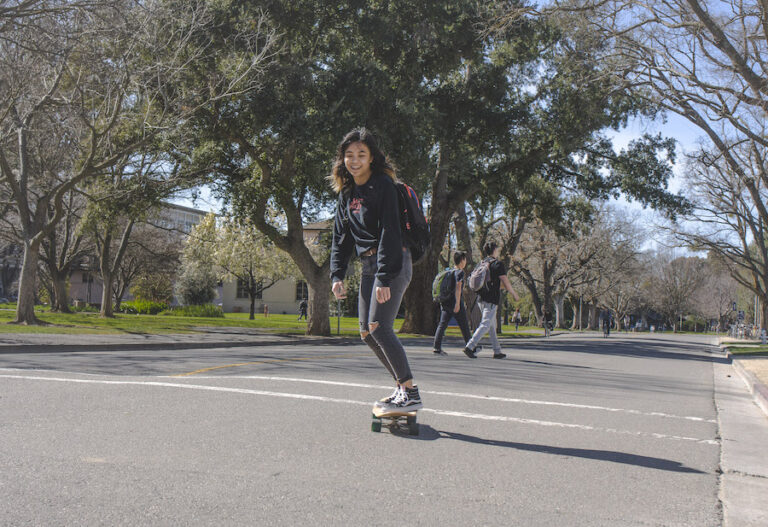
Davis, widely recognized as the bicycle capital of the United States, is well-known for the bikes that whizz across streets and sidewalks. However, some students prefer a different mode of transportation — still on wheels, but with four instead of two. Skateboarders glide amongst the sea of bikers, choosing to use their boards to commute to class instead of using the traditional bikes.

“I brought [my skateboard] as a secondary mode of transportation in case my bike broke down,” said first-year biology major Anna Rhee.

Second-year biochemistry and molecular biology major Jada Garcia chose a longboard to ride around campus because it is a smoother ride and made for commuting.

Miley Couwenberg, a first-year environmental science major, decided to bring her skateboard with her as well. When she committed to Davis, she researched whether there was a skatepark and found one about a mile north of campus.

“I decided to bring it because I kind of wanted to get more into skating anyways,” Couwenberg said.

Second-year environmental science and management major Kit Chou got into skateboarding just a few weeks ago after she tried out her friend’s board. A week after trying it, she bought a longboard.

“I try to skateboard every day after school,” Chou said. “I don’t really skate at school since I’m not proficient enough or I don’t trust myself enough yet. But I skate around the West Village in the parking lot, and I ride along the roads.”

Garcia, like many other skateboarders, also has a bike that she sometimes uses to ride to campus. However, she said she prefers the convenience of skateboarding.

“I found bike parking to be hard,” Garcia said. “You can always have your skateboard with you, and you can get somewhere fast right away. You can take it on the bus too. Since I live off campus, I can bus to campus and skate around once I’m here.”

When deciding whether to bike or skateboard to class, Couwenberg said that she considers the weather, since she does not like to skate in the rain, and the amount of time she has to get to class, since skating usually takes longer.

“I feel like when I skate, I go a little slower, and I see more rather than biking,” Chou said. “When biking, I’m going faster, and I’m more focused on destination. When I’m skating, I have more time to look around.”

The Davis campus and city is well known for being bike-friendly. According to Garcia, she thinks it is also fairly skateboard-friendly since the roads are all very flat.

“If you’re like, skating cautiously, it’s pretty skateboard-friendly,” Garcia said. “I skate around Davis. I will skate from my house, and there’s not much of a difference to biking. I use the same lane as everyone.”

However, according to Chou, since she just started learning to skateboard, she finds Davis more difficult to skate in.

“It is really not safe,” Chou said. “In the roundabouts, people don’t yield, and you need to have enough room to turn. Bikers don’t don’t consider how hard it is for skateboarders to turn. I’ve almost gotten into a couple accidents.”

Even though Couwenberg has been skating since she was eight years old, she still finds it difficult to skate on the Davis campus. According to her, there are a lot of cracks in the roads that are easy to trip on and cause crashes.

“Thankfully, I have not gotten into any accidents on my skateboard,” Couwenberg said. “But there was a time, I was going to class and I was going around a roundabout and I tripped on a crack, but there was a biker behind me and there were two bikers and a skateboarder coming in. I was just in the way. It was really bad because they were all maneuvering around me.”

Rhee has also had some difficult encounters with bikers on campus. According to her, the issues usually come from bikers not understanding that skateboarders do not have brakes.

“We have to stop with the sheer force of our will or just putting our foot down and stopping,” Rhee said. “So [bikers] think ‘Oh, they’re going to stop for me. I’m on a bike. I’m bigger than them.’ We can’t stop that easily, and if we do stop the board is going to keep going. I’ve just had several instances where I just had to veer around them.”

Overall, according to Couwenberg, she thinks the relationship between bikers and skaters is friendly. She thinks the environment of the campus makes it more difficult to skate than the bikers themselves. Rhee and Couwenberg like going to the Hutchinson Parking Garage to practice tricks since the roads there are smoother.

“We do little things that I would not classify as tricks,” Couwenberg said. “We jump off curbs and slide on the ground.”

According to Garcia, she thinks there is a stigma about skaters on campus and about having skateboards in class, and people may think it is disruptive to campus. However, she thinks it is actually an effective, fun way to commute.

“It’s just a really easy way to get around campus,” Garcia said. “I use my skateboard because I can.”

Also, Rhee said that the skating community on campus is really strong, and she has made many friends through skating.

“There’s definitely a community between skaters,” Couwenberg said.

Written by MARGO ROSENBAUM — features@theaggie.org

New pizza restaurant, Pizza & Pints, to open in Davis

Owner of Village Pizza & Grill is opening a new pizza restaurant in the heart of downtown Davis

The owner of Village Pizza & Grill, Aziz Fattahi, is opening another pizza restaurant at 236 B St., on the corner of Third and B streets. Fattahi, who opened Village Pizza & Grill in 2009 and also owns Village Bakery, hopes to open the restaurant near the end of March.

The new restaurant, Pizza & Pints, will have a casual setting with counter service, in contrast to Fattahi’s other restaurant, Village Pizza & Grill.

“The other restaurant is a full-service,” Fattahi said. “This is counter service. We [Village Pizza & Grill] have a very extensive menu, eclectic menu. Pizza & Pints is going to have a very limited menu — eight pizzas, four pastas and four salads […] Also, what’s different is the oven is a rotating brick oven we imported from Italy and it will burn wood.”

Pizza & Pints’ simple menu will be a departure from Village Pizza & Grill’s food selections. Village Pizza & Grill’s menu features usual fast-casual dining fare like pizza, burgers and salads, as well as some more unexpected options, like Persian dishes, yogurt soda and smoked salmon pizza. Other than pizza, pasta and salad, Pizza & Pints will also serve breakfast options.

“We will be serving coffees and breakfast items,” Fattahi said. “We do have a full bakery by the train station, and we’re planning on supplying this new restaurant with a lot of pastry options.”

Fattahi, a self-taught baker, opened Village Bakery in 1997. The bakery, located on Second St., features fresh-baked bread, pizza and pastries.

Another difference between the two restaurants will be the beer selection. As the name implies, one of Pizza & Pints’ selling points will be its large selection of craft beers.

“We have craft beers at the Village Pizza & Grill, too, but there’s only 12 taps, so there’s limited rotation options,” Fattahi said. “We’ll have 30 taps at the new place, Pizza & Pints, and we can feature more local craft beers.”

Location played a big factor in Fattahi’s decision to open a new pizza restaurant. Village Pizza & Grill is located on G St. near the perimeter of downtown, while the new restaurant will be in the heart of downtown Davis. Fattahi said the busier B St. location was the main draw and would help get the word out about the new restaurant.

“We wanted to be in a better location,” Fattahi said. “There’s not a lot of foot traffic where we are here [at the Village Pizza & Grill]. I think we have a pretty good name in town, and the fact that it’s at a good location — the main corridor from downtown to the campus — will get a lot of bicycle and foot traffic. I think it’ll probably just advertise itself.”

Pizza & Pints will be another addition to Davis’ many pizza options, including Woodstock’s, Blaze Fast-Fire’d Pizza, Uncle Vito’s Slice of NY and Steve’s Pizza, as well as the usual big chains like Domino’s and Little Caesars. While this many options might seem to make for stiff competition, Steve Wilkinson, the founder of Steve’s Pizza, did not express concern over the arrival of Pizza & Pints. Wilkinson, who opened Steve’s Pizza in 1978, noted the expansion of Davis’ dining scene and thinks it will benefit all downtown businesses.

“The downtown has changed over the years,” Wilkinson said. “There’s a lot more restaurants and bars in the downtown area. I think it just brings more people downtown, so it helps us all.”

About one in eight Americans consume pizza on any given day, according to a 2014 report from the United States Department of Agriculture. Young males consumed even more pizza, with more than one in four males ages 6-19 years eating pizza on any given day. College students also supply an ample customer base for Davis restaurants.

Independent pizza restaurants feed a large share of this market, and customers often choose them over chains. The Chicago-based food industry consulting firm Pentallect, in collaboration with Critical Mix, found that consumers rated independent restaurants as superior to chains in 12 of the 15 studied key attributes across both operational and emotional metrics, such as being community-oriented, offering personalized service and sharing values with the customers.

Pizza & Pints, an independent pizza restaurant, is expected to open near the end of March.

Written by: Sara Glicklich — city@theaggie.org

Drop in UC freshmen applications for first time in 15 years

UC freshman applications decreased by 3 percent systemwide

A fact sheet released by the UC Office of the President (UCOP), which highlighted the UC admission statistics for Fall 2019 applications, reported a 3 percent systemwide decrease in applications sent to the UC.

Claire Doan, the director of media relations for UCOP, said via email that there are several factors that might have led to the slight decrease in freshmen applications, including the many wildfires that took place directly prior to the Nov. 30 deadline for UC applications.

The deadline for UC applications, however, was extended to Dec. 15, 2018 for “students who were affected by recent natural disasters,” according to the fact sheet. Therefore, students affected by California wildfires had an additional several weeks to submit their applications.

Doan referenced projections from the California Department of Finance in her identification of other explanations for the decrease. Other explanations include “high school counselors helping students better narrow their lists of prospective college choices,” “the signing of California College Promise, which waives the first year of tuition for full-time community college students” and “national immigration policy,” Doan said.

“Also, last year’s surge was unexpected,” she explained. “So this year’s numbers may reflect some levelling off.”

Additionally, the decrease in the number of high school graduates, Doan mentioned, is relatively insignificant. About 3,000 less students are projected to graduate from high school this year in California, according to the California Department of Finance website.

The website also states that high school “graduates are expected to remain flat” until a projected increase in the 2023-24 school year.

California State Universities (CSUs) also experienced a decrease by 0.4 percent in freshmen applications according to an email from Toni Molle, the director of Public Affairs for the CSU Office of the Chancellor.

Molle attributed the slight decrease to many of the same factors Doan listed, including the natural disasters, the leveling off in the number of California high school graduates and the possibility that students are becoming more selective when applying to college.

Written by: SABRINA HABCHI — campus@theaggie.org

Interfaith Rotating Winter Shelter, HOPE rally to save Showers Program

Liability, health concerns, fees threaten to end program serving Davis homeless population

UC Davis student organization Homeless Outreach through Prevention and Education has been fundraising and raising student awareness in an attempt to save the Showers Program — a program that allows individuals experiencing homelessness to use Hickey Gym’s athletic showers for one hour on Sundays.

Two years ago, UC Davis women’s water polo coach Jamey Wright began the Showers Program after an experience volunteering with the Interfaith Rotating Winter Shelter, in which a guest needed to use a shower. Wright then developed the idea to use the Hickey Gym showers — as he noticed that the facility was underutilized on Sundays — and worked with the athletic department to start the program in December 2016.

Wright said that when he met with department leadership, he offered ideas of how the program would benefit the department and the community.

“I said really, the bottom line of why we’ve got to do this is because it’s the right thing to do, and it doesn’t cost us anything, really,” Wright said. “And the other thing is […] this really provides an opportunity for the coaches volunteering to help be there [to] run it, monitor it, [and] if they want to bring their athletes, I think it’s a great way to develop empathy.”

Wright said the program ran smoothly, with a small handful of participants — about six to nine, but at times as many as 12 individuals — coming each week. They signed simple waivers releasing the department, university and Wright from liability, and received towels and soap to use, donated by community members, the Davis Water Polo Club and athletes. In addition, Wright said he notified the UC Davis Police Department most days the program happened.

After an incident in July 2018 prompted police action, however, the Showers Program’s viability was called into question. Wright explained what happened.

“Someone who had not been part of our regular group that would come in got a bit disruptive, and so they called the campus police, and they came,” Wright said. “There was no confrontation at Hickey with this guy, but the officer that showed up was concerned. He said, ‘Yeah, I think you guys really want to rethink what you’re doing here.’”

A few weeks after the incident, the Showers Program was discontinued.

According to Wright, the athletic department had been supportive of the program, but this situation affected its willingness to continue.

“They were the ones that embraced it in the beginning and were very supportive, and I think they just got a little gun-shy when, well, maybe there’s some concerns there, maybe there’s some liability we haven’t really assessed and maybe somebody else can champion this cause for a while instead of us,” Wright said.

Already, IRWS — which partnered with the Showers Program each winter — has stepped in to continue the program after its hiatus in the late summer and fall of 2018. IRWS rented the space from the university and used its existing liability insurance to cover the program, but as IRWS only runs from Dec. 2 to Mar. 17, this was a short-term solution.

After this winter season ends, HOPE — which began volunteering with the Showers Program last summer — wants to make sure that the program continues. HOPE anticipates a need for about $500 to $600 of funding, and to this end has hosted a bake sale. In order to spread awareness, HOPE will also host a film screening and panel about homelessness on Mar. 2 at 123 Sciences Lecture Hall.

Wright said this funding may or may not allow the program to continue.

“The university would have to approve it [at] some level in there,” Wright said. “Somebody has to say, we’re going to sponsor this thing, and then they have to feel comfortable with it.”

Julia Nguyen, a third-year global disease biology major at UC Davis and outreach coordinator with HOPE, spoke about her motivation to fight for the program’s continuation.

“As a club, as volunteers, we saw how important the showers were to everyone in the community,” Nguyen said. “To have the showers here and [see] the gratitude that’s expressed by all of the participants to us volunteers was just, we knew how important it was.”

HOPE also sought to address health concerns by reaching out to CommuniCare Health Centers for a professional opinion about the program. Melissa Marshall, the chief medical officer at CommuniCare Health Centers, provided a written statement.

“While one cannot say that health risks are non-existent, they are certainly negligible in light of exercising standard precautions and providing hygiene access to this vulnerable population,” the statement said.

Nguyen said that the program serves as an important bridge between students and the city of Davis.

“It’s our job to say that we want these facilities to be used in […] inclusive ways, and we want them to be used in ways which foster a sense of community,” Nguyen said. “That’s one of the principles of UC Davis — we have principles of community. So I think that’s very relevant to how we can play a role in this, and […] the city is linked to the UC Davis campus [by] the fact that we need to be advocates together.”

Written by: Anne Fey — city@theaggie.org

The AAF looks to learn from the past

Examining the newest football league and what it means for the NFL

If one thing is for certain, it’s that the NFL is the world’s most popular football league. Since the AFL-NFL merger in 1966, other aspiring professional football leagues have come and gone, but the NFL has remained. Arguably its biggest rival was the United States Football League in 1983, but even the USFL only lasted three years before it fell apart. While past leagues have tried and failed to compete with the NFL, the Alliance of American Football seems to be taking a different route that shows it has learned from the past failures of others.

So what is the AAF? It’s a new football league that began its inaugural season a week after Super Bowl 53 and runs through the end of April. It aims to give players a second (or first) chance at professional football and to eventually make it into the NFL. It was founded by television and film producer Charlie Ebersol and former NFL executive Bill Polian.

The league is made up of many former college football stars whose professional careers fizzled out. Notable players include Trent Richardson, Christian Hackenberg, Josh Johnson and Zac Stacy, all of whom are looking to get back into the league.

Familiar coaches include former South Carolina Head Coach Steve Spurrier, former 49ers Head Coach Mike Singletary and Pac-12 journeyman Rick Neuheisel. Retired NFL legends including Jared Allen, Hines Ward and Troy Polamalu are members of the league’s leadership board.

The player contracts are worth $250,000 over three years and include other incentives and benefits, such as player health insurance. The contracts also allow players to move on to the NFL if such an opportunity arises. This salary pales in comparison to NFL salaries but is still generous considering AAF players only work four months out of the year.

The league is comprised of eight teams, most of which are located in cities that do not have a professional football team. The reason behind this is to build a fanbase without having to worry about competition with other pro franchises nearby. Cities like San Antonio, Birmingham and Salt Lake have long wanted to have a professional football team and now host AAF clubs.

Outside of Atlanta and Arizona, the markets for football are favorable for the AAF. A matchup in week two where the Orlando Apollos traveled to San Antonio to face the Commanders had a total attendance of 29,176. Another game in San Diego saw an attendance of 20,000. Although it’s early, these initial signs are encouraging.

Not only are people showing up to the game, but they are tuning in to watch as well. In the first week of action, the AAF had more viewers (2.91 million) than the NBA Saturday night game (2.38 million) between the Houston Rockets and the Oklahoma City Thunder. AAF games also have limited commercial breaks compared to those of the NFL and aim to run about 30 minutes less than an average NFL game.

The AAF rules are similar to the NFL rules with a few differences. There are no kickoffs, as teams always start at the 25-yard line after any score. There are also no extra points, as teams must go for two after every touchdown. The most drastic change, however, is with the overtime rules. Each team has one possession from the 10-yard line and four downs to score with no field goals allowed. If neither team scores, the game ends in a tie.

In week one, the AAF was trending on Twitter, specifically due to a big hit on San Diego’s quarterback Mike Bercovici. The video of the hit has been shared millions of times and seemed to catch the attention of many people online. The AAF is also catching the attention of gamblers, as the league has already allowed the public to place bets on games and interact with a unique fantasy-style game platform.

Ultimately, the goal of the AAF is not to overtake the NFL but to work alongside it.

“We really felt it was important to be in a symbiotic relationship with [the players] and complementary to the NFL,” Ebersol told Business Insider in February.

Although leagues like the USFL and XFL failed, the AAF is making a conscious effort to try and avoid the mistakes that past leagues made. Although the AAF and the NFL don’t have an official partnership, there is no antipathy between them either. Some AAF games are even set to air on the NFL Network.

In the long run, there appears to be potential benefits to both sides. The NFL does not have a minor league system where they can develop players like the other major sports leagues do, such as the NBA, MLB and NHL. Not only does a minor-league system have the potential to develop young players, but it would also help the AAF capture the interest of NFL fans looking at possible future players.

The AAF knows that historically speaking, it does not have a chance in a head-to-head battle with the NFL, so trying to work with the NFL has the potential to keep the AAF alive. In a league where millions of fans dread the long, brutal offseason without football, this alternative might be what the NFL and its fans need.

Written by: Omar Navarro — sports@theaggie.org

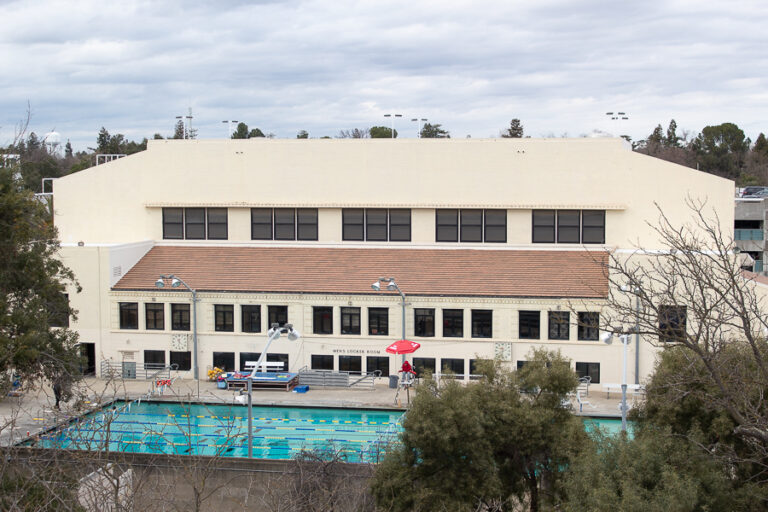
Gymnastics tops San Jose State

Hebert continues to shine in victory

It isn’t everyday that you see coveted leadership roles in Division I sports taken up by a sophomore athlete, but sophomore gymnast all-arounder Kelley Hebert found herself in a position to take up one of those roles this year. Her performance propelled the UC Davis gymnastics team to victory against San Jose State at The Pavilion last Friday, 195.050 to 193.250.

Hebert took first place in vault, tied for first place on the balance beam and on the floor and edged out Taylor Chan of SJSU for the individual all-around. Sophomores Kyla Kessler and Sarah Liddle tied for first on the uneven bars with 9.850 and sophomore Alyssa Ito took third with 9.800.

“We all really had a goal, even though everything didn’t go the way we wanted, we kept fighting through the meet and ended up with a really good score,” Hebert said.

Despite stellar individual performances recently, with Hebert posting a season high in the Aggies’ meet against New Hampshire and an individual all around title and floor exercise title against Alaska Anchorage, the Aggies have not had as many team wins.

“I was really focused on the details of this meet,” Hebert said, pointing out that there were little things from previous meets she wanted to fix.

After helping her team place second in a six team field in the Mountain Pacific Sports Federation Championship, Hebert was named the MPSF Gymnast of the Year. She then went on to qualify for the individual NCAA regional tournament along with Alexis Brown, now graduated.

While not officially a captain, the all arounder has posted consistent scores and has so far been named Mountain Pacific Sports Federation Gymnast of the Week six times. She also has the highest floor average on the team with 9.853.

The floor exercise is the event in which gymnasts are arguably best able to let their personality shine through. This is readily apparent especially given that a video of UCLA gymnast Katelyn Ohashi went viral earlier this year with a seemingly effortless yet, energized floor routine that garnered a perfect score.

The floor is Hebert’s time to shine and the event she is most confident in.

“Every time I go to floor, I have a sense of calm over me and I get into the event and it’s fun for me,” Hebert said. “As soon as I start, I have a giant smile on my face and it carries through the rest of the routine. My nerves are kind of put to the side.”

The Aggies’ lineup last year featured more freshman than usual, and that class is continuing to contribute this year in a big way, according to Head Coach John Lavallee. The way the lineup played out last year required them to compete.

“Every class had a different experience, for last year’s freshman class, we didn’t have a lot of those spots [filled],” Lavallee said. “And they were out there whether they wanted to or not.”

This provided Hebert a chance to prove herself as an asset to the team, and this year she has continued to improve.

“I actually felt, the pressure in the preseason of living up to last year, it was really getting to me,” Hebert said. “It took a lot of mental training to calm that down. I had to start this year with a fresh mindset and I incorporated an entire new bar routine.”

And Hebert is eager to mentor her other teammates.

“Last year I was looking up to people on the team,” Hebert said. “This year I wanted to be able to be someone who my teammates could look up to.”

With such a young team, Lavallee says there is some developing to be done.

“Having to perform at a higher level every week to get in the lineup, it’ll help them in the offseason to know what level they’ll need to be at,” Lavallee said.

Lavallee said one of the team’s goals is to qualify for the NCAA postseason and so far he thinks things are going well, but nothing is set in stone yet.

UC Davis will make a quick trip across the Causeway to square off against Sacramento State tomorrow before returning home to finish the regular season with two home meets in early March.

Written by: Bobby John — sports@theaggie.org

History of North and South Halls

An inside look at two of the oldest buildings on campus

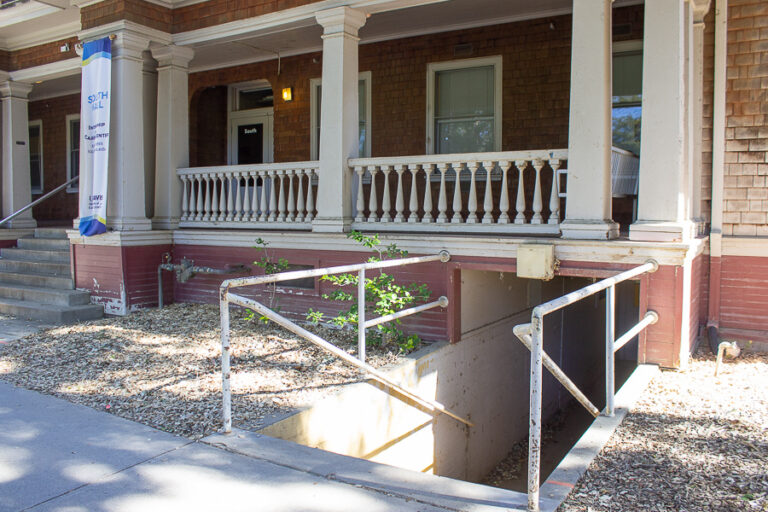
Before UC Davis was the campus we know, it was UC Berkeley’s research farm. UC Berkeley’s University Farm School opened in Davis in 1909, whose first students once the university started accepting students not pursuing degrees in agricultural sciences. Those students found their housing in North Hall and South Hall.

North Hall and South Hall are the second and third oldest buildings on the UC Davis campus to date, respectively. They were originally built as dormitories. North Hall, built in 1908, was the men’s dormitory and South Hall, built in 1912, was the women’s dormitory. South Hall also had three infirmary beds. Architects Harold Louis Cunningham and Matthew V. Politeo designed the two buildings.

In the 1960s, the North and South Hall dormitory buildings were converted to office use. South Hall was first to make that transition in 1961 and North Hall followed suit in 1964. Over the years, they served as office spaces for the Advisory Skills Center, Learning Skills Center, Internship and Career Placement Center, Services for International Students and Scholars, Student Activities, Student Affairs Research and Information and the Student Employment Center.

Today, North Hall is one of the two locations for Student Health and Counseling Services, containing the SHCS Counseling Services and the Mind Spa. It is also where the Women’s Resources and Research Center is. South Hall is now home to Advising Services, the Internship and Career Center, the Unitrans office, Student Recruitment and Retention Center, the Peace Corp office and many other student services.

“I knew that these were dormitories; I didn’t know which gender was assigned to which one,” said Cecily Nelson-Alford, the director of the Women’s Resources and Research Center, referring to the fact that the original men’s dormitory now serves as the Women’s Resources and Research Center.

The halls of the two buildings still resemble the original dormitory architecture. They’re narrow with doors on both sides all the way down the hall. The staircases leading to the upper levels of the buildings are also narrow and resemble older-styled architecture.

“It’s old,” Noelle Tran, a first-year wildlife, fish and conservation biology major, said, describing South Hall. “It’s very gloomy inside. It doesn’t surprise me that it used to be housing because I thought it was on-campus housing the first time I saw it.”

North and South Hall, two of the three historical dorm buildings, still stand today even though they are not used as dorms anymore. The third dorm building, called West Hall, was built in 1914. In 1951, West Hall was demolished, and in its place today stands the Memorial Union.

“Overtime, it’s typical that universities change and needs change, so I’ve been in buildings that used to serve very different purposes,” Nelson-Alford said.

The change in use of the two buildings is not unusual compared to other universities. It is notable, however, that two of the oldest buildings on campus, North and South Hall, still stand today to serve the students.

Written by: Ling Nguyen – features@theaggie.org

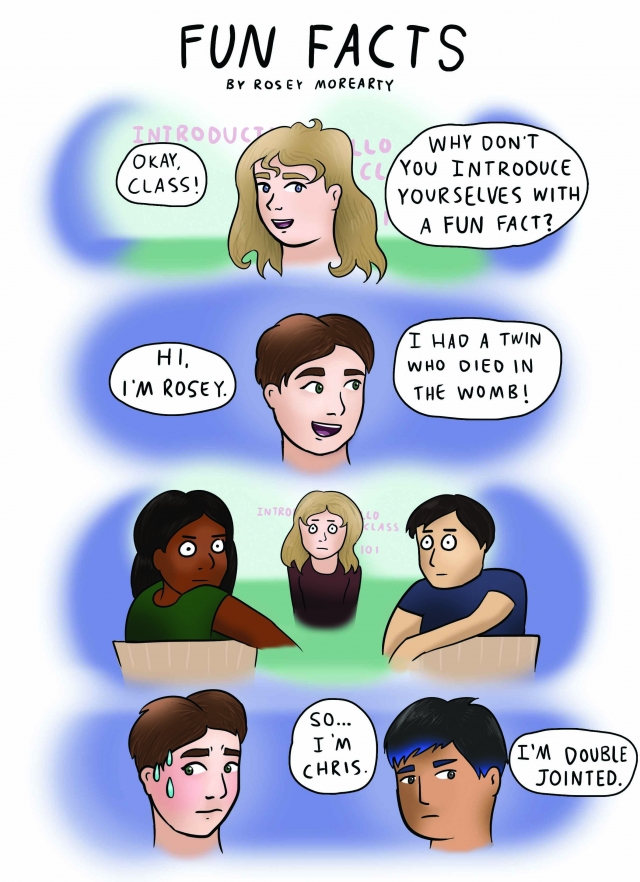
Cartoon: Fun Facts

ROSEY MOREARTY / AGGIE

Written by: Rosey Morearty — rosey@morearty.org

Guest: The Wall, immigration and The War Racket

KDVS and Shields Library’s Gary Saylin argues that money should go toward improving life — not furthering death

Most of the immigrants trying to cross the border are children, women and men seeking asylum from the horrific situations in their home countries. They deserve asylum because it is the humane and truly right thing to do.

The billions of dollars proposed for “The Wall” could not only go to getting control of the cartels, but also to safe sanctuary housing, medical clinics, educational opportunities and jobs with decent work conditions and pay for immigrants who are in desperate situations.

You may ask: How are we going to pay for all this?

Well, we have tons of money, including the $5 billion-plus proposed for “The Wall.”

Cutting back the war munitions industry would be a huge start. Bombs are expensive. Billions, trillions. It is insane how much money is funnelled into making more bombs and other weapons that feed a culture of death.

We need to be using the money to, among other things, clean up the environment, help the immigrants, build better schools and give a boost to Planned Parenthood and other humane organizations.

It is a war racket, as folk singer Buffy Sainte-Marie sings about, that is killing our planet.

People, this madness is all tied together. Think of all the money and energy that could go toward life — not death and destruction.

We need to get our priorities straight.

Written by: Gary Saylin

The writer has been doing production and programming at KDVS since the 1970s and has served as the Library Assistant at Shields Library since 1988.

American liberalism and the cult of personality

For many Americans, political figures have replaced the traditional vanguards of morality

137 years ago, Nietzsche famously quipped: “God is dead.”

In spite of its now-cliché position in philosophical rhetoric, Nietzsche’s fundamental proposition — that western society’s embrace of Enlightenment thinking had brought about the decline of belief in objective Christian morality — remains true to this day. The decline of organized religion has in turn been matched by an increase in instances of self-focused spirituality. This has become especially true among Americans, who have increasingly relegated religious practice to a passive status.

German sociologist Georg Simmel similarly noted the decline of religious practice and belief in objective morality in the post-WWI era. Simmel wrote that organized religion and monotheism had been replaced with “religiosity as an all-embracing, spontaneous process of life.” In a contemporary context, this phenomenon is best understood by the popular moniker “spiritual but not religious.” Traditionally, such a belief was largely synonymous with personal, singular religious practices or New Age spirituality.

In recent decades, however, this practice of personal spirituality has grown increasingly connected to the indirect worship of finite beings in the physical world. Absent of the belief in a transcendent God historically present in Judeo-Christian tradition, many people have increasingly applied a religious-like degree of reverence to physical beings. This has often emerged through the establishment of cults of personality centered around public figures. Frequently, these figures have been ascribed characteristics such as heroism, infallibility and benevolence — all of which have been traditionally bestowed upon religious luminaries.

In the era of the Trump presidency, this practice has become particularly apparent among certain strains of American liberalism. This degree of immanent spirituality has manifested itself through the application of traditional religious values to left-wing political figures. Examples include Robert Mueller prayer candles, the sanctification of Nancy Pelosi or the increasingly cult-like worship of Ruth Bader Ginsburg.

At first glance, it is easy to simply brush off such practices as petty humor or cultural expression, but further introspection leads one to wonder if there is a more metaphysical explanation for these practices.

Naturally, American liberals — significantly more irreligious and nontheistic than both their conservative and moderate counterparts — have grown increasingly pessimistic about the future of the country under President Donald Trump. It should come as no surprise that many of these individuals have indirectly turned to celebrity worship as a means of providing stability to their worldviews. Without belief in the objectivity of the moral dichotomy of good and evil found in fundamentalist Christian tradition, many liberals have instead applied a dualistic worldview to the contemporary political spectrum. With this understanding, each side of the partisan divide takes on a position of either innate goodness or total immorality. Consequently, this provides an existential motivation behind political resistance and reassures the participant of the dualistic nature of morality.

This practice bestows the individual in question with a belief in the intrinsic value of the world, providing a remedy to the rampant nihilism of postmodern American society. This becomes particularly important among irreligious American liberals, who are likely to have recently adopted increasingly pessimistic perspectives on the human existence.

The world can be a scary place. As western tradition turns away from a universal belief in a divinely-ordained moral order, it is natural to search for meaning and understanding in other places. With our reality progressively feeling more and more surreal, expect personal spirituality to take increasingly odd forms.

Written by: Brandon Jetter — brjetter@ucdavis.edu  

Disclaimer: The views and opinions expressed by individual columnists belong to the columnists alone and do not necessarily indicate the views and opinions held by The California Aggie.