55.5 F
Davis

Davis, California

Tuesday, December 23, 2025
Home Blog Page 480

Global Education Initiative in process at UC Davis

ALLYSON KO / AGGIE

Global Affairs is developing a global education program for UC Davis students

The Global Education Initiative is a program being developed by UC Davis Global Affairs that intends to incorporate the realities of a globally-connected world into UC Davis students’ education.

Vice Provost and Associate Chancellor of Global Affairs Joanna Regulska is one of the individuals leading the initiative.

“Global Education for All was selected in the first round of UC Davis’ call for ‘Big Ideas’ and I am the ‘champion’ of the idea,” Regulska said via email. “This means I am ensuring that we develop robust programming for students with many diverse opportunities of engaging domestically or abroad in global learning. I am serving as a spokesperson, working with faculty, academic units, alumni and potential donors to make this ambitious goal a reality.”

Nancy Erbstein, the director of Global Education for All, explained that UC Davis put out a call for what they called ‘Big Ideas’ a few years ago, and Global Education for All was selected out of the pool of ‘Big Ideas’, as it was the only proposal focused on student experience rather than research.

Regulska said that her personal experiences have allowed her to recognize the value of global learning.

“I was an international student here in the U.S. so I know what it means to gain and have a global and intercultural perspective and to learn surrounded by faculty and classmates from different cultural backgrounds and countries,” Regulska said. “I also know through lived experiences, my scholarly and professional career, and emerging trends that international and intercultural experiences are more valuable than ever in preparing our students to succeed.”

Students with skills that can be developed through global learning, such as “problem-solving, adaptability and connecting across cultures,” are in-demand upon graduation.

Erbstein explained why she believes it is important for students to engage in global education.

“We recognize that these days a lot of the major world challenges have a global dimension to them — whether you’re talking about climate change, spread of disease, inequality or migration,” Erbstein said. “We have all these new forms of transportation, new technologies, and new global institutions that are increasing our ability to connect around the world and to connect with people across cultures. If UC Davis is going to really take seriously its responsibility to be preparing students to live in that kind of world, we need to be supporting students to get connected globally and develop the skills to work globally.”

According to Erbstein, there all multiple ways to engage in global learning and studying abroad is just one of them. Global Education for All will also focus on expanding global learning within the coursework offered on campus.

“There could be virtual collaboration happening through a course with people even in another country or on another campus,” Erbstein said. “We’re looking at expanding global learning opportunities through experiential learning opportunities, so that could be involvement in research, internships, or externships or some sort of community engaged service learning. It could involve working with the refugee community that’s based in Sacramento or working with a business that has offices in northern California that works globally.”

Regulska specified three pathways through which UC Davis students might incorporate global learning: academic, experience and living and leading. The academic pathway includes participating in study abroad programs, “global, international, or intercultural dimensions” in classes students already take on campus and virtual collaborations with universities in other countries.

“Within the experience pathway, there will be an emphasis on hands-on learning experiences, whether it be internships/externships, participating in research or in service learning programs or other ways of putting classroom learning into action,” Regulska said via email. “And within the living and leading pathway, we will expand opportunities for students to gain leadership and intercultural skills on campus, in the dorms, and in the community through various student groups, community organizations and campus partners.”

Erbstein said that the initiative’s long term goal is to engage every UC Davis student in global learning. The project coordinators are still sorting through the multitude of possibilities for enhancing global learning on campus, including an enhanced global learning minor.

Erbstein also stressed student involvement in the initiative, particularly in a campus-wide steering committee with faculty, staff, administrators and four students.

“We’ve worked with … four students to convene a larger student advisory committee,” Erbstein said. “We have students from all the different colleges, undergraduate, graduate and professional students. We’re really trying to hear from students what they want global learning to look like and how it would be useful to students to have it be recognized by the campus as they think about going on and applying to grad school or postgraduate programming or jobs.”

Tiffany Trinh, a fifth-year community regional development major, is part of the Millenium Fellows cohort, which is involved in the global education initiative and engaged in incorporating a program that links their fellowships to global education for all.

“A group of us were selected to become part of the U.N. millennium fellowship, and we are branching off global education for all and trying to get the campus involved with global education either through events or performances or anything these student organizations can think of,” Trinh said. “We’re currently reviewing some pre-proposals for student organizations’ ideas and these will give us an idea for what people want to do, and there’s also applications for mini grants.”

According to Regulska, “students with ideas, questions, feedback or interest in getting involved are encouraged to email globaleducationforall@ucdavis.edu.”


Written By: Sabrina Habchi — campus@theaggie.org

 

Seasonal pay discrepancy alleged for graduate student instructors

JAMIE CHEN / AGGIE

“Equal Pay for Equal Work” petition calls to eliminate seasonal pay discrepancy

Duane Wright, a graduate student instructor in the Department of Sociology, has alleged that there is a “serious problem” with graduate student assistant instructors (AIs) receiving lower pay during summer sessions than they would for teaching courses during the normal academic year.

According to Wright, summer AIs receive two-thirds of the payment that regular session instructors receive. In response, he created the “Equal Pay for Equal Work” petition which demands equal compensation year-round.

Wright believes that since the summer sessions are equivalent to a normal academic year class with regard to courseloads, fees and academic units, graduate student teachers should also receive equalized pay.

Claire Doan, the director of media relations at the UC Office of the President, dismissed Wright’s petition, claiming it was an improper action to take.

“UAW leaders agreed to the summer compensation rates as part of the four-year contract they reached with UC in August,” Doan wrote. “The proper forum for addressing this issue was and is at the bargaining table.”

Wright, however, said a pay formula exists to determine salaries. Because graduate student instructors were not aware such a formula existed, they were not able to bring the pay disparity up during negotiations.

Doan clarified the pay formula, saying the explicit parameters for determining summer compensation rates was clearly outlined in the recent contract.

The compensation rate for teaching assistants, fellows, graduate student instructors or associate ins who have a 50 percent appointment during summer session is “the rate resulting from dividing the academic term gross salary by the maximum workload of 220 hours (quarter) or 340 hours (semester) and multiplying the result by 120 hours (for a six-week summer session),” Doan wrote via email.

“This compensation rate shall apply proportionately to other percent appointments and/or to summer sessions of different lengths,” Doan wrote. “ASEs and groups of ASEs who are currently paid at a rate greater than this in summer 2007 shall continue to be paid on that basis (plus any additional wage increases that ASEs in the unit received in the previous academic year).”

Wright, however, alleges there was an omission of the formula in the contract, making it so administrators are unclear about this stipulation to summer pay, making it harder to uncover and fix.

“That formula cannot be found in the contract, so no one reading the contract would even know that people get paid less in the summer,” Wright said. “I can personally attest to this because I was on the team that negotiated the contract in 2013-2014 and I had no idea AIs were paid less over the summer, and I never heard my colleagues speak of it — the entire time we were discussing in depth each article of the contract. It wasn’t until years later, this recent summer, when I was hired as a summer instructor that I discovered this practice.”

Wright is unsure whether this is a UC-wide or UC Davis-specific situation.

Furthermore, Wright questioned UCOP telling workers to wait till contracts expire, in four years, for any pay increase. According to wright, fairness in payment towards graduate student workers should be a higher priority.

“I think it says a lot about the executives at UCOP that when an issue of fairness comes up like this their response is to say to not address it until this contract is expired in four years,” Wright said. “I won’t be here then. I want fair pay now. And you know all those executives making six figure salaries at UCOP aren’t making 2/3rds pay over the summer either! Graduate students are struggling, especially student parents like myself.”


Wright accused the UC administration of continuously under-valuing graduate instructors that teach at the university. Graduate students who are already struggling to pay for rent and food need to make the same as their fall, winter and spring quarter counterparts, he said.

“Graduate students make very little money, yet without their labor the university would cease to function,” Wright said. “When you consider that without summer employment we make about $20k per year, that is not much to live on and certainly isn’t a living wage for those of us with children or dependents. By not getting equal pay for equal work over the summer it really hurts us.”

Another issue for Wright is that summer session AIs often don’t have teaching assistants for courses that would otherwise have assistants during the regular school year, leading to additional work for these instructors.

In the petition description, Wright emphasized that the principle of “Equal Pay for Equal Work” is common sense, and what he sees as an undervaluing of instructors by the university.

“We demand that UC Davis recognize the amount of work that graduate student summer session instructors put into these courses, and that UC Davis compensate them as such — by paying them the amount they make for teaching the same course during the normal academic year,”  Wright wrote in the petition. “We believe that this is is about the principle of ‘Equal Pay for Equal Work’ — which is about fairness and justice.”


Ellie White, a graduate student in the Center for Watershed Sciences, commented on the situation via email, and said that if these instructors knew they were being compensated at a lower rate than during the regular school year, they would “be outraged.”

“Why should my labor be valued differently from one season to the next?” White said. “Do chancellors, vice chancellors, and provosts get paid any less? No.”

The petition is currently circling through several affected groups.

“As of right now, the petition has over 100 signatures and it is just getting started because the Davis unit of the UC Student Worker Union UAW 2865, which represents AIs as well as TAs, readers and undergraduate tutors, just endorsed the petition and will be sending it out to all its members at Davis,” Wright wrote. “I expect it to get an even bigger circulation and many more signatures by next week.”


Written by: Aaron Liss — campus@theaggie.org


Happy Thanksgiving from the Editorial Board

CAITLYN SAMPLEY / AGGIE

The Editorial Board shares people they’re thankful for


Emily Stack, Editor-in-Chief

Being the elder sibling is a privilege and a responsibility, but it’s easy when your sister is as wonderful as mine is. Besides being a delightful person in her own right –– she’s a talented painter and dancer with a quick mind and sass to rival my own –– she constantly surprises me with her clear-eyed wisdom and has talked me down from many a panic attack or wrathful rant. When we’re both at my parents’ house, we still share our childhood bedroom and stay up talking until the wee hours. She’s been my best friend since she was born, and I’m thankful beyond words to have her.


Olivia Rockeman, Managing Editor

My life simply wouldn’t be the same without my three roommates, who truly give me a place to call home in Davis. I can’t think of anyone else who would pick me up off of Russell Boulevard after a bloody accident involving a JUMP Bike. Or someone who would continue to share her banana bread with me after being woken up by my ridiculously early morning alarms every weekday. Or someone who would already be awake when that alarm goes off, willing to have a heart-to-heart before 7 a.m. Cass, Lai and Fairy, I am thankful for you today and always.


Harnoor Gill, Science Editor

I am, strangely enough, thankful for my goofball of a brother. He’s 12 years old and I can safely acknowledge that the days before his birth were a little less interesting. I would characterize him as a smart and funny introverted spirit that likes basketball, video games and spending time with me. If I was instructed to use two idioms to describe our relationship, which I cannot truthfully say I have been, unfortunately, I would say that we are two peas in a pod that sometimes fight like cats and dogs. Our unhealthy infatuation with the Harry Potter series is unsurpassed by many others, so it’s probably a good thing that we were sworn to bear each other’s burdens. It is also comforting to know that there is another human being that is surviving life with the heritable idiosyncrasies of my parent’s union, namely the social awkwardness that we are both plagued with. Misery does indeed love company. Oh, before I go, I told him that I am writing about him and he has politely but persistently demanded that I mention his rapper name, so…happy Thanksgiving to Young GOAT.


Olivia Luchini, Features Editor

As an Editorial Board, we were distinctly told that we could not all write about our thanks for our mothers, so I’ve chosen the second-most important individual with an “M” name in my life: Mulaney, John. Throughout college and particularly when attending a university as large as UC Davis, it is not a rarity to feel isolated or alone and in need of a good chuckle. Throughout all of the four years I have been here, I have utilized John Mulaney’s work in some capacity to retain joy in the most exciting and dullest of quarters. Whether it is his stand up, his episode hosting Saturday Night Live (SNL) or one of his many other projects (like a certain very raunchy cartoon), John Mulaney’s unique sense of humor seems to focus on the aspects of life that go most unnoticed. More than anything, Mulaney has always been my biggest idol in writing, having mastered stand up and having served as a writer on SNL while maintaining originality and wit. This is probably a complex way of saying that I’m just thankful for comedy, but I supposed John Mulaney shall be the sacrificial turkey this Turkey Day to get roasted by my love and affection.


Hannah Holzer, Campus News Editor

In times of chaos, it’s always humbling — and sometimes overwhelmingly so — to take a step back and recognize the sheer magnitude of support and love I have in my life. My family, friends, roommates, coworkers of past and present and teachers cause me an ineffable joy and gratitude. But I’d like to specifically name, on this day of gratitude, my ever-brilliant, charismatic and caring roommate Leeann who keeps me grounded like no one else does. Leeann and I have shared a room for over two years and still give each other daily recaps every night. She’s the only person who will give me an honest take on a poor outfit choice and she reads every tweet I send her without fail. One of my very best friends, Leeann is the most thoughtful person I have ever met and I’m forever grateful for her sincerity and friendship.


Kaelyn Tuermer-Lee, City News Editor

Being three years older than my brother, I’ve always wanted to take credit and say I’ve taught him so much of what he knows. But that’s not really true — I only helped teach him the basics when he was little, the rest was all him. He’s so smart and talented in every way and he makes me the proudest older sister. I know he’ll always pick up the phone, even when he’s busy, to talk to me when I’m sad or miss home. One time, he called me saying that he really missed me and just wanted to hear my voice, which was just about the sweetest thing I’ve ever heard. I am beyond thankful to have watched him grow into the wonderful person he is today and to know that I can always lean on him no matter what.


Dominic Faria, Sports Editor

I would be remiss not to take a moment to be thankful for the city of Davis, Calif. –– my newest and truest home. I fell in love with its crazy bike circles, wild turkeys, always friendly people and overwhelming quirkiness since the day I moved here from the Bay Area. I will never outgrow the profound friendships I have formed here. I’ll never take for granted how this place continues to challenge me to achieve and to better myself. I will forever cherish the days and nights spent with people that mean so much to me in this weird, manure-smelling town –– especially when I needed so desperately to escape from my life where I used to live. So here’s to you, Davis. Thank you for being my home.


Liz Jacobson, Arts Editor

While everyone else rushes home to hug their mom this Thanksgiving, I still have a month to go until my hug. So I thought I’d let everyone know that today, I am thankful for you, mom. Even from 5,613 miles away, you keep me grounded. Everyday, or rather every night at exactly 9 p.m., I am reminded and in awe of your strength, your compassion and your penchant for a nice, big cup of black coffee. Without a doubt, I owe my best qualities to you. While I never got your knack for science and math, I absolutely would not be the person I am today without you. Thank you for passing down to me your love of both Impressionism and modern art, the Beatles and The Lord of the Rings. I can’t wait to see you soon.


Taryn DeOilers, Opinion Editor

I met my best friend and college roommate Amber in seventh grade, when she was in her Newsboys phase and I was in my angsty Paramore phase. Since then, I’ve been honored to see her blossom into the kindhearted, hilarious, brilliant, humble and accomplished woman she is today. She has been a wonderful friend to me, never failing to give level-headed advice or point out — gently and considerably — if I’m putting my morals to the side when making a decision. The past decade with Amber has been composed of late-night group projects, attending one another’s proms and formals, taking road trips to Oregon and Colorado, dancing (terribly) to Janelle Monáe and perisistly and diabolically trying to make each other cringe — this last one making up at least 95 percent of our friendship. I’m not sure what I’ll do next year, when we graduate and possibly live in different cities for the first time ever. But I do know that Amber will always be my best friend regardless of where we are in the world, and that’s more than enough to be thankful for.


Written by: The Editorial Board

Cartoon: Thank You!

DIANA OLIVARES / AGGIE

Written by: Diana Olivares  — deolivaresvalencia@ucdavis.edu


Police Logs

0
SHEREEN LEE / AGGIE

Just don’t double park

October 31

“Subject is refusing to pay his bar tab, requesting assistance.”

“Two college-aged subjects followed reporting party’s children while they were trick-or-treating.”

“Groups screaming and setting off fireworks at the park.”

“Male subject walking through complex, appeared to be looking at bicycles parked near leasing office.”


November 1

“Subjects fighting in the limo pulling over into Chevron.”


November 3

“About five transients camped out by the business storage shed. Reporting party’s employee feels uncomfortable accessing the shed with the subjects currently next to it. The subjects are all awake and seem to be changing or humming.”

“Reporting party’s Door Dash account was hacked and unknown subject ordered four cases of beer delivered to this location.”


November 4

“Reporting party double-parked a few days ago and an unknown subject left a note on his car telling him not to, the next day he found a rock sitting on his car, and today both his plates were bent.”


November 5

“Ongoing issue with reporting party’s car being egged while parked on the street. Reporting party has possible suspicious information.”


Holiday Craft Fair features local artists, holiday wares

0
RAUL MORALES / AGGIE

Davis Senior Center supports programs with funds from event revenue

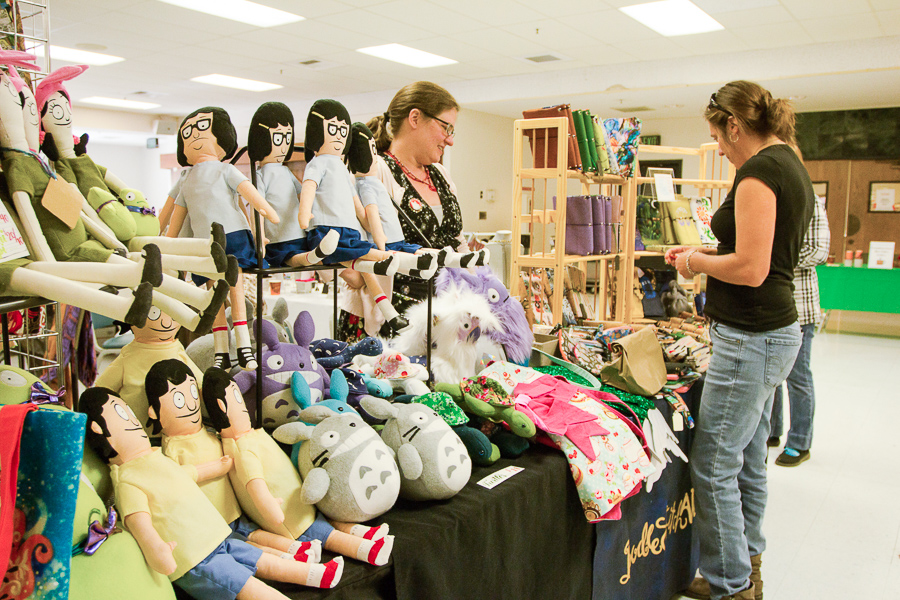
The city of Davis participated in upcoming holiday festivities by hosting the Holiday Craft Fair at the Davis Senior Center on Nov. 3. The event brought together local businesspeople and raised money for the venue, offering Davis residents an opportunity to support their community.

Complete with complimentary gift wrapping and refreshments, the fair encouraged event-goers to invest in the crafts of artists local to the Davis and Sacramento areas. Regional vendors displayed their homemade items, ranging from knitted pieces to self-illustrated and written books to woodwork.

“It’s a way to support local and regional artists and crafters because we have close to 30 vendors who will be showcasing handmade items, which can be the antidote to big-box and mall offerings,” said Dana Welch, the coordinator of the event.

Carol Sublett, a vendor and local resident, showcased a wide-ranging display of tote bags, photo magnets and stuffed animals, among others, revealing her years of experience with crafting.

“I like to take pictures and I like to shop for fabric, so this gives me an opportunity to do both and then make back the money,” Sublett said. “I sell everything at cost. I’m not doing it to make money, so I have fun with it. I have been doing this off-and-on — mostly on — for the last 15 to 20 years.”

The earnings from events like the Craft Fair help subsidize various programs at the Davis Senior Center and resources available to all community members.

“The revenue goes to the Senior Center operating budget, which goes toward the programs and services that we offer,” Welch said. “We are able to keep class fees at a reasonable level. We’re able to offer lots of complimentary things. We have a medical lending closet that’s open to anyone of any age. These are the types of resources we can offer to the entire community because of proceeds from revenues from events.”

As a member of the Davis Senior Center, Sublett responded positively to the fact that revenue from the event goes back into the venue and its services.

“I like that, because I’m a senior,” Sublett said. “I belong to the Senior Center and I get the Senior Scene — which is the senior newspaper — and go on [Davis] Travelaires trips.”

The fair, which always happens on the first week of November, helps residents initiate holiday cheer and invest in festive decorations or presents.

“We put [the event] at this time so it’s a festive kick off to the holiday season, ahead of all the holiday rush, so it feels more relaxed,” Welch said. “It’s a much more visibly rich experience when you go to something organically created versus a regular store.”

The Craft Fair featured artists of all backgrounds, expertise and experiences. In addition to Sublett’s table, retired industrial arts teacher Gerry Anderson and middle school student Charlotte Sloane showcased their crafts. Anderson’s hobby of woodworking originated from his time as an educator.

“I taught drafting and CAD [computer-aided design] and woodshop — that’s how I learned to do it,” Anderson said. “Now I do it for myself instead of trying to teach 30 screaming, wild people in my classes. I just support this [craft fair] because I like the small shows.”

Sloane, belonging to a younger generation of crafters, has been participating in the City of Davis’ Holiday Craft Fair for the past three years, displaying angel ornaments handmade out of felt material.

“I saw something similar to this at the Davis Art Center sale a couple years ago and then I was interested,” Sloane said. “I was trying to figure out how to do it and then for Christmas I got a book on how to do them and it’s just gone from there. It’s really therapeutic because this is all you’re thinking about when you’re doing it.”

As for the future, Sloane hopes to start selling her products online and see schools implementing craft programs into their offered courses.

“We have a ceramics class and an art class, but not so much fiber arts classes,” Sloane said. “I would take that class if they included that. I love what I do, it’s really fun.”

Written by: Renee Hoh — city@theaggie.org

Happy Birthday Harry!

0

An exhibit in Shields Library celebrates the 21st anniversary of the first Harry Potter book

UC Davis students have been invited to the Harry Potter exhibit at Shields Library on campus. From now until March 2019, students can visit and check out various items on display in honor of the famous “Harry Potter” series by J.K Rowling.

Subject Specialist Librarian Roberto Delgadillo prepared the exhibit with the assistance of Bibliographic Consultant Karen McCoy. The focus of the exhibit, called “Harry Potter Turns 21!,” was to honor the books in a way that appreciates both the phenomenon of and academic sides of the world that J.K. Rowling created. By showcasing the exhibit in this way, those visiting can learn more about the series through various viewpoints.

To relate UC Davis to the book series, selected materials including a 700-page Harry Potter bibliography, critical review essays and an 85 page bibliography that contains academic scholarship were chosen to reflect the disciplines one would see in university. Souvenirs from The Wizarding World of Harry Potter theme park in Universal Studios, a Marauder’s Map, parchment, a golden snitch and even a mini replica of the Sorting Hat can be found as well.

“It’s not just books and things but it’s also things that people can kind of tangibly discover,” McCoy said.

On June 26th, 1997, 21 years ago, “Harry Potter and the Philosopher’s Stone” was first published by the Bloomsbury company. In the series, the character Harry Potter was actually born on July 31, 1980. Since then, the Harry Potter series has grown in popularity and represents different concepts and concerns that connect to people of all backgrounds and disciplines. It has also created a strong fanbase that has built a vast community of “devotees,” according to McCoy and Delgadillo.  

The two specialists say that the series raises topics ranging from discrimination, race, gender, sexual relations and more.

“If you read between the lines, you begin to see that, oh, this is just not merely the story of a boy who’s trying to make his way in the world but that there are other underpinnings here,” Delgadillo said.

Delgadillo cited one example of more complex topics in how Hermione is often dismissed because she is a female mudblood.

“Ironically enough, she’s the one who has got it most together,” Delgadillo said.

“Mudblood” is a derogatory term used in the books that references wizards whose parents are “muggles,” or ordinary humans. This idea relates closely to forms of racism that some can relate to outside of the book.

“I think [when it comes to] J.K Rowling and her story, she has a lot of academic background that she brings to this, which is great, but she also brings that capacity for empathy that is so necessary and why books and fiction are so necessary,” McCoy said.

One aspect of the series that makes it unique is the ways in which Rowling really “fleshes out” her characters, according to McCoy.

“There has only been one full book character study and that’s on Snape and that’s in the exhibit,” McCoy said. “He carries around what’s really true about himself but he doesn’t want to reveal that to anybody. And isn’t that so true of all of us? We don’t really want to reveal the best of ourselves for fear of what have you.”

Another way the series is uniquely tied to UC Davis is through wine.

“There’s a connection to the fact that one of the people associated with our wine collections is actually connected to the Bloomsbury publishing,” Delgadillo said.

While the exhibit touches on many academic ways of reading the texts, it is also meant to be fun and whimsical, allowing fans to relate to aspects of the book in real life. The exhibit stands in the very front of the library, so that the wizarding world seems to grab the attention of the students upon entry.

Get those wands ready and take a break from studying to check out this interactive and educational exhibit. Beside each book and item follows a brief description of its significance to the display as a whole and what it is about. Even present are the 3D printed items that McCoy herself put together and shared for the exhibit. Students can “expecto” see a lot of interesting things to celebrate 21 years of this iconic series.


Written by: Sierra Burgueno— features@theaggie.org


Student employment and the beginnings of an established career

0
ANH-TRAM BUI / AGGIE

How employment on campus can impact the trajectory of a student’s future

Many students first job experiences come during college. While classes and extracurricular activities often occupy a lot of time, finding a job is an introduction to what adult life really has in store. With assets like the Internship and Career Center, students have a wide range of job opportunities to explore. Ranging from paid internships to entry-level positions in a desired field, no matter where students intend to go after college their first job experience can provide the necessary spark for a bright future.

Marcie Kirk Holland, the executive director for the Internship and Career Center, described the many resources available to students once they decide to start looking for a job.

“The Internship and Career Center is a centralized full service available to students of all majors, all classes and all career interests,” Holland said. “Our primary database is Aggie Job Link, and all students have an account. Students can use this to search for available positions through specific keywords.”

In addition to Aggie Job Link, the ICC also offers workshops where students can participate in mock interviews, learn tips for success in a more formal atmosphere as well as get help with drafting a resume. Holland stressed the idea of strategic job finding, allowing students to explore many different careers before deciding which one is the right fit. Holland provided examples for the types of hands-on experience students can find through on campus jobs.

“For research, a student could work cleaning dishware on a campus lab,” Holland said. “This will allow the student to meet other professional researchers and learn lab techniques while getting familiar with how research is conducted. In business, students can find employment through the bookstores or accounting offices on campus.”

The value of the experience provided by these types of employment options is something well worth the hours spent. Many job descriptions on campus are starting to include learning objectives, so students know exactly what they will get out of the experience.

“The Campus Recreation and Unions is one example of how jobs are providing leadership training,” Holland said. “A student can work as a Student Assistant 2 and later move up to become an SA 3, eventually working their way to getting supervisor experience even as an undergraduate.”

Holland believes that the role students play in employment is something that keeps the flow of UC Davis alive and well.

“Students often have the mindset of, ‘I just had a student job,’” Holland said. “Students are really the ones that keep things moving. Think of all the places that would not function without student employment: the Coffee House, the Dining Commons. There is a strong pride in working on campus.”

Breanna Almanza, a second-year managerial economics major, works in the Segundo Market and described what her schooling experience was like before working on campus.

“It was really chill,” Almanza said. “Before working, I had a lot of time on my hands. I love movies, so I had movie marathons all the time. I decided I [needed] something to motivate me to do work.”

After having a job for a few quarters, Almanza learned to adapt to her evolving schedule and make time for both school and work.

“It’s been different every quarter, it’s never the same,” Almanza said. “Time management is key. I’m working and going to school at the same time; most people can’t do that, or they don’t have the opportunity. You feel a lot more accomplished.”

For Manza, working somewhere like the Segundo Market has given her an escape from academics and allowed her to interact with students that make the job feel less like an obligatory experience. She has gained valuable experience that she hopes to transfer into other fields.

“I love working at the market,” Almanza said. “I would love to stay there, but in the future, I either want to move up in my position or go somewhere else to help my career. Maybe interning in accounting would be best.”

Andrew Causus, a fourth-year English major and employee at Spokes Grill, spoke about his experiences working and how being on campus has benefited him more than working off campus.

“Working on campus with other students is a cool dynamic,” Causus said. “In other jobs I’ve had, you work with people of all ages and they have different worldviews and life experience.”

This quarter has proven to be a bigger challenge for Causus than any other because of his goal to graduate soon. His increased workload of 20 units and the 20 hours of work a week do not allow for much free time, but Causus finds peace knowing he can plan accordingly.

“For me, it’s all about scheduling,” Causus said.

Causus’ main objective is to become a teacher, and his job as a tutor falls right in line with his professional goals. Causus described how tutoring and earlier work he did for his high school teachers helped him realize his teaching potential.

“Tutoring is a lot of fun,” Causus said. “It’s interesting because I have observed and helped out in my high school during the summer. I would work with my English teachers, and they would let me talk to the class every so often. It’s a very different dynamic between tutoring and teaching a whole class. I like that I’ve gotten experience in both of those spaces.”


Written by: Vincent Sanchez — features@theaggie.org


Kanye. Trump. The Breakup.

ALLYSON KO / AGGIE

Kanye West and his separation from stupidity

Hopeful news from the Yeezus himself. Kanye West has gone through an agonizing breakup with our celebrity-in-chief, Donald J. Trump. Mr. West tweeted: “My eyes are now wide open and now realize I’ve been used to spread messages I don’t believe in. I am distancing myself from politics and completely focusing on being creative!!!”

According to my sources, West has been sliding down a slope of questionable behavior since the breakup. For starters, he’s cut the color orange out of his Yeezy collections because it reminds him of his ex-companion. West has also owned up to the fact that anti-intellectualism had been one of the many afflictions he’d suffered before the heartbreaking breakup.

Although there has been no word from the Trump camp, Donald Trump is suffering as well. Just recently, he refused to answer journalist Jim Acosta’s question on why the two love birds split.

“You are a rude, terrible person,” Trump yelled as he stormed out of the conference room with tears staining his eyes.

Some say there is more to the situation than meets the eye, but the fact of the matter is that the two narcissistic do-do birds cannot live without each other.

Lastly, I just want to remind you all that the majority of America picked the biggest star of the reality television era to be the most powerful political leader on Earth, and America has been shooketh since.


Written By: Hilary Ojinnaka – hiojinnaka@ucdavis.edu


False intimacy on social media

JAMIE CHEN / AGGIE


Fake friends, fake relationships that get portrayed as real in the virtual realm

Social media has undoubtedly connected us in ways that we never really could have imagined, bringing our day-to-day activities to the forefront of our virtual community. We know where a friend of ours went on vacation this summer and which resort he or she stayed at, even if we haven’t talked to them in person for ages. This has led us to form connections with various people in a virtual world, where social interactions are frequently limited to just liking or commenting on a friend’s post. We are witnessing a false sense of intimacy on social media, in which we have multiple friends or followers but aren’t acquainted with or rarely interact with them.

Many of you might be surprised if I told you that most of our friendships on Facebook are fake or meaningless. Robin Dunbar, a professor of evolutionary psychology at Oxford University, found that out of the 150 Facebook friends an average user has only 15 who could be counted as actual friends and only five as close friends, according to research he conducted on how Facebook and real-life friendships co-relate. This means that only 10 percent of our friends on Facebook are real friends. An even lower percentage of those friends are close friends.

“There is a cognitive constraint on the size of social networks that even the communication advantages of online media are unable to overcome,” Dunbar wrote. “In practical terms, it may reflect the fact that real (as opposed to casual) relationships require at least occasional face-to-face interaction to maintain them.”

Therefore, even though contact on social media prevents a friendship from completely dying out, occasional face-to-face interactions are required to keep a friendship alive. The term “friendship” has kind of lost its relevance in this day and age, when a person having hundreds of Facebook friends isn’t actually close with the majority of them.

In the 1890s, Russian psychologist Ivan Pavlov observed that every time he rang a bell (which was used to signal meal time), his dogs would salivate — whether food was brought to them or not. Similarly, recent research has shown that people have more brain activity anticipating a reward than actually receiving one. In this case, when we get a notification on our phone, we create — or anticipate creating — intimate relations with the person who messaged us rather than forming productive relations in real life. We aren’t any different from Pavlov’s dogs who salivated when they heard the bell sound, as every time we hear the ping sound from our cell phones, we view at it as a sense of belonging with someone on our friends list. For many of us, the mere thought of being friends on social media is sufficient, so we don’t try turning that idea into meaningful friendships.

This notion of intimacy has taken over couples as well, and some of them even use social media to eradicate any speculations regarding their future. The couples who share the most on social media are often just seeking reassurance about their relationship from others, and this is done to mask their relationship insecurities. Here, we observe a false sense of intimacy constructed intentionally to make their relationship seem more stable and similar to how it was in its nascent period.

We should also keep in mind that two people can be best friends without being connected on social media, and numerous relationships would never have been possible if there was no such platform where strangers could interact with such ease. But substituting social interaction with a virtual platform where one’s bond with somebody is determined by how many mutual friends or followers they have may end up being detrimental for a friendship. We may form a new perception of who our true friends are based on how much they like or react to our posts.

We refer to social media platforms as a virtual universe and thus we need to make a distinction between real and virtual friends. We should make sure that we don’t become so immersed in the online world and reach a point where differentiating between the two universes becomes harder day by day. Being open about our lives online is in no way problematic, but we should recognize where to draw the line, as we may sometimes be giving a false sense of intimacy to people whom we don’t consider to be our actual friends.  


Written by: Kanwaljit Singh — kjssingh@ucdavis.edu

Disclaimer: The views and opinions expressed by individual columnists belong to the columnists alone and do not necessarily indicate the views and opinions held by The California Aggie.

City of Davis vows to defend against lawsuit claiming housing discrimination

JEREMY DANG / AGGIE

Council members vote to oppose civil rights lawsuit brought against West Davis Adult Active Community

The Davis City Council voted on Oct. 15 to defend against a civil rights lawsuit that claimed components of the planned West Davis Active Adult Community (WDAAC) constitute housing discrimination. The suit, Ignacio v. City of Davis et. al, claims provisions in the proposed development plan violate the Federal Fair Housing Act and exclude non-white buyers.

Mayor Brett Lee and city council members unanimously voted to oppose the lawsuit in mid-October, claiming that allegations of discrimination were unfounded. Lee read a short statement in a public council meeting following a closed session.

“The city has a long history of opposing discrimination in housing, and the city believes that the case is without merit,” Lee said. “Any program developed by West Davis Active Adult Community would be required to comply with fair housing laws.”

Davis voters gave the WDAAC the green light when the approval for the project appeared on the Nov. 6 ballot as Measure L. Prominently featured in developer’s plans is the Davis-Based Buyers Program — also known as the “Taking Care of Our Own” provision — which is the component the lawsuit takes issue with. This program reserves 90 percent of roughly 500 homes for buyers with a pre-existing relationship to the city of Davis. This includes current residents, close family members of current residents, former employees of Davis schools and those who have attended Davis schools in the past.

Samuel Ignacio, a Filipino-Hispanic senior from Sacramento, filed the action on behalf of himself and “all other similarly situated racial and ethnic minorities who desire to purchase residences in the proposed West Davis Active Adult Community,” according to a press release by his civil rights attorney Mark Merin. In addition to the City of Davis, the lawsuit also targets Binning Ranch Holding Company and J. David Taormino. Taormino and Binning Ranch are named as the developers of the WDAAC in the agreement with the city.

Merin argued that the “Taking Care of Our Own” provision constitutes de facto housing discrimination against non-white buyers. He believes that because Davis has a predominantly white senior population that the development plans inherently exclude minority purchasers from outside of Davis.

“The result of this ‘local resident’ restriction, as alleged in the civil rights complaint, is the continuation of a racially imbalanced community and the exclusion of minority would-be purchasers in violation of the Federal Fair Housing Act,” Merin wrote in the press release.  

Specifically, Merin’s complaint argued that the project is in violation of Sections 804(a) and 805(a) of the Federal Fair Housing Act. These sections explicitly prohibit discrimination against buyers on the basis of “race, color, religion, sex, handicap, familial status, or national origin.”

Merin and other opponents of “Taking Care of Our Own” blame past discriminatory housing practices for Davis’ “racially unbalanced” senior populations.

“[Davis’] senior population is disproportionately ‘white’ as a result of historic racially restrictive covenants, red-lining practices, and previous University of California hiring practices,” Merin wrote.

The California Aggie reached out to Merin but did not receive a response before the time of publication. Alan Pryor, the chair of the Yolano Sierra Club Chapter, was also among those who opposed the project in the run-up to the Measure L vote. He clarified some of the claims of historical housing discrimination in Davis that appeared in Merin’s lawsuit.

“As late as the 1950s, 1960s, some new developments in Davis were put in that had actual deed restrictions on them, on the grant deeds to the house and on the title maps for the entire neighborhood, that these properties could not be sold to anyone who is non-Caucasian,” Pryor said.

Pryor appeared to be referring to property deeds that were recently retrieved by Rik Keller of the blog The Davisite from the Yolo County Clerk Office.

“No persons except those of the white Caucasian race shall use, occupy or reside upon any residential property in the tract of land hereinabove described, or any future subdivision thereof, except when employed as a servant or domestic in the household of a white Caucasian tenant or owner,” the property deeds in question read.

Pryor explained the history of hiring practices at UC Davis.

“This started out making Davis basically completely white to begin with,” Pryor said.  “The University’s hiring practices all the way through the ‘80s greatly favored white people. Now here we are, 40 years later, where all of these professors who came to town to purchase homes […] they are going to be the primary market for this new West Davis Adult Active Community.”

Pryor viewed the WDAAC as a continuation of Davis’ historical housing discrimination.

“[The Davis-Based Buyers Program is] clearly a racially discriminatory housing policy,” Pryor said. “It will have that disparate impact on perpetuating these demographic imbalances.”

Voters approved Measure L on Nov. 6, meaning that the progress on the WDAAC will move ahead as planned as will Merin’s lawsuit. Mike Webb, the city manager of Davis, confirmed in an email on Nov. 7 that the city would continue to defend against the lawsuit going forward, citing the mayor’s statement on Oct 16.


Written by: Tim Lalonde — city@theaggie.org


Cartoon: DC Menu

ROSEY MOREARTY / AGGIE

Written by: ROSEY MOREARTY — rosey@morearty.org


Political violence as a symptom of democracy in decline

C64-92 [CC BY 2.0] / FLICKR
Why we should be worried about the rise in American violence

Violence seems to be everywhere in America. Last month, police identified the perpetrator behind a series of attempted mail bombings targeting key Democratic officials. Later that same week, a neo-Nazi gunman engaged in the deadliest anti-Semitic attack in U.S. history, murdering eleven people at a Pittsburgh synagogue. Extremists appear to be emboldened by today’s climate, as we currently live in one of the most tense environments of our lifetimes.

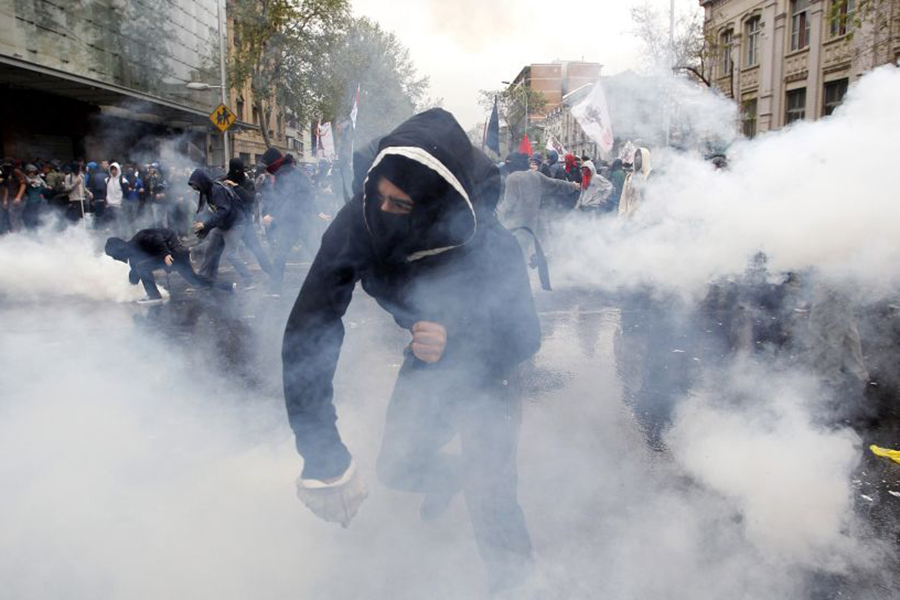
Even before the horror of last month’s tragedies, one could tell that elements of American society were rapidly degenerating into barbarity. October alone saw an increase in the frequency of political street brawls breaking out across the United States. In New York, street fighting broke out in front of the Metropolitan Republican Club in Manhattan where Gavin McInnes, the Vice Media co-founder turned far-right ideologue, was scheduled to deliver a speech. After the speech, McInnes, flanked by several members of his self-proclaimed “western chauvinist” organization the Proud Boys, confronted a group of Antifa protesters, resulting in an episode of violence that culminated in criminal charges against 12 people.

The following night in Portland — which recently has seen nearly weekly incidents of political street violence — the Proud Boys and Antifa clashed once again, this time at an intentionally provocative demonstration organized by the right-wing group Patriot Prayer. In this sense, 2018 has served as a continuation of a wretched 2017 that saw politicians assaulted and shot, civilians massacred in a religiously-motivated terror attack and a deadly white nationalist rally that brought out America’s absolute worst.

Unfortunately, political violence in modern America isn’t something new. From 1968 to 1972, America saw some of the most hostile domestic attacks in its history, often by politically motivated groups but also through overly aggressive policing government forces against protestors. The assassination of Martin Luther King Jr. in April 1968 resulted in riots in over 100 cities across the United States, with local governments and National Guard forces excessively targeting mostly low-income, African-American protestors.

Later that summer, after winning the California primary, Robert Kennedy was shot to death in a Los Angeles hotel lobby over his support for Israel in the Six Day War. Then, at the 1968 Democratic National Convention, eight days of tension between the Chicago Police Department and anti-war protestors culminated in a “police riot” on the final night, with police forces violently assaulting protestors in Lincoln Park. Violence continued well into the next decade; in an 18-month period from 1971 to 1972, the FBI recorded over 2,500 bombings on American soil. As one former Nixon aide put it: “2018 is not quite 1968, at least not yet.”

But we shouldn’t let this fact assuage our worries. Political violence, whether conducted through the government or via ideologically motivated non-state actors, is indicative of a fracturing society. And while (well, depending on who you ask), we aren’t on the verge of civil war quite yet, we should still be worried. The steady escalation and gradual normalization of open violence almost always sets the stage for something worse. In Weimar Germany, violence between the far-right Freikorps and Communist revolutionaries gave way to a power vacuum that helped facilitate the rise of Nazism. Recently in Venezuela and Turkey, political strongmen have utilized instability to accrue increasingly authoritarian political power.

Even though there is ample reason to think that something so drastic couldn’t occur on our soil — America’s democratic institutions are significantly stronger than these examples ever were — we still shouldn’t discount the possibility. Much of what has occurred in the U.S. now was entirely unimaginable a decade or two ago. The highly polarizing and populist-driven 2016 election emerged in what was a relatively healthy economic environment; now imagine what could occur in a country suddenly marred by an unsuspecting economic downturn or debilitating war. The results could be chilling, which is why it is important to safeguard the democratic institutions that prevent the worst from materializing.

We cannot allow political violence to be normalized, whether from extremist groups or through police militarization. Don’t make the mistake of saying it can’t happen here.

Written by: Brandon Jetter — brjetter@ucdavis.edu

Disclaimer: The views and opinions expressed by individual columnists belong to the columnists alone and do not necessarily indicate the views and opinions held by The California Aggie.

Not so primitive

TRACY MCCLUNG / COURTESY

Part four of a continuing series about experiences on an archaeological dig in Poland

Have you ever built an arrowhead made of obsidian or a hide scraper made from chert? It can be easy to think of stone tools as “primitive” or dismiss them as crude things made from rocks by ancient peoples and Neanderthals. Although stone tools are created from one of the most abundant items on earth, rocks, making them is quite a bit harder than one would think.

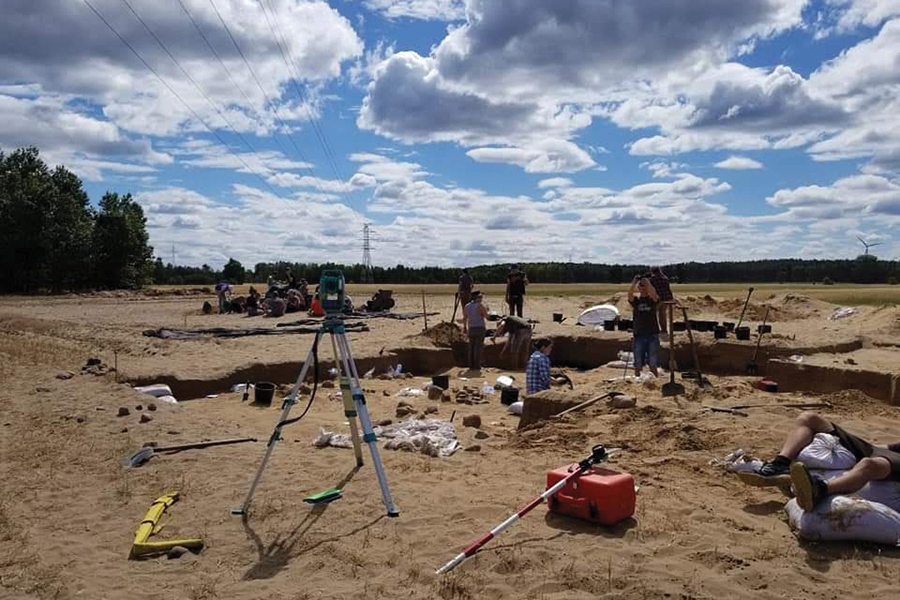
This summer I participated in the Slavia Foundation’s archaeological field school. We

excavated both Bronze Age (IV and V Period) cremations and Early Modern (16th -18th century) coffin burials. During the Bronze Age in Poland, the Lusatian culture dominated. The Lusatian people were farmers and herders, but they also worked with ceramics, metals, and sometimes gold. Even though metalworking had only be recently introduced to the world at this time, it did not mean the Lusation people exclusively made crude items from metal.

The Lusatian people in this area used bronze pins to help secure their clothing. At the dig site, a few of the pins that were found had been left as grave goods. These seemingly simple items have been difficult to recreate, even with help from today’s technology.

“They [Lusatians] could do great, for example … those bronze pins, it wasn’t easy to make them,” said Marta Gwizdala, the project osteologist.  “And for sure they knew this technique and it wasn’t easy so they weren’t primitive for me.”

Through the anthropology department at UC Davis, I have attempted to recreate even older tools; the procedure indeed proved difficult. Using a hammerstone, or a hard rock, you must first break off a piece of obsidian or chert from a large sample. If done right, then you have to break off smaller pieces from the first piece you broke off. If you have not broken the rock by this point, you can use part of an antler or a similar tool to break off even smaller pieces to give your tool the appropriate shape. This process took me a few hours, and the end result was a sharp rock that barely resembled an arrowhead.

“The stone tools look really simple, but I would have no idea on how to even start making them,” said Blair Price, a UC Davis student. “They may be simple but they served their purpose very well.”

I also tried to make a tool using a readily available resource in Poland: a beer bottle. Once the bottom was broken off, all I had to do was shape the tool using a copper pick that resembled an antler tine. I fared much better in making this tool, but it looks more aesthetically pleasing than it is useful.

This is not to say that ancient humans were smarter than us; they were just experts of the tools used in their time. Ancient peoples would not know how to use a can opener, but it is a common tool for today’s world. And while I have great difficulty making stone tools, ancient peoples did not because they were very common tools at that time.

Ancient people, even Neanderthals, were experts in the tools of their time. Just because they did not live the way we do today does not mean that they weren’t smart, skillful people.

“It also bothers me that [people believe] Neanderthals discovered fire because that’s not true,” said Alexis Henderson, a student at the field school. “Even though they had a much bigger brain capacity, people assume they were stupid and couldn’t communicate.”


Written by: Rachel Paul— science@theaggie.org


Stars make names in sports folklore

0
RAEL HANUS / AGGIE

In the cutthroat world of sports, fame finds some in ways they don’t expect

Throughout history, folk heroes –– both real and fictional –– have occupied a special place in the lexicon of human society. Some, like Paul Revere, whose largely embellished ride across the colonies screaming, “The British are coming! The British are coming!” have become household names. Other heroes are fictional and serve as representations of a specific time in history. But unlike these traditional figures, the heroes of American professional sports are much more contemporary and are very real indeed.

While most athletes accrue a larger-than-average following with their on-court play, every sport has athletes who have made their mark on popular culture through means other than all star performances. Like Ernest Lawrence Thayer’s classic poem “Casey at Bat,” where fictional baseball player Casey strikes out in epic fashion as 10,000 crazy fans cling to every pitch, some athletes have forged a tale which is equal parts folklore and performance. They have become synonymous with the fanfare and the legends which attached themselves to their legacies, which may have otherwise been different without the attention.

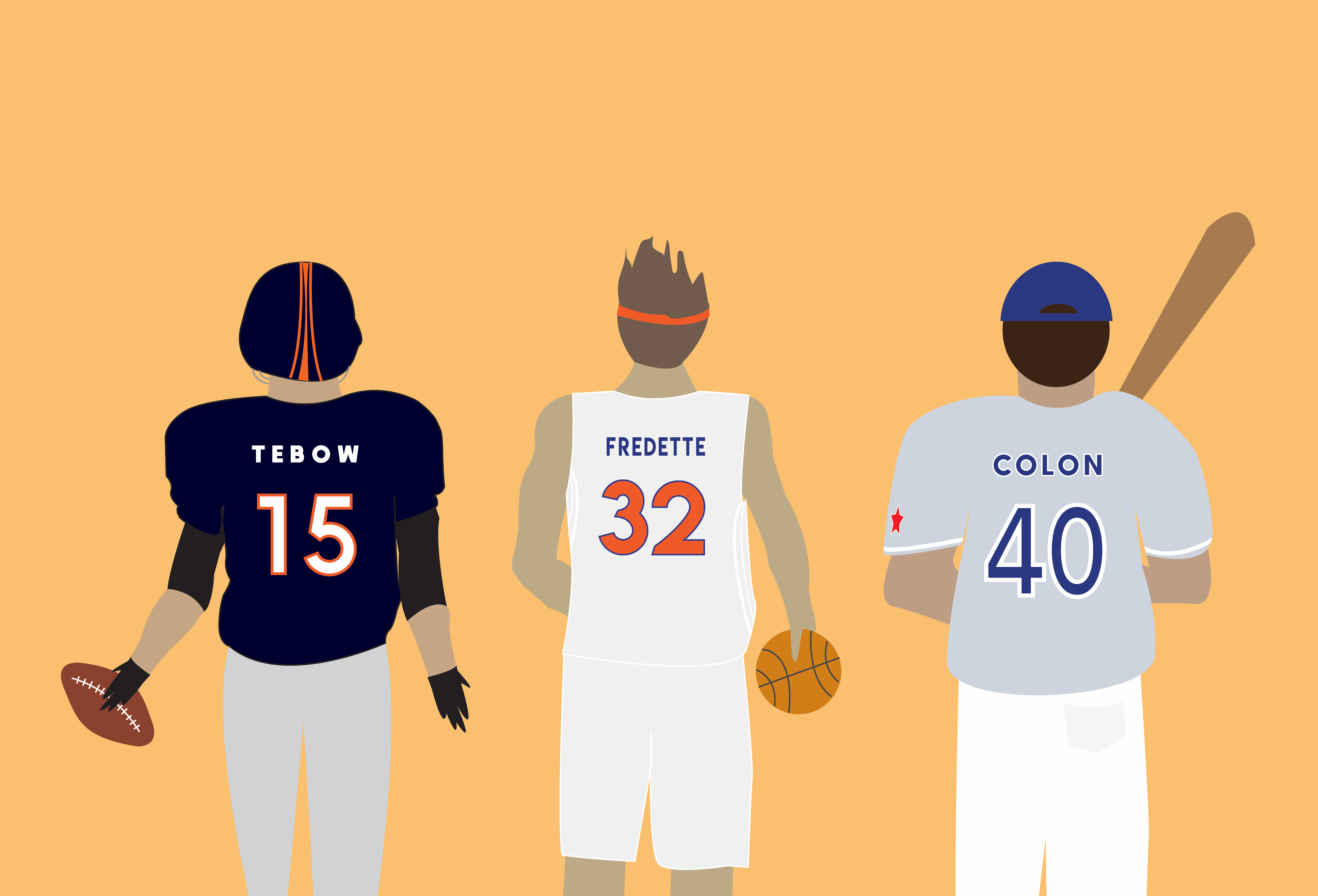
Some of these players, such as former college football star and NFL quarterback Tim Tebow, build up a cult-like following in their college days, which carries over to professional careers. For Tebow, who made his name in college as a Heisman winning quarterback for the University of Florida, his college success never truly carried over to the NFL. His signature celebration, Tebowing, became a national sensation. Despite a moderately successful sophomore season in which he started 11 games and led his team to a playoff victory over the Steelers, Tebow only lasted three years in the NFL.

Some claimed that Tebow’s inability to secure another chance to build off his successful season was in part due to the fanfare he attracted. Outlets around the country theorized that the media blitz surrounding his every move and his outspoken religious views were too much of a distraction for the team to justify keeping a quarterback with his limited skill set around.

After a series of failed comebacks with both the New England Patriots and the Philadelphia Eagles, Tebow followed in the footsteps of another folk hero in his own right: Bo Jackson. Jackson famously played professional baseball and football in the late eighties and early nineties, with far more successful results on both ends. Since 2016, Tebow has played baseball in the New York Mets farm system. Despite a less-than-spectacular post-college career however, Tebow continues to be a household name, analyzing games for ESPN, writing books and even selling products in commercials.

Like Tebow, former NBA point guard Jimmer Fredette had a storied college career which brought his name into the national spotlight. Jimmermania, as the media dubbed it, swept over the nation as people were wowed by the Brigham Young University point guard’s seemingly infinite shooting range and fantastic scoring performances. Unlike Tebow, Fredette, who was picked 10th in the NBA draft, never saw much of any success at the professional level. He was out of the NBA within five years, many of which were spent on the bench.

Fredette’s recent career has taken him overseas, where players such as former NBA All-Star Stephon Marbury have found a second wind. Playing for the Shanghai Sharks, Fredette has found the success which evaded him in the NBA, averaging 38 points-per-game in his first season overseas in 2016.

The path to becoming a folk hero in sports however, does not necessarily begin in college, nor does it need to end in disappointment. While Tebow and Fredette had to deal with early expectations, NBA guard Jeremy Lin rose from relative obscurity before making a name for himself. Lin found decent success in playing at Harvard but ultimately went undrafted. After a forgettable rookie season playing just 29 games for the Golden State Warriors and 20 more for the Reno Bighorns of the NBA D-League (now the NBA G-League), Lin’s title as an NBA player was questionable at best.

The following season, Lin was signed by the New York Knicks but sat on the bench for weeks or played occasional minutes in blowouts. As injuries and poor-play plagued the team, the Knicks put Lin into a game against the New Jersey Nets even amidst talk of waiving him. Knicks Coach Mike D’Antoni called Lin’s number, and he responded with 28 points and 8 assists off the bench.

What ensued in the following weeks was christened Linsanity. One good game turned into a stretch of unexpected success as Lin began to take over the headlines. One game, it was a buzzer-beater against the Raptors. Another, dropping 38 points against NBA superstar Kobe Bryant. While Linsanity lasted just a few weeks, Lin managed to go from fringe NBA player to appearing on back-to-back covers of Sports Illustrated.

Despite struggling with injuries since his initial rise to stardom and never fully living up to the astronomical standard that Linsanity may have set, Lin continues to be a valuable NBA player, now for the Atlanta Hawks.

Folk heroes can come from many backgrounds across many sports. Bartolo Colon, who continues to pitch two-decades into his career, has become a folk-hero in the world of professional baseball. Colon, a large man who goes by the nickname “Big Sexy,” has long received attention for his comedic at-bats. While few pitchers are known for possessing an ability on offense, Colon’s tenures in the National League have been met with laughter, causing many to revere him with equal parts ironic praise and awe. In 2016, while hitting for the New York Mets, Colon made MLB history, becoming the oldest player to hit his first home run at 42 years of age.

In 2017, John Scott, a little-known enforcer for the Arizona Coyotes, was part of a joke campaign that eventually got him voted into the NHL All-Star Game. Despite being traded from his team and pleas from the NHL not to accept the invitation, Scott went to the All-Star game and became an alternative hero to some before the game ever started. Many criticized the NHL for not going along with the movement.

What happened next went from ironic internet joke to heartwarming moment, as Scott, whose wife was expecting twins, scored two goals in the game and was carried off by teammates as the MVP. Scott played just one more NHL game before he retired.

Becoming a folk hero in the cutthroat world of sports can come at any second. Whether it’s a college career that bleeds into the pros or a fluke set of circumstances which turn the unknown into household names overnight, the legend of these players lives on in a way altogether different than those who win MVP trophies and championships.

Written by: Bradley Geiser — sports@theaggie.org